
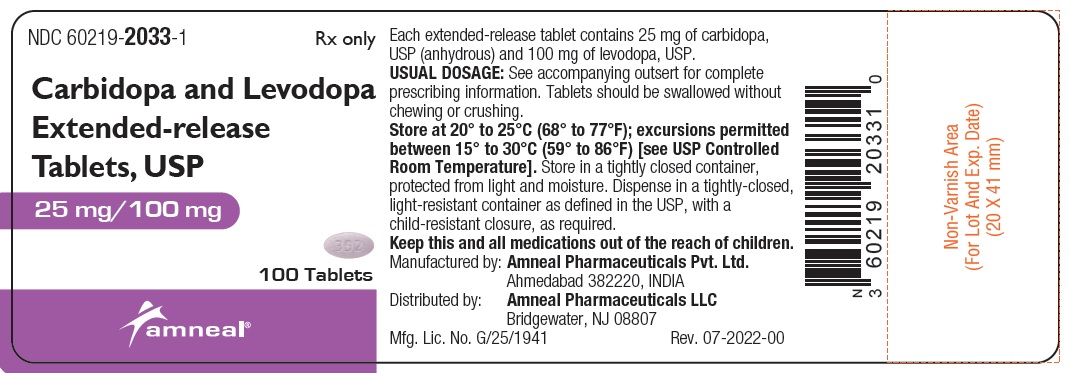
Carbidopa and Levodopa 25 mg; 100 mg Tablet, Extended Release, 100-count — NDC 60219-2033-1 (Billing 60219-2033-01)
This is a package of 100 tablets of Carbidopa and Levodopa 25 mg; 100 mg Tablet, Extended Release from Amneal Pharmaceuticals NY LLC, marketed since Dec 2022 and currently FDA-listed; retail pharmacies pay about $0.1101 per tablet (NADAC). It is the main listing for this product, which comes in 3 package sizes.
NDC database record
One package, one record: these facts belong to NDC 60219-2033-1 alone.
- Record
- FDA NDC Directory package listing · Human prescription drug
- Code segments
- 60219 labeler · 2033 product · 1 package
- Package marketed since
- Dec 21, 2022
- Sample package
- No — commercial package
- Listing certified through
- Dec 31, 2027
- Billing quantity
- 100 EA per package
- Barcode (UPC)
- 0360219203310, 0360219203419
- Medicaid fills, this package
- 262 prescriptions in the last four reported quarters
- FDA record last changed
- Sep 17, 2026
Identity & classification
Regulatory identifiers FDA, NLM and CMS codes for this package
Drug-database identifiers Medi-Span GPI and First Databank GCN / HICL / AHFS classification
- GSN (GCN sequence number): 019563
- GCN: 62592
- HICL (First Databank): 013894
- AHFS class code: 28:36.16.00
- RxCUI (RxNorm): 308988
Where does this data come from?
- FDA openFDA NDC Directory · synced Oct 1, 2026
- FDA label on DailyMed · label index refreshed Oct 5, 2026
- RxNorm (NLM RxNav) · catalog refreshed Oct 1, 2026
- Medi-Span GPI (licensed)
- First Databank (licensed) · refreshed Oct 1, 2026
RxNorm drug class
This medicine belongs to the Aromatic Amino Acid Decarboxylation Inhibitor class.
Where does this data come from?
- RxClass (NLM) · catalog refreshed Oct 1, 2026
Clinical
Levodopa and carbidopa is used to treat the symptoms of Parkinson's disease and Parkinson's-like symptoms that may develop after encephalitis (swelling of the brain) or injury to the nervous system caused by carbon monoxide poisoning or manganese poisoning. Levodopa is in a class of medications called central nervous system agents. It works by being converted to dopamine in the brain (the natural substance that is low in Parkinson's and causes the symptoms of tremor, stiffness, and slowness of movement). Carbidopa is in a class of medications called decarboxylase inhibitors. It works by preven...
Read the full MedlinePlus article ↗- It treats Parkinson’s disease and related parkinsonism, including parkinsonism after brain inflammation or carbon monoxide or manganese poisoning. Duopa is specifically for motor f...
- Follow your prescription exactly, since your doctor adjusts the dose slowly. Extended-release forms shouldn’t be chewed or crushed. Rytary and Crexont can be taken with or without...
- Nausea, dizziness, headache, vivid dreams, and uncontrolled movements called dyskinesia are common. Tell your doctor if these bother you, because a dose change may help.
- Be careful. Some people fall asleep suddenly with no warning, even after being on it a long time. If that happens, don’t drive or do risky activities, and tell your doctor.
Patient education
Supplement & herbal interactions
Where does this data come from?
- MedlinePlus (NLM) · refreshed Oct 1, 2026
- FDA label on DailyMed · label index refreshed Oct 5, 2026
Ask a licensed pharmacist directly — free, answered by our team.
Pricing
A drug doesn't have one price. Each row is a different public payment system, and none is what you'd pay at the counter — that depends on your insurance. The ⓘ on each row explains what it measures.
| Price system | Per ea | Per package |
|---|---|---|
| Retail pharmacies payNADAC · weekly | $0.110 | $11.01 / 100 tablets |
| Medicaid paysCMS SDUD · 12 mo | $0.1804 | $18.04 / 100 tablets |
| Medicare drug plans payPart D · quarterly | No Part D plan price is available for this NDC in our data. | |
Where does this data come from?
- CMS NADAC weekly file · file of Sep 30, 2026
- CMS ASP pricing files · refreshed Sep 20, 2026
- CMS Medicaid State Drug Utilization Data · through Q1 2026
- CMS Part D plan pricing files · refreshed Sep 24, 2026
- VA National Acquisition Center price file
Packaging — all sizes for this product
| Package NDC | Description | Per unit | Per pack | Marketing start | Marketing end | Status |
|---|---|---|---|---|---|---|
| 60219-2033-01 You're viewing this Main listing | 100 TABLET, EXTENDED RELEASE in 1 BOTTLE | $0.1101 / ea | $11.01 | 2022-12-21 | — | Active |
| 60219-2033-03 60219-2033-3 | 30 TABLET, EXTENDED RELEASE in 1 BOTTLE | — | — | 2022-12-21 | — | Active |
| 60219-2033-05 60219-2033-5 | 500 TABLET, EXTENDED RELEASE in 1 BOTTLE | — | — | 2022-12-21 | — | Active |
You're viewing one of 3 pack sizes for this product.
In Medicaid, this is the most-dispensed pack of this product — about 100% of fills over the last four reported quarters. See all packs ↓
Pack size FAQ
What quantity is in this package?
How does this package differ from NDC 60219-2033-03?
What NDC number is used to bill for this package of Carbidopa and Levodopa 25 mg; 100 mg Tablet, Extended Release?
Prices are the latest CMS NADAC pharmacy acquisition cost per NDC; per-pack figures are per-unit × pack quantity, shown only when the pack is denominated in the same measure NADAC prices.
Therapeutic equivalents
| Product | Labeler | Pack | NADAC/unit | TE | Status | Price vs. this |
|---|---|---|---|---|---|---|
| Carbidopa and Levodopa 25 mg/1; 100 mg 00378-0088-01 | Mylan | 100 tablets | $0.110 | AB | Availability likely | — |
| Carbidopa and Levodopa 25 mg/1; 100 mg 50228-0460-01 | ScieGen | 100 tablets | $0.110 | AB | Availability likely | — |
| Carbidopa and Levodopa 25 mg/1; 100 mg 51079-0978-20 | Mylan | 1 tablet | $0.110 | AB | Availability likely | — |
| Carbidopa and Levodopa 25 mg/1; 100 mgthis 60219-2033-01 | Amneal | 100 tablets | $0.110 | AB | Availability likely | — |
| Carbidopa And Levodopa 25 mg/1; 100 mg 16729-0078-01 | Accord | 100 tablets | $0.116 | AB | Availability likely | +5% |
| Carbidopa and Levodopa 25 mg/1; 100 mg 00615-8460-39 | NCS | 30 tablets | — | AB | FDA listed | — |
| Carbidopa and Levodopa 25 mg/1; 100 mg 46708-0332-30 | Alembic | 30 tablets | — | AB | FDA listed | — |
| Carbidopa and Levodopa 25 mg/1; 100 mg 48433-0015-20 | Safecor | 1 tablet | — | AB | FDA listed | — |
| Carbidopa and Levodopa 25 mg/1; 100 mg 62332-0332-30 | Alembic | 30 tablets | — | AB | FDA listed | — |
| Carbidopa And Levodopa 25 mg/1; 100 mg 62756-0461-08 | Sun | 100 tablets | — | — | FDA listed | — |
| Carbidopa and Levodopa 25 mg/1; 100 mg 72162-2194-01 | Bryant | 100 tablets | — | AB | FDA listed | — |
| Carbidopa and levodopa 25 mg/1; 100 mg 72888-0155-00 | Advagen | 1000 tablets | — | AB | FDA listed | — |
| Carbidopa and Levodopa 25 mg/1; 100 mg 77771-0460-01 | Radha | 100 tablets | — | AB | FDA listed | — |
Where does this data come from?
- FDA openFDA NDC Directory · synced Oct 1, 2026
- FDA Orange Book · refreshed Oct 3, 2026
- CMS NADAC weekly file · file of Sep 30, 2026
Availability & generic status
This product is an FDA-approved generic. Other versions of the same drug are listed under Therapeutic equivalents, least expensive first.
Where does this data come from?
- FDA Orange Book · refreshed Oct 3, 2026
What it looks like
Where does this data come from?
- FDA label on DailyMed · label index refreshed Oct 5, 2026
Inactive Ingredients / Excipients
Inactive ingredients, also called excipients, are components of the drug product other than the active ingredient. They may include fillers, dyes, coatings, preservatives, flavors, or other formulation ingredients.
🧪 Avoiding an ingredient? See Levodopa and Carbidopa inactive ingredients by manufacturer: every current product's list side by side, so you can ask your pharmacy for the version that does not list it.
💡 Tap an ingredient (hover on desktop) to see what it is and why it’s used.
-
UNII L06K8R7DQK
A synthetic blue dye approved by the FDA for use in medications and foods. It serves as a colorant to make pills and liquids visually distinct and easier to identify.
-
UNII WZB9127XOA
A synthetic red dye used to color medications and make them easier to identify. It serves as a colorant in tablets, capsules, and liquid formulations.
-
UNII RFW2ET671P
Hydroxypropyl cellulose is a plant-derived thickening agent made from cellulose. It acts as a binder to hold tablet ingredients together and as a film-former to coat tablets or control how fast the medicine releases.
-
UNII 70097M6I30
Magnesium stearate is a salt made from magnesium and stearic acid, a fatty substance. It's used in tablets and capsules as a lubricant and glidant to help ingredients flow smoothly during manufacturing and prevent sticking.
4 inactive ingredients listed in the exact product block matched to this NDC.
Where does this data come from?
ingredient classCode="IACT" elements from the exact product block matched by this NDC. Label-section narrative from DailyMed / the openFDA label index is shown separately when available.- FDA label on DailyMed · label index refreshed Oct 5, 2026
- FDA openFDA NDC Directory · synced Oct 1, 2026
Inactive ingredient FAQ
Are inactive ingredients the same for every manufacturer?
Why might an inactive ingredient be missing?
Can inactive ingredients matter?
Manufacturer & labeler
More NDCs from Amneal Pharmaceuticals NY LLC labeler code 60219
- Atropine 10 mg/mL Solution/ Drops NDC 60219-1750-8
- Sildenafil 25 mg Tablet, Film Coated NDC 60219-1751-1
- Sildenafil 50 mg Tablet, Film Coated NDC 60219-1752-1
- Sildenafil 100 mg Tablet, Film Coated NDC 60219-1753-1
- Abiraterone Acetate 500 mg Tablet NDC 60219-1754-6
- tiopronin 300 mg Tablet, Delayed Release NDC 60219-2009-9
- Carbidopa and Levodopa 50 mg; 200 mg Tablet, Extended Release NDC 60219-2034-1
- Azathioprine 75 mg Tablet NDC 60219-2036-1
- Azathioprine 100 mg Tablet NDC 60219-2037-1
- prochlorperazine maleate 5 mg Tablet, Film Coated NDC 60219-2038-1
- prochlorperazine maleate 10 mg Tablet, Film Coated NDC 60219-2039-1
- dexamethasone 4 mg Tablet NDC 60219-2043-1
Where does this data come from?
- FDA openFDA NDC Directory · synced Oct 1, 2026
- Drugs@FDA
Full prescribing information FDA SPL
🎯 Indications and Usage ▾
INDICATIONS AND USAGE Carbidopa and levodopa extended-release tablets are indicated in the treatment of Parkinson’s disease, post-encephalitic parkinsonism, and symptomatic parkinsonism that may follow carbon monoxide intoxication or manganese intoxication.
⏱️ Dosage and Administration ▾
DOSAGE AND ADMINISTRATION Carbidopa and levodopa extended-release tablet contains carbidopa and levodopa in a 1:4 ratio as either the 50 mg/200 mg tablet or the 25 mg/100 mg tablet. The daily dosage of carbidopa and levodopa extended-release tablets must be determined by careful titration. Patients should be monitored closely during the dose adjustment period, particularly with regard to appearance or worsening of involuntary movements, dyskinesias or nausea.
Carbidopa and levodopa extended-release tablets should not be chewed or crushed. Standard drugs for Parkinson’s disease, other than levodopa without a decarboxylase inhibitor, may be used concomitantly while carbidopa and levodopa extended-release tablet is being administered, although their dosage may have to be adjusted. Since carbidopa prevents the reversal of levodopa effects caused by pyridoxine, carbidopa and levodopa extended-release tablets can be given to patients receiving supplemental pyridoxine (vitamin B 6 ).
Management of Vitamin B6 Levels Evaluate vitamin B6 levels prior to initiating carbidopa/levodopa therapies including carbidopa and levodopa extended-release tablet, periodically during treatment, and as clinically indicated (see WARNINGS, Vitamin B6 Deficiency and Seizures ) . If vitamin B6 levels are low, supplement to sufficient levels per standard of care. Patients may initiate and continue treatment with carbidopa and levodopa extended-release tablet while supplementing vitamin B6.
Initial Dosage Patients currently treated with conventional carbidopa and levodopa preparations: Studies show that peripheral dopa-decarboxylase is saturated by the bioavailable carbidopa at doses of 70 mg a day and greater. Because the bioavailabilities of carbidopa and levodopa in carbidopa and levodopa tablets and carbidopa and levodopa extended-release tablets are different, appropriate adjustments should be made, as shown in Table 2. Table 2: Approximate Bioavailabilities at Steady State * Tablet Amount of Levodopa (mg) in Each Tablet Approximate Bioavailability Approximate Amount of Bioavailable Levodopa (mg) in Each Tablet Carbidopa and Levodopa Extended-release Tablets, 50 mg/200 mg 200 0.70 to 0.75 † 140 to 150 Carbidopa and Levodopa Tablets, 25 mg/100 mg 100 0.99 †† 99 * This table is only a guide to bioavailabilities since other factors such as food, drugs, and inter-patient variabilities may affect the bioavailability of carbidopa and levodopa. † The extent of availability of levodopa from carbidopa and levodopa extended-release tablets was about 70% to 75% relative to intravenous levodopa or standard carbidopa and levodopa tablets in the elderly. †† The extent of availability of levodopa from carbidopa and levodopa tablets was 99% relative to intravenous levodopa in the healthy elderly.
Dosage with carbidopa and levodopa extended-release tablets should be substituted at an amount that provides approximately 10% more levodopa per day, although this may need to be increased to a dosage that provides up to 30% more levodopa per day depending on clinical response (see DOSAGE AND ADMINISTRATION: Titration with carbidopa and levodopa extended-release tablet s ). The interval between doses of carbidopa and levodopa extended-release tablets should be 4 to 8 hours during the waking day. (see CLINICAL PHARMACOLOGY: Pharmacodynamics . ) A guideline for initiation of carbidopa and levodopa extended-release tablets is shown in Table 3.
Table 3: Guidelines for Initial Conversion from Carbidopa and Levodopa Tablets to Carbidopa and Levodopa Extended-release Tablets Carbidopa and Levodopa Tablets Carbidopa and Levodopa Extended-release Tablets Total Daily Dose * Suggested Levodopa (mg) Dosage Regimen 300 to 400 200 mg b.i.d. 500 to 600 300 mg b.i.d. or 200 mg t.i.d. 700 to 800 A total of 800 mg in 3 or more divided doses (e.g., 300 mg a.m., 300 mg early p.m., and 200 mg later p.m.) 900 to 1,000 A total of 1,000 mg in 3 or more divided doses (e.g., 400 mg a.m., 400 mg early p… [Excerpted — this section continues on DailyMed.]
⛔ Contraindications ▾
CONTRAINDICATIONS Nonselective monoamine oxidase (MAO) inhibitors are contraindicated for use with carbidopa and levodopa extended-release tablets. These inhibitors must be discontinued at least two weeks prior to initiating therapy with carbidopa and levodopa extended-release tablets. Carbidopa and levodopa extended-release tablets may be administered concomitantly with the manufacturer’s recommended dose of an MAO inhibitor with selectivity for MAO type B (e.g., selegiline hydrochloride) (see PRECAUTIONS, Drug Interactions ).
Carbidopa and levodopa extended-release tablets are contraindicated in patients with known hypersensitivity to any component of this drug, and in patients with narrow-angle glaucoma.
⚠️ Warnings ▾
WARNINGS When patients are receiving levodopa without a decarboxylase inhibitor, levodopa must be discontinued at least twelve hours before carbidopa and levodopa extended-release tablets are started. In order to reduce adverse reactions, it is necessary to individualize therapy. See DOSAGE AND ADMINISTRATION section before initiating therapy.
Carbidopa and levodopa extended-release tablets should be substituted at a dosage that will provide approximately 25% of the previous levodopa dosage (see DOSAGE AND ADMINISTRATION ). Carbidopa does not decrease adverse reactions due to central effects of levodopa. By permitting more levodopa to reach the brain, particularly when nausea and vomiting is not a dose-limiting factor, certain adverse central nervous system (CNS) effects, e.g., dyskinesias, will occur at lower dosages and sooner during therapy with carbidopa and levodopa extended-release than with levodopa alone.
Patients receiving carbidopa and levodopa extended-release tablets may develop increased dyskinesias compared to carbidopa and levodopa tablets. Dyskinesias are a common side effect of carbidopa and levodopa treatment. The occurrence of dyskinesias may require dosage reduction.
All patients should be observed carefully for the development of depression with concomitant suicidal tendencies. Carbidopa and levodopa extended-release tablets should be administered cautiously to patients with severe cardiovascular or pulmonary disease, bronchial asthma, renal, hepatic or endocrine disease. As with levodopa, care should be exercised in administering carbidopa and levodopa extended-release tablets to patients with a history of myocardial infarction who have residual atrial, nodal, or ventricular arrhythmias.
In such patients, cardiac function should be monitored with particular care during the period of initial dosage adjustment, in a facility with provisions for intensive cardiac care. As with levodopa, treatment with carbidopa and levodopa extended-release tablets may increase the possibility of upper gastrointestinal hemorrhage in patients with a history of peptic ulcer. Vitamin B6 Deficiency and Seizures Treatment with carbidopa and levodopa extended-release tablets may contribute to reduced vitamin B6 levels.
Higher doses of carbidopa/levodopa may increase the risk of vitamin B6 deficiency. Seizures associated with vitamin B6 deficiency have been reported in the postmarketing setting in patients taking carbidopa and levodopa extended-release tablets. In these reported cases, seizures were refractory to traditional anti-seizure medications and only resolved after vitamin B6 administration.
Other symptoms of vitamin B6 deficiency may occur, including depression, confusion, cheilosis, glossitis, dermatitis, anemia, and/or neuropathy. Evaluate vitamin B6 levels prior to initiation of carbidopa and levodopa extended-release tablets and periodically while on treatment or if symptoms associated with vitamin B6 deficiency are identified. Supplement with vitamin B6 as necessary.
Falling Asleep During Activities of Daily Living and Somnolence Patients taking carbidopa and levodopa extended-release tablets alone or with other dopaminergic drugs have reported suddenly falling asleep without prior warning of sleepiness while engaged in activities of daily living (includes operation of motor vehicles). Road traffic accidents attributed to sudden sleep onset have been reported. Although many patients reported somnolence while on dopaminergic medications, there have been reports of road traffic accidents attributed to sudden onset of sleep in which the patient did not perceive any warning signs, such as excessive drowsiness, and believed that they were alert immediately prior to the event.
Sudden onset of sleep has been reported to occur as long as one year after the initiation of treatment. Falling asleep while engaged in activities of daily living usually occurs in patients experiencing pre-existing somnolence, although some patients… [Excerpted — this section continues on DailyMed.]
🤒 Adverse Reactions ▾
ADVERSE REACTIONS In controlled clinical trials, patients predominantly with moderate to severe motor fluctuations while on carbidopa and levodopa tablets were randomized to therapy with either carbidopa and levodopa or carbidopa and levodopa extended-release tablets. The adverse experience frequency profile of carbidopa and levodopa extended-release tablets did not differ substantially from that of carbidopa and levodopa tablets, as shown in Table 1. Table 1: Clinical Adverse Experiences Occurring in 1% or Greater of Patients Adverse Experience Carbidopa and LevodopaExtended-releaseTablets Carbidopa and LevodopaTablets n = 491 n = 524 % % Dyskinesia 16.5
12.2Nausea 5.5
5.7Hallucinations 3.9
3.2Confusion 3.7
2.3Dizziness 2.9
2.3Depression 2.2
1.3Urinary tract infection 2.2
2.3Headache 2.0
1.9Dream abnormalities 1.8
0.8Dystonia 1.8
0.8Vomiting 1.8
1.9Upper respiratory infection 1.8
1.0Dyspnea 1.6 0.4 ‘On-Off’ phenomena 1.6
1.1Back pain 1.6
0.6Dry mouth 1.4
1.1Anorexia 1.2
1.1Diarrhea 1.2
0.6Insomnia 1.2
1.0Orthostatic hypotension 1.0
1.1Shoulder pain 1.0
0.6Chest pain 1.0
0.8Muscle cramps 0.8
1.0Paresthesia 0.8
1.1Urinary frequency 0.8
1.1Dyspepsia 0.6
1.1Constipation 0.2
1.5Abnormal laboratory findings occurring at a frequency of 1% or greater in approximately 443 patients who received carbidopa and levodopa extended-release tablets and 475 who received carbidopa and levodopa tablets during controlled clinical trials included: decreased hemoglobin and hematocrit; elevated serum glucose; white blood cells, bacteria and blood in the urine. The adverse experiences observed in patients in uncontrolled studies were similar to those seen in controlled clinical studies. Other adverse experiences reported overall in clinical trials in 748 patients treated with carbidopa and levodopa extended-release tablets, listed by body system in order of decreasing frequency, include: Body as a Whole: Asthenia, fatigue, abdominal pain, orthostatic effects.
Cardiovascular: Palpitation, hypertension, hypotension, myocardial infarction. Gastrointestinal: Gastrointestinal pain, dysphagia, heartburn. Metabolic: Weight loss.
Musculoskeletal: Leg pain. Nervous System/Psychiatric: Chorea, somnolence, falling, anxiety, disorientation, decreased mental acuity, gait abnormalities, extrapyramidal disorder, agitation, nervousness, sleep disorders, memory impairment. Respiratory: Cough, pharyngeal pain, common cold.
Skin: Rash. Special Senses: Blurred vision. Urogenital: Urinary incontinence.
Laboratory Tests: Decreased white blood cell count and serum potassium; increased BUN, serum creatinine and serum LDH; protein and glucose in the urine. The following adverse experiences have been reported in post-marketing experience with carbidopa and levodopa extended-release tablets: Cardiovascular: Cardiac irregularities, syncope. Gastrointestinal: Taste alterations, dark saliva.
Hypersensitivity: Angioedema, urticaria, pruritus, bullous lesions (including pemphigus-like reactions). Nervous System/Psychiatric: Increased tremor, peripheral neuropathy, psychotic episodes including delusions and paranoid ideation, pathological gambling, increased libido including hypersexuality, impulse control symptoms, seizures (including convulsions). Skin: Alopecia, flushing, dark sweat.
Urogenital: Dark urine. Other adverse reactions that have been reported with levodopa alone and with various carbidopa and levodopa formulations and may occur with carbidopa and levodopa extended-release tablets are: Cardiovascular: Phlebitis. Gastrointestinal: Gastrointestinal bleeding, development of duodenal ulcer, sialorrhea, bruxism, hiccups, flatulence, burning sensation of tongue.
Hematologic: Hemolytic and non-hemolytic anemia, thrombocytopenia, leukopenia, agranulocytosis. Hypersensitivity: Henoch-Schönlein purpura. Metabolic: Weight gain, edema.
Nervous System/Psychiatric: Ataxia, depression with suicidal tendencies, dementia, euphoria, bradykinetic episodes, numbn… [Excerpted — this section continues on DailyMed.]
🔄 Drug Interactions ▾
Drug Interactions Caution should be exercised when the following drugs are administered concomitantly with carbidopa and levodopa extended-release tablets. Symptomatic postural hypotension has occurred when carbidopa and levodopa preparations were added to the treatment of patients receiving some antihypertensive drugs. Therefore, when therapy with carbidopa and levodopa extended-release tablets is started, dosage adjustment of the antihypertensive drug may be required.
For patients receiving MAO inhibitors (Type A or B), see CONTRAINDICATIONS . Concomitant therapy with selegiline and carbidopa and levodopa may be associated with severe orthostatic hypotension not attributable to carbidopa and levodopa alone (see CONTRAINDICATIONS ). There have been rare reports of adverse reactions, including hypertension and dyskinesia, resulting from the concomitant use of tricyclic antidepressants and carbidopa and levodopa preparations.
Dopamine D 2 receptor antagonists (e.g., phenothiazines, butyrophenones, risperidone) and isoniazid may reduce the therapeutic effects of levodopa. In addition, the beneficial effects of levodopa in Parkinson’s disease have been reported to be reversed by phenytoin and papaverine. Patients taking these drugs with carbidopa and levodopa extended-release tablets should be carefully observed for loss of therapeutic response.
Use of carbidopa and levodopa extended-release tablets with dopamine-depleting agents (e.g., reserpine and tetrabenazine) or other drugs known to deplete monoamine stores is not recommended. Carbidopa and levodopa extended-release tablets and iron salts or multivitamins containing iron salts should be coadministered with caution. Iron salts can form chelates with levodopa and carbidopa and consequently reduce the bioavailability of carbidopa and levodopa.
Although metoclopramide may increase the bioavailability of levodopa by increasing gastric emptying, metoclopramide may also adversely affect disease control by its dopamine receptor antagonistic properties.
🧒 Pediatric Use ▾
Pediatric Use Safety and effectiveness in pediatric patients have not been established. Use of the drug in patients below the age of 18 is not recommended.
🧓 Geriatric Use ▾
Geriatric Use In the clinical efficacy trials for carbidopa and levodopa tablets, almost half of the patients were older than 65, but few were older than 75. No overall meaningful differences in safety or effectiveness were observed between these subjects and younger subjects, but greater sensitivity of some older individuals to adverse drug reactions such as hallucinations cannot be ruled out. There is no specific dosing recommendation based upon clinical pharmacology data as carbidopa and levodopa tablets and carbidopa and levodopa extended-release tablets are titrated as tolerated for clinical effect.
🆘 Overdosage ▾
OVERDOSAGE Management of acute overdosage with carbidopa and levodopa extended-release tablets is the same as with levodopa. Pyridoxine is not effective in reversing the actions of carbidopa and levodopa extended-release tablets. General supportive measures should be employed, along with immediate gastric lavage.
Intravenous fluids should be administered judiciously and an adequate airway maintained. Electrocardiographic monitoring should be instituted and the patient carefully observed for the development of arrhythmias; if required, appropriate antiarrhythmic therapy should be given. The possibility that the patient may have taken other drugs as well as carbidopa and levodopa extended-release tablets should be taken into consideration.
To date, no experience has been reported with dialysis; hence, its value in overdosage is not known. Based on studies in which high doses of levodopa and/or carbidopa were administered, a significant proportion of rats and mice given single oral doses of levodopa of approximately 1,500 mg/kg to 2,000 mg/kg are expected to die. A significant proportion of infant rats of both sexes are expected to die at a dose of 800 mg/kg.
A significant proportion of rats are expected to die after treatment with similar doses of carbidopa. The addition of carbidopa in a 1:10 ratio with levodopa increases the dose at which a significant proportion of mice are expected to die to 3,360 mg/kg.
🧬 Clinical Pharmacology ▾
CLINICAL PHARMACOLOGY Mechanism of Action Parkinson’s disease is a progressive, neurodegenerative disorder of the extrapyramidal nervous system affecting the mobility and control of the skeletal muscular system. Its characteristic features include resting tremor, rigidity, and bradykinetic movements. Symptomatic treatments, such as levodopa therapies, may permit the patient better mobility.
Current evidence indicates that symptoms of Parkinson’s disease are related to depletion of dopamine in the corpus striatum. Administration of dopamine is ineffective in the treatment of Parkinson’s disease apparently because it does not cross the blood-brain barrier. However, levodopa, the metabolic precursor of dopamine, does cross the blood-brain barrier, and presumably is converted to dopamine in the brain.
This is thought to be the mechanism whereby levodopa relieves symptoms of Parkinson’s disease. Pharmacodynamics When levodopa is administered orally, it is rapidly decarboxylated to dopamine in extracerebral tissues so that only a small portion of a given dose is transported unchanged to the central nervous system. For this reason, large doses of levodopa are required for adequate therapeutic effect, and these may often be accompanied by nausea and other adverse reactions, some of which are attributable to dopamine formed in extracerebral tissues.
Since levodopa competes with certain amino acids for transport across the gut wall, the absorption of levodopa may be impaired in some patients on a high protein diet. Carbidopa inhibits decarboxylation of peripheral levodopa. It does not cross the blood-brain barrier and does not affect the metabolism of levodopa within the central nervous system.
Since its decarboxylase inhibiting activity is limited to extracerebral tissues, administration of carbidopa with levodopa makes more levodopa available for transport to the brain. Patients treated with levodopa therapy for Parkinson’s disease may develop motor fluctuations characterized by end-of-dose failure, peak dose dyskinesia, and akinesia. The advanced form of motor fluctuations (‘on-off’ phenomenon) is characterized by unpredictable swings from mobility to immobility.
Although the causes of the motor fluctuations are not completely understood, in some patients they may be attenuated by treatment regimens that produce steady plasma levels of levodopa. Carbidopa and levodopa extended-release tablet contains either 50 mg of carbidopa and 200 mg of levodopa, or 25 mg of carbidopa and 100 mg of levodopa in an extended-release dosage form designed to release these ingredients over a 4- to 6-hour period. With carbidopa and levodopa extended-release tablets there is less variation in plasma levodopa levels than with carbidopa and levodopa tablets, the conventional formulation.
However, carbidopa and levodopa extended-release tablets are less systemically bioavailable than carbidopa and levodopa tablets and may require increased daily doses to achieve the same level of symptomatic relief as provided by carbidopa and levodopa tablets. In clinical trials, patients with moderate to severe motor fluctuations who received carbidopa and levodopa extended-release tablets did not experience quantitatively significant reductions in ‘off’ time when compared to carbidopa and levodopa tablets. However, global ratings of improvement as assessed by both patient and physician were better during therapy with carbidopa and levodopa extended-release tablets than with carbidopa and levodopa tablets.
In patients without motor fluctuations, carbidopa and levodopa extended-release tablets, under controlled conditions, provided the same therapeutic benefit with less frequent dosing when compared to carbidopa and levodopa tablets. Pharmacokinetics Carbidopa reduces the amount of levodopa required to produce a given response by about 75% and, when administered with levodopa, increases both plasma levels and the plasma half-life of levodopa, and decreases plasma and urinar… [Excerpted — this section continues on DailyMed.]
🧬 Mechanism of Action ▾
Mechanism of Action Parkinson’s disease is a progressive, neurodegenerative disorder of the extrapyramidal nervous system affecting the mobility and control of the skeletal muscular system. Its characteristic features include resting tremor, rigidity, and bradykinetic movements. Symptomatic treatments, such as levodopa therapies, may permit the patient better mobility.
Current evidence indicates that symptoms of Parkinson’s disease are related to depletion of dopamine in the corpus striatum. Administration of dopamine is ineffective in the treatment of Parkinson’s disease apparently because it does not cross the blood-brain barrier. However, levodopa, the metabolic precursor of dopamine, does cross the blood-brain barrier, and presumably is converted to dopamine in the brain.
This is thought to be the mechanism whereby levodopa relieves symptoms of Parkinson’s disease.
📦 How Supplied / Storage and Handling ▾
HOW SUPPLIED Carbidopa and Levodopa Extended-release Tablets USP, 50 mg/200 mg (carbidopa-levodopa) containing 50 mg of carbidopa and 200 mg of levodopa, are supplied as purple, oval, convex tablets, debossed with “G” left of bisect on one side and “391” on the other side with mottled appearance. They are supplied as follows: Bottles of 30: NDC 60219-2034-3 Bottles of 100: NDC 60219-2034-1 Bottles of 500: NDC 60219-2034-5 Carbidopa and Levodopa Extended-release Tablets USP, 25 mg/100 mg (carbidopa-levodopa) containing 25 mg of carbidopa and 100 mg of levodopa, are supplied as purple, oval, convex tablets, debossed with “G” on one side and “392” on other side with mottled appearance.
They are supplied as follows: Bottles of 30: NDC 60219-2033-3 Bottles of 100: NDC 60219-2033-1 Bottles of 500: NDC 60219-2033-5 Storage and Handling Store at 20° to 25°C (68° to 77°F); excursions permitted between 15° to 30°C (59° to 86°F) [see USP Controlled Room Temperature]. Store in a tightly closed container, protected from light and moisture. Dispense in a tightly-closed, light-resistant container.
📦 Storage and Handling ▾
Storage and Handling Store at 20° to 25°C (68° to 77°F); excursions permitted between 15° to 30°C (59° to 86°F) [see USP Controlled Room Temperature]. Store in a tightly closed container, protected from light and moisture. Dispense in a tightly-closed, light-resistant container.
📋 Description ▾
DESCRIPTION Carbidopa and levodopa extended-release tablets, USP are extended-release combination of carbidopa and levodopa for the treatment of Parkinson’s disease and syndrome. Carbidopa, USP an inhibitor of aromatic amino acid decarboxylation, is a white to creamy white, odorless or practically odorless powder, freely soluble in 3N hydrochloric acid; slightly soluble in water and in methanol; practically insoluble in alcohol, in acetone, in chloroform, and in ether, with a molecular weight of 244.24 g/mol. It is designated chemically as (-)-L-α- hydrazino-3,4-dihydroxy-α-methyldrocinnamic acid monohydrate.
Its molecular formula is C 10 H 14 N 2 O 4 •H 2 O, and its structural formula is: Tablet content is expressed in terms of anhydrous carbidopa, which has a molecular weight of 226.23 g/mol. Levodopa, USP an aromatic amino acid, is a white to off-white crystalline powder, freely soluble in 3N hydrochloric acid, slightly soluble in water and insoluble in alcohol, with a molecular weight of 197.19 g/mol. It is designated chemically as (2S)-2-Amino-3-(3,4-dihydroxyphenyl) propanoic acid.
Its molecular formula is C 9 H 11 NO 4 , and its structural formula is: Carbidopa and levodopa extended-release tablets, USP are supplied as extended-release tablets containing either 50 mg of carbidopa and 200 mg of levodopa, or 25 mg of carbidopa and 100 mg of levodopa. Inactive ingredients: hydroxypropyl cellulose, lake blend purple (contains FD&C Red No. 40, FD &C Blue No.
2) and magnesium stearate. The 50 mg/200 mg tablets are supplied as purple, oval, convex tablets, debossed with “G” left of bisect on one side and “391” on the other side with mottled appearance. The 25 mg/100 mg tablets are supplied as purple, oval, convex tablets, debossed with “G” on one side and “392” on other side with mottled appearance.
The carbidopa and levodopa extended-release tablets are polymeric-based drug delivery system that controls the release of carbidopa and levodopa as it slowly erodes. Carbidopa and levodopa extended-release tablet, 25 mg/100 mg is available to facilitate titration and as an alternative to the half-tablet of carbidopa and levodopa extended-release tablet, 50 mg/200 mg. Meets USP Dissolution Test 2.
1 1
💬 Information for Patients ▾
Information for Patients The patient should be informed that carbidopa and levodopa extended-release tablet is an extended-release formulation of carbidopa and levodopa which releases these ingredients over a 4- to 6-hour period. It is important that carbidopa and levodopa extended-release tablets be taken at regular intervals according to the schedule outlined by the physician. The patient should be cautioned not to change the prescribed dosage regimen and not to add any additional antiparkinson medications, including other carbidopa and levodopa preparations, without first consulting the physician.
If abnormal involuntary movements appear or get worse during treatment with carbidopa and levodopa extended-release tablets, the physician should be notified, as dosage adjustment may be necessary. Patients should be advised that sometimes the onset of effect of the first morning dose of carbidopa and levodopa extended-release tablets may be delayed for up to 1 hour compared with the response usually obtained from the first morning dose of carbidopa and levodopa tablets. The physician should be notified if such delayed responses pose a problem in treatment.
Patients should be advised that, occasionally, dark color (red, brown, or black) may appear in saliva, urine, or sweat after ingestion of carbidopa and levodopa extended-release tablets. Although the color appears to be clinically insignificant, garments may become discolored. The patient should be informed that a change in diet to foods that are high in protein may delay the absorption of levodopa and may reduce the amount taken up in the circulation.
Excessive acidity also delays stomach emptying, thus delaying the absorption of levodopa. Iron salts (such as in multivitamin tablets) may also reduce the amount of levodopa available to the body. The above factors may reduce the clinical effectiveness of the levodopa or carbidopa and levodopa therapy.
Patients must be advised that the whole or half tablet should be swallowed without chewing or crushing. Patients should be alerted to the possibility of sudden onset of sleep during daily activities, in some cases without awareness or warning signs, when they are taking dopaminergic agents, including levodopa. Patients should be advised to exercise caution while driving or operating machinery and that if they have experienced somnolence and/or sudden sleep onset, they must refrain from these activities.
(see WARNINGS , Falling Asleep During Activities of Daily Living and Somnolence . ) There have been reports of patients experiencing intense urges to gamble, increased sexual urges, and other intense urges, and the inability to control these urges while taking one or more of the medications that increase central dopaminergic tone that are generally used for the treatment of Parkinson’s disease, including carbidopa and levodopa extended-release tablets. Although it is not proven that the medications caused these events, these urges were reported to have stopped in some cases when the dose was reduced or the medication was stopped.
Prescribers should ask patients about the development of new or increased gambling urges, sexual urges or other urges while being treated with carbidopa and levodopa extended-release tablets. Patients should inform their physician if they experience new or increased gambling urges, increased sexual urges, or other intense urges while taking carbidopa and levodopa extended-release tablets. Physicians should consider dose reduction or stopping the medication if a patient develops such urges while taking carbidopa and levodopa extended-release tablets.
(see PRECAUTIONS, Impulse Control / Compulsive Behaviors ). Inform patients that vitamin B6 deficiency may develop during treatment with carbidopa/levodopa therapies, including carbidopa and levodopa extended-release tablets. Tell patients to inform their healthcare provider if they develop symptoms such as depression, confusion, cheilosis, glossitis, dermatitis… [Excerpted — this section continues on DailyMed.]
⚠️ Precautions ▾
PRECAUTIONS General As with levodopa, periodic evaluations of hepatic, hematopoietic, cardiovascular, and renal function are recommended during extended therapy. Patients with chronic wide-angle glaucoma may be treated cautiously with carbidopa and levodopa extended-release tablets provided the intraocular pressure is well-controlled and the patient is monitored carefully for changes in intraocular pressure during therapy. Dyskinesia Levodopa alone, as well as carbidopa and levodopa extended-release tablets are associated with dyskinesias.
The occurrence of dyskinesias may require dosage reduction. Hallucinations / Psychotic-Like Behavior Hallucinations and psychotic-like behavior have been reported with dopaminergic medications. In general, hallucinations present shortly after the initiation of therapy and may be responsive to dose reduction in levodopa.
Hallucinations may be accompanied by confusion and to a lesser extent sleep disorder (insomnia) and excessive dreaming. Carbidopa and levodopa extended-release tablets may have similar effects on thinking and behavior. This abnormal thinking and behavior may present with one or more symptoms, including paranoid ideation, delusions, hallucinations, confusion, psychotic-like behavior, disorientation, aggressive behavior, agitation, and delirium.
Ordinarily, patients with a major psychotic disorder should not be treated with carbidopa and levodopa extended-release tablets, because of the risk of exacerbating psychosis. In addition, certain medications used to treat psychosis may exacerbate the symptoms of Parkinson’s disease and may decrease the effectiveness of carbidopa and levodopa extended-release tablets. Impulse Control / Compulsive Behaviors Reports of patients taking dopaminergic medications (medications that increase central dopaminergic tone), suggest that patients may experience an intense urge to gamble, increased sexual urges, intense urges to spend money, binge eating, and/or other intense urges, and the inability to control these urges.
In some cases, although not all, these urges were reported to have stopped when the dose was reduced or the medication was discontinued. Because patients may not recognize these behaviors as abnormal, it is important for prescribers to specifically ask patients or the caregivers about the development of new or increased gambling urges, sexual urges, uncontrolled spending or other urges while being treated with carbidopa and levodopa extended-release tablets. Physicians should consider dose reduction or stopping the medication if a patient develops such urges while taking carbidopa and levodopa extended-release tablets (see Information for Patients ) .
Melanoma Epidemiological studies have shown that patients with Parkinson’s disease have a higher risk (2- to approximately 6-fold higher) of developing melanoma than the general population. Whether the increased risk observed was due to Parkinson’s disease or other factors, such as drugs used to treat Parkinson’s disease, is unclear. For the reasons stated above, patients and providers are advised to monitor for melanomas frequently and on a regular basis when using carbidopa and levodopa extended-release tablets for any indication.
Ideally, periodic skin examinations should be performed by appropriately qualified individuals (e.g., dermatologists). Information for Patients The patient should be informed that carbidopa and levodopa extended-release tablet is an extended-release formulation of carbidopa and levodopa which releases these ingredients over a 4- to 6-hour period. It is important that carbidopa and levodopa extended-release tablets be taken at regular intervals according to the schedule outlined by the physician.
The patient should be cautioned not to change the prescribed dosage regimen and not to add any additional antiparkinson medications, including other carbidopa and levodopa preparations, without first consulting the physician. If abnormal involuntary movements appea… [Excerpted — this section continues on DailyMed.]
🍼 Nursing Mothers ▾
Nursing Mothers Levodopa has been detected in human milk. Caution should be exercised when carbidopa and levodopa extended-release tablets are administered to a nursing woman.
🧬 Pharmacokinetics ▾
Pharmacokinetics Carbidopa reduces the amount of levodopa required to produce a given response by about 75% and, when administered with levodopa, increases both plasma levels and the plasma half-life of levodopa, and decreases plasma and urinary dopamine and homovanillic acid. Elimination half-life of levodopa in the presence of carbidopa is about 1.5 hours. Following carbidopa and levodopa extended-release tablets, the apparent half-life of levodopa may be prolonged because of continuous absorption.
In healthy elderly subjects (56 to 67 years old) the mean time-to-peak concentration of levodopa after a single-dose of carbidopa and levodopa extended-release tablets, 50 mg/200 mg was about 2 hours as compared to 0.5 hours after standard carbidopa and levodopa tablets. The maximum concentration of levodopa after a single-dose of carbidopa and levodopa extended-release tablets was about 35% of the standard carbidopa- levodopa tablets (1,151 ng/mL vs. 3,256 ng/mL).
The extent of availability of levodopa from Carbidopa and levodopa extended-release tablets was about 70% to 75% relative to intravenous levodopa or standard carbidopa and levodopa tablets in the elderly. The absolute bioavailability of levodopa from carbidopa and levodopa extended-release tablets (relative to intravenous) in young subjects was shown to be only about 44%. The extent of availability and the peak concentrations of levodopa were comparable in the elderly after a single-dose and at steady state after t.i.d. administration of carbidopa and levodopa extended-release tablets, 50 mg/200 mg.
In elderly subjects, the average trough levels of levodopa at steady state after the extended-release tablet were about 2 fold higher than after the standard carbidopa and levodopa tablets (163 ng/mL vs. 74 ng/mL). In these studies, using similar total daily doses of levodopa, plasma levodopa concentrations with carbidopa and levodopa extended-release tablets fluctuated in a narrower range than with carbidopa and levodopa tablets.
Because the bioavailability of levodopa from carbidopa and levodopa extended-release tablets relative to carbidopa and levodopa tablets is approximately 70% to 75%, the daily dosage of levodopa necessary to produce a given clinical response with the extended-release formulation will usually be higher. The extent of availability and peak concentrations of levodopa after a single-dose of carbidopa and levodopa extended-release tablets, 50 mg/200 mg increased by about 50% and 25%, respectively, when administered with food.
At steady state, the bioavailability of carbidopa from carbidopa and levodopa tablets is approximately 99% relative to the concomitant administration of carbidopa and levodopa. At steady state, carbidopa bioavailability from carbidopa and levodopa extended-release tablets, 50 mg/200 mg is approximately 58% relative to that from carbidopa and levodopa tablets. Pyridoxine hydrochloride (vitamin B 6 ), in oral doses of 10 mg to 25 mg, may reverse the effects of levodopa by increasing the rate of aromatic amino acid decarboxylation.
Carbidopa inhibits this action of pyridoxine.
🧬 Pharmacodynamics ▾
Pharmacodynamics When levodopa is administered orally, it is rapidly decarboxylated to dopamine in extracerebral tissues so that only a small portion of a given dose is transported unchanged to the central nervous system. For this reason, large doses of levodopa are required for adequate therapeutic effect, and these may often be accompanied by nausea and other adverse reactions, some of which are attributable to dopamine formed in extracerebral tissues. Since levodopa competes with certain amino acids for transport across the gut wall, the absorption of levodopa may be impaired in some patients on a high protein diet.
Carbidopa inhibits decarboxylation of peripheral levodopa. It does not cross the blood-brain barrier and does not affect the metabolism of levodopa within the central nervous system. Since its decarboxylase inhibiting activity is limited to extracerebral tissues, administration of carbidopa with levodopa makes more levodopa available for transport to the brain.
Patients treated with levodopa therapy for Parkinson’s disease may develop motor fluctuations characterized by end-of-dose failure, peak dose dyskinesia, and akinesia. The advanced form of motor fluctuations (‘on-off’ phenomenon) is characterized by unpredictable swings from mobility to immobility. Although the causes of the motor fluctuations are not completely understood, in some patients they may be attenuated by treatment regimens that produce steady plasma levels of levodopa.
Carbidopa and levodopa extended-release tablet contains either 50 mg of carbidopa and 200 mg of levodopa, or 25 mg of carbidopa and 100 mg of levodopa in an extended-release dosage form designed to release these ingredients over a 4- to 6-hour period. With carbidopa and levodopa extended-release tablets there is less variation in plasma levodopa levels than with carbidopa and levodopa tablets, the conventional formulation. However, carbidopa and levodopa extended-release tablets are less systemically bioavailable than carbidopa and levodopa tablets and may require increased daily doses to achieve the same level of symptomatic relief as provided by carbidopa and levodopa tablets.
In clinical trials, patients with moderate to severe motor fluctuations who received carbidopa and levodopa extended-release tablets did not experience quantitatively significant reductions in ‘off’ time when compared to carbidopa and levodopa tablets. However, global ratings of improvement as assessed by both patient and physician were better during therapy with carbidopa and levodopa extended-release tablets than with carbidopa and levodopa tablets. In patients without motor fluctuations, carbidopa and levodopa extended-release tablets, under controlled conditions, provided the same therapeutic benefit with less frequent dosing when compared to carbidopa and levodopa tablets.
📄 Carcinogenesis, Mutagenesis, Impairment of Fertility ▾
Carcinogenesis, Mutagenesis, Impairment of Fertility In a two-year bioassay of carbidopa and levodopa tablets, no evidence of carcinogenicity was found in rats receiving doses of approximately two times the maximum daily human dose of carbidopa and four times the maximum daily human dose of levodopa (equivalent to 8 carbidopa and levodopa extended-release tablets). In reproduction studies with carbidopa and levodopa tablets, no effects on fertility were found in rats receiving doses of approximately two times the maximum daily human dose of carbidopa and four times the maximum daily human dose of levodopa (equivalent to 8 carbidopa and levodopa extended-release tablets).
📄 Package Label / Principal Display Panel ▾
PRINCIPAL DISPLAY PANEL NDC 60219-2033-1 Carbidopa and Levodopa Extended-release Tablets, USP 25 mg/100 mg Rx only 100 Tablets Amneal Pharmaceuticals LLC NDC 60219-2034-1 Carbidopa and Levodopa Extended-release Tablets, USP 50 mg/200 mg Rx only 100 Tablets Amneal Pharmaceuticals LLC 1 1