
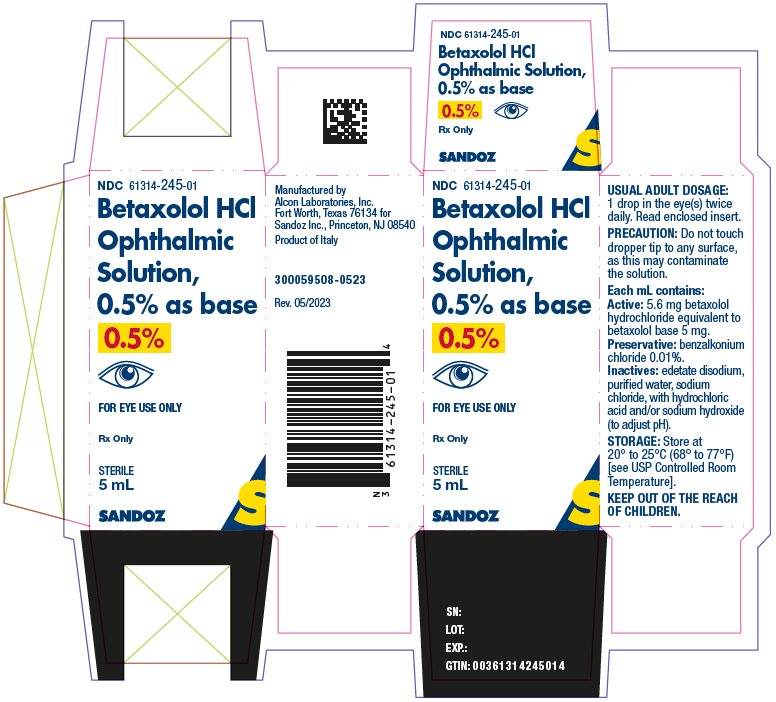
Betaxolol Hydrochloride 5.6 mg/mL Solution/ Drops — NDC 61314-245-01 (Billing 61314-0245-01)
This is a package of Betaxolol Hydrochloride 5.6 mg/mL Solution/ Drops from Sandoz Inc, marketed since May 2000 and currently FDA-listed; retail pharmacies pay about $8.96 per mL (NADAC). It is the main listing for this product, which comes in 3 package sizes.
NDC database record
One package, one record: these facts belong to NDC 61314-245-01 alone.
- Record
- FDA NDC Directory package listing · Human prescription drug
- Code segments
- 61314 labeler · 245 product · 01 package
- Package marketed since
- May 15, 2000
- Sample package
- No — commercial package
- Listing certified through
- Dec 31, 2026
- Barcode (UPC-A, from the NDC)
- 3 6131424501 4
- Medicaid fills, this package
- 654 prescriptions in the last four reported quarters
- FDA record last changed
- Jul 24, 2026
Identity & classification
Regulatory identifiers FDA, NLM and CMS codes for this package
Drug-database identifiers Medi-Span GPI and First Databank GCN / HICL / AHFS classification
- GSN (GCN sequence number): 007857
- GCN: 33210
- GPI-14 (Medi-Span): 86250010102005
- HICL (First Databank): 005168
- AHFS class code: 12:16.08.08
- RxCUI (RxNorm): 308720
Where does this data come from?
- FDA openFDA NDC Directory · synced Oct 8, 2026
- FDA label on DailyMed · label index refreshed Oct 8, 2026
- RxNorm (NLM RxNav) · catalog refreshed Oct 1, 2026
- Medi-Span GPI (licensed)
- First Databank (licensed) · refreshed Oct 8, 2026
RxNorm drug class
This medicine belongs to the beta-Adrenergic Blocker class.
Where does this data come from?
- RxClass (NLM) · catalog refreshed Oct 1, 2026
Clinical
Ophthalmic betaxolol is used to treat glaucoma, a condition in which increased pressure in the eye can lead to gradual loss of vision. Betaxolol is in a class of medications called beta blockers. It works by decreasing the pressure in the eye.
Read the full MedlinePlus article ↗- It depends on the form. The tablets treat high blood pressure. The eye drops lower pressure in the eye for ocular hypertension and chronic open-angle glaucoma.
- Tablets are taken by mouth, usually once a day, and food does not change absorption. Eye drops go into the affected eye(s), usually twice a day. Betoptic S needs a good shake first...
- Please don’t stop on your own. Stopping suddenly can make chest pain worse and has been linked to heart attacks. If you need to stop, your doctor will taper you off over about 2 we...
- Most are mild, like a slow heartbeat, tiredness, dizziness, headache or shortness of breath. Call your doctor for wheezing, swelling, fainting or worsening breathlessness.
Patient education
Supplement & herbal interactions
Betaxolol may be associated with lower levels of 1 nutrient — worth a chat with your pharmacist, not a cause for alarm.
Where does this data come from?
- MedlinePlus (NLM) · refreshed Oct 8, 2026
- FDA label on DailyMed · label index refreshed Oct 8, 2026
Ask a licensed pharmacist directly — free, answered by our team.
Pricing
A drug doesn't have one price. Each row is a different public payment system, and none is what you'd pay at the counter — that depends on your insurance. The ⓘ on each row explains what it measures.
| Price system | Per mL | Per package |
|---|---|---|
| Retail pharmacies payNADAC · weekly | $8.962 | $44.81 / 5 ml |
| Medicaid paysCMS SDUD · 12 mo | $10.03 | $50.16 / 5 ml |
| Medicare drug plans payPart D · Q2 2026 | $8.99 | $44.94 / 5 ml |
Where does this data come from?
- CMS NADAC weekly file · file of Oct 7, 2026
- CMS ASP pricing files · refreshed Sep 20, 2026
- CMS Medicaid State Drug Utilization Data · through Q4 2025
- CMS Part D plan pricing files · refreshed Sep 24, 2026
- VA National Acquisition Center price file
Packaging — all sizes for this product
| Package NDC | Description | Per unit | Per pack | Marketing start | Marketing end | Status |
|---|---|---|---|---|---|---|
| 61314-0245-01 You're viewing this Main listing | 1 BOTTLE, PLASTIC in 1 CARTON / 5 mL in 1 BOTTLE, PLASTIC | $8.96 / mL | $44.81 | 2000-05-15 | — | Active |
| 61314-0245-02 61314-245-02 | 1 BOTTLE, PLASTIC in 1 CARTON / 15 mL in 1 BOTTLE, PLASTIC | — | — | 2000-05-15 | — | Active |
| 61314-0245-03 61314-245-03 | 1 BOTTLE, PLASTIC in 1 CARTON / 10 mL in 1 BOTTLE, PLASTIC | $8.99 / mL | $89.87 | 2000-05-15 | — | Active |
This pack has the lowest per-mL cost of the 2 priced pack sizes ($8.96 NADAC).
In Medicaid, this is the most-dispensed pack of this product — about 89% of fills over the last four reported quarters. See all packs ↓
Pack size FAQ
What quantity is in this package?
What NDC number is used to bill for this package of Betaxolol Hydrochloride 5.6 mg/mL Solution/ Drops?
Prices are the latest CMS NADAC pharmacy acquisition cost per NDC; per-pack figures are per-unit × pack quantity, shown only when the pack is denominated in the same measure NADAC prices.
Therapeutic equivalents
| Product | Labeler | Pack | NADAC/unit | TE | Status | Price vs. this |
|---|---|---|---|---|---|---|
| Betaxolol Hydrochloride 5.6 mg/mLthis 61314-0245-01 | Sandoz | 1 bottle | $8.962 | AT | Availability likely | — |
Where does this data come from?
- FDA openFDA NDC Directory · synced Oct 8, 2026
- FDA Orange Book · refreshed Oct 3, 2026
- CMS NADAC weekly file · file of Oct 7, 2026
Availability & generic status
The FDA lists approved generic versions of this medicine, but that does not always mean a pharmacy can get one today. Patent rules, launch agreements, supply and pricing can affect when generics actually arrive.
Where does this data come from?
- FDA Orange Book · refreshed Oct 3, 2026
Inactive Ingredients / Excipients
Inactive ingredients, also called excipients, are components of the drug product other than the active ingredient. They may include fillers, dyes, coatings, preservatives, flavors, or other formulation ingredients.
🧪 Avoiding an ingredient? See Betaxolol inactive ingredients by manufacturer: every current product's list side by side, so you can ask your pharmacy for the version that does not list it.
💡 Tap an ingredient (hover on desktop) to see what it is and why it’s used.
-
UNII F5UM2KM3W7
Benzalkonium chloride is a chemical compound that works as a preservative and antimicrobial agent in medications. It prevents bacterial and fungal growth in liquid formulations to keep the product safe during storage and use.
-
UNII 7FLD91C86K
Edetate disodium is a chemical compound that binds and removes certain metal ions. In medicines, it acts as a preservative and stabilizer by preventing metals like calcium from interfering with the product's shelf life and consistency.
-
UNII QTT17582CB
A strong acid used to adjust and maintain the proper pH level in liquid medicines, ensuring stability and preventing breakdown of active ingredients.
-
UNII 451W47IQ8X
Sodium chloride is common table salt. It's used in medicines as a buffer to maintain proper pH, as a filler to add bulk, or to adjust the osmotic balance in liquid formulations.
-
UNII 55X04QC32I
A strong alkaline chemical used to adjust and maintain the pH balance of liquid medicines. It helps keep the medicine stable and ensures it stays effective during storage.
-
UNII 059QF0KO0R
Water is a liquid solvent that dissolves and mixes ingredients together in liquid medicines, syrups, and injections. It helps distribute the active drug evenly throughout the product.
6 inactive ingredients listed in the exact product block matched to this NDC.
Where does this data come from?
ingredient classCode="IACT" elements from the exact product block matched by this NDC. Label-section narrative from DailyMed / the openFDA label index is shown separately when available.- FDA label on DailyMed · label index refreshed Oct 8, 2026
- FDA openFDA NDC Directory · synced Oct 8, 2026
Inactive ingredient FAQ
Are inactive ingredients the same for every manufacturer?
Why might an inactive ingredient be missing?
Can inactive ingredients matter?
Manufacturer & labeler
More NDCs from Sandoz Inc labeler code 61314
- Timolol Maleate 2.5 mg/mL Solution NDC 61314-226-05
- Timolol Maleate 5 mg/mL Solution NDC 61314-227-05
- WYOST denosumab 120 mg/1.7mL Injection NDC 61314-228-94
- Cromolyn Sodium 40 mg/mL Solution/ Drops NDC 61314-237-10
- Carteolol Hydrochloride 10 mg/mL Solution NDC 61314-238-05
- JUBBONTI denosumab 60 mg/mL Injection NDC 61314-240-63
- Azelastine Hydrochloride .5 mg/mL Solution/ Drops NDC 61314-308-02
- ZARXIO filgrastim-sndz 300 ug/.5mL Injection, Solution NDC 61314-318-01
- Adalimumab 80 mg/.8mL Injection, Solution NDC 61314-325-20
- ZARXIO filgrastim-sndz 480 ug/.8mL Injection, Solution NDC 61314-326-01
- Adalimumab 40 mg/.4mL Injection, Solution NDC 61314-327-20
- Adalimumab 20 mg/.2mL Injection, Solution NDC 61314-332-64
Where does this data come from?
- FDA openFDA NDC Directory · synced Oct 8, 2026
- Drugs@FDA
Full prescribing information FDA SPL
🎯 Indications and Usage ▾
INDICATIONS AND USAGE Betaxolol Hydrochloride Ophthalmic Solution has been shown to be effective in lowering intraocular pressure and is indicated in the treatment of ocular hypertension and chronic open-angle glaucoma. It may be used alone or in combination with other anti-glaucoma drugs. In clinical studies, Betaxolol Hydrochloride Ophthalmic Solution was safely used to lower intraocular pressure in 47 patients with both glaucoma and reactive airway disease who were followed for a mean period of 15 months.
However, caution should be used in treating patients with severe reactive airway disease or a history of asthma.
⏱️ Dosage and Administration ▾
DOSAGE AND ADMINISTRATION The recommended dose is one to two drops of Betaxolol Hydrochloride Ophthalmic Solution in the affected eye(s) twice daily. In some patients, the intraocular pressure lowering responses to Betaxolol Hydrochloride Ophthalmic Solution may require a few weeks to stabilize. As with any new medication, careful monitoring of patients is advised.
If the intraocular pressure of the patient is not adequately controlled on this regimen, concomitant therapy with pilocarpine and other miotics, and/or epinephrine and/or carbonic anhydrase inhibitors can be instituted.
⛔ Contraindications ▾
CONTRAINDICATIONS Hypersensitivity to any component of this product. Betaxolol Hydrochloride Ophthalmic Solution is contraindicated in patients with sinus bradycardia, greater than a first degree atrioventricular block, cardiogenic shock, or patients with overt cardiac failure.
⚠️ Warnings ▾
WARNING Topically applied beta-adrenergic blocking agents may be absorbed systemically. The same adverse reactions found with systemic administration of beta-adrenergic blocking agents may occur with topical administration. For example, severe respiratory reactions and cardiac reactions, including death due to bronchospasm in patients with asthma, and rarely death in association with cardiac failure, have been reported with topical application of beta-adrenergic blocking agents.
Betaxolol Hydrochloride Ophthalmic Solution has been shown to have a minor effect on heart rate and blood pressure in clinical studies. Caution should be used in treating patients with a history of cardiac failure or heart block. Treatment with Betaxolol Hydrochloride Ophthalmic Solution should be discontinued at the first signs of cardiac failure.
🤒 Adverse Reactions ▾
ADVERSE REACTIONS The following adverse reactions have been reported in clinical trials with Betaxolol Hydrochloride Ophthalmic Solution. Ocular Discomfort of short duration was experienced by one in four patients, but none discontinued therapy; occasional tearing has been reported. Rare instances of decreased corneal sensitivity, erythema, itching sensation, corneal punctate staining, keratitis, anisocoria, edema, and photophobia have been reported.
Additional medical events reported with other formulations of betaxolol include blurred vision, foreign body sensation, dryness of the eyes, inflammation, discharge, ocular pain, decreased visual acuity, and crusty lashes. Systemic Systemic reactions following administration of Betaxolol Hydrochloride Ophthalmic Solution 0.5% or Betaxolol Hydrochloride Ophthalmic Suspension 0.25% have been rarely reported. These include: Cardiovascular Bradycardia, heart block and congestive failure.
Pulmonary Pulmonary distress characterized by dyspnea, bronchospasm, thickened bronchial secretions, asthma and respiratory failure. Central Nervous System Insomnia, dizziness, vertigo, headaches, depression, lethargy, and increase in signs and symptoms of myasthenia gravis. Other Hives, toxic epidermal necrolysis, hair loss and glossitis.
To report SUSPECTED ADVERSE REACTIONS, contact Sandoz Inc., at 1-800-525-8747 or FDA at 1-800-FDA-1088 or www.fda.gov/medwatch.
🔄 Drug Interactions ▾
Drug Interactions Patients who are receiving a beta-adrenergic blocking agent orally and Betaxolol Hydrochloride Ophthalmic Solution should be observed for a potential additive effect either on the intraocular pressure or on the known systemic effects of beta blockade. Close observation of the patient is recommended when a beta blocker is administered to patients receiving catecholamine-depleting drugs such as reserpine, because of possible additive effects and the production of hypotension and/or bradycardia. Betaxolol is an adrenergic blocking agent; therefore, caution should be exercised in patients using concomitant adrenergic psychotropic drugs.
🤰 Pregnancy ▾
Pregnancy Reproduction, teratology, and peri- and postnatal studies have been conducted with orally administered betaxolol HCl in rats and rabbits. There was evidence of drug related postimplantation loss in rabbits and rats at dose levels above 12 mg/kg and 128 mg/kg, respectively. Betaxolol HCl was not shown to be teratogenic, however, and there were no other adverse effects on reproduction at subtoxic dose levels.
There are no adequate and well-controlled studies in pregnant women. Betaxolol Hydrochloride Ophthalmic Solution should be used during pregnancy only if the potential benefit justifies the potential risk to the fetus.
🧒 Pediatric Use ▾
Pediatric Use Safety and effectiveness in pediatric patients have not been established.
🧓 Geriatric Use ▾
Geriatric Use No overall differences in safety or effectiveness have been observed between elderly and younger patients.
🆘 Overdosage ▾
OVERDOSAGE No information is available on overdosage of humans. The oral LD 50 of the drug ranged from 350-920 mg/kg in mice and 860-1050 mg/kg in rats. The symptoms which might be expected with an overdose of a systemically administered beta-1-adrenergic receptor blocker agent are bradycardia, hypotension and acute cardiac failure. A topical overdose of Betaxolol Hydrochloride Ophthalmic Solution may be flushed from the eye(s) with warm tap water.
🧬 Clinical Pharmacology ▾
CLINICAL PHARMACOLOGY Betaxolol Hydrochloride, a cardioselective (beta-1-adrenergic) receptor blocking agent, does not have significant membrane-stabilizing (local anesthetic) activity and is devoid of intrinsic sympathomimetic action. Orally administered beta-adrenergic blocking agents reduce cardiac output in healthy subjects and patients with heart disease. In patients with severe impairment of myocardial function, beta-adrenergic receptor antagonists may inhibit the sympathetic stimulatory effect necessary to maintain adequate cardiac function.
When instilled in the eye, Betaxolol Hydrochloride Ophthalmic Solution has the action of reducing elevated as well as normal intraocular pressure, whether or not accompanied by glaucoma. Ophthalmic betaxolol has minimal effect on pulmonary and cardiovascular parameters. Ophthalmic betaxolol (one drop in each eye) was compared to timolol and placebo in a three-way crossover study challenging nine patients with reactive airway disease who were selected on the basis of having at least a 15% reduction in the forced expiratory volume in one second (FEV 1 ) after administration of ophthalmic timolol.
Betaxolol HCl had no significant effect on pulmonary function as measured by FEV 1 , Forced Vital Capacity (FVC) and FEV 1 /VC. Additionally, the action of isoproterenol, a beta stimulant, administered at the end of the study was not inhibited by ophthalmic betaxolol. In contrast, ophthalmic timolol significantly decreased these pulmonary functions.
FEV 1 - Percent Change from Baseline 1 Means Betaxolol 1.0% a Timolol 0.5% Placebo Baseline 1.6 1.4 1.4 60 Minutes 2.3 -25.7* 5.8 120 Minutes 1.6 -27.4* 7.5 240 Minutes -6.4 -26.9*
6.9Isoproterenol b 36.1 -12.4* 42.8 1 Schoene, R. B. et al. , Am. J.
Ophthal. 97:86, 1984. a Twice the clinical concentration. b Inhaled at 240 minutes; measurement at 270 minutes. *Timolol statistically different from betaxolol and placebo (p < 0.05). No evidence of cardiovascular beta-adrenergic blockade during exercise was observed with betaxolol in a double-masked, three-way crossover study in 24 normal subjects comparing ophthalmic betaxolol, timolol and placebo for effect on blood pressure and heart rate.
Mean arterial blood pressure was not affected by any treatment; however, ophthalmic timolol produced a significant decrease in the mean heart rate. Mean Heart Rates 1 TREATMENT Bruce Stress Exercise Test Minutes Betaxolol 1% a Timolol 0.5% Placebo 0 79.2 79.3 81.2 2 130.2 126.0 130.4 4 133.4 128.0* 134.3 6 136.4 129.2* 137.9 8 139.8 131.8* 139.4 10 140.8 131.8* 141.3 1 Atkins, J. M. et al. , Am.
J. Oph. 99:173-175, Feb., 1985. a Twice the clinical concentration. *Mean pulse rate significantly lower for timolol than betaxolol or placebo (p < 0.05).
Clinical Studies Optic nerve head damage and visual field loss are the result of a sustained elevated intraocular pressure and poor ocular perfusion. Betaxolol Hydrochloride Ophthalmic Solution has the action of reducing elevated as well as normal intraocular pressure, and the mechanism of ocular hypotensive action appears to be a reduction of aqueous production as demonstrated by tonography and aqueous fluorophotometry. The onset of action with Betaxolol Hydrochloride Ophthalmic Solution can generally be noted within 30 minutes and the maximal effect can usually be detected 2 hours after topical administration.
A single dose provides a 12-hour reduction in intraocular pressure. Clinical observation of glaucoma patients treated with Betaxolol Hydrochloride Ophthalmic Solution for up to three years shows that the intraocular pressure lowering effect is well maintained. Clinical studies show that topical Betaxolol Hydrochloride Ophthalmic Solution reduces mean intraocular pressure 25% from baseline.
In trials using 22 mmHg as a generally accepted index of intraocular pressure control, Betaxolol Hydrochloride Ophthalmic Solution was effective in more than 94% of the population studied, of which 73% were treated with the b… [Excerpted — this section continues on DailyMed.]
📦 How Supplied / Storage and Handling ▾
HOW SUPPLIED Betaxolol Hydrochloride Ophthalmic Solution is a sterile, isotonic, aqueous solution of betaxolol hydrochloride. Supplied as follows: 5, 10 and 15 mL in plastic ophthalmic dispensers. 5 mL: NDC 61314-245-01 15 mL: NDC 61314-245-02 10 mL: NDC 61314-245-03 STORAGE: Store at 20° to 25°C (68° to 77°F) [see USP Controlled Room Temperature].
Rev. May 2023 300059509-0523 Manufactured by Alcon Laboratories, Inc. Fort Worth, Texas 76134 for Sandoz Inc.
Princeton, NJ 08540
📋 Description ▾
DESCRIPTION Betaxolol Hydrochloride Ophthalmic Solution contains betaxolol hydrochloride, a cardioselective beta-adrenergic receptor blocking agent, in a sterile isotonic solution. Betaxolol hydrochloride is a white, crystalline powder, soluble in water, with a molecular weight of 343.89. The chemical structure is presented below: Empirical Formula: C 18 H 29 NO 3 •HCl Chemical Name: (±)-1-[p-[2-(Cyclopropylmethoxy)ethyl]phenoxy]-3-(isopropylamino)-2-propanol hydrochloride.
Each mL contains: Active: 5.6 mg betaxolol hydrochloride equivalent to betaxolol base 5 mg. Preservative: benzalkonium chloride 0.01%. Inactives: edetate disodium, purified water, sodium chloride, with hydrochloric acid and/or sodium hydroxide (to adjust pH). chemical
💬 Information for Patients ▾
Information for Patients Do not touch dropper tip to any surface as this may contaminate the solution.
⚠️ Precautions ▾
PRECAUTIONS General Information for Patients Do not touch dropper tip to any surface as this may contaminate the solution. Diabetes Mellitus Beta-adrenergic blocking agents should be administered with caution in patients subject to spontaneous hypoglycemia or to diabetic patients (especially those with labile diabetes) who are receiving insulin or oral hypoglycemic agents. Beta-adrenergic receptor blocking agents may mask the signs and symptoms of acute hypoglycemia.
Thyrotoxicosis Beta-adrenergic blocking agents may mask certain clinical signs (e.g., tachycardia) of hyperthyroidism. Patients suspected of developing thyrotoxicosis should be managed carefully to avoid abrupt withdrawal of beta-adrenergic blocking agents, which might precipitate a thyroid storm. Muscle Weakness Beta-adrenergic blockade has been reported to potentiate muscle weakness consistent with certain myasthenic symptoms (e.g., diplopia, ptosis, and generalized weakness).
Major Surgery Consideration should be given to the gradual withdrawal of beta-adrenergic blocking agents prior to general anesthesia because of the reduced ability of the heart to respond to beta-adrenergically mediated sympathetic reflex stimuli. Pulmonary Caution should be exercised in the treatment of glaucoma patients with excessive restriction of pulmonary function. There have been reports of asthmatic attacks and pulmonary distress during betaxolol treatment.
Although rechallenges of some such patients with ophthalmic betaxolol has not adversely affected pulmonary function test results, the possibility of adverse pulmonary effects in patients sensitive to beta-blockers cannot be ruled out. Risk from Anaphylactic Reaction While taking beta-blockers, patients with a history of atopy or a history of severe anaphylactic reaction to a variety of allergens may be more reactive to repeated accidental, diagnostic, or therapeutic challenge with such allergens. Such patients may be unresponsive to the usual doses of epinephrine used to treat anaphylactic reactions.
Drug Interactions Patients who are receiving a beta-adrenergic blocking agent orally and Betaxolol Hydrochloride Ophthalmic Solution should be observed for a potential additive effect either on the intraocular pressure or on the known systemic effects of beta blockade. Close observation of the patient is recommended when a beta blocker is administered to patients receiving catecholamine-depleting drugs such as reserpine, because of possible additive effects and the production of hypotension and/or bradycardia. Betaxolol is an adrenergic blocking agent; therefore, caution should be exercised in patients using concomitant adrenergic psychotropic drugs.
Ocular In patients with angle-closure glaucoma, the immediate treatment objective is to reopen the angle by constriction of the pupil with a miotic agent. Betaxolol has little or no effect on the pupil. When Betaxolol Hydrochloride Ophthalmic Solution is used to reduce elevated intraocular pressure in angle-closure glaucoma, it should be used with a miotic and not alone.
Carcinogenesis, Mutagenesis, Impairment of Fertility Lifetime studies with betaxolol HCl have been completed in mice at oral doses of 6, 20 or 60 mg/kg/day and in rats at 3, 12 or 48 mg/kg/day; betaxolol HCl demonstrated no carcinogenic effect. Higher dose levels were not tested. In a variety of in vitro and in vivo bacterial and mammalian cell assays, betaxolol HCl was nonmutagenic.
Pregnancy Reproduction, teratology, and peri- and postnatal studies have been conducted with orally administered betaxolol HCl in rats and rabbits. There was evidence of drug related postimplantation loss in rabbits and rats at dose levels above 12 mg/kg and 128 mg/kg, respectively. Betaxolol HCl was not shown to be teratogenic, however, and there were no other adverse effects on reproduction at subtoxic dose levels.
There are no adequate and well-controlled studies in pregnant women. Betaxolol Hydrochloride Ophthalmic Solution should be us… [Excerpted — this section continues on DailyMed.]
🍼 Nursing Mothers ▾
Nursing Mothers It is not known whether betaxolol HCl is excreted in human milk. Because many drugs are excreted in human milk, caution should be exercised when Betaxolol Hydrochloride Ophthalmic Solution is administered to nursing women.
📄 Carcinogenesis, Mutagenesis, Impairment of Fertility ▾
Carcinogenesis, Mutagenesis, Impairment of Fertility Lifetime studies with betaxolol HCl have been completed in mice at oral doses of 6, 20 or 60 mg/kg/day and in rats at 3, 12 or 48 mg/kg/day; betaxolol HCl demonstrated no carcinogenic effect. Higher dose levels were not tested. In a variety of in vitro and in vivo bacterial and mammalian cell assays, betaxolol HCl was nonmutagenic.
📄 Package Label / Principal Display Panel ▾
PRINCIPAL DISPLAY PANEL NDC 61314-245-01 Betaxolol HCl Ophthalmic Solution, 0.5% as base 0.5% FOR EYE USE ONLY Rx Only STERILE 5 mL SANDOZ 5mlcarton