
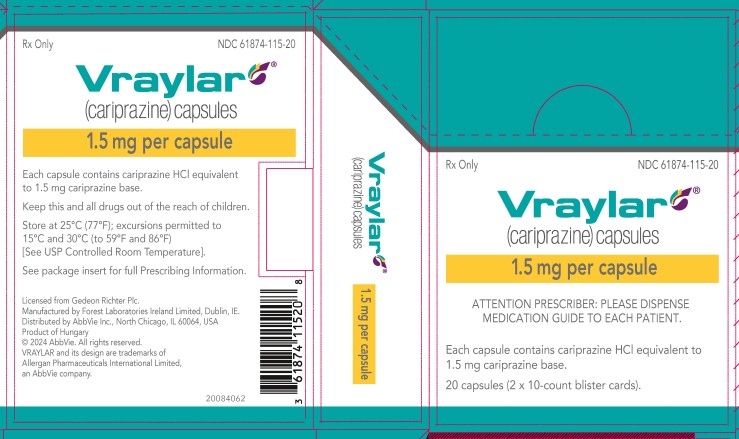
Vraylar cariprazine 1.5 mg Capsule, Gelatin Coated — NDC 61874-115-20 (Billing 61874-0115-20)
This is a package of Vraylar cariprazine 1.5 mg Capsule, Gelatin Coated from Allergan, Inc., marketed since Sep 2015 and currently FDA-listed; retail pharmacies pay about $50.84 per unit (NADAC).
NDC database record
One package, one record: these facts belong to NDC 61874-115-20 alone.
- Record
- FDA NDC Directory package listing · Human prescription drug
- Code segments
- 61874 labeler · 115 product · 20 package
- Package marketed since
- Mar 1, 2016
- Sample package
- No — commercial package
- Listing certified through
- Dec 31, 2027
- Barcode (UPC)
- 0361874250305
- Medicaid fills, this package
- 4,522 prescriptions in the last four reported quarters
- FDA record last changed
- Sep 3, 2026
Identity & classification
Regulatory identifiers FDA, NLM and CMS codes for this package
Drug-database identifiers Medi-Span GPI and First Databank GCN / HICL / AHFS classification
- GSN (GCN sequence number): 074807
- GCN: 39579
- HICL (First Databank): 042552
- AHFS class code: 28:16.08.04
- RxCUI (RxNorm): 1667660
Where does this data come from?
- FDA openFDA NDC Directory · synced Oct 8, 2026
- FDA label on DailyMed · label index refreshed Oct 8, 2026
- RxNorm (NLM RxNav) · catalog refreshed Oct 1, 2026
- Medi-Span GPI (licensed)
- First Databank (licensed) · refreshed Oct 8, 2026
RxNorm drug class
This medicine belongs to the Atypical Antipsychotic class.
Where does this data come from?
- RxClass (NLM) · catalog refreshed Oct 1, 2026
Clinical
Cariprazine is used to treat schizophrenia (a mental illness that affects how a person thinks, feels and behaves), bipolar disorder (a disease that causes depression, mania, and other abnormal moods), and major depressive disorder. Cariprazine is in a class of medications called atypical antipsychotics. It works by changing the activity of certain natural substances in the brain.
Read the full MedlinePlus article ↗- Vraylar (cariprazine) is an antipsychotic medication used for a few different conditions. It can treat schizophrenia, the manic or mixed episodes of bipolar I disorder, and the dep...
- What exactly is Vraylar used for? My doctor prescribed it but didn't fully explain.
- This one requires some patience. Vraylar and its active breakdown products stay in your body for a long time, and it can take several weeks for levels to fully build up and stabili...
- How long does it take for Vraylar to start working?
Patient education
Supplement & herbal interactions
Some supplements/herbs that may interact with Cariprazine Hydrochloride — tap one for details:
Where does this data come from?
- MedlinePlus (NLM) · refreshed Oct 8, 2026
- FDA label on DailyMed · label index refreshed Oct 8, 2026
Ask a licensed pharmacist directly — free, answered by our team.
Pricing
A drug doesn't have one price. Each row is a different public payment system, and none is what you'd pay at the counter — that depends on your insurance. The ⓘ on each row explains what it measures.
| Price system | Per ea | Per package |
|---|---|---|
| Retail pharmacies payNADAC · weekly | $50.842 | $1,016.85 / 20 capsules |
| Medicaid paysCMS SDUD · 12 mo | $49.33 | $986.54 / 20 capsules |
| Medicare drug plans payPart D · Q2 2026 | $52.32 | $1,046.33 / 20 capsules |
Where does this data come from?
- CMS NADAC weekly file · file of Oct 7, 2026
- CMS ASP pricing files · refreshed Sep 20, 2026
- CMS Medicaid State Drug Utilization Data · through Q1 2026
- CMS Part D plan pricing files · refreshed Sep 24, 2026
- VA National Acquisition Center price file
Packaging — all sizes for this product
| Package NDC | Description | Per unit | Per pack | Marketing start | Marketing end | Status |
|---|---|---|---|---|---|---|
| 61874-0115-07 61874-115-07 | 7 CAPSULE, GELATIN COATED in 1 BLISTER PACK Sample | — | — | 2016-03-01 | — | Active |
| 61874-0115-17 61874-115-17 | 1 BLISTER PACK in 1 CARTON / 7 CAPSULE, GELATIN COATED in 1 BLISTER PACK | — | — | 2016-03-01 | — | Active |
| 61874-0115-20 You're viewing this | 2 BLISTER PACK in 1 CARTON / 10 CAPSULE, GELATIN COATED in 1 BLISTER PACK | $50.84 / ea | $1,016.85 | 2016-03-01 | — | Active |
| 61874-0115-30 61874-115-30 Main listing | 30 CAPSULE, GELATIN COATED in 1 BOTTLE | $50.84 / ea | $1,525.27 | 2016-03-01 | — | Active |
| 61874-0115-31 61874-115-31 | 5 CARTON in 1 TRAY / 1 BOTTLE in 1 CARTON / 30 CAPSULE, GELATIN COATED in 1 BOTTLE | — | — | 2016-03-01 | — | Discontinued by firm |
This pack has the lowest per-ea cost of the 2 priced pack sizes ($50.84 NADAC).
This pack accounts for about 0.9% of this product's recent Medicaid fills; most go to the 30 capsules pack. See all packs ↓
Pack size FAQ
What quantity is in this package?
What NDC number is used to bill for this package of Vraylar cariprazine 1.5 mg Capsule, Gelatin Coated?
Prices are the latest CMS NADAC pharmacy acquisition cost per NDC; per-pack figures are per-unit × pack quantity, shown only when the pack is denominated in the same measure NADAC prices.
Therapeutic equivalents
| Product | Labeler | Pack | NADAC/unit | TE | Status | Price vs. this |
|---|---|---|---|---|---|---|
| Vraylar 1.5 mgthis 61874-0115-20 | Allergan, | 10 capsules | $50.842 | — | Availability likely | — |
Where does this data come from?
- FDA openFDA NDC Directory · synced Oct 8, 2026
- FDA Orange Book · refreshed Oct 3, 2026
- CMS NADAC weekly file · file of Oct 7, 2026
Availability & generic status
The FDA lists approved generic versions of this medicine, but that does not always mean a pharmacy can get one today. Patent rules, launch agreements, supply and pricing can affect when generics actually arrive.
Why the date isn’t exact: Generic timing can change because patents may be challenged, settled, licensed, added, removed, or worked around with a narrower label — and FDA approval does not always mean a pharmacy can get the generic today.
🛈 What do these terms mean?
- Patent
- Legal protection listed in the Orange Book that may delay generic approval or launch. Issued by the U.S. Patent & Trademark Office.
- Substance patent
- Covers the active drug molecule itself — the hardest to design around. A generic generally can’t launch until it expires.
- Formulation (product) patent
- Covers a specific formulation or dosage form. A generic can sometimes work around it with a different formulation.
- Method-of-use patent
- A patent covering one specific approved use of the drug — not necessarily the whole molecule. A generic can sometimes launch with a “skinny label” that carves out the protected use and keeps the others.
- Skinny label
- A generic label that omits a still-patented use when the FDA allows it — letting a generic reach the market for the unprotected uses.
- Exclusivity
- FDA-granted marketing protection, separate from patents — e.g. 5-yr new chemical entity, 7-yr orphan drug, or a +6-month pediatric extension.
- Paragraph IV
- A generic applicant’s formal challenge to a listed patent. It can potentially lead to earlier generic entry, but often involves litigation or a settlement.
- RLD / RS
- Reference Listed Drug — the brand product the FDA uses as the reference for generic applications. Reference Standard — the product the FDA expects generics to compare against in bioequivalence testing.
- TE / AB rating
- FDA therapeutic-equivalence rating. An AB rating generally means the FDA considers a generic therapeutically equivalent to — and substitutable for — the brand.
- LOE (loss of exclusivity)
- The latest patent or exclusivity currently listed — the loss-of-exclusivity / latest-listed-protection date shown on this page. Paragraph-IV challenges and settlements can move the real date earlier; FDA approval and a manufacturer’s decision to market can move it later.
Built from the FDA Orange Book. The bars above are scaled to each protection’s expiry; the red LOE marker is the last one to lapse.
| Patent | Type | Use code | Expires |
|---|---|---|---|
| US 7737142 ↗ | Drug substance | U-2544 | Sep 17, 2029 |
| US 7737142 ↗ | Drug substance | U-2545 | Sep 17, 2029 |
| US RE47350 ↗ | Method of use | U-1750 | Jul 16, 2029 |
| US 7737142 ↗ | Drug substance | U-2545 | Sep 17, 2029 |
| US 7737142 ↗ | Drug substance | U-2544 | Sep 17, 2029 |
| US 7737142 ↗ | Drug substance | U-1750 | Sep 17, 2029 |
| US 7737142 ↗ | Drug substance | U-2543 | Sep 17, 2029 |
| US 7737142 ↗ | Drug substance | U-1750 | Sep 17, 2029 |
| US 7737142 ↗ | Drug substance | U-2543 | Sep 17, 2029 |
| US 7737142 ↗ | Drug substance | U-1750 | Sep 17, 2029 |
| US RE47350 ↗ | Method of use | U-2543 | Jul 16, 2029 |
| US 7737142 ↗ | Drug substance | U-1750 | Sep 17, 2029 |
| US 7737142 ↗ | Drug substance | U-2543 | Sep 17, 2029 |
| US 7737142 ↗ | Drug substance | U-2544 | Sep 17, 2029 |
| US 7737142 ↗ | Drug substance | U-2544 | Sep 17, 2029 |
| US RE49110 ↗ | Method of use | U-2545 | Jul 16, 2029 |
| US RE49110 ↗ | Method of use | U-2544 | Jul 16, 2029 |
| US RE49110 ↗ | Method of use | U-2543 | Jul 16, 2029 |
| US RE49110 ↗ | Method of use | U-2545 | Jul 16, 2029 |
| US RE49110 ↗ | Method of use | U-2543 | Jul 16, 2029 |
| US RE49110 ↗ | Method of use | U-2544 | Jul 16, 2029 |
| US RE49110 ↗ | Method of use | U-2544 | Jul 16, 2029 |
| US RE49110 ↗ | Method of use | U-2543 | Jul 16, 2029 |
| US RE49110 ↗ | Method of use | U-2545 | Jul 16, 2029 |
| US RE49110 ↗ | Method of use | U-2545 | Jul 16, 2029 |
| US RE49110 ↗ | Method of use | U-2544 | Jul 16, 2029 |
| US RE49110 ↗ | Method of use | U-2543 | Jul 16, 2029 |
| US 7737142 ↗ | Drug substance | U-2543 | Sep 17, 2029 |
| US 7737142 ↗ | Drug substance | U-2544 | Sep 17, 2029 |
| US 7737142 ↗ | Drug substance | U-3503 | Sep 17, 2029 |
| US 7737142 ↗ | Drug substance | U-2545 | Sep 17, 2029 |
| US 7737142 ↗ | Drug substance | U-2543 | Sep 17, 2029 |
| US 7737142 ↗ | Drug substance | U-2544 | Sep 17, 2029 |
| US 7737142 ↗ | Drug substance | U-3503 | Sep 17, 2029 |
| US 7737142 ↗ | Drug substance | U-2545 | Sep 17, 2029 |
| US RE49110 ↗ | Method of use | U-2543 | Jul 16, 2029 |
| US RE49110 ↗ | Method of use | U-2544 | Jul 16, 2029 |
| US RE49110 ↗ | Method of use | U-2545 | Jul 16, 2029 |
| US RE49110 ↗ | Method of use | U-3503 | Jul 16, 2029 |
| US RE49110 ↗ | Method of use | U-2545 | Jul 16, 2029 |
| US RE49110 ↗ | Method of use | U-3503 | Jul 16, 2029 |
| US RE49110 ↗ | Method of use | U-2543 | Jul 16, 2029 |
| US RE49110 ↗ | Method of use | U-2544 | Jul 16, 2029 |
| US RE47350 ↗ | Method of use | U-2543 | Jul 16, 2029 |
| US RE47350 ↗ | Method of use | U-2544 | Jul 16, 2029 |
| US RE47350 ↗ | Method of use | U-3503 | Jul 16, 2029 |
| US RE47350 ↗ | Method of use | U-2545 | Jul 16, 2029 |
| US RE47350 ↗ | Method of use | U-2543 | Jul 16, 2029 |
| US RE47350 ↗ | Method of use | U-3503 | Jul 16, 2029 |
| US RE47350 ↗ | Method of use | U-2545 | Jul 16, 2029 |
| US RE47350 ↗ | Method of use | U-2544 | Jul 16, 2029 |
| US RE47350 ↗ | Method of use | U-3503 | Jul 16, 2029 |
| US RE49110 ↗ | Method of use | U-3503 | Jul 16, 2029 |
| US 7737142 ↗ | Drug substance | U-3503 | Sep 17, 2029 |
| US 7737142 ↗ | Drug substance | U-3503 | Sep 17, 2029 |
| US RE49110 ↗ | Method of use | U-3503 | Jul 16, 2029 |
| US RE49302 ↗ | Method of use | U-2543 | Jul 16, 2029 |
| US RE49302 ↗ | Method of use | U-2543 | Jul 16, 2029 |
| US RE49302 ↗ | Method of use | U-2543 | Jul 16, 2029 |
| US RE49302 ↗ | Method of use | U-2543 | Jul 16, 2029 |
| US RE49302 ↗ | Method of use | U-3503 | Jul 16, 2029 |
| US RE49302 ↗ | Method of use | U-2544 | Jul 16, 2029 |
| US RE49302 ↗ | Method of use | U-2545 | Jul 16, 2029 |
| US RE49302 ↗ | Method of use | U-2545 | Jul 16, 2029 |
| US RE49302 ↗ | Method of use | U-2544 | Jul 16, 2029 |
| US RE49302 ↗ | Method of use | U-3503 | Jul 16, 2029 |
| US RE49302 ↗ | Method of use | U-2544 | Jul 16, 2029 |
| US RE49302 ↗ | Method of use | U-3503 | Jul 16, 2029 |
| US RE49302 ↗ | Method of use | U-2545 | Jul 16, 2029 |
| US RE49302 ↗ | Method of use | U-2544 | Jul 16, 2029 |
| US RE49302 ↗ | Method of use | U-2545 | Jul 16, 2029 |
| US RE49302 ↗ | Method of use | U-3503 | Jul 16, 2029 |
| US RE47350 ↗ | Method of use | U-2544 | Jul 16, 2029 |
| US RE47350 ↗ | Method of use | U-2545 | Jul 16, 2029 |
| US 7737142 ↗ | Drug substance | U-2543 | Sep 17, 2029 |
| US 7943621 ↗ | Drug substance | — | Dec 20, 2028 |
| US 7943621 ↗ | Drug substance | — | Dec 16, 2028 |
| US 7943621 ↗ | Drug substance | — | Dec 16, 2028 |
| US 7943621 ↗ | Drug substance | — | Dec 20, 2028 |
| US 7943621 ↗ | Drug substance | — | Dec 16, 2028 |
| US 7943621 ↗ | Drug substance | — | Dec 16, 2028 |
| US 7737142*PED ↗ | Drug product | — | Mar 17, 2030 |
| US 7943621*PED ↗ | Drug product | — | Jun 16, 2029 |
| US 7943621*PED ↗ | Drug product | — | Jun 16, 2029 |
| US 7737142*PED ↗ | Drug product | — | Mar 17, 2030 |
| US 7737142*PED ↗ | Drug product | — | Mar 17, 2030 |
| US 7943621*PED ↗ | Drug product | — | Jun 16, 2029 |
| US 7737142*PED ↗ | Drug product | — | Mar 17, 2030 |
| US 7943621*PED ↗ | Drug product | — | Jun 16, 2029 |
| US RE47350*PED ↗ | Drug product | — | Jan 16, 2030 |
| US RE49110*PED ↗ | Drug product | — | Jan 16, 2030 |
| US RE49110*PED ↗ | Drug product | — | Jan 16, 2030 |
| US RE47350*PED ↗ | Drug product | — | Jan 16, 2030 |
| US 7737142*PED ↗ | Drug product | — | Mar 17, 2030 |
| US 7737142*PED ↗ | Drug product | — | Mar 17, 2030 |
| US 7943621*PED ↗ | Drug product | — | Jun 20, 2029 |
| US 7943621*PED ↗ | Drug product | — | Jun 20, 2029 |
| US RE49302*PED ↗ | Drug product | — | Jan 16, 2030 |
| US RE49302*PED ↗ | Drug product | — | Jan 16, 2030 |
| US RE49302*PED ↗ | Drug product | — | Jan 16, 2030 |
| US RE49302*PED ↗ | Drug product | — | Jan 16, 2030 |
| US RE49110*PED ↗ | Drug product | — | Jan 16, 2030 |
| US RE49110*PED ↗ | Drug product | — | Jan 16, 2030 |
| US RE49110*PED ↗ | Drug product | — | Jan 16, 2030 |
| US RE49110*PED ↗ | Drug product | — | Jan 16, 2030 |
| US RE47350*PED ↗ | Drug product | — | Jan 16, 2030 |
| Code | What it grants | Expires |
|---|---|---|
| M-14 | New indication / labeling change (3-year) | Dec 18, 2028 |
| NPP | New Patient Population | Dec 18, 2028 |
| M-14 | New indication / labeling change (3-year) | Dec 18, 2028 |
| NPP | New Patient Population | Dec 18, 2028 |
| M-14 | New indication / labeling change (3-year) | Dec 18, 2028 |
| NPP | New Patient Population | Dec 18, 2028 |
| M-14 | New indication / labeling change (3-year) | Dec 18, 2028 |
| M-14 | New indication / labeling change (3-year) | Dec 18, 2028 |
| NPP | New Patient Population | Dec 18, 2028 |
| M-14 | New indication / labeling change (3-year) | Dec 18, 2028 |
| NPP | New Patient Population | Dec 18, 2028 |
| PED | Pediatric Exclusivity (+6 months) | Jun 18, 2029 |
| PED | Pediatric Exclusivity (+6 months) | Jun 18, 2029 |
| PED | Pediatric Exclusivity (+6 months) | Jun 18, 2029 |
| PED | Pediatric Exclusivity (+6 months) | Jun 18, 2029 |
| PED | Pediatric Exclusivity (+6 months) | Jun 18, 2029 |
| PED | Pediatric Exclusivity (+6 months) | Jun 18, 2029 |
| PED | Pediatric Exclusivity (+6 months) | Jun 18, 2029 |
| PED | Pediatric Exclusivity (+6 months) | Jun 18, 2029 |
| PED | Pediatric Exclusivity (+6 months) | Jun 18, 2029 |
| PED | Pediatric Exclusivity (+6 months) | Jun 18, 2029 |
| PED | Pediatric Exclusivity (+6 months) | Jun 18, 2029 |
Is there a generic version of VRAYLAR 1.5 MG CAPSULE?
The FDA approved a generic — why can’t I get it at my pharmacy yet?
Why do different websites show different generic release dates?
What does “FDA listed” mean?
What does a patent or protection date mean here?
What does “current Orange Book estimate” mean?
Can a generic come out before the last patent expires?
Can a generic come out after the listed dates?
What is the difference between patents and exclusivity?
Why are there multiple patent dates?
Where does this data come from?
- FDA Orange Book · refreshed Oct 3, 2026
What it looks like
Where does this data come from?
- FDA label on DailyMed · label index refreshed Oct 8, 2026
Inactive Ingredients / Excipients
Inactive ingredients, also called excipients, are components of the drug product other than the active ingredient. They may include fillers, dyes, coatings, preservatives, flavors, or other formulation ingredients.
🧪 Avoiding an ingredient? See Cariprazine inactive ingredients by manufacturer: every current product's list side by side, so you can ask your pharmacy for the version that does not list it.
💡 Tap an ingredient (hover on desktop) to see what it is and why it’s used.
-
UNII XM0M87F357
A dark iron oxide compound that gives medicines their black or dark color. It's used as a colorant in tablets and capsules to help identify the product and make it visually distinctive.
-
UNII 2G86QN327L
Gelatin is a protein derived from animal collagen, commonly used in medicines as a gelling agent and capsule material. It helps create soft or hard capsule shells that hold and release medication, and can also thicken liquid formulations.
-
UNII 70097M6I30
Magnesium stearate is a salt made from magnesium and stearic acid, a fatty substance. It's used in tablets and capsules as a lubricant and glidant to help ingredients flow smoothly during manufacturing and prevent sticking.
-
UNII 46N107B71O
Shellac is a natural resin secreted by the lac beetle. It's used as a coating on tablets and capsules to control how quickly the medicine dissolves and to improve appearance and stability.
-
UNII O8232NY3SJ
A plant-based carbohydrate derived from corn kernels. It acts as a filler to add bulk, a binder to hold ingredients together, and a disintegrant to help the tablet break apart in your stomach for absorption.
-
UNII 15FIX9V2JP
Titanium dioxide is a bright white mineral powder commonly used as a colorant and opacifying agent. It makes pills and tablets white or lighter in color and helps make coatings non-transparent.
6 inactive ingredients listed in the exact product block matched to this NDC.
Where does this data come from?
ingredient classCode="IACT" elements from the exact product block matched by this NDC. Label-section narrative from DailyMed / the openFDA label index is shown separately when available.- FDA label on DailyMed · label index refreshed Oct 8, 2026
- FDA openFDA NDC Directory · synced Oct 8, 2026
Inactive ingredient FAQ
Are inactive ingredients the same for every manufacturer?
Why might an inactive ingredient be missing?
Can inactive ingredients matter?
Manufacturer & labeler
More NDCs from Allergan, Inc. labeler code 61874
- Viberzi Eluxadoline 75 mg Tablet, Film Coated NDC 61874-075-08
- Viberzi Eluxadoline 100 mg Tablet, Film Coated NDC 61874-100-08
- cariprazine 1.5 mg Capsule, Gelatin Coated NDC 61874-116-00
- Vraylar cariprazine 3 mg Capsule, Gelatin Coated NDC 61874-130-07
- cariprazine 3 mg Capsule, Gelatin Coated NDC 61874-131-00
- Vraylar cariprazine 4.5 mg Capsule, Gelatin Coated NDC 61874-145-07
- cariprazine 4.5 mg Capsule, Gelatin Coated NDC 61874-146-00
- Vraylar cariprazine 6 mg Capsule, Gelatin Coated NDC 61874-160-07
Where does this data come from?
- FDA openFDA NDC Directory · synced Oct 8, 2026
- Drugs@FDA
Full prescribing information FDA SPL
🚨 Boxed Warning ▾
WARNING: INCREASED MORTALITY IN ELDERLY PATIENTS WITH DEMENTIA-RELATED PSYCHOSIS and SUICIDAL THOUGHTS AND BEHAVIORS Increased Mortality in Elderly Patients with Dementia-Related Psychosis Elderly patients with dementia-related psychosis treated with antipsychotic drugs are at an increased risk of death. VRAYLAR is not approved for the treatment of patients with dementia-related psychosis [see Warnings and Precautions ( 5.1 )]. Suicidal Thoughts and Behaviors Antidepressants increased the risk of suicidal thoughts and behaviors in pediatric and young adult patients in short-term studies.
Closely monitor all antidepressant-treated patients for clinical worsening, and for the emergence of suicidal thoughts and behaviors [see Warnings and Precautions ( 5.2 )] . WARNING : INCREASED MORTALITY IN ELDERLY PATIENTS WITH DEMENTIA-RELATED PSYCHOSIS and SUICIDAL THOUGHTS AND BEHAVIORS See full prescribing information for complete boxed warning. Elderly patients with dementia-related psychosis treated with antipsychotic drugs are at an increased risk of death.
VRAYLAR is not approved for the treatment of patients with dementia-related psychosis. ( 5.1 ) Antidepressants increased the risk of suicidal thoughts and behaviors in pediatric and young adult patients. Closely monitor all antidepressant-treated patients for clinical worsening and emergence of suicidal thoughts and behaviors.
( 5.2 )
🎯 Indications and Usage ▾
1 . INDICATIONS AND USAGE VRAYLAR ® is indicated for: • Treatment of schizophrenia in adult and pediatric patients 13 years of age and older [see Clinical Studies ( 14.1 )] • Acute treatment of manic or mixed episodes associated with bipolar I disorder in adult and pediatric patients 10 years of age and older [see Clinical Studies ( 14.2 )] • Treatment of depressive episodes associated with bipolar I disorder (bipolar depression) in adult patients [see Clinical Studies ( 14.3 )] • Adjunctive therapy to antidepressants for the treatment of major depressive disorder (MDD) in adult patients [see Clinical Studies ( 14.4 )] VRAYLAR is an atypical antipsychotic indicated for: Treatment of schizophrenia in adults and pediatric patients 13 years of age and older ( 1 ) Acute treatment of manic or mixed episodes associated with bipolar I disorder in adults and pediatric patients 10 years of age and older ( 1 ) Treatment of depressive episodes associated with bipolar I disorder (bipolar depression) in adults ( 1 ) Adjunctive therapy to antidepressants for the treatment of major depressive disorder (MDD) in adults ( 1 )
⏱️ Dosage and Administration ▾
2 . DOSAGE AND ADMINISTRATION Administer VRAYLAR orally once daily with or without food ( 2 ) Starting Dose Recommended Dose Schizophrenia in Adults ( 2.2 ) 1.5 mg daily 1.5 mg to 6 mg daily Schizophrenia in Pediatric Patients (13-17 years) ( 2.2 ) 0.5 mg daily 1.5 mg to 4.5 mg daily Bipolar Mania in Adults ( 2.3 ) 1.5 mg daily 3 mg to 6 mg daily Bipolar Mania in Pediatric Patients (10-17 years) ( 2.3 ) 0.5 mg daily 3 mg or 4.5 mg daily Bipolar Depression in Adults ( 2.4 ) 1.5 mg daily 1.5 mg or 3 mg daily Adjunctive therapy to antidepressants for MDD in Adults ( 2.5 ) 1.5 mg daily 1.5 mg or 3 mg daily Adults with Schizophrenia and Bipolar Mania: Maximum recommended daily dosage is 6 mg.
Dosages above 6 mg daily do not confer significant benefit, but increase the risk of dose-related adverse reactions ( 2.2 , 2.3 ) Pediatric patients with Schizophrenia and Bipolar Mania: Maximum recommended daily dosage is 4.5 mg. Adults with Bipolar Depression: Maximum recommended daily dosage is 3 mg ( 2.4 ) Adjunctive therapy for treatment of MDD in Adults: Maximum recommended daily dosage is 3 mg ( 2.5 )
2.1General Dosing Information VRAYLAR is given orally once daily and can be taken with or without food. Because of the long half-life of cariprazine and its active metabolites, changes in dose will not be fully reflected in plasma for several weeks. Prescribers should monitor patients for adverse reactions and treatment response for several weeks after starting VRAYLAR and after each dosage change [see Warnings and Precautions ( 5.6 ) , Clinical Pharmacology ( 12.3 )] .
2.2Recommended Dosage in Schizophrenia Adult Patients The starting dosage of VRAYLAR is 1.5 mg orally once daily. The recommended dosage range is 1.5 mg to 6 mg orally once daily. The dosage can be increased to 3 mg on Day 2.
Depending upon clinical response and tolerability, further dose adjustments can be made in 1.5 mg or 3 mg increments. The maximum recommended dosage is 6 mg orally once daily. In short-term controlled trials, dosages above 6 mg daily do not confer increased effectiveness sufficient to outweigh dose-related adverse reactions [see Adverse Reactions ( 6.1 ), Clinical Studies ( 14.1 )] .
Pediatric Patients (13 to 17 years of age) The starting dosage of VRAYLAR is 0.5 mg orally once daily. The recommended dosage range is 1.5 mg to 4.5 mg orally once daily. Increase the dosage to 1.5 mg orally once daily on Day 3.
Depending upon clinical response and tolerability, the dosage may be increased to 3 mg orally once daily starting on Day 5, and to 4.5 mg orally once daily starting on Day 8. The maximum recommended dosage is 4.5 mg orally once daily.
2.3Recommended Dosage in Manic or M ixed E pisodes Associated with Bipolar I Disorder Adult Patients The starting dosage of VRAYLAR is 1.5 mg orally once daily. Increase the dosage to 3 mg orally once daily on Day 2. The recommended dosage range is 3 mg to 6 mg orally once daily.
Depending upon clinical response and tolerability, further dose adjustments can be made in 1.5 mg or 3 mg increments. The maximum recommended dosage is 6 mg orally once daily. In short-term controlled trials, dosages above 6 mg daily do not confer increased effectiveness sufficient to outweigh dose-related adverse reactions [ see Adverse Reactions ( 6.1 ), Clinical Studies ( 14.2 ) ] .
Pediatric Patients (10 to 17 years of age) The starting dosage of VRAYLAR is 0.5 mg orally once daily. The recommended dosage is 3 mg or 4.5 mg orally once daily. Increase the dosage to 1.5 mg orally once daily on Day 3 and to 3 mg orally once daily on Day 5.
Depending upon clinical response and tolerability, the dosage may be increased to 4.5 mg orally once daily starting on Day 8. The maximum recommended dosage is 4.5 mg orally once daily.
2.4Recommended Dosage in Depressive Episodes Associated with Bipolar I Disorder (Bipolar Depression) in Adult Patients The starting dosage of VRAYLAR is 1.5 mg orally once daily. Depending upon clinical response and to… [Excerpted — this section continues on DailyMed.]
💊 Dosage Forms and Strengths ▾
3 . DOSAGE FORMS AND STRENGTHS VRAYLAR (cariprazine) capsules are available in six strengths. 0.5 mg capsules: Ivory to yellow cap and a grey to green body imprinted with “FL 0.5” 0.75 mg capsules: Grey to green cap and blue body imprinted with “FL 0.75” 1.5 mg capsules: White cap and body imprinted with “FL 1.5” 3 mg capsules: Green to blue-green cap and white body imprinted with “FL 3” 4.5 mg capsules: Green to blue-green cap and body imprinted with “FL 4.5” 6 mg capsules: Purple cap and white body imprinted with “FL 6” Capsules: 0.5 mg, 0.75 mg, 1.5 mg, 3 mg, 4.5 mg, and 6 mg ( 3 )
⛔ Contraindications ▾
4 . CONTRAINDICATIONS VRAYLAR is contraindicated in patients with history of a hypersensitivity reaction to cariprazine. Reactions have ranged from rash, pruritus, urticaria, and reactions suggestive of angioedema (e.g., swollen tongue, lip swelling, face edema, pharyngeal edema, and swelling face). Known hypersensitivity to VRAYLAR ( 4 )
⚠️ Warnings and Cautions ▾
5 . WARNINGS AND PRECAUTIONS Cerebrovascular Adverse Reactions in Elderly Patients with Dementia-Related Psychosis: Increased incidence of cerebrovascular adverse reactions (e.g., stroke, transient ischemic attack) ( 5.3 ) Neuroleptic Malignant Syndrome: Manage with immediate discontinuation and close monitoring ( 5.4 ) Tardive Dyskinesia : Discontinue if appropriate ( 5.5 ) Late-Occurring Adverse Reactions: Because of VRAYLAR’s long half-life, monitor for adverse reactions and patient response for several weeks after starting VRAYLAR and with each dosage change ( 5.6 ) Metabolic Changes : Monitor for hyperglycemia/diabetes mellitus, dyslipidemia and weight gain ( 5.7 ) Leukopenia, Neutropenia, and Agranulocytosis : Perform complete blood counts (CBC) in patients with pre-existing low white blood cell counts (WBC) or history of leukopenia or neutropenia.
Consider discontinuing VRAYLAR if a clinically significant decline in WBC occurs in absence of other causative factors ( 5.8 ) Orthostatic H ypotension and Syncope : Monitor heart rate and blood pressure and warn patients with known cardiovascular or cerebrovascular disease, and risk of dehydration or syncope ( 5.9 ) Seizures: Use cautiously in patients with a history of seizures or with conditions that lower the seizure threshold ( 5.11 ) Potential for Cognitive and Motor Impairment: Use caution when operating machinery ( 5.12 )
5.1Increased Mortality in Elderly Patients with Dementia-Related Psychosis Antipsychotic drugs increase the all-cause risk of death in elderly patients with dementia-related psychosis. Analyses of 17 dementia-related psychosis placebo-controlled trials (modal duration of 10 weeks and largely in patients taking atypical antipsychotic drugs) revealed a risk of death in the drug-treated patients of between 1.6 to 1.7 times that in placebo-treated patients. Over the course of a typical 10-week controlled trial, the rate of death in drug-treated patients was about 4.5%, compared to a rate of about 2.6% in placebo-treated patients.
Although the causes of death were varied, most of the deaths appeared to be either cardiovascular (e.g., heart failure, sudden death) or infectious (e.g., pneumonia) in nature. VRAYLAR is not approved for the treatment of patients with dementia-related psychosis [see Boxed Warning , Warnings and Precautions ( 5.3 ) ] .
5.2Suicidal Thoughts and Behaviors in Children, Adolescents and Young Adults In pooled analyses of placebo-controlled trials of antidepressant drugs (SSRIs and other antidepressant classes) that included approximately 77,000 adult patients and 4,500 pediatric patients, the incidence of suicidal thoughts and behaviors in antidepressant-treated patients age 24 years and younger was greater than in placebo-treated patients. There was considerable variation in risk of suicidal thoughts and behaviors among drugs, but there was an increased risk identified in young patients for most drugs studied.
There were differences in absolute risk of suicidal thoughts and behaviors across the different indications, with the highest incidence in patients with MDD. The drug-placebo differences in the number of cases of suicidal thoughts and behaviors per 1000 patients treated are provided in Table 3. Table 3: Risk Differences of the Number of Patients of Suicidal Thoughts and Behavior in the Pooled Placebo-Controlled Trials of Antidepressants in Pediatric and Adult Patients Age Range Drug-Placebo Difference in Number of Patients of Suicidal Thoughts or Behaviors per 1000 Patients Treated Increases Compared to Placebo <18 years old 14 additional patients 18-24 years old 5 additional patients Decreases Compared to Placebo 25-64 years old 1 fewer patient ≥65 years old 6 fewer patients It is unknown whether the risk of suicidal thoughts and behaviors in children, adolescents, and young adults extends to longer-term use, i.e., beyond four months.
However, there is substantial evidence from placebo-controlled maintenance trials in adults… [Excerpted — this section continues on DailyMed.]
🤒 Adverse Reactions ▾
6 ADVERSE REACTIONS The following adverse reactions are discussed in more detail in other sections of the labeling: Increased Mortality in Elderly Patients with Dementia-Related Psychosis [see Boxed Warning and Warnings and Precautions ( 5.1 )] Suicidal Thoughts and Behaviors [see Boxed Warning and Warnings and Precautions ( 5.2 )] Cerebrovascular Adverse Reactions, Including Stroke, in Elderly Patients with Dementia-Related Psychosis [see Warnings and Precautions ( 5.3 )] Neuroleptic Malignant Syndrome [see Warnings and Precautions ( 5.4 )] Tardive Dyskinesia [see Warnings and Precautions ( 5.5 )] Late Occurring Adverse Reactions [see Warnings and Precautions ( 5.6 )] Metabolic Changes [see Warnings and Precautions ( 5.7 )] Leukopenia, Neutropenia, and Agranulocytosis [see Warnings and Precautions ( 5.8 )] Orthostatic Hypotension and Syncope [see Warnings and Precautions ( 5.9 )] Falls [see Warnings and Precautions ( 5.10 )] Seizures [ see Warnings and Precautions ( 5.11 )] Potential for Cognitive and Motor Impairment [see Warnings and Precautions ( 5.12 )] Body Temperature Dysregulation [see Warnings and Precautions ( 5.13 )] Dysphagia [see Warnings and Precautions ( 5.14 )] Most common adverse reactions in adults (incidence ≥ 5% and at least twice the rate of placebo) were ( 6.1 ) : Schizophrenia: extrapyramidal symptoms and akathisia Bipolar mania: extrapyramidal symptoms, akathisia, dyspepsia, vomiting, somnolence, and restlessness Bipolar depression: nausea, akathisia, restlessness, and extrapyramidal symptoms Adjunctive treatment of MDD: akathisia, restlessness, fatigue, constipation, nausea, insomnia, increased appetite, dizziness, and extrapyramidal symptoms To report SUSPECTED ADVERSE REACTIONS, contact AbbVie at 1-800-633-9110 or FDA at 1-800-FDA-1088 or www.fda.gov/medwatch.
6.1Clinical Trials Experience Because clinical trials are conducted under widely varying conditions, adverse reaction rates observed in the clinical trials of a drug cannot be directly compared to rates in the clinical trials of another drug and may not reflect the rates observed in practice. The information below is derived from an integrated clinical study database for VRAYLAR consisting of 6,722 adult patients exposed to one or more doses of VRAYLAR for the treatment of schizophrenia, manic or mixed episodes associated with bipolar I disorder, bipolar depression, and adjunctive treatment of major depressive disorder in placebo-controlled studies.
This experience corresponds with a total experience of 1,182.8 patient-years. A total of 4,329 VRAYLAR-treated patients had at least 6 weeks and 296 VRAYLAR-treated patients had at least 48 weeks of exposure. Adult Patients with Schizophrenia The following findings are based on four placebo-controlled, 6-week schizophrenia trials with VRAYLAR doses ranging from 1.5 to 12 mg once daily.
The maximum recommended dosage is 6 mg daily. Adverse Reactions Associated with Discontinuation of Treatment : There was no single adverse reaction leading to discontinuation that occurred at a rate of ≥ 2% in VRAYLAR-treated patients and at least twice the rate of placebo. Common Adverse Reactions (≥ 5% and at least twice the rate of placebo) : extrapyramidal symptoms and akathisia.
Adverse Reactions with an incidence of ≥ 2% and greater than placebo, at any dose are shown in Table 8. Table 8. Adverse Reactions Occurring in ≥ 2% of VRAYLAR-treated Patients and > Placebo-treated Adult Patients in 6-Week Schizophrenia Trials VRAYLAR * System Organ Class / Preferred Term Placebo (N= 584) (%) 1.5 to 3 mg/day (N=539) (%) 4.5 to 6 mg/day (N=575) (%) 9 to 12 mg/day ⸰ (N=203) (%) Cardiac Disorder s Tachycardia a 1 2 2 3 Gastrointestinal Disorders Abdominal pain b 5 3 4 7 Constipation 5 6 7 10 Diarrhea c 3 1 4 5 Dry Mouth 2 1 2 3 Dyspepsia 4 4 5 5 Nausea 5 5 7 8 Toothache 4 3 3 6 Vomiting 3 4 5 5 General Disorders/Administration Site Conditions Fatigue d 1 1 3 2 Infections and Infestations Nasopharyngitis 1 1 1 2 Urinary tra… [Excerpted — this section continues on DailyMed.]
🔄 Drug Interactions ▾
7 DRUG INTERACTIONS Table 15 displays clinically significant drug interactions with VRAYLAR. Table 15. Clinically Significant Drug Interactions with VRAYLAR Strong or Moderate CYP3A4 Inhibitors Clinical Impact: Concomitant use of VRAYLAR with a strong or moderate CYP3A4 inhibitor increases the exposures of cariprazine and its major active metabolite, didesmethylcariprazine (DDCAR), compared to use of VRAYLAR alone [see Clinical Pharmacology ( 12.3 ) ].
Intervention: If VRAYLAR is used with a strong or moderate CYP3A4 inhibitor, reduce VRAYLAR dosage [see D osage and A dministration ( 2.6 ) ] . CYP3A4 Inducers Clinical Impact: CYP3A4 is responsible for the formation and elimination of the active metabolites of cariprazine. The effect of CYP3A4 inducers on the exposure of VRAYLAR has not been evaluated, and the net effect is unclear [see Clinical Pharmacology ( 12.3 ) ].
Intervention: Concomitant use of VRAYLAR with a CYP3A4 inducer is not recommended [see Dosage and Administration ( 2.1 , 2.6 ) ] . Strong and Moderate CYP3A4 inhibitors: Reduce VRAYLAR dosage ( 2.6 , 7 ) CYP3A4 inducers: Concomitant use is not recommended ( 2.6 , 7 )
👥 Use in Specific Populations ▾
8 USE IN SPECIFIC POPULATIONS Pregnancy : Based on animal data, may cause fetal harm. ( 8.1 )
8.1Pregnancy Pregnancy Exposure Registry There is a pregnancy exposure registry that monitors pregnancy outcomes in women exposed to VRAYLAR during pregnancy. For more information, contact the National Pregnancy Registry for Atypical Antipsychotics at 1-866-961-2388 or visit http://womensmentalhealth.org/clinical-and-research-programs/pregnancyregistry/. Risk Summary Neonates exposed to antipsychotic drugs during the third trimester of pregnancy are at risk for extrapyramidal and/or withdrawal symptoms following delivery (see Clinical Considerations).
There are no available data on VRAYLAR use in pregnant women to inform any drug-associated risks for birth defects or miscarriage. The major active metabolite of cariprazine, DDCAR, has been detected in adult patients up to 12 weeks after discontinuation of VRAYLAR [see Clinical Pharmacology ( 12.3 )]. Based on animal data, VRAYLAR may cause fetal harm.
Administration of cariprazine to rats during the period of organogenesis caused malformations, lower pup survival, and developmental delays at drug exposures less than the human exposure at the maximum recommended human dose (MRHD) of 6 mg/day. However, cariprazine was not teratogenic in rabbits at doses up to 4.6 times the MRHD of 6 mg/day [see Data] . The estimated background risk of major birth defects and miscarriage for the indicated populations is unknown.
In the U.S. general population, the estimated background risk of major birth defects and miscarriage in clinically recognized pregnancies is 2-4% and 15-20%, respectively. Advise pregnant women of the potential risk to a fetus. Clinical Considerations Fetal/Neonatal Adverse Reactions Extrapyramidal and/or withdrawal symptoms, including agitation, hypertonia, hypotonia, tremor, somnolence, respiratory distress, and feeding disorder have been reported in neonates whose mothers were exposed to antipsychotic drugs during the third trimester of pregnancy.
These symptoms have varied in severity. Some neonates recovered within hours or days without specific treatment; others required prolonged hospitalization. Monitor neonates for extrapyramidal and/or withdrawal symptoms and manage symptoms appropriately.
Data Animal Data Administration of cariprazine to pregnant rats during the period of organogenesis at oral doses of 0.5, 2.5, and 7.5 mg/kg/day, which are 0.2 to 3.5 times the maximum recommended human dose (MRHD) of 6 mg/day based on AUC of total cariprazine (i.e. sum of cariprazine, DCAR, and DDCAR), caused fetal developmental toxicity at all doses, which included reduced body weight, decreased male anogenital distance, and skeletal malformations of bent limb bones, scapula, and humerus. These effects occurred in the absence or presence of maternal toxicity.
Maternal toxicity, observed as a reduction in body weight and food consumption, occurred at doses 1.2 and 3.5-times the MRHD of 6 mg/day based on AUC of total cariprazine. At these doses, cariprazine caused fetal external malformations (localized fetal thoracic edema), visceral variations (undeveloped/underdeveloped renal papillae and/or distended urethrae), and skeletal developmental variations (bent ribs, unossified sternebrae). Cariprazine had no effect on fetal survival.
Administration of cariprazine to pregnant rats during pregnancy and lactation at oral doses of 0.1, 0.3, and 1 mg/kg/day, which are 0.03 to 0.4 times the MRHD of 6 mg/day based on AUC of total cariprazine, caused a decrease in postnatal survival, birth weight, and post-weaning body weight of first generation pups at the dose that is 0.4 times the MRHD of 6 mg/day based on AUC of total cariprazine in absence of maternal toxicity. First generation pups also had pale, cold bodies and developmental delays (renal papillae not developed or underdeveloped and decreased auditory startle response in males).
Reproductive performance of the first generation pups was un… [Excerpted — this section continues on DailyMed.]
🤰 Pregnancy ▾
8.1Pregnancy Pregnancy Exposure Registry There is a pregnancy exposure registry that monitors pregnancy outcomes in women exposed to VRAYLAR during pregnancy. For more information, contact the National Pregnancy Registry for Atypical Antipsychotics at 1-866-961-2388 or visit http://womensmentalhealth.org/clinical-and-research-programs/pregnancyregistry/. Risk Summary Neonates exposed to antipsychotic drugs during the third trimester of pregnancy are at risk for extrapyramidal and/or withdrawal symptoms following delivery (see Clinical Considerations).
There are no available data on VRAYLAR use in pregnant women to inform any drug-associated risks for birth defects or miscarriage. The major active metabolite of cariprazine, DDCAR, has been detected in adult patients up to 12 weeks after discontinuation of VRAYLAR [see Clinical Pharmacology ( 12.3 )]. Based on animal data, VRAYLAR may cause fetal harm.
Administration of cariprazine to rats during the period of organogenesis caused malformations, lower pup survival, and developmental delays at drug exposures less than the human exposure at the maximum recommended human dose (MRHD) of 6 mg/day. However, cariprazine was not teratogenic in rabbits at doses up to 4.6 times the MRHD of 6 mg/day [see Data] . The estimated background risk of major birth defects and miscarriage for the indicated populations is unknown.
In the U.S. general population, the estimated background risk of major birth defects and miscarriage in clinically recognized pregnancies is 2-4% and 15-20%, respectively. Advise pregnant women of the potential risk to a fetus. Clinical Considerations Fetal/Neonatal Adverse Reactions Extrapyramidal and/or withdrawal symptoms, including agitation, hypertonia, hypotonia, tremor, somnolence, respiratory distress, and feeding disorder have been reported in neonates whose mothers were exposed to antipsychotic drugs during the third trimester of pregnancy.
These symptoms have varied in severity. Some neonates recovered within hours or days without specific treatment; others required prolonged hospitalization. Monitor neonates for extrapyramidal and/or withdrawal symptoms and manage symptoms appropriately.
Data Animal Data Administration of cariprazine to pregnant rats during the period of organogenesis at oral doses of 0.5, 2.5, and 7.5 mg/kg/day, which are 0.2 to 3.5 times the maximum recommended human dose (MRHD) of 6 mg/day based on AUC of total cariprazine (i.e. sum of cariprazine, DCAR, and DDCAR), caused fetal developmental toxicity at all doses, which included reduced body weight, decreased male anogenital distance, and skeletal malformations of bent limb bones, scapula, and humerus. These effects occurred in the absence or presence of maternal toxicity.
Maternal toxicity, observed as a reduction in body weight and food consumption, occurred at doses 1.2 and 3.5-times the MRHD of 6 mg/day based on AUC of total cariprazine. At these doses, cariprazine caused fetal external malformations (localized fetal thoracic edema), visceral variations (undeveloped/underdeveloped renal papillae and/or distended urethrae), and skeletal developmental variations (bent ribs, unossified sternebrae). Cariprazine had no effect on fetal survival.
Administration of cariprazine to pregnant rats during pregnancy and lactation at oral doses of 0.1, 0.3, and 1 mg/kg/day, which are 0.03 to 0.4 times the MRHD of 6 mg/day based on AUC of total cariprazine, caused a decrease in postnatal survival, birth weight, and post-weaning body weight of first generation pups at the dose that is 0.4 times the MRHD of 6 mg/day based on AUC of total cariprazine in absence of maternal toxicity. First generation pups also had pale, cold bodies and developmental delays (renal papillae not developed or underdeveloped and decreased auditory startle response in males).
Reproductive performance of the first generation pups was unaffected; however, the second generation pups had clinical signs and lower body weight similar… [Excerpted — this section continues on DailyMed.]
🧒 Pediatric Use ▾
8.4Pediatric Use Schizophrenia The safety and effectiveness of VRAYLAR for treatment of schizophrenia have been established in pediatric patients 13 years of age and older. Use of VRAYLAR in this population is supported by evidence from adequate and well-controlled studies in adults with schizophrenia, pharmacokinetic data from adults and pediatric patients, and safety data in pediatric patients 13 to 17 years of age [see Warnings and Precautions ( 5.7 ), Adverse Reactions ( 6.1 ), Clinical Pharmacology ( 12.3 )] .
The safety and effectiveness of VRAYLAR for the treatment of schizophrenia have not been established in pediatric patients less than 13 years of age. Manic and Mixed Episodes Associated with Bipolar I Disorder The safety and effectiveness of VRAYLAR for treatment of manic and mixed episodes associated with bipolar I disorder have been established in pediatric patients 10 years of age and older. Use of VRAYLAR in this population is supported by evidence from adequate and well-controlled studies in adults with manic and mixed episodes associated with bipolar I disorder, pharmacokinetic data from adult and pediatric patients, and safety data in pediatric patients 10 to 17 years of age [see Warnings and Precautions ( 5.7 ), Adverse Reactions ( 6.1 ), Clinical Pharmacology ( 12.3 )] .
The safety and effectiveness of VRAYLAR for the treatment of manic and mixed episodes associated with bipolar I disorder have not been established in pediatric patients less than 10 years of age. Bipolar Depression The safety and effectiveness of VRAYLAR for treatment of bipolar depression in pediatric patients have not been established. Adjunctive Therapy for Treatment of MDD The safety and effectiveness of VRAYLAR as adjunctive therapy for treatment of MDD in pediatric patients have not been established.
Antidepressants increased the risk of suicidal thoughts and behaviors in pediatric patients [see Boxed Warning, Warnings and Precautions ( 5.2 )] . Irritability Associated with Autism Spectrum Disorder The safety and effectiveness of VRAYLAR for the treatment of irritability associated with autism spectrum disorder in pediatric patients have not been established. In a single, 8-week, double-blind, placebo-controlled, flexible-dose clinical study conducted in pediatric patients 5 to 17 years of age with irritability associated with autism spectrum disorder diagnosed by the Diagnostic and Statistical Manual of Mental Disorders, 5th Edition [DSM-5] criteria, a total of 161 patients were enrolled, of which 76 patients received cariprazine and 79 received placebo.
In this study, patients 5 to 9 years of age who were randomized to active treatment received cariprazine oral solution, which is not an approved formulation. Somnolence, including sedation, occurred in 18% of cariprazine-treated compared to 1% of placebo-treated pediatric patients and was observed at a higher rate than reported in other VRAYLAR studies evaluating adult patients. The mean increase in age-and-sex adjusted body weight z-score from baseline to last visit was 0.2 for cariprazine-treated versus less than 0.1 for placebo-treated pediatric patients.
Increases in age- and sex-adjusted body weight z-score of at least
0.5SD from baseline was higher in cariprazine-treated versus placebo-treated pediatric patients (19% versus 1%). In a long term, open-label study in pediatric patients 5 to 17 years of age with irritability associated with autism spectrum disorder, the mean change in weight from baseline to last available visit was 5.3 kg; two patients discontinued due to increased weight. When body weight was adjusted for age and sex, the mean z-score change from baseline to last visit was 0.4 for cariprazine-treated patients, and 32% of patients had an increase in age- and sex-adjusted body weight z-score of at least
0.5SD from baseline. Juvenile Animal Studies Juvenile rats were administered cariprazine at doses of 1, 3 and 10 mg/kg/day by oral gavage from days 28 to 90 of… [Excerpted — this section continues on DailyMed.]
🧓 Geriatric Use ▾
8.5Geriatric Use Clinical trials of VRAYLAR did not include sufficient numbers of patients aged 65 and older to determine whether or not they respond differently from younger patients. In general, dose selection for an elderly patient should be cautious, usually starting at the low end of the dosing range, reflecting the greater frequency of decreased hepatic, renal, or cardiac function, and of concomitant disease or other drug therapy. Antipsychotic drugs increase the risk of death in elderly patients with dementia-related psychosis.
VRAYLAR is not approved for the treatment of patients with dementia-related psychosis [see Boxed Warning and Warning s and Precautions ( 5.1 , 5.3 ) ] .
🆘 Overdosage ▾
10 OVERDOSAGE
10.1Human Experience In pre-marketing clinical trials involving VRAYLAR in approximately 5000 patients or healthy subjects, accidental acute overdosage (48 mg/day) was reported in one patient. This patient experienced orthostasis and sedation. The patient fully recovered the same day.
10.2Management of Overdosage No specific antidotes for VRAYLAR are known. In managing overdose, provide supportive care, including close medical supervision and monitoring, and consider the possibility of multiple drug involvement. In case of an overdose, consult a Certified Poison Control Center (1-800-222-1222) for up-to-date guidance and advice.
🧬 Clinical Pharmacology ▾
12 . CLINICAL PHARMACOLOGY Figure 1. Plasma Concentration (Mean ± SE)-Time Profile During and Following 12-weeks of Treatment with Cariprazine 6 mg/daya
12.1Mechanism of Action The mechanism of action of cariprazine is unknown. However, the efficacy of cariprazine could be mediated through a combination of partial agonist activity at central dopamine D 2 and serotonin 5-HT 1A receptors and antagonist activity at serotonin 5-HT 2A receptors. Cariprazine forms two major metabolites, desmethylcariprazine (DCAR) and didesmethylcariprazine (DDCAR), that have in vitro receptor binding profiles similar to the parent drug.
12.2Pharmacodynamics Cariprazine acts as a partial agonist at the dopamine D 3 and D 2 receptors with high binding affinity (K i values 0.085 nM, and 0.49 nM (D 2L ) and 0.69 nM (D 2S ), respectively) and at the serotonin 5-HT 1A receptors (K i value 2.6 nM). Cariprazine acts as an antagonist at 5-HT 2 B and 5-HT 2A receptors with high and moderate binding affinity (Ki values 0.58 nM and 18.8 nM respectively) as well as it binds to the histamine H 1 receptors (K i value 23.2 nM). Cariprazine shows lower binding affinity to the serotonin 5-HT 2C and α 1 A - adrenergic receptors (K i values 134 nM and 155 nM, respectively) and has no appreciable affinity for cholinergic muscarinic receptors (IC 50 >1000 nM).
Effect on QTc Interval At a dose three times the maximum recommended dose, cariprazine does not prolong the QTc interval to clinically relevant extent.
12.3Pharmacokinetics VRAYLAR activity is thought to be mediated by cariprazine and its two major active metabolites, desmethylcariprazine (DCAR) and didesmethylcariprazine (DDCAR), which are pharmacologically equipotent to cariprazine. After multiple dose administration of VRAYLAR, mean cariprazine and DCAR concentrations reached steady state at around Week 1 to Week 2 and mean DDCAR concentrations appeared to be approaching steady state at around Week 4 to Week 8 in a 12-week study (Figure 1). The half-lives based on time to reach steady state, estimated from the mean concentration-time curves, are 2 to 4 days for cariprazine, about 1 to 2 days for DCAR, and approximately 1 to 3 weeks for DDCAR.
The time to reach steady state for the major active metabolite DDCAR was variable across patients, with some patients not achieving steady state at the end of the 12 week treatment [ s ee Dosage and Administration ( 2.1 ), Warnings and Precautions ( 5.6 ) ] . Mean concentrations of DCAR and DDCAR are approximately 30% and 400%, respectively, of cariprazine concentrations by the end of 12-week treatment. After discontinuation of VRAYLAR, cariprazine, DCAR, and DDCAR plasma concentrations declined in a multi-exponential manner.
Mean plasma concentrations of DDCAR decreased by about 50% 1 week after the last dose, and mean cariprazine and DCAR concentration dropped by about 50% in about 1 day. There was an approximately 90% decline in plasma exposure within 1 week for cariprazine and DCAR, and at about 4 weeks for DDCAR. Following a single dose of 1 mg of cariprazine administration, DDCAR remained detectable 8 weeks post-dose.
After multiple dosing of VRAYLAR, plasma exposure of cariprazine, DCAR, and DDCAR increases approximately proportionally over the therapeutic dose range. Figure 1 . Plasma Concentration (Mean ± SE) -Time Profile During and Following 12-weeks of Treatment with Cariprazine 6 mg/day a a Trough concentrations shown during treatment with cariprazine 6 mg/day.
SE: standard error; TOTAL CAR: sum concentration of cariprazine, DCAR and DDCAR; CAR: cariprazine Absorption After single dose administration of VRAYLAR, the peak plasma cariprazine concentration occurred in approximately 3-6 hours. Administration of a single dose of 1.5 mg VRAYLAR capsule with a high-fat meal did not significantly affect the C max and AUC of cariprazine or DCAR. Distribution Cariprazine and its major active metabolites are highly bound (91 to 97%) to plasma proteins.
Elimination Met… [Excerpted — this section continues on DailyMed.]
🧬 Mechanism of Action ▾
12.1Mechanism of Action The mechanism of action of cariprazine is unknown. However, the efficacy of cariprazine could be mediated through a combination of partial agonist activity at central dopamine D 2 and serotonin 5-HT 1A receptors and antagonist activity at serotonin 5-HT 2A receptors. Cariprazine forms two major metabolites, desmethylcariprazine (DCAR) and didesmethylcariprazine (DDCAR), that have in vitro receptor binding profiles similar to the parent drug.
📦 How Supplied / Storage and Handling ▾
16 HOW SUPPLIED/STORAGE AND HANDLING
16.1How Supplied VRAYLAR (cariprazine) capsules are supplied as follows: Capsule Strength Imprint Codes Capsule Color Package Configuration NDC Code 0.5 mg FL
0.5Ivory to yellow cap and grey to green body Bottle of 30 61874-250-30 0.75 mg FL
0.75Grey to green cap and blue body Bottle of 30 61874-275-30 1.5 mg FL
1.5White cap and body Blister pack of 7 61874-115-17 Bottle of 30 61874-115-30 Bottle of 90 61874-115-90 Box of 20 (Hospital Unit Dose) 61874-115-20 3 mg FL 3 Green to blue-green cap and white body Bottle of 30 61874-130-30 Bottle of 90 61874-130-90 Box of 20 (Hospital Unit Dose) 61874-130-20 4.5 mg FL
4.5Green to blue-green cap and body Bottle of 30 61874-145-30 Bottle of 90 61874-145-90 6 mg FL 6 Purple cap and white body Bottle of 30 61874-160-30 Bottle of 90 61874-160-90 (1) 1.5 mg, (6) 3 mg FL 1.5, FL 3 Mixed Blister pack of 7 61874-170-08
16.2Storage and Handling Store at 20ºC to 25°C (68ºF to 77°F); excursions permitted between 15°C and 30°C (59°F and 86°F) [see USP Controlled Room Temperature] . Protect 3 mg and 4.5 mg capsules from light to prevent potential color fading.
16.1How Supplied VRAYLAR (cariprazine) capsules are supplied as follows: Capsule Strength Imprint Codes Capsule Color Package Configuration NDC Code 0.5 mg FL
0.5Ivory to yellow cap and grey to green body Bottle of 30 61874-250-30 0.75 mg FL
0.75Grey to green cap and blue body Bottle of 30 61874-275-30 1.5 mg FL
1.5White cap and body Blister pack of 7 61874-115-17 Bottle of 30 61874-115-30 Bottle of 90 61874-115-90 Box of 20 (Hospital Unit Dose) 61874-115-20 3 mg FL 3 Green to blue-green cap and white body Bottle of 30 61874-130-30 Bottle of 90 61874-130-90 Box of 20 (Hospital Unit Dose) 61874-130-20 4.5 mg FL
4.5Green to blue-green cap and body Bottle of 30 61874-145-30 Bottle of 90 61874-145-90 6 mg FL 6 Purple cap and white body Bottle of 30 61874-160-30 Bottle of 90 61874-160-90 (1) 1.5 mg, (6) 3 mg FL 1.5, FL 3 Mixed Blister pack of 7 61874-170-08
📦 Storage and Handling ▾
16.2Storage and Handling Store at 20ºC to 25°C (68ºF to 77°F); excursions permitted between 15°C and 30°C (59°F and 86°F) [see USP Controlled Room Temperature] . Protect 3 mg and 4.5 mg capsules from light to prevent potential color fading.
📋 Description ▾
11 . DESCRIPTION The active ingredient of VRAYLAR is cariprazine, an atypical antipsychotic, in hydrochloride salt form. The chemical name is trans -N-{4-[2-[4-(2,3-dichlorophenyl)piperazine-1-yl]ethyl]cyclohexyl}-N’,N’-dimethylurea hydrochloride; its empirical formula is C 21 H 3 2 Cl 2 N 4 O•HCl and its molecular weight is 463.9 g/mol.
The chemical structure is: VRAYLAR capsules are intended for oral administration only. Each hard gelatin capsule contains 0.5, 0.75, 1.5, 3, 4.5, or 6 mg of cariprazine base (equivalent to 0.545 mg, 0.818 mg, 1.635 mg , 3.27 mg, 4.905 mg, or 6.54 mg cariprazine HCl). In addition, capsules include the following inactive ingredients: gelatin, magnesium stearate, pregelatinized starch, shellac, and titanium dioxide.
Colorants include black iron oxide (0.5, 0.75, 1.5, 3, and 6 mg), FD&C Blue 1 (0.5, 0.75, 3, 4.5, and 6 mg), FD&C Red 3 (6 mg), FD&C Red 40 (3 and 4.5 mg), or yellow iron oxide (0.5, 3, and 4.5 mg). The chemical structure for VRAYLAR is cariprazine HCl, an atypical antipsychotic. The chemical name is trans-N-{4-[2-[4-(2,3 dichlorophenyl)piperazine-1-yl]ethyl]cyclohexyl}-N’,N’-dimethylurea hydrochloride; its empirical formula is C21H33Cl3N4O and its molecular weight is 463.9 g/mol.
💬 Information for Patients ▾
17 PATIENT COUNSELING INFORMATION Advise the patient or caregiver to read the FDA-approved patient labeling ( Medication Guide ). Suicidal Thoughts and Behaviors Advise patients and caregivers to look for the emergence of suicidal thoughts and behaviors, especially early during treatment and when the dosage is adjusted up or down and instruct them to report such symptoms to their healthcare provider [ see Box Warning and Warnings and Precautions ( 5.2 ) ] . Dosage and Administration Advise patients that VRAYLAR can be taken with or without food.
Counsel them on the importance of following dosage escalation instructions [see Dosage and Administration ( 2 )]. Neuroleptic Malignant Syndrome (NMS) Counsel patients about a potentially fatal adverse reaction, Neuroleptic Malignant Syndrome (NMS), that has been reported in association with administration of antipsychotic drugs. Advise patients, family members, or caregivers to contact the healthcare provider or to report to the emergency room if they experience signs and symptoms of NMS [see Warnings and Precautions ( 5.4 )] .
Tardive Dyskinesia Counsel patients on the signs and symptoms of tardive dyskinesia and to contact their health care provider if these abnormal movements occur [see Warnings and Precautions ( 5.5 )]. Late-Occurring Adverse Reactions Counsel patients that adverse reactions may not appear until several weeks after the initiation of VRAYLAR treatment [see Warnings and Precautions ( 5.6 )]. Metabolic Changes (Hyperglycemia and Diabetes Mellitus, Dyslipidemia, and Weight Gain) Educate patients about the risk of metabolic changes, how to recognize symptoms of hyperglycemia and diabetes mellitus, and the need for specific monitoring, including blood glucose, lipids, and weight [ s ee Warnings and Precautions ( 5.7 )] .
Leukopenia/Neutropenia Advise patients with a pre-existing low WBC or a history of drug-induced leukopenia/neutropenia that they should have their CBC monitored while taking VRAYLAR [see Warnings and Precautions ( 5.8 )] . Orthostatic Hypotension and Syncope Counsel patients on the risk of orthostatic hypotension and syncope, especially early in treatment, and also at times of re-initiating treatment or increases in dose [see Warnings and Precautions ( 5.9 )] . Interference with Cognitive and Motor Performance Caution patients about performing activities requiring mental alertness, such as operating hazardous machinery or operating a motor vehicle, until they are reasonably certain that VRAYLAR therapy does not affect them adversely [see Warnings and Precautions ( 5.12 )] .
Heat Exposure and Dehydration Educate patients regarding appropriate care in avoiding overheating and dehydration [see Warnings and Precautions ( 5.13 )] . Concomitant Medication s Advise patients to notify their physicians if they are taking, or plan to take, any prescription or over-the-counter drugs since there is a potential for interactions [ see Drug Interactions ( 7 ) ] . Pregnancy Advise patients that third trimester use of VRAYLAR may cause extrapyramidal and/or withdrawal symptoms in a neonate.
Advise patients to notify their healthcare provider with a known or suspected pregnancy [ see Use in Specific Populations ( 8.1 )]. Pregnancy Registry Advise patients that there is a pregnancy exposure registry that monitors pregnancy outcomes in women exposed to VRAYLAR during pregnancy [see Use in Specific Populations ( 8.1 )] . Licensed from Gedeon Richter Plc.
Manufactured by: Forest Laboratories Ireland Limited Dublin, IE. Distributed by: AbbVie Inc. North Chicago, IL 60064, USA VRAYLAR and its design are trademarks of Allergan Pharmaceuticals International Limited, an AbbVie company. © 2025 AbbVie.
All rights reserved. 20093086
💬 Medication Guide ▾
MEDICATION GUIDE VRAYLAR ® (VRAY-lar) (cariprazine) capsules What is the most important information I should know about VRAYLAR? VRAYLAR may cause serious side effects, including : Increased risk of death in elderly people with dementia related psychosis. Medicines like VRAYLAR can raise the risk of death in elderly who have lost touch with reality (psychosis) due to confusion and memory loss (dementia).
VRAYLAR is not approved for the treatment of patients with dementia-related psychosis. Increased risk of suicidal thoughts and actions. VRAYLAR and antidepressant medicines increase the risk of suicidal thoughts or actions in people 24 years of age and younger especially within the first few months of treatment or when the dose is changed. ○ Depression and other mental illnesses are the most important causes of suicidal thoughts and actions.
How can I watch for and try to prevent suicidal thoughts and actions in myself or a family member? ○ Pay close attention to any changes, especially sudden changes in mood, behaviors, thoughts, or feelings. This is very important when VRAYLAR or the antidepressant medicine is started or when the dose is changed. ○ Call the healthcare provider right away to report new or sudden changes in mood, behavior, thoughts, or feelings, or if you develop suicidal thoughts or actions. ○ Keep all follow-up visits with the healthcare provider as scheduled.
Call the healthcare provider between visits as needed, especially if you have concerns about symptoms. Call a healthcare provider right away if you or your family member has any of the following symptoms, especially if they are new, worse, or worry you: thoughts about suicide or dying suicide attempts new or worse depression new or worse anxiety feeling very agitated or restless panic attacks trouble sleeping (insomnia) new or worse irritability acting aggressive, being angry, or violent acting on dangerous impulses an extreme increase in activity and talking (mania) See “ What are the possible side effects of VRAYLAR? ” for more information about side effects. other unusual changes in behavior or mood What is VRAYLAR?
VRAYLAR is a prescription medicine used: to treat schizophrenia in adults and children ages 13 years and older to treat short-term (acute) manic or mixed episodes that happen with bipolar I disorder in adults and children ages 10 years and older to treat depressive episodes that happen with bipolar I disorder (bipolar depression) in adults along with antidepressant medicines to treat major depressive disorder (MDD) in adults It is not known if VRAYLAR is safe and effective to treat children: under 13 years of age with schizophrenia under 10 years of age with manic or mixed episodes that happen with bipolar I disorder with bipolar depression along with antidepressant medicines to treat MDD Who should not take VRAYLAR?
Do not take VRAYLAR if you are allergic to cariprazine. See the end of this Medication Guide for a complete list of ingredients in VRAYLAR. Before taking VRAYLAR, tell your healthcare provider about all of your medical conditions, including if you: have or had heart problems or a stroke have or had low or high blood pressure have or had diabetes or high blood sugar, or a family history of diabetes or high blood sugar have or had high levels of total cholesterol, LDL cholesterol, or triglycerides or low levels of HDL cholesterol have or had seizures (convulsions) have or had kidney or liver problems have or had a low white blood cell count are pregnant or plan to become pregnant.
VRAYLAR may harm your unborn baby. Taking VRAYLAR during your third trimester of pregnancy may cause your baby to have abnormal muscle movements or withdrawal symptoms after birth. Talk to your healthcare provider about the risk to your unborn baby if you take VRAYLAR during pregnancy. ○ Tell your healthcare provider if you become pregnant or think you are pregnant during treatment with VRAYLAR. ○ There is a pregnancy exposure registry for women who… [Excerpted — this section continues on DailyMed.]
🧬 Pharmacokinetics ▾
12.3Pharmacokinetics VRAYLAR activity is thought to be mediated by cariprazine and its two major active metabolites, desmethylcariprazine (DCAR) and didesmethylcariprazine (DDCAR), which are pharmacologically equipotent to cariprazine. After multiple dose administration of VRAYLAR, mean cariprazine and DCAR concentrations reached steady state at around Week 1 to Week 2 and mean DDCAR concentrations appeared to be approaching steady state at around Week 4 to Week 8 in a 12-week study (Figure 1). The half-lives based on time to reach steady state, estimated from the mean concentration-time curves, are 2 to 4 days for cariprazine, about 1 to 2 days for DCAR, and approximately 1 to 3 weeks for DDCAR.
The time to reach steady state for the major active metabolite DDCAR was variable across patients, with some patients not achieving steady state at the end of the 12 week treatment [ s ee Dosage and Administration ( 2.1 ), Warnings and Precautions ( 5.6 ) ] . Mean concentrations of DCAR and DDCAR are approximately 30% and 400%, respectively, of cariprazine concentrations by the end of 12-week treatment. After discontinuation of VRAYLAR, cariprazine, DCAR, and DDCAR plasma concentrations declined in a multi-exponential manner.
Mean plasma concentrations of DDCAR decreased by about 50% 1 week after the last dose, and mean cariprazine and DCAR concentration dropped by about 50% in about 1 day. There was an approximately 90% decline in plasma exposure within 1 week for cariprazine and DCAR, and at about 4 weeks for DDCAR. Following a single dose of 1 mg of cariprazine administration, DDCAR remained detectable 8 weeks post-dose.
After multiple dosing of VRAYLAR, plasma exposure of cariprazine, DCAR, and DDCAR increases approximately proportionally over the therapeutic dose range. Figure 1 . Plasma Concentration (Mean ± SE) -Time Profile During and Following 12-weeks of Treatment with Cariprazine 6 mg/day a a Trough concentrations shown during treatment with cariprazine 6 mg/day.
SE: standard error; TOTAL CAR: sum concentration of cariprazine, DCAR and DDCAR; CAR: cariprazine Absorption After single dose administration of VRAYLAR, the peak plasma cariprazine concentration occurred in approximately 3-6 hours. Administration of a single dose of 1.5 mg VRAYLAR capsule with a high-fat meal did not significantly affect the C max and AUC of cariprazine or DCAR. Distribution Cariprazine and its major active metabolites are highly bound (91 to 97%) to plasma proteins.
Elimination Metabolism Cariprazine is extensively metabolized by CYP3A4 and, to a lesser extent, by CYP2D6 to DCAR and DDCAR. DCAR is further metabolized into DDCAR by CYP3A4 and CYP2D6. DDCAR is then metabolized by CYP3A4 to a hydroxylated metabolite.
Excretion Following administration of 12.5 mg/day cariprazine to patients with schizophrenia for 27 days, about 21% of the daily dose was found in urine, with approximately 1.2% of the daily dose excreted in urine as unchanged cariprazine. Studies in Specific Populations Patients with Hepatic Impairment Compared to healthy subjects, exposure (C max and AUC) in patients with either mild or moderate hepatic impairment (Child-Pugh score between 5 and 9) was approximately 25% higher for cariprazine and 20% to 30% lower for the major metabolites (DCAR and DDCAR) following daily doses of 0.5 mg cariprazine for 14 days [ see Use in Specific Populations ( 8.6 )] .
Patients with Renal Impairment Cariprazine and its major active metabolites are minimally excreted in urine. Pharmacokinetic analyses indicated no significant relationship between plasma clearance and creatinine clearance [see Use in Specific Populations ( 8.7 )] . CYP2D6 Poor Metabolizers CYP2D6 poor metabolizer status does not have clinically relevant effect on pharmacokinetics of cariprazine, DCAR, or DDCAR.
Age , Sex, Race Age, sex, or race does not have clinically relevant effect on pharmacokinetics of cariprazine, DCAR, or DDCAR in adult population. Pediatric Pharmacokinetics o… [Excerpted — this section continues on DailyMed.]
🧬 Pharmacodynamics ▾
12.2Pharmacodynamics Cariprazine acts as a partial agonist at the dopamine D 3 and D 2 receptors with high binding affinity (K i values 0.085 nM, and 0.49 nM (D 2L ) and 0.69 nM (D 2S ), respectively) and at the serotonin 5-HT 1A receptors (K i value 2.6 nM). Cariprazine acts as an antagonist at 5-HT 2 B and 5-HT 2A receptors with high and moderate binding affinity (Ki values 0.58 nM and 18.8 nM respectively) as well as it binds to the histamine H 1 receptors (K i value 23.2 nM). Cariprazine shows lower binding affinity to the serotonin 5-HT 2C and α 1 A - adrenergic receptors (K i values 134 nM and 155 nM, respectively) and has no appreciable affinity for cholinergic muscarinic receptors (IC 50 >1000 nM).
Effect on QTc Interval At a dose three times the maximum recommended dose, cariprazine does not prolong the QTc interval to clinically relevant extent.
🔬 Clinical Studies ▾
14 CLINICAL STUDIES Figure 2. Change from Baseline in PANSS total score by weekly visits (Study 2) Figure 3. Kaplan-Meier Curves of Cumulative Rate of Relapse During the Double-Blind Treatment Period Figure 3 Figure 4.
Change from Baseline in YMRS total score by study visit (Study 4) Figure 5. LS Mean* Change from Baseline in MADRS Total Score by Visits (Study 8) Figure 6. LS Mean‡ Change from Baseline to Week 6 in MADRS Total Score in Adjunctive Treatment of Major Depressive Disorder (Study 10)
14.1Schizophrenia The efficacy of VRAYLAR for the treatment of schizophrenia in adult patients was established in three, 6-week, randomized, double-blind, placebo-controlled trials in patients (mean age of 37 years, aged 18 to 60 years; 31% were female; and 45% were Caucasian) who met Diagnostic and Statistical Manual of Mental Disorders 4 th edition, Text Revision (DSM-IV-TR) criteria for schizophrenia. An active control arm (risperidone or aripiprazole) was included in two trials to assess assay sensitivity. In all three trials, VRAYLAR was superior to placebo.
Positive and Negative Syndrome Scale (PANSS) and Clinical Global Impressions-Severity (CGI-S) rating scales were used as the primary and secondary efficacy measures, respectively, for assessing psychiatric signs and symptoms in each trial: PANSS is a 30-item scale that measures positive symptoms of schizophrenia (7 items), negative symptoms of schizophrenia (7 items), and general psychopathology (16 items), each rated on a scale of 1 (absent) to 7 (extreme). The PANSS total score may range from 30 to 210 with the higher score reflecting greater severity.
The CGI-S is a validated clinician-related scale that measures the patient’s current illness state and overall clinical state on a 1 (normal, not at all ill) to 7-point (extremely ill) scale. In each study, the primary endpoint was change from baseline in PANSS total score at the end of week 6. The change from baseline for VRAYLAR and active control groups was compared to placebo.
The results of the trials are shown in Table 16. The time course of efficacy results of Study 2 is shown in Figure 2. Study 1: In a 6-week, placebo-controlled trial (N = 711) involving three fixed doses of VRAYLAR (1.5, 3, or 4.5 mg/day) and an active control (risperidone), all VRAYLAR doses and the active control were superior to placebo on the PANSS total score and the CGI-S.
Study 2: In a 6-week, placebo-controlled trial (N = 604) involving two fixed doses of VRAYLAR (3 or 6 mg/day) and an active control (aripiprazole), both VRAYLAR doses and the active control were superior to placebo on the PANSS total score and the CGI-S. Study 3: In a 6-week, placebo-controlled trial (N = 439) involving two flexible-dose range groups of VRAYLAR (3 to 6 mg/day or 6 to 9 mg/day), both VRAYLAR groups were superior to placebo on the PANSS total score and the CGI-S. The efficacy of VRAYLAR was demonstrated at doses ranging from 1.5 to 9 mg/day compared to placebo.
There was, however, a dose-related increase in certain adverse reactions, particularly above 6 mg. Therefore, the maximum recommended dose is 6 mg/day. Examination of population subgroups based on age (there were few patients over 55), sex, and race did not suggest any clear evidence of differential responsiveness.
Table 16. Primary Analysis Results from Schizophrenia Trials Study Number Treatment Group (# ITT patients ) Primary Efficacy Endpoint: PANSS Total Mean Baseline Score (SD) LS Mean Change from Baseline (SE) Placebo-subtracted Difference a (95% CI) Study 1 VRAYLAR (1.5 mg/day)* (n=140) 97.1 (9.1) -19.4 (1.6) -7.6 (-11.8, -3.3) VRAYLAR (3 mg/day)* (n=140) 97.2 (8.7) -20.7 (1.6) -8.8 (-13.1, -4.6) VRAYLAR (4.5 mg/day)* (n=145) 96.7 (9.0) -22.3 (1.6) -10.4 (-14.6, -6.2) Placebo (n=148) 97.3 (9.2) -11.8 (1.5) -- Study 2 VRAYLAR (3 mg/day)* (n=151) 96.1 (8.7) -20.2 (1.5) -6.0 (-10.1, -1.9) VRAYLAR (6 mg/day)* (n=154) 95.7 (9.4) -23.0 (1.5) -8.8 (-12.9, -4.7) Placebo (n=149) 96.5 (9.1) -14.3 (1.5) --… [Excerpted — this section continues on DailyMed.]
🔒 Drug Abuse and Dependence ▾
9 DRUG ABUSE AND DEPENDENCE
9.1Controlled Substance VRAYLAR is not a controlled substance.
9.2Abuse VRAYLAR has not been systematically studied in animals or humans for its abuse potential or its ability to induce tolerance.
9.3Dependence VRAYLAR has not been systematically studied in animals or humans for its potential for physical dependence.
🔒 Controlled Substance ▾
9.1Controlled Substance VRAYLAR is not a controlled substance.
🧪 Nonclinical Toxicology ▾
13 NONCLINICAL TOXICOLOGY
13.1Carcinogenesis, Mutagenesis, Impairment of Fertility Carcinogenesis There was no increase in the incidence of tumors following daily oral administration of cariprazine to rats for 2 years and to Tg.rasH2 mice for 6 months at doses which are up to 4 and 19 times respectively, the MRHD of 6 mg/day based on AUC of total cariprazine, (i.e. sum of AUC values of cariprazine, DCAR and DDCAR). Rats were administered cariprazine at oral doses of 0.25, 0.75, and 2.5 (males)/1, 2.5, and 7.5 mg/kg/day (females) which are 0.2 to 1.8 (males)/ 0.8 to 4.1 (females) times the MRHD of 6 mg/day based on AUC of total cariprazine.
Tg.rasH2 mice were administered cariprazine at oral doses of 1, 5, and 15 (males)/5, 15, and 50 mg/kg/day (females) which are 0.2 to 7.9 (males)/2.6 to 19 (females) times the MRHD of 6 mg/day based on AUC of total cariprazine. Mutagenesis Cariprazine was not mutagenic in the in vitro bacterial reverse mutation assay, nor clastogenic in the in vitro human lymphocyte chromosomal aberration assay or in the in vivo mouse bone marrow micronucleus assay. However, cariprazine increased the mutation frequency in the in vitro mouse lymphoma assay under conditions of metabolic activation.
The major human metabolite DDCAR was not mutagenic in the in vitro bacterial reverse mutation assay, however, it was clastogenic and induced structural chromosomal aberration in the in vitro human lymphocyte chromosomal aberration assay. Impairment of Fertility Cariprazine was administered orally to male and female rats before mating, through mating, and up to day 7 of gestation at doses of 1, 3, and 10 mg/kg/day which are 1.6 to 16 times the MRHD of 6 mg/day based on mg/m 2 . In female rats, lower fertility and conception indices were observed at all dose levels which are equal to or higher than 1.6 times the MRHD of 6 mg/day based on mg/m 2 .
No effects on male fertility were noted at any dose up to 4.3 times the MRHD of 6 mg/day based on AUC of total cariprazine.
13.2Animal Toxicology and/or Pharmacology Cariprazine caused bilateral cataract and cystic degeneration of the retina in the dog following oral daily administration for 13 weeks and/or 1 year and retinal degeneration/atrophy in the rat following oral daily administration for 2 years. Cataract in the dog was observed at 4 mg/kg/day which is 7.1 (male) and 7.7 (female) times the MRHD of 6 mg/day based on AUC of total cariprazine. The NOEL for cataract and retinal toxicity in the dog is 2 mg/kg/day which is 5 (males) to 3.6 (females) times the MRHD of 6 mg/day based on AUC of total cariprazine.
Increased incidence and severity of retinal degeneration/atrophy in the rat occurred at all doses tested, including the low dose of 0.75 mg/kg/day, at total cariprazine plasma levels less than clinical exposure (AUC) at the MRHD of 6 mg/day. Cataract was not observed in other repeat dose studies in pigmented mice or albino rats. Phospholipidosis was observed in the lungs of rats, dogs, and mice (with or without inflammation) and in the adrenal gland cortex of dogs at clinically relevant exposures (AUC) of total cariprazine.
Phospholipidosis was not reversible at the end of the 1-2 month drug-free periods. Inflammation was observed in the lungs of dogs dosed daily for 1 year with a NOEL of 1 mg/kg/day which is 2.7 (males) and 1.7 (females) times the MRHD of 6 mg/day based on AUC of total cariprazine. No inflammation was observed at the end of 2-month drug free period following administration of 2 mg/kg/day which is 5 (males) and 3.6 (females) times the MRHD of 6 mg/day based on AUC of total cariprazine; however, inflammation was still present at higher doses.
Hypertrophy of the adrenal gland cortex was observed at clinically relevant total cariprazine plasma concentrations in rats (females only) and mice following daily oral administration of cariprazine for 2 years and 6 months, respectively. Reversible hypertrophy/hyperplasia and vacuolation/vesiculation of the adr… [Excerpted — this section continues on DailyMed.]
📄 Carcinogenesis, Mutagenesis, Impairment of Fertility ▾
13.1Carcinogenesis, Mutagenesis, Impairment of Fertility Carcinogenesis There was no increase in the incidence of tumors following daily oral administration of cariprazine to rats for 2 years and to Tg.rasH2 mice for 6 months at doses which are up to 4 and 19 times respectively, the MRHD of 6 mg/day based on AUC of total cariprazine, (i.e. sum of AUC values of cariprazine, DCAR and DDCAR). Rats were administered cariprazine at oral doses of 0.25, 0.75, and 2.5 (males)/1, 2.5, and 7.5 mg/kg/day (females) which are 0.2 to 1.8 (males)/ 0.8 to 4.1 (females) times the MRHD of 6 mg/day based on AUC of total cariprazine.
Tg.rasH2 mice were administered cariprazine at oral doses of 1, 5, and 15 (males)/5, 15, and 50 mg/kg/day (females) which are 0.2 to 7.9 (males)/2.6 to 19 (females) times the MRHD of 6 mg/day based on AUC of total cariprazine. Mutagenesis Cariprazine was not mutagenic in the in vitro bacterial reverse mutation assay, nor clastogenic in the in vitro human lymphocyte chromosomal aberration assay or in the in vivo mouse bone marrow micronucleus assay. However, cariprazine increased the mutation frequency in the in vitro mouse lymphoma assay under conditions of metabolic activation.
The major human metabolite DDCAR was not mutagenic in the in vitro bacterial reverse mutation assay, however, it was clastogenic and induced structural chromosomal aberration in the in vitro human lymphocyte chromosomal aberration assay. Impairment of Fertility Cariprazine was administered orally to male and female rats before mating, through mating, and up to day 7 of gestation at doses of 1, 3, and 10 mg/kg/day which are 1.6 to 16 times the MRHD of 6 mg/day based on mg/m 2 . In female rats, lower fertility and conception indices were observed at all dose levels which are equal to or higher than 1.6 times the MRHD of 6 mg/day based on mg/m 2 .
No effects on male fertility were noted at any dose up to 4.3 times the MRHD of 6 mg/day based on AUC of total cariprazine.
📄 Recent Major Changes ▾
Indications and Usage ( 1 ) 12/2025 Dosage and Administration ( 2.2 , 2.3 , 2.6 ) 12/2025 Warnings and Precautions, Metabolic Changes ( 5.7 ) 12/2025
📄 Package Label / Principal Display Panel ▾
PRINCIPAL DISPLAY PANEL NDC 61874-115-20 Rx Only Vraylar ® (cariprazine) capsules 1.5 mg per capsule ATTENTION PRESCRIBER: PLEASE DISPENSE MEDICATION GUIDE TO EACH PATIENT. Each capsule contains cariprazine HCl equivalent to 1.5 mg cariprazine base. 20 capsules (2x10-count blister cards).
NDC 61874-115-20 Rx Only Vraylar® (cariprazine) capsules 1.5 mg per capsule ATTENTION PRESCRIBER: PLEASE DISPENSE MEDICATION GUIDE TO EACH PATIENT. Each capsule contains cariprazine HCl equivalent to 1.5 mg cariprazine base. 20 capsules (2x10-count blister cards).
PRINCIPAL DISPLAY PANEL NDC 61874-130-20 Rx Only Vraylar ® (cariprazine) capsules 3 mg per capsule ATTENTION PRESCRIBER: PLEASE DISPENSE MEDICATION GUIDE TO EACH PATIENT. Each capsule contains cariprazine HCl equivalent to 3 mg cariprazine base. 20 capsules (2x10-count blister cards) NDC 61874-130-20 Rx Only Vraylar® (cariprazine) capsules 3 mg per capsule ATTENTION PRESCRIBER: PLEASE DISPENSE MEDICATION GUIDE TO EACH PATIENT.
Each capsule contains cariprazine HCl equivalent to 3 mg cariprazine base. 20 capsules (2x10-count blister cards)
PRINCIPAL DISPLAY PANEL NDC 61874-145-30 Rx Only Vraylar ® (cariprazine) capsules 4.5 mg per capsule ATTENTION PRESCRIBER: PLEASE DISPENSE MEDICATION GUIDE TO EACH PATIENT. 30 Capsules NDC 61874-145-30 Rx Only Vraylar® (cariprazine) capsules 4.5 mg per capsule ATTENTION PRESCRIBER: PLEASE DISPENSE MEDICATION GUIDE TO EACH PATIENT. 30 Capsules
PRINCIPAL DISPLAY PANEL NDC 61874-160-30 Rx Only Vraylar ® (cariprazine) capsules 6 mg per capsule ATTENTION PRESCRIBER: PLEASE DISPENSE MEDICATION GUIDE TO EACH PATIENT. 30 Capsules NDC 61874-160-30 Rx Only Vraylar® (cariprazine) capsules 6 mg per capsule ATTENTION PRESCRIBER: PLEASE DISPENSE MEDICATION GUIDE TO EACH PATIENT. 30 Capsules
PRINCIPAL DISPLAY PANEL NDC 61874-250-30 Rx Only Vraylar ® (cariprazine) capsules 0.5 mg per capsule Dispense the accompanying Medication Guide to each patient. 30 Capsules PRINCIPAL DISPLAY PANEL NDC 61874-250-30 Rx Only Vraylar® (cariprazine) capsules 0.5 mg per capsule Dispense the accompanying Medication Guide to each patient. 30 Capsules
PRINCIPAL DISPLAY PANEL NDC 61874-275-30 Rx Only Vraylar ® (cariprazine) capsules 0.75 mg per capsule Dispense the accompanying Medication Guide to each patient. 30 Capsules PRINCIPAL DISPLAY PANEL NDC 61874-275-30 Rx Only Vraylar® (cariprazine) capsules 0.75 mg per capsule Dispense the accompanying Medication Guide to each patient. 30 Capsules
PRINCIPAL DISPLAY PANEL NDC 61874-170-08 Rx Only Vraylar ® PRINCIPAL DISPLAY PANEL NDC 61874-170-08 Rx Only Vraylar®