
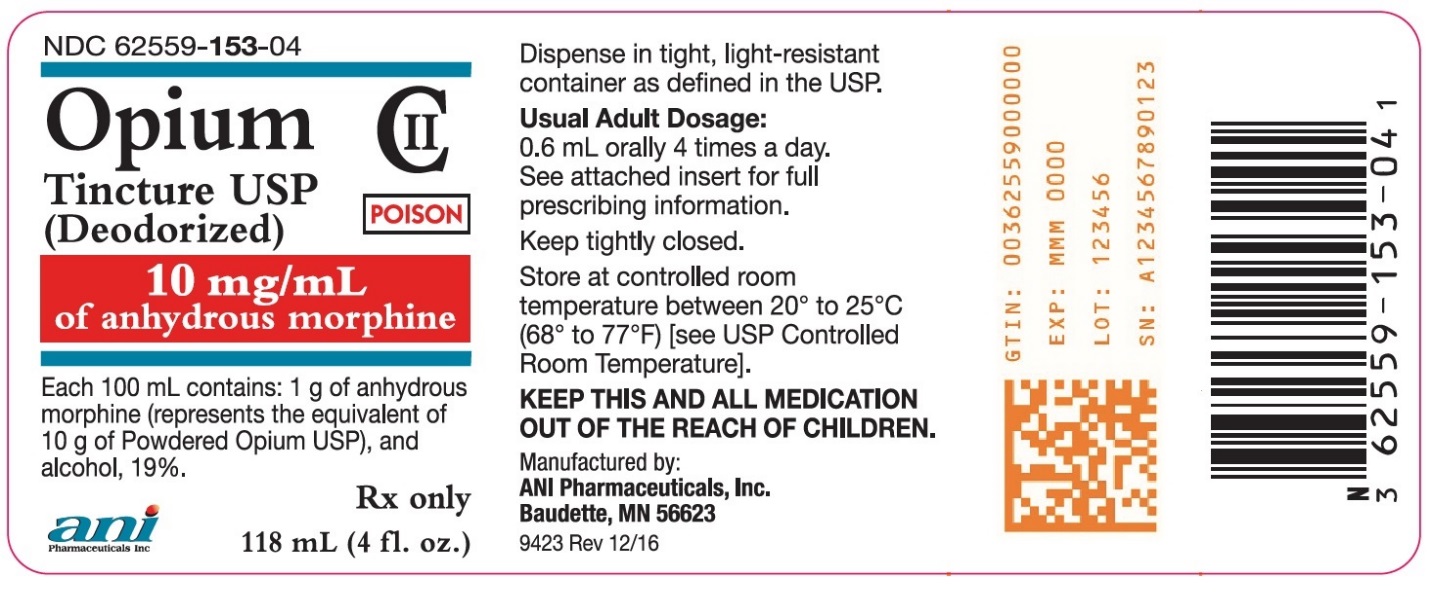
Opium Tincture Deodorized morphine 1 g/100mL Solution, 118 mL — NDC 62559-153-04 (Billing 62559-0153-04)
This is a package of 118 mL of Opium Tincture Deodorized morphine 1 g/100mL Solution from ANI Pharmaceuticals, Inc., marketed since Feb 2011 and currently FDA-listed; retail pharmacies pay about $2.86 per mL (NADAC). It is this product's only package size.
NDC database record
One package, one record: these facts belong to NDC 62559-153-04 alone.
- Record
- FDA NDC Directory package listing · Human prescription drug
- Code segments
- 62559 labeler · 153 product · 04 package
- Package marketed since
- Feb 25, 2011
- Sample package
- No — commercial package
- Listing certified through
- Dec 31, 2026
- Billing quantity
- 118 mL per package
- Barcode (UPC)
- 0362559153041
- Medicaid fills, this package
- 414 prescriptions in the last four reported quarters
- FDA record last changed
- Jul 24, 2026
Identity & classification
Regulatory identifiers FDA, NLM and CMS codes for this package
Drug-database identifiers Medi-Span GPI and First Databank GCN / HICL / AHFS classification
- GSN (GCN sequence number): 004261
- GCN: 16471
- GPI-14 (Medi-Span): 47100030201505
- HICL (First Databank): 038961
- AHFS class code: 28:08.08.00
- RxCUI (RxNorm): 830196
Where does this data come from?
- FDA openFDA NDC Directory · synced Oct 1, 2026
- FDA label on DailyMed · label index refreshed Oct 6, 2026
- RxNorm (NLM RxNav) · catalog refreshed Oct 1, 2026
- Medi-Span GPI (licensed)
- First Databank (licensed) · refreshed Oct 1, 2026
RxNorm drug class
This medicine belongs to the Antipropulsives class.
Where does this data come from?
- RxClass (NLM) · catalog refreshed Oct 1, 2026
Clinical
- Morphine treats severe pain when other treatments haven't worked or aren't suitable. Some forms are short-acting, and others are long-acting for around-the-clock pain. Your prescri...
- Follow your label exactly. Extended-release capsules and tablets must be swallowed whole, never crushed or chewed, because that can release a dangerous dose at once. For liquid, us...
- No. Alcohol can raise morphine levels and cause a fatal overdose. Avoid products containing alcohol, and check with me before taking other sedating medicines like sleep aids or anx...
- Constipation, nausea, drowsiness, and dizziness are most common. Call for help right away if you have slow or shallow breathing, extreme sleepiness, fainting, or an allergic reacti...
Patient education
Supplement & herbal interactions
Where does this data come from?
- MedlinePlus (NLM) · refreshed Oct 1, 2026
- FDA label on DailyMed · label index refreshed Oct 6, 2026
Ask a licensed pharmacist directly — free, answered by our team.
Pricing
A drug doesn't have one price. Each row is a different public payment system, and none is what you'd pay at the counter — that depends on your insurance. The ⓘ on each row explains what it measures.
| Price system | Per mL | Per package |
|---|---|---|
| Retail pharmacies payNADAC · weekly | $2.858 | $337.20 / 118 ml |
| Medicaid paysCMS SDUD · 12 mo | $3.21 | $379.32 / 118 ml |
| Medicare drug plans payPart D · quarterly | No Part D plan price is available for this NDC in our data. | |
Where does this data come from?
- CMS NADAC weekly file · file of Sep 30, 2026
- CMS ASP pricing files · refreshed Sep 20, 2026
- CMS Medicaid State Drug Utilization Data · through Q1 2026
- CMS Part D plan pricing files · refreshed Sep 24, 2026
- VA National Acquisition Center price file
Packaging — all sizes for this product
| Package NDC | Description | Marketing start | Marketing end | Status |
|---|---|---|---|---|
| 62559-0153-04 You're viewing this Main listing | 118 mL in 1 BOTTLE | 2011-02-25 | — | Active |
Therapeutic equivalents
| Product | Labeler | Pack | NADAC/unit | TE | Status | Price vs. this |
|---|---|---|---|---|---|---|
| Opium Tincture Deodorized 10 mg/mL 42799-0217-01 | Edenbridge | 118 ml | $2.858 | — | Availability likely | — |
| Opium Tincture Deodorized 1 g/100mLthis 62559-0153-04 | ANI | 118 ml | $2.858 | — | Availability likely | — |
| Opium Tincture Deodorized 10 g/1000mL 63629-1965-01 | Bryant | 118 ml | — | — | FDA listed | — |
| Opium 1 g/100mL 64950-0258-11 | Genus | 118 ml | — | — | FDA listed | — |
Where does this data come from?
- FDA openFDA NDC Directory · synced Oct 1, 2026
- FDA Orange Book · refreshed Oct 3, 2026
- CMS NADAC weekly file · file of Sep 30, 2026
Availability & generic status
We did not find an FDA-approved generic match for this exact strength, form and route.
Where does this data come from?
- FDA Orange Book · refreshed Oct 3, 2026
What it looks like
Where does this data come from?
- FDA label on DailyMed · label index refreshed Oct 6, 2026
Inactive Ingredients / Excipients
Inactive ingredients, also called excipients, are components of the drug product other than the active ingredient. They may include fillers, dyes, coatings, preservatives, flavors, or other formulation ingredients.
🧪 Avoiding an ingredient? See Morphine inactive ingredients by manufacturer: every current product's list side by side, so you can ask your pharmacy for the version that does not list it.
💡 Tap an ingredient (hover on desktop) to see what it is and why it’s used.
-
UNII 3K9958V90M
A liquid solvent derived from fermentation or chemical synthesis. In medicines, alcohol dissolves active ingredients, helps preserve the product, and improves how the body absorbs certain drugs.
-
UNII 059QF0KO0R
Water is a liquid solvent that dissolves and mixes ingredients together in liquid medicines, syrups, and injections. It helps distribute the active drug evenly throughout the product.
2 inactive ingredients listed in the exact product block matched to this NDC.
Where does this data come from?
ingredient classCode="IACT" elements from the exact product block matched by this NDC. Label-section narrative from DailyMed / the openFDA label index is shown separately when available.- FDA label on DailyMed · label index refreshed Oct 6, 2026
- FDA openFDA NDC Directory · synced Oct 1, 2026
Inactive ingredient FAQ
Are inactive ingredients the same for every manufacturer?
Why might an inactive ingredient be missing?
Can inactive ingredients matter?
Manufacturer & labeler
More NDCs from ANI Pharmaceuticals, Inc. labeler code 62559
- Cortenema Hydrocortisone 100 mg/60mL Enema NDC 62559-111-07
- Hydrocortisone 100 mg/60mL Enema NDC 62559-138-07
- Esterified Estrogens and Methyltestosterone 1.25 mg; 2.5 mg Tablet NDC 62559-149-01
- Esterified Estrogens and Methyltestosterone .625 mg; 1.25 mg Tablet NDC 62559-150-01
- Oxycodone Hydrochloride 5 mg/5mL Solution NDC 62559-151-16
- Polyethylene Glycol 3350 3350 17 g/17g Powder, For Solution NDC 62559-157-10
- fluvoxamine maleate 25 mg Tablet, Coated NDC 62559-158-01
- fluvoxamine maleate 50 mg Tablet, Coated NDC 62559-159-01
- fluvoxamine maleate 100 mg Tablet, Coated NDC 62559-160-01
- Reglan Metoclopramide Hydrochloride 5 mg Tablet NDC 62559-165-01
- Reglan Metoclopramide Hydrochloride 10 mg Tablet NDC 62559-166-01
Where does this data come from?
- FDA openFDA NDC Directory · synced Oct 1, 2026
- Drugs@FDA
Full prescribing information FDA SPL
🎯 Indications and Usage ▾
INDICATIONS AND USAGE Opium tincture is useful for the treatment of diarrhea.
⏱️ Dosage and Administration ▾
DOSAGE AND ADMINISTRATION Usual Adult Dose – 0.6 mL orally 4 times a day.
⛔ Contraindications ▾
CONTRAINDICATIONS This preparation is not recommended for use in children. It should not be used in diarrhea caused by poisoning until the toxic material is eliminated from the gastrointestinal tract.
⚠️ Warnings ▾
WARNINGS Addiction can result from opium usage. Opium preparations should be given in the smallest effective dose and as infrequently as possible to minimize the development of tolerance and physical dependence.
🤒 Adverse Reactions ▾
ADVERSE REACTIONS Constipation, nausea, and vomiting may occur in some patients. Pruritus and urticaria have been observed. To report SUSPECTED ADVERSE REACTIONS, contact ANI Pharmaceuticals, Inc. at 1-855-204-1431 or FDA at 1-800-FDA-1088 or www.fda.gov/medwatch.
🆘 Overdosage ▾
OVERDOSAGE Signs and Symptoms – Symptoms of toxicity are those of morphine and alcohol, such as nausea, vomiting, miosis, cool and clammy skin, respiratory and CNS depression, bradycardia, hypotension, and skeletal muscle flaccidity. Noncardiogenic pulmonary edema may develop after opioid overdose and monitoring of heart filling pressure may be helpful. Ethanol has been demonstrated to cause hypoglycemia in children or adults with limited glycogen stores.
In severe overdosage, apnea, circulatory collapse, cardiac arrest, and death may occur. Treatment – To obtain up-to-date information about the treatment of overdose, a good resource is your certified Regional Poison Control Center. Telephone numbers of certified poison control centers are listed in the Physicians’ Desk Reference (PDR).
In managing overdosage, consider the possibility of multiple drug overdoses, interaction among drugs, and unusual drug kinetics in your patient. Initial management of opioid overdose should emphasize establishment of a secure airway and support of ventilation and perfusion. Meticulously monitor and maintain, within acceptable limits, the patient’s vital signs, blood gases, serum electrolytes, blood glucose, etc.
Naloxone antagonizes most effects of opioids. Protect the airway as naloxone may induce vomiting. Since naloxone has a shorter duration of action than opioids, repeated doses may be needed.
In patients who abuse opioids chronically, a withdrawal syndrome may be manifest on administration of naloxone. This may include yawning, tearing, restlessness, sweating, dilated pupils, piloerection, vomiting, diarrhea, and abdominal cramps. This syndrome usually abates quickly as the effect of naloxone dissipates.
Absorption of drugs from the gastrointestinal tract may be decreased by giving activated charcoal, which, in many cases, is more effective than emesis or lavage; consider charcoal instead of or in addition to gastric emptying. Repeated doses of charcoal over time may hasten elimination of some drugs that have been absorbed. Since opium tincture can delay gastric emptying, evacuation of the stomach may be beneficial.
Safeguard the patient’s airway when employing gastric emptying or charcoal. Monitor for and treat hypoglycemia. The use of forced diuresis, peritoneal dialysis, hemodialysis or charcoal hemoperfusion has not been established to be beneficial.
🧬 Clinical Pharmacology ▾
CLINICAL PHARMACOLOGY The opiates act by enhancing tone in the long segments of longitudinal muscle and by inhibiting propulsive contraction of both circular and longitudinal muscles. Clinical evidence indicates that the analgesic activity of opium preparations is due to their morphine content. Relatively small doses that do not produce significant analgesia are effective in controlling diarrhea.
The papaverine content of the mixed alkaloids is too small to have demonstrable spasmolytic activity. Following oral administration, morphine is well absorbed from the gastrointestinal tract. It is rapidly metabolized following oral administration, however, and plasma levels of unconjugated morphine are lower than those achieved after parenteral administration.
Like other narcotic analgesics, opium preparations are metabolized in the liver. Morphine undergoes conjugation with glucuronic acid at the 3-hydroxyl group. Secondary conjugation may also occur at the 6-hydroxyl group to form the 3,6-diglucuronide.
Morphine is excreted in the urine mainly as morphine-3-glucuronide and smaller amounts of morphine-3,6-diglucuronide and unchanged drug. Approximately 75% of a dose of morphine is excreted in the urine within 48 hours.
📦 How Supplied / Storage and Handling ▾
HOW SUPPLIED Opium Tincture, USP (Deodorized), is supplied as: NDC 62559-153-04 Bottles of 4 fl oz Dispense in tightly closed containers. Store at controlled room temperature, 68° to 77°F (20° to 25°C) (see USP). Distributed by: ANI Pharmaceuticals, Inc. Baudette, MN 56623 9424 Rev 01/25 ani
📋 Description ▾
DESCRIPTION Opium Tincture, USP (Deodorized), is for oral administration. It is freed from unpleasant odor or nauseating substances by “denarcotization” with a petroleum distillate. Opium tincture is a clear, reddish-brown hydroalcoholic solution.
Each 100 mL contains 1 g of anhydrous morphine (represents the equivalent of 10 g of Powdered Opium, USP), alcohol, 19%, and water. Opium has a very characteristic odor and a very bitter taste. The opiates are the most effective and prompt-acting nonspecific antidiarrheal agents.
⚠️ Precautions ▾
PRECAUTIONS General – Opium should be used with caution in the elderly, in debilitated individuals, and in patients with increased intracranial pressure, cerebral arteriosclerosis, hepatic cirrhosis or liver insufficiency, gastrointestinal hemorrhage, myxedema, emphysema, and bronchial asthma. Drug Interactions – When preparations containing opium are administered in combination with other drugs, the cautions applicable to each ingredient should be borne in mind. Reduced dosage is indicated in poor-risk patients, in the very young or very old patient, and in those who are receiving other central-nervous system depressants.
Usage in Pregnancy – Animal reproduction studies have not been conducted with Opium Tincture, USP (Deodorized). It is also not known whether Opium Tincture, USP (Deodorized), can cause fetal harm when administered to a pregnant woman or can affect reproduction capacity. Opium Tincture, USP (Deodorized), should be given to a pregnant woman only if clearly needed.
Nursing Mothers – Caution should be exercised when Opium Tincture, USP (Deodorized), is administered to a nursing woman. Usage in Children – Safety and effectiveness in children have not been established. See CONTRAINDICATIONS .
🔒 Drug Abuse and Dependence ▾
DRUG ABUSE AND DEPENDENCE Controlled Substance – Opium Tincture, USP (Deodorized), is a Schedule II drug. See WARNINGS .
📄 Package Label / Principal Display Panel ▾
Package/Label Display Panel Opium Tincture USP (Deodorized), 10 mg/mL of anhydrous morphine, CII NDC 62559-153-04 Rx only 118 mL (4 fl. oz.) Label
Medicaid utilization & spend
Reported adverse events (FAERS)
Top reported reactions
Reporter sex
Serious outcomes
Where does this data come from?
About this NDC listing & data coverage
Listed without an FDA application
This product's marketing category indicates it is marketed without an approved FDA application (no NDA, ANDA, or BLA on file). Having an NDC does not by itself establish FDA approval — the NDC Directory is a listing system, not an approval decision. Approval-linked data such as Orange Book therapeutic-equivalence ratings therefore does not apply.
What data is (and isn’t) available for this NDC — tap to expand
| NDC identity (package / product / labeler codes) | ✓ Available |
| Labeler | ✓ Available |
| Product & package description | ✓ Available |
| Marketing category & status | ✓ Available |
| Active ingredient / dosage form / route | ✓ Available |
| FDA label (SPL via DailyMed) | ✓ Available |
| Package photos | ✓ Available |
| Inactive ingredients (structured) | ✓ Available |
| NADAC pharmacy acquisition price (CMS) | ✓ Available |
| Orange Book / therapeutic-equivalence data | — Not published for this NDC Applies only to products approved under an NDA/ANDA; many listings are out of scope. |
| HCPCS J-code billing crosswalk | — Not published for this NDC Most self-administered / retail products have no J-code — that is normal. |
| Medicaid utilization (CMS SDUD) | ✓ Available |