
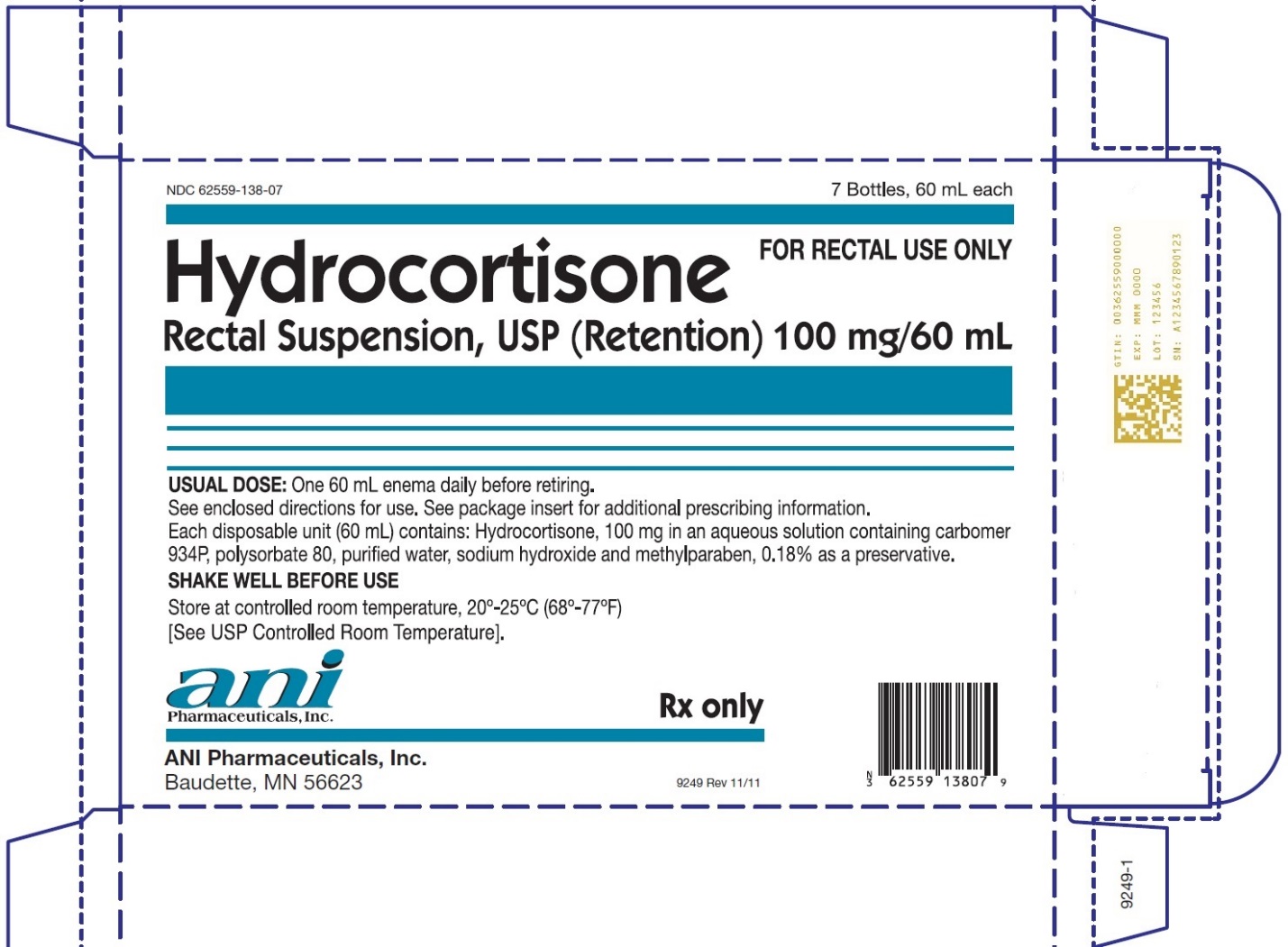
Hydrocortisone 100 mg/60mL Enema — NDC 62559-138-07 (Billing 62559-0138-07)
This is a package of Hydrocortisone 100 mg/60mL Enema from ANI Pharmaceuticals, Inc., marketed since Aug 2012 and currently FDA-listed; retail pharmacies pay about $0.1411 per mL (NADAC). It is this product's only package size.
Identity & classification
Regulatory identifiers FDA, NLM and CMS codes for this package
Drug-database identifiers Medi-Span GPI and First Databank GCN / HICL / AHFS classification
- GSN (GCN sequence number): 037045
- GCN: 66392
- GPI-14 (Medi-Span): 89150010005110
- HICL (First Databank): 002867
- AHFS class code: 84:06.08.00
- RxCUI (RxNorm): 310878
Where does this data come from?
- FDA openFDA NDC Directory · synced Oct 1, 2026
- FDA label on DailyMed · label index refreshed Oct 1, 2026
- RxNorm (NLM RxNav) · catalog refreshed Oct 1, 2026
- Medi-Span GPI (licensed)
- First Databank (licensed) · refreshed Oct 1, 2026
RxNorm drug class
This medicine belongs to the Corticosteroid class.
Where does this data come from?
- RxClass (NLM) · catalog refreshed Oct 1, 2026
Clinical
Rectal hydrocortisone is used along with other medications to treat proctitis (swelling in the rectum) and ulcerative colitis (a condition which causes swelling and sores in the lining of the large intestine and rectum). It is also used to relieve itching and swelling from hemorrhoids and other rectal problems. Hydrocortisone is in a class of medications called corticosteroids. It works by activating natural substances in the skin to reduce swelling, redness, and itching.
Read the full MedlinePlus article ↗- It is used as add-on treatment for ulcerative colitis, especially when it affects the lower or left side of the colon. It is meant to be used along with other supportive measures y...
- It's usually used once at night. Lie on your left side while you use it and for about 30 minutes after. Try to hold it in at least an hour, ideally all night. Your doctor may sugge...
- How do I use it, and how long do I keep it in?
- A usual course is about 21 days, or until you're in remission. Many people feel better within 3 to 5 days. If you use it longer, your doctor will taper you off to every other night...
Patient education
Supplement & herbal interactions
Some supplements/herbs that may interact with Hydrocortisone — tap one for details:
Hydrocortisone may be associated with lower levels of 8 nutrients — worth a chat with your pharmacist, not a cause for alarm.
Where does this data come from?
- MedlinePlus (NLM) · refreshed Oct 1, 2026
- FDA label on DailyMed · label index refreshed Oct 1, 2026
Ask a licensed pharmacist directly — free, answered by our team.
Pricing
A drug doesn't have one price. Each row is a different public payment system, and none is what you'd pay at the counter — that depends on your insurance. The ⓘ on each row explains what it measures.
| Price system | Per mL | Per package |
|---|---|---|
| Retail pharmacies payNADAC · weekly | $0.141 | $59.26 / 420 ml |
| Medicaid paysCMS SDUD · 12 mo | $0.1536 | $64.51 / 420 ml |
| Medicare drug plans payPart D · Q2 2026 | $0.2141 | $89.92 / 420 ml |
Where does this data come from?
- CMS NADAC weekly file · file of Sep 30, 2026
- CMS ASP pricing files · refreshed Sep 20, 2026
- CMS Medicaid State Drug Utilization Data · through Q1 2026
- CMS Part D plan pricing files · refreshed Sep 24, 2026
- VA National Acquisition Center price file
Packaging — all sizes for this product
| Package NDC | Description | Marketing start | Marketing end | Status |
|---|---|---|---|---|
| 62559-0138-07 You're viewing this Main listing | 7 BOTTLE in 1 BOX / 60 mL in 1 BOTTLE | 2012-08-16 | — | Active |
Therapeutic equivalents
| Product | Labeler | Pack | NADAC/unit | TE | Status | Price vs. this |
|---|---|---|---|---|---|---|
| Hydrocortisone Rectal Suspension (Retention) 100 mg/60mL 62135-0020-07 | Chartwell | 7 bottles | $0.141 | AB | Availability likely | — |
| Hydrocortisone 100 mg/60mLthis 62559-0138-07 | ANI | 7 bottles | $0.141 | AB | Availability likely | — |
| Hydrocortisone 100 mg/60mL 23155-0926-51 | Heritage | 1 bottle | — | AB | FDA listed | — |
| Cortenema 100 mg/60mL 62559-0111-07 | ANI | 7 bottles | — | AB | FDA listed | — |
Where does this data come from?
- FDA openFDA NDC Directory · synced Oct 1, 2026
- FDA Orange Book · refreshed Sep 3, 2026
- CMS NADAC weekly file · file of Sep 30, 2026
Availability & generic status
FDA-approved generic versions are listed, and recent pricing/market data suggests they may be available — see Therapeutic equivalents.
Where does this data come from?
- FDA Orange Book · refreshed Sep 3, 2026
Inactive Ingredients / Excipients
Inactive ingredients, also called excipients, are components of the drug product other than the active ingredient. They may include fillers, dyes, coatings, preservatives, flavors, or other formulation ingredients.
💡 Tap an ingredient (hover on desktop) to see what it is and why it’s used.
-
UNII K6MOM3T5YL
A synthetic polymer made from acrylic acid, crosslinked for stability. Used as a thickener and gelling agent to give medicines like creams and gels their texture, and as a binder to hold tablet ingredients together.
-
UNII A2I8C7HI9T
Methylparaben is a preservative derived from benzoic acid that prevents growth of bacteria, fungi, and mold in medicines. It extends the product's shelf life and maintains safety during storage.
-
UNII 6OZP39ZG8H
Polysorbate 80 is a synthetic emulsifier derived from sorbitol and oleic acid. It helps mix oil and water-based ingredients together in medications and improves how the product disperses in the body.
-
UNII 55X04QC32I
A strong alkaline chemical used to adjust and maintain the pH balance of liquid medicines. It helps keep the medicine stable and ensures it stays effective during storage.
-
UNII 059QF0KO0R
Water is a liquid solvent that dissolves and mixes ingredients together in liquid medicines, syrups, and injections. It helps distribute the active drug evenly throughout the product.
5 inactive ingredients listed in the exact product block matched to this NDC.
Where does this data come from?
ingredient classCode="IACT" elements from the exact product block matched by this NDC. Label-section narrative from DailyMed / the openFDA label index is shown separately when available.- FDA label on DailyMed · label index refreshed Oct 1, 2026
- FDA openFDA NDC Directory · synced Oct 1, 2026
Inactive ingredient FAQ
Are inactive ingredients the same for every manufacturer?
Why might an inactive ingredient be missing?
Can inactive ingredients matter?
Manufacturer & labeler
Where does this data come from?
- FDA openFDA NDC Directory · synced Oct 1, 2026
- Drugs@FDA
Full prescribing information FDA SPL
🎯 Indications and Usage ▾
INDICATIONS AND USAGE Hydrocortisone Rectal Suspension, USP is indicated as adjunctive therapy in the treatment of ulcerative colitis, especially distal forms, including ulcerative proctitis, ulcerative proctosigmoiditis, and left-sided ulcerative colitis. It has proved useful also in some cases involving the transverse and ascending colons.
⏱️ Dosage and Administration ▾
DOSAGE AND ADMINISTRATION The use of Hydrocortisone Rectal Suspension, USP hydrocortisone retention enema is predicated upon the concomitant use of modern supportive measures such as rational dietary control, sedatives, antidiarrheal agents, antibacterial therapy, blood replacement if necessary, etc. The usual course of therapy is one Hydrocortisone Rectal Suspension, USP nightly for 21 days, or until the patient comes into remission both clinically and proctologically. Clinical symptoms usually subside promptly within 3 to 5 days.
Improvement in the appearance of the mucosa, as seen by sigmoidoscopic examination, may lag somewhat behind clinical improvement. Difficult cases may require as long as 2 or 3 months of Hydrocortisone Rectal Suspension, USP treatment. Where the course of therapy extends beyond 21 days, Hydrocortisone Rectal Suspension, USP should be discontinued gradually by reducing administration to every other night for 2 or 3 weeks.
If clinical or proctologic improvement fails to occur within 2 or 3 weeks after starting Hydrocortisone Rectal Suspension, USP, discontinue its use. Symptomatic improvement, evidenced by decreased diarrhea and bleeding; weight gain; improved appetite; lessened fever; and decrease in leukocytosis, may be misleading and should not be used as the sole criterion in judging efficacy. Sigmoidoscopic examination and X-ray visualization are essential for adequate monitoring of ulcerative colitis.
Biopsy is useful for differential diagnosis. Patient instructions for administering Hydrocortisone Rectal Suspension, USP are enclosed in each box. It is recommended that the patient lie on their left side during administration and for 30 minutes thereafter, so that the fluid will distribute throughout the left colon.
Every effort should be made to retain the enema for at least an hour and preferably, all night. This may be facilitated by prior sedation and/or antidiarrheal medication, especially early in therapy when the urge to evacuate is great.
⛔ Contraindications ▾
CONTRAINDICATIONS Systemic fungal infections; and ileocolostomy during the immediate or early post-operative period.
⚠️ Warnings ▾
WARNINGS In severe ulcerative colitis, it is hazardous to delay needed surgery while awaiting response to medical treatment. Damage to the rectal wall can result from careless or improper insertion of an enema tip. In patients on corticosteroid therapy subjected to unusual stress, increased dosage of rapidly acting corticosteroids before, during, and after the stressful situation is indicated.
Corticosteroids may mask some signs of infection, and new infections may appear during their use. There may be decreased resistance and inability to localize infection when corticosteroids are used. Prolonged use of corticosteroids may produce posterior subcapsular cataracts, glaucoma with possible damage to the optic nerves, and may enhance the establishment of secondary ocular infections due to fungi or viruses.
Usage in Pregnancy: Since adequate human reproduction studies have not been done with corticosteroids, the use of these drugs in pregnancy, nursing mothers or women of child-bearing potential requires that the possible benefits of the drug be weighed against the potential hazards to the mother and embryo or fetus. Neonates born of mothers who have received substantial doses of corticosteroid during pregnancy should be carefully observed for signs of hypoadrenalism. Average and large doses of hydrocortisone or cortisone can cause elevation of blood pressure, salt and water retention, and increased excretion of potassium.
These effects are less likely to occur with the synthetic derivatives except when used in large doses. Dietary salt restriction and potassium supplementation may be necessary. All corticosteroids increase calcium excretion.
While on corticosteroid therapy patients should not be vaccinated against smallpox. Other immunization procedures should not be undertaken in patients who are on corticosteroids, especially on high dose, because of possible hazards of neurological complications and a lack of antibody response. Persons who are on drugs which suppress the immune system are more susceptible to infections than healthy individuals.
Chicken pox and measles, for example, can have a more serious or even fatal course in non-immune pediatric patients or adults on corticosteroids. In such pediatric patients or adults who have not had these diseases, particular care should be taken to avoid exposure. How the dose, route and duration of corticosteroid administration affects the risk of developing a disseminated infection is not known.
The contribution of the underlying disease and/or prior corticosteroid treatment to the risk is also not known. If exposed to chicken pox, prophylaxis with varicella zoster immune globulin (VZIG) may be indicated. If exposed to measles, prophylaxis with pooled intramuscular immunoglobulin (IG) may be indicated.
(See the respective package inserts for complete VZIG and IG prescribing information.) If chicken pox develops, treatment with antiviral agents may be considered. If corticosteroids are indicated in patients with latent tuberculosis or tuberculin reactivity, close observation is necessary as reactivation of the disease may occur. During prolonged corticosteroid therapy, these patients should receive chemoprophylaxis.
🤒 Adverse Reactions ▾
ADVERSE REACTIONS Local pain or burning and rectal bleeding attributed to Hydrocortisone Rectal Suspension, USP have been reported rarely. Apparent exacerbations or sensitivity reactions also occur rarely. The following adverse reactions should be kept in mind whenever corticosteroids are given by rectal administration.
Fluid and Electrolyte Disturbances: Sodium retention; fluid retention; congestive heart failure in susceptible patients; potassium loss; hypokalemic alkalosis; hypertension. Musculoskeletal: Muscle weakness; steroid myopathy; loss of muscle mass; osteoporosis; vertebral compression fractures; asceptic necrosis of femoral and humeral heads; pathologic fracture of long bones. Gastrointestinal: Peptic ulcer with possible perforation and hemorrhage; pancreatitis; abdominal distention; ulcerative esophagitis.
Dermatologic: Impaired wound healing; thin fragile skin; petechiae and ecchymoses; facial erythema; increased sweating; may suppress reactions to skin tests. Neurological: Convulsions; increased intracranial pressure with papilledema (pseudo-tumor cerebri) usually after treatment; vertigo; headache. Endocrine : Menstrual irregularities; development of Cushingoid state; suppression of growth in pediatric patients; secondary adrenocortical and pituitary unresponsiveness, particularly in times of stress, as in trauma, surgery or illness, decreased carbohydrate tolerance; manifestations of latent diabetes requirements for insulin or oral hypoglycemic agents in diabetics.
Ophthalmic: Posterior subcapsular cataracts; increased intraocular pressure; glaucoma; exophthalmos. Metabolic: Negative nitrogen balance due to protein catabolism. To report SUSPECTED ADVERSE REACTIONS, contact ANI Pharmaceuticals, Inc. at 1-855-204-1431 or FDA at 1-800-FDA-1088 or www.fda.gov/medwatch.
🧒 Pediatric Use ▾
Pediatric Use: Safety and effectiveness in pediatric patients have not been established. Growth and development of pediatric patients on prolonged corticosteroid therapy should be carefully observed.
🧬 Clinical Pharmacology ▾
CLINICAL PHARMACOLOGY Hydrocortisone is a naturally occurring glucocorticoid (adrenal corticosteroid) similar to its acetate and sodium hemisuccinate derivatives, is partially absorbed following rectal administration. Absorption studies in ulcerative colitis patients have shown up to 50% absorption of hydrocortisone administered as Hydrocortisone Rectal Suspension, USP and up to 30% of hydrocortisone acetate administered in an identical vehicle. Hydrocortisone Rectal Suspension, USP provides the potent anti-inflammatory effect of hydrocortisone.
Because this drug is absorbed from the colon, it acts both topically and systemically. Although rectal hydrocortisone, used as recommended for Hydrocortisone Rectal Suspension, USP, has a low incidence of reported adverse reactions, prolonged use presumably may cause systemic reactions associated with oral dosage forms.
📦 How Supplied / Storage and Handling ▾
HOW SUPPLIED Hydrocortisone Rectal Suspension, USP (Retention)100 mg is supplied as disposable single-dose bottles with lubricated rectal applicator tips, in boxes of seven x 60 mL (NDC 62559-138-07) and boxes of one x 60 mL (NDC 62559-138-11). Store at controlled room temperature 20° - 25°C (68° - 77°F). [See USP Controlled Room Temperature.]
📋 Description ▾
DESCRIPTION Hydrocortisone is a white to practically white, odorless, crystalline powder, very slightly soluble in water. It has the chemical name Pregn-4-ene-3,20-dione,11,17,21-trihydroxy-,(11β)- and the following structural formula: Hydrocortisone Rectal Suspension, USP is a convenient disposable single-dose hydrocortisone enema designed for ease of self-administration. Each disposable unit (60 mL) contains: Hydrocortisone, 100 mg in an aqueous solution containing carbomer 934P, polysorbate 80, purified water, sodium hydroxide and methylparaben, 0.18% as a preservative.
Chemical Structure
💬 Information for Patients ▾
Information for Patients: Persons who are on immunosuppressant doses of corticosteroids should be warned to avoid exposure to chicken pox or measles. Patients should also be advised that if they are exposed, medical advice should be sought without delay.
💬 Medication Guide ▾
PATIENT INSTRUCTIONS How to use the retention enema: Best results are achieved if the bowel is emptied immediately before the enema is given. 1. Preparing the Medication for Administration a Shake the bottle well to make sure that the suspension is homogeneous. b Remove the protective sheath from the applicator tip.
Hold the bottle at the neck so as not to cause any of the medication to be discharged. 2. Assuming the Correct Body Position a Best results are obtained by lying on left side with the left leg extended and the right leg flexed forward for balance. b An alternative to lying on the left side is the “knee-chest” position as shown here.
3. Administering the Retention Enema a Gently insert the lubricated applicator tip into the rectum, pointed slightly toward the navel (umbilicus). b Grasp the bottle firmly, then tilt slightly so that the nozzle is aimed toward the back, and squeeze slowly to instill the medication. Steady hand pressure will discharge most of the solution.
After administering, withdraw and discard the used unit. c Remain in position for at least 30 minutes to allow thorough distribution of the medication internally. Retain the enema all night, if possible. Manufactured by ANI Pharmaceuticals, Inc.
Baudette, MN 56623 9247 Rev 11/25 Step 1b Image Step 2a Image Step 2b Image Step 3b Image
⚠️ Precautions ▾
PRECAUTIONS General: Hydrocortisone Rectal Suspension, USP should be used with caution where there is a probability of impending perforation, abscess or other pyogenic infection; fresh intestinal anastomoses; obstruction; or extensive fistulas and sinus tracts. Use with caution in presence of active or latent peptic ulcer; diverticulitis; renal insufficiency; hypertension; osteoporosis; and myasthenia gravis. Steroid therapy might impair prognosis in surgery by increasing the hazard of infection.
If infection is suspected, appropriate antibiotic therapy must be administered, usually in larger than ordinary doses. Drug-induced secondary adrenocortical insufficiency may occur with prolonged Hydrocortisone Rectal Suspension, USP therapy. This is minimized by gradual reduction of dosage.
This type of relative insufficiency may persist for months after discontinuation of therapy; therefore, in any situation of stress occurring during that period, hormone therapy should be reinstituted. Since mineralocorticoid secretion may be impaired, salt and/or a mineralocorticoid should be administered concurrently. There is an enhanced effect of corticosteroids on patients with hypothyroidism and in those with cirrhosis.
Corticosteroid should be used cautiously in patients with ocular herpes simplex because of possible corneal perforation. The lowest possible dose of corticosteroid should be used to control the conditions under treatment, and when reduction in dosage is possible, the reduction should be gradual. Psychic derangement may appear when corticosteroids are used, ranging from euphoria, insomnia, mood swings, personality changes, and severe depression, to frank psychotic manifestations.
Also, existing emotional instability or psychotic tendencies may be aggravated by corticosteroids. Aspirin should be used cautiously in conjunction with corticosteroids in hypoprothrombinemia. Pediatric Use: Safety and effectiveness in pediatric patients have not been established.
Growth and development of pediatric patients on prolonged corticosteroid therapy should be carefully observed. Information for Patients: Persons who are on immunosuppressant doses of corticosteroids should be warned to avoid exposure to chicken pox or measles. Patients should also be advised that if they are exposed, medical advice should be sought without delay.
📄 Package Label / Principal Display Panel ▾
Package/Label Principal Display Panel Hydrocortisone Rectal Suspension, USP (Retention)100 mg/60 mL NDC 62559-138-07 7 Bottles, 60 mL each Rx only Carton Label Carton Label Carton