
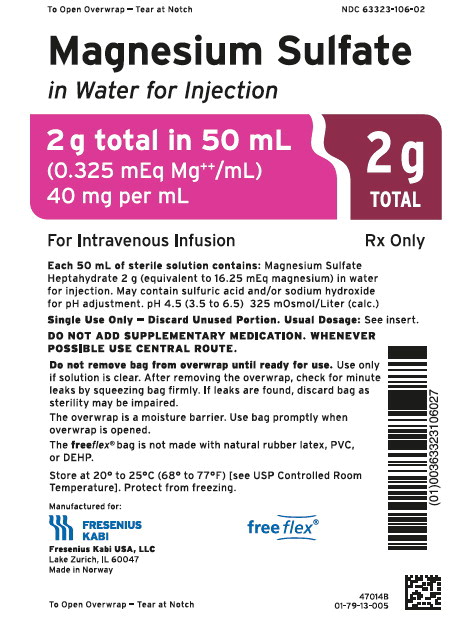
magnesium sulfate 40 mg/mL Injection, Solution — NDC 63323-106-01 (Billing 63323-0106-01)
This is a package of magnesium sulfate 40 mg/mL Injection, Solution from Fresenius Kabi USA, LLC, marketed since Mar 2016 and currently FDA-listed.
Identity & classification
Regulatory identifiers FDA, NLM and CMS codes for this package
Drug-database identifiers Medi-Span GPI and First Databank GCN / HICL / AHFS classification
- GSN (GCN sequence number): 063347
- GCN: 99097
- GPI-14 (Medi-Span): 79400010402045
- HICL (First Databank): 039652
- AHFS class code: 24:04.04.92
- RxCUI (RxNorm): 829734
Where does this data come from?
- FDA openFDA NDC Directory · synced Oct 1, 2026
- FDA label on DailyMed · label index refreshed Oct 1, 2026
- RxNorm (NLM RxNav) · catalog refreshed Oct 1, 2026
- Medi-Span GPI (licensed)
- First Databank (licensed) · refreshed Oct 1, 2026
RxNorm drug class
This medicine belongs to the Osmotically acting laxatives class.
Where does this data come from?
- RxClass (NLM) · catalog refreshed Oct 1, 2026
Clinical
- It depends on the product. Injections treat low magnesium and prevent and control seizures in preeclampsia and eclampsia. Oral products such as Epsom Salts relieve occasional const...
- Dissolve the dose in a full glass (8 ounces) of water and drink it, with extra liquid as directed. A bowel movement usually comes in ½ to 6 hours. Follow the age-based package dire...
- Flushing, sweating, low blood pressure, drowsiness and weaker reflexes are the most common. Your care team watches for these and checks your magnesium levels.
- What side effects should I expect with the injection?
Patient education
Supplement & herbal interactions
Where does this data come from?
- MedlinePlus (NLM) · refreshed Oct 1, 2026
- FDA label on DailyMed · label index refreshed Oct 1, 2026
Ask a licensed pharmacist directly — free, answered by our team.
Pricing
A drug doesn't have one price. Each row is a different public payment system, and none is what you'd pay at the counter — that depends on your insurance. The ⓘ on each row explains what it measures.
| Price system | Per mL | Per package |
|---|---|---|
| Retail pharmacies payNADAC · weekly | Not in the retail survey — common for institutional, discontinued, or low-volume packs. | |
| Medicaid paysCMS SDUD · 12 mo | $1.20 | $2,884.32 / 2400 ml |
| Medicare drug plans payPart D · quarterly | No Part D plan price is available for this NDC in our data. | |
| Medicare Part B allowsASP · J3475 | $0.446 / J3475 unit | — |
Where does this data come from?
- CMS NADAC weekly file
- CMS ASP pricing files · refreshed Sep 20, 2026
- CMS Medicaid State Drug Utilization Data · through Q1 2026
- CMS Part D plan pricing files · refreshed Sep 24, 2026
- VA National Acquisition Center price file
Billing & reimbursement
Where does this data come from?
- CMS ASP NDC-HCPCS crosswalk · refreshed Sep 22, 2026
- DMEPDAC NDC-HCPCS crosswalk
- openFDA NSDE billing units · refreshed Sep 7, 2026
Packaging — all sizes for this product
| Package NDC | Description | Marketing start | Marketing end | Status |
|---|---|---|---|---|
| 63323-0106-01 You're viewing this | 24 BAG in 1 CASE / 100 mL in 1 BAG | 2016-03-15 | — | Active |
| 63323-0106-05 63323-106-05 Main listing | 24 BAG in 1 CASE / 50 mL in 1 BAG | 2016-03-15 | — | Active |
| 63323-0106-10 63323-106-10 | 24 BAG in 1 CASE / 1000 mL in 1 BAG | 2016-03-15 | — | Active |
| 63323-0106-15 63323-106-15 | 24 BAG in 1 CASE / 500 mL in 1 BAG | 2016-03-15 | — | Active |
| 63323-0106-26 63323-106-26 | 24 BAG in 1 CASE / 50 mL in 1 BAG | 2016-03-15 | — | Active |
This pack accounts for about 6.9% of this product's recent Medicaid fills; most go to a different pack size. See all packs ↓
Pack size FAQ
What quantity is in this package?
What NDC number is used to bill for this package of magnesium sulfate 40 mg/mL Injection, Solution?
Therapeutic equivalents
| Product | Labeler | Pack | NADAC/unit | TE | Status | Price vs. this |
|---|---|---|---|---|---|---|
| Magnesium Sulfate 40 mg/mL 25021-0612-81 | Sagent | 50 ml | — | AP | FDA listed | — |
| magnesium sulfate 40 mg/mLthis 63323-0106-01 | Fresenius | 100 ml | — | AP | FDA listed | — |
| Magnesium Sulfate 40 mg/mL 47335-0992-01 | Sun | 1 pouch | — | AP | FDA listed | — |
Where does this data come from?
- FDA openFDA NDC Directory · synced Oct 1, 2026
- FDA Orange Book · refreshed Sep 3, 2026
- CMS NADAC weekly file
Availability & generic status
This product is an FDA-approved generic. Other versions of the same drug are listed under Therapeutic equivalents, least expensive first.
Where does this data come from?
- FDA Orange Book · refreshed Sep 3, 2026
Inactive Ingredients / Excipients
Inactive ingredients, also called excipients, are components of the drug product other than the active ingredient. They may include fillers, dyes, coatings, preservatives, flavors, or other formulation ingredients.
💡 Tap an ingredient (hover on desktop) to see what it is and why it’s used.
-
UNII 55X04QC32I
A strong alkaline chemical used to adjust and maintain the pH balance of liquid medicines. It helps keep the medicine stable and ensures it stays effective during storage.
-
UNII O40UQP6WCF
A strong acid used in small amounts to adjust and maintain the pH balance of a medicine, helping ensure stability and proper dissolution of the active ingredients.
2 inactive ingredients listed in the exact product block matched to this NDC.
Where does this data come from?
ingredient classCode="IACT" elements from the exact product block matched by this NDC. Label-section narrative from DailyMed / the openFDA label index is shown separately when available.- FDA label on DailyMed · label index refreshed Oct 1, 2026
- FDA openFDA NDC Directory · synced Oct 1, 2026
Inactive ingredient FAQ
Are inactive ingredients the same for every manufacturer?
Why might an inactive ingredient be missing?
Can inactive ingredients matter?
Manufacturer & labeler
Where does this data come from?
- FDA openFDA NDC Directory · synced Oct 1, 2026
- Drugs@FDA
Full prescribing information FDA SPL
🎯 Indications and Usage ▾
INDICATIONS AND USAGE Magnesium sulfate in water for injection is indicated for the prevention and control of seizures in pre-eclampsia and eclampsia, respectively. When used judiciously it effectively prevents and controls the convulsions of eclampsia without producing deleterious depression of the central nervous system of the mother or infant. However, other effective drugs are available for this purpose.
⏱️ Dosage and Administration ▾
DOSAGE AND ADMINISTRATION Magnesium sulfate in water for injection is intended for intravenous use only. For the management of pre-eclampsia or eclampsia, intravenous infusions of dilute solutions of magnesium (1% to 8%) are often given in combination with intramuscular injections of 50% magnesium sulfate injection, USP. Therefore, in the clinical conditions cited below, both forms of therapy are noted, as appropriate.
Continuous maternal administration of magnesium sulfate in pregnancy beyond 5 to 7 days can cause fetal abnormalities. In Pre-eclampsia or Eclampsia In severe pre-eclampsia or eclampsia, the total initial dose is 10 to 14 g of magnesium sulfate. To initiate therapy, 4 g of magnesium sulfate in water for injection may be administered intravenously.
The rate of IV infusion should generally not exceed 150 mg/minute, or 3.75 mL of a 4% concentration (or its equivalent) per minute, except in severe eclampsia with seizures. Simultaneously, 4 to 5 g (32.5 to 40.6 mEq) of magnesium sulfate may be administered intramuscularly into each buttock using undiluted 50% magnesium sulfate injection, USP. After the initial IV dose, some clinicians administer 1 to 2 g/hour by constant IV infusion.
Subsequent intramuscular doses of 4 to 5 g of magnesium sulfate may be injected into alternate buttocks every four hours, depending on the continuing presence of the patellar reflex, adequate respiratory function, and absence of signs of magnesium toxicity. Therapy should continue until paroxysms cease. A serum magnesium level of 6 mg/100 mL is considered optimal for control of seizures.
A total daily (24 hr) dose of 30 to 40 g magnesium sulfate should not be exceeded. In the presence of severe renal insufficiency, frequent serum magnesium concentrations must be obtained and the maximum dosage of magnesium sulfate is 20 g per 48 hours. Parenteral drug products should be inspected visually for particulate matter and discoloration prior to administration, whenever solution and container permit.
Do not administer unless solution is clear. Discard unused portion.
In Pre-eclampsia or Eclampsia In severe pre-eclampsia or eclampsia, the total initial dose is 10 to 14 g of magnesium sulfate. To initiate therapy, 4 g of magnesium sulfate in water for injection may be administered intravenously. The rate of IV infusion should generally not exceed 150 mg/minute, or 3.75 mL of a 4% concentration (or its equivalent) per minute, except in severe eclampsia with seizures.
Simultaneously, 4 to 5 g (32.5 to 40.6 mEq) of magnesium sulfate may be administered intramuscularly into each buttock using undiluted 50% magnesium sulfate injection, USP. After the initial IV dose, some clinicians administer 1 to 2 g/hour by constant IV infusion. Subsequent intramuscular doses of 4 to 5 g of magnesium sulfate may be injected into alternate buttocks every four hours, depending on the continuing presence of the patellar reflex, adequate respiratory function, and absence of signs of magnesium toxicity.
Therapy should continue until paroxysms cease. A serum magnesium level of 6 mg/100 mL is considered optimal for control of seizures. A total daily (24 hr) dose of 30 to 40 g magnesium sulfate should not be exceeded.
In the presence of severe renal insufficiency, frequent serum magnesium concentrations must be obtained and the maximum dosage of magnesium sulfate is 20 g per 48 hours. Parenteral drug products should be inspected visually for particulate matter and discoloration prior to administration, whenever solution and container permit. Do not administer unless solution is clear.
Discard unused portion.
⛔ Contraindications ▾
CONTRAINDICATIONS Intravenous magnesium should not be given to mothers with toxemia of pregnancy during the two hours preceding delivery.
⚠️ Warnings ▾
WARNINGS FETAL HARM: Continuous administration of magnesium sulfate beyond 5 to 7 days to pregnant women can lead to hypocalcemia and bone abnormalities in the developing fetus. These bone abnormalities include skeletal demineralization and osteopenia. In addition, cases of neonatal fracture have been reported.
The shortest duration of treatment that can lead to fetal harm is not known. Magnesium sulfate should be used during pregnancy only if clearly needed. If magnesium sulfate is given for treatment of preterm labor, the woman should be informed that the efficacy and safety of such use have not been established and that use of magnesium sulfate beyond 5 to 7 days may cause fetal abnormalities.
Parenteral use in the presence of renal insufficiency may lead to magnesium intoxication.
🤒 Adverse Reactions ▾
ADVERSE REACTIONS The adverse effects of parenterally administered magnesium usually are the result of magnesium intoxication. These include flushing, sweating, hypotension, depressed reflexes, flaccid paralysis, hypothermia, circulatory collapse, cardiac and central nervous system depression proceeding to respiratory paralysis. Hypocalcemia with signs of tetany secondary to magnesium sulfate therapy for eclampsia has been reported.
🆘 Overdosage ▾
OVERDOSAGE Magnesium intoxication is manifested by a sharp drop in blood pressure and respiratory paralysis. Disappearance of the patellar reflex is a useful clinical sign to detect the onset of magnesium intoxication. In the event of overdosage, artificial ventilation must be provided until a calcium salt can be injected IV to antagonize the effects of magnesium.
For Treatment of Overdose Artificial respiration is often required. Intravenous calcium, 10 to 20 mL of a 5% solution (diluted if desirable) with isotonic sodium chloride for injection) is used to counteract effects of hypermagnesemia. Subcutaneous physostigmine, 0.5 to 1 mg may be helpful.
Hypermagnesemia in the newborn may require resuscitation and assisted ventilation via endotracheal intubation or intermittent positive pressure ventilation as well as IV calcium.
For Treatment of Overdose Artificial respiration is often required. Intravenous calcium, 10 to 20 mL of a 5% solution (diluted if desirable) with isotonic sodium chloride for injection) is used to counteract effects of hypermagnesemia. Subcutaneous physostigmine, 0.5 to 1 mg may be helpful.
Hypermagnesemia in the newborn may require resuscitation and assisted ventilation via endotracheal intubation or intermittent positive pressure ventilation as well as IV calcium.
🧬 Clinical Pharmacology ▾
CLINICAL PHARMACOLOGY Magnesium (Mg ++ ) is an important cofactor for enzymatic reactions and plays an important role in neurochemical transmission and muscular excitability. Magnesium prevents or controls convulsions by blocking neuromuscular transmission and decreasing the amount of acetylcholine liberated at the end plate by the motor nerve impulse. Magnesium is said to have a depressant effect on the central nervous system, but it does not adversely affect the mother, fetus or neonate when used as directed in eclampsia or pre-eclampsia.
Normal serum magnesium levels range from 1.3 to 2.1 mEq/liter. As serum magnesium rises above 4 mEq/liter, the deep tendon reflexes are first decreased and then disappear as the serum level approaches 10 mEq/liter. At this level respiratory paralysis may occur.
Heart block also may occur at this or lower serum levels of magnesium. Magnesium acts peripherally to produce vasodilation. With low doses only flushing and sweating occur, but larger doses cause lowering of blood pressure.
The central and peripheral effects of magnesium poisoning are antagonized to some extent by intravenous administration of calcium. With intravenous administration the onset of anticonvulsant action is immediate and lasts about 30 minutes. Following intramuscular administration the onset of action occurs in about one hour and persists for three to four hours.
Effective anticonvulsant serum levels range from 2.5 to 7.5 mEq/liter. Pharmacokinetics Absorption Intravenously administered magnesium is immediately absorbed. Distribution Approximately 1 to 2% of total body magnesium is located in the extracellular fluid space.
Magnesium is 30% bound to albumin. Metabolism Magnesium is not metabolized. Excretion Magnesium is excreted solely by the kidney at a rate proportional to the serum concentration and glomerular filtration.
Special Populations Renal Insufficiency Magnesium is excreted solely by the kidney. In patients with severe renal insufficiency, the dose should be lower and frequent serum magnesium levels must be obtained (see DOSAGE AND ADMINISTRATION ). Hepatic Insufficiency Magnesium is excreted solely by the kidney.
No dosing adjustments are necessary in hepatic insufficiency. Drug-Drug Interactions Drug induced renal losses of magnesium occur with the following drugs or drug classes: Aminoglycosides Amphotericin B Cyclosporine Diuretics Digitalis Cisplatin Alcohol
Pharmacokinetics Absorption Intravenously administered magnesium is immediately absorbed. Distribution Approximately 1 to 2% of total body magnesium is located in the extracellular fluid space. Magnesium is 30% bound to albumin. Metabolism Magnesium is not metabolized. Excretion Magnesium is excreted solely by the kidney at a rate proportional to the serum concentration and glomerular filtration.
Special Populations Renal Insufficiency Magnesium is excreted solely by the kidney. In patients with severe renal insufficiency, the dose should be lower and frequent serum magnesium levels must be obtained (see DOSAGE AND ADMINISTRATION ). Hepatic Insufficiency Magnesium is excreted solely by the kidney.
No dosing adjustments are necessary in hepatic insufficiency. Drug-Drug Interactions Drug induced renal losses of magnesium occur with the following drugs or drug classes: Aminoglycosides Amphotericin B Cyclosporine Diuretics Digitalis Cisplatin Alcohol
📦 How Supplied / Storage and Handling ▾
HOW SUPPLIED Magnesium Sulfate in Water for Injection is supplied in single-dose flexible containers as follows: Product Code Unit of Sale Total Magnesium Sulfate* Total Magnesium Ion Magnesium Sulfate* Concentration Magnesium Ion Concentration Osmolarity (calc.) Unit of Use 610605 NDC 63323-106-05 Unit of 24 2 g 16.25 mEq 4% (40 mg/mL) 16.25 mEq/50 mL 325 m0smol/Liter NDC 63323-106-02 50 mL fill in a 100 mL free flex Bag 610601 NDC 63323-106-01 Unit of 24 4g 32.5 mEq 4% (40 mg/mL) 32.5 mEq/100 mL 325 m0smol/Liter NDC 63323-106-00 100 mL fill in a 100 mL free flex Bag 610615 NDC 63323-106-15 Unit of 24 20 g 162.3 mEq 4% (40 mg/mL) 32.5 mEq/100 mL 325 m0smol/Liter NDC for unit of use not present on Labeling 500 mL fill in a 500 mL free flex Bag 610610 NDC 63323-106-10 Unit of 24 40 g 325 mEq 4% (40 mg/mL) 32.5 mEq/100 mL 325 m0smol/Liter NDC for unit of use not present on Labeling 1,000 mL fill in a 1,000 mL free flex Bag 610705 NDC 63323-107-05 Unit of 24 4 g 32.5 mEq 8% (80 mg/mL) 32.5 mEq/50 mL 649 m0smol/Liter NDC 63323-107-01 50 mL fill in a 100 mL free flex Bag *As the heptahydrate.
WARNING: DO NOT USE FLEXIBLE CONTAINER IN SERIES CONNECTIONS. This container is not made with natural rubber latex or polyvinyl chloride (PVC), Non-DEHP. Store at 20° to 25°C (68° to 77°F) [see USP Controlled Room Temperature].
Protect from freezing.
📋 Description ▾
DESCRIPTION Magnesium Sulfate in Water for Injection is a sterile, nonpyrogenic solution of magnesium sulfate heptahydrate in water for injection. May contain sulfuric acid and/or sodium hydroxide for pH adjustment. The pH is 4.5 (3.5 to 6.5).
It is available in 4% and 8% concentrations. See HOW SUPPLIED section for the content and characteristics of available dosage forms and sizes. Magnesium sulfate, USP heptahydrate is chemically designated MgSO 4 • 7H 2 O, colorless crystals or white powder freely soluble in water.
Water for injection, USP is chemically designated H 2 O. The flexible container is fabricated from a specially formulated non-plasticized, film containing polypropylene and thermoplastic elastomers ( free flex ® bag). The amount of water that can permeate from the container into the overwrap is insufficient to affect the solution significantly.
Solutions in contact with the flexible container can leach out certain of the container’s chemical components in very small amounts within the expiration period. The suitability of the container material has been confirmed by tests in animals according to USP biological tests for plastic containers. Exposure to temperatures above 25ºC/77ºF during transport and storage will lead to minor losses in moisture content.
Higher temperatures lead to greater losses. It is unlikely that these minor losses will lead to clinically significant changes within the expiration period.
⚠️ Precautions ▾
PRECAUTIONS Because magnesium is removed from the body solely by the kidneys, the drug should be used with caution in patients with renal impairment. Urine output should be maintained at a level of 100 mL every four hours. Monitoring serum magnesium levels and the patient’s clinical status is essential to avoid the consequences of overdosage in toxemia.
Clinical indications of a safe dosage regimen include the presence of the patellar reflex (knee jerk) and absence of respiratory depression (approximately 16 breaths or more/minute). Serum magnesium levels usually sufficient to control convulsions range from 3 to 6 mg/100 mL (2.5 to 5 mEq/liter). The strength of the deep tendon reflexes begins to diminish when serum magnesium levels exceed 4 mEq/liter.
Reflexes may be absent at 10 mEq magnesium/liter, where respiratory paralysis is a potential hazard. An injectable calcium salt should be immediately available to counteract the potential hazards of magnesium intoxication in eclampsia. Magnesium sulfate in water for injection should be administered slowly to avoid producing hypermagnesemia.
Carcinogenesis, Mutagenesis, Impairment of Fertility Studies with magnesium sulfate in water for injection have not been performed to evaluate carcinogenic potential, mutagenic potential or effects on fertility. Pregnancy Teratogenic Effects Pregnancy Category D ( see WARNINGS and PRECAUTIONS ) . See WARNINGS and PRECAUTIONS .
Magnesium sulfate in water for injection, can cause fetal abnormalities when administered beyond 5 to 7 days to pregnant women. There are retrospective epidemiological studies and case reports documenting fetal abnormalities such as hypocalcemia, skeletal demineralization’s, osteopenia and other skeletal abnormalities with continuous maternal administration of magnesium sulfate for more than 5 to 7 days. 1-12 Magnesium sulfate in water for injection should be used during pregnancy only if clearly needed.
If this drug is used during pregnancy the woman should be apprised of the potential harm to the fetus. Nonteratogenic Effects When administered by continuous IV infusion (especially for more than 24 hours preceding delivery) to control convulsions in a toxemic woman, the newborn may show signs of magnesium toxicity, including neuromuscular or respiratory depression (see OVERDOSAGE ). Labor and Delivery Continuous administration of magnesium sulfate is an unapproved treatment for preterm labor.
The safety and efficacy of such use have not been established. The administration of magnesium sulfate in water for injection outside of its approved indication in pregnant women should be by trained obstetrical personnel in a hospital setting with appropriate obstetrical care facilities. Nursing Mothers It is not known whether this drug is excreted in human milk.
Because many drugs are excreted in human milk, caution should be exercised when magnesium sulfate in water for injection is administered to a nursing mother.
Carcinogenesis, Mutagenesis, Impairment of Fertility Studies with magnesium sulfate in water for injection have not been performed to evaluate carcinogenic potential, mutagenic potential or effects on fertility.
Pregnancy Teratogenic Effects Pregnancy Category D ( see WARNINGS and PRECAUTIONS ) . See WARNINGS and PRECAUTIONS . Magnesium sulfate in water for injection, can cause fetal abnormalities when administered beyond 5 to 7 days to pregnant women.
There are retrospective epidemiological studies and case reports documenting fetal abnormalities such as hypocalcemia, skeletal demineralization’s, osteopenia and other skeletal abnormalities with continuous maternal administration of magnesium sulfate for more than 5 to 7 days. 1-12 Magnesium sulfate in water for injection should be used during pregnancy only if clearly needed. If this drug is used during pregnancy the woman should be apprised of the potential harm to the fetus.
Nonteratogenic Effects When administered by continuous IV infusion (especially for more… [Excerpted — this section continues on DailyMed.]
📚 References ▾
REFERENCES Yokoyama K, Takahashi N, Yada Y. Prolonged maternal magnesium administration and bone metabolism in neonates. Early Human Dev .
2010; 86(3):187-91. Epub 2010 Mar 12. Wedig KE, Kogan J, Schorry EK et al.
Skeletal demineralization and fractures caused by fetal magnesium toxicity. J Perinatol . 2006; 26(6):371-4.
Nassar AH, Sakhel K, Maarouf H, et al. Adverse maternal and neonatal outcome of prolonged course of magnesium sulfate tocolysis. Acta Obstet Gynecol Scan .
2006; 85(9):1099-103. Malaeb SN, Rassi A, Haddad MC. Bone mineralization in newborns whose mothers received magnesium sulphate for tocolysis of premature labor.
Pediatr Radiol . 2004; 34(5):384-6. Epub 2004 Feb 18.
Matsuda Y, Maeda Y, Ito M, et al. Effect of magnesium sulfate treatment on neonatal bone abnormalities. Gynecol Obstet Invest .
1997; 44(2):82-8. Schanler RJ, Smith LG, Burns PA. Effects of long-term maternal intravenous magnesium sulfate therapy on neonatal calcium metabolism and bone mineral content.
Gynecol Obstet Invest. 1997; 43(4):236-41. Santi MD, Henry GW, Douglas GL.
Magnesium sulfate treatment of preterm labor as a cause of abnormal neonatal bone mineralization. J Pediatr Orthop . 1994; 14(2):249-53.
Holocomb WL, Shackelford GD, Petrie RH. Magnesium tocolysis and neonatal bone abnormalities: a controlled study. Obstet Gynecol .
1991; 78(4):611-4. Cumming WA, Thomas VJ. Hypermagnesemia: a cause of abnormal metaphyses in the neonate.
Am J Roentgenol . 1989; 152(5):1071-2. Lamm CL, Norton KL, Murphy RJ.
Congenital rickets associated with magnesium sulfate infusion for tocolysis. J Pediatr . 1988; 113(6):1078-82.
McGuinness GA, Weinstein MM, Cruikshank DP, et al. Effects of magnesium sulfate treatment on perinatal calcium metabolism. II.
Neonatal responses. Obstet Gynecol . 1980; 56(5):595-600.
Riaz M, Porat R, Brodsky NL, et al. The effect of maternal magnesium sulfate treatment on newborns: a prospective controlled study. J Perinatol.
1998; 18(6 pt 1):449-54.
📄 Package Label / Principal Display Panel ▾
PACKAGE LABEL - PRINCIPAL DISPLAY - Magnesium Sulfate 50 mL Foil Overwrap PACKAGE LABEL - PRINCIPAL DISPLAY - Magnesium Sulfate 50 mL Bag Label NDC 63323-106-02 Magnesium Sulfate in Water for Injection 2 g total in 50 mL (0.325 mEq Mg ++ /mL) 40 mg per mL 2 g TOTAL For Intravenous Infusion Rx Only PACKAGE LABEL - PRINCIPAL DISPLAY - Magnesium Sulfate 50 mL Bag Case Label Product No. 610605 Magnesium Sulfate in Water for Injection 2 g total in 50 mL (40 mg per mL) NDC 63323-106-05 Rx only PACKAGE LABEL - PRINCIPAL DISPLAY - Magnesium Sulfate 50 mL Bag Foil Overwrap PACKAGE LABEL - PRINCIPAL DISPLAY - Magnesium Sulfate 50 mL Bag Label NDC 63323-107-01 Magnesium Sulfate in Water for Injection 4 g total in 50 mL (0.65 mEq Mg ++/mL) 80 mg per mL 4 g TOTAL For Intravenous Infusion Rx Only PACKAGE LABEL - PRINCIPAL DISPLAY - Magnesium Sulfate 50 mL Bag Case Label Product No.
610705 Magnesium Sulfate in Water for Injection 4 g total in 50 mL (80 mg per mL) NDC 63323-107-05 Rx only PACKAGE LABEL - PRINCIPAL DISPLAY - Magnesium Sulfate 100 mL Bag Foil Overwrap PACKAGE LABEL - PRINCIPAL DISPLAY - Magnesium Sulfate 100 mL Bag Label NDC 63323-106-00 Magnesium Sulfate in Water for Injection 4 g total in 100 mL (0.325 mEq Mg ++ /mL) 40 mg per mL 4 g TOTAL For Intravenous Infusion Rx Only PACKAGE LABEL - PRINCIPAL DISPLAY - Magnesium Sulfate 50 mL Bag Case Label Product No. 610601 Magnesium Sulfate in Water for Injection 4 g total in 100 mL (40 mg per mL) For Intravenous Infusion NDC 63323-106-01 Rx only foil foil bag case foil foil bag case foil foil bag case
Medicaid utilization & spend
Medicaid utilization by pack size
Medicare Part D spend CMS · PART D · 2026 (Q1)
Reported adverse events (FAERS)
Top reported reactions
Age at onset
Reporter sex
Serious outcomes
Where does this data come from?
About this NDC listing & data coverage
What data is (and isn’t) available for this NDC — tap to expand
| NDC identity (package / product / labeler codes) | ✓ Available |
| Labeler | ✓ Available |
| Product & package description | ✓ Available |
| Marketing category & status | ✓ Available |
| Active ingredient / dosage form / route | ✓ Available |
| FDA label (SPL via DailyMed) | ✓ Available |
| Package photos | ✓ Available |
| Inactive ingredients (structured) | ✓ Available |
| NADAC pharmacy acquisition price (CMS) | — Not published for this NDC CMS publishes NADAC only for NDCs reported in its retail-pharmacy survey. |
| Orange Book / therapeutic-equivalence data | ✓ Available |
| HCPCS J-code billing crosswalk | ✓ Available |
| Medicaid utilization (CMS SDUD) | ✓ Available |