
Hydralazine Hydrochloride 20 mg/mL Injection, 25 vials — NDC 63323-614-01 (Billing 63323-0614-01)
This is a package of 25 vials of Hydralazine Hydrochloride 20 mg/mL Injection from Fresenius Kabi USA, LLC, marketed since Sep 2001 and currently FDA-listed. It is the main listing for this product, which comes in 4 package sizes.
NDC database record
One package, one record: these facts belong to NDC 63323-614-01 alone.
- Record
- FDA NDC Directory package listing · Human prescription drug
- Code segments
- 63323 labeler · 614 product · 01 package
- Package marketed since
- Sep 5, 2001
- Sample package
- No — commercial package
- Listing certified through
- Dec 31, 2026
- Barcode (UPC)
- 0363323614034
- Medicaid fills, this package
- 14,981 prescriptions in the last four reported quarters
- FDA record last changed
- Oct 1, 2026
Identity & classification
Regulatory identifiers FDA, NLM and CMS codes for this package
Drug-database identifiers Medi-Span GPI and First Databank GCN / HICL / AHFS classification
- GSN (GCN sequence number): 000283
- GCN: 01225
- GPI-14 (Medi-Span): 36400010102005
- HICL (First Databank): 000089
- AHFS class code: 24:08.16.00
- RxCUI (RxNorm): 966571
Where does this data come from?
- FDA openFDA NDC Directory · synced Oct 1, 2026
- FDA label on DailyMed · label index refreshed Oct 3, 2026
- RxNorm (NLM RxNav) · catalog refreshed Oct 1, 2026
- Medi-Span GPI (licensed)
- First Databank (licensed) · refreshed Oct 1, 2026
RxNorm drug class
This medicine belongs to the Arteriolar Vasodilator class.
Where does this data come from?
- RxClass (NLM) · catalog refreshed Oct 1, 2026
Clinical
- Hydralazine is a blood pressure–lowering medication. It works by relaxing the walls of your arteries so blood can flow through more easily, which brings your blood pressure down. K...
- What exactly is hydralazine supposed to do for me?
- Your prescription label and your doctor's instructions are the best guide for your specific regimen. Tablets are generally taken several times a day, and your doctor will have star...
- How do I take my hydralazine tablets — do they need to be taken with food?
Patient education
Supplement & herbal interactions
Hydralazine may be associated with lower levels of 2 nutrients — worth a chat with your pharmacist, not a cause for alarm.
Where does this data come from?
- MedlinePlus (NLM) · refreshed Oct 1, 2026
- FDA label on DailyMed · label index refreshed Oct 3, 2026
Ask a licensed pharmacist directly — free, answered by our team.
Pricing
A drug doesn't have one price. Each row is a different public payment system, and none is what you'd pay at the counter — that depends on your insurance. The ⓘ on each row explains what it measures.
| Price system | Per each | Per package |
|---|---|---|
| Retail pharmacies payNADAC · weekly | Not in the retail survey — common for institutional, discontinued, or low-volume packs. | |
| Medicaid paysCMS SDUD · 12 mo | $44.03 | $1,100.68 / 25 vials |
| Medicare drug plans payPart D · quarterly | No Part D plan price is available for this NDC in our data. | |
| Medicare Part B allowsASP · J0360 | $3.395 / J0360 unit | — |
Where does this data come from?
- CMS NADAC weekly file
- CMS ASP pricing files · refreshed Sep 20, 2026
- CMS Medicaid State Drug Utilization Data · through Q1 2026
- CMS Part D plan pricing files · refreshed Sep 24, 2026
- VA National Acquisition Center price file
Billing & reimbursement
Where does this data come from?
- CMS ASP NDC-HCPCS crosswalk · refreshed Sep 22, 2026
- DMEPDAC NDC-HCPCS crosswalk
- openFDA NSDE billing units · refreshed Sep 7, 2026
Packaging — all sizes for this product
| Package NDC | Description | Marketing start | Marketing end | Status |
|---|---|---|---|---|
| 63323-0614-55 63323-614-55 | 25 VIAL, SINGLE-DOSE in 1 TRAY / 1 mL in 1 VIAL, SINGLE-DOSE | 2011-01-31 | — | Active |
| 63323-0614-16 63323-614-16 | 25 VIAL, SINGLE-USE in 1 TRAY / 1 mL in 1 VIAL, SINGLE-USE | 2001-09-05 | — | Active |
| 63323-0614-01 You're viewing this Main listing | 25 VIAL, SINGLE-DOSE in 1 CARTON / 1 mL in 1 VIAL, SINGLE-DOSE | 2001-09-05 | — | Active |
| 63323-0614-06 63323-614-06 | 25 VIAL, SINGLE-DOSE in 1 CARTON / 1 mL in 1 VIAL, SINGLE-DOSE | 2001-09-05 | — | Active |
In Medicaid, this is the most-dispensed pack of this product — about 79% of fills over the last four reported quarters. See all packs ↓
Pack size FAQ
What quantity is in this package?
How does this package differ from NDC 63323-0614-55?
What NDC number is used to bill for this package of Hydralazine Hydrochloride 20 mg/mL Injection?
Therapeutic equivalents
| Product | Labeler | Pack | NADAC/unit | TE | Status | Price vs. this |
|---|---|---|---|---|---|---|
| Hydralazine Hydrochloride 20 mg/mL 00404-9787-01 | Henry | 1 vial | — | AP | FDA listed | — |
| Hydralazine Hydrochloride 20 mg/mL 00517-0901-25 | American | 25 vials | — | AP | FDA listed | — |
| HydrALAZINE hydrochloride 20 mg/mL 00641-6231-25 | Hikma | 25 vials | — | AP | FDA listed | — |
| Hydralazine Hydrochloride 20 mg/mL 43066-0041-25 | Baxter | 25 vials | — | AP | FDA listed | — |
| Hydralazine Hydrochloride 20 mg/mL 51662-1376-01 | HF | 1 ml | — | AP | FDA listed | — |
| Hydralazine Hydrochloride 20 mg/mL 51662-1388-01 | HF | 1 ml | — | AP | FDA listed | — |
| Hydralazine Hydrochloride 20 mg/mL 51662-1648-03 | HF | 25 pouches | — | AP | FDA listed | — |
| Hydralazine Hydrochloride 20 mg/mL 55150-0400-25 | Eugia | 25 vials | — | AP | FDA listed | — |
| Hydralazine Hydrochloride 20 mg/mL 55154-9554-05 | Cardinal | 5 vials | — | AP | FDA listed | — |
| Hydralazine Hydrochloride 20 mg/mL 55154-9587-05 | Cardinal | 5 vials | — | AP | FDA listed | — |
| Hydralazine Hydrochloride 20 mg/mLthis 63323-0614-01 | Fresenius | 25 vials | — | AP | FDA listed | — |
| Hydralazine Hydrochloride 20 mg/mL 68475-0514-02 | Navinta | 25 vials | — | AP | FDA listed | — |
| hydrALAZINE Hydrochloride 20 mg/mL 70518-3659-01 | REMEDYREPACK | 25 vials | — | AP | FDA listed | — |
| Hydralazine Hydrochloride 20 mg/mL 70710-1988-07 | Zydus | 25 vials | — | AP | FDA listed | — |
| Hydralazine Hydrochloride 20 mg/mL 71288-0205-02 | Meitheal | 25 vials | — | AP | FDA listed | — |
| Hydralazine Hydrochloride 20 mg/mL 71872-7145-01 | Medical | 1 vial | — | AP | FDA listed | — |
| Hydralazine Hydrochloride 20 mg/mL 71872-7268-01 | Medical | 1 vial | — | AP | FDA listed | — |
| HydrALAZINE hydrochloride 20 mg/mL 71872-7274-01 | Medical | 1 vial | — | AP | FDA listed | — |
| Hydralazine Hydrochloride 20 mg/mL 71872-7339-01 | Medical | 1 vial | — | AP | FDA listed | — |
| Hydralazine Hydrochloride 20 mg/mL 72572-0265-25 | Civica, | 25 vials | — | AP | FDA listed | — |
| hydrALAZINE Hydrochloride 20 mg/mL 84549-0614-55 | ProPharma | 1 ml | — | AP | FDA listed | — |
Where does this data come from?
- FDA openFDA NDC Directory · synced Oct 1, 2026
- FDA Orange Book · refreshed Oct 3, 2026
- CMS NADAC weekly file
Availability & generic status
This product is an FDA-approved generic. Other versions of the same drug are listed under Therapeutic equivalents, least expensive first.
Where does this data come from?
- FDA Orange Book · refreshed Oct 3, 2026
Inactive Ingredients / Excipients
Inactive ingredients, also called excipients, are components of the drug product other than the active ingredient. They may include fillers, dyes, coatings, preservatives, flavors, or other formulation ingredients.
💡 Tap an ingredient (hover on desktop) to see what it is and why it’s used.
-
UNII QTT17582CB
A strong acid used to adjust and maintain the proper pH level in liquid medicines, ensuring stability and preventing breakdown of active ingredients.
-
0.65 mg / 1 mL
UNII A2I8C7HI9T
Methylparaben is a preservative derived from benzoic acid that prevents growth of bacteria, fungi, and mold in medicines. It extends the product's shelf life and maintains safety during storage.
-
103.6 mg / 1 mL
UNII 6DC9Q167V3
Propylene glycol is a clear liquid derived from petroleum or vegetable sources. It acts as a solvent, humectant, and preservative in medicines, helping dissolve active ingredients and maintain product stability.
-
0.35 mg / 1 mL
UNII Z8IX2SC1OH
Propylparaben is a chemical preservative used to prevent bacterial and fungal growth in medicines and personal care products. It helps extend shelf life and maintain product safety during storage.
-
UNII 55X04QC32I
A strong alkaline chemical used to adjust and maintain the pH balance of liquid medicines. It helps keep the medicine stable and ensures it stays effective during storage.
5 inactive ingredients listed in the exact product block matched to this NDC.
Where does this data come from?
ingredient classCode="IACT" elements from the exact product block matched by this NDC. Label-section narrative from DailyMed / the openFDA label index is shown separately when available.- FDA label on DailyMed · label index refreshed Oct 3, 2026
- FDA openFDA NDC Directory · synced Oct 1, 2026
Inactive ingredient FAQ
Are inactive ingredients the same for every manufacturer?
Why might an inactive ingredient be missing?
Can inactive ingredients matter?
Manufacturer & labeler
More NDCs from Fresenius Kabi USA, LLC labeler code 63323
- Deferoxamine 95 mg/mL Injection, Powder, Lyophilized, For Solution NDC 63323-597-10
- Deferoxamine 95 mg/mL Injection, Powder, Lyophilized, For Solution NDC 63323-599-30
- Propranolol 1 mg/mL Injection, Solution NDC 63323-604-01
- Enoxaparin Sodium 100 mg/mL Injection NDC 63323-605-84
- Enoxaparin Sodium 60 mg/.6mL Injection NDC 63323-607-88
- Enoxaparin Sodium 120 mg/.8mL Injection NDC 63323-609-90
- Amiodarone Hydrochloride 50 mg/mL Injection, Solution NDC 63323-616-03
- Milrinone Lactate 1 mg/mL Injection, Solution NDC 63323-617-10
- Pemetrexed 750 mg/30mL Injection, Powder, Lyophilized, For Solution NDC 63323-621-00
- Pemetrexed 1 g/40mL Injection, Powder, Lyophilized, For Solution NDC 63323-622-00
- Sodium chloride 9 mg/mL Injection, Solution NDC 63323-623-53
- Dextrose 50 mg/mL Injection, Solution NDC 63323-624-10
Where does this data come from?
- FDA openFDA NDC Directory · synced Oct 1, 2026
- Drugs@FDA
Full prescribing information FDA SPL
🎯 Indications and Usage ▾
INDICATIONS AND USAGE: Severe essential hypertension when the drug cannot be given orally or when there is an urgent need to lower blood pressure.
⏱️ Dosage and Administration ▾
DOSAGE AND ADMINISTRATION: When there is urgent need, therapy in the hospitalized patient may be initiated intramuscularly or as a rapid intravenous bolus injection directly into the vein. Hydralazine Hydrochloride Injection should be used only when the drug cannot be given orally. The usual dose is 20-40 mg, repeated as necessary.
Certain patients (especially those with marked renal damage) may require a lower dose. Blood pressure should be checked frequently. It may begin to fall within a few minutes after injection, with the average maximal decrease occurring in 10-80 minutes.
In cases where there has been increased intracranial pressure, lowering the blood pressure may increase cerebral ischemia. Most patients can be transferred to oral hydralazine hydrochloride within 24-48 hours. The product should be used immediately after the vial is opened.
The product should not be added to infusion solutions. Hydralazine Hydrochloride Injection may discolor upon contact with metal; discolored solutions should be discarded. Parenteral drug products should be inspected visually for particulate matter and discoloration prior to administration, whenever solution and container permit.
⛔ Contraindications ▾
CONTRAINDICATIONS: Hypersensitivity to hydralazine, coronary artery disease, mitral valvular rheumatic heart disease.
⚠️ Warnings ▾
WARNINGS: In a few patients, hydralazine may produce a clinical picture simulating systemic lupus erythematosus including glomerulonephritis. In such patients, hydralazine should be discontinued unless the benefit-to-risk determination requires continued antihypertensive therapy with this drug. Symptoms and signs usually regress when the drug is discontinued but residua have been detected many years later.
Long-term treatment with steroids may be necessary (see PRECAUTIONS, Laboratory Tests ).
🤒 Adverse Reactions ▾
ADVERSE REACTIONS To report SUSPECTED ADVERSE REACTIONS, contact Fresenius Kabi USA, LLC at 1-800-551-7176 or FDA at 1-800-FDA-1088 or www.fda.gov/medwatch. Adverse reactions with hydralazine hydrochloride are usually reversible when dosage is reduced. However, in some cases it may be necessary to discontinue the drug.
The following adverse reactions have been observed, but there has not been enough systematic collection of data to support an estimate of their frequency. Common: Headache, anorexia, nausea, vomiting, diarrhea, palpitations, tachycardia, angina pectoris. Less Frequent: Digestive -constipation, paralytic ileus.
Cardiovascular -hypotension, paradoxical pressor response, edema. Respiratory -dyspnea. Neurologic -peripheral neuritis, evidenced by paresthesia, numbness, and tingling; dizziness; tremors; muscle cramps, psychotic reactions characterized by depression, disorientation, or anxiety.
Genitourinary -difficulty in urination. Hematologic -blood dyscrasias, consisting of reduction in hemoglobin and red cell count, leukopenia, agranulocytosis, purpura; lymphadenopathy; splenomegaly. Hypersensitive Reactions -rash, urticaria, pruritus, fever, chills, arthralgia, eosinophilia, and, rarely, hepatitis.
Other -nasal congestion, flushing, lacrimation, conjunctivitis.
🔄 Drug Interactions ▾
Drug Interactions MAO inhibitors should be used with caution in patients receiving hydralazine. When other potent parenteral antihypertensive drugs, such as diazoxide, are used in combination with hydralazine, patients should be continuously observed for several hours for any excessive fall in blood pressure. Profound hypotensive episodes may occur when diazoxide injection and hydralazine hydrochloride injection are used concomitantly.
🤰 Pregnancy ▾
Pregnancy Teratogenic Effects Pregnancy Category C Animal studies indicate that hydralazine is teratogenic in mice at 20-30 times the maximum daily human dose of 200-300 mg and possibly in rabbits at 10-15 times the maximum daily human dose, but that it is nonteratogenic in rats. Teratogenic effects observed were cleft palate and malformations of facial and cranial bones. There are no adequate and well-controlled studies in pregnant women.
Although clinical experience does not include any positive evidence of adverse effects on the human fetus, hydralazine should be used during pregnancy only if the expected benefit justifies the potential risk to the fetus.
🧒 Pediatric Use ▾
Pediatric Use Safety and effectiveness in pediatric patients have not been established in controlled clinical trials, although there is experience with the use of hydralazine hydrochloride in pediatric patients. The usual recommended parenteral dosage, administered intramuscularly or intravenously, is 1.7-3.5 mg/kg of body weight daily, divided into four to six doses.
🆘 Overdosage ▾
OVERDOSAGE: Acute Toxicity No deaths due to acute poisoning have been reported. Highest known dose survived: adults, 10 g orally. Oral LD 50 in rats: 173 and 187 mg/kg.
Signs and Symptoms Signs and symptoms of overdosage include hypotension, tachycardia, headache, and generalized skin flushing. Complications can include myocardial ischemia and subsequent myocardial infarction, cardiac arrhythmia, and profound shock. Treatment There is no specific antidote.
Support of the cardiovascular system is of primary importance. Shock should be treated with plasma expanders. If possible, vasopressors should not be given, but if a vasopressor is required, care should be taken not to precipitate or aggravate cardiac arrhythmia.
Tachycardia responds to beta blockers. Digitalization may be necessary, and renal function should be monitored and supported as required. No experience has been reported with extracorporeal or peritoneal dialysis.
Acute Toxicity No deaths due to acute poisoning have been reported. Highest known dose survived: adults, 10 g orally. Oral LD 50 in rats: 173 and 187 mg/kg.
Signs and Symptoms Signs and symptoms of overdosage include hypotension, tachycardia, headache, and generalized skin flushing. Complications can include myocardial ischemia and subsequent myocardial infarction, cardiac arrhythmia, and profound shock.
Treatment There is no specific antidote. Support of the cardiovascular system is of primary importance. Shock should be treated with plasma expanders.
If possible, vasopressors should not be given, but if a vasopressor is required, care should be taken not to precipitate or aggravate cardiac arrhythmia. Tachycardia responds to beta blockers. Digitalization may be necessary, and renal function should be monitored and supported as required.
No experience has been reported with extracorporeal or peritoneal dialysis.
🧬 Clinical Pharmacology ▾
CLINICAL PHARMACOLOGY: Although the precise mechanism of action of hydralazine is not fully understood, the major effects are on the cardiovascular system. Hydralazine apparently lowers blood pressure by exerting a peripheral vasodilating effect through a direct relaxation of vascular smooth muscle. Hydralazine, by altering cellular calcium metabolism, interferes with the calcium movements within the vascular smooth muscle that are responsible for initiating or maintaining the contractile state.
The peripheral vasodilating effect of hydralazine results in decreased arterial blood pressure (diastolic more than systolic); decreased peripheral vascular resistance; and an increased heart rate, stroke volume and cardiac output. The preferential dilatation of arterioles, as compared to veins, minimizes postural hypotension and promotes the increase in cardiac output. Hydralazine usually increases renin activity in plasma presumably as a result of increased secretion of renin by the renal juxtaglomerular cells in response to reflex sympathetic discharge.
This increase in renin activity leads to the production of angiotensin II, which then causes stimulation of aldosterone and consequent sodium reabsorption. Hydralazine also maintains or increases renal and cerebral blood flow. The average maximal decrease in blood pressure usually occurs 10-80 minutes after administration of hydralazine hydrochloride injection.
No other pharmacokinetic data on hydralazine hydrochloride injection are available.
📦 How Supplied / Storage and Handling ▾
HOW SUPPLIED: Product Code Unit of Sale Strength Each NP601401 NDC 63323-614-55 Unit of 25 20 mg per mL NDC 63323-614-21 1 mL Single Dose Vial Store at 20° to 25°C (68° to 77°F) [see USP Controlled Room Temperature]. The container closure is not made with natural rubber latex. Novaplus is a registered trademark of Vizient, Inc.
📋 Description ▾
DESCRIPTION: Hydralazine Hydrochloride Injection, USP is an antihypertensive available in a 2 mL vial for intravenous and intramuscular administration. Each mL of the sterile, nonpyrogenic colorless solution contains hydralazine hydrochloride USP, 20 mg; methylparaben NF, 0.65 mg; propylparaben NF, 0.35 mg; propylene glycol USP, 103.6 mg, and Water for Injection, USP q.s. The pH of the solution is 3.4 to 4.4. pH may be adjusted with hydrochloric acid and/or sodium hydroxide.
Hydralazine hydrochloride is 1-hydrazinophthalazine monohydrochloride, and its structural formula is: Hydralazine hydrochloride USP is a white to off-white, odorless crystalline powder. It is soluble in water, slightly soluble in alcohol, and very slightly soluble in ether. It melts at about 275°C, with decomposition. structure
⚠️ Precautions ▾
PRECAUTIONS: General Myocardial stimulation produced by hydralazine can cause anginal attacks and ECG changes of myocardial ischemia. The drug has been implicated in the production of myocardial infarction. It must, therefore, be used with caution in patients with suspected coronary artery disease.
The “hyperdynamic” circulation caused by hydralazine may accentuate specific cardiovascular inadequacies. For example, hydralazine may increase pulmonary artery pressure in patients with mitral valvular disease. The drug may reduce the pressor responses to epinephrine.
Postural hypotension may result from hydralazine but is less common than with ganglionic blocking agents. It should be used with caution in patients with cerebral vascular accidents. In hypertensive patients with normal kidneys who are treated with hydralazine, there is evidence of increased renal blood flow and a maintenance of glomerular filtration rate.
In some instances where control values were below normal, improved renal function has been noted after administration of hydralazine. However, as with any antihypertensive agent, hydralazine should be used with caution in patients with advanced renal damage. Peripheral neuritis, evidenced by paresthesia, numbness, and tingling, has been observed.
Publishing evidence suggests an antipyridoxine effect and that pyridoxine should be added to the regimen if symptoms develop. Laboratory Tests Complete blood counts and antinuclear antibody titer determinations are indicated before and periodically during prolonged therapy with hydralazine even though the patient is asymptomatic. These studies are also indicated if the patient develops arthralgia, fever, chest pain, continued malaise or other unexplained signs or symptoms.
A positive antinuclear antibody titer requires that the physician carefully weigh the implications of the test results against the benefits to be derived from antihypertensive therapy with hydralazine hydrochloride. Blood dyscrasias, consisting of reduction in hemoglobin and red cell count, leukopenia, agranulocytosis, and purpura, have been reported. If such abnormalities develop, therapy should be discontinued.
Drug Interactions MAO inhibitors should be used with caution in patients receiving hydralazine. When other potent parenteral antihypertensive drugs, such as diazoxide, are used in combination with hydralazine, patients should be continuously observed for several hours for any excessive fall in blood pressure. Profound hypotensive episodes may occur when diazoxide injection and hydralazine hydrochloride injection are used concomitantly.
Carcinogenesis, Mutagenesis, Impairment of Fertility In a lifetime study in Swiss albino mice, there was a statistically significant increase in the incidence of lung tumors (adenomas and adenocarcinomas) of both male and female mice given hydralazine continuously in their drinking water at a dosage of about 250 mg/kg per day (about 80 times the maximum recommended human dose). In a 2-year carcinogenicity study of rats given hydralazine by gavage at dose levels of 15, 30 and 60 mg/kg/day (approximately 5 to 20 times the recommended human daily dosage), microscopic examination of the liver revealed a small, but statistically significant increase in benign neoplastic nodules in male and female rats from the high-dose group and in female rats from the intermediate-dose group.
Benign interstitial cell tumors of the testes were also significantly increased in male rats from the high-dose group. The tumors observed are common in aged rats and a significantly increased incidence was not observed until 18 months of treatment. Hydralazine was shown to be mutagenic in bacterial systems (Gene Mutation and DNA Repair) and in one of two rats and one rabbit hepatocyte in vitro DNA repair studies.
Additional in vivo and in vitro studies using lymphoma cells, germinal cells and fibroblasts from mice, bone marrow cells from Chinese hamsters and fibroblasts from human cell lines did… [Excerpted — this section continues on DailyMed.]
🍼 Nursing Mothers ▾
Nursing Mothers It is not known whether this drug is excreted in human milk. Because many drugs are excreted in human milk, caution should be exercised when hydralazine injection is administered to a nursing woman.
📄 Carcinogenesis, Mutagenesis, Impairment of Fertility ▾
Carcinogenesis, Mutagenesis, Impairment of Fertility In a lifetime study in Swiss albino mice, there was a statistically significant increase in the incidence of lung tumors (adenomas and adenocarcinomas) of both male and female mice given hydralazine continuously in their drinking water at a dosage of about 250 mg/kg per day (about 80 times the maximum recommended human dose). In a 2-year carcinogenicity study of rats given hydralazine by gavage at dose levels of 15, 30 and 60 mg/kg/day (approximately 5 to 20 times the recommended human daily dosage), microscopic examination of the liver revealed a small, but statistically significant increase in benign neoplastic nodules in male and female rats from the high-dose group and in female rats from the intermediate-dose group.
Benign interstitial cell tumors of the testes were also significantly increased in male rats from the high-dose group. The tumors observed are common in aged rats and a significantly increased incidence was not observed until 18 months of treatment. Hydralazine was shown to be mutagenic in bacterial systems (Gene Mutation and DNA Repair) and in one of two rats and one rabbit hepatocyte in vitro DNA repair studies.
Additional in vivo and in vitro studies using lymphoma cells, germinal cells and fibroblasts from mice, bone marrow cells from Chinese hamsters and fibroblasts from human cell lines did not demonstrate any mutagenic potential for hydralazine. The extent to which these findings indicate a risk to man is uncertain. While long-term clinical observation has not suggested that human cancer is associated with hydralazine use, epidemiologic studies have so far been insufficient to arrive at any conclusions.
📄 Package Label / Principal Display Panel ▾
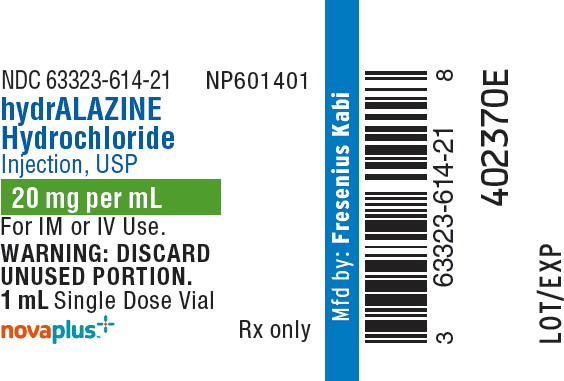
PACKAGE LABEL - PRINCIPAL DISPLAY – hydrALAZINE Hydrochloride 1 mL Single Dose Vial Label NDC 63323-614-21 NP601401 hydrALAZINE Hydrochloride Injection, USP 20 mg per mL For IM or IV Use. WARNING: DISCARD UNUSED PORTION. 1 mL Single Dose Vial Rx only PACKAGE LABEL - PRINCIPAL DISPLAY – hydrALAZINE Hydrochloride 1 mL Single Dose Vial Label
PACKAGE LABEL - PRINCIPAL DISPLAY – hydrALAZINE Hydrochloride 1 mL Single Dose Vial Tray Label NDC 63323-614-55 NP601401 hydrALAZINE Hydrochloride Injection, USP For intramuscular or intravenous use. 20 mg per mL Rx only 25 x 1 mL Single Dose Vials Novaplus is a registered trademark of Vizient, Inc. PACKAGE LABEL - PRINCIPAL DISPLAY – hydrALAZINE Hydrochloride 1 mL Single Dose Vial Tray Label
Medicaid utilization & spend
Medicaid utilization by pack size
About this NDC listing & data coverage
What data is (and isn’t) available for this NDC — tap to expand
| NDC identity (package / product / labeler codes) | ✓ Available |
| Labeler | ✓ Available |
| Product & package description | ✓ Available |
| Marketing category & status | ✓ Available |
| Active ingredient / dosage form / route | ✓ Available |
| FDA label (SPL via DailyMed) | ✓ Available |
| Package photos | ✓ Available |
| Inactive ingredients (structured) | ✓ Available |
| NADAC pharmacy acquisition price (CMS) | — Not published for this NDC CMS publishes NADAC only for NDCs reported in its retail-pharmacy survey. |
| Orange Book / therapeutic-equivalence data | ✓ Available |
| HCPCS J-code billing crosswalk | ✓ Available |
| Medicaid utilization (CMS SDUD) | ✓ Available |