
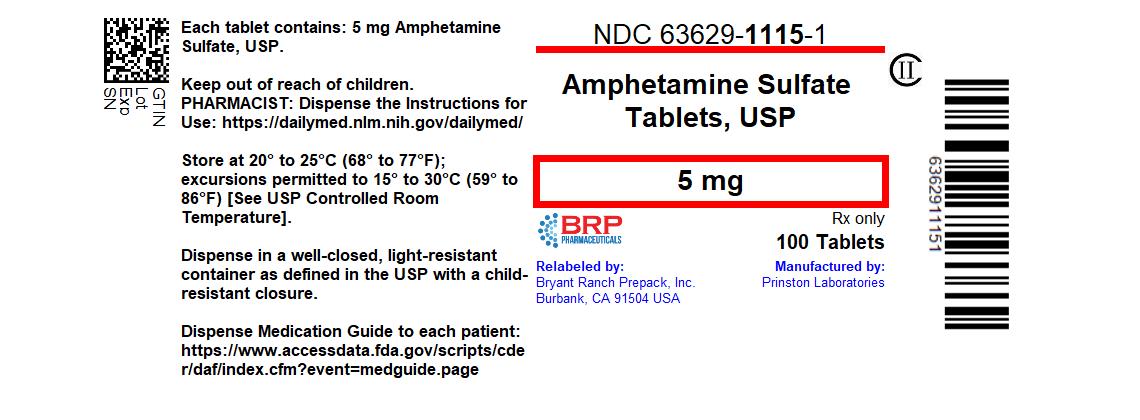
Amphetamine Sulfate 5 mg Tablet, 100-count — NDC 63629-1115-1 (Billing 63629-1115-01)
This is a package of 100 tablets of Amphetamine Sulfate 5 mg Tablet from Bryant Ranch Prepack, marketed since Jul 2020 and currently FDA-listed. It is this product's only package size.
NDC database record
One package, one record: these facts belong to NDC 63629-1115-1 alone.
- Record
- FDA NDC Directory package listing · Human prescription drug
- Code segments
- 63629 labeler · 1115 product · 1 package
- Package marketed since
- Jul 30, 2020
- Sample package
- No — commercial package
- Listing certified through
- Dec 31, 2026
- Billing quantity
- 100 EA per package
- Barcode (UPC-A, from the NDC)
- 3 6362911151 0
- FDA record last changed
- Jul 24, 2026
Identity & classification
Regulatory identifiers FDA, NLM and CMS codes for this package
Drug-database identifiers Medi-Span GPI and First Databank GCN / HICL / AHFS classification
- GSN (GCN sequence number): 005003
- GCN: 19822
- GPI-14 (Medi-Span): 61100010100310
- HICL (First Databank): 002064
- AHFS class code: 28:20.04.00
- RxCUI (RxNorm): 884655
Where does this data come from?
- FDA openFDA NDC Directory · synced Oct 8, 2026
- FDA label on DailyMed · label index refreshed Oct 8, 2026
- RxNorm (NLM RxNav) · catalog refreshed Oct 8, 2026
- Medi-Span GPI (licensed)
- First Databank (licensed) · refreshed Oct 8, 2026
RxNorm drug class
This medicine belongs to the Central Nervous System Stimulant class.
Where does this data come from?
- RxClass (NLM) · catalog refreshed Oct 8, 2026
Clinical
- It depends on the specific product. Most amphetamine products — including Adzenys XR-ODT, Dyanavel XR, and the extended-release orally disintegrating tablets — are approved to trea...
- What conditions is amphetamine actually approved to treat?
- You can take most amphetamine products with or without food — it won't meaningfully change how much you absorb. That said, eating (especially a high-fat meal) can delay when it kic...
- Is it okay to take this with food, or does it have to be on an empty stomach?
Patient education
Supplement & herbal interactions
Some supplements/herbs that may interact with Amphetamine Sulfate — tap one for details:
Where does this data come from?
- MedlinePlus (NLM) · refreshed Oct 8, 2026
- FDA label on DailyMed · label index refreshed Oct 8, 2026
Ask a licensed pharmacist directly — free, answered by our team.
Pricing
A drug doesn't have one price. Each row is a different public payment system, and none is what you'd pay at the counter — that depends on your insurance. The ⓘ on each row explains what it measures.
| Price system | Per each | Per package |
|---|---|---|
| Retail pharmacies payNADAC · weekly | Not in the retail survey — common for institutional, discontinued, or low-volume packs. | |
| Medicaid paysCMS SDUD · 12 mo | No recent Medicaid claims on file for this NDC — rare and low-volume NDCs are suppressed in the public data. | |
| Medicare drug plans payPart D · Q2 2026 | $1.53 | $153.47 / 100 tablets |
Where does this data come from?
- CMS NADAC weekly file
- CMS ASP pricing files · refreshed Sep 20, 2026
- CMS Medicaid State Drug Utilization Data · refreshed Oct 9, 2026
- CMS Part D plan pricing files · refreshed Sep 24, 2026
- VA National Acquisition Center price file
Packaging — all sizes for this product
| Package NDC | Description | Marketing start | Marketing end | Status |
|---|---|---|---|---|
| 63629-1115-01 You're viewing this Main listing | 100 TABLET in 1 BOTTLE | 2020-07-30 | — | Active |
Therapeutic equivalents
| Product | Labeler | Pack | NADAC/unit | TE | Status | Price vs. this |
|---|---|---|---|---|---|---|
| Amphetamine Sulfate 5 mg 00406-1219-01 | SpecGx | 100 tablets | $0.425 | AA | FDA listed | — |
| Amphetamine Sulfate 5 mg 00527-2524-37 | Lannett | 100 tablets | $0.457 | AA | Availability likely | — |
| Amphetamine Sulfate 5 mg 43547-0457-10 | Solco | 100 tablets | $0.457 | AA | Availability likely | — |
| Amphetamine sulfate 5 mg 43598-0897-01 | DR. | 100 tablets | $0.457 | AA | Availability likely | — |
| Amphetamine Sulfate 5 mg 52536-0057-03 | Wilshire | 30 tablets | $0.457 | AA | Availability likely | — |
| Amphetamine Sulfate 5 mg 69238-1563-01 | Amneal | 100 tablets | $0.457 | AA | Availability likely | — |
| Amphetamine Sulfate 5 mg 70010-0040-01 | Granules | 100 tablets | $0.457 | AA | Availability likely | — |
| Amphetamine Sulfate 5 mg 13107-0259-01 | Aurolife | 100 tablets | — | AA | FDA listed | — |
| Evekeo 5 mg 24338-0022-03 | Azurity | 30 tablets | — | AA | FDA listed | — |
| Amphetamine Sulfate 5 mg 42806-0029-01 | Epic | 100 tablets | — | AA | FDA listed | — |
| Amphetamine Sulfate 5 mgthis 63629-1115-01 | Bryant | 100 tablets | — | AA | FDA listed | — |
| Amphetamine Sulfate 5 mg 63629-2079-01 | Bryant | 100 tablets | — | AA | FDA listed | — |
| Amphetamine Sulfate 5 mg 63629-2499-01 | Bryant | 100 tablets | — | AA | FDA listed | — |
| Amphetamine Sulfate 5 mg 72162-1087-01 | Bryant | 100 tablets | — | AA | FDA listed | — |
| Amphetamine Sulfate 5 mg 72162-1368-01 | Bryant | 100 tablets | — | AA | FDA listed | — |
| Amphetamine Sulfate 5 mg 72162-1612-03 | Bryant | 30 tablets | — | AA | FDA listed | — |
| Amphetamine Sulfate 5 mg 69292-0106-01 | Amici | 100 tablets | — | AA | FDA listed | — |
Where does this data come from?
- FDA openFDA NDC Directory · synced Oct 8, 2026
- FDA Orange Book · refreshed Oct 3, 2026
- CMS NADAC weekly file
Availability & generic status
This product is an FDA-approved generic. Other versions of the same drug are listed under Therapeutic equivalents, least expensive first.
Where does this data come from?
- FDA Orange Book · refreshed Oct 3, 2026
Inactive Ingredients / Excipients
Inactive ingredients, also called excipients, are components of the drug product other than the active ingredient. They may include fillers, dyes, coatings, preservatives, flavors, or other formulation ingredients.
🧪 Avoiding an ingredient? See Amphetamine inactive ingredients by manufacturer: every current product's list side by side, so you can ask your pharmacy for the version that does not list it.
💡 Tap an ingredient (hover on desktop) to see what it is and why it’s used.
-
UNII OP1R32D61U
Microcrystalline cellulose is a purified form of cellulose, a natural fiber from plant sources. It acts as a binder and filler in tablets and capsules, helping hold ingredients together and give the medicine its shape and size.
-
UNII 2S7830E561
Crospovidone is a synthetic polymer derived from povidone. It acts as a disintegrant, helping the tablet or capsule break apart quickly in the stomach so the active ingredient can be absorbed.
-
UNII 70097M6I30
Magnesium stearate is a salt made from magnesium and stearic acid, a fatty substance. It's used in tablets and capsules as a lubricant and glidant to help ingredients flow smoothly during manufacturing and prevent sticking.
-
UNII 4ELV7Z65AP
Stearic acid is a fatty acid derived from plant or animal sources. It acts as a binder and lubricant in tablets and capsules, helping them hold together and flow smoothly during manufacturing.
4 inactive ingredients listed in the exact product block matched to this NDC.
Where does this data come from?
ingredient classCode="IACT" elements from the exact product block matched by this NDC. Label-section narrative from DailyMed / the openFDA label index is shown separately when available.- FDA label on DailyMed · label index refreshed Oct 8, 2026
- FDA openFDA NDC Directory · synced Oct 8, 2026
Inactive ingredient FAQ
Are inactive ingredients the same for every manufacturer?
Why might an inactive ingredient be missing?
Can inactive ingredients matter?
Manufacturer & labeler
More NDCs from Bryant Ranch Prepack labeler code 63629
- Spironolactone 100 mg Tablet, Film Coated NDC 63629-1094-1
- Phentermine Hydrochloride 30 mg Tablet NDC 63629-1106-1
- Phentermine Hydrochloride 30 mg Tablet NDC 63629-1107-1
- Phentermine Hydrochloride 30 mg Tablet NDC 63629-1108-1
- Clomipramine Hydrochloride 75 mg Capsule NDC 63629-1111-1
- Amphetamine Sulfate 10 mg Tablet NDC 63629-1114-1
- Clonazepam 1 mg Tablet NDC 63629-1116-1
- Furosemide 80 mg Tablet NDC 63629-1119-1
- Furosemide 80 mg Tablet NDC 63629-1120-1
- Methocarbamol 500 mg Tablet NDC 63629-1123-1
- Magnesium Oxide 400 mg Tablet NDC 63629-1126-1
- Sodium Fluoride Chewable .25 mg Tablet NDC 63629-1130-1
Where does this data come from?
- FDA openFDA NDC Directory · synced Oct 8, 2026
- Drugs@FDA
Full prescribing information FDA SPL
🚨 Boxed Warning ▾
WARNING AMPHETAMINES HAVE A HIGH POTENTIAL FOR ABUSE. ADMINISTRATION OF AMPHETAMINES FOR PROLONGED PERIODS OF TIME MAY LEAD TO DRUG DEPENDENCE AND MUST BE AVOIDED. PARTICULAR ATTENTION SHOULD BE PAID TO THE POSSIBILITY OF SUBJECTS OBTAINING AMPHETAMINES FOR NON-THERAPEUTIC USE OR DISTRIBUTION TO OTHERS, AND THE DRUGS SHOULD BE PRESCRIBED OR DISPENSED SPARINGLY. MISUSE OF AMPHETAMINE MAY CAUSE SUDDEN DEATH AND SERIOUS CARDIOVASCULAR ADVERSE EVENTS.
🎯 Indications and Usage ▾
INDICATIONS AND USAGE Amphetamine sulfate tablets, USP, are indicated for: 1. Narcolepsy 2. Attention Deficit Disorder with Hyperactivity as an integral part of a total treatment program which typically includes other remedial measures (psychological, educational, social) for a stabilizing effect in children with behavioral syndrome characterized by the following group of developmentally inappropriate symptoms: moderate to severe distractibility, short attention span, hyperactivity, emotional lability, and impulsivity.
The diagnosis of the syndrome should not be made with finality when these symptoms are only of comparatively recent origin. Nonlocalizing (soft) neurological signs, learning disability, and abnormal EEG may or may not be present, and a diagnosis of central nervous system dysfunction may or not be warranted. 3.
Exogenous Obesity as a short term (a few weeks) adjunct in a regimen of weight reduction based on caloric restriction for patients refractory to alternative therapy, e.g., repeated diets, group programs, and other drugs. The limited usefulness of amphetamines (see CLINICAL PHARMACOLOGY) should be weighed against possible risks inherent in use of the drug, such as those described below.
⏱️ Dosage and Administration ▾
OVERDOSAGE Individual patient response to amphetamines varies widely. While toxic symptoms occasionally occur as an idiosyncrasy at doses as low as 2 mg, they are rare with doses of less than 15 mg; 30 mg can produce severe reactions, yet doses of 400 to 500 mg are not necessarily fatal. In rats, the oral LD 50 of dextroamphetamine sulfate is 96.8 mg/Kg.
Symptoms Manifestations of acute overdosage with amphetamines include restlessness, tremor, hyperreflexia, rhabdomyolysis, rapid respiration, hyperpyrexia, confusion, assaultiveness, hallucinations, panic states. Fatigue and depression usually follow the central stimulation. Cardiovascular effects include arrhythmias, hypertension, or hypotension and circulatory collapse.
Gastrointestinal symptoms include nausea, vomiting, diarrhea, and abdominal cramps. Fatal poisoning is usually preceded by convulsions and coma. Treatment Management of acute amphetamine intoxication is largely symptomatic and includes gastric lavage and sedation with a barbiturate.
Experience with hemodialysis or peritoneal dialysis is inadequate to permit recommendation in this regard. Acidification of the urine increases amphetamine excretion. If acute, severe hypertension complicates amphetamine overdosage, administration of intravenous phentolamine has been suggested.
However, a gradual drop in blood pressure will usually result when sufficient sedation has been achieved. Chlorpromazine antagonizes the central stimulant effects of amphetamines and can be used to treat amphetamine intoxication.
⛔ Contraindications ▾
CONTRAINDICATIONS Advanced arteriosclerosis, symptomatic cardiovascular disease, moderate to severe hypertension, hyperthyroidism, known hypersensitivity or idiosyncrasy to the sympathomimetic amines. Agitated states. Patients with a history of drug abuse. During or within 14 days following the administration of monoamine oxidase inhibitors (hypertensive crises may result).
⚠️ Warnings ▾
WARNINGS Serious Cardiovascular Events Sudden Death and Pre-Existing Structural Cardiac Abnormalities or Other Serious Heart Problems Children and Adolescents Sudden death has been reported in association with CNS stimulant treatment at usual doses in children and adolescents with structural cardiac abnormalities or other serious heart problems. Although some serious heart problems alone carry an increased risk of sudden death, stimulant products generally should not be used in children or adolescents with known serious structural cardiac abnormalities, cardiomyopathy, serious heart rhythm abnormalities, or other serious cardiac problems that may place them at increased vulnerability to the sympathomimetic effects of a stimulant drug (see CONTRAINDICATIONS).
Adults Sudden deaths, stroke, and myocardial infarction have been reported in adults taking stimulant drugs at usual doses for ADHD. Although the role of stimulants in these adult cases is also unknown, adults have a greater likelihood than children of having serious structural cardiac abnormalities, cardiomyopathy, serious heart rhythm abnormalities, coronary artery disease, or other serious cardiac problems. Adults with such abnormalities should also generally not be treated with stimulant drugs (see CONTRAINDICATIONS).
Hypertension and other Cardiovascular Conditions Stimulant medications cause a modest increase in average blood pressure (about 2 to 4 mmHg) and average heart rate (about 3 to 6 bpm), and individuals may have larger increases. While the mean changes alone would not be expected to have short-term consequences, all patients should be monitored for larger changes in heart rate and blood pressure. Caution is indicated in treating patients whose underlying medical conditions might be compromised by increases in blood pressure or heart rate, e.g., those with pre-existing hypertension, heart failure, recent myocardial infarction, or ventricular arrhythmia (see CONTRAINDICATIONS).
Assessing Cardiovascular Status in Patients being Treated with Stimulant Medications Children, adolescents, or adults who are being considered for treatment with stimulant medications should have a careful history (including assessment for a family history of sudden death or ventricular arrhythmia) and physical exam to assess for the presence of cardiac disease, and should receive further cardiac evaluation if findings suggest such disease (e.g., electrocardiogram and echocardiogram). Patients who develop symptoms such as exertional chest pain, unexplained syncope, or other symptoms suggestive of cardiac disease during stimulant treatment should undergo a prompt cardiac evaluation.
Psychiatric Adverse Events Pre-Existing Psychosis Administration of stimulants may exacerbate symptoms of behavior disturbance and thought disorder in patients with a pre-existing psychotic disorder. Bipolar Illness Particular care should be taken in using stimulants to treat ADHD in patients with comorbid bipolar disorder because of concern for possible induction of a mixed/manic episode in such patients. Prior to initiating treatment with a stimulant, patients with comorbid depressive symptoms should be adequately screened to determine if they are at risk for bipolar disorder; such screening should include a detailed psychiatric history, including a family history of suicide, bipolar disorder, and depression.
Emergence of New Psychotic or Manic Symptoms Treatment emergent psychotic or manic symptoms, e.g., hallucinations, delusional thinking, or mania in children and adolescents without a prior history of psychotic illness or mania can be caused by stimulants at usual doses. If such symptoms occur, consideration should be given to a possible causal role of the stimulant, and discontinuation of treatment may be appropriate. In a pooled analysis of multiple short-term, placebo-controlled studies, such symptoms occurred in about 0.1% ( 4 patients with events out of 3482 exposed to methylphenidate or amphetamin… [Excerpted — this section continues on DailyMed.]
🤒 Adverse Reactions ▾
ADVERSE REACTIONS Cardiovascular Palpitations, tachycardia, elevation of blood pressure. There have been isolated reports of cardiomyopathy associated with chronic amphetamine use. Central Nervous System Psychotic episodes at recommended doses (rare), overstimulation, restlessness, dizziness, insomnia, euphoria, dyskinesia, dysphoria, tremor, headache, exacerbation of motor and phonic tics and Tourette's syndrome.
Gastrointestinal Dryness of the mouth, unpleasant taste, diarrhea, constipation and other gastrointestinal disturbances. Anorexia and weight loss may occur as undesirable effects when amphetamines are used for other than the anorectic effect. Allergic Urticaria Endocrine Impotence, changes in libido, and frequent or prolonged erections.
Musculoskeletal Rhabdomyolysis
🆘 Overdosage ▾
DRUG ABUSE AND DEPENDENCE Amphetamine sulfate tablets are a Schedule II controlled substance. Amphetamines have been extensively abused. Tolerance, extreme psychological dependence, and severe social disability have occurred.
There are reports of patients who have increased the dosage to many times the recommended. Abrupt cessation following prolonged high dosage administration results in extreme fatigue and mental depression; changes are also noted on the sleep EEG. Manifestations of chronic intoxication with amphetamines include severe dermatosis, marked insomnia, irritability, hyperactivity and personality changes.
The most severe manifestation of chronic intoxication is psychosis, often clinically indistinguishable from schizophrenia. This is rare with oral amphetamines.
🧬 Clinical Pharmacology ▾
CLINICAL PHARMACOLOGY Amphetamines are non-catecholamine, sympathomimetic amines with CNS stimulant activity. Peripheral actions include elevations of systolic and diastolic blood pressures, and weak bronchodilator, and respiratory stimulant action. Amphetamine, as the racemic form, differs from dextroamphetamine in a number of ways.
The l-isomer is more potent than the d-isomer in cardiovascular activity, but much less potent in causing CNS excitatory effects. The racemic mixture also is less effective as an appetite suppressant when compared to dextroamphetamine. There is neither specific evidence which clearly establishes the mechanism whereby amphetamines produce mental and behavioral effects in children, nor conclusive evidence regarding how those effects relate to the condition of the central nervous system.
Drugs in this class used in obesity are commonly known as "anorectics" or "anorexigenics." It has not been established, however, that the action of such drugs in treating obesity is primarily one of appetite suppression. Other central nervous system actions or metabolic effects, may be involved, for example. Adult obese subjects instructed in dietary management and treated with "anorectic" drugs lose more weight on the average than these treated with placebo and diet, as determined in relatively short-term clinical trials.
The magnitude of increased weight loss of drug-treated patients over placebo-treated patients is only a fraction of a pound a week. The rate of weight loss is greatest in the first weeks of therapy for both drug and placebo subjects and tends to decrease in succeeding weeks. The origins of the increased weight loss due to the various possible drug effects are not established.
The amount of weight loss associated with the use of an "anorectic" drug varies from trial to trial, and the increased weight loss appears to be related in part to variables other than the drug prescribed, such as the physician-investigator, the population treated, and the diet prescribed. Studies do not permit conclusions as to the relative importance of the drug and nondrug factors on weight loss. The natural history of obesity is measured in years, whereas the studies cited are restricted to few weeks duration; thus, the total impact of drug-induced weight loss over that of diet alone must be considered clinically limited.
📦 How Supplied / Storage and Handling ▾
HOW SUPPLIED Amphetamine sulfate tablets, USP, are supplied as follows: 5 mg: White, round, convex tablet, uppers scored and debossed "5" on the left side, lowers debossed "S" in bottles of 100 tablets with child-resistant closure, NDC 63629-1115-1. 10 mg: White, round, convex tablet, uppers are double crossed scored and debossed "1" on the lower left corner and "0" on the lower right corner, lowers debossed "S" in bottles of 100 tablets with child-resistant closure, NDC 63629-1114-1. Store at 20° to 25°C (68° to 77°F); excursions permitted between 15oC and 30oC (59oF and 86oF). [see USP Controlled Room Temperature.] Dispense in a well-closed container, as defined in the USP.
Repackaged/Relabeled by: Bryant Ranch Prepack, Inc. Burbank, CA 91504
📋 Description ▾
DESCRIPTION Amphetamine Sulfate is a sympathomimetic amino of the amphetamine group. It is a white, odorless crystalline powder. It has a slightly bitter taste.
Its solutions are acid to litmus, having a pH of 5 to 8. It is freely soluble in water, slightly soluble in alcohol and practically insoluble in ether. Each tablet, for oral administration contains 5 mg or 10 mg of amphetamine sulfate, USP.
Each tablet also contains the following inactive ingredients: crospovidone, magnesium stearate, silicified microcrystalline cellulose, and stearic acid. Structural Formula: CHemical Structure
💬 Medication Guide ▾
MEDICATION GUIDE Amphetamine Sulfate Tablets, USP (am fet’ a meen sul’ fate) Read this Medication Guide before you or your child starts taking amphetamine sulfate tablets and each time you get a refill. There may be new information. This information does not take the place of talking to your doctor about you or your child's treatment.
What is the most important information I should know about amphetamine sulfate tablets? Amphetamine sulfate tablets are a stimulant medicine. Some people have had the following problems when taking stimulant medicines such as amphetamine sulfate tablets: 1.
Heart-related problems: • sudden death in people who have heart problems or heart defects • stroke and heart attack in adults • increased blood pressure and heart rate Tell your doctor if you or your child has any heart problems, heart defects, high blood pressure, or a family history of these problems. Your doctor should check you or your child carefully for heart problems before starting amphetamine sulfate tablets. Your doctor should check you or your child's blood pressure and heart rate regularly during treatment with amphetamine sulfate tablets.
Call your doctor right away if you or your child have any signs of heart problems such as chest pain, shortness of breath, or fainting while taking amphetamine sulfate tablets. 2 . Mental (Psychiatric) problems including: In children, teenagers, and adults: • new or worse behavior and thought problems • new or worse bipolar illness • new or worse aggressive behavior or hostility In Children and Teenagers who have psychiatric problems, new psychotic symptoms such as: • hearing voices • seeing things that are not real • believing things that are not true • being suspicious • new manic symptoms Tell your doctor about any mental problems you or your child have, or about a family history of suicide, bipolar illness, or depression.
Call your doctor right away if you or your child have any new or worsening mental symptoms or problems while taking amphetamine sulfate tablets, especially: • seeing or hearing things that are not real • believing things that are not real • being suspicious 3. Circulation problems in fingers and toes [Peripheral vasculopathy, including Raynaud's phenomenon]. • Fingers or toes may feel numb, cool, painful • Fingers or toes may change color from pale, to blue, to red Tell your doctor if you have or your child has numbness, pain, skin color change, or sensitivity to temperature in your fingers or toes.
Call your doctor right away if you have or your child has any signs of unexplained wounds appearing on fingers or toes while taking amphetamine sulfate tablets. What are amphetamine sulfate tablets? • Amphetamine sulfate tablets are a central nervous system stimulant prescription medicine used for the treatment of: • a sleep disorder called narcolepsy. • Attention-Deficit Hyperactivity Disorder (ADHD). Amphetamine sulfate tablets may help increase attention and decrease impulsiveness and hyperactivity in patients with ADHD.
Amphetamine sulfate tablets should be used as part of a total treatment program for ADHD that may include counseling or other therapies. • exogenous obesity. Amphetamine sulfate tablets may be used as part of a short-term, weight reduction program for obesity. • Amphetamine sulfate tablets are not for use as an anorectic agent for exogenous obesity in children less than 12 years of age. • Amphetamine sulfate tablets are not for use for ADHD in children less than 3 years old. • The effects of long term use of amphetamine sulfate tablets in children are not known.
Amphetamine sulfate tablets are a federally controlled substance (CII) because it contains amphetamine that can be a target for people who abuse prescription medicines or street drugs. Keep amphetamine sulfate tablets in a safe place to protect it from theft. Never give your amphetamine sulfate tablets to anyone else, because it may cause death or harm them.
Selling or giving away amphetamine sulfate t… [Excerpted — this section continues on DailyMed.]
⚠️ Precautions ▾
PRECAUTIONS General Caution is to be exercised in prescribing amphetamines for patients with even mild hypertension. The least amount feasible should be prescribed or dispensed at one time in order to minimize the possibility of overdosage. Information for Patients Amphetamines may impair the ability of the patient to engage in potentially hazardous activities such as operating machinery or vehicle; the patient should therefore be cautioned accordingly.
Circulation problems in fingers and toes [Peripheral vasculopathy, including Raynaud's phenomenon] • Instruct patients beginning treatment with amphetamine sulfate tablets about the risk of peripheral vasculopathy, including Raynaud's Phenomenon, and associated signs and symptoms: fingers or toes may feel numb, cool, painful, and/or may change color from pale, to blue, to red. • Instruct patients to report to their physician any new numbness, pain, skin color change, or sensitivity to temperature in fingers or toes. • Instruct patients to call their physician immediately with any signs of unexplained wounds appearing on fingers or toes while taking amphetamine sulfate tablets. • Further clinical evaluation (e.g., rheumatology referral) may be appropriate for certain patients.
Drug Interactions Acidifying agents Gastrointestinal acidifying agents (guanethidine, reserpine, glutamic acid HCl, ascorbic acid, fruit juices, etc.) lower absorption of amphetamines. Urinary acidifying agents (ammonium chloride, sodium acid phosphate, etc.) increase concentration of the ionized species of the amphetamine molecule, thereby increasing urinary excretion. Both groups of agents lower blood levels and efficacy of amphetamines.
Adrenergic blockers Adrenergic blockers are inhibited by amphetamines. Alkalinizing agents Gastrointestinal alkalinizing agents (sodium bicarbonate, etc.) increase absorption of amphetamines. Urinary alkalinizing agents (acetazolamide, some thiazides) increase the concentration of the non-ionized species of the amphetamine molecule, thereby decreasing urinary excretion.
Both groups of agents increase blood levels and therefore potentiate the action of amphetamines. Antidepressants tricyclic Amphetamines may enhance the activity of tricyclic or sympathomimetic agents; d-amphetamine with desipramine or protriptyline and possibly other tricyclics cause striking and sustained increases in the concentration of d-amphetamine in the brain; cardiovascular effects can be potentiated. CYP2D6 Inhibitors The concomitant use of amphetamine sulfate tablets and CYP2D6 inhibitors may increase the exposure of amphetamine sulfate tablets compared to the use of the drug alone and increase the risk of serotonin syndrome.
Initiate with lower doses and monitor patients for signs and symptoms of serotonin syndrome particularly during amphetamine sulfate tablets initiation and after a dosage increase. If serotonin syndrome occurs, discontinue amphetamine sulfate tablets and the CYP2D6 inhibitor (see WARNING, OVERDOSAGE). Examples of CYP2D6 Inhibitors include paroxetine and fluoxetine (also serotonergic drugs), quinidine, ritonavir.
Serotonergic Drugs The concomitant use of amphetamine sulfate tablets and serotonergic drugs increases the risk of serotonin syndrome. Initiate with lower doses and monitor patients for signs and symptoms of serotonin syndrome, particularly during amphetamine sulfate tablets initiation or dosage increase. If serotonin syndrome occurs, discontinue amphetamine sulfate tablets and the concomitant serotonergic drug(s) (see WARNING and PRECAUTIONS).
Examples of serotonergic drugs include selective serotonin reuptake inhibitors (SSRI), serotonin norepinephrine reuptake inhibitors (SNRI), triptans, tricyclic antidepressants, fentanyl, lithium, tramadol, tryptophan, buspirone, St. John's Wort. MAO inhibitors MAOI antidepressants, as well as a metabolic of furazolidone, slow amphetamine metabolism.
This slowing potentiates amphetamines, increasing their affect on the release… [Excerpted — this section continues on DailyMed.]
📄 Package Label / Principal Display Panel ▾
PACKAGE LABEL.PRINCIPAL DISPLAY PANEL Container Label 5 mg Container Label 10 mg
Medicare Part D spend CMS · PART D · 2026 (Q1)
About this NDC listing & data coverage
What data is (and isn’t) available for this NDC — tap to expand
| NDC identity (package / product / labeler codes) | ✓ Available |
| Labeler | ✓ Available |
| Product & package description | ✓ Available |
| Marketing category & status | ✓ Available |
| Active ingredient / dosage form / route | ✓ Available |
| FDA label (SPL via DailyMed) | ✓ Available |
| Package photos | ✓ Available |
| Inactive ingredients (structured) | ✓ Available |
| NADAC pharmacy acquisition price (CMS) | — Not published for this NDC CMS publishes NADAC only for NDCs reported in its retail-pharmacy survey. |
| Orange Book / therapeutic-equivalence data | ✓ Available |
| HCPCS J-code billing crosswalk | — Not published for this NDC Most self-administered / retail products have no J-code — that is normal. |
| Medicaid utilization (CMS SDUD) | — Not published for this NDC CMS reports utilization only for NDCs with Medicaid claims above its privacy threshold. |