
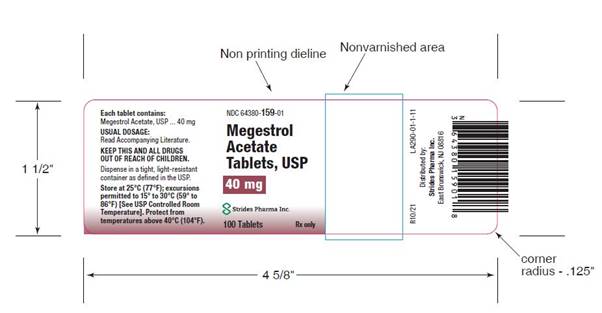
Megestrol Acetate 40 mg Tablet, 100-count — NDC 64380-159-01 (Billing 64380-0159-01)
This is a package of 100 tablets of Megestrol Acetate 40 mg Tablet from Strides Pharma Science Limited, marketed since Apr 2022 and currently FDA-listed; retail pharmacies pay about $0.2408 per tablet (NADAC). It is the main listing for this product, which comes in 3 package sizes.
NDC database record
One package, one record: these facts belong to NDC 64380-159-01 alone.
- Record
- FDA NDC Directory package listing · Human prescription drug
- Code segments
- 64380 labeler · 159 product · 01 package
- Package marketed since
- Apr 4, 2022
- Sample package
- No — commercial package
- Listing certified through
- Dec 31, 2026
- Billing quantity
- 100 EA per package
- Barcode (UPC-A, from the NDC)
- 3 6438015901 8
- Medicaid fills, this package
- 9,314 prescriptions in the last four reported quarters
- FDA record last changed
- Jul 24, 2026
Identity & classification
Regulatory identifiers FDA, NLM and CMS codes for this package
Drug-database identifiers Medi-Span GPI and First Databank GCN / HICL / AHFS classification
- GSN (GCN sequence number): 008829
- GCN: 38681
- GPI-14 (Medi-Span): 21404020100310
- HICL (First Databank): 003923
- AHFS class code: 10:00.00.00
- RxCUI (RxNorm): 860215
Where does this data come from?
- FDA openFDA NDC Directory · synced Oct 8, 2026
- FDA label on DailyMed · label index refreshed Oct 8, 2026
- RxNorm (NLM RxNav) · catalog refreshed Oct 1, 2026
- Medi-Span GPI (licensed)
- First Databank (licensed) · refreshed Oct 8, 2026
RxNorm drug class
This medicine belongs to the Progestin class.
Where does this data come from?
- RxClass (NLM) · catalog refreshed Oct 1, 2026
Clinical
Megestrol tablets are used to relieve the symptoms and reduce the suffering caused by advanced breast cancer and advanced endometrial cancer (cancer that begins in the lining of the uterus). Megestrol suspension is used to treat loss of appetite, malnutrition, and severe weight loss in patients with acquired immunodeficiency syndrome (AIDS). Megestrol should not be used to prevent loss of appetite and severe weight loss in patients who have not yet developed this condition. Megestrol is a man-made version of the human hormone progesterone. It treats breast cancer and endometrial cancer by affe...
Read the full MedlinePlus article ↗- It depends on the form. The oral suspension is used for appetite and weight loss in people with AIDS. The tablets are used for palliative treatment of advanced breast or endometria...
- Both forms are taken by mouth. If you use the suspension, shake the bottle well first. It can be taken with or without meals. Follow your prescriber's directions and the label.
- With the suspension, the common ones are nausea, diarrhea, rash, gas, weakness, high blood pressure, and impotence. Mention any that bother you. Call right away for signs of a bloo...
- No. Megestrol can harm an unborn baby and should not be used in pregnancy. If you could become pregnant, you should have a negative pregnancy test first and use effective contracep...
Patient education
Supplement & herbal interactions
Some supplements/herbs that may interact with Megestrol Acetate — tap one for details:
Where does this data come from?
- MedlinePlus (NLM) · refreshed Oct 8, 2026
- FDA label on DailyMed · label index refreshed Oct 8, 2026
Ask a licensed pharmacist directly — free, answered by our team.
Pricing
A drug doesn't have one price. Each row is a different public payment system, and none is what you'd pay at the counter — that depends on your insurance. The ⓘ on each row explains what it measures.
| Price system | Per ea | Per package |
|---|---|---|
| Retail pharmacies payNADAC · weekly | $0.241 | $24.08 / 100 tablets |
| Medicaid paysCMS SDUD · 12 mo | $0.3077 | $30.77 / 100 tablets |
| Medicare drug plans payPart D · Q2 2026 | $0.4237 | $42.37 / 100 tablets |
Where does this data come from?
- CMS NADAC weekly file · file of Oct 7, 2026
- CMS ASP pricing files · refreshed Sep 20, 2026
- CMS Medicaid State Drug Utilization Data · through Q1 2026
- CMS Part D plan pricing files · refreshed Sep 24, 2026
- VA National Acquisition Center price file
Packaging — all sizes for this product
| Package NDC | Description | Per unit | Per pack | Marketing start | Marketing end | Status |
|---|---|---|---|---|---|---|
| 64380-0159-01 You're viewing this Main listing | 100 TABLET in 1 BOTTLE | $0.2408 / ea | $24.08 | 2022-04-04 | — | Active |
| 64380-0159-02 64380-159-02 | 250 TABLET in 1 BOTTLE | $0.2408 / ea | $60.20 | 2022-04-04 | — | Active |
| 64380-0159-03 64380-159-03 | 500 TABLET in 1 BOTTLE | $0.2408 / ea | $120.39 | 2022-04-04 | — | Active |
You're viewing the smallest of 3 pack sizes for this product.
This pack has the lowest per-ea cost of the 3 priced pack sizes ($0.2408 NADAC).
In Medicaid, this is the most-dispensed pack of this product — about 74% of fills over the last four reported quarters. See all packs ↓
Pack size FAQ
What quantity is in this package?
How does this package differ from NDC 64380-0159-02?
What NDC number is used to bill for this package of Megestrol Acetate 40 mg Tablet?
Prices are the latest CMS NADAC pharmacy acquisition cost per NDC; per-pack figures are per-unit × pack quantity, shown only when the pack is denominated in the same measure NADAC prices.
Therapeutic equivalents
| Product | Labeler | Pack | NADAC/unit | TE | Status | Price vs. this |
|---|---|---|---|---|---|---|
| Megestrol Acetate 40 mg 00555-0607-02 | Teva | 100 tablets | $0.241 | AB | Availability likely | — |
| Megestrol Acetate 40 mg 00904-7236-61 | Major | 100 tablets | $0.241 | AB | Availability likely | — |
| Megestrol Acetate 40 mgthis 64380-0159-01 | Strides | 100 tablets | $0.241 | AB | Availability likely | — |
| Megestrol Acetate 40 mg 71335-2181-01 | Bryant | 30 tablets | — | AB | FDA listed | — |
| Megestrol Acetate 40 mg 71335-2544-01 | Bryant | 30 tablets | — | AB | FDA listed | — |
Where does this data come from?
- FDA openFDA NDC Directory · synced Oct 8, 2026
- FDA Orange Book · refreshed Oct 3, 2026
- CMS NADAC weekly file · file of Oct 7, 2026
Availability & generic status
This product is an FDA-approved generic. Other versions of the same drug are listed under Therapeutic equivalents, least expensive first.
Where does this data come from?
- FDA Orange Book · refreshed Oct 3, 2026
What it looks like
Where does this data come from?
- FDA label on DailyMed · label index refreshed Oct 8, 2026
Inactive Ingredients / Excipients
Inactive ingredients, also called excipients, are components of the drug product other than the active ingredient. They may include fillers, dyes, coatings, preservatives, flavors, or other formulation ingredients.
🧪 Avoiding an ingredient? See Megestrol inactive ingredients by manufacturer: every current product's list side by side, so you can ask your pharmacy for the version that does not list it.
💡 Tap an ingredient (hover on desktop) to see what it is and why it’s used.
-
UNII 5C5403N26O
Acacia is a natural gum derived from acacia tree sap. It serves as a binder, thickener, and emulsifier to help hold ingredients together, improve texture, and stabilize the medicine.
-
UNII O7TSZ97GEP
A mineral compound that serves as a filler and binding agent in tablets and capsules. It adds bulk to the medicine and helps hold ingredients together during manufacturing.
-
UNII EWQ57Q8I5X
Lactose monohydrate is a natural sugar derived from milk. It serves as a filler and binder in tablets and capsules, helping create the proper size, texture, and consistency of the medicine.
-
UNII 70097M6I30
Magnesium stearate is a salt made from magnesium and stearic acid, a fatty substance. It's used in tablets and capsules as a lubricant and glidant to help ingredients flow smoothly during manufacturing and prevent sticking.
-
UNII ETJ7Z6XBU4
Silicon dioxide is a naturally occurring mineral used as a glidant and anti-caking agent. It helps powder ingredients flow smoothly and prevents clumping during manufacturing and storage.
-
UNII O8232NY3SJ
A plant-based carbohydrate derived from corn kernels. It acts as a filler to add bulk, a binder to hold ingredients together, and a disintegrant to help the tablet break apart in your stomach for absorption.
6 inactive ingredients listed in the exact product block matched to this NDC.
Where does this data come from?
ingredient classCode="IACT" elements from the exact product block matched by this NDC. Label-section narrative from DailyMed / the openFDA label index is shown separately when available.- FDA label on DailyMed · label index refreshed Oct 8, 2026
- FDA openFDA NDC Directory · synced Oct 8, 2026
Inactive ingredient FAQ
Are inactive ingredients the same for every manufacturer?
Why might an inactive ingredient be missing?
Can inactive ingredients matter?
Manufacturer & labeler
More NDCs from Strides Pharma Science Limited labeler code 64380
- Valganciclovir 450 mg Tablet, Film Coated NDC 64380-153-01
- Minocycline Hydrochloride 50 mg Tablet NDC 64380-154-01
- Minocycline Hydrochloride 75 mg Tablet NDC 64380-155-01
- Minocycline Hydrochloride 100 mg Tablet NDC 64380-156-01
- Butalbital, Acetaminophen and Caffeine 50 mg; 325 mg; 40 mg Tablet NDC 64380-157-01
- Megestrol Acetate 20 mg Tablet NDC 64380-158-01
- Megestrol Acetate 40 mg/mL Suspension NDC 64380-160-01
- Valganciclovir 450 mg Tablet, Film Coated NDC 64380-161-01
- Oxybutynin Chloride 5 mg Tablet NDC 64380-162-01
- Propafenone Hydrochloride 300 mg Tablet, Film Coated NDC 64380-163-01
- Propafenone Hydrochloride 225 mg Tablet, Film Coated NDC 64380-164-01
- Propafenone Hydrochloride 150 mg Tablet, Film Coated NDC 64380-165-01
Where does this data come from?
- FDA openFDA NDC Directory · synced Oct 8, 2026
- Drugs@FDA
Full prescribing information FDA SPL
🎯 Indications and Usage ▾
INDICATIONS AND USAGE Megestrol acetate tablets are indicated for the palliative treatment of advanced carcinoma of the breast or endometrium (ie, recurrent, inoperable, or metastatic disease). It should not be used in lieu of currently accepted procedures such as surgery, radiation, or chemotherapy.
⏱️ Dosage and Administration ▾
DOSAGE AND ADMINISTRATION Breast cancer : 160 mg/day (40 mg q.i.d.). Endometrial carcinoma: 40 to 320 mg/day in divided doses. At least 2 months of continuous treatment is considered an adequate period for determining the efficacy of megestrol acetate.
⛔ Contraindications ▾
CONTRAINDICATIONS History of hypersensitivity to megestrol acetate or any component of the formulation.
⚠️ Warnings ▾
WARNINGS Megestrol acetate may cause fetal harm when administered to a pregnant woman. Fertility and reproduction studies with high doses of megestrol acetate have shown a reversible feminizing effect on some male rat fetuses. There are no adequate and well-controlled studies in pregnant women.
If this drug is used during pregnancy, or if the patient becomes pregnant while taking (receiving) this drug, the patient should be apprised of the potential hazard to the fetus. Women of childbearing potential should be advised to avoid becoming pregnant. The use of megestrol in other types of neoplastic disease is not recommended.
(See also PRECAUTIONS, Carcinogenesis, Mutagenesis, Impairment of Fertility section.) The glucocorticoid activity of megestrol acetate tablets has not been fully evaluated. Clinical cases of new onset diabetes mellitus, exacerbation of pre-existing diabetes mellitus, and overt Cushing's syndrome have been reported in association with the chronic use of megestrol acetate. In addition, clinical cases of adrenal insufficiency have been observed in patients receiving or being withdrawn from chronic megestrol acetate therapy in the stressed and non-stressed state.
Furthermore, adrenocorticotropin (ACTH) stimulation testing has revealed the frequent occurrence of asymptomatic pituitary-adrenal suppression in patients treated with chronic megestrol acetate therapy. Therefore, the possibility of adrenal insufficiency should be considered in any patient receiving or being withdrawn from chronic megestrol acetate therapy who presents with symptoms and/or signs suggestive of hypoadrenalism (e.g., hypotension, nausea, vomiting, dizziness, or weakness) in either the stressed or non-stressed state.
Laboratory evaluation for adrenal insufficiency and consideration of replacement or stress doses of a rapidly acting glucocorticoid are strongly recommended in such patients. Failure to recognize inhibition of the hypothalamic-pituitary-adrenal axis may result in death. Finally, in patients who are receiving or being withdrawn from chronic megestrol acetate therapy, consideration should be given to the use of empiric therapy with stress doses of a rapidly acting glucocorticoid in conditions of stress or serious intercurrent illness.
(e.g., surgery, infection).
🤒 Adverse Reactions ▾
ADVERSE REACTIONS Weight Gain Weight gain is a frequent side effect of megestrol. This gain has been associated with increased appetite and is not necessarily associated with fluid retention. Thromboembolic Phenomena Thromboembolic phenomena including thrombophlebitis and pulmonary embolism (in some cases fatal) have been reported.
Glucocorticoid Effects (See WARNINGS section.) Other Adverse Reactions Heart failure, nausea and vomiting, edema, breakthrough menstrual bleeding, dyspnea, tumor flare (with or without hypercalcemia), hyperglycemia, glucose intolerance, alopecia, hypertension, carpal tunnel syndrome, mood changes, hot flashes, malaise, asthenia, lethargy, sweating and rash. To report SUSPECTED ADVERSE REACTIONS, contact Strides Pharma Inc. at 1-877-244-9825 or go to www.strides.com or FDA at 1-800-FDA-1088 or www.fda.gov/medwatch.
🤰 Pregnancy ▾
Pregnancy Pregnancy Category D. (See WARNINGS section.)
🧒 Pediatric Use ▾
Pediatric Use Safety and effectiveness in pediatric patients have not been established.
🧓 Geriatric Use ▾
Geriatric Use Insufficient data from clinical studies of megestrol acetate tablets are available for patients 65 years of age and older to determine whether they respond differently than younger patients. Other reported clinical experience has not identified differences in responses between elderly and younger patients. In general, dose selection for an elderly patient should be cautious, usually starting at the low end of the dosing range, reflecting the greater frequency of decreased hepatic, renal, or cardiac function, and of concomitant disease or other drug therapy.
Megestrol acetate is known to be substantially excreted by the kidney, and the risk of toxic reactions to this drug may be greater in patients with impaired renal function. Because elderly patients are more likely to have decreased renal function, care should be taken in dose selection, and it may be useful to monitor renal function.
🆘 Overdosage ▾
OVERDOSAGE No serious unexpected side effects have resulted from studies involving megestrol acetate administered in dosages as high as 1600 mg/day. Oral administration of large, single doses of megestrol acetate (5 g/kg) did not produce toxic effects in mice. Megestrol acetate has not been tested for dialyzability; however, due to its low solubility it is postulated that this would not be an effective means of treating overdose.
🧬 Clinical Pharmacology ▾
CLINICAL PHARMACOLOGY While the precise mechanism by which megestrol produces its antineoplastic effects against endometrial carcinoma is unknown at the present time, inhibition of pituitary gonadotropin production and resultant decrease in estrogen secretion may be factors. There is evidence to suggest a local effect as a result of the marked changes brought about by the direct instillation of progestational agents into the endometrial cavity. The antineoplastic action of megestrol acetate on carcinoma of the breast is effected by modifying the action of other steroid hormones and by exerting a direct cytotoxic effect on tumor cells.
In metastatic cancer, hormone receptors may be present in some tissues but not others. The receptor mechanism is a cyclic process whereby estrogen produced by the ovaries enters the target cell, forms a complex with cytoplasmic receptor and is transported into the cell nucleus. There it induces gene transcription and leads to the alteration of normal cell functions.
Pharmacologic doses of megestrol acetate not only decrease the number of hormone-dependent human breast cancer cells but also are capable of modifying and abolishing the stimulatory effects of estrogen on these cells. It has been suggested that progestins may inhibit in one of two ways: by interfering with either the stability, availability, or turnover of the estrogen receptor complex in its interaction with genes or in conjunction with the progestin receptor complex, by interacting directly with the genome to turn off specific estrogen-responsive genes.
There are several analytical methods used to estimate megestrol acetate plasma levels, including mass fragmentography, gas chromatography (GC), high pressure liquid chromatography (HPLC), and radioimmunoassay. The plasma levels by HPLC assay or radioimmunoassay methods are about one-sixth those obtained by the GC method. The plasma levels are dependent not only on the method used, but also on intestinal and hepatic inactivation of the drug, which may be affected by factors such as intestinal tract motility, intestinal bacteria, antibiotics administered, body weight, diet, and liver function.
Metabolites account for only 5% to 8% of the administered dose and are considered negligible. The major route of drug elimination in humans is the urine. When radiolabeled megestrol acetate was administered to humans in doses of 4 to 90 mg, the urinary excretion within 10 days ranged from 56.5% to 78.4% (mean 66.4%) and fecal excretion ranged from 7.7% to 30.3% (mean 19.8%).
The total recovered radioactivity varied between 83.1% and 94.7% (mean 86.2%). Respiratory excretion as labeled carbon dioxide and fat storage may have accounted for at least part of the radioactivity not found in the urine and feces. In normal male volunteers (n=23) who received 160 mg of megestrol acetate given as a 40 mg q.i.d. regimen, the oral absorption of megestrol acetate appeared to be variable.
Plasma levels were assayed by a high pressure liquid chromatographic (HPLC) procedure. Peak drug levels for the first 40 mg dose ranged from 10 to 56 ng/mL (mean 27.6 ng/mL) and the times to peak concentrations ranged from 1.0 to 3.0 hours (mean 2.2 hours). Plasma elimination half-life ranged from 13.0 to 104.9 hours (mean 34.2 hours).
The steady state plasma concentrations for a 40 mg q.i.d. regimen have not been established.
📦 How Supplied / Storage and Handling ▾
HOW SUPPLIED Megestrol acetate tablets, 20 mg, are white, round, flat-faced, beveled-edged, bisected, debossed with "Par 289" on one side. They are supplied in bottles of 100's (NDC #64380-158-01). Megestrol acetate tablets, 40 mg, are white, round, flat-faced, beveled-edged, bisected, debossed with "Par 290" on one side.
They are supplied in bottles of 100's (NDC #64380-159-01), 250's (NDC #64380-159-02) and 500's (NDC #64380-159-03). STORAGE Store at 25°C (77°F); excursions permitted to 15° to 30°C (59° to 86°F) [see USP Controlled Room Temperature]. Protect from temperatures above 40 0 C (104 0 F).
📋 Description ▾
DESCRIPTION Megestrol acetate is a synthetic, antineoplastic and progestational drug. Megestrol acetate is a white, crystalline solid chemically designated as 17(alpha)-(acetyloxy)-6-methylpregna-4,6-diene-3,20-dione. Solubility at 37°C in water is 2 mcg per mL, solubility in plasma is 24 mcg per mL.
Its molecular weight is 384.51. The molecular formula is C 24 H 32 O 4 and the structural formula is represented as follows: Megestrol acetate is supplied as tablets for oral administration containing 20 mg and 40 mg megestrol acetate. Megestrol acetate tablets contain the following inactive ingredients: acacia spray dried, colloidal silicon dioxide, corn starch, di-calcium phosphate dihydrate powder, lactose hydrous impalpable, magnesium stearate and pregelatinized starch.
Chemical structure
💬 Information for Patients ▾
Information for Patients Patients using megestrol acetate should receive the following instructions: This medication is to be used as directed by the physician. Report any adverse reaction experiences while taking this medication.
⚠️ Precautions ▾
PRECAUTIONS General Close surveillance is indicated for any patient treated for recurrent or metastatic cancer. Use with caution in patients with a history of thromboembolic disease. Use in Diabetics Exacerbation of pre-existing diabetes with increased insulin requirements has been reported in association with the use of megestrol.
Information for Patients Patients using megestrol acetate should receive the following instructions: This medication is to be used as directed by the physician. Report any adverse reaction experiences while taking this medication. Laboratory Tests Breast malignancies in which estrogen and/or progesterone receptors are positive are more likely to respond to megestrol.
Carcinogenesis, Mutagenesis, Impairment of Fertility Administration of megestrol acetate to female dogs for up to 7 years is associated with an increased incidence of both benign and malignant tumors of the breast. Comparable studies in rats and studies in monkeys are not associated with an increased incidence of tumors. The relationship of the dog tumors to humans is unknown but should be considered in assessing the benefit-to-risk ratio when prescribing megestrol acetate and in surveillance of patients on therapy.
(See WARNINGS section.) Pregnancy Pregnancy Category D. (See WARNINGS section.) Nursing Mothers Because of the potential for adverse effects on the newborn, nursing should be discontinued if megestrol is required for treatment of cancer. Pediatric Use Safety and effectiveness in pediatric patients have not been established.
Geriatric Use Insufficient data from clinical studies of megestrol acetate tablets are available for patients 65 years of age and older to determine whether they respond differently than younger patients. Other reported clinical experience has not identified differences in responses between elderly and younger patients. In general, dose selection for an elderly patient should be cautious, usually starting at the low end of the dosing range, reflecting the greater frequency of decreased hepatic, renal, or cardiac function, and of concomitant disease or other drug therapy.
Megestrol acetate is known to be substantially excreted by the kidney, and the risk of toxic reactions to this drug may be greater in patients with impaired renal function. Because elderly patients are more likely to have decreased renal function, care should be taken in dose selection, and it may be useful to monitor renal function.
🍼 Nursing Mothers ▾
Nursing Mothers Because of the potential for adverse effects on the newborn, nursing should be discontinued if megestrol is required for treatment of cancer.
📄 Package Label / Principal Display Panel ▾
PACKAGE LABEL.PRINCIPAL DISPLAY PANEL NDC 64380- 158 -01 Megestrol Acetate Tablets, USP 20 mg Strides Pharma Inc. 100 Tablets Rx only 64380-158-01
PACKAGE LABEL.PRINCIPAL DISPLAY PANEL NDC 64380- 159 -01 Megestrol Acetate Tablets, USP 40 mg Strides Pharma Inc. 100 Tablets Rx only 64380-159-01
PACKAGE LABEL.PRINCIPAL DISPLAY PANEL NDC 64380- 159 -02 Megestrol Acetate Tablets, USP 40 mg Strides Pharma Inc. 250 Tablets Rx only 40 mg label - 250 tablets
PACKAGE LABEL.PRINCIPAL DISPLAY PANEL NDC 64380- 159 -03 Megestrol Acetate Tablets, USP 40 mg Strides Pharma Inc. 500 Tablets Rx only 40 mg label - 500 tablets