
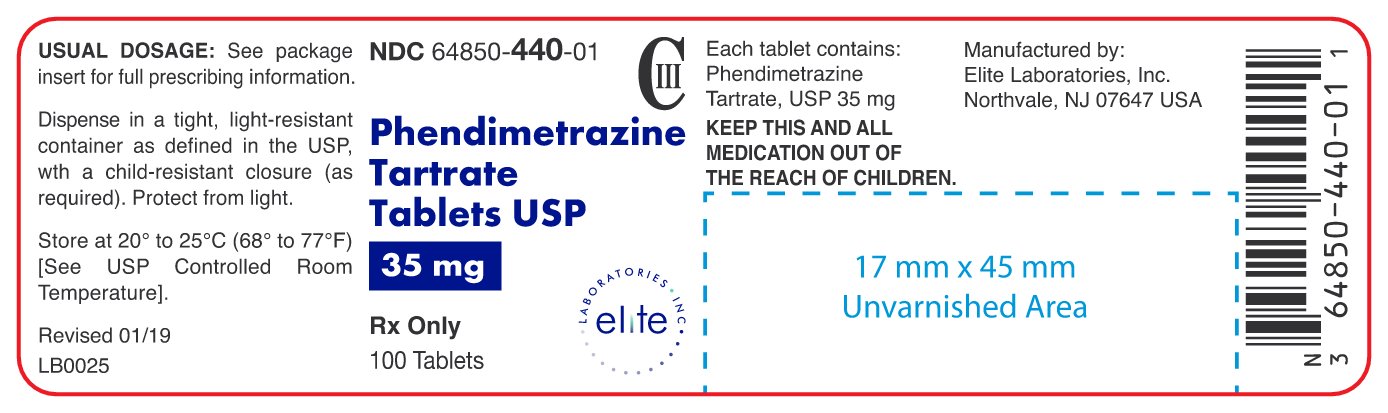
Phendimetrazine Tartrate 35 mg Tablet, 100-count — NDC 64850-440-01 (Billing 64850-0440-01)
This is a package of 100 tablets of Phendimetrazine Tartrate 35 mg Tablet from Elite Laboratories, Inc, marketed since Nov 2012 and currently FDA-listed; retail pharmacies pay about $0.1320 per tablet (NADAC). It is the main listing for this product, which comes in 2 package sizes.
Identity & classification
Regulatory identifiers FDA, NLM and CMS codes for this package
Drug-database identifiers Medi-Span GPI and First Databank GCN / HICL / AHFS classification
- GSN (GCN sequence number): 005170
- GCN: 20852
- GPI-14 (Medi-Span): 61200050100305
- HICL (First Databank): 002115
- AHFS class code: 28:20.08.04
- RxCUI (RxNorm): 979549
Where does this data come from?
- FDA openFDA NDC Directory · synced Oct 1, 2026
- FDA label on DailyMed · label index refreshed Oct 1, 2026
- RxNorm (NLM RxNav) · catalog refreshed Oct 1, 2026
- Medi-Span GPI (licensed)
- First Databank (licensed) · refreshed Oct 1, 2026
RxNorm drug class
This medicine belongs to the Sympathomimetic Amine Anorectic class.
Where does this data come from?
- RxClass (NLM) · catalog refreshed Oct 1, 2026
Clinical
Phendimetrazine is used as a short-term treatment with diet to help certain people who are obese to lose weight. Phendimetrazine is in a class of medications called central nervous system stimulants. It works by changing the amounts of certain natural substances in the brain
Read the full MedlinePlus article ↗- It's a short-term prescription aid for weight loss — not a cure for obesity. It works by stimulating your central nervous system in a way that may reduce your appetite, helping you...
- What exactly is phendimetrazine supposed to do for me?
- That's a decision your prescriber makes based on your situation. The tablet is taken two to three times a day before meals, while the extended-release capsule is taken just once in...
- How do I know which form — the tablet or the extended-release capsule — is right for me?
Patient education
Supplement & herbal interactions
Some supplements/herbs that may interact with Phendimetrazine Tartrate — tap one for details:
Where does this data come from?
- MedlinePlus (NLM) · refreshed Oct 1, 2026
- FDA label on DailyMed · label index refreshed Oct 1, 2026
Ask a licensed pharmacist directly — free, answered by our team.
Pricing
A drug doesn't have one price. Each row is a different public payment system, and none is what you'd pay at the counter — that depends on your insurance. The ⓘ on each row explains what it measures.
| Price system | Per ea | Per package |
|---|---|---|
| Retail pharmacies payNADAC · weekly | $0.132 | $13.20 / 100 tablets |
| Medicaid paysCMS SDUD · 12 mo | $0.1754 | $17.54 / 100 tablets |
| Medicare drug plans payPart D · quarterly | No Part D plan price is available for this NDC in our data. | |
Where does this data come from?
- CMS NADAC weekly file · file of Sep 30, 2026
- CMS ASP pricing files · refreshed Sep 20, 2026
- CMS Medicaid State Drug Utilization Data · through Q1 2026
- CMS Part D plan pricing files · refreshed Sep 24, 2026
- VA National Acquisition Center price file
Packaging — all sizes for this product
| Package NDC | Description | Per unit | Per pack | Marketing start | Marketing end | Status |
|---|---|---|---|---|---|---|
| 64850-0440-01 You're viewing this Main listing | 100 TABLET in 1 BOTTLE | $0.1320 / ea | $13.20 | 2012-11-20 | — | Active |
| 64850-0440-10 64850-440-10 | 1000 TABLET in 1 BOTTLE | $0.1320 / ea | $132.04 | 2012-11-20 | — | Active |
You're viewing the smallest of 2 pack sizes for this product.
This pack has the lowest per-ea cost of the 2 priced pack sizes ($0.1320 NADAC).
Pack size FAQ
What quantity is in this package?
How does this package differ from NDC 64850-0440-10?
What NDC number is used to bill for this package of Phendimetrazine Tartrate 35 mg Tablet?
Prices are the latest CMS NADAC pharmacy acquisition cost per NDC; per-pack figures are per-unit × pack quantity, shown only when the pack is denominated in the same measure NADAC prices.
Therapeutic equivalents
| Product | Labeler | Pack | NADAC/unit | TE | Status | Price vs. this |
|---|---|---|---|---|---|---|
| Phendimetrazine Tartrate 35 mg 10702-0077-01 | KVK-TECH, | 100 tablets | $0.132 | AA | Availability likely | — |
| Phendimetrazine Tartrate 35 mgthis 64850-0440-01 | Elite | 100 tablets | $0.132 | AA | Availability likely | — |
| Phendimetrazine Tartrate 35 mg 69543-0410-10 | Virtus | 100 tablets | $0.132 | AA | Availability likely | — |
| Phendimetrazine Tartrate 35 mg 10702-0045-01 | KVK-TECH, | 100 tablets | — | AA | FDA listed | — |
| Phendimetrazine Tartrate 35 mg 10702-0078-01 | KVK-TECH, | 100 tablets | — | AA | FDA listed | — |
| Phendimetrazine Tartrate 35 mg 17224-0800-28 | Calvin | 28 tablets | — | AA | FDA listed | — |
| Phendimetrazine Tartrate 35 mg 43063-0510-07 | PD-Rx | 7 tablets | — | AA | FDA listed | — |
| Phendimetrazine Tartrate 35 mg 50090-0715-00 | A-S | 30 tablets | — | AA | FDA listed | — |
| Phendimetrazine Tartrate 35 mg 50090-2235-00 | A-S | 100 tablets | — | AA | Discontinued | — |
| Phendimetrazine Tartrate 35 mg 50090-6552-02 | A-S | 90 tablets | — | AA | FDA listed | — |
| Phendimetrazine Tartrate 35 mg 63629-2489-01 | Bryant | 1000 tablets | — | AA | FDA listed | — |
| Phendimetrazine Tartrate 35 mg 66267-0394-60 | NuCare | 60 tablets | — | AA | FDA listed | — |
| Phendimetrazine Tartrate 35 mg 68071-3509-06 | NuCare | 60 tablets | — | AA | FDA listed | — |
| Phendimetrazine Tartrate 35 mg 68071-3839-09 | NuCare | 90 tablets | — | AA | FDA listed | — |
| Phendimetrazine Tartrate 35 mg 68788-7236-01 | Preferred | 14 tablets | — | AA | FDA listed | — |
| Phendimetrazine Tartrate 35 mg 71335-0074-00 | Bryant | 120 tablets | — | AA | FDA listed | — |
| Phendimetrazine Tartrate 35 mg 71335-0324-00 | Bryant | 120 tablets | — | AA | FDA listed | — |
| Phendimetrazine Tartrate 35 mg 71335-1840-00 | Bryant | 120 tablets | — | AA | FDA listed | — |
| Phendimetrazine Tartrate 35 mg 72162-2044-00 | Bryant | 1000 tablets | — | AA | FDA listed | — |
Where does this data come from?
- FDA openFDA NDC Directory · synced Oct 1, 2026
- FDA Orange Book · refreshed Sep 3, 2026
- CMS NADAC weekly file · file of Sep 30, 2026
Availability & generic status
This product is an FDA-approved generic. Other versions of the same drug are listed under Therapeutic equivalents, least expensive first.
Where does this data come from?
- FDA Orange Book · refreshed Sep 3, 2026
What it looks like
Where does this data come from?
- FDA label on DailyMed · label index refreshed Oct 1, 2026
Inactive Ingredients / Excipients
Inactive ingredients, also called excipients, are components of the drug product other than the active ingredient. They may include fillers, dyes, coatings, preservatives, flavors, or other formulation ingredients.
💡 Tap an ingredient (hover on desktop) to see what it is and why it’s used.
-
UNII OP1R32D61U
Microcrystalline cellulose is a purified form of cellulose, a natural fiber from plant sources. It acts as a binder and filler in tablets and capsules, helping hold ingredients together and give the medicine its shape and size.
-
UNII 35SW5USQ3G
A synthetic yellow dye used to color medicines. It helps make tablets, capsules, and liquids visually distinct so patients can easily identify their medication.
-
UNII EWQ57Q8I5X
Lactose monohydrate is a natural sugar derived from milk. It serves as a filler and binder in tablets and capsules, helping create the proper size, texture, and consistency of the medicine.
-
UNII 70097M6I30
Magnesium stearate is a salt made from magnesium and stearic acid, a fatty substance. It's used in tablets and capsules as a lubricant and glidant to help ingredients flow smoothly during manufacturing and prevent sticking.
-
UNII ETJ7Z6XBU4
Silicon dioxide is a naturally occurring mineral used as a glidant and anti-caking agent. It helps powder ingredients flow smoothly and prevents clumping during manufacturing and storage.
-
UNII AG9B65PV6B
A starch derivative made from corn that helps tablets and capsules break apart quickly when swallowed. It acts as a disintegrant, allowing the medicine to dissolve and be absorbed in your stomach and intestines.
6 inactive ingredients listed in the exact product block matched to this NDC.
Where does this data come from?
ingredient classCode="IACT" elements from the exact product block matched by this NDC. Label-section narrative from DailyMed / the openFDA label index is shown separately when available.- FDA label on DailyMed · label index refreshed Oct 1, 2026
- FDA openFDA NDC Directory · synced Oct 1, 2026
Inactive ingredient FAQ
Are inactive ingredients the same for every manufacturer?
Why might an inactive ingredient be missing?
Can inactive ingredients matter?
Manufacturer & labeler
Where does this data come from?
- FDA openFDA NDC Directory · synced Oct 1, 2026
- Drugs@FDA
Full prescribing information FDA SPL
🎯 Indications and Usage ▾
INDICATIONS AND USAGE Phendimetrazine tartrate is indicated in the management of exogenous obesity as a short term adjunct (a few weeks) in a regimen of weight reduction based on caloric restriction in patients with an initial body mass index (BMI) of 30 kg/m 2 or higher who have not responded to appropriate weight reducing regimen (diet and/or exercise) alone. Below is a chart of Body Mass Index (BMI) based on various heights and weights. BMI is calculated by taking the patient’s weight in kilograms (kg), divided by the patient’s height, in meters (m), squared.
Metric conversions are as follow: pounds ÷ 2.2 = kg; inches x 0.0254 = meters. BODY MASS INDEX (BMI), kg/m 2 Height (feet, inches) Weight 5’0” 5’3” 5’6” 5’9” 6’0” 6’3” (pounds) 140 27 25 23 21 19 18 150 29 27 24 22 20 19 160 31 28 26 24 22 20 170 33 30 28 25 23 21 180 35 32 29 27 25 23 190 37 34 31 28 26 24 200 39 36 32 30 27 25 210 41 37 34 31 29 26 220 43 39 36 33 30 28 230 45 41 37 34 31 29 240 47 43 39 36 33 30 250 49 44 40 37 34 31 Phendimetrazine tartrate is indicated for the use as monotherapy only
⏱️ Dosage and Administration ▾
DOSAGE AND ADMINISTRATION Usual Adult Dosage: 1 tablet (35 mg) twice a day or three times a day one hour before meals. Dosage should be individualized to obtain an adequate response with the lowest effective dosage. In some cases, 1/2 tablet (17.5 mg) per dose may be adequate. Dosage should not exceed 2 tablets three times a day.
⛔ Contraindications ▾
CONTRAINDICATIONS Known hypersensitivity or idiosyncratic reactions to sympathomimetics. Advanced arteriosclerosis, symptomatic cardiovascular disease, moderate and severe hypertension, hyperthyroidism, and glaucoma. Highly nervous or agitated patients. Patients with a history of drug abuse. Patients taking other CNS stimulants, including monoamine oxidase inhibitors
⚠️ Warnings ▾
WARNINGS Phendimetrazine tartrate should not be used in combination with other anorectic agents, including prescribed drugs, over-the-counter preparations and herbal products. In a case-control epidemiological study, the use of anorectic agents, including phendimetrazine tartrate, was associated with an increased risk of developing pulmonary hypertension, a rare, but often fatal disorder. The use of anorectic agents for longer than three months was associated with a 23-fold increase in the risk of developing pulmonary hypertension.
Increased risk of pulmonary hypertension with repeated courses of therapy cannot be excluded. The onset or aggravation of exertional dyspnea, or unexplained symptoms of angina pectoris, syncope, or lower extremity edema suggest the possibility of occurrence of pulmonary hypertension. Under these circumstances, phendimetrazine tartrate should be immediately discontinued, and the patient should be evaluated for the possible presence of pulmonary hypertension.
Valvular heart disease associated with the use of some anorectic agents such as fenfluramine and dexfenfluramine has been reported. Possible contributing factors include use for extended periods of time, higher than recommended dose, and/or use in combination with other anorectic drugs. However, no cases of this valvulopathy have been reported when phendimetrazine tartrate has been used alone.
The potential risk of possible serious adverse effects such as valvular heart disease and pulmonary hypertension should be assessed carefully against the potential benefit of weight loss. Baseline cardiac evaluation should be considered to detect pre-existing valvular heart diseases or pulmonary hypertension prior to initiation of phendimetrazine treatment. Phendimetrazine tartrate is not recommended in patients with known heart murmur or valvular heart disease.
Echocardiogram during and after treatment could be useful for detecting any valvular disorders which may occur. To limit unwarranted exposure and risks, treatment with phendimetrazine tartrate should be continued only if the patient has satisfactory weight loss within the first 4 weeks of treatment (i.e., weight loss of at least 4 pounds, or as determined by the physician and patient). Tolerance to the anorectic effect of phendimetrazine develops within a few weeks.
When this occurs, its use should be discontinued; the maximum recommended dose should not be exceeded. Use of phendimetrazine tartrate within 14 days following the administration of monoamine oxidase inhibitors may result in a hypertensive crisis. Abrupt cessation of administration following prolonged high dosage results in extreme fatigue and depression.
Because of the effect on the central nervous system, phendimetrazine tartrate may impair the ability of the patient to engage in potentially hazardous activities such as operating machinery or driving a motor vehicle; the patient should therefore be cautioned accordingly. Phendimetrazine tartrate is not recommended for patients who used any anorectic agents within the prior year.
🤒 Adverse Reactions ▾
ADVERSE REACTIONS Cardiovascular: Palpitation, tachycardia, elevated blood pressure, ischemic events. Valvular heart disease associated with the use of some anorectic agents such as fenfluramine and dexfenfluramine, both independently and especially when used in combination with other anorectic drugs, have been reported. However, no case of this valvulopathy has been reported when phendimetrazine tartrate has been used alone.
Central Nervous System: Overstimulation, restlessness, insomnia, agitation, flushing, tremor, sweating, dizziness, headache, psychotic state, blurring of vision. Gastrointestinal: Dryness of the mouth, nausea, diarrhea, constipation, stomach pain. Genitourinary: Urinary frequency, dysuria, changes in libido.
🔄 Drug Interactions ▾
Interactions Drug Interactions Efficacy of phendimetrazine tartrate with other anorectic agents has not been studied and the combined use may have the potential for serious cardiac problems. Drug/Laboratory Test Interactions
Drug Interactions Efficacy of phendimetrazine tartrate with other anorectic agents has not been studied and the combined use may have the potential for serious cardiac problems.
🔄 Drug / Laboratory Test Interactions ▾
Drug/Laboratory Test Interactions
🤰 Pregnancy ▾
Pregnancy Pregnancy Category C Studies with Phendimetrazine Tartrate have not been performed to evaluate carcinogenic potential, mutagenic potential or effects on fertility. Usage in Pregnancy Safe use in pregnancy has not been established. Until more information is available, phendimetrazine tartrate should not be taken by women who are or may become pregnant unless, in the opinion of the physician, the potential benefits outweigh the possible hazards.
🧒 Pediatric Use ▾
Pediatric Use Safety and effectiveness in pediatric patients have not been established.
🆘 Overdosage ▾
OVERDOSAGE Acute overdosage with phendimetrazine tartrate may manifest itself by the following signs and symptoms: unusual restlessness, confusion, belligerence, hallucinations, and panic states. Fatigue and depression usually follow the central stimulation. Cardiovascular effects include arrhythmias, hypertension, or hypotension and circulatory collapse.
Gastrointestinal symptoms include nausea, vomiting, diarrhea, and abdominal cramps. Poisoning may result in convulsions, coma, and death. The management of overdosage is largely symptomatic.
It includes sedation with a barbiturate. If hypertension is marked, the use of a nitrate or rapid-acting alpha receptor-blocking agent should be considered. Experience with hemodialysis or peritoneal dialysis is inadequate to permit recommendations for its use.
🧬 Clinical Pharmacology ▾
CLINICAL PHARMACOLOGY Phendimetrazine tartrate is a sympathomimetic amine with pharmacological activity similar to the prototype drugs of this class used in obesity, the amphetamines. Actions include central nervous system stimulation and elevation of blood pressure. Tachyphylaxis and tolerance have been demonstrated with all drugs of this class in which these phenomena have been looked for.
Drugs of this class used in obesity are commonly known as “anorectics” or “anorexigenics”. It has not been established, however, that the action of such drugs in treating obesity is primarily one of appetite suppression. Other central nervous system actions or metabolic effects, may be involved for example.
Adult obese subjects instructed in dietary management and treated with anorectic drugs, lose more weight on the average than those treated with placebo and diet, as determined in relatively short term clinical trials. The magnitude of increased weight loss of drug-treated patients over placebo-treated patients is only a fraction of a pound a week. The rate of weight loss is greatest in the first weeks of therapy for both drug and placebo subjects and tends to decrease in succeeding weeks.
The possible origin of the increased weight loss due to the various drug effects is not established. The amount of weight loss associated with the use of an anorectic drug varies from trial to trial, and the increased weight loss appears to be related in part to variables other than the drug prescribed, such as the physician investigator, the population treated, and the diet prescribed. Studies do not permit conclusions as to the relative importance of the drug and non-drug factors on weight loss.
The natural history of obesity is measured in years, whereas the studies cited are restricted to a few weeks duration; thus, the total impact of drug-induced weight loss over that of diet alone must be considered clinically limited. The major route of elimination is via the kidneys where most of the drug and metabolites are excreted. Some of the drug is metabolized to phenmetrazine and also phendimetrazine-N-oxide.
The average half-life of elimination when studied under controlled conditions is about 3.7 hours for both the extended-release and immediate release forms. The absorption half-life of the drug and from the immediate release 35 mg phendimetrazine tablets is appreciably more rapid than the absorption rate of the drug from the extended-release formulation.
📦 How Supplied / Storage and Handling ▾
HOW SUPPLIED Phendimetrazine Tartrate Tablets, USP 35 mg are available as Yellow, round, biconvex tablets debossed “A 327” on bisected side. Available in bottles of 100’s (NDC 64850-440-01) and 1000’s (NDC 64850-440-10). Store at 20° to 25°C (68° to 77°F) [See USP Controlled Room Temperature]. Printed with food grade ink. Manufactured by: Elite Laboratories, Inc 165 Ludlow Avenue, Northvale, NJ 07647 USA IN0513 Rev. 01/2019
📋 Description ▾
DESCRIPTION Phendimetrazine tartrate, as the dextro isomer, has the chemical name of (2S,3S)-3,4-Dimethyl-2-phenylmorpholine L-(+)-tartrate (1:1). The structural formula is: Phendimetrazine tartrate is a white, odorless crystalline powder. It is freely soluble in water; sparingly soluble in warm alcohol, insoluble in chloroform, acetone, ether and benzene.
In addition, the following inactive ingredients are present: colloidal silicon dioxide, D&C Yellow #10 Aluminum Lake, lactose monohydrate, magnesium stearate, microcrystalline cellulose and sodium starch glycolate.
⚠️ Precautions ▾
PRECAUTIONS Caution is to be exercised in prescribing phendimetrazine for patients with even mild hypertension. Insulin requirements in diabetes mellitus may be altered in association with the use of phendimetrazine tartrate and the concomitant dietary regimen. Phendimetrazine tartrate may decrease the hypotensive effect of guanethidine.
The least amount feasible should be prescribed or dispensed at one time in order to minimize the possibility of overdosage. Interactions Drug Interactions Efficacy of phendimetrazine tartrate with other anorectic agents has not been studied and the combined use may have the potential for serious cardiac problems. Drug/Laboratory Test Interactions Carcinogenesis, Mutagenesis, Impairment of Fertility Studies with Phendimetrazine Tartrate have not been performed to evaluate carcinogenic potential, mutagenic potential or effects on fertility.
Pregnancy Pregnancy Category C Studies with Phendimetrazine Tartrate have not been performed to evaluate carcinogenic potential, mutagenic potential or effects on fertility. Usage in Pregnancy Safe use in pregnancy has not been established. Until more information is available, phendimetrazine tartrate should not be taken by women who are or may become pregnant unless, in the opinion of the physician, the potential benefits outweigh the possible hazards.
Labor and Delivery Nursing Mothers It is not known whether this drug is excreted in human milk. Because many drugs are excreted in human milk, phendimetrazine tartrate should not be taken by women who are nursing unless, in the opinion of the physician, the potential benefits outweigh the possible hazards. Pediatric Use Safety and effectiveness in pediatric patients have not been established.
🍼 Nursing Mothers ▾
Nursing Mothers It is not known whether this drug is excreted in human milk. Because many drugs are excreted in human milk, phendimetrazine tartrate should not be taken by women who are nursing unless, in the opinion of the physician, the potential benefits outweigh the possible hazards.
🔒 Drug Abuse and Dependence ▾
DRUG ABUSE AND DEPENDENCE Controlled Substance Phendimetrazine tartrate is a Schedule III controlled substance. Dependence Phendimetrazine tartrate is related chemically and pharmacologically to the amphetamines. Amphetamines and related stimulant drugs have been extensively abused, and the possibility of abuse of phendimetrazine should be kept in mind when evaluating the desirability of including a drug as part of a weight reduction program.
Abuse of amphetamines and related drugs may be associated with intense psychological dependence and severe social dysfunction. There are reports of patients who have increased the dosage to many times that recommended. Abrupt cessation following prolonged high dosage administration results in extreme fatigue and mental depression; changes are also noted on the sleep EEG.
Manifestations of chronic intoxication with anorectic drugs include severe dermatoses, marked insomnia, irritability, hyperactivity and personality changes. The most severe manifestation of chronic intoxications is psychosis, often clinically indistinguishable from schizophrenia.
🔒 Controlled Substance ▾
Controlled Substance Phendimetrazine tartrate is a Schedule III controlled substance.
📄 Carcinogenesis, Mutagenesis, Impairment of Fertility ▾
Carcinogenesis, Mutagenesis, Impairment of Fertility Studies with Phendimetrazine Tartrate have not been performed to evaluate carcinogenic potential, mutagenic potential or effects on fertility.
📄 Package Label / Principal Display Panel ▾
PRINCIPAL DISPLAY PANEL
PRINCIPAL DISPLAY PANEL