
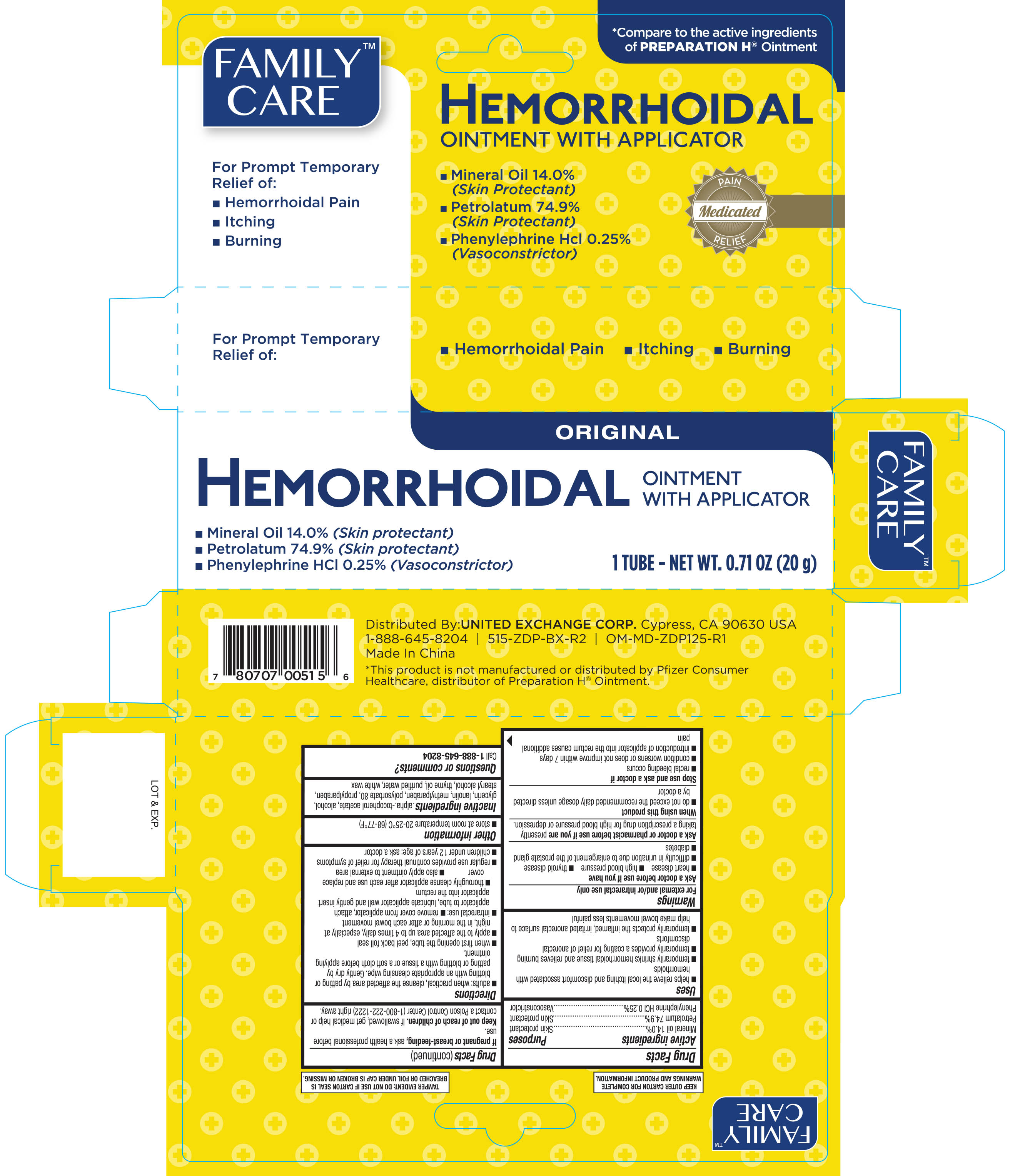
Family Care Hemorrhoidal Mineral oil 140 mg/100g; 749 mg/100g; 2.5 mg/100g Ointment — NDC 65923-003-20 (Billing 65923-0003-20)
This is a package of Family Care Hemorrhoidal Mineral oil 140 mg/100g; 749 mg/100g; 2.5 mg/100g Ointment from United Exchange Corp, marketed since Nov 2014 and currently FDA-listed. It is this product's only package size.
NDC database record
One package, one record: these facts belong to NDC 65923-003-20 alone.
- Record
- FDA NDC Directory package listing · Human OTC drug
- Code segments
- 65923 labeler · 003 product · 20 package
- Package marketed since
- Nov 24, 2014
- Sample package
- No — commercial package
- Listing certified through
- Dec 31, 2026
- Barcode (UPC)
- 0780707005156
- FDA record last changed
- Jul 24, 2026
Identity & classification
Regulatory identifiers FDA, NLM and CMS codes for this package
Where does this data come from?
- FDA openFDA NDC Directory · synced Oct 8, 2026
- FDA label on DailyMed · label index refreshed Oct 8, 2026
- RxNorm (NLM RxNav) · catalog refreshed Oct 8, 2026
- Medi-Span GPI (licensed)
- First Databank (licensed) · refreshed Oct 8, 2026
Clinical
- Mostly for occasional constipation, by mouth or as an enema. Some enemas are also used for fecal impaction or to clear residue after a barium test. One topical product is used for...
- Take it only at bedtime and not with meals. It usually works in about 6 to 8 hours. An enema usually works within 2 to 15 minutes.
- Space it out. Take mineral oil 2 or more hours before or after other drugs, since laxatives may affect how they work. Tell me if you take a stool softener.
- Not longer than 1 week. If constipation continues or your bowel habits suddenly change for 2 weeks, see your doctor.
Patient education
Supplement & herbal interactions
Some supplements/herbs that may interact with Mineral Oil — tap one for details:
Mineral Oil may be associated with lower levels of 7 nutrients — worth a chat with your pharmacist, not a cause for alarm.
Where does this data come from?
- MedlinePlus (NLM) · refreshed Oct 8, 2026
- FDA label on DailyMed · label index refreshed Oct 8, 2026
Ask a licensed pharmacist directly — free, answered by our team.
Pricing
A drug doesn't have one price. Each row is a different public payment system, and none is what you'd pay at the counter — that depends on your insurance. The ⓘ on each row explains what it measures.
| Price system | Per g | Per package |
|---|---|---|
| Retail pharmacies payNADAC · weekly | Not in the retail survey — common for institutional, discontinued, or low-volume packs. | |
| Medicaid paysCMS SDUD · 12 mo | No recent Medicaid claims on file for this NDC — rare and low-volume NDCs are suppressed in the public data. | |
| Medicare drug plans payPart D · quarterly | No Part D plan price is available for this NDC in our data. | |
Where does this data come from?
- CMS NADAC weekly file
- CMS ASP pricing files · refreshed Sep 20, 2026
- CMS Medicaid State Drug Utilization Data · refreshed Oct 9, 2026
- CMS Part D plan pricing files · refreshed Sep 24, 2026
- VA National Acquisition Center price file
Packaging — all sizes for this product
| Package NDC | Description | Marketing start | Marketing end | Status |
|---|---|---|---|---|
| 65923-0003-20 You're viewing this Main listing | 1 TUBE in 1 CARTON / 20 g in 1 TUBE | 2014-11-24 | — | Active |
Therapeutic equivalents
| Product | Labeler | Pack | NADAC/unit | TE | Status | Price vs. this |
|---|---|---|---|---|---|---|
| Family Care Hemorrhoidal 140 mg/100g; 749 mg/100g; 2.5 mg/100gthis 65923-0003-20 | United | 1 tube | — | — | FDA listed | — |
Where does this data come from?
- FDA openFDA NDC Directory · synced Oct 8, 2026
- FDA Orange Book · refreshed Oct 3, 2026
- CMS NADAC weekly file
Availability & generic status
We did not find an FDA-approved generic match for this exact strength, form and route.
Where does this data come from?
- FDA Orange Book · refreshed Oct 3, 2026
Inactive Ingredients / Excipients
Inactive ingredients, also called excipients, are components of the drug product other than the active ingredient. They may include fillers, dyes, coatings, preservatives, flavors, or other formulation ingredients.
🧪 Avoiding an ingredient? See Mineral Oil inactive ingredients by manufacturer: every current product's list side by side, so you can ask your pharmacy for the version that does not list it.
💡 Tap an ingredient (hover on desktop) to see what it is and why it’s used.
-
UNII 3K9958V90M
A liquid solvent derived from fermentation or chemical synthesis. In medicines, alcohol dissolves active ingredients, helps preserve the product, and improves how the body absorbs certain drugs.
-
UNII 9E8X80D2L0
A synthetic form of vitamin E used as an antioxidant and preservative in medications. It helps prevent the active ingredients from degrading when exposed to oxygen or light.
-
UNII PDC6A3C0OX
Glycerin is a clear, thick liquid derived from plant oils or fats. It acts as a humectant to retain moisture, a sweetener, and a solvent in medications.
-
UNII 7EV65EAW6H
Lanolin is a waxy substance derived from sheep's wool. It's used in medicines as an emollient and skin-conditioning agent to soften formulations and improve spreadability in topical products like creams and ointments.
-
UNII A2I8C7HI9T
Methylparaben is a preservative derived from benzoic acid that prevents growth of bacteria, fungi, and mold in medicines. It extends the product's shelf life and maintains safety during storage.
-
UNII 6OZP39ZG8H
Polysorbate 80 is a synthetic emulsifier derived from sorbitol and oleic acid. It helps mix oil and water-based ingredients together in medications and improves how the product disperses in the body.
-
UNII Z8IX2SC1OH
Propylparaben is a chemical preservative used to prevent bacterial and fungal growth in medicines and personal care products. It helps extend shelf life and maintain product safety during storage.
-
UNII 2KR89I4H1Y
Stearyl alcohol is a waxy, fatty substance derived from natural oils or made synthetically. It acts as an emulsifier and thickener in medicines, helping mix ingredients together and give the product the right texture.
-
UNII 2UK410MY6B
Thyme oil is an essential oil extracted from the thyme plant. It's used in medicines as a flavoring agent and preservative to improve taste and help maintain product stability.
-
UNII 059QF0KO0R
Water is a liquid solvent that dissolves and mixes ingredients together in liquid medicines, syrups, and injections. It helps distribute the active drug evenly throughout the product.
-
UNII 7G1J5DA97F
White wax is a refined, bleached plant-based or mineral wax that serves as a coating and hardening agent in medicines. It helps control how fast the drug dissolves and improves the product's texture and appearance.
11 inactive ingredients listed in the exact product block matched to this NDC.
Label-section wording can be broader than the structured product block and may mention additional formulation ingredients.
Where does this data come from?
ingredient classCode="IACT" elements from the exact product block matched by this NDC. Label-section narrative from DailyMed / the openFDA label index is shown separately when available.- FDA label on DailyMed · label index refreshed Oct 8, 2026
- FDA openFDA NDC Directory · synced Oct 8, 2026
Inactive ingredient FAQ
Are inactive ingredients the same for every manufacturer?
Why might an inactive ingredient be missing?
Can inactive ingredients matter?
Manufacturer & labeler
More NDCs from United Exchange Corp labeler code 65923
- Family Care Antifungal Tolnaftate 10 mg/g Cream NDC 65923-021-28
- Gelmicin Hydrocortisone with Aloe 1 g/100g Cream NDC 65923-035-40
- Family Care Antifungal Clotrimazole 10 mg/g Cream NDC 65923-052-28
- Iodent Oral Analgesic Benzocaine 200 mg/g Gel NDC 65923-094-11
- Family Care Maximum Strength Medicated Anti Itch Menthol 10 mg/g; 10 mg/g Cream NDC 65923-104-14
- Coralite Extra Strength Pain Relief Sleeve Knee Menthol 336 mg Patch NDC 65923-121-01
Where does this data come from?
- FDA openFDA NDC Directory · synced Oct 8, 2026
- Drugs@FDA
FDA label — Drug Facts FDA SPL
🎯 Indications and Usage ▾
Directions adults: when practical, cleanse the affected area by patting or blotting with an appropriate cleansing wipe. Gently dry by patting or blotting with a tissue or a soft cloth before applying ointment when first opening tube, peel back foil seal apply to the affected area up to 4 times daily, especially at night, in the morning or after each bowel movement intrarectal use: remove cover from applicator, attach applicator to tube, lubricate applicator well and gently insert applicator into the rectum thoroughly cleanse applicator after each use and replace cover also apply ointment to external area regular use provides continual therapy for relief of symptoms children under 12 years of age: ask a doctor
⏱️ Dosage and Administration ▾
Distributed by: United Exchange Corp Cypress, CA 90630 USA Made in China
⚠️ Warnings ▾
Warnings For external use only / or intrarectal use only
📦 Storage and Handling ▾
Other information store at 20° C to 25°C (68° to 77°F)
🧪 Active Ingredient ▾
Active ingredients Purpose Mineral oil 14%.........................................................Protectant Petrolatum 74.9%.....................................................Protectant Phenylephrine HCl 0.25%...................................Vasoconstrictor
🧪 Inactive Ingredients ▾
Inactive ingredients .alpha.-tocopherol acetate, alcohol, glycerin, lanolin, methylparaben, polysorbate 80, propylparaben, stearyl alcohol, thyme oil, purified water, white wax
🎯 Purpose ▾
Uses helps relieve the local itching and discomfort associated with hemorrhoids temporarily shrinks hemorrhoidal tissue and relieve burning temporarily provides a coating for relief of anorectal discomforts temporarily protects the inflamed, irritated anorectal surface to help make bowel movements less painful
📄 Ask a Doctor Before Use If ▾
Ask a doctor before use if you have heart disease high blood pressure thyroid disease difficulty in urination due to enlargement of the prostate gland diabetes
📄 Ask a Doctor or Pharmacist Before Use If ▾
Ask a doctor or a pharmacist before use if you are now taking a prescription drug for high blood pressure or depression
📄 When Using This Product ▾
When using this product do not use more than the recommended daily dosage unless directed by a doctor
📄 Stop Use and Ask a Doctor If ▾
Stop use and ask a doctor if rectal bleeding occurs condition gets worse or does not get better within 7 days introduction of applicator into the rectum causes additional pain
🤰 If Pregnant or Breast-Feeding ▾
If pregnant or breast-feeding, ask a physician before use.
📄 Keep Out of Reach of Children ▾
Keep out of reach of children. If swallowed, get medical help or contact a Poison Control Center right away.
📄 Package Label / Principal Display Panel ▾
515
About this NDC listing & data coverage
What data is (and isn’t) available for this NDC — tap to expand
| NDC identity (package / product / labeler codes) | ✓ Available |
| Labeler | ✓ Available |
| Product & package description | ✓ Available |
| Marketing category & status | ✓ Available |
| Active ingredient / dosage form / route | ✓ Available |
| FDA label (SPL via DailyMed) | ✓ Available |
| Package photos | ✓ Available |
| Inactive ingredients (structured) | ✓ Available |
| NADAC pharmacy acquisition price (CMS) | — Not published for this NDC CMS publishes NADAC only for NDCs reported in its retail-pharmacy survey. |
| Orange Book / therapeutic-equivalence data | — Not published for this NDC Applies only to products approved under an NDA/ANDA; many listings are out of scope. |
| HCPCS J-code billing crosswalk | — Not published for this NDC Most self-administered / retail products have no J-code — that is normal. |
| Medicaid utilization (CMS SDUD) | — Not published for this NDC CMS reports utilization only for NDCs with Medicaid claims above its privacy threshold. |