
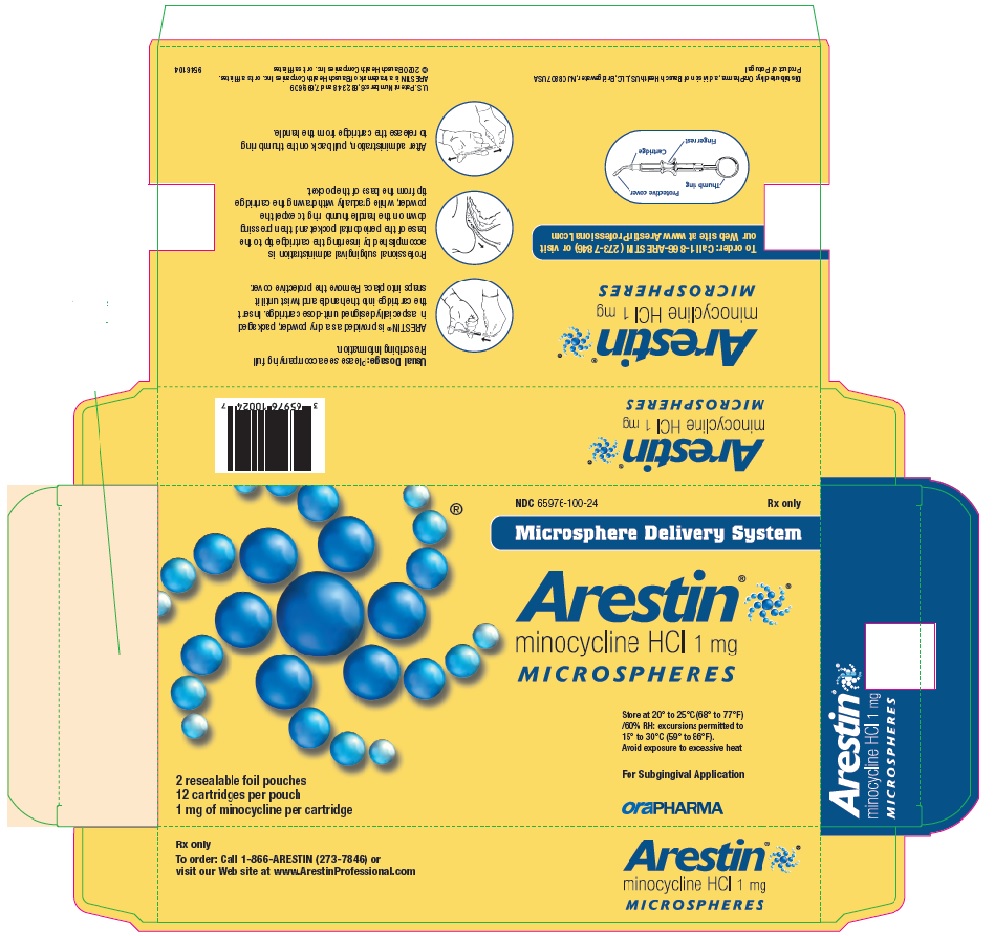
Arestin Minocycline Hydrochloride 1 mg Powder, 1 powder — NDC 65976-100-01 (Billing 65976-0100-01)
This is a package of 1 powder of Arestin Minocycline Hydrochloride 1 mg Powder from OraPharma, Inc., marketed since Mar 2011 and currently FDA-listed. It is the main listing for this product, which comes in 3 package sizes.
Other active recalls for Minocycline Hydrochloride (different manufacturers) — 1 · tap to view
Identity & classification
Regulatory identifiers FDA, NLM and CMS codes for this package
Drug-database identifiers Medi-Span GPI and First Databank GCN / HICL / AHFS classification
- GSN (GCN sequence number): 052126
- GCN: 19662
- GPI-14 (Medi-Span): 88452050106320
- HICL (First Databank): 025203
- AHFS class code: 08:12.24.00
- RxCUI (RxNorm): 351121
Where does this data come from?
- FDA openFDA NDC Directory · synced Oct 1, 2026
- FDA label on DailyMed · label index refreshed Oct 1, 2026
- RxNorm (NLM RxNav) · catalog refreshed Oct 1, 2026
- Medi-Span GPI (licensed)
- First Databank (licensed) · refreshed Oct 1, 2026
RxNorm drug class
This medicine belongs to the Tetracycline-class Drug class.
Where does this data come from?
- RxClass (NLM) · catalog refreshed Oct 1, 2026
Clinical
- It depends on the product. Capsules, tablets and IV minocycline treat certain bacterial infections. Extended-release tablets and Amzeeq foam treat inflammatory acne. Zilxi foam and...
- Minocycline capsules and regular tablets can be taken with or without food. Swallow them whole with a full glass of water. Avoid taking them right before lying down, since that is...
- Nausea, vomiting, diarrhea, headache and dizziness are possible. You may also sunburn more easily, so limit sun and tanning beds. Call your doctor if you have severe diarrhea, visi...
- These products can reduce how much minocycline your body absorbs. Ask me or your prescriber how to space them out. Also tell us if you take blood thinners, penicillin or isotretino...
Patient education
Supplement & herbal interactions
Some supplements/herbs that may interact with Minocycline Hydrochloride — tap one for details:
Minocycline Hydrochloride may be associated with lower levels of 11 nutrients — worth a chat with your pharmacist, not a cause for alarm.
Where does this data come from?
- MedlinePlus (NLM) · refreshed Oct 1, 2026
- FDA label on DailyMed · label index refreshed Oct 1, 2026
Ask a licensed pharmacist directly — free, answered by our team.
Pricing
A drug doesn't have one price. Each row is a different public payment system, and none is what you'd pay at the counter — that depends on your insurance. The ⓘ on each row explains what it measures.
| Price system | Per g | Per package |
|---|---|---|
| Retail pharmacies payNADAC · weekly | Not in the retail survey — common for institutional, discontinued, or low-volume packs. | |
| Medicaid paysCMS SDUD · 12 mo | No recent Medicaid claims on file for this NDC — rare and low-volume NDCs are suppressed in the public data. | |
| Medicare drug plans payPart D · quarterly | No Part D plan price is available for this NDC in our data. | |
Where does this data come from?
- CMS NADAC weekly file
- CMS ASP pricing files · refreshed Sep 20, 2026
- CMS Medicaid State Drug Utilization Data · refreshed Oct 3, 2026
- CMS Part D plan pricing files · refreshed Sep 24, 2026
- VA National Acquisition Center price file
Packaging — all sizes for this product
| Package NDC | Description | Marketing start | Marketing end | Status |
|---|---|---|---|---|
| 65976-0100-01 You're viewing this Main listing | 1 POWDER in 1 POUCH | 2011-03-21 | — | Active |
| 65976-0100-12 65976-100-12 | 1 POUCH in 1 BOX / 1 TRAY in 1 POUCH / 12 POWDER in 1 TRAY | 2011-03-21 | — | Active |
| 65976-0100-24 65976-100-24 | 2 POUCH in 1 BOX / 1 TRAY in 1 POUCH / 12 POWDER in 1 TRAY | 2011-03-21 | — | Active |
Pack size FAQ
What quantity is in this package?
What NDC number is used to bill for this package of Arestin Minocycline Hydrochloride 1 mg Powder?
Therapeutic equivalents
| Product | Labeler | Pack | NADAC/unit | TE | Status | Price vs. this |
|---|---|---|---|---|---|---|
| Arestin 1 mgthis 65976-0100-01 | OraPharma, | 1 powder | — | — | FDA listed | — |
Where does this data come from?
- FDA openFDA NDC Directory · synced Oct 1, 2026
- FDA Orange Book · refreshed Sep 3, 2026
- CMS NADAC weekly file
Availability & generic status
We did not find an FDA-approved generic match for this exact strength, form and route.
Where does this data come from?
- FDA Orange Book · refreshed Sep 3, 2026
Inactive Ingredients / Excipients
Inactive ingredients, also called excipients, are components of the drug product other than the active ingredient. They may include fillers, dyes, coatings, preservatives, flavors, or other formulation ingredients.
Where does this data come from?
IACT rows and label-wide narrative are kept separate; availability and product-level specificity depend on the submitted label.- FDA label on DailyMed · label index refreshed Oct 1, 2026
- FDA openFDA NDC Directory · synced Oct 1, 2026
Inactive ingredient FAQ
Are inactive ingredients the same for every manufacturer?
Why might an inactive ingredient be missing?
Can inactive ingredients matter?
Manufacturer & labeler
Where does this data come from?
- FDA openFDA NDC Directory · synced Oct 1, 2026
- Drugs@FDA
Full prescribing information FDA SPL
🎯 Indications and Usage ▾
INDICATIONS AND USE ARESTIN is indicated as an adjunct to scaling and root planing procedures for reduction of pocket depth in patients with adult periodontitis. ARESTIN may be used as part of a periodontal maintenance program which includes good oral hygiene and scaling and root planing.
⏱️ Dosage and Administration ▾
DOSAGE AND ADMINISTRATION ARESTIN is provided as a dry powder, packaged in a unit-dose cartridge with a deformable tip (see Figure 1), which is inserted into a spring-loaded cartridge handle mechanism (see Figure 2) to administer the product. The oral health care professional removes the disposable cartridge from its pouch and connects the cartridge to the handle mechanism (see Figures 3-4 ). ARESTIN is a variable dose product, dependent on the size, shape, and number of pockets being treated.
In US clinical trials, up to 122 unit-dose cartridges were used in a single visit and up to 3 treatments, at 3-month intervals, were administered in pockets with pocket depth of 5 mm or greater. The administration of ARESTIN does not require local anesthesia. Professional subgingival administration is accomplished by inserting the unit-dose cartridge to the base of the periodontal pocket and then pressing the thumb ring in the handle mechanism to expel the powder while gradually withdrawing the tip from the base of the pocket.
The handle mechanism should be sterilized between patients. ARESTIN does not have to be removed, as it is bioresorbable, nor is an adhesive or dressing required. Arestin figures.jpg
⛔ Contraindications ▾
CONTRAINDICATIONS ARESTIN should not be used in any patient who has a known sensitivity to minocycline or tetracyclines.
⚠️ Warnings ▾
WARNINGS THE USE OF DRUGS OF THE TETRACYCLINE CLASS DURING TOOTH DEVELOPMENT (LAST HALF OF PREGNANCY, INFANCY, AND CHILDHOOD TO THE AGE OF 8 YEARS) MAY CAUSE PERMANENT DISCOLORATION OF THE TEETH (YELLOW-GRAY BROWN). This adverse reaction is more common during long-term use of the drugs, but has been observed following repeated short-term courses. Enamel hypoplasia has also been reported.
TETRACYCLINE DRUGS, THEREFORE, SHOULD NOT BE USED IN THIS AGE GROUP, OR IN PREGNANT OR NURSING WOMEN, UNLESS THE POTENTIAL BENEFITS ARE CONSIDERED TO OUTWEIGH THE POTENTIAL RISKS. Results of animal studies indicate that tetracyclines cross the placenta, are found in fetal tissues, and can have toxic effects on the developing fetus (often related to retardation of skeletal development). Evidence of embryotoxicity has also been noted in animals treated early in pregnancy.
If any tetracyclines are used during pregnancy, or if the patient becomes pregnant while taking this drug, the patient should be apprised of the potential hazard to the fetus. Photosensitivity manifested by an exaggerated sunburn reaction has been observed in some individuals taking tetracyclines. Patients apt to be exposed to direct sunlight or ultraviolet light should be advised that this reaction can occur with tetracycline drugs, and treatment should be discontinued at the first evidence of skin erythema.
🤒 Adverse Reactions ▾
ADVERSE REACTIONS The most frequently reported non-dental, treatment-emergent adverse events in the 3 multicenter US trials were headache, infection, flu syndrome, and pain. Table 5: Adverse Events (AEs) Reported in ≥3% of the Combined Clinical Trial Population of 3 Multicenter US Trials by Treatment Group SRP Alone N=250 SRP + Vehicle N=249 SRP + ARESTIN ® N=423 Number (%) of Subjects Treatment-emergent AEs 62.4% 71.9% 68.1% Total Number of AEs 543 589 987 Periodontitis 25.6% 28.1% 16.3% Tooth Disorder 12.0% 13.7% 12.3% Tooth Caries 9.2% 11.2% 9.9% Dental Pain 8.8% 8.8% 9.9% Gingivitis 7.2% 8.8% 9.2% Headache 7.2% 11.6% 9.0% Infection 8.0% 9.6% 7.6% Stomatitis 8.4% 6.8% 6.4% Mouth Ulceration 1.6% 3.2% 5.0% Flu Syndrome 3.2% 6.4% 5.0% Pharyngitis 3.2% 1.6% 4.3% Pain 4.0% 1.2% 4.3% Dyspepsia 2.0% 0 4.0% Infection Dental 4.0% 3.6% 3.8% Mucous Membrane Disorder 2.4% 0.8% 3.3% The change in clinical attachment levels was similar across all study arms, suggesting that neither the vehicle nor ARESTIN compromise clinical attachment.
Postmarketing Experience The following adverse reaction has been identified during postapproval use of minocycline products when taken orally. Because this reaction is reported voluntarily from a population of uncertain size, it is not always possible to reliably estimate their frequency or establish a causal relationship to drug exposure. Skin and subcutaneous tissue disorders: Acute febrile neutrophilic dermatosis (Sweet’s syndrome).
To report SUSPECTED ADVERSE REACTIONS, contact OraPharma at 1-800-321-4576 or FDA at 1-800-FDA-1088 or www.fda.gov/medwatch.
🧒 Pediatric Use ▾
Pediatric Use Since adult periodontitis does not affect children, the safety and effectiveness of ARESTIN in pediatric patients cannot be established.
🧬 Clinical Pharmacology ▾
CLINICAL PHARMACOLOGY Mechanism of Action The mechanism of action of ARESTIN as an adjunct to scaling and root planing procedures for reduction of pocket depth in patients with adult periodontitis is unknown. Microbiology Minocycline, a member of the tetracycline class of antibiotics, has a broad spectrum of activity. It is bacteriostatic and exerts its antimicrobial activity by inhibiting protein synthesis.
In vitro susceptibility testing has shown that the organisms Porphyromonas gingivalis, Prevotella intermedia, Fusobacterium nucleatum, Eikenella corrodens , and Actinobacillus actinomycetemcomitans , which are associated with periodontal disease, are susceptible to minocycline at concentrations of ≤8 mcg/mL; qualitative and quantitative changes in plaque microorganisms have not been demonstrated in subjects with periodontitis, using this product. The emergence of minocycline-resistant bacteria in single-site plaque samples was studied in subjects before and after treatment with ARESTIN at 2 centers.
There was a slight increase in the numbers of minocycline-resistant bacteria at the end of the 9-month study period; however, the number of subjects studied was small and the clinical significance of these findings is unknown. The emergence of minocycline-resistant bacteria and changes in the presence of Candida albicans and Staphylococcus aureus in the gastrointestinal tract were studied in subjects treated with ARESTIN in one phase 3 study. No changes in the presence of minocycline-resistant bacteria or Candida albicans or Staphylococcus aureus were seen at the end of the 56-day study period.
Pharmacokinetics In a pharmacokinetic study, 18 subjects (10 men and 8 women) with moderate to advanced chronic periodontitis were treated with a mean dose of 46.2 mg (25 to 112 unit doses) of ARESTIN. After fasting for at least 10 hours, subjects received subgingival application of ARESTIN (1 mg per treatment site) following scaling and root planing at a minimum of 30 sites on at least 8 teeth. Investigational drug was administered to all eligible sites ≥5 mm in probing depth.
Mean dose normalized saliva AUC and C max were found to be approximately 125 and 1000 times higher than those of serum parameters, respectively. Clinical Studies In 2 well-controlled, multicenter, investigator-blind, vehicle-controlled, parallel-design studies (3 arms), 748 subjects (study OPI-103A=368, study OPI-103B=380) with generalized moderate to advanced adult periodontitis characterized by a mean probing depth of 5.90 and 5.81 mm, respectively, were enrolled. Subjects received 1 of 3 treatments: (1) scaling and root planing (SRP), (2) SRP + vehicle (bioresorbable polymer, PGLA), and (3) SRP + ARESTIN.
To qualify for the study, subjects were required to have 4 teeth with periodontal pockets of 6 to 9 mm that bled on probing. However, treatment was administered to all sites with mean probing depths of 5 mm or greater. Subjects studied were in good general health.
Subjects with poor glycemic control or active infectious diseases were excluded from the studies. Retreatment occurred at 3 and 6 months after initial treatment, and any new site with pocket depth ≥5 mm also received treatment. Subjects treated with ARESTIN were found to have statistically significantly reduced probing pocket depth compared with those treated with SRP alone or SRP + vehicle at 9 months after initial treatment, as shown in Table 1 .
Table 1: Probing Pocket Depth at Baseline and Change in Pocket Depth at 9 Months from 2 Multicenter US Clinical Trials Time Study OPI-103A N=368 Study OPI-103B N=380 SRP Alone n=124 SRP + Vehicle n=123 SRP + ARESTIN n=121 SRP Alone n=126 SRP + Vehicle n=126 SRP + ARESTIN n=128 SE = standard error; SRP = scaling and root planing; PD = pocket depth Significantly different from SRP: *(P ≤0.05); **(P ≤0.001) Significantly different from SRP + vehicle: †† (P ≤0.001) PD (mm) at Baseline [Mean ± SE] 5.88 5.91 5.88 5.79 5.82 5.81 ±0.04 ±0.04 ±0.04 ±0.03 ±0.04 ±0.0… [Excerpted — this section continues on DailyMed.]
🧬 Mechanism of Action ▾
Mechanism of Action The mechanism of action of ARESTIN as an adjunct to scaling and root planing procedures for reduction of pocket depth in patients with adult periodontitis is unknown.
📦 How Supplied / Storage and Handling ▾
HOW SUPPLIED ARESTIN ® (minocycline hydrochloride) microspheres, 1 mg is supplied as follows: NDC 65976-100-01 1 unit-dose cartridge with desiccant in a heat-sealed, foil-laminated pouch NDC 65976-100-24 12 unit-dose cartridges in 1 tray with desiccant in a heat-sealed, foil-laminated, resealable pouch. There are 2 pouches in each box. Each unit-dose cartridge contains the product identifier “OP-1.” Storage Conditions Store at 20° to 25°C (68° to 77°F)/60% RH: excursions permitted to 15° to 30°C (59° to 86°F).
Avoid exposure to excessive heat.
📦 Storage and Handling ▾
Storage Conditions Store at 20° to 25°C (68° to 77°F)/60% RH: excursions permitted to 15° to 30°C (59° to 86°F). Avoid exposure to excessive heat.
📋 Description ▾
DESCRIPTION ARESTIN (minocycline hydrochloride) microspheres, 1 mg is a subgingival sustained-release product containing the antibiotic minocycline hydrochloride incorporated into a bioresorbable polymer, Poly (glycolide-co-dl-lactide) or PGLA, for professional subgingival administration into periodontal pockets. Each unit-dose cartridge delivers minocycline hydrochloride equivalent to 1 mg of minocycline free base. The molecular formula of minocycline hydrochloride is C 23 H 27 N 3 O 7 ● HCl, and the molecular weight is 493.94.
The structural formula of minocycline hydrochloride is: image-01.jpg
💬 Information for Patients ▾
Information for Patients After treatment, patients should avoid chewing hard, crunchy, or sticky foods (i.e., carrots, taffy, and gum) with the treated teeth for 1 week, as well as avoid touching treated areas. Patients should also postpone the use of interproximal cleaning devices around the treated sites for 10 days after administration of ARESTIN. Patients should be advised that although some mild to moderate sensitivity is expected during the first week after SRP and administration of ARESTIN, they should notify the dentist promptly if pain, swelling, or other problems occur.
Patients should be notified to inform the dentist if itching, swelling, rash, papules, reddening, difficulty breathing, or other signs and symptoms of possible hypersensitivity occur.
⚠️ Precautions ▾
PRECAUTIONS Hypersensitivity Reactions and Hypersensitivity Syndrome The following adverse events have been reported with minocycline products when taken orally. Hypersensitivity reactions and hypersensitivity syndrome that included, but were not limited to anaphylaxis, anaphylactoid reaction, angioneurotic edema, urticaria, rash, eosinophilia, and one or more of the following: hepatitis, pneumonitis, nephritis, myocarditis, and pericarditis may be present. Swelling of the face, pruritus, fever and lymphadenopathy have been reported with the use of ARESTIN.
Some of these reactions were serious. Post-marketing cases of anaphylaxis and serious skin reactions such as Stevens-Johnson syndrome and erythema multiforme have been reported with oral minocycline. Autoimmune Syndromes Tetracyclines, including oral minocycline, have been associated with the development of autoimmune syndromes including a lupus-like syndrome manifested by arthralgia, myalgia, rash, and swelling.
Sporadic cases of serum sickness-like reaction have presented shortly after oral minocycline use, manifested by fever, rash, arthralgia, lymphadenopathy and malaise. In symptomatic patients, liver function tests, ANA, CBC, and other appropriate tests should be performed to evaluate the patients. No further treatment with ARESTIN should be administered to the patient.
The use of ARESTIN in an acutely abscessed periodontal pocket has not been studied and is not recommended. While no overgrowth by opportunistic microorganisms, such as yeast, was noted during clinical studies, as with other antimicrobials, the use of ARESTIN may result in overgrowth of non-susceptible microorganisms including fungi. The effects of treatment for greater than 6 months have not been studied.
ARESTIN should be used with caution in patients having a history of predisposition to oral candidiasis. The safety and effectiveness of ARESTIN have not been established for the treatment of periodontitis in patients with coexistent oral candidiasis. ARESTIN has not been clinically tested in immunocompromised patients (such as those immunocompromised by diabetes, chemotherapy, radiation therapy, or infection with HIV).
If superinfection is suspected, appropriate measures should be taken. ARESTIN has not been clinically tested in pregnant women. ARESTIN has not been clinically tested for use in the regeneration of alveolar bone, either in preparation for or in conjunction with the placement of endosseous (dental) implants or in the treatment of failing implants.
Information for Patients After treatment, patients should avoid chewing hard, crunchy, or sticky foods (i.e., carrots, taffy, and gum) with the treated teeth for 1 week, as well as avoid touching treated areas. Patients should also postpone the use of interproximal cleaning devices around the treated sites for 10 days after administration of ARESTIN. Patients should be advised that although some mild to moderate sensitivity is expected during the first week after SRP and administration of ARESTIN, they should notify the dentist promptly if pain, swelling, or other problems occur.
Patients should be notified to inform the dentist if itching, swelling, rash, papules, reddening, difficulty breathing, or other signs and symptoms of possible hypersensitivity occur. Carcinogenicity, Mutagenicity, Impairment of Fertility Dietary administration of minocycline in long-term tumorigenicity studies in rats resulted in evidence of thyroid tumor production. Minocycline has also been found to produce thyroid hyperplasia in rats and dogs.
In addition, there has been evidence of oncogenic activity in rats in studies with a related antibiotic, oxytetracycline (i.e., adrenal and pituitary tumors). Minocycline demonstrated no potential to cause genetic toxicity in a battery of assays which included a bacterial reverse mutation assay (Ames test), an in vitro mammalian cell gene mutation test (L5178Y/TK +/- mouse lymphoma assay), an in vitro mammalian chromosome abe… [Excerpted — this section continues on DailyMed.]
🍼 Nursing Mothers ▾
Nursing Mothers Tetracyclines are excreted in human milk. Because of the potential for serious adverse reactions in nursing infants from the tetracyclines, a decision should be made whether to discontinue nursing or discontinue the drug, taking into account the importance of the drug to the mother (see WARNINGS ).
🧬 Pharmacokinetics ▾
Pharmacokinetics In a pharmacokinetic study, 18 subjects (10 men and 8 women) with moderate to advanced chronic periodontitis were treated with a mean dose of 46.2 mg (25 to 112 unit doses) of ARESTIN. After fasting for at least 10 hours, subjects received subgingival application of ARESTIN (1 mg per treatment site) following scaling and root planing at a minimum of 30 sites on at least 8 teeth. Investigational drug was administered to all eligible sites ≥5 mm in probing depth.
Mean dose normalized saliva AUC and C max were found to be approximately 125 and 1000 times higher than those of serum parameters, respectively.
📄 Carcinogenesis, Mutagenesis, Impairment of Fertility ▾
Carcinogenicity, Mutagenicity, Impairment of Fertility Dietary administration of minocycline in long-term tumorigenicity studies in rats resulted in evidence of thyroid tumor production. Minocycline has also been found to produce thyroid hyperplasia in rats and dogs. In addition, there has been evidence of oncogenic activity in rats in studies with a related antibiotic, oxytetracycline (i.e., adrenal and pituitary tumors).
Minocycline demonstrated no potential to cause genetic toxicity in a battery of assays which included a bacterial reverse mutation assay (Ames test), an in vitro mammalian cell gene mutation test (L5178Y/TK +/- mouse lymphoma assay), an in vitro mammalian chromosome aberration test, and an in vivo micronucleus assay conducted in ICR mice. Fertility and general reproduction studies have provided evidence that minocycline impairs fertility in male rats.
📄 Package Label / Principal Display Panel ▾
PRINCIPAL DISPLAY PANEL - 1 mg Carton NDC 65976-100-24 Microsphere Delivery System Arestin ® minocycline HCl 1mg MICROSPHERES Store at 20° to 25°C (68° to 77°F) /60% RH: excursions permitted to 15° to 30°C (59° to 86°F). Avoid exposure to excessive heat For Subgingival Application Rx only To order: Call 1-866-ARESTIN (273-7846) or visit our Web site at www.ArestinProfessional.com ora PHARMA 2 resealable foil pouches 12 cartridges per pouch 1 mg of minocycline carton 24
Principal Display Panel – 1 mg pouch containing 1 cartridge Microsphere Delivery System Arestin ® minocycline HCl 1 mg MICROSPHERES For use only with the patient listed on the prescription label. Rx Pack: Not for dental professional resale For Subgingival Application Rx only Pouch contains 1 cartridge Cartridge contains 1 mg minocycline For more information, call 1-866-ARESTIN (273-7846) or visit www.ArestinProfessional.com Distributed by: OraPharma, a division of Bausch Health US, LLC Bridgewater, NJ 08807 USA © 2020 Bausch Health Companies Inc. or its affiliates Usual Dosage: Please see accompanying full Prescribing Information. carton 1
Medicare Part D spend CMS · PART D · 2026 (Q1)
Reported adverse events (FAERS)
Top reported reactions
Age at onset
Reporter sex
Serious outcomes
Where does this data come from?
About this NDC listing & data coverage
What data is (and isn’t) available for this NDC — tap to expand
| NDC identity (package / product / labeler codes) | ✓ Available |
| Labeler | ✓ Available |
| Product & package description | ✓ Available |
| Marketing category & status | ✓ Available |
| Active ingredient / dosage form / route | ✓ Available |
| FDA label (SPL via DailyMed) | ✓ Available |
| Package photos | ✓ Available |
| Inactive ingredients (structured) | — Not published for this NDC The labeler did not submit a structured excipient list, or no SPL is available. |
| NADAC pharmacy acquisition price (CMS) | — Not published for this NDC CMS publishes NADAC only for NDCs reported in its retail-pharmacy survey. |
| Orange Book / therapeutic-equivalence data | — Not published for this NDC Applies only to products approved under an NDA/ANDA; many listings are out of scope. |
| HCPCS J-code billing crosswalk | — Not published for this NDC Most self-administered / retail products have no J-code — that is normal. |
| Medicaid utilization (CMS SDUD) | — Not published for this NDC CMS reports utilization only for NDCs with Medicaid claims above its privacy threshold. |