
KEPIVANCE palifermin 5.16 mg/1.2mL Injection, Powder, Lyophilized, For Solution, 3 vials — NDC 66658-113-03 (Billing 66658-0113-03)
This is a package of 3 vials of KEPIVANCE palifermin 5.16 mg/1.2mL Injection, Powder, Lyophilized, For Solution from Swedish Orphan Biovitrum AB (publ), marketed since Aug 2023 and currently FDA-listed. It is the main listing for this product, which comes in 2 package sizes.
NDC database record
One package, one record: these facts belong to NDC 66658-113-03 alone.
- Record
- FDA NDC Directory package listing · Human prescription drug
- Code segments
- 66658 labeler · 113 product · 03 package
- Package marketed since
- Aug 4, 2023
- Sample package
- No — commercial package
- Listing certified through
- Dec 31, 2026
- Billing quantity
- 3 EA per package
- Barcode (UPC-A, from the NDC)
- 3 6665811303 6
- FDA record last changed
- Jul 24, 2026
Identity & classification
Regulatory identifiers FDA, NLM and CMS codes for this package
Drug-database identifiers Medi-Span GPI and First Databank GCN / HICL / AHFS classification
- GSN (GCN sequence number): 085361
- GCN: 54821
- GPI-14 (Medi-Span): 21765060002115
- HICL (First Databank): 026792
- AHFS class code: 84:16.00.00
- RxCUI (RxNorm): 2643434
Where does this data come from?
- FDA openFDA NDC Directory · synced Oct 1, 2026
- FDA label on DailyMed · label index refreshed Oct 5, 2026
- RxNorm (NLM RxNav) · catalog refreshed Oct 1, 2026
- Medi-Span GPI (licensed)
- First Databank (licensed) · refreshed Oct 1, 2026
RxNorm drug class
This medicine belongs to the Mucocutaneous Epithelial Cell Growth Factor class.
Where does this data come from?
- RxClass (NLM) · catalog refreshed Oct 1, 2026
Clinical
Palifermin is used to prevent and to speed the healing of severe sores in the mouth and throat that may be caused by chemotherapy and radiation therapy used to treat cancers of the blood or bone marrow (soft fatty material in the middle of bones that makes blood cells). Palifermin may not be safe to use to prevent and treat mouth sores in patients who have other types of cancer. Palifermin is in a class of medications called human keratinocyte growth factors. It works by stimulating the growth of cells in the mouth and throat.
Read the full MedlinePlus article ↗- It helps reduce how often and how long you get severe mouth sores during intensive chemotherapy for a blood cancer when your own stem cells are given back. It is supportive care an...
- A healthcare professional gives it as a quick IV injection. You get it for 3 days before chemotherapy and 3 days after, for 6 doses. Your team will set the timing around your treat...
- Rash, itching, redness, swelling and fever are common. Some people notice a thick or discolored tongue, changed taste or tingling around the mouth. Tell your team about a severe ra...
- Yes. It should not be given within 24 hours before, during, or within 24 hours after chemotherapy. In a trial, giving it that close made mouth sores worse and longer lasting.
Patient education
Supplement & herbal interactions
Some supplements/herbs that may interact with Palifermin — tap one for details:
Where does this data come from?
- MedlinePlus (NLM) · refreshed Oct 1, 2026
- FDA label on DailyMed · label index refreshed Oct 5, 2026
Ask a licensed pharmacist directly — free, answered by our team.
Pricing
A drug doesn't have one price. Each row is a different public payment system, and none is what you'd pay at the counter — that depends on your insurance. The ⓘ on each row explains what it measures.
| Price system | Per mL | Per package |
|---|---|---|
| Retail pharmacies payNADAC · weekly | Not in the retail survey — common for institutional, discontinued, or low-volume packs. | |
| Medicaid paysCMS SDUD · 12 mo | No recent Medicaid claims on file for this NDC — rare and low-volume NDCs are suppressed in the public data. | |
| Medicare drug plans payPart D · quarterly | No Part D plan price is available for this NDC in our data. | |
| Medicare Part B allowsASP · J2425 | $38.690 / J2425 unit | — |
Where does this data come from?
- CMS NADAC weekly file
- CMS ASP pricing files · refreshed Sep 20, 2026
- CMS Medicaid State Drug Utilization Data · refreshed Oct 5, 2026
- CMS Part D plan pricing files · refreshed Sep 24, 2026
- VA National Acquisition Center price file
Billing & reimbursement
Where does this data come from?
- CMS ASP NDC-HCPCS crosswalk · refreshed Sep 22, 2026
- DMEPDAC NDC-HCPCS crosswalk
- openFDA NSDE billing units · refreshed Sep 7, 2026
Packaging — all sizes for this product
| Package NDC | Description | Marketing start | Marketing end | Status |
|---|---|---|---|---|
| 66658-0113-03 You're viewing this Main listing | 3 VIAL, SINGLE-USE in 1 CARTON / 1.2 mL in 1 VIAL, SINGLE-USE | 2023-08-04 | — | Active |
| 66658-0113-06 66658-113-06 | 6 VIAL, SINGLE-USE in 1 CARTON / 1.2 mL in 1 VIAL, SINGLE-USE | 2023-08-04 | — | Active |
Pack size FAQ
What quantity is in this package?
How does this package differ from NDC 66658-0113-06?
What NDC number is used to bill for this package of KEPIVANCE palifermin 5.16 mg/1.2mL Injection, Powder, Lyophilized, For Solution?
Therapeutic equivalents
| Product | Labeler | Pack | NADAC/unit | TE | Status | Price vs. this |
|---|---|---|---|---|---|---|
| Kepivance 5.16 mg/1.2mLthis 66658-0113-03 | Swedish | 3 vials | — | — | FDA listed | — |
Where does this data come from?
- FDA openFDA NDC Directory · synced Oct 1, 2026
- FDA Purple Book · refreshed Oct 5, 2026
- CMS NADAC weekly file
Availability & biosimilar status
Biologics have no small-molecule generics; biosimilar competition is tracked in the FDA Purple Book.
Where does this data come from?
- FDA Purple Book · refreshed Oct 5, 2026
Inactive Ingredients / Excipients
Inactive ingredients, also called excipients, are components of the drug product other than the active ingredient. They may include fillers, dyes, coatings, preservatives, flavors, or other formulation ingredients.
🧪 Avoiding an ingredient? See Palifermin inactive ingredients by manufacturer: every current product's list side by side, so you can ask your pharmacy for the version that does not list it.
💡 Tap an ingredient (hover on desktop) to see what it is and why it’s used.
-
1.6 mg / 1.2 mL
UNII 4QD397987E
An amino acid used as a buffer and stabilizer in medications. It helps maintain the pH balance and protects the active drug from breaking down during storage and use.
-
41 mg / 1.2 mL
UNII 3OWL53L36A
A natural sugar alcohol derived from seaweed or synthesized in the lab. It's used as a filler to add bulk, a sweetener in sugar-free formulas, and a disintegrant to help tablets break apart in the stomach.
-
0.11 mg / 1.2 mL
UNII 7T1F30V5YH
A synthetic emulsifier derived from sorbitol and oleic acid. It helps mix oil and water-based ingredients together and keeps them from separating in liquid formulations.
-
21 mg / 1.2 mL
UNII C151H8M554
A natural sugar derived from sugar cane or sugar beets. It's used as a sweetener, filler, and binder to improve taste, add bulk, and help hold tablet or capsule ingredients together.
4 inactive ingredients listed in the exact product block matched to this NDC.
Where does this data come from?
ingredient classCode="IACT" elements from the exact product block matched by this NDC. Label-section narrative from DailyMed / the openFDA label index is shown separately when available.- FDA label on DailyMed · label index refreshed Oct 5, 2026
- FDA openFDA NDC Directory · synced Oct 1, 2026
Inactive ingredient FAQ
Are inactive ingredients the same for every manufacturer?
Why might an inactive ingredient be missing?
Can inactive ingredients matter?
Manufacturer & labeler
More NDCs from Swedish Orphan Biovitrum AB (publ) labeler code 66658
- Orfadin Nitisinone 2 mg Capsule NDC 66658-102-60
- Orfadin Nitisinone 5 mg Capsule NDC 66658-105-60
- Orfadin Nitisinone 10 mg Capsule NDC 66658-110-60
- Orfadin Nitisinone 20 mg Capsule NDC 66658-120-60
- ORFADIN nitisinone 4 mg/mL Suspension NDC 66658-204-90
- Synagis palivizumab 50 mg/.5mL Injection, Solution NDC 66658-230-01
- Synagis palivizumab 100 mg/mL Injection, Solution NDC 66658-231-01
- Kineret anakinra 100 mg/.67mL Injection, Solution NDC 66658-234-07
- GAMIFANT emapalumab-lzsg 10 mg/2mL Injection NDC 66658-501-01
Where does this data come from?
- FDA openFDA NDC Directory · synced Oct 1, 2026
- Drugs@FDA
Full prescribing information FDA SPL
🎯 Indications and Usage ▾
1 INDICATIONS AND USAGE Kepivance is a mucocutaneous epithelial human growth factor indicated to decrease the incidence and duration of severe oral mucositis in patients with hematologic malignancies receiving myelotoxic therapy in the setting of autologous hematopoietic stem cell support. Kepivance is indicated as supportive care for preparative regimens predicted to result in ≥ WHO Grade 3 mucositis in the majority of patients. ( 1.1 ) Limitations of Use The safety and efficacy of Kepivance have not been established in patients with non-hematologic malignancies ( 1.2 , 5.1 ) Kepivance was not effective in decreasing the incidence of severe mucositis in patients with hematologic malignancies receiving myelotoxic therapy in the setting of allogeneic hematopoietic stem cell support.
( 1.2 , 14.3 ) Kepivance is not recommended for use with melphalan 200 mg/m 2 as a conditioning regimen ( 14.2 ).
1.1Indications Kepivance is indicated to decrease the incidence and duration of severe oral mucositis in patients with hematologic malignancies receiving myelotoxic therapy in the setting of autologous hematopoietic stem cell support. Kepivance is indicated as supportive care for preparative regimens predicted to result in ≥ WHO Grade 3 mucositis in the majority of patients. Kepivance is a mucocutaneous epithelial human growth factor indicated to decrease the incidence and duration of severe oral mucositis in patients with hematologic malignancies receiving myelotoxic therapy in the setting of autologous hematopoietic stem cell support.
Kepivance is indicated as supportive care for preparative regimens predicted to result in ≥ WHO Grade 3 mucositis in the majority of patients.
1.2Limitations of Use The safety and efficacy of Kepivance have not been established in patients with non-hematologic malignancies )]. The safety and efficacy of Kepivance have not been established in patients with non-hematologic malignancies [see Warnings and Precautions ( 5.1 )]. Kepivance was not effective in decreasing the incidence of severe mucositis in patients with hematologic malignancies receiving myelotoxic therapy in the setting of allogeneic hematopoietic stem cell support.
Kepivance was not effective in decreasing the incidence of severe mucositis in patients with hematologic malignancies receiving myelotoxic therapy in the setting of allogeneic hematopoietic stem cell support [See Clinical Studies ( 14.3 )] . Kepivance is not recommended for use with melphalan 200 mg/m as a conditioning regimen. Kepivance is not recommended for use with melphalan 200 mg/m 2 as a conditioning regimen [See Clinical Studies ( 14.2 )] .
⏱️ Dosage and Administration ▾
2 DOSAGE AND ADMINISTRATION Administer as an intravenous bolus injection at a dose of 60 mcg/kg/day for 3 consecutive days before and 3 consecutive days after myelotoxic therapy for a total of 6 doses ( 2.1 ) Administer the first 3 doses prior to myelotoxic therapy with the third dose 24 to 48 hours before myelotoxic therapy ( 2.1 ) Administer the last 3 doses after myelotoxic therapy is complete with the first of these doses on the day of hematopoietic stem cell infusion after the infusion is completed, and at least 7 days after the most recent administration of Kepivance ( 2.1 )
2.1Recommended Dosage Regimen The recommended dose of Kepivance is 60 mcg/kg/day, administered as an intravenous bolus injection for 3 consecutive days before and 3 consecutive days after myelotoxic therapy, for a total of 6 doses. The recommended dose of Kepivance is 60 mcg/kg/day, administered as an intravenous bolus injection for 3 consecutive days before and 3 consecutive days after myelotoxic therapy, for a total of 6 doses. Administer the first 3 doses prior to myelotoxic therapy.
Administer the third dose 24 to 48 hours prior to beginning myelotoxic therapy Administer the first 3 doses prior to myelotoxic therapy. Administer the third dose 24 to 48 hours prior to beginning myelotoxic therapy [see Drug Interactions ( 7 )]. Administer the last 3 doses after myelotoxic therapy is complete; administer the first of these doses on the day of hematopoietic stem cell infusion after the infusion is completed, and at least 7 days after the most recent administration of Kepivance [see Drug Interactions ( 7 )].
2.2Preparation and Administration Preparation Prepare the solution for infusion, using aseptic technique, as follows: Reconstitute Kepivance lyophilized powder with Sterile Water for Injection, USP (not supplied) by slowly injecting 1.2 mL of Sterile Water for Injection, USP to yield a final concentration of 5 mg/mL. Swirl the contents gently during dissolution. Do not shake or vigorously agitate the vial.
Dissolution of Kepivance can take up to 3 minutes. Visually inspect the solution for discoloration and particulate matter before administration. The reconstituted solution should be clear and colorless.
Do not administer Kepivance if discoloration or particulates are observed. Do not filter the reconstituted solution during preparation or administration. Do not freeze the reconstituted solution.
Protect from light. Administration Administer Kepivance by intravenous bolus injection. If heparin is used to maintain an intravenous line, rinse the line with saline prior to and after Kepivance administration [see Drug Interactions ( 7 )].
The reconstituted solution contains no preservatives and is intended for single use only. Discard any unused portion. Following reconstitution, it is recommended that the product be used immediately.
If not used immediately, the reconstituted solution of Kepivance may be stored refrigerated in its carton at 2° to 8°C (36° to 46°F) for up to 24 hours. Prior to injection, allow Kepivance to reach room temperature for a maximum of 1 hour protected from light. Discard Kepivance left at room temperature for more than 1 hour.
💊 Dosage Forms and Strengths ▾
3 DOSAGE FORMS AND STRENGTHS For injection: 5.16 mg lyophilized powder in single-dose vials. For injection: 5.16 mg lyophilized powder in single-dose vials ( 3 )
⛔ Contraindications ▾
4 CONTRAINDICATIONS None None
⚠️ Warnings and Cautions ▾
5 WARNINGS AND PRECAUTIONS Potential for stimulation of tumor growth — Kepivance is not indicated for non-hematologic tumors. The effects of Kepivance on stimulation of keratinocyte growth factor (KGF) receptor-expressing, non-hematopoietic tumors in patients are not known ( 1 , 5.1 )
5.1Potential for Stimulation of Tumor Growth The safety and efficacy of Kepivance have not been established in patients with non-hematologic malignancies. The effects of Kepivance on stimulation of KGF receptor-expressing, non-hematopoietic tumors in patients are not known. Kepivance has been shown to enhance the growth of human epithelial tumor cell lines in vitro and to increase the rate of tumor cell line growth in a human carcinoma xenograft model [see Clinical Pharmacology ( 12.1 )].
🤒 Adverse Reactions ▾
6 ADVERSE REACTIONS Most common adverse reactions (incidence ≥20% and 5%≥placebo) are rash, fever, elevated serum amylase, pruritus, erythema, and edema ( 6 ) To report SUSPECTED ADVERSE REACTIONS, contact Swedish Orphan Biovitrum at 1-866-773-5274 or FDA at 1-800-FDA-1088 or www.fda.gov/medwatch.
6.1Clinical Trial Experience Because clinical trials are conducted under widely varying conditions, adverse reaction rates observed in the clinical trials of a drug cannot be directly compared to rates in the clinical trials of another drug and may not reflect the rates observed in clinical practice. The data described in Table 1 and the discussion below reflect exposure to Kepivance in 409 patients with hematologic malignancies who were enrolled in 3 randomized, placebo-controlled clinical trials and a pharmacokinetic study.
Patients received Kepivance either before, or before and after, regimens of myelotoxic chemotherapy, with or without total body irradiation (TBI), followed by hematopoietic stem cell support. Kepivance was administered in daily doses ranging from 5 to 80 mcg/kg/day. The total dose of Kepivance ranged from 15 to 480 mcg/kg with a median of 360 mcg/kg.
The population had a median age of 48 years (range: 41 to 60 years), 62% were male and 83% were White with 7.4 % Black and 6.2 % Hispanic. Non Hodgkin's lymphoma (NHL) was the most common malignancy followed by Hodgkin's disease, multiple myeloma, and leukemia. The most common adverse reactions attributed to Kepivance were skin toxicities (rash, erythema, edema, pruritus), oral toxicities (dysesthesia, tongue discoloration, tongue thickening, alteration of taste), pain, arthralgias, and dysesthesia.
The median time to onset of cutaneous toxicity was 6 days following the first of 3 consecutive daily doses of Kepivance, with a median duration of 5 days. In patients receiving Kepivance, dysesthesia (including hyperesthesia, hypoesthesia, and paresthesia) was usually localized to the perioral region, whereas in patients receiving placebo dysesthesias were more likely to occur in extremities. The most common serious adverse reaction attributed to Kepivance was skin rash, reported in less than 1% (3/409) of patients treated.
Grade 3 skin rashes occurred in 3% of patients (9/409) receiving Kepivance and 2% (5/241) receiving placebo. Table 1. Incidence of Adverse Reactions Occurring with a Between-Group Difference of ≥ 5% BODY SYSTEM Adverse Reaction Kepivance (n = 409) % Placebo (n = 241) % BODY AS A WHOLE Edema 28 21 Pain 16 11 Fever 39 34 GASTROINTESTINAL Mouth/Tongue Thickness or Discoloration 17 8 MUSCULOSKELETAL Arthralgia 10 5 SKIN AND APPENDAGES Rash 62 50 Pruritus 35 24 Erythema 32 22 SPECIAL SENSES Taste Altered 16 8 CENTRAL NERVOUS SYSTEM / PERIPHERAL NERVOUS SYSTEM Dysesthesia – Hyperesthesia / hypoesthesia/ paresthesia 12 7 METABOLIC Elevated serum lipase All grades 28 23 Grade 3 and 4 11 5 Elevated serum amylase All grades 62 54 Grade 3 and 4 38 31 Cataracts: In a postmarketing safety study, the incidence of cataracts was numerically higher among patients receiving Kepivance than in the control population.
(See 14 CLINICAL STUDIES ). Infections: In a randomized, double-blind, placebo-controlled post-approval study designed to determine the efficacy of Kepivance with a high-dose melphalan preparative regimen, the incidence of treatment-emergent infections was significantly greater in patients treated with Kepivance compared to placebo. A total of 281 patients were randomized to 3 arms: Kepivance before melphalan on days -6, -5, -4 and after melphalan on days 0, 1, and 2 (pre-post) (n=115); Kepivance before melphalan on days -6, -5, -4 (pre) (n=109); or placebo (n=57).
The incidence of reported infections were pre-post - 50%; pre - 47%; and placebo - 25% [see Clinical Studies ( 14.2 )] . Laboratory Test Findings: Reversible elevations in serum lipase and amylase, which did not require treatment, were reported in 28% and 62% of patients receiving Kepivance and 2… [Excerpted — this section continues on DailyMed.]
🔄 Drug Interactions ▾
7 DRUG INTERACTIONS In vitro and in vivo data showed that palifermin interacts with unfractionated as well as low molecular weight heparins with no noticeable effect on the pharmacodynamics of either drug. If heparin is used to maintain an intravenous line, rinse the line with saline prior to and after Kepivance administration [see Clinical Pharmacology ( 12.3 )] . Do not administer Kepivance within 24 hours before, during infusion of, or within 24 hours after administration of myelotoxic chemotherapy [see Dosage and Administration ( 2.1 ) and Clinical Studies ( 14 )].
In a clinical trial, administration of Kepivance within 24 hours of chemotherapy resulted in increased severity and duration of oral mucositis. Heparin increases systemic exposure; flush intravenous line between heparin and Kepivance. ( 7 ) Do not administer within 24 hours of myelotoxic chemotherapy.
( 7 , 14 )
👥 Use in Specific Populations ▾
8 USE IN SPECIFIC POPULATIONS Pregnancy: Based on animal data, may cause fetal harm ( 8.1 ) Lactation: Breastfeeding not recommended 8.2 )
8.1Pregnancy Risk Summary Based on findings in animal studies, Kepivance may cause fetal harm when administered to pregnant women. There are no data available on Kepivance use in pregnant women to inform a drug-associated risk of major birth defects and miscarriage or adverse maternal or fetal outcomes. In animal reproduction studies, intravenous administration of palifermin to pregnant rabbits and rats during the period of organogenesis resulted in embryo-fetal mortality and alterations to growth [see Data ] .
The estimated background risk of major birth defects and miscarriage for the indicated populations is unknown. All pregnancies have a background risk of birth defect, loss, or other adverse outcomes. In the U.S. general population, the estimated background risk of major birth defects and miscarriage in clinically recognized pregnancies is 2-4% and 15-20%, respectively.
Data Animal data In embryo-fetal development studies, palifermin was administered intravenously to pregnant rabbits and rats during the perid of organogenesis. Doses were 5, 60, and 150 μg/kg/day in rabbits (gestation days 6-18) and 100, 300, and 1000 μg/kg/day in rats (gestation days 6 through 17). Increased post-implantation loss and decreased fetal body weights occurred along with maternal toxicity (clinical signs and reductions in body weight gain and food consumption) at doses of 150 μg/kg/day in rabbits and 1000 μg/kg/day in rats.
Increased skeletal variations was noted in rats at 1000 μg/kg/day. Doses of 150 μg/kg/day in rabbits and 1000 μg/kg/day in rats are approximately 5-times (rabbits) and 35-times (rats) the exposure (AUC) in patients receiving the recommended dose of 60 μg/kg/day.
8.2Lactation Risk Summary There are no data on the presence of Kepivance in human milk, the effect on the breastfed child, or the effect on milk production. Since many drugs are secreted into human milk, and because of the potential for serious adverse reactions in a nursing child, breastfeeding should be discontinued during treatment and for at least 2 weeks after the last dose.
8.3Females and Males of Reproductive Potential Infertility Based on findings from animal studies, palifermin may impair fertility in females and males of reproductive potential [see Nonclinical Toxicology ( 13.1 )] . The reversibility of the effects on fertility is unknown.
8.4Pediatric Use Information on the dosing and safety of Kepivance in the pediatric population is limited. However, use of Kepivance in pediatric patients ages 1 to 16 years is supported by evidence from adequate and well-controlled studies of Kepivance in adults and a phase 1 study that included 27 pediatric patients with acute leukemia undergoing hematopoietic stem cell transplant. Three age groups were studied: ages 1 to 2 (n=9), ages 3 to 11 (n=9), and ages 12 to 16 (n=9); 56% were male, 26% were Caucasian, 63% Hispanic; 81% ALL, 19% AML.
The patients received high-dose cytotoxic therapy consisting of fractionated total body irradiation (TBI) (12 Gy total dose), high dose etoposide (1500 mg/m 2 ), and high dose cyclophosphamide (120 mg/kg) followed by allogeneic hematopoietic stem cell support. The dose intensity of this preparative regimen is comparable to the dose intensity of the Study 1 preparative regimen. See Clinical Studies [14.1].
Kepivance was administered as a daily intravenous injection for 3 consecutive days prior to initiation of cytotoxic therapy and for 3 consecutive days following infusion of hematopoietic stem cells. Three dose levels, 40, 60, and 80 mcg/kg/dose, were evaluated. There was no dose limiting toxicity identified at any dose level.
Adverse events were similar to those reported in adult studies. The incidence of palifermin related adverse events was highest in the 80 μg/kg cohort. The overall incidence of WHO grade 3 and 4 oral mucositis was 10/27… [Excerpted — this section continues on DailyMed.]
🤰 Pregnancy ▾
8.1Pregnancy Risk Summary Based on findings in animal studies, Kepivance may cause fetal harm when administered to pregnant women. There are no data available on Kepivance use in pregnant women to inform a drug-associated risk of major birth defects and miscarriage or adverse maternal or fetal outcomes. In animal reproduction studies, intravenous administration of palifermin to pregnant rabbits and rats during the period of organogenesis resulted in embryo-fetal mortality and alterations to growth [see Data ] .
The estimated background risk of major birth defects and miscarriage for the indicated populations is unknown. All pregnancies have a background risk of birth defect, loss, or other adverse outcomes. In the U.S. general population, the estimated background risk of major birth defects and miscarriage in clinically recognized pregnancies is 2-4% and 15-20%, respectively.
Data Animal data In embryo-fetal development studies, palifermin was administered intravenously to pregnant rabbits and rats during the perid of organogenesis. Doses were 5, 60, and 150 μg/kg/day in rabbits (gestation days 6-18) and 100, 300, and 1000 μg/kg/day in rats (gestation days 6 through 17). Increased post-implantation loss and decreased fetal body weights occurred along with maternal toxicity (clinical signs and reductions in body weight gain and food consumption) at doses of 150 μg/kg/day in rabbits and 1000 μg/kg/day in rats.
Increased skeletal variations was noted in rats at 1000 μg/kg/day. Doses of 150 μg/kg/day in rabbits and 1000 μg/kg/day in rats are approximately 5-times (rabbits) and 35-times (rats) the exposure (AUC) in patients receiving the recommended dose of 60 μg/kg/day.
🧒 Pediatric Use ▾
8.4Pediatric Use Information on the dosing and safety of Kepivance in the pediatric population is limited. However, use of Kepivance in pediatric patients ages 1 to 16 years is supported by evidence from adequate and well-controlled studies of Kepivance in adults and a phase 1 study that included 27 pediatric patients with acute leukemia undergoing hematopoietic stem cell transplant. Three age groups were studied: ages 1 to 2 (n=9), ages 3 to 11 (n=9), and ages 12 to 16 (n=9); 56% were male, 26% were Caucasian, 63% Hispanic; 81% ALL, 19% AML.
The patients received high-dose cytotoxic therapy consisting of fractionated total body irradiation (TBI) (12 Gy total dose), high dose etoposide (1500 mg/m 2 ), and high dose cyclophosphamide (120 mg/kg) followed by allogeneic hematopoietic stem cell support. The dose intensity of this preparative regimen is comparable to the dose intensity of the Study 1 preparative regimen. See Clinical Studies [14.1].
Kepivance was administered as a daily intravenous injection for 3 consecutive days prior to initiation of cytotoxic therapy and for 3 consecutive days following infusion of hematopoietic stem cells. Three dose levels, 40, 60, and 80 mcg/kg/dose, were evaluated. There was no dose limiting toxicity identified at any dose level.
Adverse events were similar to those reported in adult studies. The incidence of palifermin related adverse events was highest in the 80 μg/kg cohort. The overall incidence of WHO grade 3 and 4 oral mucositis was 10/27 (37%).
The pharmacokinetics of Kepivance was evaluated in the phase 1 study. Age (1 to 16 years) did not affect the pharmacokinetics of palifermin over the dose range (40 to 80 mcg/kg). Palifermin concentrations declined in the first 30 minutes after dosing.
An increase in palifermin concentrations occurred at around 2 to 4 hours post-dose for some subjects, which was followed by a second, slow decline phase. A similar trend has been observed in adult patients. The mean half-life range was 2.6 to 5.6 hours in pediatric patients following the first 60 mcg/kg dose of Kepivance.
No accumulation was observed following 3 consecutive doses of Kepivance. Palifermin exposure did not increase linearly with increasing doses. The first dose AUC 0-inf (mean) of Kepivance 60 mcg/kg/day in adult patients (18 to 63 years) was 38.2 ng*hr/mL compared to 46.1 ng*hr/mL (range of means: 22.8 to 81.6) for pediatric patients (1 to 16 years).
The mean clearance was 1730 mL/hr/kg for adults and 2481 mL/hr/kg (range of means: 1700 to 3460) in pediatric patients.
🧓 Geriatric Use ▾
8.5Geriatric Use Clinical studies of Kepivance did not include sufficient numbers of subjects aged 65 years and older to determine whether they responded differently from younger subjects [see Clinical Pharmacology ( 12.3 )].
🧬 Clinical Pharmacology ▾
12 CLINICAL PHARMACOLOGY
12.1Mechanism of Action KGF is an endogenous protein in the fibroblast growth factor (FGF) family that binds to the KGF receptor. Binding of KGF to its receptor has been reported to result in proliferation, differentiation, and migration of epithelial cells. The KGF receptor, one of four receptors in the FGF family, has been reported to be present on epithelial cells in many tissues examined including the tongue, buccal mucosa, esophagus, stomach, intestine, salivary gland, lung, liver, pancreas, kidney, bladder, mammary gland, skin (hair follicles and sebaceous gland), and the lens of the eye.
The KGF receptor has been reported to not be present on cells of the hematopoietic lineage. Endogenous KGF is produced by mesenchymal cells and is upregulated in response to epithelial tissue injury. In mice and rats, Kepivance enhanced proliferation of epithelial cells (as measured by Ki67 immunohistochemical staining and BrDU uptake) and demonstrated an increase in tissue thickness of the tongue, buccal mucosa, and gastrointestinal tract.
Kepivance has been studied in murine models of chemotherapy and radiation-induced gastrointestinal injury. In such models, administration of Kepivance prior to and/or after the cytotoxic insult improved survival and reduced weight loss compared to control animals. Kepivance has been shown to enhance the growth of human epithelial tumor cell lines in vitro at concentrations ≥ 10 mcg/mL (> 15-fold higher than average therapeutic concentrations in humans).
In nude mouse xenograft models, three consecutive daily treatments of Kepivance at doses of 1,500 and 4,000 mcg/kg (25- and 67-fold higher than the recommended human dose, respectively) repeated weekly for 4 to 6 weeks were associated with a dose-dependent increase in the growth rate of 1 of 7 KGF receptor-expressing human tumor cell lines.
12.2Pharmacodynamics Epithelial cell proliferation was assessed by Ki67 immunohistochemical staining in healthy subjects. A 3-fold or greater increase in Ki67 staining was observed in buccal biopsies from 3 of 6 healthy subjects given Kepivance at 40 mcg/kg/day intravenously for 3 days, when measured 24 hours after the third dose. Dose-dependent epithelial cell proliferation was observed in healthy subjects given single intravenous doses of 120 to 250 mcg/kg 48 hours post-dosing.
12.3Pharmacokinetics The pharmacokinetics of Kepivance were studied in healthy subjects and patients with hematologic malignancies. After single intravenous doses of 20 to 250 mcg/kg in healthy subjects and 60 mcg/kg in cancer patients, Kepivance concentrations declined over 95% in the first 30 minutes post-dose. A slight increase or plateau in concentration occurred at approximately 1 to 4 hours, followed by a terminal decline phase.
Kepivance exhibited linear pharmacokinetics with extravascular distribution. In cancer patients compared with healthy subjects, after a 60 mcg/kg single dose of Kepivance the average total body clearance (CL) was 2- to 4-fold higher, and volume of distribution at steady state (Vss) was 2-fold higher. The elimination half-life was similar between healthy subjects and cancer patients (average 4.5 hours with a range of 3.3 to 5.7 hours).
No accumulation of Kepivance occurred after 3 consecutive daily doses of 20 and 40 mcg/kg in healthy subjects or 60 mcg/kg in cancer patients. Age (1 to 16 years) did not affect the pharmacokinetics of palifermin over the dose range of 40 to 80 mcg/kg [see Use in Specific Populations ( 8.4 )] . Drug Interactions Co-administration with Heparin The potential pharmacokinetic interaction between palifermin and heparin was evaluated in a single-dose study in 27 healthy subjects receiving palifermin (60 mcg/kg) co-administered with and without therapeutic levels of unfractionated heparin.
This co-administration resulted in a 5-fold increase in palifermin AUC and an 80% decrease in the mean CL. There was no significant effect of palifermin on heparin activit… [Excerpted — this section continues on DailyMed.]
🧬 Mechanism of Action ▾
12.1Mechanism of Action KGF is an endogenous protein in the fibroblast growth factor (FGF) family that binds to the KGF receptor. Binding of KGF to its receptor has been reported to result in proliferation, differentiation, and migration of epithelial cells. The KGF receptor, one of four receptors in the FGF family, has been reported to be present on epithelial cells in many tissues examined including the tongue, buccal mucosa, esophagus, stomach, intestine, salivary gland, lung, liver, pancreas, kidney, bladder, mammary gland, skin (hair follicles and sebaceous gland), and the lens of the eye.
The KGF receptor has been reported to not be present on cells of the hematopoietic lineage. Endogenous KGF is produced by mesenchymal cells and is upregulated in response to epithelial tissue injury. In mice and rats, Kepivance enhanced proliferation of epithelial cells (as measured by Ki67 immunohistochemical staining and BrDU uptake) and demonstrated an increase in tissue thickness of the tongue, buccal mucosa, and gastrointestinal tract.
Kepivance has been studied in murine models of chemotherapy and radiation-induced gastrointestinal injury. In such models, administration of Kepivance prior to and/or after the cytotoxic insult improved survival and reduced weight loss compared to control animals. Kepivance has been shown to enhance the growth of human epithelial tumor cell lines in vitro at concentrations ≥ 10 mcg/mL (> 15-fold higher than average therapeutic concentrations in humans).
In nude mouse xenograft models, three consecutive daily treatments of Kepivance at doses of 1,500 and 4,000 mcg/kg (25- and 67-fold higher than the recommended human dose, respectively) repeated weekly for 4 to 6 weeks were associated with a dose-dependent increase in the growth rate of 1 of 7 KGF receptor-expressing human tumor cell lines.
📦 How Supplied / Storage and Handling ▾
16 HOW SUPPLIED/STORAGE AND HANDLING Kepivance is supplied as a lyophilized powder in single-dose vials containing 5.16 mg of palifermin. Kepivance vials are supplied in: a dispensing pack containing 3 vials (NDC 66658-113-03) Store Kepivance vials in the dispensing pack in its carton refrigerated at 2° to 8°C (36° to 46°F) until time of use. Protect from light.
📋 Description ▾
11 DESCRIPTION Kepivance (palifermin) is a truncated human KGF produced by recominant DNA technology in E coli . Kepivance is a water soluble, 140 amino acid protein with a molecular weight of 16.3 kilodaltons. It differs from endogenous human KGF in that the first 23 N terminal amino acids have been deleted to improve protein stability.
Kepivance is supplied as a sterile, white, preservative-free, lyophilized powder for intravenous injection after reconstitution with 1.2 mL of Sterile Water for Injection, USP. Reconstitution yields a clear, colorless solution of Kepivance (5 mg/mL) with a pH of 6.5. Each single-dose vial of Kepivance contains palifermin (5.16 mg),with L histidine (1.60 mg), mannitol (41 mg), polysorbate 20 (0.11 mg or 0.01% w/v), and sucrose (21 mg).
💬 Information for Patients ▾
17 PATIENT COUNSELING INFORMATION Advise patients to report the following to healthcare providers: Rashes and reddening of skin [see Adverse Reactions ( 6.1 )] Itchiness [see Adverse Reactions ( 6.1 )] Swelling of tongue [see Adverse Reactions ( 6.1 )] Changes in mouth and tongue sensation [see Adverse Reactions ( 6.1 )] Alteration in taste [see Adverse Reactions ( 6.1 )] Inform patients That the safety and efficacy of Kepivance have not been established in patients with non-hematologic malignancies [see Indications and Usage ( 1 ) and Warnings and Precautions ( 5.1 )] Of the evidence of tumor growth and stimulation in cell culture and in animal models of non-hematopoietic human tumors [see Warnings and Precautions ( 5.1 ) and Clinical Pharmacology ( 12.1 )] sobi SWEDISH ORPHAN BIOVITRUM Manufactured by : Swedish Orphan Biovitrum AB (publ) SE-112 76 Stockholm, Sweden U.S.
License No. 1859 © Swedish Orphan Biovitrum AB (publ). All rights reserved.
🧬 Pharmacokinetics ▾
12.3Pharmacokinetics The pharmacokinetics of Kepivance were studied in healthy subjects and patients with hematologic malignancies. After single intravenous doses of 20 to 250 mcg/kg in healthy subjects and 60 mcg/kg in cancer patients, Kepivance concentrations declined over 95% in the first 30 minutes post-dose. A slight increase or plateau in concentration occurred at approximately 1 to 4 hours, followed by a terminal decline phase.
Kepivance exhibited linear pharmacokinetics with extravascular distribution. In cancer patients compared with healthy subjects, after a 60 mcg/kg single dose of Kepivance the average total body clearance (CL) was 2- to 4-fold higher, and volume of distribution at steady state (Vss) was 2-fold higher. The elimination half-life was similar between healthy subjects and cancer patients (average 4.5 hours with a range of 3.3 to 5.7 hours).
No accumulation of Kepivance occurred after 3 consecutive daily doses of 20 and 40 mcg/kg in healthy subjects or 60 mcg/kg in cancer patients. Age (1 to 16 years) did not affect the pharmacokinetics of palifermin over the dose range of 40 to 80 mcg/kg [see Use in Specific Populations ( 8.4 )] . Drug Interactions Co-administration with Heparin The potential pharmacokinetic interaction between palifermin and heparin was evaluated in a single-dose study in 27 healthy subjects receiving palifermin (60 mcg/kg) co-administered with and without therapeutic levels of unfractionated heparin.
This co-administration resulted in a 5-fold increase in palifermin AUC and an 80% decrease in the mean CL. There was no significant effect of palifermin on heparin activity with respect to activated partial thromboplastin time (aPTT). A second study was conducted in 31 evaluable healthy subjects receiving palifermin (40 mcg/kg/day for 3 days) co-administered with and without therapeutic levels of unfractionated heparin.
In this study, coadministration of heparin and palifermin resulted in a 425% increase in palifermin AUC and a 76.5, 73.1, and 38.8% decrease in palifermin CL, volume of distribution, and half-life, respectively. These changes in palifermin PK did not have a noticeable effect on Ki67 expression in buccal biopsies, used as a marker of epithelial cell proliferation. Pharmacokinetics in Specific Populations Renal Impairment Results from a pharmacokinetics study in 24 subjects with varying degrees of renal impairment demonstrated that renal impairment has little or no influence on Kepivance pharmacokinetics.
Hepatic Impairment The pharmacokinetic profile of patients with hepatic insufficiency has not been assessed. Elderly In a single-dose study, subjects received a 180-mcg/kg or 90-mcg/kg dose of palifermin administered by intravenous bolus injection. Subjects over the age of 65 (n=8) had an approximately 30% lower rate of CL on average than those 65 and younger (n=19).
No dose adjustment is recommended for the geriatric population [see Use in Specific Populations ( 8.5 )] .
🧬 Pharmacodynamics ▾
12.2Pharmacodynamics Epithelial cell proliferation was assessed by Ki67 immunohistochemical staining in healthy subjects. A 3-fold or greater increase in Ki67 staining was observed in buccal biopsies from 3 of 6 healthy subjects given Kepivance at 40 mcg/kg/day intravenously for 3 days, when measured 24 hours after the third dose. Dose-dependent epithelial cell proliferation was observed in healthy subjects given single intravenous doses of 120 to 250 mcg/kg 48 hours post-dosing.
🔬 Clinical Studies ▾
14 CLINICAL STUDIES
14.1Autologous transplantation preparative regimens that include total body irradiation The safety and efficacy of Kepivance in decreasing the incidence and duration of severe oral mucositis in patients with hematologic malignancies (NHL, Hodgkin's disease, acute myeloid leukemia, acute lymphoblastic leukemia, chronic myeloid leukemia, chronic lymphocytic leukemia, or multiple myeloma) receiving myelotoxic therapy requiring hematopoietic stem cell support, were established in a randomized placebo-controlled clinical trial of 212 patients (Study 1) and a randomized, schedule-ranging, placebo-controlled clinical trial of 169 patients (Study 2).
In Study 1, patients received high-dose cytotoxic therapy consisting of fractionated total-body irradiation (TBI) (12 Gy total dose), high-dose etoposide (60 mg/kg), and high-dose cyclophosphamide (100 mg/kg) followed by hematopoietic stem cell support. Patients were randomized to receive either Kepivance (n = 106) or placebo (n = 106). Kepivance 60 mcg/kg was administered as a daily intravenous injection for 3 consecutive days prior to initiation of cytotoxic therapy and for 3 consecutive days following infusion of hematopoietic stem cells.
The major efficacy outcome was the number of days during which patients experienced severe oral mucositis (Grade 3/4 on the WHO [World Health Organization] scale) WHO Oral Mucositis Scale: Grade 1 = soreness/erythema; Grade 2 = erythema, ulcers, can eat solids; Grade 3 = ulcers, requires liquid diet only; Grade 4 = alimentation not possible. . Other analyses included the incidence, duration, and severity of oral mucositis and the use of opioid analgesia. There was no evidence of a delay in time to hematopoietic recovery in patients who received Kepivance as compared to patients who received placebo.
The results of Study 1 are presented in Table 2 and Figure 1 . Table 2: Study 1 Efficacy Outcomes * P < 0.001 compared to placebo, using Generalized Cochran-Mantel-Haenszel (CMH) test stratified for study center. Efficacy Variable Kepivance (60 mcg/kg/day) (n = 106) Placebo (n = 106) Median (25 th , 75 th percentile) Days of WHO Grade 3/4 Oral Mucositis* 3 (0, 6) 9 (6, 13) Incidence of WHO Grade 3/4 Oral Mucositis 63% (67/106) 98% (104/106) Median (25 th , 75 th percentile) Days of WHO Grade 3/4 Oral Mucositis in Affected Patients 6 (3, 8) (n = 67) 9 (6, 13) (n = 104) Incidence of WHO Grade 4 Oral Mucositis 20% 62% Median (25 th , 75 th percentile) Cumulative Opiod Dose (morphine mg equivalents) 212 (3, 558) 535 (269, 1429) Figure 1: Study 1 Incidence of Oral Mucositis by Maximum Grade WHO Oral Mucositis Scale Study 2 was a randomized, multi-center, placebo-controlled trial comparing varying schedules of Kepivance.
All patients received high-dose cytotoxic therapy consisting of fractionated TBI (12cGy total dose), high-dose etoposide (60 mg/kg), and high-dose cyclophosphamide (75-100 mg/kg) followed by hematopoietic stem cell support. The results for Study 1 were supported by results observed in the subset of patients in Study 2 who received the same dose and schedule of Kepivance administered in Study 1. One arm of Study 2 that included patients who received Kepivance for 3 consecutive days prior to initiation of cytotoxic therapy, a dose given on the last day of TBI prior to etoposide, and for 3 consecutive days following infusion of hematopoietic stem cells was prematurely closed by the Safety Committee for lack of efficacy and a trend towards increased severity and duration of oral mucositis as compared to placebo-treated patients.
The Safety Committee attributed the safety finding to Kepivance having been administered within 24 hours of chemotherapy, which resulted in an increased sensitivity of the rapidly dividing epithelial cells in the immediate post-chemotherapy period [see Dosage and Administration ( 2.1 ) and Drug Interactions ( 7 )] . Figure 1
14.2Lack of Efficacy: Autologous transplantation preparative regimen using high… [Excerpted — this section continues on DailyMed.]
🧪 Nonclinical Toxicology ▾
13 NONCLINICAL TOXICOLOGY
13.1Carcinogenesis, Mutagenesis, Impairment of Fertility Palifermin was not carcinogenic in a 26-week study in rasH2 transgenic mice at intravenous doses of 0.1, 1, or 10 mg/kg/dose. Palifermin was not genotoxic in the reverse mutation bacterial (Ames) test, cytogenic test, or rat micronucleus assay. In a fertility and early embryonic development study, palifermin was administered intravenously to male and female rats at doses of 100, 300 or 1000 μg/kg/day.
Males were dosed 28 days prior to mating through cohabitation and females were dosed 14 days prior to mating through gestation Day 7. Decreased epididymal sperm counts, and increased post-implantation losses were observed at doses ≥ 300 μg/kg/day (5 fold the recommended human dose, on a body weight basis). Increased pre-implantation loss and decreased fertility index, were observed at a palifermin dose of 1000 μg/kg/day.
📄 Carcinogenesis, Mutagenesis, Impairment of Fertility ▾
13.1Carcinogenesis, Mutagenesis, Impairment of Fertility Palifermin was not carcinogenic in a 26-week study in rasH2 transgenic mice at intravenous doses of 0.1, 1, or 10 mg/kg/dose. Palifermin was not genotoxic in the reverse mutation bacterial (Ames) test, cytogenic test, or rat micronucleus assay. In a fertility and early embryonic development study, palifermin was administered intravenously to male and female rats at doses of 100, 300 or 1000 μg/kg/day.
Males were dosed 28 days prior to mating through cohabitation and females were dosed 14 days prior to mating through gestation Day 7. Decreased epididymal sperm counts, and increased post-implantation losses were observed at doses ≥ 300 μg/kg/day (5 fold the recommended human dose, on a body weight basis). Increased pre-implantation loss and decreased fertility index, were observed at a palifermin dose of 1000 μg/kg/day.
📄 Package Label / Principal Display Panel ▾
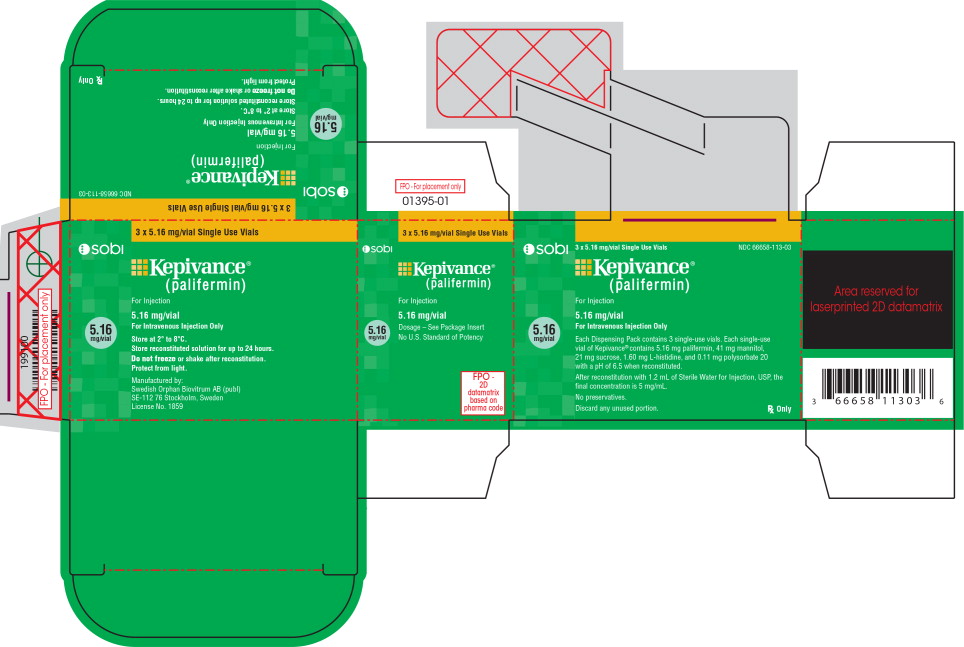
Principal Display Panel – 3 Pack 5.16 mg/1.2 mL Carton Label sobi 3 x 5.16 mg/vial Single Use Vials NDC 66658-113-03 Kepivance® (palifermin) For Injection 5.16 mg/vial For Intravenous Injection Only Each Dispensing Pack contains 3 single-use vials. Each single-use vial of Kepivance® contains 5.16 mg palifermin, 41 mg mannitol, 21 mg sucrose, 1.60 mg L-histidine, and 0.11 mg polysorbate 20 with a pH of 6.5 when reconstituted. After reconstitution with 1.2 mL of Sterile Water for Injection, USP, the final concentration is 5 mg/mL.
No preservatives. Discard any unused portion. Rx Only Principal Display Panel – 3 Pack 5.16 mg/1.2 mL Carton Label
About this NDC listing & data coverage
What data is (and isn’t) available for this NDC — tap to expand
| NDC identity (package / product / labeler codes) | ✓ Available |
| Labeler | ✓ Available |
| Product & package description | ✓ Available |
| Marketing category & status | ✓ Available |
| Active ingredient / dosage form / route | ✓ Available |
| FDA label (SPL via DailyMed) | ✓ Available |
| Package photos | ✓ Available |
| Inactive ingredients (structured) | ✓ Available |
| NADAC pharmacy acquisition price (CMS) | — Not published for this NDC CMS publishes NADAC only for NDCs reported in its retail-pharmacy survey. |
| Orange Book / therapeutic-equivalence data | — Not published for this NDC Applies only to products approved under an NDA/ANDA; many listings are out of scope. |
| HCPCS J-code billing crosswalk | ✓ Available |
| Medicaid utilization (CMS SDUD) | — Not published for this NDC CMS reports utilization only for NDCs with Medicaid claims above its privacy threshold. |