
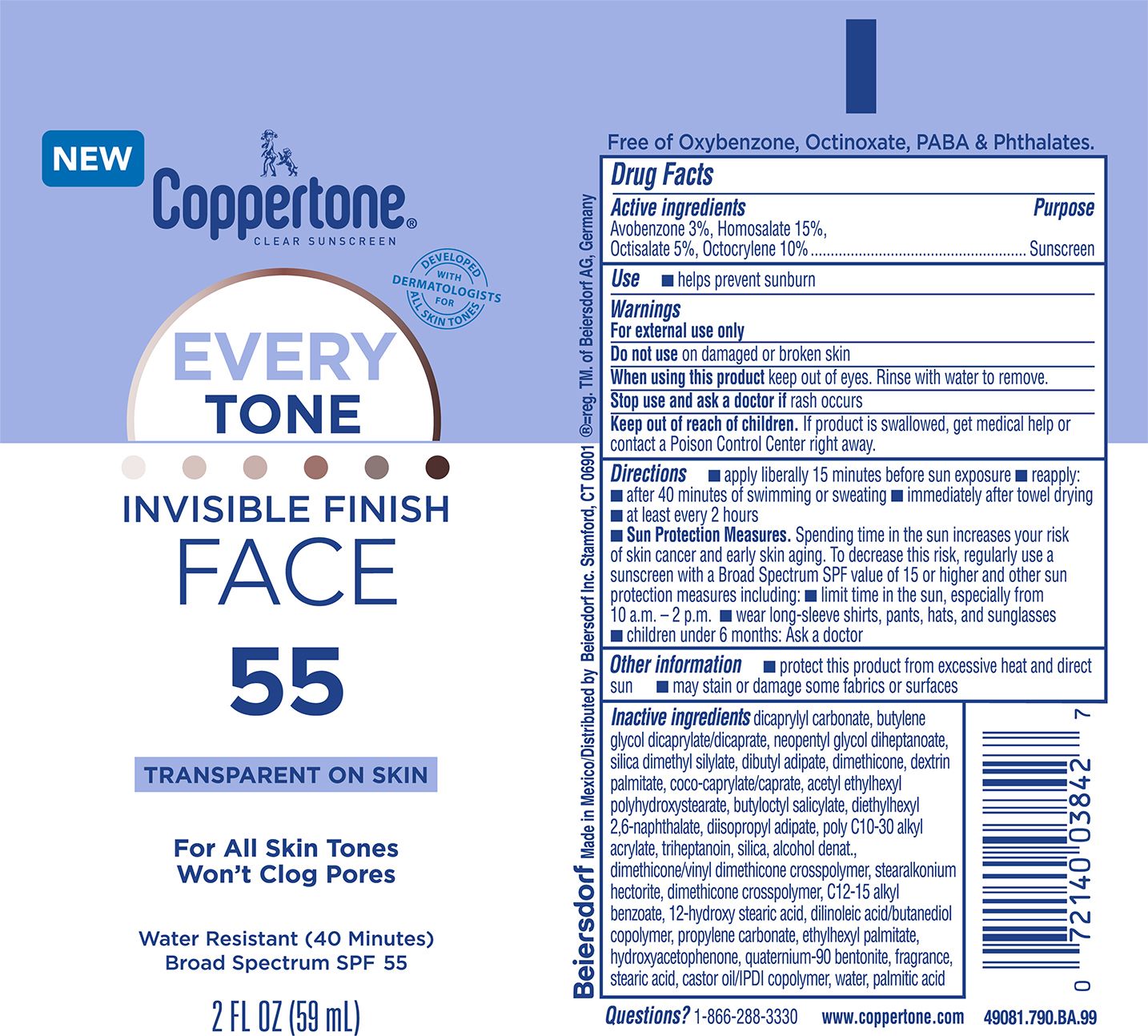
Coppertone EveryTone Face Sunscreen SPF 55 Avobenzone 3%, Homosalate 15%, Octisalate 5%, Octocrylene 10% 15 g/100g; 10 g/100g; 5 g/100g; 3 g/100g Lotion, 59 g
🆔 Identity & classification
Where does this data come from?
🏭 Manufacturer & labeler
Where does this data come from?
🩺 Clinical
Coppertone EveryTone Face Sunscreen SPF 55 is a topical lotion containing four active ingredients that function as ultraviolet (UV) light filters. Avobenzone, homosalate, octisalate, and octocrylene are all commonly used in sunscreen products to help absorb or scatter UVA and UVB rays from the sun. This product is marketed as an over-the-counter monograph drug, meaning it follows FDA's established category rules for sunscreen formulations rather than being individually reviewed.
Patient education
Supplement & herbal interactions
Where does this data come from?
Ask a licensed pharmacist directly — free, answered by our team.
💊 What it looks like
Where does this data come from?
🧪 Inactive Ingredients / Excipients
Inactive ingredients, also called excipients, are components of the drug product other than the active ingredient. They may include fillers, dyes, coatings, preservatives, flavors, or other formulation ingredients.
💡 Tap an ingredient (hover on desktop) to see what it is and why it’s used.
-
UNII 933ANU3H2S
12-Hydroxystearic acid is a fatty acid derived from plant or animal oils. It works as a thickener and emulsifier in medicines, helping blend ingredients together and give the product a smooth, stable texture.
-
UNII 8Z5ZAL5H3V
A synthetic polymer made from acrylate compounds. It acts as a thickener and stabilizer in topical formulations, helping create the right texture and prevent separation of ingredients.
-
UNII 3K9958V90M
A liquid solvent derived from fermentation or chemical synthesis. In medicines, alcohol dissolves active ingredients, helps preserve the product, and improves how the body absorbs certain drugs.
-
UNII A9EJ3J61HQ
A synthetic liquid derived from benzoic acid and long-chain alcohols. It functions as a solvent and penetration enhancer in topical formulations, helping active ingredients dissolve and absorb into the skin.
-
UNII 75D21FL1PI
A synthetic liquid derived from butylene glycol and fatty acids. It acts as an emollient and solvent to help dissolve or suspend active ingredients, improving texture and absorption in topical or oral formulations.
-
UNII 2EH13UN8D3
A synthetic compound used as a solvent and penetration enhancer in topical formulations. It helps dissolve active ingredients and allows them to penetrate the skin more effectively.
-
UNII 8D9H4QU99H
A synthetic fatty acid ester derived from coconut oil, used as an emulsifier and solubilizer to help mix oil and water-based ingredients and improve how the body absorbs certain drugs.
-
UNII 89B2BSF9I3
A synthetic compound made by chemically combining corn dextrin (a starch derivative) with palmitic acid. It acts as a binder and flow agent, helping hold tablet ingredients together and improve powder handling during manufacturing.
-
UNII F4K100DXP3
Dibutyl adipate is a synthetic oily liquid derived from adipic acid. It serves as a plasticizer and solvent in medicines, helping softens coatings and improves flexibility so tablets and capsules don't crack or break.
-
UNII 609A3V1SUA
A silky liquid derived from caprylic acid that acts as an emollient and solvent in formulations. It helps dissolve active ingredients and improves the spreadability and feel of lotions, creams, and topical products.
-
UNII I0DQJ7YGXM
A synthetic chemical compound used as a plasticizer in pharmaceutical coatings. It makes film coatings more flexible and durable so they don't crack or peel during manufacturing and storage.
-
UNII P7E6YFV72X
Diisopropyl adipate is a clear, oily liquid derived from adipic acid. It acts as a plasticizer and solvent in medicines, helping soften coatings and improve how the drug dissolves or spreads in the body.
-
UNII 1F2S8T535O
A synthetic polymer made from fatty acids and a chemical compound that binds ingredients together. It works as a binder and film-former in solid dosage forms, helping hold tablets together and coat their surface.
-
UNII 92RU3N3Y1O
Dimethicone is a silicone-based oil that acts as an anti-foaming agent and lubricant in medicines. It reduces gas bubbles in liquid formulations and helps coat and protect the stomach lining when ingested.
-
UNII 9E4CO0W6C5
A silicone-based polymer that forms soft, spongy particles. Used as a texture modifier and suspending agent to improve how the product feels and flows, and to help keep ingredients evenly distributed throughout the formulation.
-
UNII 2865993309
Ethylhexyl palmitate is an oily chemical made from palm oil and alcohol. It acts as an emollient and skin-conditioning agent in topical medicines, helping the product spread smoothly and keeping skin soft.
-
UNII 329LCV5BTF
A blend of fragrance compounds used to add pleasant smell to the medicine. Fragrances mask bitter or unpleasant tastes and odors, making the medication easier to take.
-
UNII ZF94AP8MEY
Hydrogenated castor oil is a processed plant oil made by adding hydrogen to castor oil. It's used as a binder to help hold tablet ingredients together and as a lubricant to prevent sticking during manufacturing.
-
UNII G1L3HT4CMH
A synthetic compound used in medicines as a preservative and antimicrobial agent. It helps prevent bacterial and fungal growth, extending the product's shelf life.
-
UNII 43B0856528
A synthetic chemical compound used as a binder and hardening agent. It helps create a durable coating on tablets or capsules to protect the medication and control how quickly it releases in the body.
-
UNII 5LKW3C543X
A synthetic oily liquid derived from neopentyl glycol and heptanoic acid. It serves as an emollient and solvent in formulations, helping to dissolve or suspend active ingredients and improve the texture and spreadability of topical products.
-
UNII 2V16EO95H1
Palmitic acid is a saturated fatty acid derived from plant and animal sources. It serves as an emulsifier and lubricant in medicines, helping ingredients mix smoothly and preventing sticking during manufacturing.
-
UNII 8D08K3S51E
Propylene carbonate is a clear liquid solvent derived from propylene. It helps dissolve or suspend active ingredients in liquid medicines and can improve how well the product flows and mixes.
-
UNII 97K5YEF88C
A clay-based ingredient used as a suspending agent and thickener in liquid medicines. It helps keep solid particles evenly distributed throughout the product so the medication mixes properly when shaken.
-
UNII EU2PSP0G0W
Silica dimethyl silylate is a silicon-based powder that acts as a glidant and anti-caking agent. It reduces friction between particles and helps powders flow smoothly during manufacturing and tablet compression.
-
UNII ETJ7Z6XBU4
Silicon dioxide is a naturally occurring mineral used as a glidant and anti-caking agent. It helps powder ingredients flow smoothly and prevents clumping during manufacturing and storage.
-
UNII 4ELV7Z65AP
Stearic acid is a fatty acid derived from plant or animal sources. It acts as a binder and lubricant in tablets and capsules, helping them hold together and flow smoothly during manufacturing.
-
UNII 2P6O7CFW5K
Triheptanoin is a synthetic fat made from glycerol and seven-carbon fatty acids. It's used as a caloric supplement and carrier in certain formulations to deliver active ingredients and provide nutritional support.
-
UNII 059QF0KO0R
Water is a liquid solvent that dissolves and mixes ingredients together in liquid medicines, syrups, and injections. It helps distribute the active drug evenly throughout the product.
29 inactive ingredients listed in the exact product block matched to this NDC.
Label-section wording can be broader than the structured product block and may mention additional formulation ingredients.
Where does this data come from?
ingredient classCode="IACT" elements from the exact product block matched by this NDC. Label-section narrative from DailyMed / the openFDA label index is shown separately when available.Inactive ingredient FAQ
Are inactive ingredients the same for every manufacturer?
Why might an inactive ingredient be missing?
Can inactive ingredients matter?
💲 Pricing
A drug doesn't have one price. Each row is a different public payment system, and none is what you'd pay at the counter — that depends on your insurance. The ⓘ on each row explains what it measures.
| Price system | Per g | Per package |
|---|---|---|
| Retail pharmacies payNADAC · weekly | Not in the retail survey — common for institutional, discontinued, or low-volume packs. | |
| Medicaid paysCMS SDUD · 12 mo | No recent Medicaid claims on file for this NDC — rare and low-volume NDCs are suppressed in the public data. | |
| Medicare drug plans payPart D · quarterly | No Part D plan price is available for this NDC in our data. | |
Where does this data come from?
🔁 Therapeutic equivalents
| Product | Labeler | Pack | NADAC/unit | TE | Status | Price vs. this |
|---|---|---|---|---|---|---|
| Coppertone EveryTone Face Sunscreen SPF 55 15 g/100g; 10 g/100g; 5 g/100g; 3 g/100gthis 66800-1094-02 | Beiersdorf | 59 g | — | — | FDA listed | — |
Where does this data come from?
⏳ Availability & generic status
We did not find an FDA-approved generic match for this exact strength, form and route.
Where does this data come from?
🔬 Reported adverse events (FAERS)
Top reported reactions
Age at onset
Reporter sex
Serious outcomes
Where does this data come from?
📦 Packaging — all sizes for this product
| Package NDC | Description | Marketing start | Status |
|---|---|---|---|
| 66800-1094-02 You're viewing this | 59 g in 1 TUBE (66800-1094-2) | 2023-11-01 | Active |
🧭 About this NDC listing & data coverage
What data is (and isn’t) available for this NDC — tap to expand
| NDC identity (package / product / labeler codes) | ✓ Available |
| Labeler | ✓ Available |
| Product & package description | ✓ Available |
| Marketing category & status | ✓ Available |
| Active ingredient / dosage form / route | ✓ Available |
| FDA label (SPL via DailyMed) | ✓ Available |
| Package photos | ✓ Available |
| Inactive ingredients (structured) | ✓ Available |
| NADAC pharmacy acquisition price (CMS) | — Not published for this NDC CMS publishes NADAC only for NDCs reported in its retail-pharmacy survey. |
| Orange Book / therapeutic-equivalence data | — Not published for this NDC Applies only to products approved under an NDA/ANDA; many listings are out of scope. |
| HCPCS J-code billing crosswalk | — Not published for this NDC Most self-administered / retail products have no J-code — that is normal. |
| Medicaid utilization (CMS SDUD) | — Not published for this NDC CMS reports utilization only for NDCs with Medicaid claims above its privacy threshold. |
Questions about this listing
Is this NDC FDA-approved?
Why is there no price listed?
Is the NDC printed on the package the same as the 11-digit billing NDC?
What do the three segments of this NDC mean?
Is this package still being marketed?
Who lists this product with the FDA?
Do I need a prescription for this product?
Where does this data come from?
📄 FDA label — Drug Facts FDA SPL
🎯 Indications and Usage ▾
Use ■ helps prevent sunburn
⏱️ Dosage and Administration ▾
Directions ■ apply liberally 15 minutes before sun exposure ■ reapply: ■ after 40 minutes of swimming or sweating ■ immediately after towel drying ■ at least every 2 hours ■ Sun Protection Measures. Spending time in the sun increases your risk of skin cancer and early skin aging. To decrease this risk, regularly use a sunscreen with a Broad Spectrum SPF value of 15 or higher and other sun protection measures including: ■ limit time in the sun, especially from 10 a.m. – 2 p.m. ■ wear long-sleeve shirts, pants, hats, and sunglasses ■ children under 6 months: Ask a doctor
⚠️ Warnings ▾
Warnings For external use only
🧪 Active Ingredient ▾
Active ingredients Avobenzone 3%, Homosalate 15%, Octisalate 5%, Octocrylene 10%
🧪 Inactive Ingredients ▾
Inactive ingredients dicaprylyl carbonate, butylene glycol dicaprylate/dicaprate, neopentyl glycol diheptanoate, silica dimethyl silylate, dibutyl adipate, dimethicone, dextrin palmitate, coco-caprylate/caprate, acetyl ethylhexyl polyhydroxystearate, butyloctyl salicylate, diethylhexyl 2,6-naphthalate, diisopropyl adipate, poly C10-30 alkyl acrylate, triheptanoin, silica, alcohol denat., dimethicone/vinyl dimethicone crosspolymer, stearalkonium hectorite, dimethicone crosspolymer, C12-15 alkyl benzoate, 12-hydroxy stearic acid, dilinoleic acid/butanediol copolymer, propylene carbonate, ethylhexyl palmitate, hydroxyacetophenone, quaternium-90 bentonite, fragrance, stearic acid, castor oil/IPDI copolymer, water, palmitic acid
🎯 Purpose ▾
Purpose Sunscreen