
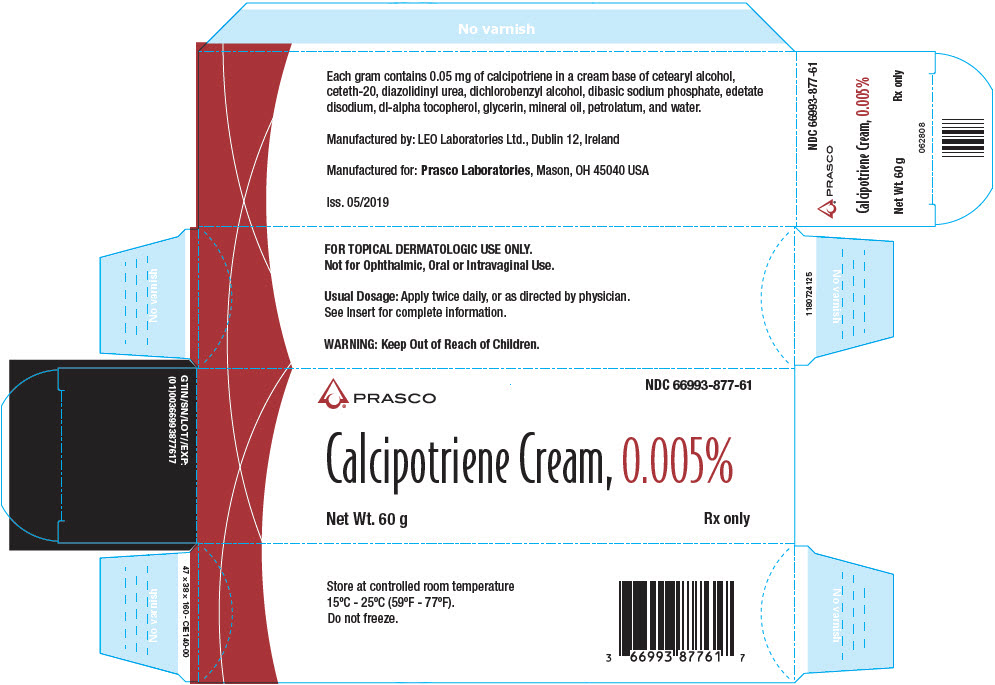
Calcipotriene 50 ug/g Cream — NDC 66993-877-61 (Billing 66993-0877-61)
This is a package of Calcipotriene 50 ug/g Cream from Prasco Laboratories, marketed since Oct 1996 and currently FDA-listed; retail pharmacies pay about $1.06 per g (NADAC). It is the main listing for this product, which comes in 2 package sizes.
NDC database record
One package, one record: these facts belong to NDC 66993-877-61 alone.
- Record
- FDA NDC Directory package listing · Human prescription drug
- Code segments
- 66993 labeler · 877 product · 61 package
- Package marketed since
- Oct 1, 1996
- Sample package
- No — commercial package
- Listing certified through
- Dec 31, 2026
- Barcode (UPC-A, from the NDC)
- 3 6699387761 7
- Medicaid fills, this package
- 19,462 prescriptions in the last four reported quarters
- FDA record last changed
- Jul 24, 2026
Identity & classification
Regulatory identifiers FDA, NLM and CMS codes for this package
Drug-database identifiers Medi-Span GPI and First Databank GCN / HICL / AHFS classification
- GSN (GCN sequence number): 021134
- GCN: 01851
- GPI-14 (Medi-Span): 90250025003710
- HICL (First Databank): 013331
- AHFS class code: 84:24.12.00
- RxCUI (RxNorm): 313921
Where does this data come from?
- FDA openFDA NDC Directory · synced Oct 8, 2026
- FDA label on DailyMed · label index refreshed Oct 8, 2026
- RxNorm (NLM RxNav) · catalog refreshed Oct 1, 2026
- Medi-Span GPI (licensed)
- First Databank (licensed) · refreshed Oct 8, 2026
RxNorm drug class
This medicine belongs to the Vitamin D Analog class.
Where does this data come from?
- RxClass (NLM) · catalog refreshed Oct 1, 2026
Clinical
Calcipotriene is used to treat psoriasis (a skin disease in which red, scaly patches form due to increased production of skin cells on some areas of the body). Calcipotriene is in a class of medications called synthetic vitamin D3 derivatives. It works by slowing the excessive production of skin cells.
Read the full MedlinePlus article ↗- It treats plaque psoriasis. The foam is for the scalp and body in adults and children 4 and older. Pellix is a scalp solution.
- Comb your hair to remove scales and part it. Apply it twice daily only to the lesions and rub it in gently. Keep it off your forehead and away from your eyes, and wash your hands a...
- How do I apply the Pellix scalp solution?
- Mild redness, pain or itching where you apply it are the most common. Call me or your doctor if irritation gets excessive or you have a sensitivity reaction.
Patient education
Supplement & herbal interactions
Some supplements/herbs that may interact with Calcipotriene — tap one for details:
Where does this data come from?
- MedlinePlus (NLM) · refreshed Oct 8, 2026
- FDA label on DailyMed · label index refreshed Oct 8, 2026
Ask a licensed pharmacist directly — free, answered by our team.
Pricing
A drug doesn't have one price. Each row is a different public payment system, and none is what you'd pay at the counter — that depends on your insurance. The ⓘ on each row explains what it measures.
| Price system | Per g | Per package |
|---|---|---|
| Retail pharmacies payNADAC · weekly | $1.056 | $63.34 / 60 g |
| Medicaid paysCMS SDUD · 12 mo | $1.32 | $78.94 / 60 g |
| Medicare drug plans payPart D · Q2 2026 | $1.86 | $111.75 / 60 g |
Where does this data come from?
- CMS NADAC weekly file · file of Oct 7, 2026
- CMS ASP pricing files · refreshed Sep 20, 2026
- CMS Medicaid State Drug Utilization Data · through Q4 2025
- CMS Part D plan pricing files · refreshed Sep 24, 2026
- VA National Acquisition Center price file
Packaging — all sizes for this product
| Package NDC | Description | Per unit | Per pack | Marketing start | Marketing end | Status |
|---|---|---|---|---|---|---|
| 66993-0877-61 You're viewing this Main listing | 1 TUBE in 1 CARTON / 60 g in 1 TUBE | $1.06 / g | $63.34 | 1996-10-01 | — | Active |
| 66993-0877-78 66993-877-78 | 1 TUBE in 1 CARTON / 120 g in 1 TUBE | $1.04 / g | $125.21 | 1996-10-01 | — | Active |
In Medicaid, this is the most-dispensed pack of this product — about 87% of fills over the last four reported quarters. See all packs ↓
Pack size FAQ
What quantity is in this package?
What NDC number is used to bill for this package of Calcipotriene 50 ug/g Cream?
Prices are the latest CMS NADAC pharmacy acquisition cost per NDC; per-pack figures are per-unit × pack quantity, shown only when the pack is denominated in the same measure NADAC prices.
Therapeutic equivalents
| Product | Labeler | Pack | NADAC/unit | TE | Status | Price vs. this |
|---|---|---|---|---|---|---|
| calcipotriene 50 ug/g 16714-0763-01 | Northstar | 1 tube | $1.056 | AB | Availability likely | — |
| Calcipotriene 50 ug/gthis 66993-0877-61 | Prasco | 1 tube | $1.056 | AB | Availability likely | — |
| calcipotriene 50 ug/g 68462-0501-65 | Glenmark | 1 tube | $1.056 | AB | Availability likely | — |
| calcipotriene 50 ug/g 66993-0878-61 | Prasco | 1 tube | $2.084 | AB | Availability likely | +97% |
| Calcipotriene 50 ug/g 68462-0310-65 | Glenmark | 60 g | $2.084 | AB | Availability likely | +97% |
| Trionex 72835-0902-02 | V2 | 1 kit | — | — | FDA listed | — |
Where does this data come from?
- FDA openFDA NDC Directory · synced Oct 8, 2026
- FDA Orange Book · refreshed Oct 3, 2026
- CMS NADAC weekly file · file of Oct 7, 2026
Availability & generic status
FDA-approved generic versions are listed, and recent pricing/market data suggests they may be available — see Therapeutic equivalents.
Where does this data come from?
- FDA Orange Book · refreshed Oct 3, 2026
Inactive Ingredients / Excipients
Inactive ingredients, also called excipients, are components of the drug product other than the active ingredient. They may include fillers, dyes, coatings, preservatives, flavors, or other formulation ingredients.
🧪 Avoiding an ingredient? See Calcipotriene Topical inactive ingredients by manufacturer: every current product's list side by side, so you can ask your pharmacy for the version that does not list it.
💡 Tap an ingredient (hover on desktop) to see what it is and why it’s used.
-
UNII 7QWA1RIO01
A synthetic form of vitamin E used as an antioxidant in medicines. It prevents oils and fats in the formulation from breaking down, helping the drug remain stable and effective during storage.
-
UNII I835H2IHHX
A waxy substance derived from plant oils, used as an emulsifier and solubilizer to help mix oil and water ingredients together and keep them blended throughout the product's shelf life.
-
UNII 2DMT128M1S
A waxy solid derived from plant or animal sources. It acts as an emulsifier to blend oil and water components, and also thickens the medicine to give it the right texture and consistency.
-
UNII H5RIZ3MPW4
A chemical preservative used to prevent bacterial and fungal growth in medicines. It helps extend shelf life and maintain product safety during storage and use.
-
UNII 1NKX3648J9
A synthetic antimicrobial compound used as a preservative in medicines and topical products to prevent bacterial and fungal growth, helping keep the medication safe and effective during storage.
-
UNII 7FLD91C86K
Edetate disodium is a chemical compound that binds and removes certain metal ions. In medicines, it acts as a preservative and stabilizer by preventing metals like calcium from interfering with the product's shelf life and consistency.
-
UNII PDC6A3C0OX
Glycerin is a clear, thick liquid derived from plant oils or fats. It acts as a humectant to retain moisture, a sweetener, and a solvent in medications.
-
UNII T5L8T28FGP
Mineral oil is a clear, odorless liquid derived from crude oil. It acts as a lubricant and emollient in medications, helping pills slide smoothly during manufacturing and aiding moisture retention in topical products.
-
UNII 4T6H12BN9U
Petrolatum is a purified mineral oil-based jelly derived from petroleum. In medicines, it acts as an emollient, lubricant, and moisture barrier to soften skin, reduce friction, and help prevent water loss from formulations.
-
UNII GR686LBA74
Sodium phosphate, dibasic is a salt derived from phosphoric acid. It acts as a buffer to help maintain the medicine's pH balance and may serve as a binder or filler in tablets and capsules.
-
UNII 059QF0KO0R
Water is a liquid solvent that dissolves and mixes ingredients together in liquid medicines, syrups, and injections. It helps distribute the active drug evenly throughout the product.
11 inactive ingredients listed in the exact product block matched to this NDC.
Where does this data come from?
ingredient classCode="IACT" elements from the exact product block matched by this NDC. Label-section narrative from DailyMed / the openFDA label index is shown separately when available.- FDA label on DailyMed · label index refreshed Oct 8, 2026
- FDA openFDA NDC Directory · synced Oct 8, 2026
Inactive ingredient FAQ
Are inactive ingredients the same for every manufacturer?
Why might an inactive ingredient be missing?
Can inactive ingredients matter?
Manufacturer & labeler
More NDCs from Prasco Laboratories labeler code 66993
- Fluticasone Propionate Diskus 100 ug Powder, Metered NDC 66993-791-97
- Fluticasone Propionate Diskus 250 ug Powder, Metered NDC 66993-792-97
- pioglitazone and glimepiride 30 mg; 2 mg Tablet NDC 66993-821-30
- pioglitazone and glimepiride 30 mg; 4 mg Tablet NDC 66993-822-30
- triamterene 50 mg Capsule NDC 66993-831-02
- Triamterene 100 mg Capsule NDC 66993-832-02
- calcipotriene 50 ug/g Ointment NDC 66993-878-61
- Betamethasone Dipropionate .5 mg/g Ointment NDC 66993-897-15
- metronidazole 10 mg/g Gel NDC 66993-936-58
- Calcipotriene and Betamethasone Dipropionate 50 ug/g; .5 mg/g Ointment NDC 66993-938-61
- Testosterone 16.2 mg/g Gel NDC 66993-951-88
- Testosterone 16.2 mg/g Gel NDC 66993-952-30
Where does this data come from?
- FDA openFDA NDC Directory · synced Oct 8, 2026
- Drugs@FDA
Full prescribing information FDA SPL
🎯 Indications and Usage ▾
INDICATIONS AND USAGE Calcipotriene Cream, 0.005%, is indicated for the treatment of plaque psoriasis. The safety and effectiveness of topical calcipotriene in dermatoses other than psoriasis have not been established.
⏱️ Dosage and Administration ▾
DOSAGE AND ADMINISTRATION Apply a thin layer of Calcipotriene Cream to the affected skin twice daily and rub in gently and completely. The safety and efficacy of Calcipotriene Cream have been demonstrated in patients treated for eight weeks.
⛔ Contraindications ▾
CONTRAINDICATIONS Calcipotriene Cream is contraindicated in those patients with a history of hypersensitivity to any of the components of the preparation. It should not be used by patients with demonstrated hypercalcemia or evidence of vitamin D toxicity. Calcipotriene Cream should not be used on the face.
⚠️ Warnings ▾
WARNINGS Contact dermatitis, including allergic contact dermatitis, has been observed with the use of Calcipotriene Cream.
🤒 Adverse Reactions ▾
ADVERSE REACTIONS
🤰 Pregnancy ▾
Pregnancy Teratogenic Effects Studies of teratogenicity were done by the oral route where bioavailability is expected to be approximately 40-60% of the administered dose. Increased rabbit maternal and fetal toxicity was noted at 12 μg/kg/day (132 μg/m 2 /day). Rabbits administered 36 μg/kg/day (396 μg/m 2 /day) resulted in fetuses with a significant increase in the incidences of pubic bones, forelimb phalanges, and incomplete bone ossification.
In a rat study, oral doses of 54 μg/kg/day (318 μg/m 2 /day) resulted in a significantly higher incidence of skeletal abnormalities consisting primarily of enlarged fontanelles and extra ribs. The enlarged fontanelles are most likely due to calcipotriene's effect upon calcium metabolism. The maternal and fetal calculated no-effect exposures in the rat (43.2 μg/m 2 /day) and rabbit (17.6 μg/m 2 /day) studies are approximately equal to the expected human systemic exposure level (18.5 μg/m 2 /day) from dermal application.
There are no adequate and well-controlled studies in pregnant women. Therefore, Calcipotriene Cream should be used during pregnancy only if the potential benefit justifies the potential risk to the fetus.
🧒 Pediatric Use ▾
Pediatric Use Safety and effectiveness of Calcipotriene Cream in pediatric patients have not been established. Because of a higher ratio of skin surface area to body mass, pediatric patients are at greater risk than adults of systemic adverse effects when they are treated with topical medication.
🧓 Geriatric Use ▾
Geriatric Use Of the total number of patients in clinical studies of calcipotriene cream, approximately 15% were 65 or older, while approximately 3% were 75 and over. There were no significant differences in adverse events for subjects over 65 years compared to those under 65 years of age. However, the greater sensitivity of older individuals cannot be ruled out.
🆘 Overdosage ▾
OVERDOSAGE Topically applied calcipotriene can be absorbed in sufficient amounts to produce systemic effects. Elevated serum calcium has been observed with excessive use of topical calcipotriene. If elevation in serum calcium should occur, discontinue treatment until normal calcium levels are restored. (See PRECAUTIONS .)
🧬 Clinical Pharmacology ▾
CLINICAL PHARMACOLOGY In humans, the natural supply of vitamin D depends mainly on exposure to the ultraviolet rays of the sun for conversion of 7-dehydrocholesterol to vitamin D 3 (cholecalciferol) in the skin. Calcipotriene is a synthetic analog of vitamin D 3 . Clinical studies with radiolabelled calcipotriene ointment indicate that approximately 6% (± 3%, SD) of the applied dose of calcipotriene is absorbed systemically when the ointment is applied topically to psoriasis plaques, or 5% (± 2.6%, SD) when applied to normal skin, and much of the absorbed active is converted to inactive metabolites within 24 hours of application.
Systemic absorption of the cream has not been studied. Vitamin D and its metabolites are transported in the blood, bound to specific plasma proteins. The active form of the vitamin, 1,25-dihydroxy vitamin D 3 (calcitriol), is known to be recycled via the liver and excreted in the bile.
Calcipotriene metabolism following systemic uptake is rapid, and occurs via a similar pathway to the natural hormone.
📦 How Supplied / Storage and Handling ▾
HOW SUPPLIED Calcipotriene Cream, 0.005% is available in: 60 gram aluminum tubes (NDC 66993-877-61) 120 gram aluminum tubes (NDC 66993-877-78)
📦 Storage and Handling ▾
STORAGE Store at controlled room temperature 15°C - 25°C (59°F - 77°F). Do not freeze.
📋 Description ▾
DESCRIPTION Calcipotriene Cream, 0.005% contains calcipotriene monohydrate, a synthetic vitamin D 3 derivative, for topical dermatological use. Chemically, calcipotriene monohydrate is (5Z,7E,22E,24S)-24-cyclopropyl-9,10-secochola-5,7,10(19),22-tetraene-1α,3β,24-triol monohydrate, with the empirical formula C 27 H 40 O 3 •H 2 O, a molecular weight of 430.6, and the following structural formula: Calcipotriene monohydrate is a white or off-white crystalline substance. Calcipotriene Cream contains calcipotriene monohydrate equivalent to 50 μg/g anhydrous calcipotriene in a cream base of cetearyl alcohol, ceteth-20, diazolidinyl urea, dichlorobenzyl alcohol, dibasic sodium phosphate, edetate disodium, dl-alpha tocopherol, glycerin, mineral oil, petrolatum, and water.
Structural formula for calcipotriene monohydrate
💬 Information for Patients ▾
Information for Patients Patients using Calcipotriene Cream should receive the following information and instructions: This medication is to be used only as directed by the physician. It is for external use only. Avoid contact with the face or eyes.
As with any topical medication, patients should wash their hands after application. This medication should not be used for any disorder other than that for which it was prescribed. Patients should report to their physician any signs of adverse reactions.
Patients that apply Calcipotriene Cream to exposed portions of the body should avoid excessive exposure to either natural or artificial sunlight (including tanning booths, sun lamps, etc.).
⚠️ Precautions ▾
PRECAUTIONS General Use of Calcipotriene Cream may cause transient irritation of both lesions and surrounding uninvolved skin. If irritation develops, Calcipotriene Cream should be discontinued. For external use only.
Keep out of the reach of children. Always wash hands thoroughly after use. Reversible elevation of serum calcium has occurred with use of topical calcipotriene.
If elevation in serum calcium outside the normal range should occur, discontinue treatment until normal calcium levels are restored. Information for Patients Patients using Calcipotriene Cream should receive the following information and instructions: This medication is to be used only as directed by the physician. It is for external use only.
Avoid contact with the face or eyes. As with any topical medication, patients should wash their hands after application. This medication should not be used for any disorder other than that for which it was prescribed.
Patients should report to their physician any signs of adverse reactions. Patients that apply Calcipotriene Cream to exposed portions of the body should avoid excessive exposure to either natural or artificial sunlight (including tanning booths, sun lamps, etc.). Carcinogenesis, Mutagenesis, Impairment of Fertility When calcipotriene was applied topically to mice for up to 24 months at dosages of 3, 10 and 30 µg/kg/day (corresponding to 9, 30 and 90 µg/m 2 /day), no significant changes in tumor incidence were observed when compared to control.
In a study in which albino hairless mice were exposed to both UVR and topically applied calcipotriene, a reduction in the time required for UVR to induce the formation of skin tumors was observed (statistically significant in males only), suggesting that calcipotriene may enhance the effect of UVR to induce skin tumors. Patients that apply Calcipotriene Cream to exposed portions of the body should avoid excessive exposure to either natural or artificial sunlight (including tanning booths, sun lamps, etc.). Physicians may wish to limit or avoid use of phototherapy in patients that use Calcipotriene Cream.
Calcipotriene did not elicit any mutagenic effects in an Ames mutagenicity assay, a mouse lymphoma TK locus assay, a human lymphocyte chromosome aberration assay, or in a micronucleus assay conducted in mice. Studies in rats at doses up to 54 μg/kg/day (324 μg/m 2 /day) of calcipotriene indicated no impairment of fertility or general reproductive performance. Pregnancy Teratogenic Effects Studies of teratogenicity were done by the oral route where bioavailability is expected to be approximately 40-60% of the administered dose.
Increased rabbit maternal and fetal toxicity was noted at 12 μg/kg/day (132 μg/m 2 /day). Rabbits administered 36 μg/kg/day (396 μg/m 2 /day) resulted in fetuses with a significant increase in the incidences of pubic bones, forelimb phalanges, and incomplete bone ossification. In a rat study, oral doses of 54 μg/kg/day (318 μg/m 2 /day) resulted in a significantly higher incidence of skeletal abnormalities consisting primarily of enlarged fontanelles and extra ribs.
The enlarged fontanelles are most likely due to calcipotriene's effect upon calcium metabolism. The maternal and fetal calculated no-effect exposures in the rat (43.2 μg/m 2 /day) and rabbit (17.6 μg/m 2 /day) studies are approximately equal to the expected human systemic exposure level (18.5 μg/m 2 /day) from dermal application. There are no adequate and well-controlled studies in pregnant women.
Therefore, Calcipotriene Cream should be used during pregnancy only if the potential benefit justifies the potential risk to the fetus. Nursing Mothers There is evidence that maternal 1,25-dihydroxy vitamin D 3 (calcitriol) may enter the fetal circulation, but it is not known whether it is excreted in human milk. The systemic disposition of calcipotriene is expected to be similar to that of the naturally occurring vitamin.
Because many drugs are excreted in human milk, caution should b… [Excerpted — this section continues on DailyMed.]
🍼 Nursing Mothers ▾
Nursing Mothers There is evidence that maternal 1,25-dihydroxy vitamin D 3 (calcitriol) may enter the fetal circulation, but it is not known whether it is excreted in human milk. The systemic disposition of calcipotriene is expected to be similar to that of the naturally occurring vitamin. Because many drugs are excreted in human milk, caution should be exercised when Calcipotriene Cream is administered to a nursing woman.
🔬 Clinical Studies ▾
CLINICAL STUDIES Adequate and well-controlled trials of patients treated with Calcipotriene Cream have demonstrated improvement usually beginning after 2 weeks of therapy. This improvement continued with approximately 50% of patients showing at least marked improvement in the signs and symptoms of psoriasis after 8 weeks of therapy, but only approximately 4% showed complete clearing.
📄 Carcinogenesis, Mutagenesis, Impairment of Fertility ▾
Carcinogenesis, Mutagenesis, Impairment of Fertility When calcipotriene was applied topically to mice for up to 24 months at dosages of 3, 10 and 30 µg/kg/day (corresponding to 9, 30 and 90 µg/m 2 /day), no significant changes in tumor incidence were observed when compared to control. In a study in which albino hairless mice were exposed to both UVR and topically applied calcipotriene, a reduction in the time required for UVR to induce the formation of skin tumors was observed (statistically significant in males only), suggesting that calcipotriene may enhance the effect of UVR to induce skin tumors.
Patients that apply Calcipotriene Cream to exposed portions of the body should avoid excessive exposure to either natural or artificial sunlight (including tanning booths, sun lamps, etc.). Physicians may wish to limit or avoid use of phototherapy in patients that use Calcipotriene Cream. Calcipotriene did not elicit any mutagenic effects in an Ames mutagenicity assay, a mouse lymphoma TK locus assay, a human lymphocyte chromosome aberration assay, or in a micronucleus assay conducted in mice.
Studies in rats at doses up to 54 μg/kg/day (324 μg/m 2 /day) of calcipotriene indicated no impairment of fertility or general reproductive performance.
📄 Package Label / Principal Display Panel ▾
PRINCIPAL DISPLAY PANEL - 60 g Tube Carton NDC 66993-877-61 PRASCO Calcipotriene Cream, 0.005% Net Wt. 60 g Rx only PRINCIPAL DISPLAY PANEL - 60 g Tube Carton
Principal Display Panel - 120 g Tube Carton PRASCO NDC 66993-877-78 Calcipotriene Cream 0.005% Net Wt. 120 g Rx only Principal Display Panel - 120 g Tube Carton