
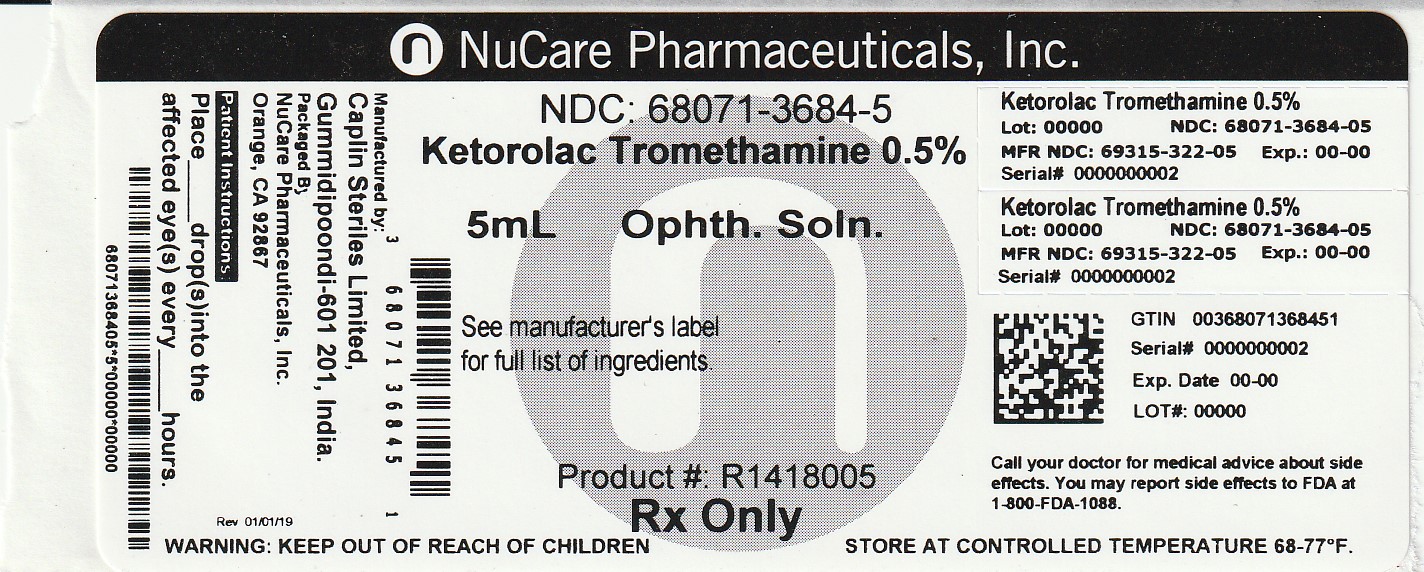
Ketorolac Tromethamine 5 mg/mL Solution/ Drops — NDC 68071-3684-5 (Billing 68071-3684-05)
This is a package of Ketorolac Tromethamine 5 mg/mL Solution/ Drops from NuCare Pharmaceuticals, Inc., marketed since Jun 2024 and currently FDA-listed. It is this product's only package size.
NDC database record
One package, one record: these facts belong to NDC 68071-3684-5 alone.
- Record
- FDA NDC Directory package listing · Human prescription drug
- Code segments
- 68071 labeler · 3684 product · 5 package
- Package marketed since
- Sep 18, 2024
- Sample package
- No — commercial package
- Listing certified through
- Dec 31, 2026
- Barcode (UPC)
- 0368071368451
- FDA record last changed
- Jul 24, 2026
Other active recalls for Ketorolac Tromethamine (different manufacturers) — 3 · tap to view
Identity & classification
Regulatory identifiers FDA, NLM and CMS codes for this package
- RxCUI (RxNorm): 860107
Where does this data come from?
- FDA openFDA NDC Directory · synced Oct 8, 2026
- FDA label on DailyMed · label index refreshed Oct 6, 2026
- RxNorm (NLM RxNav) · catalog refreshed Oct 1, 2026
- Medi-Span GPI (licensed)
- First Databank (licensed) · refreshed Oct 8, 2026
RxNorm drug class
This medicine belongs to the Nonsteroidal Anti-inflammatory Drug class.
Where does this data come from?
- RxClass (NLM) · catalog refreshed Oct 1, 2026
Clinical
Ophthalmic ketorolac is used to treat itchy eyes caused by allergies. It also is used to treat swelling and redness (inflammation) that can occur after cataract surgery. Ketorolac is in a class of medications called nonsteroidal anti-inflammatory drugs (NSAIDs). It works by stopping the release of substances that cause allergy symptoms and inflammation.
Read the full MedlinePlus article ↗- It depends on the form. The injection, tablets and Sprix nasal spray are for short-term relief of moderate to moderately severe pain in adults. The eye drops treat eye itching from...
- For pain, no more than 5 days total, counting injection, tablets and spray together. Taking it longer or at higher doses raises the risk of serious side effects without better reli...
- No. Ketorolac should not be combined with aspirin or other NSAIDs because the risk of stomach bleeding and other serious effects goes up with no extra benefit. Always check with me...
- Can I take it with ibuprofen or aspirin?
Patient education
Supplement & herbal interactions
Some supplements/herbs that may interact with Ketorolac Tromethamine — tap one for details:
Ketorolac Tromethamine may be associated with lower levels of 1 nutrient — worth a chat with your pharmacist, not a cause for alarm.
Where does this data come from?
- MedlinePlus (NLM) · refreshed Oct 1, 2026
- FDA label on DailyMed · label index refreshed Oct 6, 2026
Ask a licensed pharmacist directly — free, answered by our team.
Pricing
A drug doesn't have one price. Each row is a different public payment system, and none is what you'd pay at the counter — that depends on your insurance. The ⓘ on each row explains what it measures.
| Price system | Per mL | Per package |
|---|---|---|
| Retail pharmacies payNADAC · weekly | Not in the retail survey — common for institutional, discontinued, or low-volume packs. | |
| Medicaid paysCMS SDUD · 12 mo | No recent Medicaid claims on file for this NDC — rare and low-volume NDCs are suppressed in the public data. | |
| Medicare drug plans payPart D · Q2 2026 | $2.30 | $11.49 / 5 ml |
Where does this data come from?
- CMS NADAC weekly file
- CMS ASP pricing files · refreshed Sep 20, 2026
- CMS Medicaid State Drug Utilization Data · refreshed Oct 8, 2026
- CMS Part D plan pricing files · refreshed Sep 24, 2026
- VA National Acquisition Center price file
Packaging — all sizes for this product
| Package NDC | Description | Marketing start | Marketing end | Status |
|---|---|---|---|---|
| 68071-3684-05 You're viewing this Main listing | 1 BOTTLE, DROPPER in 1 CARTON / 5 mL in 1 BOTTLE, DROPPER | 2024-09-18 | — | Active |
Therapeutic equivalents
| Product | Labeler | Pack | NADAC/unit | TE | Status | Price vs. this |
|---|---|---|---|---|---|---|
| Ketorolac Tromethamine 5 mg/mL 65145-0140-01 | Caplin | 1 bottle | $1.338 | AT | Availability likely | — |
| Ketorolac Tromethamine 5 mg/mL 42571-0137-25 | Micro | 5 ml | $1.451 | AT | Availability likely | — |
| Ketorolac Tromethamine 5 mg/mL 60505-1003-01 | Apotex | 1 bottle | $1.451 | AT | Availability likely | — |
| Ketorolac Tromethamine 5 mg/mL 61314-0126-05 | Sandoz | 5 ml | $1.451 | AT | Availability likely | — |
| Ketorolac Tromethamine 5 mg/mL 65145-0139-01 | Caplin | 1 bottle | $1.451 | AT | Availability likely | — |
| Ketorolac Tromethamine 5 mg/mL 47335-0220-90 | Sun | 1 bottle | $1.475 | — | FDA listed | — |
| Acular 5 mg/mL 00023-2181-05 | Allergan, | 1 bottle | — | AT | FDA listed | — |
| Ketorolac Tromethamine 5 mg/mL 47335-0219-90 | Sun | 1 bottle | — | — | FDA listed | — |
| Ketorolac Tromethamine 5 mg/mL 47335-0221-90 | Sun | 1 bottle | — | — | FDA listed | — |
| Ketorolac Tromethamine 5 mg/mL 50090-2746-00 | A-S | 5 ml | — | AT | FDA listed | — |
| Ketorolac Tromethamine 5 mg/mL 63187-0628-05 | Proficient | 1 bottle | — | — | FDA listed | — |
| Ketorolac Tromethamine 5 mg/mL 63187-0777-05 | Proficient | 1 bottle | — | AT | FDA listed | — |
| Ketorolac Tromethamine 5 mg/mL 65145-0138-01 | Caplin | 1 bottle | — | AT | FDA listed | — |
| Ketorolac Tromethamine 5 mg/mL 65862-0770-05 | Aurobindo | 1 bottle | — | — | FDA listed | — |
| Ketorolac Tromethamine 5 mg/mL 67296-2210-01 | Redpharm | 1 bottle | — | AT | FDA listed | — |
| Ketorolac Tromethamine 5 mg/mL 67296-2253-01 | Redpharm | 1 bottle | — | AT | FDA listed | — |
| Ketorolac Tromethamine 5 mg/mL 68071-2252-05 | NuCare | 5 ml | — | AT | FDA listed | — |
| Ketorolac Tromethamine 5 mg/mL 68071-2400-05 | NuCare | 1 bottle | — | — | FDA listed | — |
| Ketorolac Tromethamine 5 mg/mLthis 68071-3684-05 | NuCare | 1 bottle | — | AT | FDA listed | — |
| Ketorolac Tromethamine 5 mg/mL 68071-3880-05 | NuCare | 1 bottle | — | AT | FDA listed | — |
| Ketorolac Tromethamine 5 mg/mL 68788-8549-05 | Preferred | 5 ml | — | AT | FDA listed | — |
| Ketorolac Tromethamine 5 mg/mL 69315-0322-03 | Leading | 1 bottle | — | AT | FDA listed | — |
| Ketorolac Tromethamine 5 mg/mL 70512-0790-03 | SOLA | 1 bottle | — | AT | FDA listed | — |
| Ketorolac Tromethamine 5 mg/mL 71205-0296-05 | Proficient | 5 ml | — | AT | FDA listed | — |
| Ketorolac Tromethamine 5 mg/mL 72162-2384-02 | Bryant | 5 ml | — | AT | FDA listed | — |
| Ketorolac Tromethamine 5 mg/mL 72189-0335-05 | Direct | 5 ml | — | AT | FDA listed | — |
| Ketorolac Tromethamine 5 mg/mL 67296-2318-05 | Redpharm | 1 bottle | — | AT | FDA listed | — |
Where does this data come from?
- FDA openFDA NDC Directory · synced Oct 8, 2026
- FDA Orange Book · refreshed Oct 3, 2026
- CMS NADAC weekly file
Availability & generic status
This product is an FDA-approved generic. Other versions of the same drug are listed under Therapeutic equivalents, least expensive first.
Where does this data come from?
- FDA Orange Book · refreshed Oct 3, 2026
Inactive Ingredients / Excipients
Inactive ingredients, also called excipients, are components of the drug product other than the active ingredient. They may include fillers, dyes, coatings, preservatives, flavors, or other formulation ingredients.
🧪 Avoiding an ingredient? See Ketorolac inactive ingredients by manufacturer: every current product's list side by side, so you can ask your pharmacy for the version that does not list it.
💡 Tap an ingredient (hover on desktop) to see what it is and why it’s used.
-
UNII F5UM2KM3W7
Benzalkonium chloride is a chemical compound that works as a preservative and antimicrobial agent in medications. It prevents bacterial and fungal growth in liquid formulations to keep the product safe during storage and use.
-
UNII 7FLD91C86K
Edetate disodium is a chemical compound that binds and removes certain metal ions. In medicines, it acts as a preservative and stabilizer by preventing metals like calcium from interfering with the product's shelf life and consistency.
-
UNII QTT17582CB
A strong acid used to adjust and maintain the proper pH level in liquid medicines, ensuring stability and preventing breakdown of active ingredients.
-
UNII 9T1C662FKS
A synthetic detergent and emulsifier derived from octylphenol. It helps blend water and oil-based ingredients together and improves how the medicine disperses in the body, commonly used in injectable and topical formulations.
-
UNII 451W47IQ8X
Sodium chloride is common table salt. It's used in medicines as a buffer to maintain proper pH, as a filler to add bulk, or to adjust the osmotic balance in liquid formulations.
-
UNII 55X04QC32I
A strong alkaline chemical used to adjust and maintain the pH balance of liquid medicines. It helps keep the medicine stable and ensures it stays effective during storage.
-
UNII 059QF0KO0R
Water is a liquid solvent that dissolves and mixes ingredients together in liquid medicines, syrups, and injections. It helps distribute the active drug evenly throughout the product.
7 inactive ingredients listed in the exact product block matched to this NDC.
Where does this data come from?
ingredient classCode="IACT" elements from the exact product block matched by this NDC. Label-section narrative from DailyMed / the openFDA label index is shown separately when available.- FDA label on DailyMed · label index refreshed Oct 6, 2026
- FDA openFDA NDC Directory · synced Oct 8, 2026
Inactive ingredient FAQ
Are inactive ingredients the same for every manufacturer?
Why might an inactive ingredient be missing?
Can inactive ingredients matter?
Manufacturer & labeler
More NDCs from NuCare Pharmaceuticals, Inc. labeler code 68071
- Amoxicillin 250 mg/5mL Powder, For Suspension NDC 68071-3678-1
- Ibuprofen 600 mg Tablet, Film Coated NDC 68071-3679-1
- Cephalexin 250 mg Capsule NDC 68071-3680-4
- Clindamycin Hydrochloride 150 mg Capsule NDC 68071-3681-4
- Diazepam 5 mg Tablet NDC 68071-3682-1
- Oxycodone and Acetaminophen 5 mg; 325 mg Tablet NDC 68071-3683-6
- Hydrocodone Bitartrate and Acetaminophen 5 mg; 325 mg Tablet NDC 68071-3685-6
- Diazepam 5 mg Tablet NDC 68071-3686-1
- Lansoprazole 15 mg Capsule, Delayed Release NDC 68071-3687-3
- Diclofenac sodium 30 mg/g Gel NDC 68071-3688-1
- Estradiol 2 mg Tablet NDC 68071-3689-9
- NP Thyroid 30 LEVOTHYROXINE, LIOTHYRONINE 19 ug; 4.5 ug Tablet NDC 68071-3690-3
Where does this data come from?
- FDA openFDA NDC Directory · synced Oct 8, 2026
- Drugs@FDA
Full prescribing information FDA SPL
🎯 Indications and Usage ▾
1 INDICATIONS AND USAGE Ketorolac tromethamine ophthalmic solution is indicated for the temporary relief of ocular itching due to seasonal allergic conjunctivitis. Ketorolac tromethamine ophthalmic solution is also indicated for the treatment of postoperative inflammation in patients who have undergone cataract extraction. Ketorolac tromethamine ophthalmic solution is a nonsteroidal, anti- inflammatory indicated for: The treatment of inflammation following cataract surgery.
( 1 ) The temporary relief of ocular itching due to seasonal allergic conjunctivitis. ( 1 )
⏱️ Dosage and Administration ▾
2 DOSAGE AND ADMINISTRATION One drop of ketorolac tromethamine ophthalmic solution should be applied to the affected eye(s) four times a day for relief of ocular itching due to seasonal allergic conjunctivitis. For the treatment of postoperative inflammation in patients who have undergone cataract extraction, one drop of ketorolac tromethamine ophthalmic solution should be applied to the affected eye four times daily beginning 24 hours after cataract surgery and continuing through the first 2 weeks of the postoperative period.
( 2.1 )
2.1Recommended Dosing Patient Dosing The recommended dose of ketorolac tromethamine ophthalmic solution is one drop four times a day to the affected eye(s) for relief of ocular itching due to seasonal allergic conjunctivitis. For the treatment of postoperative inflammation in patients who have undergone cataract extraction, one drop of ketorolac tromethamine ophthalmic solution should be applied to the affected eye four times daily beginning 24 hours after cataract surgery and continuing through the first 2 weeks of the postoperative period.
2.2Use with Other Topical Ophthalmic Medications Ketorolac tromethamine ophthalmic solution has been safely administered in conjunction with other ophthalmic medications such as antibiotics, alpha-agonists, beta blockers, carbonic anhydrase inhibitors, cycloplegics, and mydriatics. Drops should be administered at least 5 minutes apart.
2.1Recommended Dosing Patient Dosing The recommended dose of ketorolac tromethamine ophthalmic solution is one drop four times a day to the affected eye(s) for relief of ocular itching due to seasonal allergic conjunctivitis. For the treatment of postoperative inflammation in patients who have undergone cataract extraction, one drop of ketorolac tromethamine ophthalmic solution should be applied to the affected eye four times daily beginning 24 hours after cataract surgery and continuing through the first 2 weeks of the postoperative period.
2.2Use with Other Topical Ophthalmic Medications Ketorolac tromethamine ophthalmic solution has been safely administered in conjunction with other ophthalmic medications such as antibiotics, alpha-agonists, beta blockers, carbonic anhydrase inhibitors, cycloplegics, and mydriatics. Drops should be administered at least 5 minutes apart.
💊 Dosage Forms and Strengths ▾
3 DOSAGE FORMS AND STRENGTHS 5 mL size bottle filled with 3 mL of ketorolac tromethamine ophthalmic solution, 0.5% (5 mg/mL) 10 mL size bottle filled with 5 mL of ketorolac tromethamine ophthalmic solution, 0.5% (5 mg/mL) 10 mL size bottle filled with 10 mL of ketorolac tromethamine ophthalmic solution, 0.5% (5 mg/mL) Ophthalmic solution containing 5 mg/mL ketorolac tromethamine. ( 3 ) 5 mL size bottle filled with 3 mL of solution 10 mL size bottle filled with 5 mL of solution 10 mL size bottle filled with 10 mL of solution
⛔ Contraindications ▾
4 CONTRAINDICATIONS Ketorolac tromethamine ophthalmic solution is contraindicated in patients with previously demonstrated hypersensitivity to any of the ingredients in the formulation. Hypersensitivity to any component of this product. ( 4 )
⚠️ Warnings and Cautions ▾
5 WARNINGS AND PRECAUTIONS Delayed healing ( 5.1 ) Cross-sensitivity or hypersensitivity ( 5.2 ) Increased bleeding time due to interference with thrombocyte aggregation ( 5.3 ) Corneal effects including keratitis ( 5.4 )
5.1Delayed Healing Topical nonsteroidal anti-inflammatory drugs (NSAIDs) may slow or delay healing. Topical corticosteroids are also known to slow or delay healing. Concomitant use of topical NSAIDs and topical steroids may increase the potential for healing problems.
5.2Cross-Sensitivity or Hypersensitivity There is the potential for cross-sensitivity to acetylsalicylic acid, phenylacetic acid derivatives, and other NSAIDs. There have been reports of bronchospasm or exacerbation of asthma associated with the use of ketorolac tromethamine ophthalmic solution in patients who have either a known hypersensitivity to aspirin/non-steroidal anti-inflammatory drugs or a past medical history of asthma. Therefore, caution should be used when treating individuals who have previously exhibited sensitivities to these drugs.
5.3Increased Bleeding Time With some NSAIDs, there exists the potential for increased bleeding time due to interference with thrombocyte aggregation. There have been reports that ocularly applied nonsteroidal anti-inflammatory drugs may cause increased bleeding of ocular tissues (including hyphemas) in conjunction with ocular surgery. It is recommended that ketorolac tromethamine ophthalmic solution be used with caution in patients with known bleeding tendencies or who are receiving other medications, which may prolong bleeding time.
5.4Corneal Effects Use of topical NSAIDs may result in keratitis. In some susceptible patients, continued use of topical NSAIDs may result in epithelial breakdown, corneal thinning, corneal erosion, corneal ulceration, or corneal perforation. These events may be sight threatening.
Patients with evidence of corneal epithelial breakdown should immediately discontinue use of topical NSAIDs and should be closely monitored for corneal health. Postmarketing experience with topical NSAIDs suggests that patients with complicated ocular surgeries, corneal denervation, corneal epithelial defects, diabetes mellitus, ocular surface diseases (e.g., dry eye syndrome), rheumatoid arthritis, or repeat ocular surgeries within a short period of time may be at increased risk for corneal adverse events which may become sight threatening.
Topical NSAIDs should be used with caution in these patients. Postmarketing experience with topical NSAIDs also suggests that use more than 1 day prior to surgery or use beyond 14 days post-surgery may increase patient risk for the occurrence and severity of corneal adverse events.
5.5Contact Lens Wear Ketorolac tromethamine ophthalmic solution should not be administered while wearing contact lenses.
5.1Delayed Healing Topical nonsteroidal anti-inflammatory drugs (NSAIDs) may slow or delay healing. Topical corticosteroids are also known to slow or delay healing. Concomitant use of topical NSAIDs and topical steroids may increase the potential for healing problems.
5.2Cross-Sensitivity or Hypersensitivity There is the potential for cross-sensitivity to acetylsalicylic acid, phenylacetic acid derivatives, and other NSAIDs. There have been reports of bronchospasm or exacerbation of asthma associated with the use of ketorolac tromethamine ophthalmic solution in patients who have either a known hypersensitivity to aspirin/non-steroidal anti-inflammatory drugs or a past medical history of asthma. Therefore, caution should be used when treating individuals who have previously exhibited sensitivities to these drugs.
5.3Increased Bleeding Time With some NSAIDs, there exists the potential for increased bleeding time due to interference with thrombocyte aggregation. There have been reports that ocularly applied nonsteroidal anti-inflammatory drugs may cause increased bleeding of ocular tissues (including hyphemas) in conjunction with ocular surgery. It is re… [Excerpted — this section continues on DailyMed.]
🤒 Adverse Reactions ▾
6 ADVERSE REACTIONS The most frequent adverse reactions reported by up to 40% of patients participating in clinical trials have been transient stinging and burning on instillation. ( 6.1 ) To report SUSPECTED ADVERSE REACTIONS, contact LEADING PHARMA,LLC AT 1-844-740-7500 or FDA at 1-800-FDA-1088 or www.fda.gov/medwatch.
6.1Clinical Studies Experience Because clinical studies are conducted under widely varying conditions, adverse reaction rates observed in the clinical studies of a drug cannot be directly compared to the rates in the clinical studies of another drug and may not reflect the rates observed in practice. The most frequent adverse reactions reported with the use of ketorolac tromethamine ophthalmic solutions have been transient stinging and burning on instillation. These reactions were reported by up to 40% of patients participating in clinical trials.
Other adverse reactions occurring approximately 1 to 10% of the time during treatment with ketorolac tromethamine ophthalmic solutions included allergic reactions, corneal edema, iritis, ocular inflammation, ocular irritation, superficial keratitis, and superficial ocular infections. Other adverse reactions reported rarely with the use of ketorolac tromethamine ophthalmic solutions included: corneal infiltrates, corneal ulcer, eye dryness, headaches, and visual disturbance (blurry vision).
6.2Postmarketing Experience The following adverse reactions have been identified during post-marketing use of ketorolac tromethamine ophthalmic solution 0.5% in clinical practice. Because they are reported voluntarily from a population of unknown size, estimates of frequency cannot be made. The reactions, which have been chosen for inclusion due to either their seriousness, frequency of reporting, possible causal connection to topical ketorolac tromethamine ophthalmic solution 0.5% or a combination of these factors, include bronchospasm or exacerbation of asthma, corneal erosion, corneal perforation, corneal thinning, and epithelial breakdown [see Warnings and Precautions (5.2, 5.4) ].
👥 Use in Specific Populations ▾
8 USE IN SPECIFIC POPULATIONS
8.1Pregnancy Teratogenic Effects. Pregnancy Category C Pregnancy Category C: Ketorolac tromethamine, administered during organogenesis, was not teratogenic in rabbits and rats at oral doses of 3.6 mg/kg/day and 10 mg/kg/day, respectively. These doses are approximately 100 times and 250 times higher respectively than the maximum recommended human topical ophthalmic daily dose of 2 mg (5 mg/mL x 0.05 mL/drop, x 4 drops x 2 eyes) to affected eyes on a mg/kg basis.
Additionally, when administered to rats after Day 17 of gestation at oral doses up to 1.5 mg/kg/day (approximately 40 times the typical human topical ophthalmic daily dose), ketorolac tromethamine resulted in dystocia and increased pup mortality. There are no adequate and well-controlled studies in pregnant women. Ketorolac tromethamine ophthalmic solution should be used during pregnancy only if the potential benefit justifies the potential risk to the fetus.
Nonteratogenic Effects: Because of the known effects of prostaglandin-inhibiting drugs on the fetal cardiovascular system (closure of the ductus arteriosus), the use of ketorolac tromethamine ophthalmic solution during late pregnancy should be avoided.
8.3Nursing Mothers Because many drugs are excreted in human milk, caution should be exercised when ketorolac tromethamine ophthalmic solution is administered to a nursing woman.
8.4Pediatric Use Safety and efficacy in pediatric patients below the age of 2 have not been established.
8.5Geriatric Use No overall clinical differences in safety or effectiveness have been observed between elderly and other adult patients.
🤰 Pregnancy ▾
8.1Pregnancy Teratogenic Effects. Pregnancy Category C Pregnancy Category C: Ketorolac tromethamine, administered during organogenesis, was not teratogenic in rabbits and rats at oral doses of 3.6 mg/kg/day and 10 mg/kg/day, respectively. These doses are approximately 100 times and 250 times higher respectively than the maximum recommended human topical ophthalmic daily dose of 2 mg (5 mg/mL x 0.05 mL/drop, x 4 drops x 2 eyes) to affected eyes on a mg/kg basis.
Additionally, when administered to rats after Day 17 of gestation at oral doses up to 1.5 mg/kg/day (approximately 40 times the typical human topical ophthalmic daily dose), ketorolac tromethamine resulted in dystocia and increased pup mortality. There are no adequate and well-controlled studies in pregnant women. Ketorolac tromethamine ophthalmic solution should be used during pregnancy only if the potential benefit justifies the potential risk to the fetus.
Nonteratogenic Effects: Because of the known effects of prostaglandin-inhibiting drugs on the fetal cardiovascular system (closure of the ductus arteriosus), the use of ketorolac tromethamine ophthalmic solution during late pregnancy should be avoided.
🧒 Pediatric Use ▾
8.4Pediatric Use Safety and efficacy in pediatric patients below the age of 2 have not been established.
🧓 Geriatric Use ▾
8.5Geriatric Use No overall clinical differences in safety or effectiveness have been observed between elderly and other adult patients.
🧬 Clinical Pharmacology ▾
12 CLINICAL PHARMACOLOGY
12.1Mechanism of Action Ketorolac tromethamine is a nonsteroidal anti-inflammatory drug which, when administered systemically, has demonstrated analgesic, anti-inflammatory, and anti-pyretic activity. The mechanism of its action is thought to be due to its ability to inhibit prostaglandin biosynthesis.
12.3Pharmacokinetics Two drops of 0.5% ketorolac tromethamine ophthalmic solution instilled into the eyes of patients 12 hours and 1 hour prior to cataract extraction achieved a mean ketorolac concentration of 95 ng/mL in the aqueous humor of 8 of 9 eyes tested (range 40 to 170 ng/mL). One drop of 0.5% ketorolac tromethamine ophthalmic solution was instilled into 1 eye and 1 drop of vehicle into the other eye TID in 26 healthy subjects. Five (5) of 26 subjects had detectable concentrations of ketorolac in their plasma (range 11 to 23 ng/mL) at Day 10 during topical ocular treatment.
The range of concentrations following TID dosing of 0.5% ketorolac tromethamine ophthalmic solution are approximately 4 to 8% of the steady state mean minimum plasma concentration observed following four times daily oral administration of 10 mg ketorolac in humans (290 ± 70 ng/mL).
🧬 Mechanism of Action ▾
12.1Mechanism of Action Ketorolac tromethamine is a nonsteroidal anti-inflammatory drug which, when administered systemically, has demonstrated analgesic, anti-inflammatory, and anti-pyretic activity. The mechanism of its action is thought to be due to its ability to inhibit prostaglandin biosynthesis.
📦 How Supplied / Storage and Handling ▾
16 HOW SUPPLIED/STORAGE AND HANDLING Ketorolac tromethamine ophthalmic solution 0.5% is supplied sterile, in white opaque plastic LDPE bottles with white droppers, with gray high density polyethylene (HDPE) caps as follows: 5 mL in 10 mL bottle NDC 68071-3684-5 Storage : Store at 20° to 25°C (68° to 77°F) [See USP Controlled Room Temperature]. Protect from light.
📋 Description ▾
11 DESCRIPTION Ketorolac tromethamine ophthalmic solution 0.5% is a member of the pyrrolo-pyrrole group of nonsteroidal anti-inflammatory drugs (NSAIDs) for ophthalmic use. Its chemical name is (±)-5-Benzoyl-2, 3-dihydro-1H pyrrolizine-1-carboxylic acid compound with 2-amino-2-(hydroxymethyl)-1,3-propanediol (1:1) and it has the following structure: Ketorolac tromethamine ophthalmic solution is supplied as a sterile isotonic aqueous 0.5% solution, with a pH of 7.4. Ketorolac tromethamine ophthalmic solution is a racemic mixture of R-(+) and S-(-) -ketorolac tromethamine.
Ketorolac tromethamine may exist in three crystal forms. All forms are equally soluble in water. The pKa of ketorolac is 3.5.
This white to off-white crystalline substance discolors on prolonged exposure to light. The molecular weight of ketorolac tromethamine is 376.41. The osmolality of ketorolac tromethamine ophthalmic solution is 290 mOsmol/kg.
Each mL of ketorolac tromethamine ophthalmic solution contains: Active: ketorolac tromethamine 0.5%. Preservative: benzalkonium chloride 0.01%. Inactives: edetate disodium 0.1%; octoxynol 40; water for injection; sodium chloride; hydrochloric acid and/or sodium hydroxide to adjust the pH. ketorolac-tromethamine-structure
💬 Information for Patients ▾
17 PATIENT COUNSELING INFORMATION
17.1Slow or Delayed Healing Patients should be informed of the possibility that slow or delayed healing may occur while using nonsteroidal anti-inflammatory drugs (NSAIDs).
17.2Avoiding Contamination of the Product Patients should be instructed to avoid allowing the tip of the bottle to contact the eye or surrounding structures because this could cause the tip to become contaminated by common bacteria known to cause ocular infections. Serious damage to the eye and subsequent loss of vision may result from using contaminated solutions. Also, to avoid the potential for cross-contamination, the patient should be advised to use one bottle for each eye following bilateral ocular surgery.
The use of the same bottle of topical eye drops for both eyes following bilateral ocular surgery is not recommended.
17.3Contact Lens Wear Patients should be advised that ketorolac tromethamine ophthalmic solution should not be administered while wearing contact lenses.
17.4Intercurrent Ocular Conditions Patients should be advised that if they develop an intercurrent ocular condition (e.g., trauma or infection) or have ocular surgery, they should immediately seek their physician’s advice concerning the continued use of ketorolac tromethamine ophthalmic solution.
17.5Concomitant Topical Ocular Therapy Patients should be advised that if more than one topical ophthalmic medication is being used, the medicines should be administered at least 5 minutes apart. Manufactured by Caplin Steriles Limited, Gummidipoondi – 601 201, India. Distributed by: Leading Pharma, LLC Fairfield, NJ 07004, USA. Code:TN/Drugs/TN00003457 Revised: 03/2024 22200683
17.1Slow or Delayed Healing Patients should be informed of the possibility that slow or delayed healing may occur while using nonsteroidal anti-inflammatory drugs (NSAIDs).
17.2Avoiding Contamination of the Product Patients should be instructed to avoid allowing the tip of the bottle to contact the eye or surrounding structures because this could cause the tip to become contaminated by common bacteria known to cause ocular infections. Serious damage to the eye and subsequent loss of vision may result from using contaminated solutions. Also, to avoid the potential for cross-contamination, the patient should be advised to use one bottle for each eye following bilateral ocular surgery.
The use of the same bottle of topical eye drops for both eyes following bilateral ocular surgery is not recommended.
17.3Contact Lens Wear Patients should be advised that ketorolac tromethamine ophthalmic solution should not be administered while wearing contact lenses.
17.4Intercurrent Ocular Conditions Patients should be advised that if they develop an intercurrent ocular condition (e.g., trauma or infection) or have ocular surgery, they should immediately seek their physician’s advice concerning the continued use of ketorolac tromethamine ophthalmic solution.
17.5Concomitant Topical Ocular Therapy Patients should be advised that if more than one topical ophthalmic medication is being used, the medicines should be administered at least 5 minutes apart. Manufactured by Caplin Steriles Limited, Gummidipoondi – 601 201, India. Distributed by: Leading Pharma, LLC Fairfield, NJ 07004, USA. Code:TN/Drugs/TN00003457 Revised: 03/2024 22200683
🍼 Nursing Mothers ▾
8.3Nursing Mothers Because many drugs are excreted in human milk, caution should be exercised when ketorolac tromethamine ophthalmic solution is administered to a nursing woman.
🧬 Pharmacokinetics ▾
12.3Pharmacokinetics Two drops of 0.5% ketorolac tromethamine ophthalmic solution instilled into the eyes of patients 12 hours and 1 hour prior to cataract extraction achieved a mean ketorolac concentration of 95 ng/mL in the aqueous humor of 8 of 9 eyes tested (range 40 to 170 ng/mL). One drop of 0.5% ketorolac tromethamine ophthalmic solution was instilled into 1 eye and 1 drop of vehicle into the other eye TID in 26 healthy subjects. Five (5) of 26 subjects had detectable concentrations of ketorolac in their plasma (range 11 to 23 ng/mL) at Day 10 during topical ocular treatment.
The range of concentrations following TID dosing of 0.5% ketorolac tromethamine ophthalmic solution are approximately 4 to 8% of the steady state mean minimum plasma concentration observed following four times daily oral administration of 10 mg ketorolac in humans (290 ± 70 ng/mL).
🔬 Clinical Studies ▾
6.1Clinical Studies Experience Because clinical studies are conducted under widely varying conditions, adverse reaction rates observed in the clinical studies of a drug cannot be directly compared to the rates in the clinical studies of another drug and may not reflect the rates observed in practice. The most frequent adverse reactions reported with the use of ketorolac tromethamine ophthalmic solutions have been transient stinging and burning on instillation. These reactions were reported by up to 40% of patients participating in clinical trials.
Other adverse reactions occurring approximately 1 to 10% of the time during treatment with ketorolac tromethamine ophthalmic solutions included allergic reactions, corneal edema, iritis, ocular inflammation, ocular irritation, superficial keratitis, and superficial ocular infections. Other adverse reactions reported rarely with the use of ketorolac tromethamine ophthalmic solutions included: corneal infiltrates, corneal ulcer, eye dryness, headaches, and visual disturbance (blurry vision).
14 CLINICAL STUDIES Two controlled clinical studies showed that ketorolac tromethamine ophthalmic solution was significantly more effective than its vehicle in relieving ocular itching caused by seasonal allergic conjunctivitis. Two controlled clinical studies showed that patients treated for two weeks with ketorolac tromethamine ophthalmic solution were less likely to have measurable signs of inflammation (cell and flare) than patients treated with its vehicle. Results from clinical studies indicate that ketorolac tromethamine has no significant effect upon intraocular pressure; however, changes in intraocular pressure may occur following cataract surgery.
🧪 Nonclinical Toxicology ▾
13 NONCLINICAL TOXICOLOGY
13.1Carcinogenesis & Mutagenesis & Impairment of Fertility Ketorolac tromethamine was not carcinogenic in either rats given up to 5 mg/kg/day orally for 24 months or in mice given 2 mg/kg/day orally for 18 months. These doses are approximately 125 times and 50 times higher respectively than the maximum recommended human topical ophthalmic daily dose given as QID for itching to affected eyes on a mg/kg basis. Ketorolac tromethamine was not mutagenic in vitro in the Ames assay or in forward mutation assays.
Similarly, it did not result in an in vitro increase in unscheduled DNA synthesis or an in vivo increase in chromosome breakage in mice. However, ketorolac tromethamine did result in an increased incidence in chromosomal aberrations in Chinese hamster ovary cells. Ketorolac tromethamine did not impair fertility when administered orally to male and female rats at doses up to 9 mg/kg/day and 16 mg/kg/day, respectively.
These doses are respectively 225 and 400 times higher than the typical human topical ophthalmic daily dose.
📄 Carcinogenesis, Mutagenesis, Impairment of Fertility ▾
13.1Carcinogenesis & Mutagenesis & Impairment of Fertility Ketorolac tromethamine was not carcinogenic in either rats given up to 5 mg/kg/day orally for 24 months or in mice given 2 mg/kg/day orally for 18 months. These doses are approximately 125 times and 50 times higher respectively than the maximum recommended human topical ophthalmic daily dose given as QID for itching to affected eyes on a mg/kg basis. Ketorolac tromethamine was not mutagenic in vitro in the Ames assay or in forward mutation assays.
Similarly, it did not result in an in vitro increase in unscheduled DNA synthesis or an in vivo increase in chromosome breakage in mice. However, ketorolac tromethamine did result in an increased incidence in chromosomal aberrations in Chinese hamster ovary cells. Ketorolac tromethamine did not impair fertility when administered orally to male and female rats at doses up to 9 mg/kg/day and 16 mg/kg/day, respectively.
These doses are respectively 225 and 400 times higher than the typical human topical ophthalmic daily dose.
📄 Package Label / Principal Display Panel ▾
PACKAGE LABEL.PRINCIPAL DISPLAY PANEL pdp
Medicare Part D spend CMS · PART D · 2026 (Q1)
About this NDC listing & data coverage
What data is (and isn’t) available for this NDC — tap to expand
| NDC identity (package / product / labeler codes) | ✓ Available |
| Labeler | ✓ Available |
| Product & package description | ✓ Available |
| Marketing category & status | ✓ Available |
| Active ingredient / dosage form / route | ✓ Available |
| FDA label (SPL via DailyMed) | ✓ Available |
| Package photos | ✓ Available |
| Inactive ingredients (structured) | ✓ Available |
| NADAC pharmacy acquisition price (CMS) | — Not published for this NDC CMS publishes NADAC only for NDCs reported in its retail-pharmacy survey. |
| Orange Book / therapeutic-equivalence data | ✓ Available |
| HCPCS J-code billing crosswalk | — Not published for this NDC Most self-administered / retail products have no J-code — that is normal. |
| Medicaid utilization (CMS SDUD) | — Not published for this NDC CMS reports utilization only for NDCs with Medicaid claims above its privacy threshold. |