
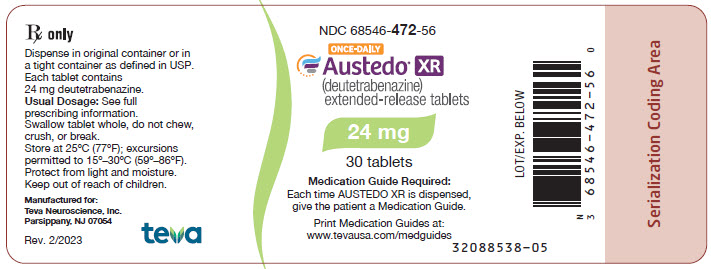
Austedo XR deutetrabenazine 18 mg Tablet, Film Coated, Extended Release, 30-count — NDC 68546-479-56 (Billing 68546-0479-56)
This is a package of 30 tablets of Austedo XR deutetrabenazine 18 mg Tablet, Film Coated, Extended Release from Teva Neuroscience, Inc., marketed since Jul 2024 and currently FDA-listed; retail pharmacies pay about $251.16 per tablet (NADAC). It is this product's only package size.
NDC database record
One package, one record: these facts belong to NDC 68546-479-56 alone.
- Record
- FDA NDC Directory package listing · Human prescription drug
- Code segments
- 68546 labeler · 479 product · 56 package
- Package marketed since
- Jul 1, 2024
- Sample package
- No — commercial package
- Listing certified through
- Dec 31, 2026
- Billing quantity
- 30 EA per package
- Barcode (UPC)
- 0368546172606, 0368546170602, 0368546171609
- Medicaid fills, this package
- 1,687 prescriptions in the last four reported quarters
- FDA record last changed
- Oct 8, 2026
Identity & classification
Regulatory identifiers FDA, NLM and CMS codes for this package
Drug-database identifiers Medi-Span GPI and First Databank GCN / HICL / AHFS classification
- GSN (GCN sequence number): 086271
- GCN: 55959
- GPI-14 (Medi-Span): 62380030007525
- HICL (First Databank): 044192
- AHFS class code: 28:56.00.00
- RxCUI (RxNorm): 1876910
Where does this data come from?
- FDA openFDA NDC Directory · synced Oct 8, 2026
- FDA label on DailyMed · label index refreshed Oct 8, 2026
- RxNorm (NLM RxNav) · catalog refreshed Oct 1, 2026
- Medi-Span GPI (licensed)
- First Databank (licensed) · refreshed Oct 8, 2026
RxNorm drug class
This medicine belongs to the Other nervous system drugs class.
Where does this data come from?
- RxClass (NLM) · catalog refreshed Oct 1, 2026
Clinical
- It treats involuntary movements in adults. That means chorea from Huntington’s disease and tardive dyskinesia. Both Austedo and Austedo XR are approved for these.
- Swallow the tablet whole, without chewing, crushing or breaking it. Austedo XR is taken once a day, with or without food. Austedo is taken with food, and at higher total daily dose...
- The most common ones are sleepiness, fatigue, diarrhea and dry mouth. Some people also have trouble sleeping or catch more colds. Don’t drive until you know how it affects you.
- Call about any new or worse depression, suicidal thoughts, or unusual behavior changes. Also call if you feel very restless, have stiffness, slowed movement, or falls, or if you ge...
Patient education
Supplement & herbal interactions
Some supplements/herbs that may interact with Deutetrabenazine — tap one for details:
Where does this data come from?
- MedlinePlus (NLM) · refreshed Oct 8, 2026
- FDA label on DailyMed · label index refreshed Oct 8, 2026
Ask a licensed pharmacist directly — free, answered by our team.
Pricing
A drug doesn't have one price. Each row is a different public payment system, and none is what you'd pay at the counter — that depends on your insurance. The ⓘ on each row explains what it measures.
| Price system | Per ea | Per package |
|---|---|---|
| Retail pharmacies payNADAC · weekly | $251.161 | $7,534.83 / 30 tablets |
| Medicaid paysCMS SDUD · 12 mo | $246.06 | $7,381.72 / 30 tablets |
| Medicare drug plans payPart D · Q2 2026 | $254.43 | $7,633.00 / 30 tablets |
Where does this data come from?
- CMS NADAC weekly file · file of Oct 7, 2026
- CMS ASP pricing files · refreshed Sep 20, 2026
- CMS Medicaid State Drug Utilization Data · through Q1 2026
- CMS Part D plan pricing files · refreshed Sep 24, 2026
- VA National Acquisition Center price file
Packaging — all sizes for this product
| Package NDC | Description | Marketing start | Marketing end | Status |
|---|---|---|---|---|
| 68546-0479-56 You're viewing this Main listing | 30 TABLET, FILM COATED, EXTENDED RELEASE in 1 BOTTLE | 2024-07-01 | — | Active |
Therapeutic equivalents
| Product | Labeler | Pack | NADAC/unit | TE | Status | Price vs. this |
|---|---|---|---|---|---|---|
| Austedo Xr 18 mgthis 68546-0479-56 | Teva | 30 tablets | $251.161 | — | Availability likely | — |
Where does this data come from?
- FDA openFDA NDC Directory · synced Oct 8, 2026
- FDA Orange Book · refreshed Oct 3, 2026
- CMS NADAC weekly file · file of Oct 7, 2026
Availability & generic status
We did not find an FDA-approved generic match for this exact strength, form and route. Patent/protection dates below may affect future generic timing.
Why the date isn’t exact: Generic timing can change because patents may be challenged, settled, licensed, added, removed, or worked around with a narrower label — and FDA approval does not always mean a pharmacy can get the generic today.
🛈 What do these terms mean?
- Patent
- Legal protection listed in the Orange Book that may delay generic approval or launch. Issued by the U.S. Patent & Trademark Office.
- Substance patent
- Covers the active drug molecule itself — the hardest to design around. A generic generally can’t launch until it expires.
- Formulation (product) patent
- Covers a specific formulation or dosage form. A generic can sometimes work around it with a different formulation.
- Method-of-use patent
- A patent covering one specific approved use of the drug — not necessarily the whole molecule. A generic can sometimes launch with a “skinny label” that carves out the protected use and keeps the others.
- Skinny label
- A generic label that omits a still-patented use when the FDA allows it — letting a generic reach the market for the unprotected uses.
- Exclusivity
- FDA-granted marketing protection, separate from patents — e.g. 5-yr new chemical entity, 7-yr orphan drug, or a +6-month pediatric extension.
- Paragraph IV
- A generic applicant’s formal challenge to a listed patent. It can potentially lead to earlier generic entry, but often involves litigation or a settlement.
- RLD / RS
- Reference Listed Drug — the brand product the FDA uses as the reference for generic applications. Reference Standard — the product the FDA expects generics to compare against in bioequivalence testing.
- TE / AB rating
- FDA therapeutic-equivalence rating. An AB rating generally means the FDA considers a generic therapeutically equivalent to — and substitutable for — the brand.
- LOE (loss of exclusivity)
- The latest patent or exclusivity currently listed — the loss-of-exclusivity / latest-listed-protection date shown on this page. Paragraph-IV challenges and settlements can move the real date earlier; FDA approval and a manufacturer’s decision to market can move it later.
Built from the FDA Orange Book. The bars above are scaled to each protection’s expiry; the red LOE marker is the last one to lapse.
| Patent | Type | Use code | Expires |
|---|---|---|---|
| US 11446291 ↗ | Method of use | U-1995 | Mar 7, 2036 |
| US 11446291 ↗ | Method of use | U-1995 | Mar 7, 2036 |
| US 11446291 ↗ | Method of use | U-1995 | Mar 7, 2036 |
| US 11446291 ↗ | Method of use | U-1995 | Mar 7, 2036 |
| US 11446291 ↗ | Method of use | U-1995 | Mar 7, 2036 |
| US 11564917 ↗ | Method of use | U-1995 | Mar 7, 2036 |
| US 11564917 ↗ | Method of use | U-1995 | Mar 7, 2036 |
| US 11564917 ↗ | Method of use | U-1995 | Mar 7, 2036 |
| US 11564917 ↗ | Method of use | U-1995 | Mar 7, 2036 |
| US 11564917 ↗ | Method of use | U-1995 | Mar 7, 2036 |
| US 11648244 ↗ | Method of use | U-1995 | Mar 7, 2036 |
| US 11648244 ↗ | Method of use | U-1995 | Mar 7, 2036 |
| US 11648244 ↗ | Method of use | U-1995 | Mar 7, 2036 |
| US 11648244 ↗ | Method of use | U-1995 | Mar 7, 2036 |
| US 11648244 ↗ | Method of use | U-1995 | Mar 7, 2036 |
| US 12016858 ↗ | Method of use | U-1995 | Mar 7, 2036 |
| US 12016858 ↗ | Method of use | U-3055 | Mar 7, 2036 |
| US 12016858 ↗ | Method of use | U-3055 | Mar 7, 2036 |
| US 12016858 ↗ | Method of use | U-3055 | Mar 7, 2036 |
| US 12016858 ↗ | Method of use | U-3055 | Mar 7, 2036 |
| US 12016858 ↗ | Method of use | U-3055 | Mar 7, 2036 |
| US 12016858 ↗ | Method of use | U-3055 | Mar 7, 2036 |
| US 12016858 ↗ | Method of use | U-3055 | Mar 7, 2036 |
| US 12016858 ↗ | Method of use | U-3055 | Mar 7, 2036 |
| US 12016858 ↗ | Method of use | U-1995 | Mar 7, 2036 |
| US 12016858 ↗ | Method of use | U-1995 | Mar 7, 2036 |
| US 12016858 ↗ | Method of use | U-1995 | Mar 7, 2036 |
| US 12016858 ↗ | Method of use | U-1995 | Mar 7, 2036 |
| US 12016858 ↗ | Method of use | U-1995 | Mar 7, 2036 |
| US 12016858 ↗ | Method of use | U-1995 | Mar 7, 2036 |
| US 12016858 ↗ | Method of use | U-1995 | Mar 7, 2036 |
| US 9550780 ↗ | Drug substance | U-1995 | Sep 18, 2033 |
| US 9550780 ↗ | Drug substance | U-3055 | Sep 18, 2033 |
| US 9550780 ↗ | Drug substance | U-3055 | Sep 18, 2033 |
| US 9550780 ↗ | Drug substance | U-1995 | Sep 18, 2033 |
| US 9550780 ↗ | Drug substance | U-3055 | Sep 18, 2033 |
| US 9550780 ↗ | Drug substance | U-1995 | Sep 18, 2033 |
| US 9550780 ↗ | Drug substance | U-3055 | Sep 18, 2033 |
| US 9550780 ↗ | Drug substance | U-1995 | Sep 18, 2033 |
| US 9550780 ↗ | Drug substance | U-3055 | Sep 18, 2033 |
| US 9550780 ↗ | Drug substance | U-1995 | Sep 18, 2033 |
| US 11179386 ↗ | Method of use | U-1995 | Mar 15, 2038 |
| US 11179386 ↗ | Method of use | U-3055 | Mar 15, 2038 |
| US 11179386 ↗ | Method of use | U-3055 | Mar 15, 2038 |
| US 11179386 ↗ | Method of use | U-1995 | Mar 15, 2038 |
| US 11179386 ↗ | Method of use | U-3055 | Mar 15, 2038 |
| US 11179386 ↗ | Method of use | U-1995 | Mar 15, 2038 |
| US 11179386 ↗ | Method of use | U-1995 | Mar 15, 2038 |
| US 11179386 ↗ | Method of use | U-3055 | Mar 15, 2038 |
| US 11179386 ↗ | Method of use | U-3055 | Mar 15, 2038 |
| US 11179386 ↗ | Method of use | U-1995 | Mar 15, 2038 |
| US 10959996 ↗ | Method of use | U-3055 | Mar 7, 2036 |
| US 10959996 ↗ | Method of use | U-3055 | Mar 7, 2036 |
| US 10959996 ↗ | Method of use | U-3055 | Mar 7, 2036 |
| US 10959996 ↗ | Method of use | U-3055 | Mar 7, 2036 |
| US 10959996 ↗ | Method of use | U-3055 | Mar 7, 2036 |
| US 11311488 ↗ | Method of use | U-1995 | Jun 10, 2041 |
| US 11311488 ↗ | Method of use | U-3055 | Jun 10, 2041 |
| US 11311488 ↗ | Method of use | U-3055 | Jun 10, 2041 |
| US 11311488 ↗ | Method of use | U-1995 | Jun 10, 2041 |
| US 11311488 ↗ | Method of use | U-3055 | Jun 10, 2041 |
| US 11311488 ↗ | Method of use | U-1995 | Jun 10, 2041 |
| US 11311488 ↗ | Method of use | U-3055 | Jun 10, 2041 |
| US 11311488 ↗ | Method of use | U-1995 | Jun 10, 2041 |
| US 11311488 ↗ | Method of use | U-3055 | Jun 10, 2041 |
| US 11311488 ↗ | Method of use | U-1995 | Jun 10, 2041 |
| US 11357772 ↗ | Method of use | U-3055 | Mar 7, 2036 |
| US 11357772 ↗ | Method of use | U-1995 | Mar 7, 2036 |
| US 11357772 ↗ | Method of use | U-3055 | Mar 7, 2036 |
| US 11357772 ↗ | Method of use | U-1995 | Mar 7, 2036 |
| US 11357772 ↗ | Method of use | U-1995 | Mar 7, 2036 |
| US 11357772 ↗ | Method of use | U-3055 | Mar 7, 2036 |
| US 11357772 ↗ | Method of use | U-3055 | Mar 7, 2036 |
| US 11357772 ↗ | Method of use | U-1995 | Mar 7, 2036 |
| US 11357772 ↗ | Method of use | U-1995 | Mar 7, 2036 |
| US 11357772 ↗ | Method of use | U-3055 | Mar 7, 2036 |
| US 11179386 ↗ | Method of use | U-1995 | Mar 15, 2038 |
| US 11179386 ↗ | Method of use | U-3055 | Mar 15, 2038 |
| US 11179386 ↗ | Method of use | U-3055 | Mar 15, 2038 |
| US 11179386 ↗ | Method of use | U-3055 | Mar 15, 2038 |
| US 11179386 ↗ | Method of use | U-1995 | Mar 15, 2038 |
| US 11179386 ↗ | Method of use | U-1995 | Mar 15, 2038 |
| US 10959996 ↗ | Method of use | U-3055 | Mar 7, 2036 |
| US 10959996 ↗ | Method of use | U-3055 | Mar 7, 2036 |
| US 10959996 ↗ | Method of use | U-3055 | Mar 7, 2036 |
| US 11311488 ↗ | Method of use | U-1995 | Jun 10, 2041 |
| US 11311488 ↗ | Method of use | U-3055 | Jun 10, 2041 |
| US 11311488 ↗ | Method of use | U-3055 | Jun 10, 2041 |
| US 11311488 ↗ | Method of use | U-3055 | Jun 10, 2041 |
| US 11311488 ↗ | Method of use | U-1995 | Jun 10, 2041 |
| US 11311488 ↗ | Method of use | U-1995 | Jun 10, 2041 |
| US 9550780 ↗ | Drug substance | U-1995 | Sep 18, 2033 |
| US 9550780 ↗ | Drug substance | U-3055 | Sep 18, 2033 |
| US 9550780 ↗ | Drug substance | U-3055 | Sep 18, 2033 |
| US 9550780 ↗ | Drug substance | U-3055 | Sep 18, 2033 |
| US 9550780 ↗ | Drug substance | U-1995 | Sep 18, 2033 |
| US 9550780 ↗ | Drug substance | U-1995 | Sep 18, 2033 |
| US 11564917 ↗ | Method of use | U-1995 | Mar 7, 2036 |
| US 11564917 ↗ | Method of use | U-1995 | Mar 7, 2036 |
| US 11564917 ↗ | Method of use | U-1995 | Mar 7, 2036 |
| US 11446291 ↗ | Method of use | U-1995 | Mar 7, 2036 |
| US 11446291 ↗ | Method of use | U-1995 | Mar 7, 2036 |
| US 11446291 ↗ | Method of use | U-1995 | Mar 7, 2036 |
| US 11357772 ↗ | Method of use | U-1995 | Mar 7, 2036 |
| US 11357772 ↗ | Method of use | U-3055 | Mar 7, 2036 |
| US 11357772 ↗ | Method of use | U-3055 | Mar 7, 2036 |
| US 11357772 ↗ | Method of use | U-3055 | Mar 7, 2036 |
| US 11357772 ↗ | Method of use | U-1995 | Mar 7, 2036 |
| US 11357772 ↗ | Method of use | U-1995 | Mar 7, 2036 |
| US 11648244 ↗ | Method of use | U-1995 | Mar 7, 2036 |
| US 11648244 ↗ | Method of use | U-1995 | Mar 7, 2036 |
| US 11648244 ↗ | Method of use | U-1995 | Mar 7, 2036 |
| US 12599598 ↗ | Method of use | U-3055 | Jun 10, 2041 |
| US 12599598 ↗ | Method of use | U-1995 | Jun 10, 2041 |
| US 12599598 ↗ | Method of use | U-3055 | Jun 10, 2041 |
| US 12599598 ↗ | Method of use | U-1995 | Jun 10, 2041 |
| US 12599598 ↗ | Method of use | U-3055 | Jun 10, 2041 |
| US 12599598 ↗ | Method of use | U-1995 | Jun 10, 2041 |
| US 12599598 ↗ | Method of use | U-3055 | Jun 10, 2041 |
| US 12599598 ↗ | Method of use | U-1995 | Jun 10, 2041 |
| US 12599598 ↗ | Method of use | U-3055 | Jun 10, 2041 |
| US 12599598 ↗ | Method of use | U-1995 | Jun 10, 2041 |
| US 12599598 ↗ | Method of use | U-3055 | Jun 10, 2041 |
| US 12599598 ↗ | Method of use | U-1995 | Jun 10, 2041 |
| US 12599598 ↗ | Method of use | U-3055 | Jun 10, 2041 |
| US 12599598 ↗ | Method of use | U-1995 | Jun 10, 2041 |
| US 12599598 ↗ | Method of use | U-3055 | Jun 10, 2041 |
| US 12599598 ↗ | Method of use | U-1995 | Jun 10, 2041 |
| US 12589075 ↗ | Method of use | U-3055 | Jun 10, 2041 |
| US 12589075 ↗ | Method of use | U-1995 | Jun 10, 2041 |
| US 12589075 ↗ | Method of use | U-3055 | Jun 10, 2041 |
| US 12589075 ↗ | Method of use | U-1995 | Jun 10, 2041 |
| US 12589075 ↗ | Method of use | U-3055 | Jun 10, 2041 |
| US 12589075 ↗ | Method of use | U-1995 | Jun 10, 2041 |
| US 12589075 ↗ | Method of use | U-3055 | Jun 10, 2041 |
| US 12589075 ↗ | Method of use | U-1995 | Jun 10, 2041 |
| US 12589075 ↗ | Method of use | U-3055 | Jun 10, 2041 |
| US 12589075 ↗ | Method of use | U-1995 | Jun 10, 2041 |
| US 12589075 ↗ | Method of use | U-3055 | Jun 10, 2041 |
| US 12589075 ↗ | Method of use | U-1995 | Jun 10, 2041 |
| US 12589075 ↗ | Method of use | U-3055 | Jun 10, 2041 |
| US 12589075 ↗ | Method of use | U-1995 | Jun 10, 2041 |
| US 12589075 ↗ | Method of use | U-3055 | Jun 10, 2041 |
| US 12589075 ↗ | Method of use | U-1995 | Jun 10, 2041 |
| US 8524733 ↗ | Drug substance | — | Apr 3, 2031 |
| US 11813232 ↗ | Drug product | — | Mar 15, 2038 |
| US 8524733 ↗ | Drug substance | — | Apr 3, 2031 |
| US 8524733 ↗ | Drug substance | — | Apr 3, 2031 |
| US 11813232 ↗ | Drug product | — | Mar 15, 2038 |
| US 11813232 ↗ | Drug product | — | Mar 15, 2038 |
| US 8524733 ↗ | Drug substance | — | Apr 3, 2031 |
| US 8524733 ↗ | Drug substance | — | Apr 3, 2031 |
| US 8524733 ↗ | Drug substance | — | Apr 3, 2031 |
| US 11813232 ↗ | Drug product | — | Mar 15, 2038 |
| US 11813232 ↗ | Drug product | — | Mar 15, 2038 |
| US 11813232 ↗ | Drug product | — | Mar 15, 2038 |
| US 11813232 ↗ | Drug product | — | Mar 15, 2038 |
| US 11813232 ↗ | Drug product | — | Mar 15, 2038 |
| US 8524733 ↗ | Drug substance | — | Apr 3, 2031 |
| US 8524733 ↗ | Drug substance | — | Apr 3, 2031 |
| US 11813232*PED ↗ | Drug product | — | Sep 15, 2038 |
| US 11813232*PED ↗ | Drug product | — | Sep 15, 2038 |
| US 11813232*PED ↗ | Drug product | — | Sep 15, 2038 |
| US 11648244*PED ↗ | Drug product | — | Sep 7, 2036 |
| US 11648244*PED ↗ | Drug product | — | Sep 7, 2036 |
| US 11648244*PED ↗ | Drug product | — | Sep 7, 2036 |
| US 11446291*PED ↗ | Drug product | — | Sep 7, 2036 |
| US 11446291*PED ↗ | Drug product | — | Sep 7, 2036 |
| US 11446291*PED ↗ | Drug product | — | Sep 7, 2036 |
| US 11446291*PED ↗ | Drug product | — | Sep 7, 2036 |
| US 11446291*PED ↗ | Drug product | — | Sep 7, 2036 |
| US 11564917*PED ↗ | Drug product | — | Sep 7, 2036 |
| US 11564917*PED ↗ | Drug product | — | Sep 7, 2036 |
| US 11564917*PED ↗ | Drug product | — | Sep 7, 2036 |
| US 11564917*PED ↗ | Drug product | — | Sep 7, 2036 |
| US 11564917*PED ↗ | Drug product | — | Sep 7, 2036 |
| US 11648244*PED ↗ | Drug product | — | Sep 7, 2036 |
| US 11648244*PED ↗ | Drug product | — | Sep 7, 2036 |
| US 11648244*PED ↗ | Drug product | — | Sep 7, 2036 |
| US 11648244*PED ↗ | Drug product | — | Sep 7, 2036 |
| US 11648244*PED ↗ | Drug product | — | Sep 7, 2036 |
| US 11813232*PED ↗ | Drug product | — | Sep 15, 2038 |
| US 11813232*PED ↗ | Drug product | — | Sep 15, 2038 |
| US 11813232*PED ↗ | Drug product | — | Sep 15, 2038 |
| US 11813232*PED ↗ | Drug product | — | Sep 15, 2038 |
| US 11813232*PED ↗ | Drug product | — | Sep 15, 2038 |
| US 9550780*PED ↗ | Drug product | — | Mar 18, 2034 |
| US 9550780*PED ↗ | Drug product | — | Mar 18, 2034 |
| US 9550780*PED ↗ | Drug product | — | Mar 18, 2034 |
| US 9550780*PED ↗ | Drug product | — | Mar 18, 2034 |
| US 9550780*PED ↗ | Drug product | — | Mar 18, 2034 |
| US 11179386*PED ↗ | Drug product | — | Sep 15, 2038 |
| US 11179386*PED ↗ | Drug product | — | Sep 15, 2038 |
| US 11179386*PED ↗ | Drug product | — | Sep 15, 2038 |
| US 11179386*PED ↗ | Drug product | — | Sep 15, 2038 |
| US 11179386*PED ↗ | Drug product | — | Sep 15, 2038 |
| US 8524733*PED ↗ | Drug product | — | Oct 3, 2031 |
| US 8524733*PED ↗ | Drug product | — | Oct 3, 2031 |
| US 8524733*PED ↗ | Drug product | — | Oct 3, 2031 |
| US 8524733*PED ↗ | Drug product | — | Oct 3, 2031 |
| US 8524733*PED ↗ | Drug product | — | Oct 3, 2031 |
| US 10959996*PED ↗ | Drug product | — | Sep 7, 2036 |
| US 10959996*PED ↗ | Drug product | — | Sep 7, 2036 |
| US 10959996*PED ↗ | Drug product | — | Sep 7, 2036 |
| US 10959996*PED ↗ | Drug product | — | Sep 7, 2036 |
| US 10959996*PED ↗ | Drug product | — | Sep 7, 2036 |
| US 11357772*PED ↗ | Drug product | — | Sep 7, 2036 |
| US 11357772*PED ↗ | Drug product | — | Sep 7, 2036 |
| US 11357772*PED ↗ | Drug product | — | Sep 7, 2036 |
| US 11357772*PED ↗ | Drug product | — | Sep 7, 2036 |
| US 11357772*PED ↗ | Drug product | — | Sep 7, 2036 |
| US 12016858*PED ↗ | Drug product | — | Sep 7, 2036 |
| US 12016858*PED ↗ | Drug product | — | Sep 7, 2036 |
| US 12016858*PED ↗ | Drug product | — | Sep 7, 2036 |
| US 12016858*PED ↗ | Drug product | — | Sep 7, 2036 |
| US 12016858*PED ↗ | Drug product | — | Sep 7, 2036 |
| US 12016858*PED ↗ | Drug product | — | Sep 7, 2036 |
| US 12016858*PED ↗ | Drug product | — | Sep 7, 2036 |
| US 12016858*PED ↗ | Drug product | — | Sep 7, 2036 |
| US 11179386*PED ↗ | Drug product | — | Sep 15, 2038 |
| US 11179386*PED ↗ | Drug product | — | Sep 15, 2038 |
| US 11179386*PED ↗ | Drug product | — | Sep 15, 2038 |
| US 10959996*PED ↗ | Drug product | — | Sep 7, 2036 |
| US 10959996*PED ↗ | Drug product | — | Sep 7, 2036 |
| US 10959996*PED ↗ | Drug product | — | Sep 7, 2036 |
| US 9550780*PED ↗ | Drug product | — | Mar 18, 2034 |
| US 9550780*PED ↗ | Drug product | — | Mar 18, 2034 |
| US 9550780*PED ↗ | Drug product | — | Mar 18, 2034 |
| US 11564917*PED ↗ | Drug product | — | Sep 7, 2036 |
| US 11564917*PED ↗ | Drug product | — | Sep 7, 2036 |
| US 11564917*PED ↗ | Drug product | — | Sep 7, 2036 |
| US 11446291*PED ↗ | Drug product | — | Sep 7, 2036 |
| US 11446291*PED ↗ | Drug product | — | Sep 7, 2036 |
| US 11446291*PED ↗ | Drug product | — | Sep 7, 2036 |
| US 11357772*PED ↗ | Drug product | — | Sep 7, 2036 |
| US 11357772*PED ↗ | Drug product | — | Sep 7, 2036 |
| US 11357772*PED ↗ | Drug product | — | Sep 7, 2036 |
| US 8524733*PED ↗ | Drug product | — | Oct 3, 2031 |
| US 8524733*PED ↗ | Drug product | — | Oct 3, 2031 |
| US 8524733*PED ↗ | Drug product | — | Oct 3, 2031 |
Is there a generic version of AUSTEDO XR 18 MG TABLET?
The FDA approved a generic — why can’t I get it at my pharmacy yet?
Why do different websites show different generic release dates?
What does “FDA listed” mean?
What does a patent or protection date mean here?
What does “current Orange Book estimate” mean?
Can a generic come out before the last patent expires?
Can a generic come out after the listed dates?
What is the difference between patents and exclusivity?
Why are there multiple patent dates?
Where does this data come from?
- FDA Orange Book · refreshed Oct 3, 2026
What it looks like
Where does this data come from?
- FDA label on DailyMed · label index refreshed Oct 8, 2026
Inactive Ingredients / Excipients
Inactive ingredients, also called excipients, are components of the drug product other than the active ingredient. They may include fillers, dyes, coatings, preservatives, flavors, or other formulation ingredients.
🧪 Avoiding an ingredient? See Deutetrabenazine inactive ingredients by manufacturer: every current product's list side by side, so you can ask your pharmacy for the version that does not list it.
💡 Tap an ingredient (hover on desktop) to see what it is and why it’s used.
-
UNII 5138Q19F1X
Ammonia is a colorless gas made from nitrogen and hydrogen. It's used in medicines as a pH buffer to maintain the correct acidity level and help keep the product stable.
-
UNII 8PJ61P6TS3
Butyl alcohol is a clear liquid organic solvent derived from petroleum or natural sources. In medicines, it helps dissolve active ingredients and serves as a solvent in liquid formulations and some topical products.
-
UNII REK4960K2U
Butylated hydroxyanisole is a synthetic preservative that prevents oils and fats in medicines from spoiling or becoming rancid. It keeps the medicine stable and extends its shelf life.
-
UNII 1P9D0Z171K
BHT is a synthetic antioxidant that prevents fats and oils in medicines from breaking down and becoming rancid. It helps keep the product stable and effective during storage.
-
UNII CID8Z8N95N
Carminic acid is a red-to-purple dye extracted from cochineal insects. It's used in medicines as a colorant to give tablets, capsules, or liquids their red or pink appearance.
-
UNII 3J2P07GVB6
Cellulose acetate is a plant-derived polymer made by chemically modifying cellulose fibers. In medications, it serves as a film-coating material for tablets and capsules to protect the drug, control release, and improve appearance.
-
UNII WZB9127XOA
A synthetic red dye used to color medications and make them easier to identify. It serves as a colorant in tablets, capsules, and liquid formulations.
-
UNII H77VEI93A8
A synthetic yellow dye used to color medications. It helps identify the drug and make it visually distinctive, with no effect on how the medicine works.
-
UNII XM0M87F357
A dark iron oxide compound that gives medicines their black or dark color. It's used as a colorant in tablets and capsules to help identify the product and make it visually distinctive.
-
UNII 9XZ8H6N6OH
A plant-based cellulose derivative used as a binder to hold tablet ingredients together, a thickener in liquids, and a coating agent to control how fast the medicine dissolves.
-
UNII 3NXW29V3WO
Hypromellose is a plant-based thickener made from cellulose. It's used in medicines as a binder to hold ingredients together, a coating for tablets, and a thickener for liquids.
-
UNII ND2M416302
Isopropyl alcohol is a clear liquid solvent derived from petroleum. In medicines, it dissolves active ingredients and other components, helps the product flow smoothly, and aids in sterilization during manufacturing.
-
UNII 70097M6I30
Magnesium stearate is a salt made from magnesium and stearic acid, a fatty substance. It's used in tablets and capsules as a lubricant and glidant to help ingredients flow smoothly during manufacturing and prevent sticking.
-
UNII G2M7P15E5P
Polyethylene glycol 3350 is a synthetic polymer used as a solvent, humectant, and thickening agent in medicines. It helps dissolve other ingredients, retain moisture in the product, and achieve the desired consistency.
-
UNII 3WJQ0SDW1A
Polyethylene glycol is a synthetic liquid or solid polymer used in medicines as a solvent, lubricant, and humectant. It helps dissolve active ingredients, reduces friction during manufacturing, and retains moisture in the final product.
-
UNII 11628IH70O
Polyethylene oxide is a synthetic polymer derived from ethylene. In medicines, it acts as a binder to hold ingredients together, a thickener to adjust texture, and a disintegrant to help the tablet or capsule break apart for absorption.
-
UNII 3IG9032SAH
A synthetic polymer derived from ethylene that forms a thick, gel-like substance in water. It acts as a binder and thickener in medications, helping hold solid forms together and controlling how quickly the medicine releases into your body.
-
UNII 532B59J990
Polyvinyl alcohol is a synthetic polymer made from plant-derived materials. It's used as a binder to hold ingredients together, a film-former in coatings, and a thickener in liquid formulations.
-
UNII 6DC9Q167V3
Propylene glycol is a clear liquid derived from petroleum or vegetable sources. It acts as a solvent, humectant, and preservative in medicines, helping dissolve active ingredients and maintain product stability.
-
UNII 46N107B71O
Shellac is a natural resin secreted by the lac beetle. It's used as a coating on tablets and capsules to control how quickly the medicine dissolves and to improve appearance and stability.
-
UNII 451W47IQ8X
Sodium chloride is common table salt. It's used in medicines as a buffer to maintain proper pH, as a filler to add bulk, or to adjust the osmotic balance in liquid formulations.
-
UNII 7SEV7J4R1U
A powder made from a naturally occurring mineral. In medicines, talc works as a glidant and anti-caking agent, helping tablets and capsules flow smoothly during manufacturing and preventing clumping.
-
UNII 15FIX9V2JP
Titanium dioxide is a bright white mineral powder commonly used as a colorant and opacifying agent. It makes pills and tablets white or lighter in color and helps make coatings non-transparent.
23 inactive ingredients listed in the exact product block matched to this NDC.
Where does this data come from?
ingredient classCode="IACT" elements from the exact product block matched by this NDC. Label-section narrative from DailyMed / the openFDA label index is shown separately when available.- FDA label on DailyMed · label index refreshed Oct 8, 2026
- FDA openFDA NDC Directory · synced Oct 8, 2026
Inactive ingredient FAQ
Are inactive ingredients the same for every manufacturer?
Why might an inactive ingredient be missing?
Can inactive ingredients matter?
Manufacturer & labeler
More NDCs from Teva Neuroscience, Inc. labeler code 68546
- Austedo XR deutetrabenazine 24 mg Tablet, Film Coated, Extended Release NDC 68546-472-56
- Austedo XR deutetrabenazine 30 mg Tablet, Film Coated, Extended Release NDC 68546-473-56
- Austedo XR deutetrabenazine 36 mg Tablet, Film Coated, Extended Release NDC 68546-474-56
- Austedo XR deutetrabenazine 42 mg Tablet, Film Coated, Extended Release NDC 68546-475-56
- Austedo XR deutetrabenazine 48 mg Tablet, Film Coated, Extended Release NDC 68546-476-56
- AUSTEDO XR deutetrabenazine Kit NDC 68546-477-28
Where does this data come from?
- FDA openFDA NDC Directory · synced Oct 8, 2026
- Drugs@FDA
Full prescribing information FDA SPL
🚨 Boxed Warning ▾
WARNING: DEPRESSION AND SUICIDALITY IN PATIENTS WITH HUNTINGTON’S DISEASE AUSTEDO XR and AUSTEDO can increase the risk of depression and suicidal thoughts and behavior (suicidality) in patients with Huntington’s disease. Anyone considering the use of AUSTEDO XR or AUSTEDO must balance the risks of depression and suicidality with the clinical need for treatment of chorea. Closely monitor patients for the emergence or worsening of depression, suicidality, or unusual changes in behavior.
Patients, their caregivers, and families should be informed of the risk of depression and suicidality and should be instructed to report behaviors of concern promptly to the treating physician. Particular caution should be exercised in treating patients with a history of depression or prior suicide attempts or ideation, which are increased in frequency in Huntington’s disease. AUSTEDO XR and AUSTEDO are contraindicated in patients who are suicidal, and in patients with untreated or inadequately treated depression [see Contraindications ( 4 ) and Warnings and Precautions ( 5.1 )].
WARNING: DEPRESSION AND SUICIDALITY IN PATIENTS WITH HUNTINGTON’S DISEASE See full prescribing information for complete boxed warning. Increases the risk of depression and suicidal thoughts and behavior (suicidality) in patients with Huntington’s disease ( 5.1 ) Balance risks of depression and suicidality with the clinical need for treatment of chorea when considering the use of AUSTEDO XR or AUSTEDO ( 5.1 ) Monitor patients for the emergence or worsening of depression, suicidality, or unusual changes in behavior ( 5.1 ) Inform patients, caregivers, and families of the risk of depression and suicidality and instruct to report behaviors of concern promptly to the treating physician ( 5.1 ) Exercise caution when treating patients with a history of depression or prior suicide attempts or ideation ( 5.1 ) AUSTEDO XR and AUSTEDO are contraindicated in patients who are suicidal, and in patients with untreated or inadequately treated depression ( 4 , 5.1 )
🎯 Indications and Usage ▾
1 INDICATIONS AND USAGE AUSTEDO XR ® and AUSTEDO ® are indicated in adults for the treatment of: chorea associated with Huntington’s disease [see Clinical Studies ( 14.1 )] tardive dyskinesia [see Clinical Studies ( 14.2 )] AUSTEDO XR and AUSTEDO are vesicular monoamine transporter 2 (VMAT2) inhibitors indicated in adults for the treatment of: Chorea associated with Huntington’s disease ( 1 ) Tardive dyskinesia ( 1 )
⏱️ Dosage and Administration ▾
2 DOSAGE AND ADMINISTRATION AUSTEDO XR AUSTEDO Recommended Starting Dosage 12 mg once daily (12 mg per day) 6 mg twice daily (12 mg per day) Titrate at weekly intervals by 6 mg per day based on reduction of chorea or tardive dyskinesia, and tolerability, up to a maximum recommended daily dosage of 48 mg ( 2.1 ) Administer AUSTEDO XR with or without food in once-daily doses ( 2.1 ) Administer AUSTEDO with food and administer total daily dosages of 12 mg or above in two divided doses ( 2.1 ) Swallow tablets whole; do not chew, crush, or break ( 2.1 ) If switching patients from tetrabenazine, discontinue tetrabenazine and initiate AUSTEDO XR or AUSTEDO the following day.
See full prescribing information for recommended conversion table ( 2.2 ) Maximum recommended dosage of AUSTEDO XR or AUSTEDO in poor CYP2D6 metabolizers is 36 mg per day ( 2.4 , 8.7 )
2.1Dosing Information The dose of AUSTEDO XR and AUSTEDO is determined individually for each patient based on reduction of chorea or tardive dyskinesia and tolerability. Table 1 displays the recommended dosage and important administration instructions of AUSTEDO XR and AUSTEDO when first prescribed to patients who are not being switched from tetrabenazine (a related VMAT2 inhibitor). Table 1: Recommended Dosage and Important Administration Instructions for AUSTEDO XR and AUSTEDO AUSTEDO XR extended-release tablet AUSTEDO tablet Recommended Starting Dosage 12 mg once daily (12 mg per day) 6 mg twice daily (12 mg per day) Recommended Dose Titration The dosage of AUSTEDO XR or AUSTEDO may be increased at weekly intervals in increments of 6 mg per day based on reduction of chorea or tardive dyskinesia, and tolerability, up to a maximum recommended daily dosage of 48 mg [see Clinical Trials ( 14.1 , 14.2 )] .
Important Administration Instructions Administer AUSTEDO XR with or without food [see Clinical Pharmacology ( 12.3 )] . Swallow AUSTEDO XR whole. Do not chew, crush, or break tablets.
Administer AUSTEDO XR once daily. Administer AUSTEDO with food [see Clinical Pharmacology ( 12.3 )] . Swallow AUSTEDO whole.
Do not chew, crush, or break tablets. Administer AUSTEDO total daily dosages of 12 mg or above in two divided doses. Switching Between AUSTEDO and AUSTEDO XR When switching between AUSTEDO tablets (twice daily) and AUSTEDO XR extended-release tablets (once daily), switch to the same total daily dosage.
2.2Switching Patients from Tetrabenazine to AUSTEDO XR or AUSTEDO Discontinue tetrabenazine and initiate AUSTEDO XR or AUSTEDO the following day. The recommended initial dosing regimen of AUSTEDO XR or AUSTEDO in patients switching from tetrabenazine to AUSTEDO XR or AUSTEDO is shown in Table 2. Table 2: Recommended Initial Dosing Regimen when Switching from Tetrabenazine to AUSTEDO XR or AUSTEDO Current tetrabenazine daily dosage Initial regimen of AUSTEDO XR extended-release tablet Initial regimen of AUSTEDO tablet 12.5 mg 6 mg once daily 6 mg once daily 25 mg 12 mg once daily 6 mg twice daily 37.5 mg 18 mg once daily 9 mg twice daily 50 mg 24 mg once daily 12 mg twice daily 62.5 mg 30 mg once daily 15 mg twice daily 75 mg 36 mg once daily 18 mg twice daily 87.5 mg 42 mg once daily 21 mg twice daily 100 mg 48 mg once daily 24 mg twice daily After patients are switched to AUSTEDO XR or AUSTEDO, the dose may be adjusted at weekly intervals [see Dosage and Administration ( 2.1 )] .
2.3Dosage Adjustment with Strong CYP2D6 Inhibitors In patients receiving strong CYP2D6 inhibitors, the total daily dosage of AUSTEDO XR or AUSTEDO should not exceed 36 mg [see Drug Interactions ( 7.1 ) and Clinical Pharmacology ( 12.3 )] .
2.4Dosage Adjustment in Poor CYP2D6 Metabolizers In patients who are poor CYP2D6 metabolizers, the total daily dosage of AUSTEDO XR or AUSTEDO should not exceed 36 mg [see Use in Specific Populations ( 8.7 )].
2.5Discontinuation and Interruption of Treatment Treatment with AUSTEDO XR or AUSTEDO can be discontinued without tapering. Following treatment interruption… [Excerpted — this section continues on DailyMed.]
💊 Dosage Forms and Strengths ▾
3 DOSAGE FORMS AND STRENGTHS AUSTEDO XR extended-release tablets are available in the following strengths: The 6 mg extended-release tablets are round, grey-coated tablets, with “Q6” printed in black ink on one side. The 12 mg extended-release tablets are round, blue-coated tablets, with “Q12” printed in black ink on one side. The 18 mg extended-release tablets are round, light grey-coated tablets, with “Q18” printed in black ink on one side.
The 24 mg extended-release tablets are round, purple-coated tablets, with “Q24” printed in black ink on one side. The 30 mg extended-release tablets are round, light orange-coated tablets, with “Q30” printed in black ink on one side. The 36 mg extended-release tablets are round, light purple-coated tablets, with “Q36” printed in black ink on one side.
The 42 mg extended-release tablets are round, orange-coated tablets, with “Q42” printed in black ink on one side. The 48 mg extended-release tablets are round, pink-coated tablets, with “Q48” printed in black ink on one side. AUSTEDO tablets are available in the following strengths: The 6 mg tablets are round, purple-coated tablets, with “SD” over “6” printed in black ink on one side.
The 9 mg tablets are round, blue-coated tablets, with “SD” over “9” printed in black ink on one side. The 12 mg tablets are round, beige-coated tablets, with “SD” over “12” printed in black ink on one side. Extended-release tablets: 6 mg, 12 mg, 18 mg, 24 mg, 30 mg, 36 mg, 42 mg, and 48 mg ( 3 ) Tablets: 6 mg, 9 mg, and 12 mg ( 3 )
⛔ Contraindications ▾
4 CONTRAINDICATIONS AUSTEDO XR and AUSTEDO are contraindicated in patients: With Huntington’s disease who are suicidal, or have untreated or inadequately treated depression [see Warnings and Precautions ( 5.1 )] . With hepatic impairment [see Use in Specific Populations ( 8.6 ), Clinical Pharmacology ( 12.3 )] . Taking reserpine.
At least 20 days should elapse after stopping reserpine before starting AUSTEDO XR or AUSTEDO [see Drug Interactions ( 7.2 )] . Taking monoamine oxidase inhibitors (MAOIs). AUSTEDO XR and AUSTEDO should not be used in combination with an MAOI, or within 14 days of discontinuing therapy with an MAOI [see Drug Interactions ( 7.3 )] .
Taking tetrabenazine or valbenazine [see Drug Interactions ( 7.6 )] . Suicidal, or untreated/inadequately treated depression in patients with Huntington’s disease ( 4 , 5.1 ) Hepatic impairment ( 4 , 8.6 , 12.3 ) Taking reserpine, MAOIs, tetrabenazine, or valbenazine ( 4 , 7.2 , 7.3 , 7.6 )
⚠️ Warnings and Cautions ▾
5 WARNINGS AND PRECAUTIONS QT Prolongation: Avoid use in patients with congenital long QT syndrome or with arrhythmias associated with a prolonged QT interval ( 5.3 ) Neuroleptic Malignant Syndrome (NMS): Discontinue if this occurs ( 5.4 ) Akathisia, agitation, restlessness, and parkinsonism: Reduce dose or discontinue if this occurs ( 5.5 , 5.6 ) Sedation/somnolence: May impair the patient’s ability to drive or operate complex machinery ( 5.7 )
5.1Depression and Suicidality in Patients with Huntington’s Disease Patients with Huntington’s disease are at increased risk for depression, and suicidal ideation or behaviors (suicidality). AUSTEDO XR and AUSTEDO may increase the risk for suicidality in patients with Huntington’s disease. In a 12-week, double-blind, placebo-controlled trial, suicidal ideation was reported by 2% of patients treated with AUSTEDO, compared to no patients on placebo; no suicide attempts and no completed suicides were reported.
Depression was reported by 4% of patients treated with AUSTEDO. When considering the use of AUSTEDO XR or AUSTEDO, the risk of suicidality should be balanced against the need for treatment of chorea. All patients treated with AUSTEDO XR or AUSTEDO should be observed for new or worsening depression or suicidality.
If depression or suicidality does not resolve, consider discontinuing treatment with AUSTEDO XR or AUSTEDO. Patients, their caregivers, and families should be informed of the risks of depression, worsening depression, and suicidality associated with AUSTEDO XR and AUSTEDO, and should be instructed to report behaviors of concern promptly to the treating physician. Patients with Huntington’s disease who express suicidal ideation should be evaluated immediately.
5.2Clinical Worsening and Adverse Events in Patients with Huntington’s Disease Huntington’s disease is a progressive disorder characterized by changes in mood, cognition, chorea, rigidity, and functional capacity over time. VMAT2 inhibitors, including AUSTEDO XR and AUSTEDO, may cause a worsening in mood, cognition, rigidity, and functional capacity. Prescribers should periodically re-evaluate the need for AUSTEDO XR or AUSTEDO in their patients by assessing the effect on chorea and possible adverse effects, including sedation/somnolence, depression and suicidality, parkinsonism, akathisia, restlessness, and cognitive decline.
It may be difficult to distinguish between adverse reactions and progression of the underlying disease; decreasing the dose or stopping the drug may help the clinician to distinguish between the two possibilities. In some patients, the underlying chorea itself may improve over time, decreasing the need for AUSTEDO XR or AUSTEDO.
5.3QTc Prolongation AUSTEDO XR and AUSTEDO may prolong the QT interval, but the degree of QT prolongation is not clinically significant when AUSTEDO XR or AUSTEDO is administered within the recommended dosage range [see Clinical Pharmacology (12.2)] . AUSTEDO XR and AUSTEDO should be avoided in patients with congenital long QT syndrome and in patients with a history of cardiac arrhythmias. Certain circumstances may increase the risk of the occurrence of torsade de pointes and/or sudden death in association with the use of drugs that prolong the QTc interval, including (1) bradycardia; (2) hypokalemia or hypomagnesemia; (3) concomitant use of other drugs that prolong the QTc interval; and (4) presence of congenital prolongation of the QT interval.
5.4Neuroleptic Malignant Syndrome (NMS) A potentially fatal symptom complex sometimes referred to as Neuroleptic Malignant Syndrome (NMS) has been reported in association with drugs that reduce dopaminergic transmission. While NMS has not been observed in patients receiving AUSTEDO XR or AUSTEDO, it has been observed in patients receiving tetrabenazine (a closely related VMAT2 inhibitor). Clinicians should be alerted to the signs and symptoms associated with NMS.
Clinical manifestations of NMS are hyperpyrexia, muscle rigidit… [Excerpted — this section continues on DailyMed.]
🤒 Adverse Reactions ▾
6 ADVERSE REACTIONS The following serious adverse reactions are discussed in greater detail in other sections of the labeling: Depression and Suicidality in Patients with Huntington’s disease [see Warnings and Precautions ( 5.1 )] QTc Prolongation [see Warnings and Precautions ( 5.3 )] Neuroleptic Malignant Syndrome (NMS) [see Warnings and Precautions ( 5.4 )] Akathisia, Agitation, and Restlessness [see Warnings and Precautions ( 5.5 )] Parkinsonism [see Warnings and Precautions ( 5.6 )] Sedation and Somnolence [see Warnings and Precautions ( 5.7 )] Hyperprolactinemia [see Warnings and Precautions ( 5.8 )] Binding to Melanin-Containing Tissues [see Warnings and Precautions ( 5.9 )] Most common adverse reactions (>8% of AUSTEDO-treated patients with Huntington’s disease and greater than placebo): somnolence, diarrhea, dry mouth, and fatigue ( 6.1 ) Most common adverse reactions (that occurred in 4% of AUSTEDO-treated patients with tardive dyskinesia and greater than placebo): nasopharyngitis and insomnia ( 6.1 ) To report SUSPECTED ADVERSE REACTIONS, contact Teva Pharmaceuticals at 1-888-483-8279 or FDA at 1-800-FDA-1088 or www.fda.gov/medwatch .
6.1Clinical Trials Experience Because clinical trials are conducted under widely varying conditions, adverse reaction rates observed in the clinical trials of a drug cannot be directly compared to rates in the clinical trials of another drug and may not reflect the rates observed in practice. The studies described below were conducted with AUSTEDO tablets; adverse reactions with AUSTEDO XR extended-release tablets are expected to be similar to AUSTEDO tablets. Patients with Huntington’s Disease Study 1 [see Clinical Studies ( 14.1 )] was a randomized, 12-week, placebo-controlled study in patients with chorea associated with Huntington’s disease.
A total of 45 patients received AUSTEDO, and 45 patients received placebo. Patients ranged in age between 23 and 74 years (mean 54 years); 56% were male, and 92% were Caucasian. The most common adverse reactions occurring in greater than 8% of AUSTEDO-treated patients were somnolence, diarrhea, dry mouth, and fatigue.
Adverse reactions occurring in 4% or more of patients treated with AUSTEDO, and with a greater incidence than in patients on placebo, are summarized in Table 3. Table 3: Adverse Reactions in Patients with Huntington's Disease (Study 1) Experienced by at Least 4% of Patients on AUSTEDO and with a Greater Incidence than on Placebo Adverse Reaction AUSTEDO (N = 45) % Placebo (N = 45) % Somnolence 11 4 Diarrhea 9 0 Dry mouth 9 7 Fatigue 9 4 Urinary tract infection 7 2 Insomnia 7 4 Anxiety 4 2 Constipation 4 2 Contusion 4 2 One or more adverse reactions resulted in a reduction of the dose of study medication in 7% of patients in Study 1.
The most common adverse reaction resulting in dose reduction in patients receiving AUSTEDO was dizziness (4%). Agitation led to discontinuation in 2% of patients treated with AUSTEDO in Study 1. Patients with Tardive Dyskinesia The data described below reflect 410 tardive dyskinesia patients participating in clinical trials.
AUSTEDO was studied primarily in two 12-week, placebo-controlled trials (fixed dose, dose escalation) [see Clinical Studies ( 14.2 )] . The population was 18 to 80 years of age, and had tardive dyskinesia and had concurrent diagnoses of mood disorder (33%) or schizophrenia/schizoaffective disorder (63%). In these studies, AUSTEDO was administered in doses ranging from 12-48 mg per day.
All patients continued on previous stable regimens of antipsychotics; 71% and 14% respective atypical and typical antipsychotic medications at study entry. The most common adverse reactions occurring in greater than 3% of AUSTEDO-treated patients and greater than placebo were nasopharyngitis and insomnia. The adverse reactions occurring in >2% or more patients treated with AUSTEDO (12-48 mg per day) and greater than in placebo patients in two double-blind, placebo-controlled studies in patients with… [Excerpted — this section continues on DailyMed.]
🔄 Drug Interactions ▾
7 DRUG INTERACTIONS Concomitant use of strong CYP2D6 inhibitors: Maximum recommended dose of AUSTEDO XR or AUSTEDO is 36 mg per day ( 2.3 , 7.1 ) Alcohol or other sedating drugs: May have additive sedation and somnolence ( 7.5 )
7.1Strong CYP2D6 Inhibitors A reduction in AUSTEDO XR or AUSTEDO dose may be necessary when adding a strong CYP2D6 inhibitor in patients maintained on a stable dose of AUSTEDO XR or AUSTEDO. Concomitant use of strong CYP2D6 inhibitors (e.g., paroxetine, fluoxetine, quinidine, bupropion) has been shown to increase the systemic exposure to the active dihydro-metabolites of deutetrabenazine by approximately 3-fold. The daily dose of AUSTEDO XR or AUSTEDO should not exceed 36 mg per day in patients taking strong CYP2D6 inhibitors [see Dosage and Administration ( 2.3 ) and Clinical Pharmacology ( 12.3 )].
7.2Reserpine Reserpine binds irreversibly to VMAT2 and the duration of its effect is several days. Prescribers should wait for chorea or dyskinesia to reemerge before administering AUSTEDO XR or AUSTEDO to help reduce the risk of overdosage and major depletion of serotonin and norepinephrine in the central nervous system. At least 20 days should elapse after stopping reserpine before starting AUSTEDO XR or AUSTEDO.
AUSTEDO XR and AUSTEDO should not be used concomitantly with reserpine [see Contraindications ( 4 )] .
7.3Monoamine Oxidase Inhibitors (MAOIs) AUSTEDO XR and AUSTEDO are contraindicated in patients taking MAOIs. AUSTEDO XR and AUSTEDO should not be used in combination with an MAOI, or within 14 days of discontinuing therapy with an MAOI [see Contraindications ( 4 )] .
7.4Neuroleptic Drugs The risk of parkinsonism, NMS, and akathisia may be increased by concomitant use of AUSTEDO XR or AUSTEDO with dopamine antagonists or antipsychotics.
7.5Alcohol or Other Sedating Drugs Concomitant use of alcohol or other sedating drugs may have additive effects and worsen sedation and somnolence [see Warnings and Precautions ( 5.7 )].
7.6Concomitant Tetrabenazine or Valbenazine AUSTEDO XR and AUSTEDO are contraindicated in patients currently taking tetrabenazine or valbenazine. AUSTEDO XR or AUSTEDO may be initiated the day following discontinuation of tetrabenazine [see Dosage and Administration ( 2.2 )].
👥 Use in Specific Populations ▾
8 USE IN SPECIFIC POPULATIONS Pregnancy: Based on animal data, may cause fetal harm ( 8.1 )
8.1Pregnancy Risk Summary There are no adequate data on the developmental risk associated with the use of AUSTEDO XR or AUSTEDO in pregnant women. Administration of deutetrabenazine to rats during organogenesis produced no clear adverse effect on embryofetal development. However, administration of tetrabenazine to rats throughout pregnancy and lactation resulted in an increase in stillbirths and postnatal offspring mortality [see Data].
In the U.S. general population, the estimated background risk of major birth defects and miscarriage in clinically recognized pregnancies is 2-4% and 15-20%, respectively. The background risk of major birth defects and miscarriage for the indicated population is unknown. Data Animal Data Oral administration of deutetrabenazine (5, 10, or 30 mg/kg/day) or tetrabenazine (30 mg/kg/day) to pregnant rats during organogenesis had no clear effect on embryofetal development.
The highest dose tested was 6 times the maximum recommended human dose of 48 mg/day, on a body surface area (mg/m 2 ) basis. The effects of deutetrabenazine when administered during organogenesis to rabbits or during pregnancy and lactation to rats have not been assessed. Tetrabenazine had no effects on embryofetal development when administered to pregnant rabbits during the period of organogenesis at oral doses up to 60 mg/kg/day.
When tetrabenazine was administered to female rats (doses of 5, 15, and 30 mg/kg/day) from the beginning of organogenesis through the lactation period, an increase in stillbirths and offspring postnatal mortality was observed at 15 and 30 mg/kg/day, and delayed pup maturation was observed at all doses.
8.2Lactation Risk Summary There are no data on the presence of deutetrabenazine or its metabolites in human milk, the effects on the breastfed infant, or the effects of the drug on milk production. The developmental and health benefits of breastfeeding should be considered along with the mother’s clinical need for AUSTEDO XR or AUSTEDO and any potential adverse effects on the breastfed infant from AUSTEDO XR or AUSTEDO or from the underlying maternal condition.
8.4Pediatric Use Chorea associated with Huntington’s Disease and Tardive Dyskinesia The safety and effectiveness of AUSTEDO XR and AUSTEDO have not been established in pediatric patients for the treatment of chorea associated with Huntington’s disease or for the treatment of tardive dyskinesia. Tourette Syndrome The safety and effectiveness of AUSTEDO XR and AUSTEDO have not been established in pediatric patients for the treatment of Tourette syndrome. Efficacy was not demonstrated in two randomized, double-blind, placebo-controlled studies in pediatric patients aged 6 to 16 years with Tourette syndrome.
One study evaluated fixed doses of deutetrabenazine over 8 weeks (NCT03571256); the other evaluated flexible doses of deutetrabenazine over 12 weeks (NCT03452943). The studies included a total of 274 pediatric patients who received at least one dose of deutetrabenazine or placebo. The primary efficacy endpoint in both studies was the change from baseline to end-of-treatment on the Yale Global Tic Severity Scale Total Tic Score (YGTSS-TTS).
The estimated treatment effect of deutetrabenazine on the YGTSS-TTS was not statistically significantly different from placebo in either study. The placebo subtracted least squares means difference in YGTSS-TTS from baseline to end-of-treatment was -0.7 (95% CI: -4.1, 2.8) in the flexible dose study and -0.8 (95% CI: -3.9, 2.3) for the primary analysis in the fixed dose study. The following adverse reactions were reported in frequencies of at least 5% of pediatric patients treated with AUSTEDO and with a greater incidence than in pediatric patients receiving placebo (AUSTEDO vs placebo): headache (includes: migraine, migraine with aura, and headache; 13% vs 9%), somnolence (includes: sedation, hypersomnia, and somnolence… [Excerpted — this section continues on DailyMed.]
🤰 Pregnancy ▾
8.1Pregnancy Risk Summary There are no adequate data on the developmental risk associated with the use of AUSTEDO XR or AUSTEDO in pregnant women. Administration of deutetrabenazine to rats during organogenesis produced no clear adverse effect on embryofetal development. However, administration of tetrabenazine to rats throughout pregnancy and lactation resulted in an increase in stillbirths and postnatal offspring mortality [see Data].
In the U.S. general population, the estimated background risk of major birth defects and miscarriage in clinically recognized pregnancies is 2-4% and 15-20%, respectively. The background risk of major birth defects and miscarriage for the indicated population is unknown. Data Animal Data Oral administration of deutetrabenazine (5, 10, or 30 mg/kg/day) or tetrabenazine (30 mg/kg/day) to pregnant rats during organogenesis had no clear effect on embryofetal development.
The highest dose tested was 6 times the maximum recommended human dose of 48 mg/day, on a body surface area (mg/m 2 ) basis. The effects of deutetrabenazine when administered during organogenesis to rabbits or during pregnancy and lactation to rats have not been assessed. Tetrabenazine had no effects on embryofetal development when administered to pregnant rabbits during the period of organogenesis at oral doses up to 60 mg/kg/day.
When tetrabenazine was administered to female rats (doses of 5, 15, and 30 mg/kg/day) from the beginning of organogenesis through the lactation period, an increase in stillbirths and offspring postnatal mortality was observed at 15 and 30 mg/kg/day, and delayed pup maturation was observed at all doses.
🧒 Pediatric Use ▾
8.4Pediatric Use Chorea associated with Huntington’s Disease and Tardive Dyskinesia The safety and effectiveness of AUSTEDO XR and AUSTEDO have not been established in pediatric patients for the treatment of chorea associated with Huntington’s disease or for the treatment of tardive dyskinesia. Tourette Syndrome The safety and effectiveness of AUSTEDO XR and AUSTEDO have not been established in pediatric patients for the treatment of Tourette syndrome. Efficacy was not demonstrated in two randomized, double-blind, placebo-controlled studies in pediatric patients aged 6 to 16 years with Tourette syndrome.
One study evaluated fixed doses of deutetrabenazine over 8 weeks (NCT03571256); the other evaluated flexible doses of deutetrabenazine over 12 weeks (NCT03452943). The studies included a total of 274 pediatric patients who received at least one dose of deutetrabenazine or placebo. The primary efficacy endpoint in both studies was the change from baseline to end-of-treatment on the Yale Global Tic Severity Scale Total Tic Score (YGTSS-TTS).
The estimated treatment effect of deutetrabenazine on the YGTSS-TTS was not statistically significantly different from placebo in either study. The placebo subtracted least squares means difference in YGTSS-TTS from baseline to end-of-treatment was -0.7 (95% CI: -4.1, 2.8) in the flexible dose study and -0.8 (95% CI: -3.9, 2.3) for the primary analysis in the fixed dose study. The following adverse reactions were reported in frequencies of at least 5% of pediatric patients treated with AUSTEDO and with a greater incidence than in pediatric patients receiving placebo (AUSTEDO vs placebo): headache (includes: migraine, migraine with aura, and headache; 13% vs 9%), somnolence (includes: sedation, hypersomnia, and somnolence; 11% vs 2%), fatigue (8% vs 3%), increased appetite (5% vs <1%), and increased weight (5% vs <1%).
Juvenile Animal Toxicity Data Deutetrabenazine orally administered to juvenile rats from postnatal days 21 through 70 (at 2.5, 5, or 10 mg/kg/day) resulted in an increased incidence of tremor, hyperactivity, and adverse increases in motor activity at ≥5 mg/kg/day, and reduced body weight and food consumption at 10 mg/kg/day. There was no reproductive or early embryonic toxicity up to the highest dose. All drug-related findings were reversible after a drug-free period.
The no observed adverse effect level (NOAEL) in juvenile rats was 2.5 mg/kg/day. These drug-related findings were similar to those observed in adult rats; however, the juvenile rats were more sensitive.
🧓 Geriatric Use ▾
8.5Geriatric Use Clinical studies of AUSTEDO XR and AUSTEDO did not include sufficient numbers of subjects aged 65 and over to determine whether they respond differently from younger subjects. Other reported clinical experience has not identified differences in responses between the elderly and younger patients. In general, dose selection for an elderly patient should be cautious, usually starting at the low end of the dosing range, reflecting the greater frequency of hepatic, renal, and cardiac dysfunction, and of concomitant disease or other drug therapy.
🆘 Overdosage ▾
10 OVERDOSAGE Overdoses ranging from 100 mg to 1 g have been reported in the literature with tetrabenazine, a closely related VMAT2 inhibitor. The following adverse reactions occurred with overdosing: acute dystonia, oculogyric crisis, nausea and vomiting, sweating, sedation, hypotension, confusion, diarrhea, hallucinations, rubor, and tremor. Treatment should consist of those general measures employed in the management of overdosage with any central nervous system-active drug.
General supportive and symptomatic measures are recommended. Cardiac rhythm and vital signs should be monitored. In managing overdosage, the possibility of multiple drug involvement should always be considered.
The physician should consider contacting a poison control center on the treatment of any overdose. Telephone numbers for certified poison control centers are listed on the American Association of Poison Control Centers website www.aapcc.org.
🧬 Clinical Pharmacology ▾
12 CLINICAL PHARMACOLOGY
12.1Mechanism of Action The precise mechanism by which deutetrabenazine exerts its effects in the treatment of tardive dyskinesia and chorea in patients with Huntington’s disease is unknown but is believed to be related to its effect as a reversible depletor of monoamines (such as dopamine, serotonin, norepinephrine, and histamine) from nerve terminals. The major circulating metabolites (α-dihydrotetrabenazine [HTBZ] and β-HTBZ) of deutetrabenazine, are reversible inhibitors of VMAT2, resulting in decreased uptake of monoamines into synaptic vesicles and depletion of monoamine stores.
12.2Pharmacodynamics Cardiac Electrophysiology At the maximum recommended dose, AUSTEDO XR and AUSTEDO do not prolong the QT interval to any clinically relevant extent. An exposure-response analysis on QTc prolongation from a study in extensive or intermediate (EM) and poor CYP2D6 metabolizers (PM) showed that a clinically-relevant effect can be excluded at exposures following single doses of 24 and 48 mg of AUSTEDO. Melanin Binding Deutetrabenazine or its metabolites bind to melanin-containing tissues (i.e., eye, skin, fur) in pigmented rats.
After a single oral dose of radiolabeled deutetrabenazine, radioactivity was still detected in eye and fur at 35 days following dosing [see Warnings and Precautions ( 5.9 )].
12.3Pharmacokinetics After oral dosing, plasma concentrations of deutetrabenazine are low compared to that of the active deuterated metabolites because of the extensive hepatic metabolism of deutetrabenazine. AUSTEDO XR Systemic exposure (i.e., peak plasma concentrations [C max ] and the area under the plasma concentration-time curve [AUC]) for deutetrabenazine and the active, deuterated dihydro metabolites (HTBZ), α-HTBZ and β-HTBZ, increased proportionally to dose following single doses of AUSTEDO XR over the recommended clinical dosage range (6 mg to 48 mg).
AUSTEDO Systemic exposure (C max and AUC) for the active metabolites increased proportionally to dose following single or multiple doses of deutetrabenazine (6 mg to 24 mg and 7.5 mg twice daily to 22.5 mg twice daily). Absorption Following oral administration of deutetrabenazine, the extent of absorption is at least 80%. AUSTEDO XR Peak plasma concentrations (C max ) of deutetrabenazine, deuterated α-HTBZ, and β-HTBZ are reached within approximately 3 hours, followed by sustained plateaus for several hours allowing for a 24-hour dosing interval.
AUSTEDO Peak plasma concentrations (C max ) of deutetrabenazine, deuterated α-HTBZ and β-HTBZ are reached within 3 to 4 hours after dosing. Effect of Food AUSTEDO XR The effects of food on the bioavailability of AUSTEDO XR were studied in subjects administered a single dose with and without food. Food had no effect on C max or AUC of deutetrabenazine, α-HTBZ or β-HTBZ [see Dosage and Administration ( 2.1 )] .
AUSTEDO The effects of food on the bioavailability of AUSTEDO were studied in subjects administered a single dose with and without food. Food had no effect on AUC of α-HTBZ or β-HTBZ, although C max was increased by approximately 50% in the presence of food [see Dosage and Administration ( 2.1 )] . Distribution The median volume of distribution (Vc/F) of the α-HTBZ, and the β-HTBZ metabolites of deutetrabenazine are approximately 500 L and 730 L, respectively.
Results of PET-scan studies in humans show that following intravenous injection of 11 C-labeled tetrabenazine or α-HTBZ, radioactivity is rapidly distributed to the brain, with the highest binding in the striatum and lowest binding in the cortex. The protein binding of deutetrabenazine and deuterated α-HTBZ and β-HTBZ in human plasma at the concentration of 0.1 µM is 82%, 57%, and 49% respectively, with no preferential binding of drug-related total radioactivity to the cellular components of human blood. Elimination AUSTEDO XR and AUSTEDO are primarily renally eliminated in the form of metabolites.
The half-life of the active deuterated α-HTBZ, β-H… [Excerpted — this section continues on DailyMed.]
🧬 Mechanism of Action ▾
12.1Mechanism of Action The precise mechanism by which deutetrabenazine exerts its effects in the treatment of tardive dyskinesia and chorea in patients with Huntington’s disease is unknown but is believed to be related to its effect as a reversible depletor of monoamines (such as dopamine, serotonin, norepinephrine, and histamine) from nerve terminals. The major circulating metabolites (α-dihydrotetrabenazine [HTBZ] and β-HTBZ) of deutetrabenazine, are reversible inhibitors of VMAT2, resulting in decreased uptake of monoamines into synaptic vesicles and depletion of monoamine stores.
📦 How Supplied / Storage and Handling ▾
16 HOW SUPPLIED/STORAGE AND HANDLING
16.1How Supplied AUSTEDO XR extended-release tablets are supplied in the following configurations: Strength Description Package Configuration NDC Code 6 mg Round, grey-coated tablets, with “Q6” printed in black ink on one side Bottle with child-resistant cap / 30 count 68546-470-56 12 mg Round, blue-coated tablets, with “Q12” printed in black ink on one side Bottle with child-resistant cap / 30 count 68546-471-56 18 mg Round, light grey-coated tablets, with “Q18” printed in black ink on one side Bottle with child-resistant cap / 30 count 68546-479-56 24 mg Round, purple-coated tablets, with “Q24” printed in black ink on one side Bottle with child-resistant cap / 30 count 68546-472-56 30 mg Round, light orange-coated tablets, with “Q30” printed in black ink on one side Bottle with child-resistant cap / 30 count 68546-473-56 36 mg Round, light purple-coated tablets, with “Q36” printed in black ink on one side Bottle with child-resistant cap / 30 count 68546-474-56 42 mg Round, orange-coated tablets, with “Q42” printed in black ink on one side Bottle with child-resistant cap / 30 count 68546-475-56 48 mg Round, pink-coated tablets, with “Q48” printed in black ink on one side Bottle with child-resistant cap / 30 count 68546-476-56 AUSTEDO XR Patient Titration Kits are supplied in the following configuration: Strength Description Package Configuration NDC Code 4-Week Patient Titration Kit 12 mg Round, blue-coated tablets, with “Q12” printed in black ink on one side Titration Kit / 28 count Each Titration Kit contains 1 child-resistant blister pack, containing one foil card with extended-release tablets in the following configuration: Seven 12 mg tablets taken during Week 1; seven 18 mg tablets taken during Week 2; seven 24 mg tablets taken during Week 3; and seven 30 mg tablets taken during Week 4.
68546-477-29 18 mg Round, light grey-coated tablets, with “Q18” printed in black ink on one side 24 mg Round, purple-coated tablets, with “Q24” printed in black ink on one side 30 mg Round, light orange-coated tablets, with “Q30” printed in black ink on one side AUSTEDO tablets are supplied in the following configurations: Strength Description Package Configuration NDC Code 6 mg Round, purple-coated tablets, with “SD” over “6” printed in black ink on one side Bottle with child-resistant cap / 60 count 68546-170-60 9 mg Round, blue-coated tablets, with “SD” over “9” printed in black ink on one side Bottle with child-resistant cap / 60 count 68546-171-60 12 mg Round, beige-coated tablets, with “SD” over “12” printed in black ink on one side Bottle with child-resistant cap / 60 count 68546-172-60
16.2Storage Store at 25°C (77°F); excursions permitted to 15°C to 30°C (59°F to 86°F) [see USP Controlled Room Temperature] . Protect from light and moisture. Dispense in original containers or in tight containers as defined in USP.
📋 Description ▾
11 DESCRIPTION AUSTEDO XR extended-release tablets and AUSTEDO tablets are formulated with deutetrabenazine, a vesicular monoamine transporter 2 (VMAT2) inhibitor for oral administration. The molecular weight of deutetrabenazine is 323.46; the pKa is 6.31. Deutetrabenazine is a hexahydro-dimethoxybenzoquinolizine derivative and has the following chemical name: ( RR, SS )-1, 3, 4, 6, 7, 11b-hexahydro-9, 10-di(methoxy-d 3 )-3-(2-methylpropyl)-2H-benzo[a]quinolizin-2-one.
The molecular formula for deutetrabenazine is C 19 H 21 D 6 NO 3 . Deutetrabenazine is a racemic mixture containing the following structures: Deutetrabenazine is a white to slightly yellow crystalline powder that is sparingly soluble in water and soluble in ethanol. AUSTEDO XR AUSTEDO XR extended-release tablets contain 6 mg, 12 mg, 18 mg, 24 mg, 30 mg, 36 mg, 42 mg, or 48 mg deutetrabenazine, and the following inactive ingredients: ammonium hydroxide, black iron oxide, butyl alcohol, butylated hydroxyanisole, butylated hydroxytoluene, cellulose acetate, hydroxypropyl cellulose, hypromellose, isopropyl alcohol, magnesium stearate, polyethylene glycol, polyethylene glycol 3350, polyethylene oxide, polyvinyl alcohol, propylene glycol, shellac, sodium chloride, talc, titanium dioxide, and FD&C red #40 lake.
The 6 mg, 12 mg, 18 mg, 30 mg, 36 mg, and 42 mg extended-release tablets also contain FD&C yellow #6 lake. The 6 mg, 12 mg, 24 mg, and 36 mg extended-release tablets also contain FD&C blue #2 lake. The 18 mg extended-release tablets also contain carmine.
AUSTEDO XR Delivery System Components and Performance AUSTEDO XR uses osmotic pressure to deliver deutetrabenazine at a controlled rate. The delivery system, which resembles a round tablet in appearance, consists of a bilayer core tablet that contains deutetrabenazine along with other excipients. The biologically inert components of the tablet remain intact during gastrointestinal transit and are eliminated in the stool.
AUSTEDO AUSTEDO tablets contain 6 mg, 9 mg, or 12 mg deutetrabenazine, and the following inactive ingredients: ammonium hydroxide, black iron oxide, butyl alcohol, butylated hydroxyanisole, butylated hydroxytoluene, magnesium stearate, mannitol, microcrystalline cellulose, polyethylene glycol, polyethylene oxide, polysorbate 80, polyvinyl alcohol, povidone, propylene glycol, shellac, talc, titanium dioxide, and FD&C blue #2 lake. The 6 mg tablets also contain FD&C red #40 lake. The 12 mg tablets also contain FD&C yellow #6 lake. chemical-structure.jpg
💬 Information for Patients ▾
17 PATIENT COUNSELING INFORMATION Advise the patient or caregiver to read the FDA-approved patient labeling (Medication Guide). Administration Instructions Instruct patients to swallow AUSTEDO XR or AUSTEDO whole and not to chew, crush, or break AUSTEDO XR or AUSTEDO [see Dosage and Administration (2.1)]. AUSTEDO XR Advise patients to take AUSTEDO XR with or without food in once-daily doses.
Inform patients not to be concerned if they occasionally notice something that looks like a tablet shell in their stool [see Description ( 11 )] . AUSTEDO Advise patients to take AUSTEDO with food. Advise patients to take daily dosages of 12 mg or higher in two divided doses (twice daily).
Risk of Depression and Suicide in Patients with Huntington’s Disease Advise patients, their caregivers, and families that AUSTEDO XR and AUSTEDO may increase the risk of depression, worsening depression, and suicidality, and to immediately report any symptoms to a healthcare provider [see Contraindications ( 4 ), Warnings and Precautions ( 5.1 )] . Prolongation of the QTc Interval Inform patients to consult their physician immediately if they feel faint, lose consciousness, or have heart palpitations [see Warnings and Precautions ( 5.3 )] .
Advise patients to inform physicians that they are taking AUSTEDO XR or AUSTEDO before any new drug is taken. Parkinsonism Inform patients that AUSTEDO XR and AUSTEDO may cause Parkinson-like symptoms, which could be severe. Advise patients to consult their healthcare provider if they experience slight shaking, body stiffness, trouble moving, trouble keeping their balance, or falls [see Warnings and Precautions ( 5.6 )].
Risk of Sedation and Somnolence Advise patients that AUSTEDO XR and AUSTEDO may cause sedation and somnolence and may impair the ability to perform tasks that require complex motor and mental skills. Until they learn how they respond to a stable dose of AUSTEDO XR or AUSTEDO, patients should be careful doing activities that require them to be alert, such as driving a car or operating machinery [see Warnings and Precautions ( 5.7 )] . Interaction with Alcohol or Other Sedating Drugs Advise patients that alcohol or other drugs that cause sleepiness will worsen somnolence [see Drug Interactions ( 7.5 )] .
Concomitant Medications Advise patients to notify their physician of all medications they are taking and to consult with their healthcare provider before starting any new medications because of a potential for interactions [see Contraindications ( 4 ) and Drug Interactions ( 7.1 , 7.4 )]. Manufactured for: Teva Neuroscience, Inc. Parsippany, NJ 07054 © 2025 Teva Neuroscience, Inc.
AUS-013 AUSTEDO XR U.S. Patent Nos: 8,524,733; 9,550,780; 10,959,996; 11,179,386; 11,357,772; 11,311,488; 11,564,917; 11,446,291; 11,648,244; 11,813,232; 12,016,858 AUSTEDO U.S. Patent Nos: 8,524,733; 9,233,959; 9,296,739; 9,550,780; 9,814,708; 10,959,996; 11,179,386; 11,357,772; 11,564,917; 11,446,291; 11,648,244; 11,666,566; 11,813,232; 12,016,858
💬 Medication Guide ▾
MEDICATION GUIDE MEDICATION GUIDE AUSTEDO XR ® ( aw-STED-oh XR ) (deutetrabenazine) extended-release tablets, for oral use AUSTEDO ® ( aw-STED-oh ) (deutetrabenazine) tablets, for oral use What is the most important information I should know about AUSTEDO XR and AUSTEDO? AUSTEDO XR and AUSTEDO can cause serious side effects in people with Huntington’s disease, including: depression suicidal thoughts suicidal actions Do not start taking AUSTEDO XR or AUSTEDO if you have Huntington’s disease and are depressed (have untreated depression or depression that is not well controlled by medicine) or have suicidal thoughts.
Pay close attention to any changes, especially sudden changes, in mood, behaviors, thoughts, or feelings. This is especially important when AUSTEDO XR or AUSTEDO is started and when the dose is changed. Call your healthcare provider right away if you become depressed or have any of the following symptoms, especially if they are new, worse, or worry you: feel sad or have crying spells lose interest in seeing your friends or doing things you used to enjoy sleep a lot more or a lot less than usual feel unimportant feel guilty feel hopeless or helpless feel more irritable, angry, or aggressive than usual feel more or less hungry than usual or notice a big change in your body weight have trouble paying attention feel tired or sleepy all the time have thoughts about hurting yourself or ending your life What are AUSTEDO XR and AUSTEDO?
AUSTEDO XR and AUSTEDO are prescription medicines that are used to treat: the involuntary movements (chorea) of Huntington’s disease. AUSTEDO XR and AUSTEDO do not cure the cause of the involuntary movements, and it does not treat other symptoms of Huntington’s disease, such as problems with thinking or emotions. movements in the face, tongue, or other body parts that cannot be controlled (tardive dyskinesia). It is not known if AUSTEDO XR and AUSTEDO are safe and effective in children.
Who should not take AUSTEDO XR or AUSTEDO? Do not take AUSTEDO XR or AUSTEDO if you: have Huntington’s disease and are depressed or have thoughts of suicide. See “ What is the most important information I should know about AUSTEDO XR and AUSTEDO? ” have liver problems. are taking reserpine.
Do not take medicines that contain reserpine with AUSTEDO XR or AUSTEDO. If your healthcare provider plans to switch you from taking reserpine to AUSTEDO XR or AUSTEDO, you must wait at least 20 days after your last dose of reserpine before you start taking AUSTEDO XR or AUSTEDO. are taking a monoamine oxidase inhibitor (MAOI) medicine. Do not take an MAOI within 14 days after you stop taking AUSTEDO XR or AUSTEDO.
Do not start AUSTEDO XR or AUSTEDO if you stopped taking an MAOI in the last 14 days. Ask your healthcare provider or pharmacist if you are not sure. are taking tetrabenazine. If your healthcare provider plans to switch you from tetrabenazine to AUSTEDO XR or AUSTEDO, take your first dose of AUSTEDO XR or AUSTEDO on the day after your last dose of tetrabenazine. are taking valbenazine.
Before taking AUSTEDO XR or AUSTEDO, tell your healthcare provider about all of your medical conditions, including if you: have emotional or mental problems (for example, depression, nervousness, anxiety, anger, agitation, psychosis, previous suicidal thoughts or suicide attempts). have liver disease. have an irregular heart rhythm or heartbeat (QT prolongation, cardiac arrhythmia) or a heart problem called congenital long QT syndrome. have low levels of potassium or magnesium in your blood (hypokalemia or hypomagnesemia). have breast cancer or a history of breast cancer. are pregnant or plan to become pregnant.
It is not known if AUSTEDO XR or AUSTEDO can harm your unborn baby. are breastfeeding or plan to breastfeed. It is not known if AUSTEDO XR or AUSTEDO passes into breast milk. Tell your healthcare provider about all of the medicines you take , including prescription and over-the-counter medicines, vitamins, and herbal supple… [Excerpted — this section continues on DailyMed.]
🧬 Pharmacokinetics ▾
12.3Pharmacokinetics After oral dosing, plasma concentrations of deutetrabenazine are low compared to that of the active deuterated metabolites because of the extensive hepatic metabolism of deutetrabenazine. AUSTEDO XR Systemic exposure (i.e., peak plasma concentrations [C max ] and the area under the plasma concentration-time curve [AUC]) for deutetrabenazine and the active, deuterated dihydro metabolites (HTBZ), α-HTBZ and β-HTBZ, increased proportionally to dose following single doses of AUSTEDO XR over the recommended clinical dosage range (6 mg to 48 mg).
AUSTEDO Systemic exposure (C max and AUC) for the active metabolites increased proportionally to dose following single or multiple doses of deutetrabenazine (6 mg to 24 mg and 7.5 mg twice daily to 22.5 mg twice daily). Absorption Following oral administration of deutetrabenazine, the extent of absorption is at least 80%. AUSTEDO XR Peak plasma concentrations (C max ) of deutetrabenazine, deuterated α-HTBZ, and β-HTBZ are reached within approximately 3 hours, followed by sustained plateaus for several hours allowing for a 24-hour dosing interval.
AUSTEDO Peak plasma concentrations (C max ) of deutetrabenazine, deuterated α-HTBZ and β-HTBZ are reached within 3 to 4 hours after dosing. Effect of Food AUSTEDO XR The effects of food on the bioavailability of AUSTEDO XR were studied in subjects administered a single dose with and without food. Food had no effect on C max or AUC of deutetrabenazine, α-HTBZ or β-HTBZ [see Dosage and Administration ( 2.1 )] .
AUSTEDO The effects of food on the bioavailability of AUSTEDO were studied in subjects administered a single dose with and without food. Food had no effect on AUC of α-HTBZ or β-HTBZ, although C max was increased by approximately 50% in the presence of food [see Dosage and Administration ( 2.1 )] . Distribution The median volume of distribution (Vc/F) of the α-HTBZ, and the β-HTBZ metabolites of deutetrabenazine are approximately 500 L and 730 L, respectively.
Results of PET-scan studies in humans show that following intravenous injection of 11 C-labeled tetrabenazine or α-HTBZ, radioactivity is rapidly distributed to the brain, with the highest binding in the striatum and lowest binding in the cortex. The protein binding of deutetrabenazine and deuterated α-HTBZ and β-HTBZ in human plasma at the concentration of 0.1 µM is 82%, 57%, and 49% respectively, with no preferential binding of drug-related total radioactivity to the cellular components of human blood. Elimination AUSTEDO XR and AUSTEDO are primarily renally eliminated in the form of metabolites.
The half-life of the active deuterated α-HTBZ, β-HTBZ, and total (α+β)-HTBZ metabolites is approximately 12 hours, 7.5 hours, and 9 to 11 hours, respectively. The clearance values (CL/F) of the α-HTBZ, and β-HTBZ metabolites of AUSTEDO are approximately 65 L/hour and 200 L/hour, respectively, for a 70 kg HD or TD patient with functional CYP2D6 metabolism in the fed state. The elimination half-life and clearance of AUSTEDO XR are similar to that of AUSTEDO.
Metabolism In vitro experiments in human liver microsomes demonstrate that deutetrabenazine is extensively biotransformed, mainly by carbonyl reductase, to its major active metabolites, α-HTBZ and β-HTBZ, which are subsequently metabolized primarily by CYP2D6, with minor contributions of CYP1A2 and CYP3A4/5, to form several minor metabolites. Excretion In a mass balance study in 6 healthy subjects, 75% to 86% of the deutetrabenazine dose was excreted in the urine, and fecal recovery accounted for 8% to 11% of the dose.
Urinary excretion of the α-HTBZ and β-HTBZ metabolites from deutetrabenazine each accounted for less than 10% of the administered dose. Sulfate and glucuronide conjugates of the α-HTBZ and β-HTBZ metabolites of deutetrabenazine, as well as products of oxidative metabolism, accounted for the majority of metabolites in the urine. Specific Populations Male and Female Patients There is no apparent effect of g… [Excerpted — this section continues on DailyMed.]
🧬 Pharmacodynamics ▾
12.2Pharmacodynamics Cardiac Electrophysiology At the maximum recommended dose, AUSTEDO XR and AUSTEDO do not prolong the QT interval to any clinically relevant extent. An exposure-response analysis on QTc prolongation from a study in extensive or intermediate (EM) and poor CYP2D6 metabolizers (PM) showed that a clinically-relevant effect can be excluded at exposures following single doses of 24 and 48 mg of AUSTEDO. Melanin Binding Deutetrabenazine or its metabolites bind to melanin-containing tissues (i.e., eye, skin, fur) in pigmented rats.
After a single oral dose of radiolabeled deutetrabenazine, radioactivity was still detected in eye and fur at 35 days following dosing [see Warnings and Precautions ( 5.9 )].
🔬 Clinical Studies ▾
14 CLINICAL STUDIES The studies described below establishing effectiveness for Huntington’s disease and tardive dyskinesia were conducted with AUSTEDO tablets. The efficacy of AUSTEDO XR is based on a relative bioavailability study comparing AUSTEDO XR tablets administered once daily and AUSTEDO tablets administered twice daily [see Clinical Pharmacology ( 12.3 )] .
14.1Chorea Associated with Huntington’s Disease The efficacy of AUSTEDO as a treatment for chorea associated with Huntington's disease was established primarily in Study 1, a randomized, double-blind, placebo-controlled, multi-center trial conducted in 90 ambulatory patients with manifest chorea associated with Huntington’s disease. The diagnosis of Huntington’s disease was based on family history, neurological exam, and genetic testing. Treatment duration was 12 weeks, including an 8-week dose titration period and a 4-week maintenance period, followed by a 1-week washout.
Patients were not blinded to discontinuation. AUSTEDO was started at 6 mg per day and titrated upward, at weekly intervals, in 6 mg increments until satisfactory treatment of chorea was achieved, intolerable side effects occurred, or until a maximal dose of 48 mg per day was reached. The primary efficacy endpoint was the Total Maximal Chorea Score, an item of the Unified Huntington's Disease Rating Scale (UHDRS).
On this scale, chorea is rated from 0 to 4 (with 0 representing no chorea) for 7 different parts of the body. The total score ranges from 0 to 28. Of the 90 patients enrolled, 87 patients completed the study.
The mean age was 54 (range 23 to 74). Patients were 56% male and 92% Caucasian. The mean dose after titration was 40 mg per day.
Table 5 and Figure 1 summarize the effects of AUSTEDO on chorea based on the Total Maximal Chorea Score. Total Maximal Chorea Scores for patients receiving AUSTEDO improved by approximately 4.4 units from baseline to the maintenance period (average of Week 9 and Week 12), compared to approximately 1.9 units in the placebo group. The treatment effect of -2.5 units was statistically significant (p<0.0001).
The Maintenance Endpoint is the mean of the Total Maximal Chorea Scores for the Week 9 and Week 12 visits. At the Week 13 follow-up visit (1 week after discontinuation of the study medication), the Total Maximal Chorea Scores of patients who had received AUSTEDO returned to baseline (Figure 1). Table 5: Change from Baseline to Maintenance Therapy in Total Maximal Chorea (TMC) * Score in Patients with Huntington’s Disease Treated with AUSTEDO in Study 1 Motor Endpoint AUSTEDO N = 45 Placebo N = 45 p value Change in Total Chorea Score * from Baseline to Maintenance Therapy † -4.4 -1.9 <0.0001 * TMC is a subscale of the Unified Huntington's Disease Rating Scale (UHDRS) † Primary efficacy endpoint Figure 1: Total Maximal Chorea Score Over Time in Study 1 Figure 2: Distribution of the Change in Total Maximal Chorea Scores in Study 1 Figure 2 shows the distribution of values for the change in Total Maximal Chorea Score in Study 1.
Negative values indicate a reduction in chorea and positive numbers indicate an increase in chorea. A patient-rated global impression of change assessed how patients rated their overall Huntington’s disease symptoms. Fifty-one percent of patients treated with AUSTEDO rated their symptoms as “Much Improved” or “Very Much Improved” at the end of treatment, compared to 20% of placebo-treated patients.
In a physician-rated clinical global impression of change, physicians rated 42% percent of patients treated with AUSTEDO as “Much Improved” or “Very Much Improved” at the end of treatment compared to 13% of placebo-treated patients. figure-01.jpg figure-02.jpg
14.2Tardive Dyskinesia The efficacy of AUSTEDO in the treatment for tardive dyskinesia was established in two 12‑week, randomized, double-blind, placebo-controlled, multi-center trials conducted in 335 adult ambulatory patients with tardive dyskinesia caused by use of dopamine recept… [Excerpted — this section continues on DailyMed.]
🧪 Nonclinical Toxicology ▾
13 NONCLINICAL TOXICOLOGY
13.1Carcinogenesis, Mutagenesis, Impairment of Fertility Carcinogenesis No carcinogenicity studies were performed with deutetrabenazine. No increase in tumors was observed in p53 +/– transgenic mice treated orally with tetrabenazine at doses of 0, 5, 15, and 30 mg/kg/day for 26 weeks. Mutagenesis Deutetrabenazine and its deuterated α-HTBZ and β-HTBZ metabolites were negative in in vitro (bacterial reverse mutation and chromosome aberration in human peripheral blood lymphocytes) assays in the presence or absence of metabolic activation and in the in vivo micronucleus assay in mice.
Impairment of Fertility The effects of deutetrabenazine on fertility have not been evaluated. Oral administration of deutetrabenazine (doses of 5, 10, or 30 mg/kg/day) to female rats for 3 months resulted in estrous cycle disruption at all doses; the lowest dose tested was similar to the maximum recommended human dose (48 mg/day) on a body surface area (mg/m 2 ) basis. Oral administration of tetrabenazine (doses of 5, 15, or 30 mg/kg/day) to female rats prior to and throughout mating, and continuing through day 7 of gestation, resulted in disrupted estrous cyclicity at doses greater than 5 mg/kg/day.
No effects on mating and fertility indices or sperm parameters (motility, count, density) were observed when males were treated orally with tetrabenazine at doses of 5, 15 or 30 mg/kg/day prior to and throughout mating with untreated females.
📄 Carcinogenesis, Mutagenesis, Impairment of Fertility ▾
13.1Carcinogenesis, Mutagenesis, Impairment of Fertility Carcinogenesis No carcinogenicity studies were performed with deutetrabenazine. No increase in tumors was observed in p53 +/– transgenic mice treated orally with tetrabenazine at doses of 0, 5, 15, and 30 mg/kg/day for 26 weeks. Mutagenesis Deutetrabenazine and its deuterated α-HTBZ and β-HTBZ metabolites were negative in in vitro (bacterial reverse mutation and chromosome aberration in human peripheral blood lymphocytes) assays in the presence or absence of metabolic activation and in the in vivo micronucleus assay in mice.
Impairment of Fertility The effects of deutetrabenazine on fertility have not been evaluated. Oral administration of deutetrabenazine (doses of 5, 10, or 30 mg/kg/day) to female rats for 3 months resulted in estrous cycle disruption at all doses; the lowest dose tested was similar to the maximum recommended human dose (48 mg/day) on a body surface area (mg/m 2 ) basis. Oral administration of tetrabenazine (doses of 5, 15, or 30 mg/kg/day) to female rats prior to and throughout mating, and continuing through day 7 of gestation, resulted in disrupted estrous cyclicity at doses greater than 5 mg/kg/day.
No effects on mating and fertility indices or sperm parameters (motility, count, density) were observed when males were treated orally with tetrabenazine at doses of 5, 15 or 30 mg/kg/day prior to and throughout mating with untreated females.
📄 Package Label / Principal Display Panel ▾
Package/Label Display Panel NDC 68546- 470 -56 ONCE-DAILY Austedo XR ® (deutetrabenazine) extended-release tablets 6 mg Medication Guide Required: Each time AUSTEDO XR is dispensed, give the patient a Medication Guide. Print Medication Guides at: www.tevausa.com/medguides 30 tablets image
Package/Label Display Panel NDC 68546- 471 -56 ONCE-DAILY Austedo XR ® (deutetrabenazine) extended-release tablets 12 mg Medication Guide Required: Each time AUSTEDO XR is dispensed, give the patient a Medication Guide. Print Medication Guides at: www.tevausa.com/medguides 30 tablets image
Package/Label Display Panel NDC 68546- 479 -56 ONCE-DAILY Austedo XR ® (deutetrabenazine) extended-release tablets 18 mg Medication Guide Required: Each time AUSTEDO XR is dispensed, give the patient a Medication Guide. Print Medication Guides at: www.tevausa.com/medguides 30 tablets image
Package/Label Display Panel NDC 68546- 472 -56 ONCE-DAILY Austedo XR ® (deutetrabenazine) extended-release tablets 24 mg Medication Guide Required: Each time AUSTEDO XR is dispensed, give the patient a Medication Guide. Print Medication Guides at: www.tevausa.com/medguides 30 tablets image
Package/Label Display Panel NDC 68546- 473 -56 ONCE-DAILY Austedo XR ® (deutetrabenazine) extended-release tablets 30 mg Medication Guide Required: Each time AUSTEDO XR is dispensed, give the patient a Medication Guide. Print Medication Guides at: www.tevausa.com/medguides 30 tablets image
Package/Label Display Panel NDC 68546- 474 -56 ONCE-DAILY Austedo XR ® (deutetrabenazine) extended-release tablets 36 mg Medication Guide Required: Each time AUSTEDO XR is dispensed, give the patient a Medication Guide. Print Medication Guides at: www.tevausa.com/medguides 30 tablets image
Package/Label Display Panel NDC 68546- 475 -56 ONCE-DAILY Austedo XR ® (deutetrabenazine) extended-release tablets 42 mg Medication Guide Required: Each time AUSTEDO XR is dispensed, give the patient a Medication Guide. Print Medication Guides at: www.tevausa.com/medguides 30 tablets image
Package/Label Display Panel NDC 68546- 476 -56 ONCE-DAILY Austedo XR ® (deutetrabenazine) extended-release tablets 48 mg Medication Guide Required: Each time AUSTEDO XR is dispensed, give the patient a Medication Guide. Print Medication Guides at: www.tevausa.com/medguides 30 tablets image
Package/Label Display Panel NDC 68546-490- 52 ONCE-DAILY Austedo ® XR (deutetrabenazine) extended-release tablets 6 mg, 12 mg, 24 mg Once Daily Patient Titration Kit 4 WEEKS Rx Only Medication Guide Required: Each time AUSTEDO XR is dispensed, give the patient the accompanying Medication Guide. Print Medication Guides at: www.tevausa.com/medguides Dispense in this sealed carton. Monthly carton contains 42 tablets in 2 child-resistant packs including, 14 grey tablets, each containing 6 mg of deutetrabenazine, 14 blue tablets, each containing 12 mg of deutetrabenazine, and 14 purple tablets, each containing 24 mg of deutetrabenazine. teva image
Package/Label Display Panel NDC 68546- 477 -29 ONCE-DAILY Austedo XR ® (deutetrabenazine) extended-release tablets 12 mg, 18 mg, 24 mg, 30 mg One Tablet, Once-Daily Patient Titration Kit 4 WEEKS Rx only Medication Guide Required: Each time AUSTEDO XR is dispensed, give the patient the accompanying Medication Guide. Print Medication Guides at: www.tevausa.com/medguides Dispense in this sealed carton. Monthly carton contains 28 tablets in a child-resistant blister pack, including, 7 blue tablets, each containing 12 mg of deutetrabenazine, 7 light grey tablets, each containing 18 mg of deutetrabenazine, 7 purple tablets, each containing 24 mg of deutetrabenazine, 7 light orange tablets, each containing 30 mg of deutetrabenazine. teva image
Package/Label Display Panel NDC 68546- 170 -60 Austedo ® (deutetrabenazine) tablets 6 mg Medication Guide Required: Each time AUSTEDO is dispensed, give the patient a Medication Guide. 60 tablets image
Package/Label Display Panel NDC 68546- 171 -60 Austedo ® (deut… [Excerpted — this section continues on DailyMed.]