
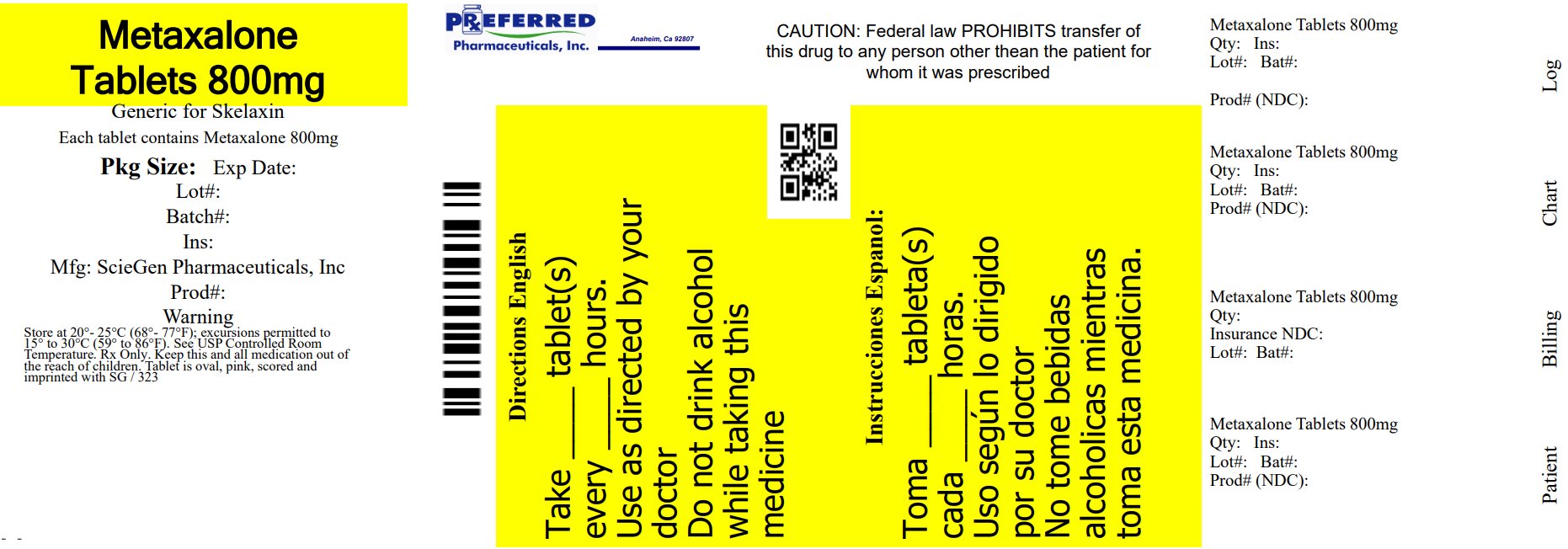
Metaxalone 800 mg Tablet, 90-count
🆔 Identity & classification
Where does this data come from?
🏷️ RxNorm drug class
This medicine belongs to the Muscle Relaxant class.
Where does this data come from?
🏭 Manufacturer & labeler
Where does this data come from?
🩺 Clinical
Metaxalone, a muscle relaxant, is used with rest, physical therapy, and other measures to relax muscles and relieve pain and discomfort caused by strains, sprains, and other muscle injuries. Metaxalone is in a class of medications called skeletal muscle relaxants. It works by slowing activity in the nervous system to allow the body to relax.
Read the full MedlinePlus article ↗- Metaxalone is a muscle relaxant used to help ease pain and discomfort from short-term musculoskeletal conditions — things like muscle strains or injuries. It's not meant to be used...
- Drowsiness is one of the most common side effects, yes. Dizziness, headache, and feeling irritable or nervous can also happen. You should not drive, operate heavy machinery, or do...
- Will metaxalone make me too drowsy to function?
- It does matter — and you should be consistent. Taking metaxalone with a high-fat meal significantly increases the amount of drug absorbed into your body compared to taking it on an...
Patient education
Supplement & herbal interactions
Some supplements/herbs that may interact with Metaxalone — tap one for details:
Where does this data come from?
Ask a licensed pharmacist directly — free, answered by our team.
💊 What it looks like
Where does this data come from?
🧪 Inactive Ingredients / Excipients
Inactive ingredients, also called excipients, are components of the drug product other than the active ingredient. They may include fillers, dyes, coatings, preservatives, flavors, or other formulation ingredients.
💡 Tap an ingredient (hover on desktop) to see what it is and why it’s used.
-
UNII 8C3Z4148WZ
Alginic acid is a natural polymer extracted from brown seaweed. In medicines, it acts as a thickener, binder, and disintegrant to help form tablets and control how quickly the medicine dissolves.
-
UNII D9C330MD8B
Copovidone is a synthetic polymer made by combining two types of plastic-like molecules. It acts as a binder and film-former to help hold tablet ingredients together and improve how the medicine dissolves in your body.
-
UNII 1K09F3G675
Ferric oxide red is an inorganic iron compound used as a colorant in medicines. It gives tablets, capsules, or other dosage forms a red or reddish tint for identification and appearance.
-
UNII 70097M6I30
Magnesium stearate is a salt made from magnesium and stearic acid, a fatty substance. It's used in tablets and capsules as a lubricant and glidant to help ingredients flow smoothly during manufacturing and prevent sticking.
-
UNII FZ989GH94E
Povidone is a synthetic polymer made from a plastic-like material. It acts as a binder to hold tablet ingredients together and as a disintegrant to help the tablet break apart in your stomach so the medicine can be absorbed.
-
UNII C269C4G2ZQ
Sodium alginate is a natural thickener and gelling agent derived from seaweed. In medicines, it acts as a binder to hold ingredients together, a thickener to adjust texture, and a disintegrant to help the tablet or capsule break apart for absorption.
-
UNII O8232NY3SJ
A plant-based carbohydrate derived from corn kernels. It acts as a filler to add bulk, a binder to hold ingredients together, and a disintegrant to help the tablet break apart in your stomach for absorption.
7 inactive ingredients listed in the exact product block matched to this NDC.
Where does this data come from?
ingredient classCode="IACT" elements from the exact product block matched by this NDC. Label-section narrative from DailyMed / the openFDA label index is shown separately when available.Inactive ingredient FAQ
Are inactive ingredients the same for every manufacturer?
Why might an inactive ingredient be missing?
Can inactive ingredients matter?
💲 Pricing
A drug doesn't have one price. Each row is a different public payment system, and none is what you'd pay at the counter — that depends on your insurance. The ⓘ on each row explains what it measures.
| Price system | Per each | Per package |
|---|---|---|
| Retail pharmacies payNADAC · weekly | Not in the retail survey — common for institutional, discontinued, or low-volume packs. | |
| Medicaid paysCMS SDUD · 12 mo | No recent Medicaid claims on file for this NDC — rare and low-volume NDCs are suppressed in the public data. | |
| Medicare drug plans payPart D · Q2 2026 | $1.73 | $155.76 / 90 tablets |
Where does this data come from?
🔁 Therapeutic equivalents
| Product | Labeler | Pack | NADAC/unit | TE | Status | Price vs. this |
|---|---|---|---|---|---|---|
| Metaxalone 800 mg 00527-1435-01 | Lannett | 100 tablets | $0.402 | AB | Availability likely | — |
| Metaxalone 800 mg 00591-2341-01 | Actavis | 100 tablets | $0.402 | AB | Availability likely | — |
| Metaxalone 800 mg 00904-6831-04 | Major | 30 tablets | $0.402 | AB | Availability likely | — |
| Metaxalone 800 mg 50228-0323-01 | ScieGen | 100 tablets | $0.402 | AB | Availability likely | — |
| Metaxalone 800 mg 50268-0530-15 | AvPAK | 50 tablets | $0.402 | AB | Availability likely | — |
| Metaxalone 800 mg 55111-0650-01 | Dr. | 100 tablets | $0.402 | AB | Availability likely | — |
| Metaxalone 800 mg 60687-0663-21 | American | 30 tablets | $0.402 | AB | Availability likely | — |
| Metaxalone 800 mg 65162-0553-10 | Amneal | 100 tablets | $0.402 | AB | Availability likely | — |
| Metaxalone 800 mg 68001-0485-00 | BluePoint | 100 tablets | $0.402 | AB | Availability likely | — |
| Metaxalone 800 mg 42291-0985-50 | AvKARE | 500 tablets | — | AB | FDA listed | — |
| Metaxalone 800 mg 50090-3650-00 | A-S | 30 tablets | — | AB | FDA listed | — |
| Metaxalone 800 mg 50090-3670-00 | A-S | 20 tablets | — | AB | FDA listed | — |
| Metaxalone 800 mg 51655-0171-20 | Northwind | 20 tablets | — | AB | FDA listed | — |
| Metaxalone 800 mg 51655-0792-20 | Northwind | 20 tablets | — | AB | FDA listed | — |
| Metaxalone 800 mg 53746-0553-01 | Amneal | 100 tablets | — | AB | FDA listed | — |
| Metaxalone 800 mg 55700-0494-30 | Quality | 30 tablets | — | AB | FDA listed | — |
| Metaxalone 800 mg 60760-0093-06 | St. | 6 tablets | — | AB | Discontinued | — |
| Metaxalone 800 mg 60760-0289-06 | St. | 6 tablets | — | AB | FDA listed | — |
| Metaxalone 800 mg 61919-0832-90 | DIRECT | 90 tablets | — | AB | FDA listed | — |
| Metaxalone 800 mg 63187-0490-10 | Proficient | 10 tablets | — | AB | FDA listed | — |
| Metaxalone 800 mg 63629-2097-01 | Bryant | 100 tablets | — | AB | FDA listed | — |
| Metaxalone 800 mg 63629-8014-01 | Bryant | 30 tablets | — | AB | FDA listed | — |
| Metaxalone 800 mg 68788-7675-00 | Preferred | 15 tablets | — | AB | FDA listed | — |
| Metaxalone 800 mgthis 68788-8678-09 | Preferred | 90 tablets | — | AB | FDA listed | — |
| Metaxalone 800 mg 69306-0100-01 | Doc | 100 tablets | — | AB | FDA listed | — |
| Metaxalone 800 mg 69306-0311-20 | Doc | 20 tablets | — | AB | FDA listed | — |
| Metaxalone 800 mg 70518-0771-00 | REMEDYREPACK | 90 tablets | — | AB | FDA listed | — |
| Metaxalone 800 mg 70518-4559-00 | REMEDYREPACK | 90 tablets | — | AB | FDA listed | — |
| Metaxalone 800 mg 71205-0016-10 | Proficient | 10 tablets | — | AB | FDA listed | — |
| Metaxalone 800 mg 71205-0326-20 | Proficient | 20 tablets | — | AB | FDA listed | — |
| Metaxalone 800 mg 71205-0426-14 | Proficient | 14 tablets | — | AB | FDA listed | — |
| Metaxalone 800 mg 71335-0375-00 | Bryant | 100 tablets | — | AB | FDA listed | — |
| Metaxalone 800 mg 71335-0958-00 | Bryant | 100 tablets | — | AB | FDA listed | — |
| Metaxalone 800 mg 71335-2066-01 | Bryant | 30 tablets | — | AB | FDA listed | — |
| Metaxalone 800 mg 72162-1083-01 | Bryant | 100 tablets | — | AB | FDA listed | — |
| Metaxalone 800 mg 72189-0645-30 | Direct_Rx | 30 tablets | — | AB | FDA listed | — |
| Metaxalone 800 mg 72789-0028-15 | PD-Rx | 15 tablets | — | AB | FDA listed | — |
| Metaxalone 800 mg 76420-0232-20 | Asclemed | 20 tablets | — | AB | FDA listed | — |
| Metaxalone 800 mg 76420-0898-01 | Asclemed | 100 tablets | — | AB | FDA listed | — |
| Metaxalone 800 mg 80425-0084-02 | Advanced | 60 tablets | — | AB | FDA listed | — |
| Metaxalone 800 mg 80425-0122-02 | Advanced | 60 tablets | — | AB | FDA listed | — |
| Metaxalone 800 mg 80425-0131-02 | Advanced | 60 tablets | — | AB | FDA listed | — |
| Metaxalone 800 mg 80425-0524-01 | Advanced | 30 tablets | — | AB | FDA listed | — |
| Metaxalone 800 mg 80425-0580-01 | Advanced | 30 tablets | — | AB | FDA listed | — |
| Metaxalone 800 mg 85509-1435-01 | PHOENIX | 120 tablets | — | AB | FDA listed | — |
| Metaxalone 800 mg 85509-2341-01 | PHOENIX | 100 tablets | — | AB | FDA listed | — |
| Metaxalone 800 mg 85766-0011-01 | Sportpharm | 100 tablets | — | AB | FDA listed | — |
| Metaxalone 800 mg 85766-0143-01 | Sportpharm | 100 tablets | — | AB | FDA listed | — |
| Metaxalone 800 mg 68788-4168-01 | Preferred | 100 tablets | — | AB | FDA listed | — |
| Metaxalone 800 mg 72789-0592-30 | PD-Rx | 30 tablets | — | AB | FDA listed | — |
Where does this data come from?
⏳ Availability & generic status
This product is an FDA-approved generic. Other versions of the same drug are listed under Therapeutic equivalents, least expensive first.
Where does this data come from?
📊 Medicare Part D spend CMS · PART D · 2026 (Q1)
🔬 Reported adverse events (FAERS)
Top reported reactions
Age at onset
Reporter sex
Serious outcomes
Where does this data come from?
📦 Packaging — all sizes for this product
| Package NDC | Description | Marketing start | Status |
|---|---|---|---|
| 68788-8678-01 | 100 TABLET in 1 BOTTLE (68788-8678-1) | 2024-05-28 | Active |
| 68788-8678-09 You're viewing this | 90 TABLET in 1 BOTTLE (68788-8678-9) | 2024-05-28 | Active |
You're viewing the smallest of 2 pack sizes for this product.
Pack size FAQ
What quantity is in NDC 68788-8678-09?
What is the difference between NDC 68788-8678-09 and NDC 68788-8678-01?
What NDC number is used to bill for this package of Metaxalone 800 mg Tablet?
🧭 About this NDC listing & data coverage
What data is (and isn’t) available for this NDC — tap to expand
| NDC identity (package / product / labeler codes) | ✓ Available |
| Labeler | ✓ Available |
| Product & package description | ✓ Available |
| Marketing category & status | ✓ Available |
| Active ingredient / dosage form / route | ✓ Available |
| FDA label (SPL via DailyMed) | ✓ Available |
| Package photos | ✓ Available |
| Inactive ingredients (structured) | ✓ Available |
| NADAC pharmacy acquisition price (CMS) | — Not published for this NDC CMS publishes NADAC only for NDCs reported in its retail-pharmacy survey. |
| Orange Book / therapeutic-equivalence data | ✓ Available |
| HCPCS J-code billing crosswalk | — Not published for this NDC Most self-administered / retail products have no J-code — that is normal. |
| Medicaid utilization (CMS SDUD) | — Not published for this NDC CMS reports utilization only for NDCs with Medicaid claims above its privacy threshold. |
Questions about this listing
Why is there no price listed?
Is the NDC printed on the package the same as the 11-digit billing NDC?
What do the three segments of this NDC mean?
Is this package still being marketed?
Does this product come in other package sizes?
Who lists this product with the FDA?
Do I need a prescription for this product?
Where does this data come from?
📄 Full prescribing information FDA SPL
🎯 Indications and Usage ▾
INDICATIONS AND USAGE Metaxalone is indicated as an adjunct to rest, physical therapy, and other measures for the relief of discomforts associated with acute, painful musculoskeletal conditions. The mode of action of this drug has not been clearly identified, but may be related to its sedative properties. Metaxalone does not directly relax tense skeletal muscles in man.
⏱️ Dosage and Administration ▾
DOSAGE AND ADMINISTRATION The recommended dose for adults and children over 12 years of age is one 800 mg tablet three to four times a day.
⛔ Contraindications ▾
CONTRAINDICATIONS Known hypersensitivity to any components of this product. Known tendency to drug induced, hemolytic, or other anemias. Significantly impaired renal or hepatic function.
⚠️ Warnings ▾
WARNINGS Serotonin Syndrome Cases of serotonin syndrome, a potentially life-threatening condition, have been reported during concomitant use of serotonergic drugs with metaxalone used within the recommended dosage range (see PRECAUTIONS: Drug Interactions ) and with metaxalone as a single agent taken at doses higher than the recommended dose (see OVERDOSAGE ). Serotonergic drugs include selective serotonin reuptake inhibitors (SSRIs), serotonin and norepinephrine reuptake inhibitors (SNRIs), tricyclic antidepressants (TCAs), triptans, 5-HT3 receptor antagonists, opioids (particularly fentanyl, meperidine, and methadone), drugs that affect the serotonergic neurotransmitter system (e.g., mirtazapine, trazodone, tramadol), and drugs that impair metabolism of serotonin (including monoamine oxidase (MAO) inhibitors, both those intended to treat psychiatric disorders and also others, such as linezolid and intravenous methylene blue) (see PRECAUTIONS: Drug Interactions ).
Serotonin syndrome symptoms may include mental status changes (e.g., agitation, hallucinations, coma), autonomic instability (e.g., tachycardia, labile blood pressure, hyperthermia), neuromuscular aberrations (e.g., hyperreflexia, incoordination, rigidity), and/or gastrointestinal symptoms (e.g., nausea, vomiting, diarrhea). The onset of symptoms generally occurs within several hours to a few days, but may occur later than that. Discontinue metaxalone if serotonin syndrome is suspected.
Risks from Concomitant Use with Alcohol or other CNS Depressants The sedative effects of metaxalone and other CNS depressants (e.g., alcohol, benzodiazepines, opioids, tricyclic antidepressants (TCAs)) may be additive. Exercise caution with patients who take more than one of these CNS depressants simultaneously. Follow patients closely for signs and symptoms of respiratory depression and sedation (see PRECAUTIONS: Drug Interactions ).
🤒 Adverse Reactions ▾
ADVERSE REACTIONS The most frequent reactions to metaxalone include: CNS: drowsiness, dizziness, headache, and nervousness or “irritability”; Digestive: nausea, vomiting, gastrointestinal upset. Other adverse reactions are: Immune System: anaphylaxis, hypersensitivity reaction, rash with or without pruritus; Hematologic: leukopenia; hemolytic anemia; Hepatobiliary: jaundice. CNS: cases of serotonin syndrome, a potentially life-threatening condition, have been reported during concomitant use of serotonergic drugs with metaxalone used within the recommended dosage range and with metaxalone as a single agent taken at doses higher than the recommended dose (see WARNINGS , PRECAUTIONS: Drug Interactions , and OVERDOSAGE ).
To report SUSPECTED ADVERSE REACTIONS, contact Dr.Reddy’s Laboratories, Inc., at 1-888-375-3784 or FDA at 1-800-FDA-1088 or http://www.fda.gov/medwatch
🔄 Drug Interactions ▾
Drug Interactions CNS Depressants: The sedative effects of metaxalone and other CNS depressants (e.g., alcohol, benzodiazepines, opioids, tricyclic antidepressants (TCAs)) may be additive. Exercise caution with patients who take more than one of these CNS depressants simultaneously. Follow patients closely for signs and symptoms of respiratory depression and sedation (see WARNINGS ).
Serotonergic Drugs: Serotonin syndrome has resulted from concomitant use of serotonergic drugs with metaxalone used within the recommended dosage range (see WARNINGS ). If concomitant use is warranted, carefully observe the patient, particularly during treatment initiation and dose adjustment. Discontinue metaxalone if serotonin syndrome is suspected.
Examples of serotonergic drugs include: selective serotonin reuptake inhibitors (SSRIs), serotonin and norepinephrine reuptake inhibitors (SNRIs), tricyclic antidepressants (TCAs), triptans, 5-HT3 receptor antagonists, opioids (particularly fentanyl, meperidine, and methadone), drugs that affect the serotonin neurotransmitter system (e.g., mirtazapine, trazodone, tramadol), monoamine oxidase (MAO) inhibitors (those intended to treat psychiatric disorders and also others, such as linezolid and intravenous methylene blue).
🤰 Pregnancy ▾
Pregnancy Reproduction studies in rats have not revealed evidence of impaired fertility or harm to the fetus due to metaxalone. Post marketing experience has not revealed evidence of fetal injury, but such experience cannot exclude the possibility of infrequent or subtle damage to the human fetus. Safe use of metaxalone has not been established with regard to possible adverse effects upon fetal development.
Therefore, metaxalone tablets should not be used in women who are or may become pregnant and particularly during early pregnancy unless, in the judgement of the physician, the potential benefits outweigh the possible hazards.
🧒 Pediatric Use ▾
Pediatric Use Safety and effectiveness in children 12 years of age and below have not been established.
🆘 Overdosage ▾
OVERDOSAGE Deaths by deliberate or accidental overdose have occurred with metaxalone, particularly in combination with antidepressants, and have been reported with this class of drug in combination with alcohol. Serotonin syndrome has been reported when metaxalone was used at doses higher than the recommended dose (see WARNINGS and ADVERSE REACTIONS ). When determining the LD 50 in rats and mice, progressive sedation, hypnosis and finally respiratory failure were noted as the dosage increased.
In dogs, no LD 50 could be determined as the higher doses produced an emetic action in 15 to 30 minutes. Treatment - Gastric lavage and supportive therapy. Consultation with a regional poison control center is recommended.
🧬 Clinical Pharmacology ▾
CLINICAL PHARMACOLOGY Mechanism of Action: The mechanism of action of metaxalone in humans has not been established, but may be due to general central nervous system (CNS) depression. Metaxalone has no direct action on the contractile mechanism of striated muscle, the motor end plate, or the nerve fiber. Pharmacokinetics: The pharmacokinetics of metaxalone have been evaluated in healthy adult volunteers after single dose administration of metaxalone under fasted and fed conditions at doses ranging from 400 mg to 800 mg.
Absorption Peak plasma concentrations of metaxalone occur approximately 3 hours after a 400 mg oral dose under fasted conditions. Thereafter, metaxalone concentrations decline log-linearly with a terminal half-life of 9.0 ± 4.8 hours. Doubling the dose of metaxalone from 400 mg to 800 mg results in a roughly proportional increase in metaxalone exposure as indicated by peak plasma concentrations (C max ) and area under the curve (AUC).
Dose proportionality at doses above 800 mg has not been studied. The absolute bioavailability of metaxalone is not known. The single-dose pharmacokinetic parameters of metaxalone in two groups of healthy volunteers are shown in Table 1.
Table 1: Mean (%CV) Metaxalone Pharmacokinetic Parameters Dose (mg) C max (ng/mL) T max (h) AUC ∞ (ng •h/mL) t 1/2 (h) CL/F (L/h) 400 1 983 (53) 3.3 (35) 7,479 (51) 9.0 (53) 68 (50) 800 2 1,816 (43) 3.0 (39) 15,044 (46) 8.0 (58) 66 (51) 1 Subjects received 1x400 mg tablet under fasted conditions (N=42) 2 Subjects received 2x400 mg tablets under fasted conditions (N=59) Food Effects A randomized, two-way, crossover study was conducted in 42 healthy volunteers (31 males, 11 females) administered one 400 mg metaxalone tablet under fasted conditions and following a standard high-fat breakfast.
Subjects ranged in age from 18 to 48 years (mean age = 23.5 ± 5.7 years). Compared to fasted conditions, the presence of a high fat meal at the time of drug administration increased C max by 177.5% and increased AUC (AUC 0-t, AUC ∞ ) by 123.5% and 115.4%, respectively. Time-to-peak concentration (T max ) was also delayed (4.3 h versus 3.3 h) and terminal half-life was decreased (2.4 h versus 9.0 h) under fed conditions compared to fasted.
In a second food effect study of similar design, two 400 mg metaxalone tablets (800 mg) were administered to healthy volunteers (N=59, 37 males, 22 females), ranging in age from 18 to 50 years (mean age = 25.6± 8.7 years). Compared to fasted conditions, the presence of a high fat meal at the time of drug administration increased C max by 193.6% and increased AUC (AUC 0-t, AUC ∞ ) by 146.4% and 142.2%, respectively. Time-to-peak concentration (T max ) was also delayed (4.9 h versus 3.0 h) and terminal half-life was decreased (4.2 h versus 8.0 h) under fed conditions compared to fasted conditions.
Similar food effect results were observed in the above study when one metaxalone 800 mg tablet was administered in place of two metaxalone 400 mg tablets. The increase in metaxalone exposure coinciding with a reduction in half-life may be attributed to more complete absorption of metaxalone in the presence of a high fat meal (Figure 1). Figure 1 - Mean (SD) Concentrations of Metaxalone following an 800 mg Dose under Fasted and Fed Conditions.
Distribution, Metabolism, and Excretion Although plasma protein binding and absolute bioavailability of metaxalone are not known, the apparent volume of distribution (V/F ~ 800 L) and lipophilicity (log P = 2.42) of metaxalone suggest that the drug is extensively distributed in the tissues. Metaxalone is metabolized by the liver and excreted in the urine as unidentified metabolites. Hepatic Cytochrome P450 enzymes play a role in the metabolism of metaxalone.
Specifically, CYP1A2, CYP2D6, CYP2E1, and CYP3A4 and, to a lesser extent, CYP2C8, CYP2C9, and CYP2C19 appear to metabolize metaxalone. Metaxalone does not significantly inhibit major CYP enzymes such as CYP1A2, CYP2A6, CYP2B6, CYP2C8, CYP2C9, CY…
🧬 Mechanism of Action ▾
Mechanism of Action: The mechanism of action of metaxalone in humans has not been established, but may be due to general central nervous system (CNS) depression. Metaxalone has no direct action on the contractile mechanism of striated muscle, the motor end plate, or the nerve fiber.
📦 How Supplied / Storage and Handling ▾
HOW SUPPLIED Metaxalone Tablets, USP 800 mg are available as pink, capsule shape scored tablet debossed with ‘SG’ on scored side and ‘323’ on the other. NDC 68788-8678-9 : Bottles of 90 Tablets NDC 68788-8678-1 : Bottles of 100 Tablets Store at 20° to 25°C (68° to 77°F); excursions permitted to 15° to 30°C (59° to 86°F) [See USP Controlled Room Temperature]. Dispense in well-closed, light-resistant containers.
You can ask your pharmacist or doctor for information about Metaxalone Tablets USP, or call 1-888-375-3784. Rx Only Manufactured by: ScieGen Pharmaceuticals, Inc. Hauppauge, NY 11788, USA Manufactured for: Dr.Reddy’s Laboratories Inc.
Princeton, New Jersey 08540, USA Rev: 06/20 Repackaged By: Preferred Pharmaceuticals Inc.
📋 Description ▾
DESCRIPTION Metaxalone Tablets, USP are available as an 800 mg, capsule shaped, scored pink tablet. Chemically, metaxalone, USP is 5-[(3,5-dimethylphenoxy)methyl]-2-oxazolidinone. The empirical formula is C 12 H 15 NO 3 , which corresponds to a molecular weight of 221.25.
The structural formula is: Metaxalone, USP is a white to almost white, crystalline powder freely soluble in dichloromethane, soluble in methanol, sparingly soluble in ethanol and ethyl acetate, slightly soluble in toluene and isopropanol, insoluble in water and n -hexane. Each tablet contains 800 mg metaxalone, USP and the following inactive ingredients: alginic acid, corn starch, ferric oxide red, copovidone, magnesium stearate, povidone, pregelatinized starch, sodium alginate. Metaxalone 800 mg - Chemical Structure
💬 Information for Patients ▾
Information for Patients Driving or Operating Heavy Machinery: Metaxalone may impair mental and/or physical abilities required for performance of hazardous tasks, such as operating machinery or driving a motor vehicle, especially when used with alcohol or other CNS depressants. Serotonin Syndrome: Inform patients that metaxalone could cause a rare but potentially life-threatening condition resulting from administration of doses higher than the recommended dose or from concomitant administration of serotonergic drugs with metaxalone used within the recommended dosage range.
Warn patients of the symptoms of serotonin syndrome and to seek medical attention right away if symptoms develop. Instruct patients to inform their healthcare providers if they are taking, or plan to take, serotonergic medications (see WARNINGS , PRECAUTIONS: Drug Interactions, and OVERDOSAGE ).