
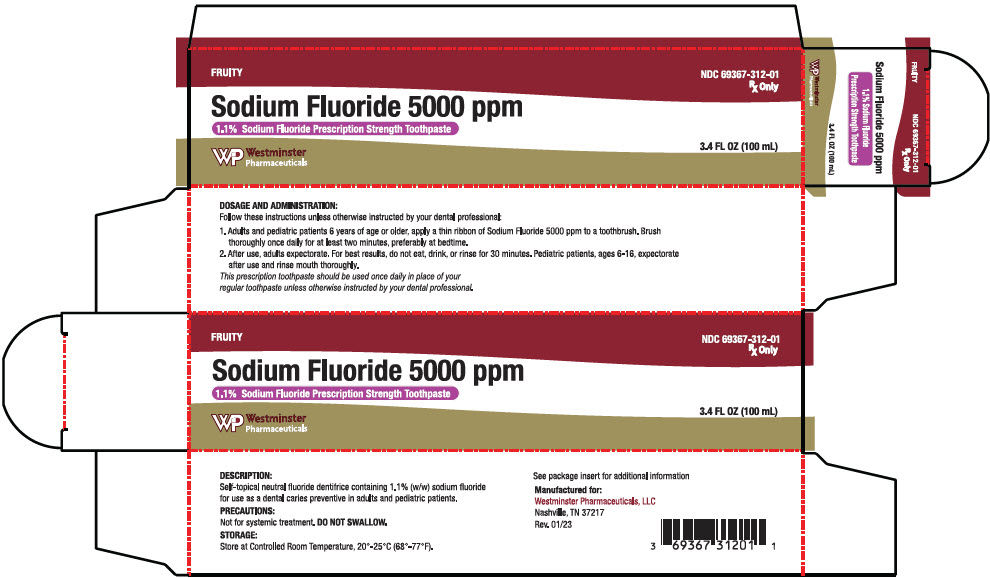
Sodium Fluoride 5000 PPM 6 mg/mL Paste, 100 mL — NDC 69367-312-01 (Billing 69367-0312-01)
This is a package of 100 mL of Sodium Fluoride 5000 PPM 6 mg/mL Paste from Westminster Pharmaceuticals, LLC, marketed since Jun 2021 and currently FDA-listed; retail pharmacies pay about $0.0975 per mL (NADAC). It is this product's only package size.
NDC database record
One package, one record: these facts belong to NDC 69367-312-01 alone.
- Record
- FDA NDC Directory package listing · Human prescription drug
- Code segments
- 69367 labeler · 312 product · 01 package
- Package marketed since
- Jun 16, 2021
- Sample package
- No — commercial package
- Listing certified through
- Dec 31, 2027
- Billing quantity
- 100 mL per package
- Barcode (UPC-A, from the NDC)
- 3 6936731201 1
- Medicaid fills, this package
- 765 prescriptions in the last four reported quarters
- FDA record last changed
- Oct 8, 2026
Identity & classification
Regulatory identifiers FDA, NLM and CMS codes for this package
Drug-database identifiers Medi-Span GPI and First Databank GCN / HICL / AHFS classification
- GSN (GCN sequence number): 060583
- GCN: 26755
- HICL (First Databank): 001127
- AHFS class code: 34:04.00.00
Where does this data come from?
- FDA openFDA NDC Directory · synced Oct 8, 2026
- FDA label on DailyMed · label index refreshed Oct 8, 2026
- RxNorm (NLM RxNav) · catalog refreshed Oct 1, 2026
- Medi-Span GPI (licensed)
- First Databank (licensed) · refreshed Oct 8, 2026
Clinical
Fluoride is used to prevent tooth decay. It is taken up by teeth and helps to strengthen teeth, resist acid, and block the cavity-forming action of bacteria. Fluoride usually is prescribed for children and adults whose homes have water that is not fluoridated (already has fluoride added). This medication is sometimes prescribed for other uses; ask your doctor or pharmacist for more information.
Read the full MedlinePlus article ↗This is a dental paste containing sodium fluoride at a concentration of 5000 parts per million. Sodium fluoride is typically used in topical dental products to help strengthen tooth enamel and reduce cavity formation. The paste form is applied directly to the teeth by a dental professional. This product is marketed without an approved FDA application.
Patient education
Supplement & herbal interactions
Where does this data come from?
- MedlinePlus (NLM) · refreshed Oct 8, 2026
- FDA label on DailyMed · label index refreshed Oct 8, 2026
Ask a licensed pharmacist directly — free, answered by our team.
Pricing
A drug doesn't have one price. Each row is a different public payment system, and none is what you'd pay at the counter — that depends on your insurance. The ⓘ on each row explains what it measures.
| Price system | Per mL | Per package |
|---|---|---|
| Retail pharmacies payNADAC · weekly | $0.098 | $9.75 / 100 ml |
| Medicaid paysCMS SDUD · 12 mo | $0.1765 | $17.65 / 100 ml |
| Medicare drug plans payPart D · quarterly | No Part D plan price is available for this NDC in our data. | |
Where does this data come from?
- CMS NADAC weekly file · file of Oct 7, 2026
- CMS ASP pricing files · refreshed Sep 20, 2026
- CMS Medicaid State Drug Utilization Data · through Q1 2026
- CMS Part D plan pricing files · refreshed Sep 24, 2026
- VA National Acquisition Center price file
Packaging — all sizes for this product
| Package NDC | Description | Marketing start | Marketing end | Status |
|---|---|---|---|---|
| 69367-0312-01 You're viewing this Main listing | 100 mL in 1 TUBE | 2021-06-16 | — | Active |
Therapeutic equivalents
| Product | Labeler | Pack | NADAC/unit | TE | Status | Price vs. this |
|---|---|---|---|---|---|---|
| Denta 5000 Plus 1.1 g/100g 16571-0814-50 | Rising | 51 g | $0.063 | — | Availability likely | save 35% |
| Sodium Fluoride 5000 Plus 5 mg/g 69367-0309-51 | Westminster | 1 tube | $0.063 | — | Availability likely | save 35% |
| SF 5000 Plus 5 mg/g 60258-0150-01 | Cypress | 1 tube | $0.093 | — | FDA listed | save 5% |
| Sodium Fluoride 5000 ppm Fruit 6 mg/mL 11527-0730-44 | Sheffield | 1 tube | $0.097 | — | Availability likely | — |
| Sodium Fluoride 5000 ppm Spearmint 6 mg/mL 11527-0750-43 | Sheffield | 1 tube | $0.097 | — | Availability likely | — |
| Sodium Fluoride 5000 ppm Dry Mouth 6.1 mg/mL 11527-0755-34 | Sheffield | 1 tube | $0.097 | — | Availability likely | — |
| Sodium Fluoride 5000 PPM 6 mg/mL 69367-0311-01 | Westminster | 100 ml | $0.097 | — | Availability likely | — |
| Sodium Fluoride 5000 PPM 6 mg/mLthis 69367-0312-01 | Westminster | 100 ml | $0.097 | — | Availability likely | — |
| DentaGel 1.1 g/100g 16571-0815-60 | Rising | 56 g | $0.108 | — | Availability likely | +11% |
| PreviDent 5000 Dry Mouth 6.1 mg/mL 00126-0016-61 | Colgate | 100 ml | — | — | FDA listed | — |
| PreviDent 5000 Booster Plus Fruitastic 6 mg/mL 00126-0072-92 | Colgate | 100 ml | — | — | FDA listed | — |
| PreviDent 5000 Booster Plus Spearmint 6 mg/mL 00126-0074-92 | Colgate | 100 ml | — | — | FDA listed | — |
| PreviDent Fresh Mint 5 mg/g 00126-0088-02 | Colgate | 1 tube | — | — | FDA listed | — |
| PreviDent 5000 Plus Fruitastic 11 mg/g 00126-0286-66 | Colgate | 1 tube | — | — | FDA listed | — |
| PreviDent 5000 Plus Spearmint 11 mg/g 00126-0287-66 | Colgate | 1 tube | — | — | FDA listed | — |
| PreviDent Very Berry 5 mg/g 00126-0288-02 | Colgate | 1 tube | — | — | FDA listed | — |
| PreviDent OrthoDefense 6 mg/mL 00126-0289-92 | Colgate | 100 ml | — | — | FDA listed | — |
| PreviDent 5000 Kids 6 mg/mL 00126-0311-92 | Colgate | 100 ml | — | — | FDA listed | — |
| Acclean Anti-Cavity 1.1 g/100g 00404-0173-04 | Henry | 1 tube | — | — | FDA listed | — |
| Sodium Flouride 5 mg/mL 42291-0741-51 | AvKARE | 1 tube | — | — | FDA listed | — |
| Clinpro 5000 5 mg/g 48878-3120-04 | Solventum | 1 tube | — | — | FDA listed | — |
| Clinpro 5000 5 mg/g 48878-3130-04 | Solventum | 1 tube | — | — | FDA listed | — |
| Clinpro 5000 5 mg/g 48878-3140-04 | Solventum | 1 tube | — | — | FDA listed | — |
| Just Right 5000 1.1 g/100g 57511-0001-01 | Elevate | 97 g | — | — | FDA listed | — |
| Just Right 5000 1.1 g/100g 57511-0002-01 | Elevate | 97 g | — | — | FDA listed | — |
| Just Right 5000 1.1 g/100g 57511-0003-01 | Elevate | 97 g | — | — | FDA listed | — |
| Allday 5000 1.1 g/100g 57511-0005-01 | Elevate | 2 tubes | — | — | FDA listed | — |
| FluoriMax 5000 1.1 g/100g 57511-0504-01 | Elevate | 96 g | — | — | FDA listed | — |
| PRO Gel 5000 Mint 5000 ug/g 61578-0215-01 | DENTAL | 68 g | — | — | FDA listed | — |
| PRO Gel 5000 Citrus 5000 ug/g 61578-0216-01 | DENTAL | 68 g | — | — | FDA listed | — |
| Neutramaxx 5000 Plus Turbo 1.1 g/112g 63783-0500-04 | Massco | 112 g | — | — | FDA listed | — |
| Neutramaxx 5000 Tcp 1.1 g/112g 63783-0501-04 | Massco | 112 g | — | — | FDA listed | — |
| Neutra Maxx 5000 1.428 g/120g 63783-0504-06 | Massco | 120 g | — | — | FDA listed | — |
| Prosys .11 g/100g 66975-0782-01 | Benco | 113 g | — | — | FDA listed | — |
| Super Mint Prescription 1.1 g/100g 83729-0102-10 | SuperMouth, | 1 tube | — | — | FDA listed | — |
| Super Chocolate Prescription 1.1 g/100g 83729-0103-10 | SuperMouth, | 1 tube | — | — | FDA listed | — |
Where does this data come from?
- FDA openFDA NDC Directory · synced Oct 8, 2026
- FDA Orange Book · refreshed Oct 3, 2026
- CMS NADAC weekly file · file of Oct 7, 2026
Availability & generic status
We did not find an FDA-approved generic match for this exact strength, form and route.
Where does this data come from?
- FDA Orange Book · refreshed Oct 3, 2026
What it looks like
Where does this data come from?
- FDA label on DailyMed · label index refreshed Oct 8, 2026
Inactive Ingredients / Excipients
Inactive ingredients, also called excipients, are components of the drug product other than the active ingredient. They may include fillers, dyes, coatings, preservatives, flavors, or other formulation ingredients.
💡 Tap an ingredient (hover on desktop) to see what it is and why it’s used.
-
UNII O7TSZ97GEP
A mineral compound that serves as a filler and binding agent in tablets and capsules. It adds bulk to the medicine and helps hold ingredients together during manufacturing.
-
UNII WZB9127XOA
A synthetic red dye used to color medications and make them easier to identify. It serves as a colorant in tablets, capsules, and liquid formulations.
-
UNII PDC6A3C0OX
Glycerin is a clear, thick liquid derived from plant oils or fats. It acts as a humectant to retain moisture, a sweetener, and a solvent in medications.
-
UNII Y6O7T4G8P9
Hydrated silica is a fine powder form of silicon dioxide with absorbed water. It works as an anti-caking agent and absorbent in medicines, helping powders stay free-flowing and preventing clumping.
-
UNII OJ245FE5EU
Sodium benzoate is a salt derived from benzoic acid, a preservative. It's added to medicines to prevent growth of bacteria, fungi, and other microorganisms that could spoil the product.
-
UNII 368GB5141J
A detergent and foaming agent derived from coconut or palm oil. In medications, it helps break down and mix oil and water-based ingredients, aids in tablet disintegration, and improves how the drug dissolves and spreads in the mouth or digestive system.
-
UNII 506T60A25R
Sorbitol is a natural sugar alcohol derived from glucose. It serves as a sweetener, humectant, and bulking agent in medications to improve taste and help maintain moisture in the product.
-
UNII 15FIX9V2JP
Titanium dioxide is a bright white mineral powder commonly used as a colorant and opacifying agent. It makes pills and tablets white or lighter in color and helps make coatings non-transparent.
-
UNII 059QF0KO0R
Water is a liquid solvent that dissolves and mixes ingredients together in liquid medicines, syrups, and injections. It helps distribute the active drug evenly throughout the product.
-
UNII TTV12P4NEE
Xanthan gum is a thickening and stabilizing ingredient made from fermented corn or other sugars. It's added to medicines to improve texture, prevent separation of liquids and solids, and help the product stay consistent.
-
UNII VCQ006KQ1E
Xylitol is a naturally occurring sugar alcohol derived from plants. It's used in medicines as a sweetener, bulking agent, and to improve taste, especially in liquid formulations and chewable tablets.
11 inactive ingredients listed in the exact product block matched to this NDC.
Where does this data come from?
ingredient classCode="IACT" elements from the exact product block matched by this NDC. Label-section narrative from DailyMed / the openFDA label index is shown separately when available.- FDA label on DailyMed · label index refreshed Oct 8, 2026
- FDA openFDA NDC Directory · synced Oct 8, 2026
Inactive ingredient FAQ
Are inactive ingredients the same for every manufacturer?
Why might an inactive ingredient be missing?
Can inactive ingredients matter?
Manufacturer & labeler
More NDCs from Westminster Pharmaceuticals, LLC labeler code 69367
- Miglitol 100 mg Tablet, Coated NDC 69367-305-01
- Eplerenone 25 mg Tablet, Coated NDC 69367-307-09
- Eplerenone 50 mg Tablet, Coated NDC 69367-308-09
- Sodium Fluoride 5000 Plus 5 mg/g Cream NDC 69367-309-51
- Sodium Fluoride 1.1% Gel 5 mg/g Gel NDC 69367-310-56
- Sodium Fluoride 5000 PPM 6 mg/mL Paste NDC 69367-311-01
- Sodium Fluoride and Potassium Nitrate 5.8 mg/mL; 57.5 mg/mL Gel NDC 69367-318-01
- Acetaminophen 160 mg/5mL Liquid NDC 69367-323-04
- Pregabalin 25 mg Capsule NDC 69367-324-09
- Pregabalin 50 mg Capsule NDC 69367-325-09
- Pregabalin 75 mg Capsule NDC 69367-326-09
- Pregabalin 100 mg Capsule NDC 69367-327-09
Where does this data come from?
- FDA openFDA NDC Directory · synced Oct 8, 2026
- Drugs@FDA
Full prescribing information FDA SPL
🎯 Indications and Usage ▾
INDICATIONS AND USAGE A dental caries preventive; for once daily self-applied topical use. It is well established that 1.1% sodium fluoride is safe and extraordinarily effective as a caries preventive when applied frequently with mouthpiece applicators. 1-4 Sodium Fluoride 5000 ppm 1.1% sodium fluoride in a squeeze-tube is easily applied onto a toothbrush.
This prescription should be used once daily in place of your regular toothpaste, unless otherwise instructed by your dental professional. May be used in areas where drinking water is fluoridated since topical fluoride cannot produce fluorosis. (See WARNINGS for exception.)
⏱️ Dosage and Administration ▾
DOSAGE AND ADMINISTRATION Follow these instructions unless otherwise instructed by your dental professional: Adults and pediatric patients 6 years of age or older, apply a thin ribbon of Sodium Fluoride 5000 ppm to a toothbrush. Brush teeth thoroughly once daily for at least two minutes, preferably at bedtime, in place of your regular toothpaste. After use, adults expectorate.
For best results, do not eat, drink, or rinse for 30 minutes. Pediatric patients, age 6-16, expectorate after use and rinse mouth thoroughly.
⛔ Contraindications ▾
CONTRAINDICATIONS Do not use in pediatric patients under age 6 years unless recommended by a dentist or physician.
⚠️ Warnings ▾
WARNINGS Prolonged daily ingestion may result in various degrees of dental fluorosis in pediatric patients under age 6 years, especially if the water fluoridation exceeds 0.6 ppm, since younger pediatric patients frequently cannot perform the brushing process without significant swallowing. Use in pediatric patients under age 6 years requires special supervision to prevent repeated swallowing of toothpaste, which could cause dental fluorosis. Pediatric patients under age 12 should be supervised in the use of this product.
Read directions carefully before using. Keep out of reach of infants and children.
🤒 Adverse Reactions ▾
ADVERSE REACTIONS Allergic reactions and other idiosyncrasies have been rarely reported. To report SUSPECTED ADVERSE REACTIONS, contact Westminster Pharmaceuticals, LLC at 1-844-221-7294 or FDA at 1-800-FDA-1088 or www.fda.gov/medwatch.
🤰 Pregnancy ▾
Pregnancy Teratogenic Effects Pregnancy Category B It has been shown that fluoride crosses the placenta of rats, but only 0.01% of the amount administered is incorporated in fetal tissue. Animal studies (rats, mice, rabbits) have shown that fluoride is not a teratogen. Maternal exposure to 12.2 mg fluoride/kg of body weight (rats) or 13.1 mg/kg of body weight (rabbits) did not affect the litter size or fetal weight and did not increase the frequency of skeletal or visceral malformations.
There are no adequate and well-controlled studies in pregnant women. However, epidemiological studies conducted in areas with high levels of naturally fluoridated water showed no increase in birth defects. Heavy exposure to fluoride during in utero development may result in skeletal fluorosis, which becomes evident in childhood.
🧒 Pediatric Use ▾
Pediatric Use The use of Sodium Fluoride 5000 ppm in pediatric age groups 6 to 16 years as a caries preventive is supported by pioneering clinical studies with 1.1% sodium fluoride gels in mouth trays in students age 11-14 years conducted by Englander et al. 2-4 Safety and effectiveness in pediatric patients below the age of 6 years have not been established. Please refer to the CONTRAINDICATIONS and WARNINGS sections.
🆘 Overdosage ▾
OVERDOSAGE Accidental ingestion of large amounts of fluoride may result in acute burning in the mouth and sore tongue. Nausea, vomiting, and diarrhea may occur soon after ingestion (within 30 minutes) and are accompanied by salivation, hematemesis, and epigastric cramping abdominal pain. These symptoms may persist for 24 hours.
If less than 5 mg fluoride/kg body weight (i.e., less than 2.3 mg fluoride/lb body weight) has been ingested, give calcium (e.g., milk) orally to relieve gastrointestinal symptoms and observe for a few hours. If more than 5 mg fluoride/kg body weight (i.e., more than 2.3 mg fluoride/lb body weight) have been ingested, induce vomiting, give orally soluble calcium (e.g., milk, 5% calcium gluconate or calcium lactate solution) and immediately seek medical assistance. For accidental ingestion of more than 15 mg fluoride/kg of body weight (i.e., more than 6.9 mg fluoride/lb body weight), induce vomiting and admit immediately to a hospital facility.
A treatment dose (a thin ribbon) of Sodium Fluoride 5000 ppm contains 2.5 mg fluoride. A
3.4FL OZ tube (100 mL) contains approximately 605 mg fluoride.
🧬 Clinical Pharmacology ▾
CLINICAL PHARMACOLOGY Frequent topical applications to the teeth with preparations having a relatively high fluoride content increase tooth resistance to acid dissolution and enhance penetration of the fluoride ion into tooth enamel.
📦 How Supplied / Storage and Handling ▾
How Supplied
3.4FL OZ (100mL) NET WT. Tube NDC 69367-311-01 Spearmint
3.4FL OZ (100mL) NET WT. Tube NDC 69367-312-01 Fruity STORAGE Store at Controlled Room Temperature, 20°-25°C (68°-77°F).
📦 Storage and Handling ▾
STORAGE Store at Controlled Room Temperature, 20°-25°C (68°-77°F).
📋 Description ▾
DESCRIPTION Self-topical neutral fluoride dentifrice containing 1.1% (w/w) sodium fluoride for use as a dental caries preventive in adults and pediatric patients. Active Ingredient Sodium Fluoride 1.1% (w/w) Inactive Ingredients Dicalcium phosphate, flavor, glycerin, hydrated silica, purified water, sodium benzoate, sodium lauryl sulfate, sorbitol, titanium dioxide, xanthan gum, xylitol. This product also contains flavor, FD&C blue No.
1 (Spearmint only), FD&C red No. 40 (Fruity only).
⚠️ Precautions ▾
PRECAUTIONS General Not for systemic treatment. DO NOT SWALLOW. Carcinogenesis, Mutagenesis, Impairment of Fertility In a study conducted in rodents, no carcinogenesis was found in male and female mice and female rats treated with fluoride at dose levels ranging from 4.1 to 9.1 mg/kg of body weight.
Equivocal evidence of carcinogenesis was reported in male rats treated with 2.5 and 4.1 mg/kg of body weight. In a second study, no carcinogenesis was observed in rats, males or females, treated with fluoride up to 11.3 mg/kg of body weight. Epidemiological data provide no credible evidence for an association between fluoride, either naturally occurring or added to drinking water, and risk of human cancer.
Fluoride ion is not mutagenic in standard bacterial systems. It has been shown that fluoride ion has potential to induce chromosome aberrations in cultured human and rodent cells at doses much higher than those to which humans are exposed. In vivo data are conflicting.
Some studies report chromosome damage in rodents, while other studies using similar protocols report negative results. Potential adverse reproductive effects of fluoride exposure in humans have not been adequately evaluated. Adverse effects on reproduction were reported for rats, mice, fox, and cattle exposed to 100 ppm or greater concentrations of fluoride in their diet or drinking water.
Other studies conducted in rats demonstrated that lower concentrations of fluoride (5 mg/kg of body weight) did not result in impaired fertility and reproductive capabilities. Pregnancy Teratogenic Effects Pregnancy Category B It has been shown that fluoride crosses the placenta of rats, but only 0.01% of the amount administered is incorporated in fetal tissue. Animal studies (rats, mice, rabbits) have shown that fluoride is not a teratogen.
Maternal exposure to 12.2 mg fluoride/kg of body weight (rats) or 13.1 mg/kg of body weight (rabbits) did not affect the litter size or fetal weight and did not increase the frequency of skeletal or visceral malformations. There are no adequate and well-controlled studies in pregnant women. However, epidemiological studies conducted in areas with high levels of naturally fluoridated water showed no increase in birth defects.
Heavy exposure to fluoride during in utero development may result in skeletal fluorosis, which becomes evident in childhood. Nursing Mothers It is not known if fluoride is excreted in human milk. However, many drugs are excreted in milk, and caution should be exercised when products containing fluoride are administered to a nursing woman.
Reduced milk production was reported in farm-raised fox when the animals were fed a diet containing a high concentration of fluoride (98-137 mg/kg of body weight). No adverse effects on parturition, lactation, or offspring were seen in rats administered fluoride up to 5 mg/kg of body weight. Pediatric Use The use of Sodium Fluoride 5000 ppm in pediatric age groups 6 to 16 years as a caries preventive is supported by pioneering clinical studies with 1.1% sodium fluoride gels in mouth trays in students age 11-14 years conducted by Englander et al.
2-4 Safety and effectiveness in pediatric patients below the age of 6 years have not been established. Please refer to the CONTRAINDICATIONS and WARNINGS sections.
🍼 Nursing Mothers ▾
Nursing Mothers It is not known if fluoride is excreted in human milk. However, many drugs are excreted in milk, and caution should be exercised when products containing fluoride are administered to a nursing woman. Reduced milk production was reported in farm-raised fox when the animals were fed a diet containing a high concentration of fluoride (98-137 mg/kg of body weight).
No adverse effects on parturition, lactation, or offspring were seen in rats administered fluoride up to 5 mg/kg of body weight.
📄 Carcinogenesis, Mutagenesis, Impairment of Fertility ▾
Carcinogenesis, Mutagenesis, Impairment of Fertility In a study conducted in rodents, no carcinogenesis was found in male and female mice and female rats treated with fluoride at dose levels ranging from 4.1 to 9.1 mg/kg of body weight. Equivocal evidence of carcinogenesis was reported in male rats treated with 2.5 and 4.1 mg/kg of body weight. In a second study, no carcinogenesis was observed in rats, males or females, treated with fluoride up to 11.3 mg/kg of body weight.
Epidemiological data provide no credible evidence for an association between fluoride, either naturally occurring or added to drinking water, and risk of human cancer. Fluoride ion is not mutagenic in standard bacterial systems. It has been shown that fluoride ion has potential to induce chromosome aberrations in cultured human and rodent cells at doses much higher than those to which humans are exposed.
In vivo data are conflicting. Some studies report chromosome damage in rodents, while other studies using similar protocols report negative results. Potential adverse reproductive effects of fluoride exposure in humans have not been adequately evaluated.
Adverse effects on reproduction were reported for rats, mice, fox, and cattle exposed to 100 ppm or greater concentrations of fluoride in their diet or drinking water. Other studies conducted in rats demonstrated that lower concentrations of fluoride (5 mg/kg of body weight) did not result in impaired fertility and reproductive capabilities.
📚 References ▾
REFERENCES Accepted Dental Therapeutics, Ed. 40, ADA, Chicago. P. 405-407, 1984. Englander, HR, Keyes et al:JADA 75: 638-644, 1967. Englander, HR, et al:JADA 78: 783-787, 1969. Englander, HR, et al:JADA 83: 354-358, 1971.
📄 Package Label / Principal Display Panel ▾
PRINCIPAL DISPLAY PANEL - 100 mL Tube Carton - SPEARMINT SPEARMINT NDC 69367-311-01 Rx Only Sodium Fluoride 5000 ppm 1.1% Sodium Fluoride Prescription Strength Toothpaste
3.4FL OZ (100 mL) Westminster Pharmaceuticals PRINCIPAL DISPLAY PANEL - 100 mL Tube Carton - SPEARMINT
PRINCIPAL DISPLAY PANEL - 100 mL Tube Carton - FRUITY FRUITY NDC 69367-312-01 Rx Only Sodium Fluoride 5000 ppm 1.1% Sodium Fluoride Prescription Strength Toothpaste
3.4FL OZ (100 mL) Westminster Pharmaceuticals PRINCIPAL DISPLAY PANEL - 100 mL Tube Carton - FRUITY
Medicaid utilization & spend
Reported adverse events (FAERS)
Top reported reactions
Age at onset
Reporter sex
Serious outcomes
Where does this data come from?
About this NDC listing & data coverage
Listed without an FDA application
This product's marketing category indicates it is marketed without an approved FDA application (no NDA, ANDA, or BLA on file). Having an NDC does not by itself establish FDA approval — the NDC Directory is a listing system, not an approval decision. Approval-linked data such as Orange Book therapeutic-equivalence ratings therefore does not apply.
What data is (and isn’t) available for this NDC — tap to expand
| NDC identity (package / product / labeler codes) | ✓ Available |
| Labeler | ✓ Available |
| Product & package description | ✓ Available |
| Marketing category & status | ✓ Available |
| Active ingredient / dosage form / route | ✓ Available |
| FDA label (SPL via DailyMed) | ✓ Available |
| Package photos | ✓ Available |
| Inactive ingredients (structured) | ✓ Available |
| NADAC pharmacy acquisition price (CMS) | ✓ Available |
| Orange Book / therapeutic-equivalence data | — Not published for this NDC Applies only to products approved under an NDA/ANDA; many listings are out of scope. |
| HCPCS J-code billing crosswalk | — Not published for this NDC Most self-administered / retail products have no J-code — that is normal. |
| Medicaid utilization (CMS SDUD) | ✓ Available |