
Technescan MAG3 Technescan Tc 99m Mertiatide 1 mg Injection, Powder, Lyophilized, For Solution, 5 vials — NDC 69945-096-20 (Billing 69945-0096-20)
This is a package of 5 vials of Technescan MAG3 Technescan Tc 99m Mertiatide 1 mg Injection, Powder, Lyophilized, For Solution from Curium US LLC, marketed since Jun 1990 and currently FDA-listed. It is this product's only package size.
NDC database record
One package, one record: these facts belong to NDC 69945-096-20 alone.
- Record
- FDA NDC Directory package listing · Human prescription drug
- Code segments
- 69945 labeler · 096 product · 20 package
- Package marketed since
- Jun 15, 1990
- Sample package
- No — commercial package
- Listing certified through
- Dec 31, 2027
- Billing quantity
- 5 EA per package
- Barcode (UPC-A, from the NDC)
- 3 6994509620 3
- Medicaid fills, this package
- 78 prescriptions in the last four reported quarters
- FDA record last changed
- Jul 24, 2026
Identity & classification
Regulatory identifiers FDA, NLM and CMS codes for this package
Drug-database identifiers Medi-Span GPI and First Databank GCN / HICL / AHFS classification
- GSN (GCN sequence number): 078220
- GCN: 44506
- HICL (First Databank): 024553
- AHFS class code: 36:40.00.00
Where does this data come from?
- FDA openFDA NDC Directory · synced Oct 1, 2026
- FDA label on DailyMed · label index refreshed Oct 3, 2026
- RxNorm (NLM RxNav) · catalog refreshed Oct 1, 2026
- Medi-Span GPI (licensed)
- First Databank (licensed) · refreshed Oct 1, 2026
Clinical
Patient education
Supplement & herbal interactions
Where does this data come from?
- MedlinePlus (NLM) · refreshed Oct 1, 2026
- FDA label on DailyMed · label index refreshed Oct 3, 2026
Ask a licensed pharmacist directly — free, answered by our team.
Pricing
A drug doesn't have one price. Each row is a different public payment system, and none is what you'd pay at the counter — that depends on your insurance. The ⓘ on each row explains what it measures.
| Price system | Per mL | Per package |
|---|---|---|
| Retail pharmacies payNADAC · weekly | Not in the retail survey — common for institutional, discontinued, or low-volume packs. | |
| Medicaid paysCMS SDUD · 12 mo | $306.22 | — |
| Medicare drug plans payPart D · quarterly | No Part D plan price is available for this NDC in our data. | |
Where does this data come from?
- CMS NADAC weekly file
- CMS ASP pricing files · refreshed Sep 20, 2026
- CMS Medicaid State Drug Utilization Data · through Q1 2026
- CMS Part D plan pricing files · refreshed Sep 24, 2026
- VA National Acquisition Center price file
Packaging — all sizes for this product
| Package NDC | Description | Marketing start | Marketing end | Status |
|---|---|---|---|---|
| 69945-0096-20 You're viewing this Main listing | 5 VIAL in 1 CELLO PACK / 1 INJECTION, POWDER, LYOPHILIZED, FOR SOLUTION in 1 VIAL | 1990-06-15 | — | Active |
Therapeutic equivalents
| Product | Labeler | Pack | NADAC/unit | TE | Status | Price vs. this |
|---|---|---|---|---|---|---|
| Technescan MAG3 1 mgthis 69945-0096-20 | Curium | 5 vials | — | AP | FDA listed | — |
Where does this data come from?
- FDA openFDA NDC Directory · synced Oct 1, 2026
- FDA Orange Book · refreshed Oct 3, 2026
- CMS NADAC weekly file
Availability & generic status
The FDA lists approved generic versions of this medicine, but that does not always mean a pharmacy can get one today. Patent rules, launch agreements, supply and pricing can affect when generics actually arrive.
Where does this data come from?
- FDA Orange Book · refreshed Oct 3, 2026
Inactive Ingredients / Excipients
Inactive ingredients, also called excipients, are components of the drug product other than the active ingredient. They may include fillers, dyes, coatings, preservatives, flavors, or other formulation ingredients.
💡 Tap an ingredient (hover on desktop) to see what it is and why it’s used.
-
UNII QTT17582CB
A strong acid used to adjust and maintain the proper pH level in liquid medicines, ensuring stability and preventing breakdown of active ingredients.
-
20 mg
UNII EWQ57Q8I5X
Lactose monohydrate is a natural sugar derived from milk. It serves as a filler and binder in tablets and capsules, helping create the proper size, texture, and consistency of the medicine.
-
UNII 55X04QC32I
A strong alkaline chemical used to adjust and maintain the pH balance of liquid medicines. It helps keep the medicine stable and ensures it stays effective during storage.
-
40 mg
UNII QTO9JB4MDD
Sodium tartrate is a salt derived from tartaric acid, a natural compound found in grapes. In medicines, it acts as a buffer to help stabilize the pH, and sometimes serves as a filler or binder to give the product proper structure and consistency.
-
0.05 mg
UNII 1BQV3749L5
Stannous chloride is a tin-based chemical compound used as a reducing agent and antioxidant in pharmaceuticals. It helps prevent oxidation of active ingredients and stabilizes certain formulations, particularly in products requiring preservation of potency.
-
0.2 mg
UNII R30H55TN67
Stannous chloride is a tin-based chemical compound used in medicines as a reducing agent and stabilizer. It helps prevent oxidation of other active ingredients and maintains the product's chemical stability during storage.
6 inactive ingredients listed in the exact product block matched to this NDC.
Where does this data come from?
ingredient classCode="IACT" elements from the exact product block matched by this NDC. Label-section narrative from DailyMed / the openFDA label index is shown separately when available.- FDA label on DailyMed · label index refreshed Oct 3, 2026
- FDA openFDA NDC Directory · synced Oct 1, 2026
Inactive ingredient FAQ
Are inactive ingredients the same for every manufacturer?
Why might an inactive ingredient be missing?
Can inactive ingredients matter?
Manufacturer & labeler
More NDCs from Curium US LLC labeler code 69945
- Ultratag RBC Kit for the Preparation of Technetium Tc 99m Red Blood Cells Kit NDC 69945-068-20
- Ultra-Technekow V4 Technetium Tc-99m 7.5 Ci Injection, Solution NDC 69945-075-11
- Strontium Sr-82 Chloride 50 mCi/50mCi Solution NDC 69945-082-00
- Technescan HDP Technetium Tc 99m Oxidronate 3.15 mg Injection, Powder, Lyophilized, For Solution NDC 69945-091-20
- Technetium Tc 99m Sestamibi 1 mg/mL Injection NDC 69945-092-20
- Technescan PYP Technetium Tc 99m Pyrophosphate 11.9 mg/10mL; 3.2 mg/10mL Injection, Powder, Lyophilized, For Solution NDC 69945-094-20
- Xenon, Xe-133 5 mCi/mL Gas NDC 69945-097-11
- Xenon, Xe-133 10 mCi/mL Gas NDC 69945-098-21
- Ultra-Technekow V4 Technetium Tc-99m 11 Ci Injection, Solution NDC 69945-110-12
- THALLOUS CHLORIDE Tl 201 1 mCi/mL Injection, Solution NDC 69945-120-28
- Pulmotech MAA kit for the preparation of technetium Tc 99m albumin aggregated 2 mg/15mL Injection, Powder, Lyophilized, For Suspension NDC 69945-139-20
- Ultra-Technekow V4 Technetium Tc-99m 14 Ci Injection, Solution NDC 69945-140-13
Where does this data come from?
- FDA openFDA NDC Directory · synced Oct 1, 2026
- Drugs@FDA
Full prescribing information FDA SPL
🎯 Indications and Usage ▾
INDICATIONS AND USAGE Technetium Tc 99m mertiatide is a renal imaging agent for use in the diagnosis of congenital and acquired abnormalities, renal failure, urinary tract obstruction, and calculi in adults and pediatric patients. (See Pediatric Use. ) It is a diagnostic aid in providing renal function, split function, renal angiograms, and renogram curves for whole kidney and renal cortex.
⏱️ Dosage and Administration ▾
DOSAGE AND ADMINISTRATION The suggested dose range employed in the average adult patient (70 kg) for renal function and imaging studies is 185 MBq (5 mCi) to 370 MBq (10 mCi). In pediatric patients the recommended dose range is
2.6 MBq/kg (70 μCi/kg) to
5.2MBq/kg (140 μCi/kg) with a minimum dose of 37 MBq (1 mCi). The patient dose should be measured by a suitable radioactivity calibration system immediately prior to administration. Parenteral drug products should be inspected visually for particulate matter and discoloration prior to administration.
Aseptic procedures and a shielded syringe should be employed in withdrawing doses for administration to patients. The user should wear waterproof gloves during the administration procedure.
⛔ Contraindications ▾
CONTRAINDICATIONS None known.
⚠️ Warnings ▾
WARNINGS None known.
🤒 Adverse Reactions ▾
ADVERSE REACTIONS The following adverse reactions have been reported: nausea, vomiting, wheezing, dyspnea, itching, rash, tachycardia, hypertension, shaking chills, fever, and seizure.
🤰 Pregnancy ▾
Pregnancy Animal reproduction studies have not been conducted with technetium Tc 99m mertiatide. It is also not known whether this drug can cause fetal harm when administered to a pregnant woman or can affect reproduction capacity. Technetium Tc 99m mertiatide should be given to a pregnant woman only if clearly needed.
🧒 Pediatric Use ▾
Pediatric Use Safety and effectiveness in pediatric patients under the age of 30 days have not been established.
🧬 Clinical Pharmacology ▾
CLINICAL PHARMACOLOGY Following intravenous injection of technetium Tc 99m mertiatide, the appearance, concentration, and excretion of the tracer in the kidney can be monitored to assess renal function. Although technetium Tc 99m mertiatide is highly plasma protein bound following intravenous injection, the protein binding is reversible and the tracer is rapidly excreted by the kidneys via active tubular secretion and glomerular filtration. Following intravenous injection of technetium Tc 99m mertiatide in normal volunteers, 89% of the tracer was plasma protein bound.
In healthy subjects with normal renal function (mean serum creatinine 1.2 mg/dL) technetium Tc 99m mertiatide was rapidly cleared from the blood. The plasma clearance was approximately 0.3 liters/minute and the amount of technetium Tc 99m mertiatide excreted in the urine in three hours was nearly 90% of the dose. In a study performed in three patients with renal impairment (serum creatinine greater than 6.3 mg/dL), there was decreased blood clearance and a decrease in the amount excreted in the urine over three hours.
In these patients, 78% of the tracer was plasma protein bound after intravenous injection. The mean plasma clearance of technetium Tc 99m mertiatide was 0.03 liters/minute and 21.3% was excreted in three hours on average. In both healthy subjects and patients with renal impairment, the plasma concentration-time profile showed a biexponential decline.
📦 How Supplied / Storage and Handling ▾
HOW SUPPLIED Catalog Number 096. Technescan MAG3 is supplied as a lyophilized powder packaged in vials. Each reaction vial contains 1 mg betiatide, 0.05 mg (minimum) stannous chloride dihydrate (SnCl 2 •2H 2 O), 0.2 mg (maximum) total tin expressed as stannous chloride dihydrate (SnCl 2 •2H 2 O), 40 mg sodium tartrate dihydrate (Na 2 C 4 H 2 O 6 •2H 2 O), and 20 mg lactose monohydrate.
The pH of the reconstituted drug is between 5.0 and 6.0. No bacteriostatic preservative is present. Packages containing 5 reaction vials (NDC 69945-096-20) are available.
📦 Storage and Handling ▾
STORAGE Technescan MAG3 should be stored at controlled room temperature 20° to 25°C (68° to 77°F) and protected from light until use. The reconstituted vial should be stored at room temperature (15° to 30°C) and must be used within six hours of preparation. Table 4.
Radiation Dose Estimates for Tc 99m Mertiatide *Calculated by Oak Ridge Associated Universities, based upon the pediatric phantom series of Christy and Eckerman of Oak Ridge National Laboratories. The adult radiation absorbed doses were calculated based on data from ten normal volunteers using the Medical Internal Radiation Dose Committee (MIRD) schema. **Radioactive doses for 1-, 5-, and 10-year olds are based on a maximum dose of
7.4MBq/kg (200 μCi/kg). 8-day Old 1-year Old** 5-year Old** 10-year Old** 15-year Old Adult Assumed Weight (kg) 3.4 9.8 19 32 57 70 Tc 99m Mertiatide Dose 37 MBq (1 mCi)
72.52MBq (1.96 mCi) 140.6 MBq (3.8 mCi) 236.8 MBq (6.4 mCi) 370 MBq (10 mCi) 370 MBq (10 mCi) Organ mSv rem mSv rem mSv rem mSv rem mSv rem mSv rem Gallbladder Wall 2.701 0.27 2.466 0.235 1.547 0.160 1.658 0.166 1.961 0.200 1.628 0.160 Lower Large Intestine Wall 1.739 0.17 1.595 0.161 2.250 0.220 2.368 0.237 4.070 0.400 3.256 0.330 Small Intestine 0.518 0.052 0.5439 0.055 1.195 0.122 1.397 0.141 2.035 0.200 1.628 0.160 Upper Large Intestine Wall 0.962 0.096 0.943 0.096 1.828 0.186 2.0365 0.205 2.442 0.250 1.887 0.190 Kidneys 1.406 0.14 1.088 0.112 1.308 0.129 1.5155 0.154 1.739 0.180 1.443 0.140 Liver 0.3219 0.032 0.3046 0.031 0.394 0.038 0.4262 0.0435 0.481 0.048 0.3626 0.036 Ovaries 0.592 0.058 0.6164 0.061 1.322 0.133 1.5392 0.154 3.330 0.330 2.5900 0.260 Red Marrow 0.1628 0.016 0.1595 0.0161 0.281 0.0277 0.3552 0.0352 0.629 0.063 0.4810 0.050 Testes 0.518 0.051 0.5294 0.053 1.0826 0.110 1.1840 0.122 2.368 0.240 1.628 0.160 Urinary Bladder Wall 11.470 1.1 9.428 0.921 21.090 2.090 23.680 2.368 59.20 6.00 48.1000
4.80Total Body 0.2405 0.024 0.2176 0.022 0.3656 0.0365 0.4026 0.0410 0.814 0.081 0.6660 0.065
📋 Description ▾
DESCRIPTION Technescan MAG3™ is a kit for the preparation of technetium Tc 99m mertiatide, a diagnostic radiopharmaceutical. It is supplied as a sterile, nonpyrogenic, lyophilized powder. Each vial contains betiatide (N-[N-[N-[(benzoylthio) acetyl]glycyl]glycyl]-glycine).
After reconstitution with sterile sodium pertechnetate Tc 99m injection, the technetium Tc 99m mertiatide (disodium[N-[N-[N-(mercaptoacetyl) glycyl]glycyl] glycinato (2-) - N,N′,N″,S′]oxotechnetate (2-)) which is formed is suitable for intravenous administration. Each 10 milliliter vial contains 1 milligram betiatide, 0.05 milligram (minimum) stannous chloride dihydrate (SnCl 2 •2H 2 O) and 0.2 milligram (maximum) total tin expressed as stannous chloride dihydrate (SnCl 2 •2H 2 O), 40 milligrams sodium tartrate dihydrate (Na 2 C 4 H 2 O 6 •2H 2 O), and 20 milligrams lactose monohydrate.
Prior to lyophilization, sodium hydroxide or hydrochloric acid may be added for pH adjustment. The pH of the reconstituted drug is between 5.0 and 6.0. No bacteriostatic preservative is present.
The contents are sealed under argon. Betiatide is light sensitive and must be protected from light. Betiatide and technetium Tc 99m mertiatide have the following structural formulas: image description image description
⚠️ Precautions ▾
PRECAUTIONS General The contents of this kit are not radioactive. However, after sodium pertechnetate Tc 99m is added, adequate shielding of the final preparation must be maintained. Contents of the reaction vial are intended only for use in the preparation of technetium Tc 99m mertiatide and are NOT to be administered directly to the patient.
To help reduce the radiation dose to the bladder, as well as other target organs, the patient should increase his or her fluid intake (unless medically contraindicated) and void as often as possible after the injection of technetium Tc 99m mertiatide for six hours after the imaging procedure. Technetium Tc 99m mertiatide should not be used more than six hours after preparation. The components of the kit are sterile and nonpyrogenic.
It is essential that the user follow the directions carefully and use aseptic procedures normally employed in making additions and withdrawals from sterile, nonpyrogenic containers during the addition of pertechnetate solution and the withdrawal of doses for patient administration. The technetium Tc 99m labeling reactions involved in preparing Technescan MAG3 depend on maintaining the stannous ion in the reduced state. Any oxidant present in the sodium pertechnetate Tc 99m may adversely affect the quality of the radiopharmaceutical.
Therefore, sodium pertechnetate Tc 99m containing oxidants should not be employed. As in the use of any other radioactive material, care should be taken to ensure minimum radiation exposure to the patient and to occupational workers. Radiopharmaceuticals should be used only by physicians who are qualified by specific training in the safe use and handling of radionuclides.
Carcinogenesis, Mutagenesis, Impairment of Fertility No long term animal studies have been performed to evaluate carcinogenic or mutagenic potential, or whether this drug affects fertility in males or females. Pregnancy Animal reproduction studies have not been conducted with technetium Tc 99m mertiatide. It is also not known whether this drug can cause fetal harm when administered to a pregnant woman or can affect reproduction capacity.
Technetium Tc 99m mertiatide should be given to a pregnant woman only if clearly needed. Nursing Mothers Technetium Tc 99m is excreted in human milk during lactation, therefore, formula feedings should be substituted for breast feeding. Pediatric Use Safety and effectiveness in pediatric patients under the age of 30 days have not been established.
🍼 Nursing Mothers ▾
Nursing Mothers Technetium Tc 99m is excreted in human milk during lactation, therefore, formula feedings should be substituted for breast feeding.
📄 Carcinogenesis, Mutagenesis, Impairment of Fertility ▾
Carcinogenesis, Mutagenesis, Impairment of Fertility No long term animal studies have been performed to evaluate carcinogenic or mutagenic potential, or whether this drug affects fertility in males or females.
📄 Package Label / Principal Display Panel ▾
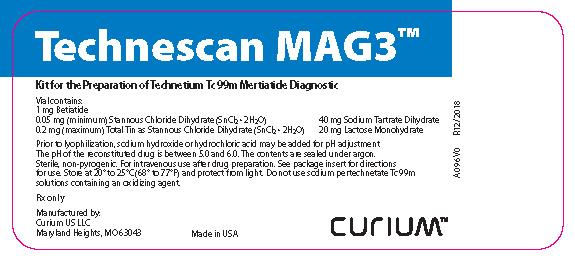
PRINCIPAL PANEL DISPLAY - A096V0 Technescan MAG3 ™ Kit for the Preparation of Technetium Tc 99m Mertiatide Diagnostic Vial contains: 1 mg Betiatide 0.05 mg (minimum) Stannous Chloride Dihydrate (SnCl 2 ● 2H 2 O) 40 mg Sodium Tartrate Dihydrate 0.2 mg (maximum) Total Tin as Stannous Chloride Dihydrate (SnCl 2 ● 2H 2 O) 20 mg Lactose Monohydrate Prior to lyophilization, sodium hydroxide or hydrochloric acid may be added for pH adjustment. The pH of the reconstituted drug is between 5.0 and 6.0. The contents are sealed under argon.
Sterile, non-pyrogenic. For intravenous use after drug preparation. See package insert for directions for use.
Store at 20˚ to 25˚C (68˚ to77˚F) and protect from light. Do not use sodium pertechnetate Tc 99m solutions containing an oxidizing agent. Rx only Manufactured by: Curium US LLC Maryland Heights, MO 63043 Made in USA CURIUM TM A096V0 R12/2018 image description
Medicaid utilization & spend
About this NDC listing & data coverage
What data is (and isn’t) available for this NDC — tap to expand
| NDC identity (package / product / labeler codes) | ✓ Available |
| Labeler | ✓ Available |
| Product & package description | ✓ Available |
| Marketing category & status | ✓ Available |
| Active ingredient / dosage form / route | ✓ Available |
| FDA label (SPL via DailyMed) | ✓ Available |
| Package photos | ✓ Available |
| Inactive ingredients (structured) | ✓ Available |
| NADAC pharmacy acquisition price (CMS) | — Not published for this NDC CMS publishes NADAC only for NDCs reported in its retail-pharmacy survey. |
| Orange Book / therapeutic-equivalence data | ✓ Available |
| HCPCS J-code billing crosswalk | — Not published for this NDC Most self-administered / retail products have no J-code — that is normal. |
| Medicaid utilization (CMS SDUD) | ✓ Available |