
CLOBETASOL PROPIONATE .5 mg/mL Solution — NDC 70752-153-20 (Billing 70752-0153-20)
This is a package of CLOBETASOL PROPIONATE .5 mg/mL Solution from Quagen Pharmaceuticals LLC, marketed since Mar 2022 and currently FDA-listed; retail pharmacies pay about $0.2401 per mL (NADAC).
NDC database record
One package, one record: these facts belong to NDC 70752-153-20 alone.
- Record
- FDA NDC Directory package listing · Human prescription drug
- Code segments
- 70752 labeler · 153 product · 20 package
- Package marketed since
- Mar 14, 2022
- Sample package
- No — commercial package
- Listing certified through
- Dec 31, 2026
- Barcode (UPC-A, from the NDC)
- 3 7075215320 1
- Medicaid fills, this package
- 205 prescriptions in the last four reported quarters
- FDA record last changed
- Jul 24, 2026
Other active recalls for Clobetasol Propionate (different manufacturers) — 1 · tap to view
Identity & classification
Regulatory identifiers FDA, NLM and CMS codes for this package
Drug-database identifiers Medi-Span GPI and First Databank GCN / HICL / AHFS classification
- GSN (GCN sequence number): 015349
- GCN: 15891
- GPI-14 (Medi-Span): 90550025102005
- HICL (First Databank): 003327
- AHFS class code: 84:06.08.00
- RxCUI (RxNorm): 861487
Where does this data come from?
- FDA openFDA NDC Directory · synced Oct 1, 2026
- FDA label on DailyMed · label index refreshed Oct 6, 2026
- RxNorm (NLM RxNav) · catalog refreshed Oct 1, 2026
- Medi-Span GPI (licensed)
- First Databank (licensed) · refreshed Oct 1, 2026
RxNorm drug class
This medicine belongs to the Corticosteroid class.
Where does this data come from?
- RxClass (NLM) · catalog refreshed Oct 1, 2026
Clinical
Clobetasol topical is used to treat the itching, redness, dryness, crusting, scaling, inflammation, and discomfort of various scalp and skin conditions, including psoriasis (a skin disease in which red, scaly patches form on some areas of the body) and eczema (a skin disease that causes the skin to be dry and itchy and to sometimes develop red, scaly rashes). Clobetasol is in a class of medications called corticosteroids. It works by activating natural substances in the skin to reduce swelling, redness, and itching.
Read the full MedlinePlus article ↗- It calms inflamed, itchy skin and scalp conditions, including plaque psoriasis. The exact use depends on your product, such as shampoo for scalp psoriasis or spray for plaque psori...
- Usually only a short time, often 2 weeks and up to 4 weeks for some products. Stop when your skin is under control. If you see no improvement in 2 weeks, check back with your presc...
- Generally no. Most clobetasol skin products should not be used on the face, armpits or groin. Keep it out of your eyes and mouth, and follow your product's directions.
- Mild burning, stinging, itching or dryness where you apply it. Call your doctor if your skin thins, breaks out, looks infected or gets worse. Also call for signs of steroid effects...
Patient education
Supplement & herbal interactions
Some supplements/herbs that may interact with Clobetasol Propionate — tap one for details:
Clobetasol may be associated with lower levels of 8 nutrients — worth a chat with your pharmacist, not a cause for alarm.
Where does this data come from?
- MedlinePlus (NLM) · refreshed Oct 1, 2026
- FDA label on DailyMed · label index refreshed Oct 6, 2026
Ask a licensed pharmacist directly — free, answered by our team.
Pricing
A drug doesn't have one price. Each row is a different public payment system, and none is what you'd pay at the counter — that depends on your insurance. The ⓘ on each row explains what it measures.
| Price system | Per mL | Per package |
|---|---|---|
| Retail pharmacies payNADAC · weekly | $0.240 | $6.00 / 25 ml |
| Medicaid paysCMS SDUD · 12 mo | $0.5681 | $14.20 / 25 ml |
| Medicare drug plans payPart D · Q2 2026 | $0.3488 | $8.72 / 25 ml |
Where does this data come from?
- CMS NADAC weekly file · file of Sep 30, 2026
- CMS ASP pricing files · refreshed Sep 20, 2026
- CMS Medicaid State Drug Utilization Data · through Q1 2026
- CMS Part D plan pricing files · refreshed Sep 24, 2026
- VA National Acquisition Center price file
Packaging — all sizes for this product
| Package NDC | Description | Per unit | Per pack | Marketing start | Marketing end | Status |
|---|---|---|---|---|---|---|
| 70752-0153-04 70752-153-04 Main listing | 1 BOTTLE in 1 CARTON / 50 mL in 1 BOTTLE | $0.1359 / mL | $6.80 | 2022-03-14 | — | Active |
| 70752-0153-20 You're viewing this | 1 BOTTLE in 1 CARTON / 25 mL in 1 BOTTLE | $0.2401 / mL | $6.00 | 2022-03-14 | — | Active |
Per mL, this pack runs about 77% above the cheapest pack (NDC 70752-0153-04, $0.1359 vs $0.2401 NADAC).
This pack accounts for about 21% of this product's recent Medicaid fills; most go to a different pack size. See all packs ↓
Pack size FAQ
What quantity is in this package?
What NDC number is used to bill for this package of CLOBETASOL PROPIONATE .5 mg/mL Solution?
Prices are the latest CMS NADAC pharmacy acquisition cost per NDC; per-pack figures are per-unit × pack quantity, shown only when the pack is denominated in the same measure NADAC prices.
Therapeutic equivalents
| Product | Labeler | Pack | NADAC/unit | TE | Status | Price vs. this |
|---|---|---|---|---|---|---|
| clobetasol propionate .5 mg/mL 43386-0028-60 | Lupin | 1 bottle | $0.120 | AT | FDA listed | save 50% |
| Clobetasol Propionate .5 mg/mL 00168-0269-50 | E. | 50 ml | $0.136 | AT | Availability likely | save 43% |
| Clobetasol Propionate .5 mg/mL 21922-0061-22 | Encube | 1 bottle | $0.240 | AT | Availability likely | — |
| Clobetasol Propionate .5 mg/mL 42571-0362-81 | Micro | 1 bottle | $0.240 | AT | Availability likely | — |
| Clobetasol Propionate .5 mg/mL 51672-1293-02 | Sun | 1 bottle | $0.240 | AT | Availability likely | — |
| Clobetasol Propionate .5 mg/mL 62332-0486-25 | Alembic | 1 bottle | $0.240 | AT | Availability likely | — |
| Clobetasol Propionate .5 mg/mLthis 70752-0153-20 | Quagen | 1 bottle | $0.240 | AT | Availability likely | — |
| Clobetasol Propionate .5 mg/mL 68462-0532-28 | Glenmark | 1 bottle | $0.362 | — | FDA listed | +51% |
| Clobetasol Propionate .4625 mg/mL 33342-0321-39 | Macleods | 1 bottle | — | AT | FDA listed | — |
| clobetasol propionate .5 mg/mL 40032-0028-60 | Novel | 1 bottle | — | AT | FDA listed | — |
| Clobetasol Propionate .5 mg/mL 46708-0486-25 | Alembic | 1 bottle | — | AT | FDA listed | — |
| Clobetasol Propionate .5 mg/mL 50090-5264-00 | A-S | 1 bottle | — | AT | FDA listed | — |
| Clobetasol Propionate .5 mg/mL 51407-0737-25 | Golden | 1 bottle | — | AT | FDA listed | — |
Where does this data come from?
- FDA openFDA NDC Directory · synced Oct 1, 2026
- FDA Orange Book · refreshed Oct 3, 2026
- CMS NADAC weekly file · file of Sep 30, 2026
Availability & generic status
This product is an FDA-approved generic. Other versions of the same drug are listed under Therapeutic equivalents, least expensive first.
Where does this data come from?
- FDA Orange Book · refreshed Oct 3, 2026
Inactive Ingredients / Excipients
Inactive ingredients, also called excipients, are components of the drug product other than the active ingredient. They may include fillers, dyes, coatings, preservatives, flavors, or other formulation ingredients.
🧪 Avoiding an ingredient? See Clobetasol inactive ingredients by manufacturer: every current product's list side by side, so you can ask your pharmacy for the version that does not list it.
Where does this data come from?
IACT rows and label-wide narrative are kept separate; availability and product-level specificity depend on the submitted label.- FDA label on DailyMed · label index refreshed Oct 6, 2026
- FDA openFDA NDC Directory · synced Oct 1, 2026
Inactive ingredient FAQ
Are inactive ingredients the same for every manufacturer?
Why might an inactive ingredient be missing?
Can inactive ingredients matter?
Manufacturer & labeler
More NDCs from Quagen Pharmaceuticals LLC labeler code 70752
- Triamcinolone Acetonide 1 mg/g Paste NDC 70752-140-16
- Butalbital, Acetaminophen and Caffeine 50 mg; 325 mg; 40 mg Capsule NDC 70752-141-10
- Butalbital, Acetaminophen and Caffeine 50 mg; 325 mg; 40 mg Tablet NDC 70752-142-10
- Butalbital, Acetaminophen and Caffeine 50 mg; 300 mg; 40 mg Capsule NDC 70752-144-10
- Butalbital and Acetaminophen 50 mg; 300 mg Tablet NDC 70752-147-10
- Butalbital and Acetaminophen 50 mg; 325 mg Tablet NDC 70752-148-10
- FLUOCINONIDE .5 mg/mL Solution NDC 70752-154-05
- Fluocinolone Acetonide .11 mg/mL Oil NDC 70752-156-06
- Fluocinolone Acetonide .11 mg/mL Oil NDC 70752-158-06
- FLUOCINOLONE ACETONIDE .11 mg/mL Oil NDC 70752-159-20
- Phenobarbital 16.2 mg Tablet NDC 70752-161-10
- Phenobarbital 32.4 mg Tablet NDC 70752-162-10
Where does this data come from?
- FDA openFDA NDC Directory · synced Oct 1, 2026
- Drugs@FDA
Full prescribing information FDA SPL
🎯 Indications and Usage ▾
INDICATIONS AND USAGE Clobetasol propionate topical solution is indicated for short-term topical treatment of inflammatory and pruritic manifestations of moderate to severe corticosteroid-responsive dermatoses of the scalp. Treatment beyond 2 consecutive weeks is not recommended, and the total dosage should not exceed 50 mL/week because of the potential for the drug to suppress the HPA axis. This product is not recommended for use in pediatric patients under 12 years of age.
⏱️ Dosage and Administration ▾
DOSAGE AND ADMINISTRATION Clobetasol propionate topical solution should be applied to the affected scalp areas twice daily, once in the morning and once at night. Clobetasol propionate topical solution is potent; therefore, treatment must be limited to 2 consecutive weeks and amounts greater than 50 mL/week should not be used. Clobetasol propionate topical solution is not to be used with occlusive dressings.
Geriatric Use: In studies where geriatric patients (65 years of age or older, see PRECAUTIONS ) have been treated with clobetasol propionate topical solution, safety did not differ from that in younger patients; therefore, no dosage adjustment is recommended.
⛔ Contraindications ▾
CONTRAINDICATIONS Clobetasol propionate topical solution is contraindicated in patients with primary infections of the scalp, or in patients who are hypersensitive to clobetasol propionate, other corticosteroids, or any ingredient in this preparation.
🤒 Adverse Reactions ▾
ADVERSE REACTIONS Clobetasol propionate topical solution is generally well tolerated when used for 2-week treatment periods. The most frequent adverse events reported for clobetasol propionate topical solution have been local and have included burning and/or stinging sensation, which occurred in 29 of 294 patients; scalp pustules, which occurred in 3 of 294 patients; and tingling and folliculitis, each of which occurred in 2 of 294 patients. Less frequent adverse events were itching and tightness of the scalp, dermatitis, tenderness, headache, hair loss, and eye irritation, each of which occurred in 1 of 294 patients.
The following local adverse reactions are reported infrequently when topical corticosteroids are used as recommended. These reactions are listed in an approximately decreasing order of occurrence: burning, itching, irritation, dryness, folliculitis, hypertrichosis, acneiform eruptions, hypopigmentation, perioraldermatitis, allergic contact dermatitis, maceration of the skin, secondary infection, skin atrophy, striae, and miliaria. Systemic absorption of topical corticosteroids has produced reversible HPA axis suppression, manifestations of Cushing syndrome, hyperglycemia, and glucosuria in some patients.
In rare instances, treatment (or withdrawal of treatment) of psoriasis with corticosteroids is thought to have exacerbated the disease or provoked the pustular form of the disease, so careful patient supervision is recommended. To report SUSPECTED ADVERSE REACTIONS, contact Quagen Pharmaceuticals LLC at 1-888-344-9603 or FDA at 1-800-FDA-1088 or www.fda.gov/medwatch.
🆘 Overdosage ▾
OVERDOSAGE Topically applied clobetasol propionate topical solution can be absorbed in sufficient amounts to produce systemic effects (see PRECAUTIONS ).
🧬 Clinical Pharmacology ▾
CLINICAL PHARMACOLOGY The corticosteroids are a class of compounds comprising steroid hormones secreted by the adrenal cortex and their synthetic analogs. In pharmacologic doses, corticosteroids are used primarily for their anti-inflammatory and/or immunosuppressive effects. Topical corticosteroids such as clobetasol propionate are effective in the treatment of corticosteroid-responsive dermatoses primarily because of their anti-inflammatory, antipruritic, and vasoconstrictive actions.
However, while the physiologic, pharmacologic, and clinical effects of the corticosteroids are well known, the exact mechanisms of their actions in each disease are uncertain. Clobetasol propionate, a corticosteroid, has been shown to have topical (dermatologic) and systemic pharmacologic and metabolic effects characteristic of this class of drugs. Pharmacokinetics The extent of percutaneous absorption of topical corticosteroids, including clobetasol propionate, is determined by many factors, including the vehicle, the integrity of the epidermal barrier, and the use of occlusive dressings (see DOSAGE AND ADMINISTRATION ).
As with all topical corticosteroids, clobetasol propionate can be absorbed from normal intact skin. Inflammation and/or other disease processes in the skin may increase percutaneous absorption. Occlusive dressings substantially increase the percutaneous absorption of topical corticosteroids (see DOSAGE AND ADMINISTRATION ).
Once absorbed through the skin, topical corticosteroids enter pharmacokinetic pathways similarly to systemically administered corticosteroids. Corticosteroids are bound to plasma proteins in varying degrees. Corticosteroids are metabolized primarily in the liver and are then excreted by the kidneys.
Some of the topical corticosteroids, including clobetasol propionate and its metabolites, are also excreted into the bile. Following repeated nonocclusive application in the treatment of scalp psoriasis, there is some evidence that clobetasol propionate topical solution has the potential to depress plasma cortisol levels in some patients. However, hypothalamic-pituitary-adrenal (HPA) axis effects produced by systemically absorbed clobetasol propionate have been shown to be transient and reversible upon completion of a 2-week course of treatment.
📦 How Supplied / Storage and Handling ▾
HOW SUPPLIED Clobetasol Propionate Topical Solution USP, 0.05% is supplied in plastic squeeze bottles. 25 mL (NDC 70752-153-20) 50 mL (NDC 70752-153-04). Store at 20° to 25°C (68° to 77°F); excursions permitted between 15° to 30°C (59° to 86°F) [See USP Controlled Room Temperature]. Do not use near an open flame. Rx Only Manufactured by: Quagen Pharmaceuticals LLC West Caldwell, NJ 07006 52029 Rev. 03/2022
⚠️ Precautions ▾
PRECAUTIONS General Clobetasol propionate is a highly potent topical corticosteroid that has been shown to suppress the HPA axis at doses as low as 2 g (of ointment) per day. Systemic absorption of topical corticosteroids has resulted in reversible HPA axis suppression, manifestations of Cushing syndrome, hyperglycemia, and glucosuria in some patients. Conditions that augment systemic absorption include the application of the more potent corticosteroids, use over large surface areas, prolonged use, and the addition of occlusive dressings.
Therefore, patients receiving a large dose of a potent topical steroid applied to a large surface area should be evaluated periodically for evidence of HPA axis suppression by using the urinary free cortisol and ACTH stimulation tests. If HPA axis suppression is noted, an attempt should be made to withdraw the drug, to reduce the frequency of application, or to substitute a less potent steroid. Recovery of HPA axis function is generally prompt and complete upon discontinuation of the drug.
Infrequently, signs and symptoms of steroid withdrawal may occur, requiring supplemental systemic corticosteroids. Pediatric patients may absorb proportionally larger amounts of topical corticosteroids and thus be more susceptible to systemic toxicity (see PRECAUTIONS: Pediatric Use ). If irritation develops, topical corticosteroids should be discontinued and appropriate therapy instituted.
Irritation is possible if clobetasol propionate topical solution contacts the eye. If that should occur, immediate flushing of the eye with a large volume of water is recommended. If the inflammatory lesion becomes infected, the use of an appropriate antifungal or antibacterial agent should be instituted.
If a favorable response does not occur promptly, the corticosteroid should be discontinued until the infection has been adequately controlled. Although clobetasol propionate topical solution is intended for the treatment of inflammatory conditions of the scalp, it should be noted that certain areas of the body, such as the face, groin, and axillae, are more prone to atrophic changes than other areas of the body following treatment with corticosteroids. Frequent observation of the patient is important if these areas are to be treated.
As with other potent topical corticosteroids, clobetasol propionate topical solution should not be used in the treatment of rosacea and perioral dermatitis. Topical corticosteroids in general should not be used in the treatment of acne or as sole therapy in widespread plaque psoriasis. Information for Patients Patients using clobetasol propionate topical solution should receive the following information and instructions: 1.
This medication is to be used as directed by the physician and should not be used longer than the prescribed time period. It is for external use only. Avoid contact with the eyes.
2. This medication should not be used for any disorder other than that for which it was prescribed. 3.
The treated skin area should not be bandaged or otherwise covered or wrapped so as to be occlusive. 4. Patients should report any signs of local adverse reactions to the physician.
Laboratory Tests The following tests may be helpful in evaluating patients for HPA axis suppression: Urinary free cortisol test ACTH stimulation test Carcinogenesis, Mutagenesis, Impairment of Fertility Long-term animal studies have not been performed to evaluate the carcinogenic potential of clobetasol propionate. Studies in the rat following subcutaneous administration at dosage levels up to 50 mcg/kg/day revealed that the females exhibited an increase in the number of resorbed embryos and a decrease in the number of living fetuses at the highest dose.
Clobetasol propionate was nonmutagenic in 3 different test systems: the Ames test, the Saccharomycescerevisiae gene conversion assay, and the E. coli B WP2 fluctuation test. Pregnancy Teratogenic Effects: Pregnancy Category C. Corticosteroids have been shown to be t… [Excerpted — this section continues on DailyMed.]
📄 Package Label / Principal Display Panel ▾
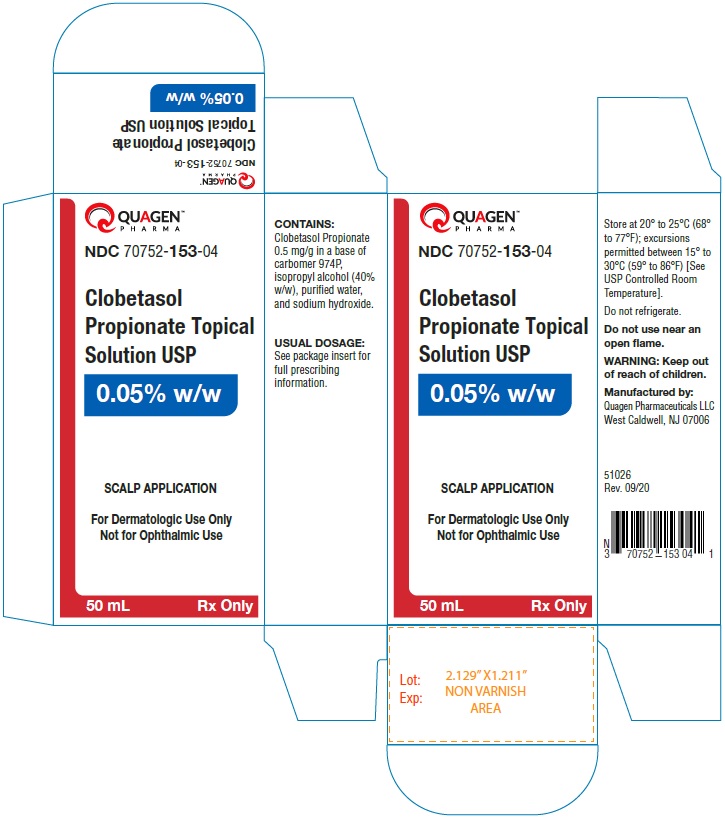
PACKAGE LABEL PRINCIPAL DISPLAY PANEL 50 mL Carton Label NDC 70752- 153 -04 Clobetasol Propionate Topical Solution USP, 0.05% w/w SCALP APPLICATION For Dermatologic Use Only Not for Ophthalmic Use Rx Only 50 mL carton