
Atropine Sulfate 10 mg/mL Solution/ Drops — NDC 70756-653-35 (Billing 70756-0653-35)
This is a package of Atropine Sulfate 10 mg/mL Solution/ Drops from Lifestar Pharma LLC, marketed since Jan 2024 and currently FDA-listed; retail pharmacies pay about $4.16 per mL (NADAC). It is this product's only package size.
Other active recalls for Atropine Sulfate (different manufacturers) — 2 · tap to view
Identity & classification
Regulatory identifiers FDA, NLM and CMS codes for this package
Drug-database identifiers Medi-Span GPI and First Databank GCN / HICL / AHFS classification
- GSN (GCN sequence number): 007866
- GCN: 32952
- GPI-14 (Medi-Span): 86350010102010
- HICL (First Databank): 002004
- AHFS class code: 12:08.08.00
- RxCUI (RxNorm): 1190655
Where does this data come from?
- FDA openFDA NDC Directory · synced Oct 1, 2026
- FDA label on DailyMed · label index refreshed Oct 1, 2026
- RxNorm (NLM RxNav) · catalog refreshed Oct 1, 2026
- Medi-Span GPI (licensed)
- First Databank (licensed) · refreshed Oct 1, 2026
RxNorm drug class
This medicine belongs to the Anticholinergic class.
Where does this data come from?
- RxClass (NLM) · catalog refreshed Oct 1, 2026
Clinical
Ophthalmic atropine is used before eye examinations to dilate (open) the pupil, the black part of the eye through which you see. It is also used to relieve pain caused by swelling and inflammation of the eye.
Read the full MedlinePlus article ↗- It depends on the form. The injection is used in emergencies like poisonings and slow heart rhythms, and around surgery to reduce secretions. The eye drops and ointment dilate the...
- Injections are given by a healthcare professional, usually into a vein. ATROPEN is injected into the outer thigh in an emergency, and you should seek medical care right away. Eye p...
- Dry mouth, blurred vision, light sensitivity, a faster heartbeat, flushing, dizziness, and constipation are common. These come from atropine's drying effects. Injection site pain c...
- Seek emergency help for trouble breathing, swelling or a spreading rash, chest pain, a racing or irregular heartbeat, hallucinations, or a high fever with no sweating. Eye pain wit...
Patient education
Supplement & herbal interactions
Some supplements/herbs that may interact with Atropine Sulfate — tap one for details:
Where does this data come from?
- MedlinePlus (NLM) · refreshed Oct 1, 2026
- FDA label on DailyMed · label index refreshed Oct 1, 2026
Ask a licensed pharmacist directly — free, answered by our team.
Pricing
A drug doesn't have one price. Each row is a different public payment system, and none is what you'd pay at the counter — that depends on your insurance. The ⓘ on each row explains what it measures.
| Price system | Per mL | Per package |
|---|---|---|
| Retail pharmacies payNADAC · weekly | $4.162 | $62.43 / 15 ml |
| Medicaid paysCMS SDUD · 12 mo | $6.17 | $92.62 / 15 ml |
| Medicare drug plans payPart D · Q2 2026 | $7.91 | $118.59 / 15 ml |
Where does this data come from?
- CMS NADAC weekly file · file of Sep 30, 2026
- CMS ASP pricing files · refreshed Sep 20, 2026
- CMS Medicaid State Drug Utilization Data · through Q1 2026
- CMS Part D plan pricing files · refreshed Sep 24, 2026
- VA National Acquisition Center price file
Packaging — all sizes for this product
| Package NDC | Description | Marketing start | Marketing end | Status |
|---|---|---|---|---|
| 70756-0653-35 You're viewing this Main listing | 1 BOTTLE in 1 CARTON / 15 mL in 1 BOTTLE | 2024-01-08 | — | Active |
Therapeutic equivalents
| Product | Labeler | Pack | NADAC/unit | TE | Status | Price vs. this |
|---|---|---|---|---|---|---|
| Atropine 10 mg/mL 60219-1750-08 | Amneal | 1 bottle | $4.162 | AT1 | Availability likely | — |
| Atropine sulfate 10 mg/mL 70069-0583-01 | Somerset | 1 bottle | $4.162 | AT1 | Availability likely | — |
| Atropine Sulfate 10 mg/mLthis 70756-0653-35 | Lifestar | 1 bottle | $4.162 | AT1 | Availability likely | — |
| Atropine 10 mg/mL 60219-1749-03 | Amneal | 1 bottle | $5.134 | AT1 | Availability likely | +23% |
| Atropine sulfate 10 mg/mL 70069-0582-01 | Somerset | 1 bottle | $5.134 | AT1 | Availability likely | +23% |
| Atropine Sulfate 10 mg/mL 70756-0652-25 | Lifestar | 1 bottle | $5.134 | AT1 | Availability likely | +23% |
| Isopto Atropine 10 mg/mL 00065-0303-55 | Alcon | 1 bottle | $9.701 | AT2 | Discontinued | +133% |
| atropine sulfate 10 mg/mL 00065-0817-01 | Alcon | 1 bottle | $10.345 | AT2 | Availability likely | +149% |
| Atropine Sulfate 10 mg/mL 70069-0716-01 | Somerset | 1 bottle | $10.345 | AT2 | Availability likely | +149% |
| Atropine sulfate 10 mg/mL 42799-0826-01 | Edenbridge | 1 bottle | $11.515 | AT1 | Availability likely | +177% |
| Atropine 10 mg/mL 60219-1748-02 | Amneal | 1 bottle | $11.515 | AT1 | Availability likely | +177% |
| Atropine 10 mg/mL 60505-6226-00 | Apotex | 1 bottle | $11.515 | AT1 | Availability likely | +177% |
| Atropine sulfate 10 mg/mL 70069-0581-01 | Somerset | 1 bottle | $11.515 | AT1 | Availability likely | +177% |
| Atropine Sulfate 10 mg/mL 70756-0651-25 | Lifestar | 1 bottle | $11.515 | AT1 | Availability likely | +177% |
| Atropine Sulfate 10 mg/mL 72603-0264-01 | NorthStar | 1 bottle | $11.515 | AT1 | Availability likely | +177% |
| Atropine Sulfate 10 mg/mL 24208-0965-01 | Bausch | 10 vials | — | — | FDA listed | — |
| Atropine 10 mg/mL 50090-7000-00 | A-S | 1 bottle | — | AT1 | FDA listed | — |
| Atropine 10 mg/mL 50090-7313-00 | A-S | 1 bottle | — | AT1 | FDA listed | — |
| Atropine Sulfate 10 mg/mL 67296-2124-05 | Redpharm | 1 bottle | — | AT1 | FDA listed | — |
| Atropine 10 mg/mL 67296-2200-05 | Redpharm | 1 bottle | — | AT1 | FDA listed | — |
| Atropine Sulfate 10 mg/mL 82260-0001-01 | Bausch | 10 vials | — | — | FDA listed | — |
| Atropine 10 mg/mL 68083-0671-01 | Gland | 1 bottle | — | AT1 | FDA listed | — |
| Atropine 10 mg/mL 68083-0669-01 | Gland | 1 bottle | — | AT1 | FDA listed | — |
| Atropine 10 mg/mL 68083-0670-01 | Gland | 1 bottle | — | AT1 | FDA listed | — |
Where does this data come from?
- FDA openFDA NDC Directory · synced Oct 1, 2026
- FDA Orange Book · refreshed Sep 3, 2026
- CMS NADAC weekly file · file of Sep 30, 2026
Availability & generic status
This product is an FDA-approved generic. Other versions of the same drug are listed under Therapeutic equivalents, least expensive first.
Where does this data come from?
- FDA Orange Book · refreshed Sep 3, 2026
Inactive Ingredients / Excipients
Inactive ingredients, also called excipients, are components of the drug product other than the active ingredient. They may include fillers, dyes, coatings, preservatives, flavors, or other formulation ingredients.
💡 Tap an ingredient (hover on desktop) to see what it is and why it’s used.
-
UNII F5UM2KM3W7
Benzalkonium chloride is a chemical compound that works as a preservative and antimicrobial agent in medications. It prevents bacterial and fungal growth in liquid formulations to keep the product safe during storage and use.
-
UNII 7FLD91C86K
Edetate disodium is a chemical compound that binds and removes certain metal ions. In medicines, it acts as a preservative and stabilizer by preventing metals like calcium from interfering with the product's shelf life and consistency.
-
UNII QTT17582CB
A strong acid used to adjust and maintain the proper pH level in liquid medicines, ensuring stability and preventing breakdown of active ingredients.
-
UNII RN3152OP35
Hypromellose is a plant-based thickener and film-former derived from cellulose. In medicines, it's used to create coatings on tablets and capsules, control how fast the drug dissolves, and improve the product's texture and stability.
-
UNII 55X04QC32I
A strong alkaline chemical used to adjust and maintain the pH balance of liquid medicines. It helps keep the medicine stable and ensures it stays effective during storage.
-
UNII 22ADO53M6F
A mineral salt derived from phosphoric acid, used as a buffer to maintain the pH balance of the medication and help stabilize the active ingredients.
-
UNII 593YOG76RN
A salt made from sodium and phosphate that helps regulate acidity and maintain proper pH balance in the medicine. It also acts as a buffer to keep the product stable.
7 inactive ingredients listed in the exact product block matched to this NDC.
Where does this data come from?
ingredient classCode="IACT" elements from the exact product block matched by this NDC. Label-section narrative from DailyMed / the openFDA label index is shown separately when available.- FDA label on DailyMed · label index refreshed Oct 1, 2026
- FDA openFDA NDC Directory · synced Oct 1, 2026
Inactive ingredient FAQ
Are inactive ingredients the same for every manufacturer?
Why might an inactive ingredient be missing?
Can inactive ingredients matter?
Manufacturer & labeler
Where does this data come from?
- FDA openFDA NDC Directory · synced Oct 1, 2026
- Drugs@FDA
Full prescribing information FDA SPL
🎯 Indications and Usage ▾
1 INDICATIONS AND USAGE Atropine Sulfate Ophthalmic Solution, 1% is indicated in adults and pediatric patients aged three (3) months and older for: Atropine is an anticholinergic indicated in adults and pediatric patients aged three (3) months and older for: Cycloplegia (1.1) Mydriasis (1.2) Penalization of the healthy eye in the treatment of amblyopia (1.3)
1.1 Cycloplegia
1.2 Mydriasis
1.3 Penalization of the Healthy Eye in the Treatment of Amblyopia
⏱️ Dosage and Administration ▾
2 DOSAGE AND ADMINISTRATION Apply 1 drop topically to the cul-de-sac of the conjunctiva, forty minutes prior to the intended maximal dilation time. In adults and pediatric patients aged 3 years and older, doses may be repeated up to twice daily as needed. Apply 1 drop topically to the cul-de-sac of the conjunctiva, forty minutes prior to the intended maximal dilation time.
(2) In adults and pediatric patients aged 3 years and older, doses may be repeated up to twice daily as needed. (2)
💊 Dosage Forms and Strengths ▾
3 DOSAGE FORMS AND STRENGTHS Atropine Sulfate Ophthalmic Solution, USP 1%: each mL contains 10 mg of atropine sulfate equivalent to 8.3 mg of atropine Ophthalmic solution: 1% atropine sulfate
⛔ Contraindications ▾
4 CONTRAINDICATIONS Hypersensitivity or allergic reaction to any ingredient in formulation.
4.1Hypersensitivity Atropine Sulfate Ophthalmic Solution 1% is contraindicated in patients who have demonstrated a previous hypersensitivity or known allergic reaction to any ingredient of the formulation.
⚠️ Warnings and Cautions ▾
5 WARNINGS AND PRECAUTIONS Photophobia and blurred vision due to pupil unresponsiveness and cycloplegia may last up to 2 weeks. (5.1) Risk of blood pressure increase from systemic absorption. (5.2)
5.1Photophobia and Blurred Vision Photophobia and blurred vision due to pupil unresponsiveness and cycloplegia may last up to 2 weeks.
5.2Elevation of Blood Pressure Elevations in blood pressure from systemic absorption has been reported following conjunctival instillation of recommended doses of Atropine Sulfate Ophthalmic Solution, 1%.
5.3Risk of Contamination Do not touch the dropper tip to the eye, eyelids, or any other surface as this may contaminate the solution.
🤒 Adverse Reactions ▾
6 ADVERSE REACTIONS The following serious adverse reactions are described below and elsewhere in the labeling: Photophobia and Blurred Vision [See Warnings and Precautions (5.1)] Elevation in Blood Pressure [See Warnings and Precautions (5.2)] The following adverse reactions were identified in clinical studies or postmarketing reports following use of atropine sulfate ophthalmic solution. Because these reactions are reported voluntarily from a population of uncertain size, it is not always possible to reliably estimate their frequency or establish a causal relationship to drug exposure.
Most common adverse reactions that have been reported are eye pain and stinging on administration, blurred vision, photophobia, decreased lacrimation, increased heart rate and blood pressure. To report SUSPECTED ADVERSE REACTIONS, contact Lifestar Pharma LLC at 1-888-995-4337 or FDA at 1-800-FDA-1088 or www.fda.gov/medwatch .
6.1Ocular Adverse Reactions Eye pain and stinging occurs upon instillation. Other commonly occurring adverse reactions include, blurred vision, photophobia, superficial keratitis and decreased lacrimation. Allergic reactions such as papillary conjunctivitis, contact dermatitis, and lid edema may also occur less commonly.
6.2Systemic Adverse Reactions Systemic effects of atropine are related to its anti-muscarinic activity. Systemic adverse events reported include dryness of skin, mouth, and throat from decreased secretions from mucus membranes; restlessness, irritability or delirium from stimulation of the central nervous system; tachycardia; flushed skin of the face and neck.
🔄 Drug Interactions ▾
7 DRUG INTERACTIONS The use of atropine and monoamine oxidase inhibitors (MAOI) is generally not recommended because of the potential to precipitate hypertensive crisis.
7.1Monoamine Oxidase Inhibitors (MAOI) The use of atropine and monoamine oxidase inhibitors (MAOI) is generally not recommended because of the potential to precipitate hypertensive crisis.
👥 Use in Specific Populations ▾
8 USE IN SPECIFIC POPULATIONS Should only be used in pregnant women if clearly needed.
8.1Pregnancy Risk Summary There are no adequate and well-controlled studies of atropine sulfate administration in pregnant women to inform a drug-associated risk. Adequate animal development and reproduction studies have not been conducted with atropine sulfate. In humans, 1% atropine sulfate is systemically bioavailable following topical ocular administration [see Clinical Pharmacology (12.3)] .
Atropine Sulfate Ophthalmic Solution 1% should only be used during pregnancy if the potential benefit justifies the potential risk to the fetus.
8.2Lactation Risk Summary There is no information to inform risk regarding the presence of atropine in human milk following ocular administration of atropine sulfate to the mother. The effects on breastfed infants and the effects on milk production are also unknown. The developmental and health benefits of breastfeeding should be considered along with the mother's clinical need for atropine sulfate and any potential adverse effects on the breastfed child from atropine sulfate.
8.4Pediatric Use The safety and effectiveness of Atropine Sulfate Ophthalmic Solution 1% have been established in pediatric patients aged 3 months and older. Use of Atropine Sulfate Ophthalmic Solution 1% is supported by evidence from adequate and well-controlled trials with additional safety data from published literature. Due to the potential for systemic absorption, the use of Atropine Sulfate Ophthalmic Solution 1% in pediatric patients aged 3 months to 3 years should be limited to no more than one drop per eye per day.
Use in pediatric patients younger than 3 months of age is not recommended.
8.5Geriatric Use No overall differences in safety and effectiveness have been observed between elderly and younger adult patients.
🆘 Overdosage ▾
10 OVERDOSAGE In the event of accidental ingestion or toxic overdosage with atropine sulfate ophthalmic solution, supportive care may include a short acting barbiturate or diazepam as needed to control marked excitement and convulsions. Large doses for sedation should be avoided because central depressant action may coincide with the depression occurring late in atropine poisoning. Central stimulants are not recommended.
Physostigmine, given by slow intravenous injection of 1 to 4 mg (0.5 to 1 mg in pediatric populations), rapidly abolishes delirium and coma caused by large doses of atropine. Since physostigmine is rapidly destroyed, the patient may again lapse into coma after one to two hours, and repeated doses may be required. Artificial respiration with oxygen may be necessary.
Cooling measures may be needed to help to reduce fever, especially in pediatric populations. The fatal adult dose of atropine is not known. In pediatric patients, 10 mg or less may be fatal.
🧬 Clinical Pharmacology ▾
12 CLINICAL PHARMACOLOGY
12.1Mechanism of Action Atropine is a reversible antagonist of muscarine-like actions of acetyl-choline and is therefore classified as an antimuscarinic agent. Atropine is relatively selective for muscarinic receptors. Its potency at nicotinic receptors is much lower, and actions at non-muscarinic receptors are generally undetectable clinically.
Atropine does not distinguish among the M1, M2, and M3 subgroups of muscarinic receptors. The pupillary constrictor muscle depends on muscarinic cholinoceptor activation. This activation is blocked by topical atropine resulting in unopposed sympathetic dilator activity and mydriasis.
Atropine also weakens the contraction of the ciliary muscle, or cycloplegia. Cycloplegia results in loss of the ability to accommodate such that the eye cannot focus for near vision.
12.2Pharmacodynamics The onset of action after administration of atropine sulfate ophthalmic solution 1%, is usually within 40 minutes with maximal effect being reached in about 2 hours. The effect can last for up to 2 weeks in a normal eye.
12.3Pharmacokinetics The bioavailability of atropine sulfate ophthalmic solution 1% was assessed in six healthy subjects, 24 to 29 years of age. Subjects received either 0.3 mg atropine sulfate administered as bolus intravenous injection or 0.3 mg administered as 30 μL instilled unilaterally in the cul-de-sac of the eye. Plasma l-hyoscyamine concentrations were determined over selected intervals up to eight hours after dose administration.
The mean bioavailability of topically applied atropine was 63.5 ± 29% (range 19 to 95%) with large inter-individual differences. Mean maximum observed plasma concentration for the ophthalmic solution was 288 ± 73 pg/mL. Maximum concentration was reached in 28 ± 27 min after administration.
Terminal half-life of l-hyoscamine was not affected by route of administration and was calculated to be 3 ± 1.2 hours (intravenous) and 2.5 ± 0.8 hours (topical ophthalmic). In another placebo-controlled study, the systemic exposure to l-hyoscyamine, and the anti-cholinergic effects of atropine were investigated in eight ocular surgery patients 56 to 66 years of age, following single topical ocular 0.4 mg atropine dose (given as 40 microliters of atropine sulfate ophthalmic solution, 1%). The mean (± standard deviation (SD)) C max of l-hyoscyamine in these patients was 860 ± 402 pg/mL, achieved within 8 minutes of eyedrop instillation.
Following intravenous administration, the mean (± SD) elimination half-life (t 1/2 ) of atropine was reported to be longer in pediatric subjects under 2 years (6.9 ± 3.3 hours) and in geriatric patients 65 to 75 years (10.0 ± 7.3 hours), compared to in children over 2 years (2.5 ± 1.2 hours) and in adults 16 to 58 years (3.0 ± 0.9 hours). [see Use in Specific Populations (8.4)] . Atropine is destroyed by enzymatic hydrolysis, particularly in the liver; from 13 to 50% is excreted unchanged in the urine. Traces are found in various secretions, including milk.
The major metabolites of atropine are noratropine, atropin-n-oxide, tropine, and tropic acid. Atropine readily crosses the placental barrier and enters the fetal circulation, but is not found in amniotic fluid. Atropine binds poorly (about 44%) to plasma protein, mainly to alpha-1 acid glycoprotein; age has no effect on the serum protein binding of atropine.
Atropine binding to α-1 acid glycoprotein was concentration dependent (2 to 20 mcg/mL) and nonlinear in vitro and in vivo . There is no gender effect on the pharmacokinetics of atropine administered by injection.
📦 How Supplied / Storage and Handling ▾
16 HOW SUPPLIED/STORAGE AND HANDLING Atropine Sulfate Ophthalmic Solution, USP 1% is supplied as clear, colorless solution in a three piece white bottle with a natural nozzle and red cap in the following sizes: NDC 70756-651-25 2 mL fill in 5 mL bottle NDC 70756-652-25 5 mL fill in 5 mL bottle NDC 70756-653-35 15 mL fill in 15 mL bottle Storage: Store at 20° to 25°C (68° to 77°F) [See USP Controlled Room Temperature]. Keep container tightly closed. After opening, Atropine Sulfate Ophthalmic Solution can be used until the expiration date on the bottle.
📋 Description ▾
11 DESCRIPTION Atropine Sulfate Ophthalmic Solution, USP 1% is a sterile topical anticholinergic for ophthalmic use. The active ingredient is represented by the chemical structure Chemical Name: Benzeneacetic acid, α-(hydroxymethyl)-, 8-methyl-8-azabicyclo[3.2.1.]oct-3-yl ester, endo –(±)-, sulfate (2:1) (salt), monohydrate. Molecular Formula: (C 17 H 23 NO 3 ) 2 H 2 SO 4 H 2 O Molecular Weight: 694.84 g/mol Atropine sulfate, USP appears as colorless, almost white to white solid.
It is very soluble in water and glacial acetic acid, freely soluble in ethanol (96%) and practically insoluble in diethyl ether. Each mL of Atropine Sulfate Ophthalmic Solution USP, 1% contains: Active : atropine sulfate, USP 10 mg equivalent to 8.3 mg of atropine. Inactives: benzalkonium chloride 0.1 mg (0.01%), dibasic sodium phosphate anhydrous, edetate disodium dihydrate, hypromellose (2910), monobasic sodium phosphate monohydrate, hydrochloric acid and/or sodium hydroxide may be added to adjust pH (3.5 to 6.0), and water for injection USP. structure
💬 Information for Patients ▾
17 PATIENT COUNSELING INFORMATION Risk of Contamination Advise patients to not touch the dropper tip to the eye, eyelids, or any other surface as this may contaminate the solution. Keep the bottle tightly closed. Instillation Site Pain Advise patients that drops will sting upon instillation.
Sensitivity to Light and Blurred Vision Advise patients that they will experience sensitivity to light and blurred vision which may last for a couple of weeks. Manufactured for: Lifestar Pharma LLC 1200 MacArthur Blvd. Mahwah, NJ 07430 USA Made in India Revised: 09/2025, V-3
🔬 Clinical Studies ▾
14 CLINICAL STUDIES Topical administration of Atropine Sulfate Ophthalmic Solution 1% results in cycloplegia and mydriasis which has been demonstrated in several controlled clinical studies in adults and pediatric patients. Maximal mydriasis usually occurs in about 40 minutes and maximal cycloplegia is usually achieved in about 60 to 90 minutes after single administration. Full recovery usually occurs in approximately one week, but may last a couple of weeks.
🧪 Nonclinical Toxicology ▾
13 NONCLINICAL TOXICOLOGY
13.1Carcinogenesis, Mutagenesis, Impairment of Fertility Carcinogenesis Long term studies in animals have not been performed to evaluate the carcinogenic potential of atropine sulfate. Mutagenesis Atropine sulfate was negative in the salmonella/microsome mutagenicity test. Impairment of Fertility Studies to evaluate impairment of fertility have not been conducted.
📄 Package Label / Principal Display Panel ▾
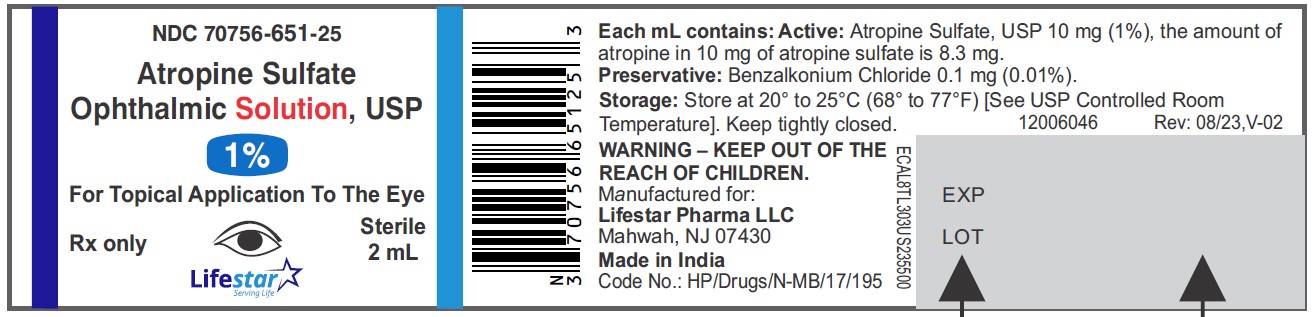
PACKAGE LABEL.PRINCIPAL DISPLAY PANEL NDC 70756-651-25 Atropine Sulfate Ophthalmic Solution, USP 1% 2 mL Rx only Sterile NDC 70756-651-25 Atropine Sulfate Ophthalmic Solution, USP 1% 2 mL Rx only Sterile NDC 70756-652-25 Atropine Sulfate Ophthalmic Solution, USP 1% 5 mL Rx only Sterile NDC 70756-652-25 Atropine Sulfate Ophthalmic Solution, USP 1% 5 mL Rx only Sterile NDC 70756-653-35 Atropine Sulfate Ophthalmic Solution, USP 1% 15 mL Rx only Sterile NDC 70756-653-35 Atropine Sulfate Ophthalmic Solution, USP 1% 15 mL Rx only Sterile 2mlbottlelabel 2mlcartonlabel 5mlbottlelabel 5mlcartonlabel 15mlbottlelabel 15mlcartonlabel