
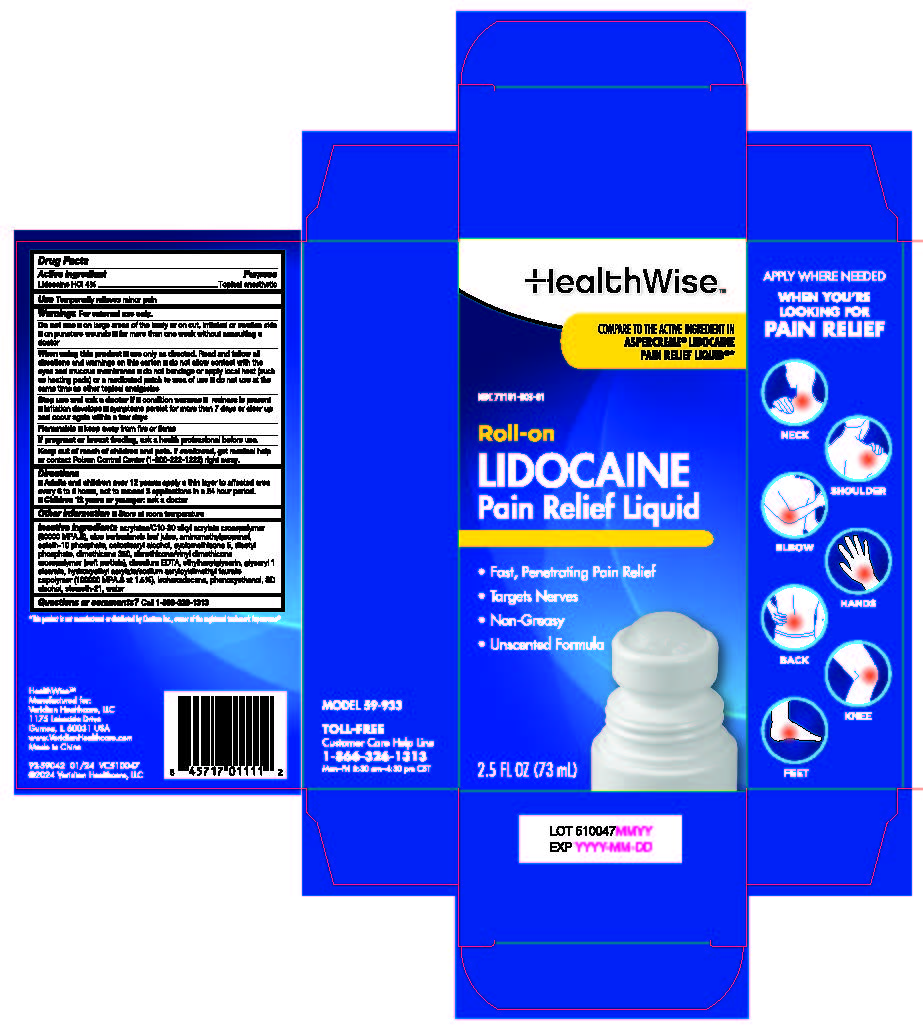
HealthWise Roll-On Lidocaine Pain Relief Liquid Lidocaine HCI 4 g/mL Liquid
🆔 Identity & classification
Where does this data come from?
🏭 Manufacturer & labeler
Where does this data come from?
🩺 Clinical
- Lidocaine numbs just the area being worked on without affecting your whole body the way general anesthesia does. It blocks pain signals right at the nerve, so you stay awake and al...
- Why does my doctor use lidocaine instead of putting me fully to sleep for a procedure?
- Topical lidocaine products are meant for intact minor skin injuries — things like small burns, scrapes, insect bites, or skin irritations. You should only apply them to the area de...
- Can I use the over-the-counter cream or spray on any part of my body?
Patient education
Supplement & herbal interactions
Where does this data come from?
Ask a licensed pharmacist directly — free, answered by our team.
🧪 Inactive Ingredients / Excipients
Inactive ingredients, also called excipients, are components of the drug product other than the active ingredient. They may include fillers, dyes, coatings, preservatives, flavors, or other formulation ingredients.
💡 Tap an ingredient (hover on desktop) to see what it is and why it’s used.
-
UNII 8Z5ZAL5H3V
A synthetic polymer made from acrylate compounds. It acts as a thickener and stabilizer in topical formulations, helping create the right texture and prevent separation of ingredients.
-
UNII 3K9958V90M
A liquid solvent derived from fermentation or chemical synthesis. In medicines, alcohol dissolves active ingredients, helps preserve the product, and improves how the body absorbs certain drugs.
-
UNII ZY81Z83H0X
Aloe vera leaf is a plant extract derived from the aloe plant. It is used in medicines as a natural moisturizer and skin-soothing agent in topical formulations.
-
UNII LU49E6626Q
A synthetic organic compound used as a pH buffer and neutralizing agent in medicines. It helps maintain the proper acidity level in liquid formulations to improve stability and comfort.
-
UNII 4E05O5N49G
Ceteth-10 phosphate is a synthetic ingredient made by combining a fatty alcohol with phosphate groups. It works as an emulsifier and surfactant to help mix oil and water in liquid formulations.
-
UNII 2DMT128M1S
A waxy solid derived from plant or animal sources. It acts as an emulsifier to blend oil and water components, and also thickens the medicine to give it the right texture and consistency.
-
UNII 0THT5PCI0R
A silicone-based liquid that helps distribute active ingredients evenly throughout topical products. It acts as a solvent and emollient, allowing medicines to spread smoothly on skin while improving texture and absorption.
-
UNII 2V6E5WN99N
A lipid compound made from fatty acids, used as an emulsifier and stabilizer in medicines to help mix oil and water-based ingredients and keep them from separating.
-
UNII 2Y53S6ATLU
Dimethicone 350 is a silicone-based oil. It works as a lubricant and anti-foaming agent to help the medicine flow smoothly during manufacturing and reduce unwanted bubbles in the final product.
-
UNII 9E4CO0W6C5
A silicone-based polymer that forms soft, spongy particles. Used as a texture modifier and suspending agent to improve how the product feels and flows, and to help keep ingredients evenly distributed throughout the formulation.
-
UNII 8NLQ36F6MM
Edetate disodium anhydrous is a chemical compound that binds to metal ions in a medicine. It's used as a stabilizer to prevent unwanted chemical reactions and help keep the drug product effective during storage.
-
UNII 147D247K3P
Ethylhexylglycerin is a synthetic preservative used to prevent bacteria and mold from growing in medicines and personal care products. It helps keep the product safe and stable throughout its shelf life.
-
UNII 258491E1RZ
A waxy substance made from glycerin and stearic acid, commonly used as an emulsifier to help blend oil and water ingredients together in medicines. It also helps thicken and stabilize the product's texture.
-
UNII 86FQE96TZ4
A synthetic polymer, this ingredient acts as a thickener and suspending agent in liquid formulations. It helps maintain uniform consistency and keeps particles evenly distributed throughout the medicine.
-
UNII 918X1OUF1E
Isohexadecane is a synthetic hydrocarbon oil used as an emollient and solvent in topical medicines. It helps dissolve active ingredients and improves spreadability and absorption through the skin.
-
UNII ZBP1YXW0H8
A fragrant oil extracted from lavender plants, used as a flavoring and scent agent in medicines to improve taste and aroma.
-
UNII HIE492ZZ3T
Phenoxyethanol is a synthetic preservative and antimicrobial agent used to prevent bacterial and fungal growth in medicines and cosmetic products, extending shelf life and maintaining product safety.
-
UNII 53J3F32P58
A synthetic detergent derived from stearic acid, a fatty substance. It helps dissolve or distribute oil-based ingredients evenly throughout the medicine, acting as an emulsifier and solubilizer in tablets and capsules.
-
UNII 059QF0KO0R
Water is a liquid solvent that dissolves and mixes ingredients together in liquid medicines, syrups, and injections. It helps distribute the active drug evenly throughout the product.
19 inactive ingredients listed in the exact product block matched to this NDC.
Label-section wording can be broader than the structured product block and may mention additional formulation ingredients.
Where does this data come from?
ingredient classCode="IACT" elements from the exact product block matched by this NDC. Label-section narrative from DailyMed / the openFDA label index is shown separately when available.Inactive ingredient FAQ
Are inactive ingredients the same for every manufacturer?
Why might an inactive ingredient be missing?
Can inactive ingredients matter?
💲 Pricing
A drug doesn't have one price. Each row is a different public payment system, and none is what you'd pay at the counter — that depends on your insurance. The ⓘ on each row explains what it measures.
| Price system | Per mL | Per package |
|---|---|---|
| Retail pharmacies payNADAC · weekly | Not in the retail survey — common for institutional, discontinued, or low-volume packs. | |
| Medicaid paysCMS SDUD · 12 mo | No recent Medicaid claims on file for this NDC — rare and low-volume NDCs are suppressed in the public data. | |
| Medicare drug plans payPart D · quarterly | No Part D plan price is available for this NDC in our data. | |
Where does this data come from?
🔁 Therapeutic equivalents
| Product | Labeler | Pack | NADAC/unit | TE | Status | Price vs. this |
|---|---|---|---|---|---|---|
| HealthWise Roll-On Lidocaine Pain Relief Liquid 4 g/mLthis 71101-0003-01 | Veridian | 1 bottle | — | — | FDA listed | — |
| HealthWise Roll-On Lidocaine Pain Relief Liquid Lavender Scent 4 g/mL 71101-0029-01 | Veridian | 1 bottle | — | — | FDA listed | — |
| TheraCare Roll-on Lidocaine Pain Relief Liquid 4 g/mL 71101-0087-01 | Veridian | 1 bottle | — | — | FDA listed | — |
| TheraCare Roll-on Lidocaine Pain Relief Liquid - Lavender 4 g/mL 71101-0088-01 | Veridian | 1 bottle | — | — | FDA listed | — |
Where does this data come from?
⏳ Availability & generic status
We did not find an FDA-approved generic match for this exact strength, form and route.
Where does this data come from?
🔬 Reported adverse events (FAERS)
Top reported reactions
Reporter sex
Serious outcomes
Where does this data come from?
📦 Packaging — all sizes for this product
| Package NDC | Description | Marketing start | Status |
|---|---|---|---|
| 71101-0003-01 You're viewing this | 1 BOTTLE, WITH APPLICATOR in 1 CARTON (71101-003-01) / 73 mL in 1 BOTTLE, WITH APPLICATOR | 2024-02-01 | Active |
🧭 About this NDC listing & data coverage
What data is (and isn’t) available for this NDC — tap to expand
| NDC identity (package / product / labeler codes) | ✓ Available |
| Labeler | ✓ Available |
| Product & package description | ✓ Available |
| Marketing category & status | ✓ Available |
| Active ingredient / dosage form / route | ✓ Available |
| FDA label (SPL via DailyMed) | ✓ Available |
| Package photos | ✓ Available |
| Inactive ingredients (structured) | ✓ Available |
| NADAC pharmacy acquisition price (CMS) | — Not published for this NDC CMS publishes NADAC only for NDCs reported in its retail-pharmacy survey. |
| Orange Book / therapeutic-equivalence data | — Not published for this NDC Applies only to products approved under an NDA/ANDA; many listings are out of scope. |
| HCPCS J-code billing crosswalk | — Not published for this NDC Most self-administered / retail products have no J-code — that is normal. |
| Medicaid utilization (CMS SDUD) | — Not published for this NDC CMS reports utilization only for NDCs with Medicaid claims above its privacy threshold. |
Questions about this listing
Is this NDC FDA-approved?
Why is there no price listed?
Is the NDC printed on the package the same as the 11-digit billing NDC?
What do the three segments of this NDC mean?
Is this package still being marketed?
Who lists this product with the FDA?
Do I need a prescription for this product?
Where does this data come from?
📄 FDA label — Drug Facts FDA SPL
🎯 Indications and Usage ▾
Uses temporarily relieves minor pain
⏱️ Dosage and Administration ▾
Directions adults and children over 12 years: apply a thin layer to affected area every 6 to 8 hours, not to exceed 3 applications in a 24-hour period children 12 years or younger: ask a doctor
⚠️ Warnings ▾
Warnings For external use only When using this product use only as directed. Read and follow all directions and warnings on this carton. do not allow contact with the eyes and mucus membranes do not bandage tightly or apply local heat (such as heating pads) or a medicated patch to the area of use do not use at the same time as other topical analgesics Stop use and ask a doctor if condition worsens redness is present irritation develops symptoms persist for more than 7 days or clear up and occur again within a few days Flammable ■ Keep away from fire or flame If pregnant or breast-feeding, ask a health professional before use.
Keep out of reach of children. If swallowed, get medical help or contact a Poison Control Center (1-800-222-1222) right away.
🧪 Active Ingredient ▾
Active ingredient Lidocaine 4%
🧪 Inactive Ingredients ▾
Inactive ingredients Inactive ingredients acrylates/C10-30 alkyl acrylate crosspolymer (60000 MPA.S), aloe barbadensis leaf juice, aminomethylpropanol, ceteth-10 phosphate, cetostearyl alcohol, cyclomethicone 5, dicetyl phosphate, dimethicone 350, dimethicone/vinyl dimethicone crosspolymer (soft particle), disodium EDTA, ethylhexylglycerin, glyceryl 1 stearate, hydroxyethyl acrylate/sodium acryloyldimethyl taurate copolymer (100000 MPA.S at 1.5%), isohexadecane, phenoxyethanol, SD alcohol, steareth-21, water
🎯 Purpose ▾
Purpose Topical analgesic