
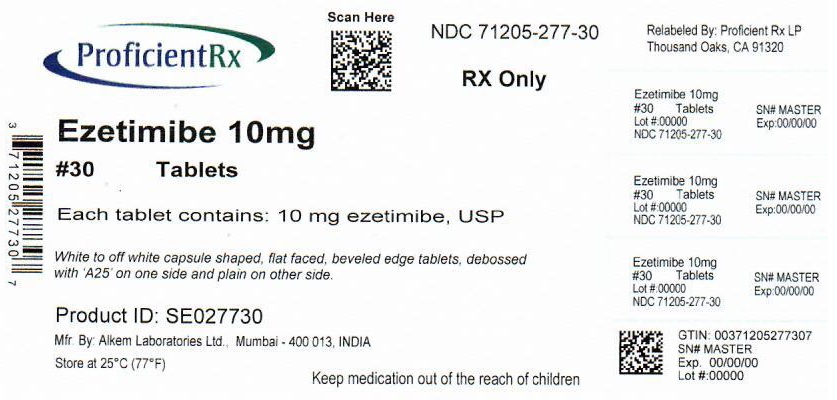
Ezetimibe 10 mg Tablet, 90-count — NDC 71205-277-90 (Billing 71205-0277-90)
This is a package of 90 tablets of Ezetimibe 10 mg Tablet from Proficient Rx LP, marketed since Dec 2017 and currently FDA-listed.
Identity & classification
Regulatory identifiers FDA, NLM and CMS codes for this package
Drug-database identifiers Medi-Span GPI and First Databank GCN / HICL / AHFS classification
- GSN (GCN sequence number): 051214
- GCN: 18387
- GPI-14 (Medi-Span): 39300030000320
- HICL (First Databank): 024459
- AHFS class code: 24:06.05.00
- RxCUI (RxNorm): 349556
Where does this data come from?
- FDA openFDA NDC Directory · synced Oct 1, 2026
- FDA label on DailyMed · label index refreshed Oct 1, 2026
- RxNorm (NLM RxNav) · catalog refreshed Oct 1, 2026
- Medi-Span GPI (licensed)
- First Databank (licensed) · refreshed Oct 1, 2026
RxNorm drug class
This medicine belongs to the Dietary Cholesterol Absorption Inhibitor class.
Where does this data come from?
- RxClass (NLM) · catalog refreshed Oct 1, 2026
Clinical
- Great question. Ezetimibe works in your intestine — it blocks a protein that absorbs cholesterol from your food and bile, so less cholesterol gets into your bloodstream. Statins, o...
- What exactly does ezetimibe do, and how is it different from a statin?
- You can take it at whatever time of day works best for you — morning, evening, whatever you'll remember. Food doesn't affect how well it's absorbed, so with or without a meal is fi...
- Can I take ezetimibe at any time of day, and does it matter if I eat first?
Patient education
Supplement & herbal interactions
Some supplements/herbs that may interact with Ezetimibe — tap one for details:
Where does this data come from?
- MedlinePlus (NLM) · refreshed Oct 1, 2026
- FDA label on DailyMed · label index refreshed Oct 1, 2026
Ask a licensed pharmacist directly — free, answered by our team.
Pricing
A drug doesn't have one price. Each row is a different public payment system, and none is what you'd pay at the counter — that depends on your insurance. The ⓘ on each row explains what it measures.
| Price system | Per each | Per package |
|---|---|---|
| Retail pharmacies payNADAC · weekly | Not in the retail survey — common for institutional, discontinued, or low-volume packs. | |
| Medicaid paysCMS SDUD · 12 mo | No recent Medicaid claims on file for this NDC — rare and low-volume NDCs are suppressed in the public data. | |
| Medicare drug plans payPart D · Q2 2026 | $0.2167 | $19.50 / 90 tablets |
Where does this data come from?
- CMS NADAC weekly file
- CMS ASP pricing files · refreshed Sep 20, 2026
- CMS Medicaid State Drug Utilization Data · refreshed Oct 2, 2026
- CMS Part D plan pricing files · refreshed Sep 24, 2026
- VA National Acquisition Center price file
Packaging — all sizes for this product
| Package NDC | Description | Marketing start | Marketing end | Status |
|---|---|---|---|---|
| 71205-0277-30 71205-277-30 Main listing | 30 TABLET in 1 BOTTLE | 2019-05-01 | — | Active |
| 71205-0277-60 71205-277-60 | 60 TABLET in 1 BOTTLE | 2019-05-01 | — | Active |
| 71205-0277-90 You're viewing this | 90 TABLET in 1 BOTTLE | 2019-05-01 | — | Active |
You're viewing the largest of 3 pack sizes for this product.
Pack size FAQ
What quantity is in this package?
How does this package differ from NDC 71205-0277-30?
What NDC number is used to bill for this package of Ezetimibe 10 mg Tablet?
Therapeutic equivalents
| Product | Labeler | Pack | NADAC/unit | TE | Status | Price vs. this |
|---|---|---|---|---|---|---|
| Ezetimibe 10 mg 00904-7103-04 | Major | 30 tablets | $0.067 | AB | Availability likely | — |
| Ezetimibe 10 mg 16714-0813-01 | NorthStar | 30 tablets | $0.067 | AB | Availability likely | — |
| Ezetimibe 10 mg 50228-0379-05 | ScieGen | 500 tablets | $0.067 | AB | Availability likely | — |
| Ezetimibe 10 mg 50268-0298-12 | AvPAK | 20 tablets | $0.067 | AB | Availability likely | — |
| Ezetimibe 10 mg 51660-0200-05 | Ohm | 500 tablets | $0.067 | AB | Availability likely | — |
| Ezetimibe 10 mg 59651-0052-05 | Aurobindo | 500 tablets | $0.067 | AB | Availability likely | — |
| Ezetimibe 10 mg 60687-0373-21 | American | 30 tablets | $0.067 | AB | Availability likely | — |
| Ezetimibe 10 mg 68462-0226-05 | Glenmark | 500 tablets | $0.067 | AB | Availability likely | — |
| ezetimibe 10 mg 82009-0024-05 | Quallent | 500 tablets | $0.067 | AB | Availability likely | — |
| Ezetimibe 10 mg 00591-3713-05 | Actavis | 500 tablets | $0.067 | AB | Discontinued | — |
| Ezetimibe 10 mg 16729-0433-10 | Accord | 30 tablets | $0.071 | AB | Availability likely | — |
| Ezetimibe 10 mg 00781-5690-05 | Sandoz | 500 tablets | $0.084 | AB | Discontinued | — |
| Zetia 10 mg 78206-0178-01 | Organon | 30 tablets | $13.937 | AB | Availability likely | — |
| Ezetimibe 10 mg 10135-0787-05 | Marlex | 500 tablets | — | AB | FDA listed | — |
| Ezetimibe 10 mg 31722-0628-01 | Camber | 100 tablets | — | AB | FDA listed | — |
| Ezetimibe 10 mg 33342-0373-07 | Macleods | 30 tablets | — | — | FDA listed | — |
| Ezetimibe 10 mg 50090-3422-00 | A-S | 30 tablets | — | AB | FDA listed | — |
| Ezetimibe 10 mg 50090-3657-00 | A-S | 30 tablets | — | AB | FDA listed | — |
| Ezetimibe 10 mg 50090-6630-00 | A-S | 30 tablets | — | AB | FDA listed | — |
| Ezetimibe 10 mg 50090-6631-00 | A-S | 90 tablets | — | AB | FDA listed | — |
| Ezetimibe 10 mg 50090-7099-00 | A-S | 90 tablets | — | AB | FDA listed | — |
| Ezetimibe 10 mg 50090-7236-00 | A-S | 90 tablets | — | AB | FDA listed | — |
| Ezetimibe 10 mg 50090-7338-00 | A-S | 90 tablets | — | AB | FDA listed | — |
| Ezetimibe 10 mg 50090-7339-00 | A-S | 30 tablets | — | AB | FDA listed | — |
| Ezetimibe 10 mg 50090-7689-00 | A-S | 90 tablets | — | AB | FDA listed | — |
| Ezetimibe 10 mg 50090-7690-00 | A-S | 30 tablets | — | AB | FDA listed | — |
| Ezetimibe 10 mg 60429-0982-05 | Golden | 500 tablets | — | AB | FDA listed | — |
| Ezetimibe 10 mg 63629-7413-01 | Bryant | 30 tablets | — | AB | FDA listed | — |
| Ezetimibe 10 mg 67877-0490-01 | Ascend | 100 tablets | — | AB | FDA listed | — |
| ezetimibe 10 mg 68382-0773-01 | Zydus | 100 tablets | — | AB | FDA listed | — |
| Ezetimibe 10 mg 69238-1154-01 | Amneal | 1000 tablets | — | AB | FDA listed | — |
| ezetimibe 10 mg 70771-1109-00 | Zydus | 1000 tablets | — | AB | FDA listed | — |
| Ezetimibe 10 mg 71205-0145-30 | Proficient | 30 tablets | — | AB | FDA listed | — |
| Ezetimibe 10 mgthis 71205-0277-90 | Proficient | 90 tablets | — | AB | FDA listed | — |
| Ezetimibe 10 mg 71335-0684-01 | Bryant | 30 tablets | — | AB | FDA listed | — |
| Ezetimibe 10 mg 71335-0933-01 | Bryant | 30 tablets | — | AB | FDA listed | — |
| Ezetimibe 10 mg 71335-1127-01 | Bryant | 30 tablets | — | AB | FDA listed | — |
| Ezetimibe 10 mg 71335-2123-01 | Bryant | 30 tablets | — | AB | FDA listed | — |
| Ezetimibe 10 mg 71335-3092-01 | Bryant | 30 tablets | — | AB | FDA listed | — |
| Ezetimibe 10 mg 76333-0170-15 | Orient | 30 tablets | — | AB | FDA listed | — |
| Ezetimibe 10 mg 82804-0064-30 | Proficient | 30 tablets | — | AB | FDA listed | — |
| Ezetimibe 10 mg 82804-0211-30 | Proficient | 30 tablets | — | AB | FDA listed | — |
| ezetimibe 10 mg 48433-0161-03 | Safecor | 30 tablets | — | AB | FDA listed | — |
Where does this data come from?
- FDA openFDA NDC Directory · synced Oct 1, 2026
- FDA Orange Book · refreshed Sep 3, 2026
- CMS NADAC weekly file
Availability & generic status
This product is an FDA-approved generic. Other versions of the same drug are listed under Therapeutic equivalents, least expensive first.
Where does this data come from?
- FDA Orange Book · refreshed Sep 3, 2026
What it looks like
Where does this data come from?
- FDA label on DailyMed · label index refreshed Oct 1, 2026
Inactive Ingredients / Excipients
Inactive ingredients, also called excipients, are components of the drug product other than the active ingredient. They may include fillers, dyes, coatings, preservatives, flavors, or other formulation ingredients.
Where does this data come from?
IACT rows and label-wide narrative are kept separate; availability and product-level specificity depend on the submitted label.- FDA label on DailyMed · label index refreshed Oct 1, 2026
- FDA openFDA NDC Directory · synced Oct 1, 2026
Inactive ingredient FAQ
Are inactive ingredients the same for every manufacturer?
Why might an inactive ingredient be missing?
Can inactive ingredients matter?
Manufacturer & labeler
Where does this data come from?
- FDA openFDA NDC Directory · synced Oct 1, 2026
- Drugs@FDA
Full prescribing information FDA SPL
🎯 Indications and Usage ▾
1 INDICATIONS & USAGE Therapy with lipid-altering agents should be only one component of multiple risk factor intervention in individuals at significantly increased risk for atherosclerotic vascular disease due to hypercholesterolemia. Drug therapy is indicated as an adjunct to diet when the response to a diet restricted in saturated fat and cholesterol and other nonpharmacologic measures alone has been inadequate. Ezetimibe Tablet is an inhibitor of intestinal cholesterol (and related phytosterol) absorption indicated as an adjunct to diet to: • Reduce elevated total-C, LDL-C, Apo B, and non-HDL-C in patients with primary hyperlipidemia, alone or in combination with an HMG-CoA reductase inhibitor (statin) (1.1) • Reduce elevated total-C, LDL-C, Apo B, and non-HDL-C in patients with mixed hyperlipidemia in combination with fenofibrate (1.1) • Reduce elevated total-C and LDL-C in patients with homozygous familial hypercholesterolemia (HoFH), in combination with atorvastatin or simvastatin (1.2) • Reduce elevated sitosterol and campesterol in patients with homozygous sitosterolemia (phytosterolemia) (1.3) Limitations of Use ( 1.4 ) • The effect of Ezetimibe Tablets on cardiovascular morbidity and mortality has not been determined. • Ezetimibe Tablets has not been studied in Fredrickson Type I, III, IV, and V dyslipidemias.
1.1Primary Hyperlipidemia Monotherapy Ezetimibe Tablets, administered alone, is indicated as adjunctive therapy to diet for the reduction of elevated total cholesterol (total-C), low-density lipoprotein cholesterol (LDL-C), apolipoprotein B (Apo B), and non-high-density lipoprotein cholesterol (non-HDL-C) in patients with primary (heterozygous familial and non-familial) hyperlipidemia. Combination Therapy with HMG-CoA Reductase Inhibitors (Statins) Ezetimibe Tablets, administered in combination with a 3-hydroxy-3-methylglutaryl-coenzyme A (HMG-CoA) reductase inhibitor (statin), is indicated as adjunctive therapy to diet for the reduction of elevated total-C, LDL-C, Apo B, and non-HDL-C in patients with primary (heterozygous familial and non-familial) hyperlipidemia.
Combination Therapy with Fenofibrate Ezetimibe Tablets, administered in combination with fenofibrate, is indicated as adjunctive therapy to diet for the reduction of elevated total-C, LDL-C, Apo B, and non-HDL-C in adult patients with mixed hyperlipidemia.
1.2Homozygous Familial Hypercholesterolemia (HoFH) The combination of Ezetimibe Tablets and atorvastatin or simvastatin is indicated for the reduction of elevated total-C and LDL-C levels in patients with HoFH, as an adjunct to other lipid-lowering treatments (e.g., LDL apheresis) or if such treatments are unavailable.
1.3Homozygous Sitosterolemia Ezetimibe Tablet is indicated as adjunctive therapy to diet for the reduction of elevated sitosterol and campesterol levels in patients with homozygous familial sitosterolemia.
1.4Limitations of Use The effect of Ezetimibe Tablets on cardiovascular morbidity and mortality has not been determined. Ezetimibe Tablets has not been studied in Fredrickson Type I, III, IV, and V dyslipidemias.
⏱️ Dosage and Administration ▾
2 DOSAGE & ADMINISTRATION • One 10-mg tablet once daily, with or without food ( 2.1 ) • Dosing of Ezetimibe Tablets should occur either ≥2 hours before or ≥4 hours after administration of a bile acid sequestrant. ( 2.3 , 7.4 )
2.1General Dosing Information The recommended dose of Ezetimibe Tablets is 10 mg once daily. Ezetimibe Tablets can be administered with or without food.
2.2Concomitant Lipid-Lowering Therapy Ezetimibe Tablets may be administered with a statin (in patients with primary hyperlipidemia) or with fenofibrate (in patients with mixed hyperlipidemia) for incremental effect. For convenience, the daily dose of Ezetimibe Tablets may be taken at the same time as the statin or fenofibrate, according to the dosing recommendations for the respective medications.
2.3Co-Administration with Bile Acid Sequestrants Dosing of Ezetimibe Tablets should occur either ≥2 hours before or ≥4 hours after administration of a bile acid sequestrant [see Drug Interactions ( 7.4 )] .
2.4Patients with Hepatic Impairment No dosage adjustment is necessary in patients with mild hepatic impairment [see Warnings and Precautions ( 5.4 )].
2.5Patients with Renal Impairment No dosage adjustment is necessary in patients with renal impairment [see Clinical Pharmacology ( 12.3 )]. When given with simvastatin in patients with moderate to severe renal impairment (estimated glomerular filtration rate <60 mL/min/1.73 m 2 ), doses of simvastatin exceeding 20 mg should be used with caution and close monitoring [see Use in Specific Populations ( 8.6 )].
2.6Geriatric Patients No dosage adjustment is necessary in geriatric patients [see Clinical Pharmacology ( 12.3 )].
💊 Dosage Forms and Strengths ▾
3 DOSAGE FORMS & STRENGTHS 10-mg tablets are white to off white capsule shaped, flat faced, beveled edge tablets, debossed with “A25ˮ on one side and plain on other side. • Tablets: 10 mg ( 3 )
⛔ Contraindications ▾
4 CONTRAINDICATIONS Ezetimibe Tablet is contraindicated in the following conditions: • The combination of Ezetimibe Tablets with a statin is contraindicated in patients with active liver disease or unexplained persistent elevations in hepatic transaminase levels. • Women who are pregnant or may become pregnant. Because statins decrease cholesterol synthesis and possibly the synthesis of other biologically active substances derived from cholesterol, Ezetimibe Tablets in combination with a statin may cause fetal harm when administered to pregnant women.
Additionally, there is no apparent benefit to therapy during pregnancy, and safety in pregnant women has not been established. If the patient becomes pregnant while taking this drug, the patient should be apprised of the potential hazard to the fetus and the lack of known clinical benefit with continued use during pregnancy. [See Use in Specific Populations ( 8.1 ).] • Nursing mothers. Because statins may pass into breast milk, and because statins have the potential to cause serious adverse reactions in nursing infants, women who require Ezetimibe Tablets treatment in combination with a statin should be advised not to nurse their infants [see Use in Specific Populations ( 8.3 )]. • Patients with a known hypersensitivity to any component of this product.
Hypersensitivity reactions including anaphylaxis, angioedema, rash and urticaria have been reported with Ezetimibe Tablets [see Adverse Reactions ( 6.2 )] . • Statin contraindications apply when Ezetimibe Tablet is used with a statin: • Active liver disease, which may include unexplained persistent elevations in hepatic transaminase levels ( 4 , 5.2 ) • Women who are pregnant or may become pregnant ( 4 , 8.1 ) • Nursing mothers ( 4 , 8.3 ) • Known hypersensitivity to product components ( 4 , 6.2 )
⚠️ Warnings and Cautions ▾
5 WARNINGS AND PRECAUTIONS • Ezetimibe Tablet is not recommended in patients with moderate or severe hepatic impairment. ( 5.4 , 8.7 , 12.3 ) • Liver enzyme abnormalities and monitoring: Persistent elevations in hepatic transaminase can occur when Ezetimibe Tablet is added to a statin. Therefore, when Ezetimibe Tablet is added to statin therapy, monitor hepatic transaminase levels before and during treatment according to the recommendations for the individual statin used.
( 5.2 ) • Skeletal muscle effects (e.g., myopathy and rhabdomyolysis): • Cases of myopathy and rhabdomyolysis have been reported in patients treated with Ezetimibe Tablets co-administered with a statin and with Ezetimibe Tablets administered alone. Risk for skeletal muscle toxicity increases with higher doses of statin, advanced age (>65), hypothyroidism, renal impairment, and depending on the statin used, concomitant use of other drugs. ( 5.3 , 6.2 )
5.1Use with Statins or Fenofibrate Concurrent administration of Ezetimibe Tablets with a specific statin or fenofibrate should be in accordance with the product labeling for that medication.
5.2Liver Enzymes In controlled clinical monotherapy studies, the incidence of consecutive elevations (≥3 x the upper limit of normal [ULN]) in hepatic transaminase levels was similar between Ezetimibe Tablets (0.5%) and placebo (0.3%). In controlled clinical combination studies of Ezetimibe Tablets initiated concurrently with a statin, the incidence of consecutive elevations (≥3 x ULN) in hepatic transaminase levels was 1.3% for patients treated with Ezetimibe Tablets administered with statins and 0.4% for patients treated with statins alone.
These elevations in transaminases were generally asymptomatic, not associated with cholestasis, and returned to baseline after discontinuation of therapy or with continued treatment. When Ezetimibe Tablet is co-administered with a statin, liver tests should be performed at initiation of therapy and according to the recommendations of the statin. Should an increase in ALT or AST ≥3 x ULN persist, consider withdrawal of Ezetimibe Tablets and/or the statin.
5.3Myopathy/Rhabdomyolysis In clinical trials, there was no excess of myopathy or rhabdomyolysis associated with Ezetimibe Tablets compared with the relevant control arm (placebo or statin alone). However, myopathy and rhabdomyolysis are known adverse reactions to statins and other lipid-lowering drugs. In clinical trials, the incidence of creatine phosphokinase (CPK) >10 x ULN was 0.2% for Ezetimibe Tablets vs.
0.1% for placebo, and 0.1% for Ezetimibe Tablets co-administered with a statin vs. 0.4% for statins alone. Risk for skeletal muscle toxicity increases with higher doses of statin, advanced age (>65), hypothyroidism, renal impairment, and depending on the statin used, concomitant use of other drugs.
In post-marketing experience with Ezetimibe Tablets, cases of myopathy and rhabdomyolysis have been reported. Most patients who developed rhabdomyolysis were taking a statin prior to initiating Ezetimibe Tablets. However, rhabdomyolysis has been reported with Ezetimibe Tablets monotherapy and with the addition of Ezetimibe Tablets to agents known to be associated with increased risk of rhabdomyolysis, such as fibrates.
Ezetimibe Tablets and any statin or fibrate that the patient is taking concomitantly should be immediately discontinued if myopathy is diagnosed or suspected. The presence of muscle symptoms and a CPK level >10 x the ULN indicates myopathy.
5.4Hepatic Impairment Due to the unknown effects of the increased exposure to ezetimibe in patients with moderate to severe hepatic impairment, Ezetimibe Tablet is not recommended in these patients. [See Clinical Pharmacology ( 12.3 ).]
🤒 Adverse Reactions ▾
6 ADVERSE REACTIONS The following serious adverse reactions are discussed in greater detail in other sections of the label: • Liver enzyme abnormalities [see Warnings and Precautions ( 5.2 )] • Rhabdomyolysis and myopathy [see Warnings and Precautions ( 5.3 )] Monotherapy Studies: In the Ezetimibe Tablets controlled clinical trials database (placebo-controlled) of 2396 patients with a median treatment duration of 12 weeks (range 0 to 39 weeks), 3.3% of patients on Ezetimibe Tablets and 2.9% of patients on placebo discontinued due to adverse reactions.
The most common adverse reactions in the group of patients treated with Ezetimibe Tablets that led to treatment discontinuation and occurred at a rate greater than placebo were: • Arthralgia (0.3%) • Dizziness (0.2%) • Gamma-glutamyltransferase increased (0.2%) The most commonly reported adverse reactions (incidence ≥2% and greater than placebo) in the Ezetimibe Tablets monotherapy controlled clinical trial database of 2396 patients were: upper respiratory tract infection (4.3%), diarrhea (4.1%), arthralgia (3.0%), sinusitis (2.8%), and pain in extremity (2.7%).
Statin Co-Administration Studies: In the Ezetimibe Tablets + statin controlled clinical trials database of 11,308 patients with a median treatment duration of 8 weeks (range 0 to 112 weeks), 4.0% of patients on Ezetimibe Tablets + statin and 3.3% of patients on statin alone discontinued due to adverse reactions. The most common adverse reactions in the group of patients treated with Ezetimibe Tablets + statin that led to treatment discontinuation and occurred at a rate greater than statin alone were: • Alanine aminotransferase increased (0.6%) • Myalgia (0.5%) • Fatigue, aspartate aminotransferase increased, headache, and pain in extremity (each at 0.2%) The most commonly reported adverse reactions (incidence ≥2% and greater than statin alone) in the Ezetimibe Tablets + statin controlled clinical trial database of 11,308 patients were: nasopharyngitis (3.7%), myalgia (3.2%), upper respiratory tract infection (2.9%), arthralgia (2.6%) and diarrhea (2.5%). • Common adverse reactions in clinical trials: • Ezetimibe Tablets co-administered with a statin (incidence ≥2% and greater than statin alone): • nasopharyngitis, myalgia, upper respiratory tract infection, arthralgia, and diarrhea ( 6 ) • Ezetimibe Tablets administered alone (incidence ≥2% and greater than placebo): • Upper respiratory tract infection, diarrhea, arthralgia, sinusitis, and pain in extremity ( 6 ) To report SUSPECTED ADVERSE REACTIONS, contact Ascend Laboratories, LLC at 1-877-ASC-RX01 (877-272-7901) or FDA at 1-800-FDA-1088 or www.fda.gov/medwatch.
6.1Clinical Trials Experience Because clinical studies are conducted under widely varying conditions, adverse reaction rates observed in the clinical studies of a drug cannot be directly compared to rates in the clinical studies of another drug and may not reflect the rates observed in clinical practice. Monotherapy In 10 double-blind, placebo-controlled clinical trials, 2396 patients with primary hyperlipidemia (age range 9 to 86 years, 50% women, 90% Caucasians, 5% Blacks, 3% Hispanics, 2% Asians) and elevated LDL-C were treated with Ezetimibe Tablets 10 mg/day for a median treatment duration of 12 weeks (range 0 to 39 weeks).
Adverse reactions reported in ≥2% of patients treated with Ezetimibe Tablets and at an incidence greater than placebo in placebo-controlled studies of Ezetimibe Tablets, regardless of causality assessment, are shown in Table 1. TABLE 1: Clinical Adverse Reactions Occurring in ≥ 2% of Patients Treated with Ezetimibe Tablets and at an Incidence Greater than Placebo, Regardless of Causality Body System/Organ Class Adverse Reaction Ezetimibe Tablets 10 mg (%) n = 2396 Placebo (%) n = 1159 Gastrointestinal disorders Diarrhea 4.1
3.7General disorders and administration site conditions Fatigue 2.4
1.5Infections and infestations Influenza 2.0
1.5Sinusitis 2.8
2.2 Upper respiratory tract inf…
🔄 Drug Interactions ▾
7 DRUG INTERACTIONS [See Clinical Pharmacology ( 12.3 ).] Cyclosporine: Combination increases exposure of Ezetimibe Tablets and cyclosporine. Cyclosporine concentrations should be monitored in patients taking Ezetimibe Tablets concomitantly. ( 7.1 , 12.3 ) Fenofibrate: Combination increases exposure of Ezetimibe Tablets.
If cholelithiasis is suspected in a patient receiving Ezetimibe Tablets and fenofibrate, gallbladder studies are indicated and alternative lipid-lowering therapy should be considered. ( 6.1 , 7.3 ) Fibrates: Co-administration of Ezetimibe Tablets with fibrates other than fenofibrate is not recommended until use in patients is adequately studied. ( 7.2 ) Cholestyramine: Combination decreases exposure of Ezetimibe Tablets.
( 2.3 , 7.4 , 12.3 )
7.1Cyclosporine Caution should be exercised when using Ezetimibe Tablets and cyclosporine concomitantly due to increased exposure to both ezetimibe and cyclosporine. Cyclosporine concentrations should be monitored in patients receiving Ezetimibe Tablets and cyclosporine. The degree of increase in ezetimibe exposure may be greater in patients with severe renal insufficiency.
In patients treated with cyclosporine, the potential effects of the increased exposure to ezetimibe from concomitant use should be carefully weighed against the benefits of alterations in lipid levels provided by ezetimibe.
7.2Fibrates The efficacy and safety of co-administration of ezetimibe with fibrates other than fenofibrate have not been studied. Fibrates may increase cholesterol excretion into the bile, leading to cholelithiasis. In a preclinical study in dogs, ezetimibe increased cholesterol in the gallbladder bile [see Nonclinical Toxicology ( 13.2 )] .
Co-administration of Ezetimibe Tablets with fibrates other than fenofibrate is not recommended until use in patients is adequately studied.
7.3Fenofibrate If cholelithiasis is suspected in a patient receiving Ezetimibe Tablets and fenofibrate, gallbladder studies are indicated and alternative lipid-lowering therapy should be considered [see Adverse Reactions ( 6.1 ) and the product labeling for fenofibrate] .
7.4Cholestyramine Concomitant cholestyramine administration decreased the mean area under the curve (AUC) of total ezetimibe approximately 55%. The incremental LDL-C reduction due to adding ezetimibe to cholestyramine may be reduced by this interaction.
7.5Coumarin Anticoagulants If ezetimibe is added to warfarin, a coumarin anticoagulant, the International Normalized Ratio (INR) should be appropriately monitored.
👥 Use in Specific Populations ▾
8 USE IN SPECIFIC POPULATIONS
8.1Pregnancy Pregnancy Category C: There are no adequate and well-controlled studies of ezetimibe in pregnant women. Ezetimibe should be used during pregnancy only if the potential benefit justifies the risk to the fetus. In oral (gavage) embryo-fetal development studies of ezetimibe conducted in rats and rabbits during organogenesis, there was no evidence of embryolethal effects at the doses tested (250, 500, 1000 mg/kg/day).
In rats, increased incidences of common fetal skeletal findings (extra pair of thoracic ribs, unossified cervical vertebral centra, shortened ribs) were observed at 1000 mg/kg/day (~10 x the human exposure at 10 mg daily based on AUC 0-24hr for total ezetimibe). In rabbits treated with ezetimibe, an increased incidence of extra thoracic ribs was observed at 1000 mg/kg/day (150 x the human exposure at 10 mg daily based on AUC 0-24hr for total ezetimibe). Ezetimibe crossed the placenta when pregnant rats and rabbits were given multiple oral doses.
Multiple-dose studies of ezetimibe given in combination with statins in rats and rabbits during organogenesis result in higher ezetimibe and statin exposures. Reproductive findings occur at lower doses in combination therapy compared to monotherapy. All statins are contraindicated in pregnant and nursing women.
When Ezetimibe Tablet is administered with a statin in a woman of childbearing potential, refer to the pregnancy category and product labeling for the statin. [See Contraindications ( 4 ).]
8.3Nursing Mothers It is not known whether ezetimibe is excreted into human breast milk. In rat studies, exposure to total ezetimibe in nursing pups was up to half of that observed in maternal plasma. Because many drugs are excreted in human milk, caution should be exercised when Ezetimibe Tablet is administered to a nursing woman.
Ezetimibe Tablets should not be used in nursing mothers unless the potential benefit justifies the potential risk to the infant.
8.4Pediatric Use The effects of Ezetimibe Tablets co-administered with simvastatin (n=126) compared to simvastatin monotherapy (n=122) have been evaluated in adolescent boys and girls with heterozygous familial hypercholesterolemia (HeFH). In a multicenter, double-blind, controlled study followed by an open-label phase, 142 boys and 106 postmenarchal girls, 10 to 17 years of age (mean age 14.2 years, 43% females, 82% Caucasians, 4% Asian, 2% Blacks, 13% multi-racial) with HeFH were randomized to receive either Ezetimibe Tablets co-administered with simvastatin or simvastatin monotherapy.
Inclusion in the study required 1) a baseline LDL-C level between 160 and 400 mg/dL and 2) a medical history and clinical presentation consistent with HeFH. The mean baseline LDL-C value was 225 mg/dL (range: 161 to 351 mg/dL) in the Ezetimibe Tablets co-administered with simvastatin group compared to 219 mg/dL (range: 149 to 336 mg/dL) in the simvastatin monotherapy group. The patients received co-administered Ezetimibe Tablets and simvastatin (10 mg, 20 mg, or 40 mg) or simvastatin monotherapy (10 mg, 20 mg, or 40 mg) for 6 weeks, co-administered Ezetimibe Tablets and 40 mg simvastatin or 40 mg simvastatin monotherapy for the next 27 weeks, and open-label co-administered Ezetimibe Tablets and simvastatin (10 mg, 20 mg, or 40 mg) for 20 weeks thereafter.
The results of the study at Week 6 are summarized in Table 3. Results at Week 33 were consistent with those at Week 6. TABLE 3: Mean Percent Difference at Week 6 Between the Pooled Ezetimibe Tablets Co-Administered with Simvastatin Group and the Pooled Simvastatin Monotherapy Group in Adolescent Patients with Heterozygous Familial Hypercholesterolemia Total-C LDL-C Apo B Non-HDL-C TG* HDL-C Mean percent difference between treatment groups -12% -15% -12% -14% -2% +0.1% 95% Confidence Interval (-15%,-9%) (-18%,-12%) (-15%, -9%) (-17%, -11%) (-9%, +4%) (-3%, +3%) * For triglycerides, median % change from baseline From the start of the trial to the end…
🤰 Pregnancy ▾
8.1Pregnancy Pregnancy Category C: There are no adequate and well-controlled studies of ezetimibe in pregnant women. Ezetimibe should be used during pregnancy only if the potential benefit justifies the risk to the fetus. In oral (gavage) embryo-fetal development studies of ezetimibe conducted in rats and rabbits during organogenesis, there was no evidence of embryolethal effects at the doses tested (250, 500, 1000 mg/kg/day).
In rats, increased incidences of common fetal skeletal findings (extra pair of thoracic ribs, unossified cervical vertebral centra, shortened ribs) were observed at 1000 mg/kg/day (~10 x the human exposure at 10 mg daily based on AUC 0-24hr for total ezetimibe). In rabbits treated with ezetimibe, an increased incidence of extra thoracic ribs was observed at 1000 mg/kg/day (150 x the human exposure at 10 mg daily based on AUC 0-24hr for total ezetimibe). Ezetimibe crossed the placenta when pregnant rats and rabbits were given multiple oral doses.
Multiple-dose studies of ezetimibe given in combination with statins in rats and rabbits during organogenesis result in higher ezetimibe and statin exposures. Reproductive findings occur at lower doses in combination therapy compared to monotherapy. All statins are contraindicated in pregnant and nursing women.
When Ezetimibe Tablet is administered with a statin in a woman of childbearing potential, refer to the pregnancy category and product labeling for the statin. [See Contraindications ( 4 ).]
🧒 Pediatric Use ▾
8.4Pediatric Use The effects of Ezetimibe Tablets co-administered with simvastatin (n=126) compared to simvastatin monotherapy (n=122) have been evaluated in adolescent boys and girls with heterozygous familial hypercholesterolemia (HeFH). In a multicenter, double-blind, controlled study followed by an open-label phase, 142 boys and 106 postmenarchal girls, 10 to 17 years of age (mean age 14.2 years, 43% females, 82% Caucasians, 4% Asian, 2% Blacks, 13% multi-racial) with HeFH were randomized to receive either Ezetimibe Tablets co-administered with simvastatin or simvastatin monotherapy.
Inclusion in the study required 1) a baseline LDL-C level between 160 and 400 mg/dL and 2) a medical history and clinical presentation consistent with HeFH. The mean baseline LDL-C value was 225 mg/dL (range: 161 to 351 mg/dL) in the Ezetimibe Tablets co-administered with simvastatin group compared to 219 mg/dL (range: 149 to 336 mg/dL) in the simvastatin monotherapy group. The patients received co-administered Ezetimibe Tablets and simvastatin (10 mg, 20 mg, or 40 mg) or simvastatin monotherapy (10 mg, 20 mg, or 40 mg) for 6 weeks, co-administered Ezetimibe Tablets and 40 mg simvastatin or 40 mg simvastatin monotherapy for the next 27 weeks, and open-label co-administered Ezetimibe Tablets and simvastatin (10 mg, 20 mg, or 40 mg) for 20 weeks thereafter.
The results of the study at Week 6 are summarized in Table 3. Results at Week 33 were consistent with those at Week 6. TABLE 3: Mean Percent Difference at Week 6 Between the Pooled Ezetimibe Tablets Co-Administered with Simvastatin Group and the Pooled Simvastatin Monotherapy Group in Adolescent Patients with Heterozygous Familial Hypercholesterolemia Total-C LDL-C Apo B Non-HDL-C TG* HDL-C Mean percent difference between treatment groups -12% -15% -12% -14% -2% +0.1% 95% Confidence Interval (-15%,-9%) (-18%,-12%) (-15%, -9%) (-17%, -11%) (-9%, +4%) (-3%, +3%) * For triglycerides, median % change from baseline From the start of the trial to the end of Week 33, discontinuations due to an adverse reaction occurred in 7 (6%) patients in the Ezetimibe Tablets co-administered with simvastatin group and in 2 (2%) patients in the simvastatin monotherapy group.
During the trial, hepatic transaminase elevations (two consecutive measurements for ALT and/or AST ≥3 x ULN) occurred in four (3%) individuals in the Ezetimibe Tablets co-administered with simvastatin group and in two (2%) individuals in the simvastatin monotherapy group. Elevations of CPK (≥10 x ULN) occurred in two (2%) individuals in the Ezetimibe Tablets co-administered with simvastatin group and in zero individuals in the simvastatin monotherapy group. In this limited controlled study, there was no significant effect on growth or sexual maturation in the adolescent boys or girls, or on menstrual cycle length in girls.
Co-administration of Ezetimibe Tablets with simvastatin at doses greater than 40 mg/day has not been studied in adolescents. Also, Ezetimibe Tablets has not been studied in patients younger than 10 years of age or in pre-menarchal girls. Based on total ezetimibe (ezetimibe + ezetimibe-glucuronide), there are no pharmacokinetic differences between adolescents and adults.
Pharmacokinetic data in the pediatric population <10 years of age are not available.
🧓 Geriatric Use ▾
8.5Geriatric Use Monotherapy Studies Of the 2396 patients who received Ezetimibe Tablets in clinical studies, 669 (28%) were 65 and older, and 111 (5%) were 75 and older. Statin Co-Administration Studies Of the 11,308 patients who received Ezetimibe Tablets + statin in clinical studies, 3587 (32%) were 65 and older, and 924 (8%) were 75 and older. No overall differences in safety and effectiveness were observed between these patients and younger patients, and other reported clinical experience has not identified differences in responses between the elderly and younger patients, but greater sensitivity of some older individuals cannot be ruled out [see Clinical Pharmacology ( 12.3 )] .
🆘 Overdosage ▾
10 OVERDOSAGE In clinical studies, administration of ezetimibe, 50 mg/day to 15 healthy subjects for up to 14 days, 40 mg/day to 18 patients with primary hyperlipidemia for up to 56 days, and 40 mg/day to 27 patients with homozygous sitosterolemia for 26 weeks was generally well tolerated. One female patient with homozygous sitosterolemia took an accidental overdose of ezetimibe 120 mg/day for 28 days with no reported clinical or laboratory adverse events. In the event of an overdose, symptomatic and supportive measures should be employed.
🧬 Clinical Pharmacology ▾
12 CLINICAL PHARMACOLOGY
12.1Mechanism of Action Ezetimibe reduces blood cholesterol by inhibiting the absorption of cholesterol by the small intestine. In a 2-week clinical study in 18 hypercholesterolemic patients, Ezetimibe Tablets inhibited intestinal cholesterol absorption by 54%, compared with placebo. Ezetimibe Tablets had no clinically meaningful effect on the plasma concentrations of the fat-soluble vitamins A, D, and E (in a study of 113 patients), and did not impair adrenocortical steroid hormone production (in a study of 118 patients).
The cholesterol content of the liver is derived predominantly from three sources. The liver can synthesize cholesterol, take up cholesterol from the blood from circulating lipoproteins, or take up cholesterol absorbed by the small intestine. Intestinal cholesterol is derived primarily from cholesterol secreted in the bile and from dietary cholesterol.
Ezetimibe has a mechanism of action that differs from those of other classes of cholesterol-reducing compounds (statins, bile acid sequestrants [resins], fibric acid derivatives, and plant stanols). The molecular target of ezetimibe has been shown to be the sterol transporter, Niemann-Pick C1-Like 1 (NPC1L1), which is involved in the intestinal uptake of cholesterol and phytosterols. Ezetimibe does not inhibit cholesterol synthesis in the liver, or increase bile acid excretion.
Instead, ezetimibe localizes at the brush border of the small intestine and inhibits the absorption of cholesterol, leading to a decrease in the delivery of intestinal cholesterol to the liver. This causes a reduction of hepatic cholesterol stores and an increase in clearance of cholesterol from the blood; this distinct mechanism is complementary to that of statins and of fenofibrate [see Clinical Studies ( 14.1 )] .
12.2Pharmacodynamics Clinical studies have demonstrated that elevated levels of total-C, LDL-C and Apo B, the major protein constituent of LDL, promote human atherosclerosis. In addition, decreased levels of HDL-C are associated with the development of atherosclerosis. Epidemiologic studies have established that cardiovascular morbidity and mortality vary directly with the level of total-C and LDL-C and inversely with the level of HDL-C.
Like LDL, cholesterol-enriched triglyceride-rich lipoproteins, including very-low-density lipoproteins (VLDL), intermediate-density lipoproteins (IDL), and remnants, can also promote atherosclerosis. The independent effect of raising HDL-C or lowering TG on the risk of coronary and cardiovascular morbidity and mortality has not been determined. Ezetimibe Tablets reduces total-C, LDL-C, Apo B, non-HDL-C, and TG, and increases HDL-C in patients with hyperlipidemia.
Administration of Ezetimibe Tablets with a statin is effective in improving serum total-C, LDL-C, Apo B, non-HDL-C, TG, and HDL-C beyond either treatment alone. Administration of Ezetimibe Tablets with fenofibrate is effective in improving serum total-C, LDL-C, Apo B, and non-HDL-C in patients with mixed hyperlipidemia as compared to either treatment alone. The effects of ezetimibe given either alone or in addition to a statin or fenofibrate on cardiovascular morbidity and mortality have not been established.
12.3Pharmacokinetics Absorption After oral administration, ezetimibe is absorbed and extensively conjugated to a pharmacologically active phenolic glucuronide (ezetimibe-glucuronide). After a single 10-mg dose of Ezetimibe Tablets to fasted adults, mean ezetimibe peak plasma concentrations (Cmax) of 3.4 to 5.5 ng/mL were attained within 4 to 12 hours (Tmax).Ezetimibe-glucuronide mean Cmax values of 45 to 71 ng/mL were achieved between 1 and 2 hours (Tmax). There was no substantial deviation from dose proportionality between 5 and 20 mg.
The absolute bioavailability of ezetimibecannot be determined, as the compound is virtually insoluble in aqueous media suitable for injection. Effect of Food on Oral Absorption Concomitant food administration (high-fa…
🧬 Mechanism of Action ▾
12.1Mechanism of Action Ezetimibe reduces blood cholesterol by inhibiting the absorption of cholesterol by the small intestine. In a 2-week clinical study in 18 hypercholesterolemic patients, Ezetimibe Tablets inhibited intestinal cholesterol absorption by 54%, compared with placebo. Ezetimibe Tablets had no clinically meaningful effect on the plasma concentrations of the fat-soluble vitamins A, D, and E (in a study of 113 patients), and did not impair adrenocortical steroid hormone production (in a study of 118 patients).
The cholesterol content of the liver is derived predominantly from three sources. The liver can synthesize cholesterol, take up cholesterol from the blood from circulating lipoproteins, or take up cholesterol absorbed by the small intestine. Intestinal cholesterol is derived primarily from cholesterol secreted in the bile and from dietary cholesterol.
Ezetimibe has a mechanism of action that differs from those of other classes of cholesterol-reducing compounds (statins, bile acid sequestrants [resins], fibric acid derivatives, and plant stanols). The molecular target of ezetimibe has been shown to be the sterol transporter, Niemann-Pick C1-Like 1 (NPC1L1), which is involved in the intestinal uptake of cholesterol and phytosterols. Ezetimibe does not inhibit cholesterol synthesis in the liver, or increase bile acid excretion.
Instead, ezetimibe localizes at the brush border of the small intestine and inhibits the absorption of cholesterol, leading to a decrease in the delivery of intestinal cholesterol to the liver. This causes a reduction of hepatic cholesterol stores and an increase in clearance of cholesterol from the blood; this distinct mechanism is complementary to that of statins and of fenofibrate [see Clinical Studies ( 14.1 )] .
📦 How Supplied / Storage and Handling ▾
16 HOW SUPPLIED/STORAGE AND HANDLING Ezetimibe Tablets, USP 10 mg, are white to off white capsule shaped, flat faced, beveled edge tablets, debossed with ‘A25’ on one side and plain on other side. They are supplied as follows: NDC 71205-277-30 bottles of 30 NDC 71205-277-60 bottles of 60 NDC 71205-277-90 bottles of 90 Storage Store at 25°C (77°F); excursions permitted between 15 to 30°C (59 to 86°F). [See USP Controlled Room Temperature.] Protect from moisture.
📋 Description ▾
11 DESCRIPTION Ezetimibe, USP is in a class of lipid-lowering compounds that selectively inhibits the intestinal absorption of cholesterol and related phytosterols. The chemical name of ezetimibe, USP is 1-(4-fluorophenyl)-3(R)-[3-(4-fluorophenyl)-3(S)-hydroxypropyl]-4(S)-(4-hydroxyphenyl)-2-azetidinone. The empirical formula is C 24 H 21 F 2 NO 3 .
Its molecular weight is 409.4 and its structural formula is: Ezetimibe, USP is a white to off white, crystalline powder that is soluble in methanol. Ezetimibe, USP has a melting point of about 163°C and is stable at ambient temperature. Ezetimibe Tablet, USP is available as a tablet for oral administration containing 10 mg of ezetimibe, USP and the following inactive ingredients: lactose monohydrate, croscarmellose sodium, Hypromellose, sodium lauryl sulfate, crospovidone, microcrystaline cellulose, and magnesium stearate. ezetimibe-structure
💬 Information for Patients ▾
17 PATIENT COUNSELING INFORMATION See FDA-Approved Patient Labeling (Patient Information). Patients should be advised to adhere to their National Cholesterol Education Program (NCEP)-recommended diet, a regular exercise program, and periodic testing of a fasting lipid panel.
17.1Muscle Pain All patients starting therapy with ezetimibe should be advised of the risk of myopathy and told to report promptly any unexplained muscle pain, tenderness or weakness. The risk of this occurring is increased when taking certain types of medication. Patients should discuss all medication, both prescription and over-the-counter, with their physician.
17.2Liver Enzymes Liver tests should be performed when Ezetimibe Tablet is added to statin therapy and according to statin recommendations.
17.3Pregnancy Women of childbearing age should be advised to use an effective method of birth control to prevent pregnancy while using Ezetimibe Tablets added to statin therapy. Discuss future pregnancy plans with your patients, and discuss when to stop combination Ezetimibe Tablets and statin therapy if they are trying to conceive. Patients should be advised that if they become pregnant they should stop taking combination Ezetimibe Tablets and statin therapy and call their healthcare professional.
17.4Breastfeeding Women who are breastfeeding should be advised to not use Ezetimibe Tablets added to statin therapy. Patients who have a lipid disorder and are breastfeeding should be advised to discuss the options with their healthcare professionals. Manufactured by: Alkem Laboratories Ltd.
Mumbai - 400 013, INDIA Distributed by: Ascend Laboratories, LLC Parsippany, NJ 07054 Relabeled by: Proficient Rx LP Thousand Oaks, CA 91320 Revised: March, 2017 PT 2508-01
Medicare Part D spend CMS · PART D · 2026 (Q1)
About this NDC listing & data coverage
What data is (and isn’t) available for this NDC — tap to expand
| NDC identity (package / product / labeler codes) | ✓ Available |
| Labeler | ✓ Available |
| Product & package description | ✓ Available |
| Marketing category & status | ✓ Available |
| Active ingredient / dosage form / route | ✓ Available |
| FDA label (SPL via DailyMed) | ✓ Available |
| Package photos | ✓ Available |
| Inactive ingredients (structured) | — Not published for this NDC The labeler did not submit a structured excipient list, or no SPL is available. |
| NADAC pharmacy acquisition price (CMS) | — Not published for this NDC CMS publishes NADAC only for NDCs reported in its retail-pharmacy survey. |
| Orange Book / therapeutic-equivalence data | ✓ Available |
| HCPCS J-code billing crosswalk | — Not published for this NDC Most self-administered / retail products have no J-code — that is normal. |
| Medicaid utilization (CMS SDUD) | — Not published for this NDC CMS reports utilization only for NDCs with Medicaid claims above its privacy threshold. |