
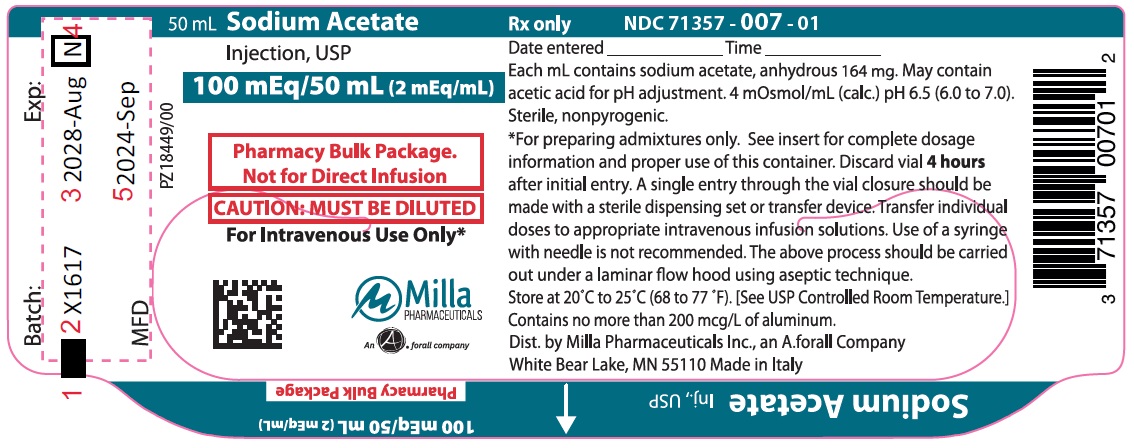
Sodium Acetate 400 meq/100mL Injection, Solution, Concentrate
🆔 Identity & classification
Where does this data come from?
🏷️ RxNorm drug class
This medicine belongs to the Electrolyte solutions class.
Where does this data come from?
🏭 Manufacturer & labeler
Where does this data come from?
🩺 Clinical
- It's used in a hospital or clinical setting to raise sodium levels in patients whose sodium has dropped too low — a condition called hyponatremia. This usually happens when someone...
- What is Sodium Acetate Injection actually used for?
- Neither, exactly. It's given through an IV line directly into a vein, but only after it's been carefully diluted by pharmacy staff into a larger bag of IV fluid. It's never injecte...
- How is this medication given — do I swallow it or get a shot?
Patient education
Supplement & herbal interactions
Where does this data come from?
Ask a licensed pharmacist directly — free, answered by our team.
🧪 Inactive Ingredients / Excipients
Inactive ingredients, also called excipients, are components of the drug product other than the active ingredient. They may include fillers, dyes, coatings, preservatives, flavors, or other formulation ingredients.
Where does this data come from?
IACT rows and label-wide narrative are kept separate; availability and product-level specificity depend on the submitted label.Inactive ingredient FAQ
Are inactive ingredients the same for every manufacturer?
Why might an inactive ingredient be missing?
Can inactive ingredients matter?
💲 Pricing
A drug doesn't have one price. Each row is a different public payment system, and none is what you'd pay at the counter — that depends on your insurance. The ⓘ on each row explains what it measures.
| Price system | Per mL | Per package |
|---|---|---|
| Retail pharmacies payNADAC · weekly | Not in the retail survey — common for institutional, discontinued, or low-volume packs. | |
| Medicaid paysCMS SDUD · 12 mo | No recent Medicaid claims on file for this NDC — rare and low-volume NDCs are suppressed in the public data. | |
| Medicare drug plans payPart D · quarterly | No Part D plan price is available for this NDC in our data. | |
Where does this data come from?
🔁 Therapeutic equivalents
| Product | Labeler | Pack | NADAC/unit | TE | Status | Price vs. this |
|---|---|---|---|---|---|---|
| Sodium Acetate 4 meq/100mL 63323-0032-00 | Fresenius | 20 vials | — | AP | FDA listed | — |
| Sodium Acetate 400 meq/100mLthis 71357-0009-10 | MILLA | 10 vials | — | AP | FDA listed | — |
Where does this data come from?
⏳ Availability & generic status
This product is an FDA-approved generic. Other versions of the same drug are listed under Therapeutic equivalents, least expensive first.
Where does this data come from?
📊 Medicare Part D spend CMS · PART D · 2026 (Q1)
📦 Packaging — all sizes for this product
| Package NDC | Description | Marketing start | Status |
|---|---|---|---|
| 71357-0009-10 You're viewing this | 10 VIAL, PHARMACY BULK PACKAGE in 1 CASE (71357-009-10) / 100 mL in 1 VIAL, PHARMACY BULK PACKAGE (71357-009-01) | 2024-12-06 | Active |
🧭 About this NDC listing & data coverage
What data is (and isn’t) available for this NDC — tap to expand
| NDC identity (package / product / labeler codes) | ✓ Available |
| Labeler | ✓ Available |
| Product & package description | ✓ Available |
| Marketing category & status | ✓ Available |
| Active ingredient / dosage form / route | ✓ Available |
| FDA label (SPL via DailyMed) | ✓ Available |
| Package photos | ✓ Available |
| Inactive ingredients (structured) | — Not published for this NDC The labeler did not submit a structured excipient list, or no SPL is available. |
| NADAC pharmacy acquisition price (CMS) | — Not published for this NDC CMS publishes NADAC only for NDCs reported in its retail-pharmacy survey. |
| Orange Book / therapeutic-equivalence data | ✓ Available |
| HCPCS J-code billing crosswalk | — Not published for this NDC Most self-administered / retail products have no J-code — that is normal. |
| Medicaid utilization (CMS SDUD) | — Not published for this NDC CMS reports utilization only for NDCs with Medicaid claims above its privacy threshold. |
Questions about this listing
Why is there no price listed?
Is the NDC printed on the package the same as the 11-digit billing NDC?
What do the three segments of this NDC mean?
Is this package still being marketed?
Who lists this product with the FDA?
Do I need a prescription for this product?
Where does this data come from?
📄 Full prescribing information FDA SPL
🎯 Indications and Usage ▾
INDICATIONS AND USAGE Sodium Acetate Injection, USP is indicated as a source of sodium for addition to large volume intravenous fluids to prevent or correct hyponatremia in patients with restricted or no oral intake. It is also useful as an additive for preparing specific intravenous fluid formulas when the needs of the patient cannot be met by standard electrolyte or nutrient solutions.
⏱️ Dosage and Administration ▾
DOSAGE AND ADMINISTRATION Sodium Acetate Injection, USP is administered intravenously only after dilution in a larger volume of fluid . The dose and rate of administration are dependent upon the individual needs of the patient. Serum sodium should be monitored as a guide to dosage.
Using aseptic technique, transfer the desired amount to other intravenous fluids to provide the appropriate number of milliequivalents (mEq) of sodium acetate. Sodium Acetate Injection, USP in the Pharmacy Bulk Package is designed for use with manual, gravity flow operations and automated compounding devices for preparing intravenous nutritional admixtures. Admixtures must be stored under refrigeration and used within 24 hours after compounding.
Parenteral drug products should be inspected visually for particulate matter and discoloration prior to administration. (See PRECAUTIONS .) Directions for Dispensing From Pharmacy Bulk Package The Pharmacy Bulk Package is for use in the Pharmacy Admixtures Service only. For hanger application, peel off the paper liner from both ends of the tape hanger to expose ¾ inch long adhesive portions.
Adhere each end to the label on the bottle. The vials should be suspended as a unit in the laminar flow hood. A single entry through the vial closure should be made with a sterile dispensing set or transfer device.
Transfer individual doses to appropriate intravenous infusion solutions. Use of a syringe with needle is not recommended as it may cause leakage and multiple entries will increase the potential of microbial and particulate contamination. The above process should be carried out under a laminar flow hood using aseptic technique.
Discard any unused portion within 4 hours after initial closure entry.
⛔ Contraindications ▾
CONTRAINDICATIONS Sodium Acetate Injection, USP is contraindicated in patients with hypernatremia or fluid retention.
⚠️ Warnings ▾
WARNINGS Sodium Acetate Injection, USP must be diluted before use. To avoid sodium overload and water retention, infuse sodium-containing solutions slowly. Solutions containing sodium ions should be used with great care, if at all, in patients with congestive heart failure, severe renal insufficiency and in clinical states in which there exists edema with sodium retention.
In patients with diminished renal function, administration of solutions containing sodium ions may result in sodium retention. Solutions containing acetate ions should be used with great care in patients with metabolic or respiratory alkalosis. Acetate should be administered with great care in those conditions in which there is an increased level or an impaired utilization of this ion, such as severe hepatic insufficiency.
The intravenous administration of this solution (after appropriate dilution) can cause fluid and/or solute overloading resulting in dilution of other serum electrolyte concentrations, overhydration, congested states or pulmonary edema. Excessive administration of potassium free solutions may result in significant hypokalemia. WARNING: This product contains aluminum that may be toxic.
Aluminum may reach toxic levels with prolonged parenteral administration if kidney function is impaired. Premature neonates are particularly at risk because their kidneys are immature, and they require large amounts of calcium and phosphate solutions, which contain aluminum. Research indicates that patients with impaired kidney function, including premature neonates, who receive parenteral levels of aluminum at greater than 4 to 5 mcg/kg/day accumulate aluminum at levels associated with central nervous system and bone toxicity.
Tissue loading may occur at even lower rates of administration.
🤒 Adverse Reactions ▾
ADVERSE REACTIONS Sodium overload can occur with intravenous infusion of excessive amounts of sodium-containing solutions. (See WARNINGS and PRECAUTIONS .)
🆘 Overdosage ▾
OVERDOSAGE In the event of overdosage, discontinue infusion containing sodium acetate immediately and institute corrective therapy as indicated to reduce elevated serum sodium levels, and restore acid-base balance if necessary. (See WARNINGS , PRECAUTIONS and ADVERSE REACTIONS .)
🧬 Clinical Pharmacology ▾
CLINICAL PHARMACOLOGY Sodium is the principal cation of extracellular fluid. It comprises more than 90% of total cations at its normal plasma concentration of approximately 140 mEq/liter. The sodium ion exerts a primary role in controlling total body water and its distribution.
Acetate (CH 3 COO - ) is a hydrogen ion acceptor. It also serves as an alternate source of bicarbonate (HCO 3 - ) by metabolic conversion in the liver. This conversion has been shown to proceed readily, even in the presence of severe liver disease.
📦 How Supplied / Storage and Handling ▾
HOW SUPPLIED Sodium Acetate Injection, USP is supplied in Pharmacy Bulk Packages as follows: Total Amounts NDC No. Fill Volume Na + Acetate Concentration 71357-007-01 – Glass Fliptop Vial 71357-007-10 – Case Containing 10 Units 50 mL 100 mEq 100 mEq 16.4% 71357-008-01 – Glass Fliptop Vial 71357-008-10 – Case Containing 10 Units 100 mL 200 mEq 200 mEq 16.4% 71357-009-01 – Glass Fliptop Vial 71357-009-10 – Case Containing 10 Units 100 mL 400 mEq 400 mEq 32.8% Store at 20 to 25ºC (68 to 77ºF). [See USP Controlled Room Temperature.]
📋 Description ▾
DESCRIPTION Sodium Acetate Injection, USP is a sterile, nonpyrogenic, concentrated solution of sodium acetate in water for injection. The solution is administered after dilution by the intravenous route as an electrolyte replenisher. It must not be administered undiluted.
Each mL of 2 mEq/mL product contains 164 mg of sodium acetate (anhydrous) which provides 2 mEq each of sodium (Na + ) and acetate (CH 3 COO - ). Each mL of 4 mEq/mL product contains 328 mg of sodium acetate (anhydrous) which provides 4 mEq each of sodium (Na + ) and acetate (CH 3 COO - ). The solution contains no bacteriostat, antimicrobial agent or added buffer.
May contain acetic acid for pH adjustment; the pH is 6.5 (6.0 to 7.0). The osmolar concentration is 4 mOsmol/mL (calc.) in 2 mEq/mL product and 8 mOsmol/mL (calc.) in 4 mEq/mL product; specific gravity 1.081(2 mEq/mL) and 1.1511 (4 mEq/mL). The solution is intended as an alternative to sodium chloride to provide sodium ion (Na + ) for addition to large volume infusion fluids for intravenous use.
Sodium Acetate, USP anhydrous is chemically designated CH 3 COONa, a hygroscopic powder very soluble in water. A Pharmacy Bulk Package is a container of a sterile preparation for parenteral use that contains many single doses. The contents are intended for use in a pharmacy admixture program and are restricted to the preparation of admixtures for intravenous infusion.