
Barhemsys Amisulpride 2.5 mg/mL Injection, Solution
🆔 Identity & classification
Where does this data come from?
🏷️ RxNorm drug class
This medicine belongs to the Dopamine-2 Receptor Antagonist class.
Where does this data come from?
🏭 Manufacturer & labeler
Where does this data come from?
🩺 Clinical
- Barhemsys is used to prevent or treat nausea and vomiting that can happen after surgery — what doctors call postoperative nausea and vomiting, or PONV. If you're having surgery, yo...
- Barhemsys blocks specific dopamine receptors in a part of the brain that acts like a 'nausea alarm.' When surgery and anesthesia trigger that alarm, the brain signals the body to v...
- Most people tolerate this medicine well since it's a single, short infusion. The more commonly reported effects include chills, a temporary drop in blood pressure during the proced...
- Yes — this is important. Barhemsys can affect the heart's electrical rhythm in a way called QT prolongation, which at higher levels can increase the risk of a serious irregular hea...
Patient education
Supplement & herbal interactions
Some supplements/herbs that may interact with Amisulpride — tap one for details:
Where does this data come from?
Ask a licensed pharmacist directly — free, answered by our team.
🧪 Inactive Ingredients / Excipients
Inactive ingredients, also called excipients, are components of the drug product other than the active ingredient. They may include fillers, dyes, coatings, preservatives, flavors, or other formulation ingredients.
Where does this data come from?
IACT rows and label-wide narrative are kept separate; availability and product-level specificity depend on the submitted label.Inactive ingredient FAQ
Are inactive ingredients the same for every manufacturer?
Why might an inactive ingredient be missing?
Can inactive ingredients matter?
💲 Pricing
A drug doesn't have one price. Each row is a different public payment system, and none is what you'd pay at the counter — that depends on your insurance. The ⓘ on each row explains what it measures.
| Price system | Per mL | Per package |
|---|---|---|
| Retail pharmacies payNADAC · weekly | Not in the retail survey — common for institutional, discontinued, or low-volume packs. | |
| Medicaid paysCMS SDUD · 12 mo | No recent Medicaid claims on file for this NDC — rare and low-volume NDCs are suppressed in the public data. | |
| Medicare drug plans payPart D · quarterly | No Part D plan price is available for this NDC in our data. | |
| Medicare Part B allowsASP · J0184 | No ASP payment limit on file for J0184 this quarter. | |
Where does this data come from?
🧾 Billing & reimbursement
Where does this data come from?
🔁 Therapeutic equivalents
| Product | Labeler | Pack | NADAC/unit | TE | Status | Price vs. this |
|---|---|---|---|---|---|---|
| Barhemsys 2.5 mg/mLthis 71390-0125-20 | Acacia | 1 vial | — | — | FDA listed | — |
Where does this data come from?
⏳ Availability & generic status
We did not find an FDA-approved generic match for this exact strength, form and route. Patent/protection dates below may affect future generic timing.
Why the date isn’t exact: Generic timing can change because patents may be challenged, settled, licensed, added, removed, or worked around with a narrower label — and FDA approval does not always mean a pharmacy can get the generic today.
🛈 What do these terms mean?
- Patent
- Legal protection listed in the Orange Book that may delay generic approval or launch. Issued by the U.S. Patent & Trademark Office.
- Substance patent
- Covers the active drug molecule itself — the hardest to design around. A generic generally can’t launch until it expires.
- Formulation (product) patent
- Covers a specific formulation or dosage form. A generic can sometimes work around it with a different formulation.
- Method-of-use patent
- A patent covering one specific approved use of the drug — not necessarily the whole molecule. A generic can sometimes launch with a “skinny label” that carves out the protected use and keeps the others.
- Skinny label
- A generic label that omits a still-patented use when the FDA allows it — letting a generic reach the market for the unprotected uses.
- Exclusivity
- FDA-granted marketing protection, separate from patents — e.g. 5-yr new chemical entity, 7-yr orphan drug, or a +6-month pediatric extension.
- Paragraph IV
- A generic applicant’s formal challenge to a listed patent. It can potentially lead to earlier generic entry, but often involves litigation or a settlement.
- RLD / RS
- Reference Listed Drug — the brand product the FDA uses as the reference for generic applications. Reference Standard — the product the FDA expects generics to compare against in bioequivalence testing.
- TE / AB rating
- FDA therapeutic-equivalence rating. An AB rating generally means the FDA considers a generic therapeutically equivalent to — and substitutable for — the brand.
- LOE (loss of exclusivity)
- The latest patent or exclusivity currently listed — the loss-of-exclusivity / latest-listed-protection date shown on this page. Paragraph-IV challenges and settlements can move the real date earlier; FDA approval and a manufacturer’s decision to market can move it later.
Built from the FDA Orange Book. The bars above are scaled to each protection’s expiry; the red LOE marker is the last one to lapse.
| Patent | Type | Use code | Expires |
|---|---|---|---|
| US 9545426 ↗ | Method of use | U-1744 | Mar 10, 2031 |
| US 9545426 ↗ | Method of use | U-2754 | Mar 10, 2031 |
| US 9084765 ↗ | Method of use | U-1744 | Feb 26, 2034 |
| US 9084765 ↗ | Method of use | U-2754 | Feb 26, 2034 |
| US 9889118 ↗ | Method of use | U-2754 | Mar 10, 2031 |
| US 9889118 ↗ | Method of use | U-1744 | Mar 10, 2031 |
| US 12005042 ↗ | Method of use | U-1744 | Feb 9, 2038 |
| US 12005042 ↗ | Method of use | U-3467 | Feb 9, 2038 |
| US 12005042 ↗ | Method of use | U-3467 | Feb 9, 2038 |
| US 12005042 ↗ | Method of use | U-2754 | Feb 9, 2038 |
| US 12005042 ↗ | Method of use | U-2754 | Feb 9, 2038 |
| US 12005042 ↗ | Method of use | U-1744 | Feb 9, 2038 |
| US 11357753 ↗ | Method of use | U-2754 | Feb 9, 2038 |
| US 11357753 ↗ | Method of use | U-2754 | Feb 9, 2038 |
| US 9084765 ↗ | Method of use | U-1744 | Feb 26, 2034 |
| US 9084765 ↗ | Method of use | U-2754 | Feb 26, 2034 |
| US 9889118 ↗ | Method of use | U-2754 | Mar 10, 2031 |
| US 9889118 ↗ | Method of use | U-1744 | Mar 10, 2031 |
| US 9545426 ↗ | Method of use | U-2754 | Mar 10, 2031 |
| US 9545426 ↗ | Method of use | U-1744 | Mar 10, 2031 |
| US 12329740 ↗ | Method of use | U-2754 | Feb 9, 2038 |
| US 12329740 ↗ | Method of use | U-2754 | Feb 9, 2038 |
| US 12329740 ↗ | Method of use | U-3467 | Feb 9, 2038 |
| US 12329740 ↗ | Method of use | U-3467 | Feb 9, 2038 |
| US 12194022 ↗ | Method of use | U-1744 | Mar 10, 2031 |
| US 12194022 ↗ | Method of use | U-1744 | Mar 10, 2031 |
| US 12194022 ↗ | Method of use | U-3467 | Mar 10, 2031 |
| US 12194022 ↗ | Method of use | U-3467 | Mar 10, 2031 |
| US 9084765 ↗ | Method of use | U-3467 | Feb 26, 2034 |
| US 9084765 ↗ | Method of use | U-3467 | Feb 26, 2034 |
| US 10525033 ↗ | Drug product | — | Mar 10, 2031 |
| US 10525033 ↗ | Drug product | — | Mar 10, 2031 |
Is there a generic version of BARHEMSYS 5 MG/2 ML VIAL?
The FDA approved a generic — why can’t I get it at my pharmacy yet?
Why do different websites show different generic release dates?
What does “FDA listed” mean?
What does a patent or protection date mean here?
What does “current Orange Book estimate” mean?
Can a generic come out before the last patent expires?
Can a generic come out after the listed dates?
What is the difference between patents and exclusivity?
Why are there multiple patent dates?
Where does this data come from?
💊 Medicaid utilization by pack size
📦 Packaging — all sizes for this product
| Package NDC | Description | Marketing start | Status |
|---|---|---|---|
| 71390-0125-20 You're viewing this | 10 CARTON in 1 PACKAGE (71390-125-20) / 1 VIAL, SINGLE-DOSE in 1 CARTON (71390-125-21) / 2 mL in 1 VIAL, SINGLE-DOSE | 2020-02-27 | Active |
| 71390-0125-50 | 10 CARTON in 1 PACKAGE (71390-125-50) / 1 VIAL, SINGLE-DOSE in 1 CARTON (71390-125-51) / 4 mL in 1 VIAL, SINGLE-DOSE | 2020-02-27 | Active |
Pack size FAQ
What quantity is in NDC 71390-0125-20?
What NDC number is used to bill for this package of Barhemsys Amisulpride 2.5 mg/mL Injection, Solution?
🧭 About this NDC listing & data coverage
What data is (and isn’t) available for this NDC — tap to expand
| NDC identity (package / product / labeler codes) | ✓ Available |
| Labeler | ✓ Available |
| Product & package description | ✓ Available |
| Marketing category & status | ✓ Available |
| Active ingredient / dosage form / route | ✓ Available |
| FDA label (SPL via DailyMed) | ✓ Available |
| Package photos | ✓ Available |
| Inactive ingredients (structured) | — Not published for this NDC The labeler did not submit a structured excipient list, or no SPL is available. |
| NADAC pharmacy acquisition price (CMS) | — Not published for this NDC CMS publishes NADAC only for NDCs reported in its retail-pharmacy survey. |
| Orange Book / therapeutic-equivalence data | ✓ Available |
| HCPCS J-code billing crosswalk | ✓ Available |
| Medicaid utilization (CMS SDUD) | — Not published for this NDC CMS reports utilization only for NDCs with Medicaid claims above its privacy threshold. |
Questions about this listing
Why is there no price listed?
Is the NDC printed on the package the same as the 11-digit billing NDC?
What do the three segments of this NDC mean?
Is this package still being marketed?
Does this product come in other package sizes?
Who lists this product with the FDA?
Do I need a prescription for this product?
Does this product have a billing J-code?
Where does this data come from?
📄 Full prescribing information FDA SPL
🎯 Indications and Usage ▾
1 INDICATIONS AND USAGE BARHEMSYS ® is indicated in adults for: prevention of postoperative nausea and vomiting (PONV), either alone or in combination with an antiemetic of a different class. treatment of PONV in patients who have received antiemetic prophylaxis with an agent of a different class or have not received prophylaxis. BARHEMSYS is a dopamine-2 (D 2 ) antagonist indicated in adults for: Prevention of postoperative nausea and vomiting (PONV), either alone or in combination with an antiemetic of a different class.
( 1 ) Treatment of PONV in patients who have received antiemetic prophylaxis with an agent of a different class or have not received prophylaxis. ( 1 )
⏱️ Dosage and Administration ▾
2 DOSAGE AND ADMINISTRATION The recommended dosage of BARHEMSYS: Prevention of PONV, either alone or in combination with another antiemetic : 5 mg as a single intravenous dose infused over 1 to 2 minutes at the time of induction of anesthesia. ( 2.1 ) Treatment of PONV : 10 mg as a single intravenous dose infused over 1 to 2 minutes in the event of nausea and/or vomiting after a surgical procedure. ( 2.1 ) See full prescribing information for preparation and administration instructions .
( 2.2 )
2.1Recommended Dosage The recommended adult dosage of BARHEMSYS and infusion rate by indication is shown in the table below: Indication Adult Dosage Regimen Prevention of PONV 5 mg as a single intravenous injection infused over 1 to 2 minutes at the time of induction of anesthesia [see Dosage and Administration (2.2) ] . Treatment of PONV 10 mg as a single intravenous injection infused over 1 to 2 minutes in the event of nausea and/or vomiting after a surgical procedure [see Dosage and Administration (2.2) ] .
2.2Preparation and Administration Dilution of BARHEMSYS is not required before administration. BARHEMSYS is chemically and physically compatible with Water for Injection, 5% Dextrose Injection, 0.9% Sodium Chloride Injection, and Lactated Ringer's Solution (also known as Ringer's Lactate Solution, Compound Sodium Lactate Solution, and Hartmann's Solution), any of which may be used to flush an intravenous line before or after administration of BARHEMSYS. Protect from light.
BARHEMSYS is subject to photodegradation. Administer BARHEMSYS within 12 hours of removal of the vial from the protective carton. Prior to administration, inspect the BARHEMSYS solution visually for particulate matter and discoloration.
Discard if particulate matter or discoloration is observed.
💊 Dosage Forms and Strengths ▾
3 DOSAGE FORMS AND STRENGTHS Injection: 5 mg/2 mL (2.5 mg/mL) or 10 mg/4 mL (2.5 mg/mL) as a clear, colorless sterile solution in a single-dose vial. Injection: 5 mg/2 mL (2.5 mg/mL) or 10 mg/4 mL (2.5 mg/mL) in a single-dose vial. ( 3 )
⛔ Contraindications ▾
4 CONTRAINDICATIONS BARHEMSYS is contraindicated in patients with known hypersensitivity to amisulpride [see Adverse Reactions (6.2) ] . Known hypersensitivity to amisulpride. ( 4 )
⚠️ Warnings and Cautions ▾
5 WARNINGS AND PRECAUTIONS QT Prolongation : Occurs in a dose- and concentration-dependent manner. Avoid use in patients with congenital long QT syndrome and in patients taking droperidol. ECG monitoring is recommended in patients with pre-existing arrhythmias/cardiac conduction disorders; electrolyte abnormalities (e.g., hypokalemia or hypomagnesemia); congestive heart failure; and in patients taking other medicinal products (e.g., ondansetron) or with other medical conditions known to prolong the QT interval.
( 5.1 , 7.2 )
5.1QT Prolongation BARHEMSYS causes dose- and concentration-dependent prolongation of the QT interval [see Clinical Pharmacology (12.2) ] . The recommended dosage is 5 or 10 mg as a single intravenous dose infused over 1 to 2 minutes [see Dosage and Administration (2.1) ] . Avoid use in patients with congenital long QT syndrome and in patients taking droperidol.
Electrocardiogram (ECG) monitoring is recommended in patients with pre-existing arrhythmias/cardiac conduction disorders; electrolyte abnormalities (e.g., hypokalemia or hypomagnesemia); congestive heart failure; and in patients taking other medicinal products (e.g., ondansetron) or with other medical conditions known to prolong the QT interval [see Drug Interactions (7.2) ] .
🤒 Adverse Reactions ▾
6 ADVERSE REACTIONS Most common adverse reactions (≥ 2%) are: Prevention of PONV : increased blood prolactin concentrations, chills, hypokalemia, procedural hypotension, and abdominal distension. ( 6.1 ) Treatment of PONV : infusion site pain. ( 6.1 ) To report SUSPECTED ADVERSE REACTIONS, contact Acacia Pharma at 1-877-357-9237 or FDA at 1-800-FDA-1088 or www.fda.gov/medwatch.
6.1Clinical Trials Experience Because clinical trials are conducted under widely varying conditions, adverse reaction rates observed in the clinical trials of a drug cannot be directly compared to rates in the clinical trials of another drug and may not reflect the rates observed in practice. The data described below reflect exposure to BARHEMSYS in 1,166 patients treated in placebo-controlled trials. 748 of these patients received a dose of 5 mg for prevention of PONV (of whom 572 received another antiemetic concomitantly) and 418 patients received 10 mg for treatment of PONV [see Clinical Studies (14.1 , 14.2) ] .
The mean age of the population was 49 years (range 18 to 91 years), 87% female, 80% White/Caucasian, 9% Black, and 1% Asian. Prevention of PONV Common adverse reactions reported in at least 2% of adult patients who received BARHEMSYS 5 mg and at a higher rate than placebo in Studies 1 and 2 for the prevention of PONV are shown in Table 1. Table 1.
Common Adverse Reactions Reported in at least 2% of patients treated with BARHEMSYS and at a higher rate than placebo in Adult Patients in Studies 1 and 2 of BARHEMSYS for Prevention of PONV BARHEMSYS 5 mg Placebo N=748 N=741 Chills 4% 3% Hypokalemia 4% 2% Procedural hypotension 3% 2% Abdominal distension 2% 1% Serum prolactin concentrations were measured in Study 1 where 5% (9/176) of BARHEMSYS-treated patients vs 1% (1/166) of placebo-treated patients had increased blood prolactin reported as an adverse reaction. Serum prolactin concentrations increased from a mean of 10 ng/mL at baseline to 32 ng/mL after BARHEMSYS treatment in 112 females (upper limit of normal 29 ng/mL) and from 10 ng/mL to 19 ng/mL in 61 males (upper limit of normal 18 ng/mL).
No clinical consequences due to elevated prolactin levels were reported. Treatment of PONV The most common adverse reaction, reported in at least 2% of adult patients who received BARHEMSYS 10 mg (N=418) and at a higher rate than placebo (N=416), in clinical trials for the treatment of PONV (Studies 3 and 4) was infusion site pain (BARHEMSYS 6%; placebo 4%).
6.2Postmarketing Experience The following adverse reactions have been identified during post-approval chronic oral use of amisulpride outside of the United States (BARHEMSYS is not approved for oral dosing or chronic use). Because these reactions are reported voluntarily from a population of uncertain size, it is not always possible to reliably estimate their frequency or establish a causal relationship to drug exposure. Blood and lymphatic system disorders : agranulocytosis Cardiac disorders : bradycardia, torsades de pointes, ventricular tachycardia, prolonged QT by electrocardiogram General disorders : neuroleptic malignant syndrome Immune system disorders : angioedema, hypersensitivity, urticaria Hepatic disorders : increased hepatic enzymes Nervous system disorders : agitation, anxiety, dystonia, extrapyramidal disorder, seizure Psychiatric disorders : confusional state, insomnia, somnolence Vascular disorders : hypotension
🔄 Drug Interactions ▾
7 DRUG INTERACTIONS
7.1Dopamine Agonists Reciprocal antagonism of effects occurs between dopamine agonists (e.g., levodopa) and BARHEMSYS. Avoid using levodopa with BARHEMSYS.
7.2Drugs Prolonging the QT Interval BARHEMSYS causes dose- and concentration-dependent QT prolongation [see Clinical Pharmacology (12.2) ] . To avoid potential additive effects, avoid use of BARHEMSYS in patients taking droperidol. ECG monitoring is recommended in patients taking other drugs known to prolong the QT interval (e.g., ondansetron) [see Warnings and Precautions (5.1) ] .
👥 Use in Specific Populations ▾
8 USE IN SPECIFIC POPULATIONS Lactation : A lactating woman may pump and discard breast milk for 48 hours after BARHEMSYS administration. ( 8.2 )
8.1Pregnancy Risk Summary Available data with amisulpride use in pregnant women are insufficient to establish a drug associated risk of major birth defects, miscarriage or adverse maternal or fetal outcomes. In animal reproduction studies, there were no adverse developmental effects observed with oral administration of amisulpride in rats and rabbits during the period of organogenesis at exposures about 43 and 645 times, respectively, the exposure delivered by the highest recommended human dose (see Data ) . The estimated background risk of major birth defects and miscarriage for the indicated population is unknown.
All pregnancies have a background risk of birth defect, loss, or other adverse outcomes. In the U.S. general population, the estimated background risk of major birth defects and miscarriage in clinically recognized pregnancies is 2% to 4% and 15% to 20%, respectively. Data Animal Data Reproduction studies of amisulpride were conducted in pregnant rats administered oral doses up to 160 mg/kg/day (43 times the exposure based on area under the curve (AUC) at the highest recommended dose of 10 mg) throughout the period of organogenesis.
No adverse embryo-fetal developmental effects were observed at any dose level. Maternal animals exhibited a dose-related decrease in overall mean body weight gain. In rabbits administered amisulpride throughout the period of organogenesis, oral doses up to 210 mg/kg/day (645 times the exposure based on AUC at the highest recommended dose of 10 mg) had no adverse developmental effects on the fetus.
Maternal animals exhibited reduced mean body weight gain at doses of 100 and 210 mg/kg/day and reduced food intake was observed at 210 mg/kg/day. The pre- and post-natal developmental effects of amisulpride were assessed in rats administered oral doses of 60, 100 or 160 mg/kg/day during the periods of organogenesis and lactation. At 160 mg/kg/day (43 times the exposure based on AUC at the highest recommended dose of 10 mg), maternal animals exhibited a reduction in mean body weight gain and decrease in food intake during lactation.
Amisulpride had no effect on maternal pregnancy parameters, litter survival or pup growth, development or maturation at any dose tested.
8.2Lactation Risk Summary Based on case reports in published literature, amisulpride is present in human milk at concentrations that are 11- to 20-fold higher than human plasma in patients taking multiple oral doses of amisulpride (200 to 400 mg/day). The estimated infant daily dose ranged from 5% to 11% of the maternal dose. There are ways to minimize drug exposure to a breastfed infant (see Clinical Considerations ).
There are no reports of adverse effects on the breastfed child and no information on the effects of amisulpride on milk production. The pharmacological action of amisulpride, a dopamine-2 (D 2 ) receptor antagonist, may result in an increase in serum prolactin levels, which may lead to a reversible increase in maternal milk production [see Adverse Reactions (6.1) ]. The developmental and health benefits of breastfeeding should be considered along with the mother's clinical need for BARHEMSYS and any potential adverse effects on the breastfed child from BARHEMSYS or from the underlying maternal condition.
Clinical Considerations A lactating woman may consider interrupting breastfeeding and pumping and discarding breast milk for 48 hours after BARHEMSYS administration to minimize drug exposure to a breastfed infant.
8.3Females and Males of Reproductive Potential Infertility In animal fertility studies, administration of repeated doses of amisulpride over a 10-day period to female rats resulted in infertility that was reversible [see Nonclinical Toxicology (13.1) ].
8.4Pediatric Use Safety and effectiveness in pediatric patients have not been established.
8.5 Geriatric Use…
🤰 Pregnancy ▾
8.1Pregnancy Risk Summary Available data with amisulpride use in pregnant women are insufficient to establish a drug associated risk of major birth defects, miscarriage or adverse maternal or fetal outcomes. In animal reproduction studies, there were no adverse developmental effects observed with oral administration of amisulpride in rats and rabbits during the period of organogenesis at exposures about 43 and 645 times, respectively, the exposure delivered by the highest recommended human dose (see Data ) . The estimated background risk of major birth defects and miscarriage for the indicated population is unknown.
All pregnancies have a background risk of birth defect, loss, or other adverse outcomes. In the U.S. general population, the estimated background risk of major birth defects and miscarriage in clinically recognized pregnancies is 2% to 4% and 15% to 20%, respectively. Data Animal Data Reproduction studies of amisulpride were conducted in pregnant rats administered oral doses up to 160 mg/kg/day (43 times the exposure based on area under the curve (AUC) at the highest recommended dose of 10 mg) throughout the period of organogenesis.
No adverse embryo-fetal developmental effects were observed at any dose level. Maternal animals exhibited a dose-related decrease in overall mean body weight gain. In rabbits administered amisulpride throughout the period of organogenesis, oral doses up to 210 mg/kg/day (645 times the exposure based on AUC at the highest recommended dose of 10 mg) had no adverse developmental effects on the fetus.
Maternal animals exhibited reduced mean body weight gain at doses of 100 and 210 mg/kg/day and reduced food intake was observed at 210 mg/kg/day. The pre- and post-natal developmental effects of amisulpride were assessed in rats administered oral doses of 60, 100 or 160 mg/kg/day during the periods of organogenesis and lactation. At 160 mg/kg/day (43 times the exposure based on AUC at the highest recommended dose of 10 mg), maternal animals exhibited a reduction in mean body weight gain and decrease in food intake during lactation.
Amisulpride had no effect on maternal pregnancy parameters, litter survival or pup growth, development or maturation at any dose tested.
🧒 Pediatric Use ▾
8.4Pediatric Use Safety and effectiveness in pediatric patients have not been established.
🧓 Geriatric Use ▾
8.5Geriatric Use Of the total number of patients enrolled in controlled clinical trials who received BARHEMSYS 5 mg for prevention of PONV or 10 mg for treatment of PONV, 235 (17%) were 65 years of age and older, while 59 (4%) were 75 years of age and older. No overall differences in safety or effectiveness were observed between these patients and younger patients, and other reported clinical experience has not identified differences in responses between the elderly and younger patients, but greater sensitivity of some older individuals cannot be ruled out.
🆘 Overdosage ▾
10 OVERDOSAGE Doses of oral amisulpride (BARHEMSYS is not approved for oral dosing) above 1200 mg/day have been associated with adverse reactions related to dopamine-2 (D 2 ) antagonism, in particular: cardiovascular adverse reactions (e.g., prolongation of the QT interval, torsades de pointes, bradycardia and hypotension) [see Warnings and Precautions (5.1) ] . neuropsychiatric adverse reactions (e.g., sedation, coma, seizures, and dystonic and extrapyramidal reactions). There is no specific antidote for amisulpride overdose.
Management includes cardiac monitoring and treatment of severe extrapyramidal symptoms. Since amisulpride is weakly dialyzed, hemodialysis should not be used to eliminate the drug.
🧬 Clinical Pharmacology ▾
12 CLINICAL PHARMACOLOGY
12.1Mechanism of Action Amisulpride is a selective dopamine-2 (D 2 ) and dopamine-3 (D 3 ) receptor antagonist. D 2 receptors are located in the chemoreceptor trigger zone (CTZ) and respond to the dopamine released from the nerve endings. Activation of CTZ relays stimuli to the vomiting center which is involved in emesis.
Studies in multiple species indicate that D 3 receptors in the area postrema also play a role in emesis. Studies conducted in ferrets have shown that amisulpride inhibits emesis caused by apomorphine, with an estimated ED 50 of less than 1 mcg/kg, subcutaneously; and inhibits cisplatin-induced emesis at 2 mg/kg and morphine-induced emesis at 3 to 6 mg/kg, when given intravenously. Amisulpride has no appreciable affinity for any other receptor types apart from low affinities for 5-HT 2B and 5-HT 7 receptors.
12.2Pharmacodynamics Cardiac Electrophysiology A significant exposure-response relationship was identified between amisulpride concentration and ΔΔQTcF. In 40 healthy Caucasian and Japanese subjects, the maximum mean difference (95% upper confidence bound) in QTcF from placebo after baseline-correction (ΔΔQTcF) was 5.0 (7.1) milliseconds after a 2-minute intravenous infusion of 5 mg BARHEMSYS and 23.4 (25.5) milliseconds after an 8-minute intravenous infusion of 40 mg BARHEMSYS [see Warnings and Precautions (5.1) ] .
The recommended infusion rate is 1 to 2 minutes for 5 mg or 10 mg of BARHEMSYS [see Dosage and Administration (2.1) ].
12.3Pharmacokinetics After an intravenous infusion, the peak plasma concentration of amisulpride is achieved at the end of the infusion period and the plasma concentration decreases to about 50% of the peak value within approximately 15 minutes. The AUC (0-∞) increases dose-proportionally in the dose range from 5 mg to 40 mg (4-times the maximum recommended dose). The following mean pharmacokinetic parameters of amisulpride were observed following a single 5 or 10 mg intravenous dose in adult healthy subjects and surgical patients.
Table 2. Summary of Key Pharmacokinetic Parameters of Amisulpride from Clinical Studies Single Dose Infusion Duration (minutes) Number of Subjects Mean (SD) Peak Plasma Concentration (ng/mL) AUC (0-∞) (ng∙h/mL) Healthy Subjects 5 mg 2 39 200 (139) 154 (30) Healthy Subjects 10 mg 1 29 451 (230) 136 (28) AUC (0-2 hr) Patients 5 mg 1 to 2 26 Patients in a clinical trial for prophylaxis of PONV 161 (58) 260 (65) 27 Patients in clinical trials for treatment of PONV 127 (64) 204 (94) Patients 10 mg 1 to 2 31 285 (446) 401 (149) Distribution Following intravenous infusion, the mean volume of distribution of amisulpride is estimated to be 127 to 144 L in surgical patients and 171 L in healthy subjects.
Amisulpride distributes into erythrocytes. Plasma protein binding is 25% to 30% in the concentration range from 37 to 1850 ng/mL. Elimination The mean elimination half-life is approximately 4 to 5 hours and similar between healthy subjects and surgical patients.
Population pharmacokinetic analysis estimated that the plasma clearance of amisulpride is
20.6 L/h in surgical patients and
24.1L/h in healthy subjects. Metabolism In a mass balance study, no metabolites were detectable in plasma while four metabolites were identified in urine and feces. Each metabolite accounts for less than 7% of the dose.
In vitro amisulpride is not metabolized by major cytochrome P450 enzymes. Excretion After intravenous administration of amisulpride, 74% and 23% of the administered dose was recovered in urine and feces, respectively. 58% and 20% of the dose was excreted as unchanged amisulpride in urine and feces, respectively.
Renal clearance was estimated to be
20.5L/hr (342 mL/min) in healthy subjects suggesting that amisulpride undergoes active renal secretion. Specific Populations Age, Sex, and Racial Groups No clinically significant effect on the pharmacokinetics of amisulpride was observed based on age (18 to 90 years), sex, or race. Patients…
🧬 Mechanism of Action ▾
12.1Mechanism of Action Amisulpride is a selective dopamine-2 (D 2 ) and dopamine-3 (D 3 ) receptor antagonist. D 2 receptors are located in the chemoreceptor trigger zone (CTZ) and respond to the dopamine released from the nerve endings. Activation of CTZ relays stimuli to the vomiting center which is involved in emesis.
Studies in multiple species indicate that D 3 receptors in the area postrema also play a role in emesis. Studies conducted in ferrets have shown that amisulpride inhibits emesis caused by apomorphine, with an estimated ED 50 of less than 1 mcg/kg, subcutaneously; and inhibits cisplatin-induced emesis at 2 mg/kg and morphine-induced emesis at 3 to 6 mg/kg, when given intravenously. Amisulpride has no appreciable affinity for any other receptor types apart from low affinities for 5-HT 2B and 5-HT 7 receptors.
📦 How Supplied / Storage and Handling ▾
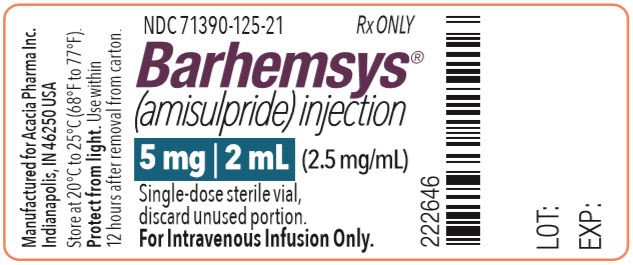
16 HOW SUPPLIED/STORAGE AND HANDLING BARHEMSYS (amisulpride) injection is supplied as follows: NDC 71390-125-20: Package of 10 cartons. Each carton (NDC 71390-125-21) contains one single-dose vial of clear, colorless, sterile solution of BARHEMSYS (amisulpride) injection, 5 mg in 2 mL (2.5 mg/mL). NDC 71390-125-50: Package of 10 cartons.
Each carton (NDC 71390-125-51) contains one single-dose vial of clear, colorless, sterile solution of BARHEMSYS (amisulpride) injection, 10 mg in 4 mL (2.5 mg/mL). Store vials at 20°C to 25°C (68°F to 77°F) [see USP Controlled Room Temperature]. Protect from light.
Administer BARHEMSYS within 12 hours after the vial is removed from the protective carton [see Dosage and Administration (2.2) ] .
📦 Storage and Handling ▾
Store vials at 20°C to 25°C (68°F to 77°F) [see USP Controlled Room Temperature]. Protect from light. Administer BARHEMSYS within 12 hours after the vial is removed from the protective carton [see Dosage and Administration (2.2) ] .
📋 Description ▾
11 DESCRIPTION The active ingredient of BARHEMSYS is amisulpride, a dopamine-2 (D 2 ) receptor antagonist. Its chemical name is 4-Amino- N -[(1-ethyl-2-pyrrolidinyl)methyl]-5-(ethylsulfonyl)- o -anisamide. It has the following chemical structure: (racemic) The empirical formula is C 17 H 27 N 3 O 4 S representing a molecular weight of 369.48.
Amisulpride is a white or almost white crystalline powder. It is practically insoluble in water, sparingly soluble in ethanol and freely soluble in methylene chloride, and has a melting point of around 126°C. The compound is racemic and shows no optical rotation and is not hygroscopic.
No other polymorphs of amisulpride have been reported. BARHEMSYS (amisulpride) injection is a clear, colorless, nonpyrogenic, sterile solution formulation of amisulpride 5 mg/2 mL (2.5 mg/mL) or 10 mg/4 mL (2.5 mg/mL) for intravenous infusion presented in a single-dose vial. It has a pH of approximately 5.0 and the osmolality of the product is between 250 and 330 mOsmol/kg.
Each 2 mL vial of BARHEMSYS contains 5 mg of amisulpride; 18.7 mg of citric acid monohydrate USP; 3.6 mg of sodium chloride USP; 32.64 mg of trisodium citrate dihydrate; hydrochloric acid NF and sodium hydroxide NF as needed to adjust the pH (4.75 to 5.25); and Water for Injection USP to make up to volume. Each 4 mL vial of BARHEMSYS contains 10 mg of amisulpride; 37.4 mg of citric acid monohydrate USP; 7.2 mg of sodium chloride USP; 65.3 mg of trisodium citrate dihydrate; hydrochloric acid NF and sodium hydroxide NF as needed to adjust the pH (4.75 to 5.25); and Water for Injection USP to make up to volume.
Chemical Structure
💬 Information for Patients ▾
17 PATIENT COUNSELING INFORMATION QT Prolongation Instruct patients to contact their healthcare provider immediately if they perceive a change in their heart rate, if they feel lightheaded, or if they have a syncopal episode [see Warnings and Precautions (5.1) ] . Drug Interactions Advise patients to report to their healthcare provider if they are taking drugs which prolong the QT interval [see Warnings and Precautions (5.1) ]. Lactation Women may consider reducing infant exposure through pumping and discarding breastmilk for 48 hours after BARHEMSYS administration [see Use in Specific Populations (8.2) ] .