
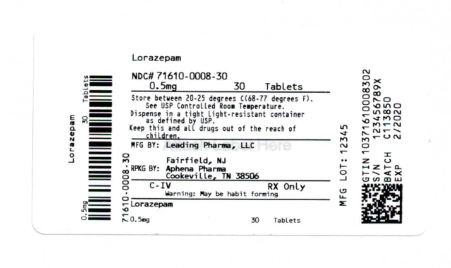
Lorazepam .5 mg Tablet, 45-count
Other active recalls for Lorazepam (different manufacturers) — 1 · tap to view
🆔 Identity & classification
Where does this data come from?
🏷️ RxNorm drug class
This medicine belongs to the Benzodiazepine class.
Where does this data come from?
🏭 Manufacturer & labeler
Where does this data come from?
🩺 Clinical
Lorazepam is used to relieve anxiety and treat insomnia. Lorazepam is in a class of medications called benzodiazepines. It works by slowing activity in the brain to allow for relaxation.
Read the full MedlinePlus article ↗- Lorazepam is mainly prescribed for anxiety disorders — it can calm anxious feelings and physical tension, especially for short periods. In tablet or liquid form, it's used for ongo...
- Yes, drowsiness is one of the most common effects — and for many people that's actually part of how it helps with anxiety. You may also notice some unsteadiness, dizziness, or mild...
- Will lorazepam make me feel really drowsy?
- No — please avoid alcohol completely while you're on lorazepam. Both alcohol and lorazepam slow down your central nervous system, and together they can make that effect dangerously...
Patient education
Supplement & herbal interactions
Some supplements/herbs that may interact with Lorazepam — tap one for details:
Lorazepam may be associated with lower levels of 1 nutrient — worth a chat with your pharmacist, not a cause for alarm.
Where does this data come from?
Ask a licensed pharmacist directly — free, answered by our team.
💊 What it looks like
Where does this data come from?
🧪 Inactive Ingredients / Excipients
Inactive ingredients, also called excipients, are components of the drug product other than the active ingredient. They may include fillers, dyes, coatings, preservatives, flavors, or other formulation ingredients.
💡 Tap an ingredient (hover on desktop) to see what it is and why it’s used.
-
UNII 3SY5LH9PMK
Anhydrous lactose is a milk sugar with no water content. It acts as a filler and binder in tablets and capsules, adding bulk and helping ingredients stick together.
-
UNII 70097M6I30
Magnesium stearate is a salt made from magnesium and stearic acid, a fatty substance. It's used in tablets and capsules as a lubricant and glidant to help ingredients flow smoothly during manufacturing and prevent sticking.
-
UNII OP1R32D61U
Microcrystalline cellulose is a purified form of cellulose, a natural fiber from plant sources. It acts as a binder and filler in tablets and capsules, helping hold ingredients together and give the medicine its shape and size.
-
UNII 0BZ5A00FQU
Polacrilin potassium is a synthetic polymer that absorbs water and swells. It acts as a disintegrant, helping tablets or capsules break apart quickly so the active ingredient can be absorbed in your body.
4 inactive ingredients listed in the exact product block matched to this NDC.
Where does this data come from?
ingredient classCode="IACT" elements from the exact product block matched by this NDC. Label-section narrative from DailyMed / the openFDA label index is shown separately when available.Inactive ingredient FAQ
Are inactive ingredients the same for every manufacturer?
Why might an inactive ingredient be missing?
Can inactive ingredients matter?
💲 Pricing
A drug doesn't have one price. Each row is a different public payment system, and none is what you'd pay at the counter — that depends on your insurance. The ⓘ on each row explains what it measures.
| Price system | Per each | Per package |
|---|---|---|
| Retail pharmacies payNADAC · weekly | Not in the retail survey — common for institutional, discontinued, or low-volume packs. | |
| Medicaid paysCMS SDUD · 12 mo | No recent Medicaid claims on file for this NDC — rare and low-volume NDCs are suppressed in the public data. | |
| Medicare drug plans payPart D · Q2 2026 | $0.1178 | $5.30 / 45 tablets |
Where does this data come from?
🔁 Therapeutic equivalents
| Product | Labeler | Pack | NADAC/unit | TE | Status | Price vs. this |
|---|---|---|---|---|---|---|
| Lorazepam .5 mg 00093-3425-01 | Teva | 100 tablets | $0.033 | AB | Availability likely | — |
| Lorazepam .5 mg 13107-0083-01 | Aurolife | 100 tablets | $0.033 | AB | Availability likely | — |
| Lorazepam .5 mg 60687-0820-01 | American | 100 tablets | $0.033 | AB | Availability likely | — |
| Lorazepam .5 mg 62135-0861-01 | Chartwell | 100 tablets | $0.033 | — | Availability likely | — |
| Lorazepam .5 mg 63304-0772-01 | SUN | 100 tablets | $0.033 | AB | Availability likely | — |
| Lorazepam .5 mg 64980-0627-01 | Rising | 100 tablets | $0.033 | AB | Availability likely | — |
| Lorazepam .5 mg 69315-0904-01 | Leading | 100 tablets | $0.033 | AB | Availability likely | — |
| Lorazepam .5 mg 00904-6007-60 | Major | 100 tablets | $0.046 | AB | Discontinued | — |
| Ativan .5 mg 00187-0063-01 | Bausch | 100 tablets | $32.865 | AB | FDA listed | — |
| Lorazepam .5 mg 51407-0996-01 | Golden | 100 tablets | — | AB | FDA listed | — |
| Lorazepam .5 mg 58118-0904-08 | Clinical | 30 tablets | — | AB | FDA listed | — |
| Lorazepam .5 mg 61919-0062-02 | DIRECT | 2 tablets | — | AB | FDA listed | — |
| Lorazepam .5 mg 62559-0195-01 | ANI | 100 tablets | — | AB | FDA listed | — |
| Lorazepam .5 mg 67046-0786-03 | Coupler | 30 tablets | — | AB | FDA listed | — |
| Lorazepam .5 mg 67296-1478-01 | Redpharm | 10 tablets | — | AB | Discontinued | — |
| Lorazepam .5 mg 67296-1629-01 | RedPharm | 10 tablets | — | AB | FDA listed | — |
| Lorazepam .5 mg 68071-3096-03 | NuCare | 30 tablets | — | AB | FDA listed | — |
| Lorazepam .5 mg 68071-3121-06 | NuCare | 6 tablets | — | AB | FDA listed | — |
| Lorazepam .5 mg 68071-3751-06 | NuCare | 60 tablets | — | AB | FDA listed | — |
| Lorazepam .5 mg 68071-4916-04 | NuCare | 45 tablets | — | AB | FDA listed | — |
| Lorazepam .5 mg 68071-5068-06 | NuCare | 6 tablets | — | AB | FDA listed | — |
| Lorazepam .5 mg 68788-7355-01 | Preferred | 100 tablets | — | AB | FDA listed | — |
| Lorazepam .5 mg 70518-1520-00 | REMEDYREPACK | 30 tablets | — | AB | FDA listed | — |
| Lorazepam .5 mg 70518-3806-00 | REMEDYREPACK | 30 tablets | — | AB | Discontinued | — |
| Lorazepam .5 mg 71205-0166-02 | Proficient | 2 tablets | — | AB | FDA listed | — |
| Lorazepam .5 mg 71205-0228-02 | Proficient | 2 tablets | — | AB | FDA listed | — |
| Lorazepam .5 mg 71205-0756-10 | Proficient | 10 tablets | — | AB | FDA listed | — |
| Lorazepam .5 mg 71335-0329-01 | Bryant | 30 tablets | — | AB | FDA listed | — |
| Lorazepam .5 mg 71335-1455-01 | Bryant | 30 tablets | — | AB | Discontinued | — |
| Lorazepam .5 mgthis 71610-0008-45 | Aphena | 45 tablets | — | AB | FDA listed | — |
| Lorazepam .5 mg 71610-0199-10 | Aphena | 10 tablets | — | AB | FDA listed | — |
| Lorazepam .5 mg 71610-0225-15 | Aphena | 15 tablets | — | AB | FDA listed | — |
| Lorazepam .5 mg 71610-0654-10 | Aphena | 10 tablets | — | AB | FDA listed | — |
| Lorazepam .5 mg 71610-0764-10 | Aphena | 10 tablets | — | AB | FDA listed | — |
| Lorazepam .5 mg 71610-0827-10 | Aphena | 10 tablets | — | AB | FDA listed | — |
| Lorazepam .5 mg 72189-0351-02 | DirectRx | 2 tablets | — | AB | FDA listed | — |
| Lorazepam .5 mg 72789-0236-30 | PD-Rx | 30 tablets | — | AB | FDA listed | — |
| Lorazepam .5 mg 72789-0355-30 | PD-Rx | 30 tablets | — | AB | FDA listed | — |
| Lorazepam .5 mg 76420-0647-01 | Asclemed | 100 tablets | — | AB | FDA listed | — |
| Lorazepam .5 mg 76420-0872-00 | Asclemed | 1000 tablets | — | AB | FDA listed | — |
| Lorazepam .5 mg 87441-0050-01 | Unit | 30 tablets | — | AB | FDA listed | — |
| Lorazepam .5 mg 60760-0947-02 | St. | 2 tablets | — | AB | FDA listed | — |
Where does this data come from?
⏳ Availability & generic status
This product is an FDA-approved generic. Other versions of the same drug are listed under Therapeutic equivalents, least expensive first.
Where does this data come from?
📊 Medicare Part D spend CMS · PART D · 2026 (Q1)
🔬 Reported adverse events (FAERS)
Top reported reactions
Age at onset
Reporter sex
Serious outcomes
Where does this data come from?
📦 Packaging — all sizes for this product
| Package NDC | Description | Marketing start | Status |
|---|---|---|---|
| 71610-0008-10 | 10 TABLET in 1 BOTTLE (71610-008-10) | 2017-10-24 | Active |
| 71610-0008-15 | 15 TABLET in 1 BOTTLE (71610-008-15) | 2017-10-24 | Active |
| 71610-0008-20 | 20 TABLET in 1 BOTTLE (71610-008-20) | 2018-10-03 | Active |
| 71610-0008-30 | 30 TABLET in 1 BOTTLE (71610-008-30) | 2017-10-24 | Active |
| 71610-0008-45 You're viewing this | 45 TABLET in 1 BOTTLE (71610-008-45) | 2017-10-24 | Active |
| 71610-0008-53 | 60 TABLET in 1 BOTTLE (71610-008-53) | 2017-10-24 | Active |
| 71610-0008-60 | 90 TABLET in 1 BOTTLE (71610-008-60) | 2017-10-24 | Active |
| 71610-0008-70 | 120 TABLET in 1 BOTTLE (71610-008-70) | 2017-10-05 | Active |
| 71610-0008-75 | 150 TABLET in 1 BOTTLE (71610-008-75) | 2018-10-17 | Active |
| 71610-0008-80 | 180 TABLET in 1 BOTTLE (71610-008-80) | 2018-10-03 | Active |
| 71610-0008-92 | 270 TABLET in 1 BOTTLE (71610-008-92) | 2018-06-27 | Active |
You're viewing one of 11 pack sizes for this product.
Pack size FAQ
What quantity is in NDC 71610-0008-45?
What is the difference between NDC 71610-0008-45 and NDC 71610-0008-10?
What NDC number is used to bill for this package of Lorazepam .5 mg Tablet?
🧭 About this NDC listing & data coverage
What data is (and isn’t) available for this NDC — tap to expand
| NDC identity (package / product / labeler codes) | ✓ Available |
| Labeler | ✓ Available |
| Product & package description | ✓ Available |
| Marketing category & status | ✓ Available |
| Active ingredient / dosage form / route | ✓ Available |
| FDA label (SPL via DailyMed) | ✓ Available |
| Package photos | ✓ Available |
| Inactive ingredients (structured) | ✓ Available |
| NADAC pharmacy acquisition price (CMS) | — Not published for this NDC CMS publishes NADAC only for NDCs reported in its retail-pharmacy survey. |
| Orange Book / therapeutic-equivalence data | ✓ Available |
| HCPCS J-code billing crosswalk | — Not published for this NDC Most self-administered / retail products have no J-code — that is normal. |
| Medicaid utilization (CMS SDUD) | — Not published for this NDC CMS reports utilization only for NDCs with Medicaid claims above its privacy threshold. |
Questions about this listing
Why is there no price listed?
Is the NDC printed on the package the same as the 11-digit billing NDC?
What do the three segments of this NDC mean?
Is this package still being marketed?
Does this product come in other package sizes?
Who lists this product with the FDA?
Do I need a prescription for this product?
Where does this data come from?
📄 Full prescribing information FDA SPL
🎯 Indications and Usage ▾
INDICATIONS AND USAGE Lorazepam is indicated for the management of anxiety disorders or for the short-term relief of the symptoms of anxiety or anxiety associated with depressive symptoms. Anxiety or tension associated with the stress of everyday life usually does not require treatment with an anxiolytic. The effectiveness of Lorazepam in long-term use, that is, more than 4 months, has not been assessed by systematic clinical studies.
The physician should periodically reassess the usefulness of the drug for the individual patient.
⏱️ Dosage and Administration ▾
DOSAGE AND ADMINISTRATION Lorazepam Tablets, USP are administered orally. For optimal results, dose, frequency of administration, and duration of therapy should be individualized according to patient response. To facilitate this, 0.5 mg, 1 mg, and 2 mg tablets are available.
The usual range is 2 to 6 mg/day given in divided doses, the largest dose being taken before bedtime, but the daily dose may vary from 1 to 10 mg/day. For anxiety, most patients require an initial dose of 2 to 3 mg/day given b.i.d. or t.i.d. For insomnia due to anxiety or transient situational stress, a single daily dose of 2 to 4 mg may be given, usually at bedtime.
For elderly or debilitated patients, an initial dosage of 1 to 2 mg/day in divided doses is recommended, to be adjusted as needed and tolerated. The dosage of lorazepam tablets should be increased gradually when needed to help avoid adverse effects. When higher dosage is indicated, the evening dose should be increased before the daytime doses.
⛔ Contraindications ▾
CONTRAINDICATIONS Lorazepam is contraindicated in patients with • hypersensitivity to benzodiazepines or to any components of the formulation. • acute narrow-angle glaucoma.
⚠️ Warnings ▾
WARNINGS Pre-existing depression may emerge or worsen during use of benzodiazepines including lorazepam. Lorazepam is not recommended for use in patients with a primary depressive disorder or psychosis. Use of benzodiazepines, including lorazepam, both used alone and in combination with other CNS depressants may lead to potentially fatal respiratory depression.
(See PRECAUTIONS , Clinically Significant Drug Interactions ) Use of benzodiazepines, including lorazepam, may lead to physical and psychological dependence. As with all patients on CNS-depressant drugs, patients receiving lorazepam should be warned not to operate dangerous machinery or motor vehicles and that their tolerance for alcohol and other CNS depressants will be diminished. Physical and Psychological Dependence The use of benzodiazepines, including lorazepam, may lead to physical and psychological dependence.
The risk of dependence increases with higher doses and longer term use and is further increased in patients with a history of alcoholism or drug abuse or in patients with significant personality disorders. The dependence potential is reduced when lorazepam is used at the appropriate dose for short-term treatment. Addiction-prone individuals (such as drug addicts or alcoholics) should be under careful surveillance when receiving lorazepam or other psychotropic agents.
In general, benzodiazepines should be prescribed for short periods only (e.g. 2 to 4 weeks). Extension of the treatment period should not take place without reevaluation of the need for continued therapy.
Continuous long-term use of the product is not recommended. Withdrawal symptoms (e.g. rebound insomnia) can appear following cessation of recommended doses after as little as one week of therapy. Abrupt discontinuation of product should be avoided and a gradual dosage-tapering schedule followed after extended therapy.
Abrupt termination of treatment may be accompanied by withdrawal symptoms. Symptoms reported following discontinuation of benzodiazepines include headache, anxiety, tension, depression, insomnia, restlessness, confusion, irritability, sweating, rebound phenomena, dysphoria, dizziness, derealization, depersonalization, hyperacusis, numbness/tingling of extremities, hypersensitivity to light, noise, and physical contact/perceptual changes, involuntary movements, nausea, vomiting, diarrhea, loss of appetite, hallucinations/delirium, convulsions/seizures, tremor, abdominal cramps, myalgia, agitation, palpitations, tachycardia, panic attacks, vertigo, hyperreflexia, short-term memory loss, and hyperthermia.
Convulsions/seizures may be more common in patients with pre-existing seizure disorders or who are taking other drugs that lower the convulsive threshold such as antidepressants. There is evidence that tolerance develops to the sedative effects of benzodiazepines. Lorazepam may have abuse potential, especially in patients with a history of drug and/or alcohol abuse.
🤒 Adverse Reactions ▾
ADVERSE REACTIONS Most adverse reactions to benzodiazepines, including CNS effects and respiratory depression, are dose dependent, with more severe effects occurring with high doses. In a sample of about 3500 patients treated for anxiety, the most frequent adverse reaction to lorazepam was sedation (15.9%), followed by dizziness (6.9%), weakness (4.2%), and unsteadiness (3.4%). The incidence of sedation and unsteadiness increased with age.
Other adverse reactions to benzodiazepines, including lorazepam are fatigue, drowsiness, amnesia, memory impairment, confusion, disorientation, depression, unmasking of depression, disinhibition, euphoria, suicidal ideation/attempt, ataxia, asthenia, extrapyramidal symptoms, convulsions/seizures, tremor, vertigo, eye-function/visual disturbance (including diplopia and blurred vision), dysarthria, slurred speech, change in libido, impotence, decreased orgasm; headache, coma; respiratory depression, apnea, worsening of sleep apnea, worsening of obstructive pulmonary disease; gastrointestinal symptoms including nausea, change in appetite, constipation, jaundice, increase in bilirubin, increase in liver transaminases, increase in alkaline phosphatase; hypersensitivity reactions, anaphylactic/oid reactions; dermatological symptoms, allergic skin reactions, alopecia; SIADH, hyponatremia, thrombocytopenia, agranulocytosis, pancytopenia; hypothermia; and autonomic manifestations.
Paradoxical reactions, including anxiety, excitation, agitation, hostility, aggression, rage, sleep disturbances/insomnia, sexual arousal, and hallucinations may occur. Small decreases in blood pressure and hypotension may occur but are usually not clinically significant, probably being related to the relief of anxiety produced by lorazepam.
🆘 Overdosage ▾
OVERDOSAGE In postmarketing experience, overdose with lorazepam has occurred predominantly in combination with alcohol and/or other drugs. Therefore, in the management of overdosage, it should be borne in mind that multiple agents may have been taken. Symptoms Overdosage of benzodiazepines is usually manifested by varying degrees of central nervous system depression ranging from drowsiness to coma.
In mild cases, symptoms include drowsiness, mental confusion, paradoxical reactions, dysarthria and lethargy. In more serious cases, and especially when other drugs or alcohol were ingested, symptoms may include ataxia, hypotonia, hypotension, cardiovascular depression, respiratory depression, hypnotic state, coma, and death. Management General supportive and symptomatic measures are recommended; vital signs must be monitored and the patient closely observed.
When there is a risk of aspiration, induction of emesis is not recommended. Gastric lavage may be indicated if performed soon after ingestion or in symptomatic patients. Administration of activated charcoal may also limit drug absorption.
Hypotension, though unlikely, usually may be controlled with norepinephrine bitartrate injection. Lorazepam is poorly dialyzable. Lorazepam glucuronide, the inactive metabolite, may be highly dialyzable.
The benzodiazepine antagonist flumazenil may be used in hospitalized patients as an adjunct to, not as a substitute for, proper management of benzodiazepine overdose. The prescriber should be aware of a risk of seizure in association with flumazenil treatment, particularly in long-term benzodiazepine users and in cyclic antidepressant overdose. The complete flumazenil package insert including “CONTRAINDICATIONS” , “WARNINGS” , and “PRECAUTIONS” should be consulted prior to use.
🧬 Clinical Pharmacology ▾
CLINICAL PHARMACOLOGY Studies in healthy volunteers show that in single high doses Lorazepam has a tranquilizing action on the central nervous system with no appreciable effect on the respiratory or cardiovascular systems. Lorazepam is readily absorbed with an absolute bioavailability of 90 percent. Peak concentrations in plasma occur approximately 2 hours following administration.
The peak plasma level of lorazepam from a 2 mg dose is approximately 20 ng/mL. The mean half-life of unconjugated lorazepam in human plasma is about 12 hours and for its major metabolite, lorazepam glucuronide, about 18 hours. At clinically relevant concentrations, lorazepam is approximately 85% bound to plasma proteins.
Lorazepam is rapidly conjugated at its 3-hydroxy group into lorazepam glucuronide which is then excreted in the urine. Lorazepam glucuronide has no demonstrable CNS activity in animals. The plasma levels of lorazepam are proportional to the dose given.
There is no evidence of accumulation of lorazepam on administration up to six months. Studies comparing young and elderly subjects have shown that advancing age does not have a significant effect on the pharmacokinetics of lorazepam. However, in one study involving single intravenous doses of 1.5 to 3 mg of Lorazepam, mean total body clearance of lorazepam decreased by 20% in 15 elderly subjects of 60 to 84 years of age compared to that in 15 younger subjects 19 to 38 years of age.
📦 How Supplied / Storage and Handling ▾
HOW SUPPLIED Lorazepam Tablets, USP are available in the following dosage strengths: 0.5 mg white, round, flat face, beveled edge tablets, debossed “EP 904” on one side and plain on the other side. They are available as follows: Bottles of 100 Tablets NDC# 0904-6007-60 Bottles of 500 Tablets NDC# 0904-6007-40 Cartons of 100 tablets (10 tablets each blister pack x 10) NDC 0904-6007-61 1 mg white, round, flat face, beveled edge tablets, debossed “EP 905” and scored on one side and "1" on the other side. They are available as follows: Bottles of 100 Tablets NDC# 0904-6008-60 Cartons of 100 tablets (10 tablets each blister pack x 10) NDC 0904-6008-61 2 mg white, round, flat face, beveled edge tablets, debossed “EP 906” and scored on one side and "2" on the other side.
They are available as follows: Bottles of 100 Tablets NDC# 0904-6009-60 Cartons of 100 tablets (10 tablets each blister pack x 10) NDC 0904-6009-61 Store at 20° to 25°C (68° to 77°F) [See USP Controlled Room Temperature]. Dispense in a tight container. BOTTLES: Keep tightly closed Store at 20° to 25°C (68° to 77°F) [See USP Controlled Room Temperature].
Dispense in a tight container.
📋 Description ▾
DESCRIPTION Lorazepam, an antianxiety agent, has the chemical formula, 7-chloro-5-( o -chlorophenyl)-1,3-dihydro-3-hydroxy-2 H -1,4-benzodiazepin-2-one: It is a nearly white powder almost insoluble in water. Each Lorazepam Tablet, to be taken orally, contains 0.5 mg, 1 mg, or 2 mg of lorazepam. The inactive ingredients present are Lactose Anhydrous, Microcrystalline Cellulose, Polacrilin Potassium and Magnesium Stearate. Lorazepam structure
💬 Medication Guide ▾
Medication Guide Lorazepam Tablets, USP CIV (lor az' e pam) What is the most important information I should know about lorazepam tablets? • Lorazepam tablets are a benzodiazepine medicine. Taking benzodiazepines with opioid medicines, alcohol, or other central nervous system depressants (including street drugs) can cause severe drowsiness, breathing problems (respiratory depression), coma and death . • Lorazepam tablets can make you sleepy or dizzy, and can slow your thinking and motor skills. o Do not drive, operate heavy machinery, or do other dangerous activities until you know how lorazepam tablets affect you. o Do not drink alcohol or take other drugs that may make you sleepy or dizzy while taking lorazepam tablets without first talking to your healthcare provider.
When taken with alcohol or drugs that cause sleepiness or dizziness, lorazepam tablets may make your sleepiness or dizziness much worse. • Do not take more lorazepam tablets than prescribed. What are lorazepam tablets? • Lorazepam tablets are a prescription medicine used: o to treat anxiety disorders o for the short-term relief of the symptoms of anxiety or anxiety that can happen with symptoms of depression • Lorazepam tablets are a federal controlled substance (C-IV) because it can be abused or lead to dependence.
Keep lorazepam tablets in a safe place to prevent misuse or abuse. Selling or giving away lorazepam tablets may harm others, and is against the law. Tell your healthcare provider if you have abused or been dependent on alcohol, prescription medicines or street drugs. • It is not known if lorazepam tablets are safe and effective in children less than 12 years of age. • It is not known if lorazepam tablets are safe and effective for use for longer than 4 months.
Do not take lorazepam tablets if you: • are allergic to lorazepam, other benzodiazepines, or any of the ingredients in lorazepam tablets. See the end of this Medication Guide for a complete list of ingredients in lorazepam tablets. Before you take lorazepam tablets, tell your healthcare provider about all of your medical conditions, including if you: • have or have had depression, mood problems, or suicidal thoughts or behavior • have a history of drug or alcohol abuse or addiction • have lung disease or breathing problems (such as COPD, sleep apnea syndrome) • have liver or kidney problems • have or have had seizures • are pregnant or plan to become pregnant.
Lorazepam tablets may harm your unborn baby. You and your healthcare provider should decide if you should take lorazepam tablets while you are pregnant. • are breastfeeding or plan to breastfeed. Lorazepam passes into your breast milk and may harm your baby.
Talk to your healthcare provider about the best way to feed your baby if you take lorazepam tablets. You should not breastfeed while taking lorazepam tablets. Tell your healthcare provider about all the medicines you take, including prescription and over-the-counter medicines, vitamins, and herbal supplements.
Taking lorazepam tablets with certain other medicines can cause side effects or affect how well lorazepam tablets or the other medicines work. Do not start or stop other medicines without talking to your healthcare provider. How should I take lorazepam tablets? • Take lorazepam tablets exactly as your healthcare provider tells you to take it.
Your healthcare provider will tell you how many lorazepam tablets to take and when to take it. • If you take too many lorazepam tablets, call your healthcare provider or go to the nearest hospital emergency room right away. What should I avoid while taking lorazepam tablets? • Lorazepam tablets can cause you to be drowsy. Do not drive a car or operate heavy machinery until you know how lorazepam tablets affect you. • You should not drink alcohol while taking lorazepam tablets.
Drinking alcohol can increase your chances of having serious side effects. What are the possible side effects of lorazepam tablets? Lorazepam tablets may cause serio…