
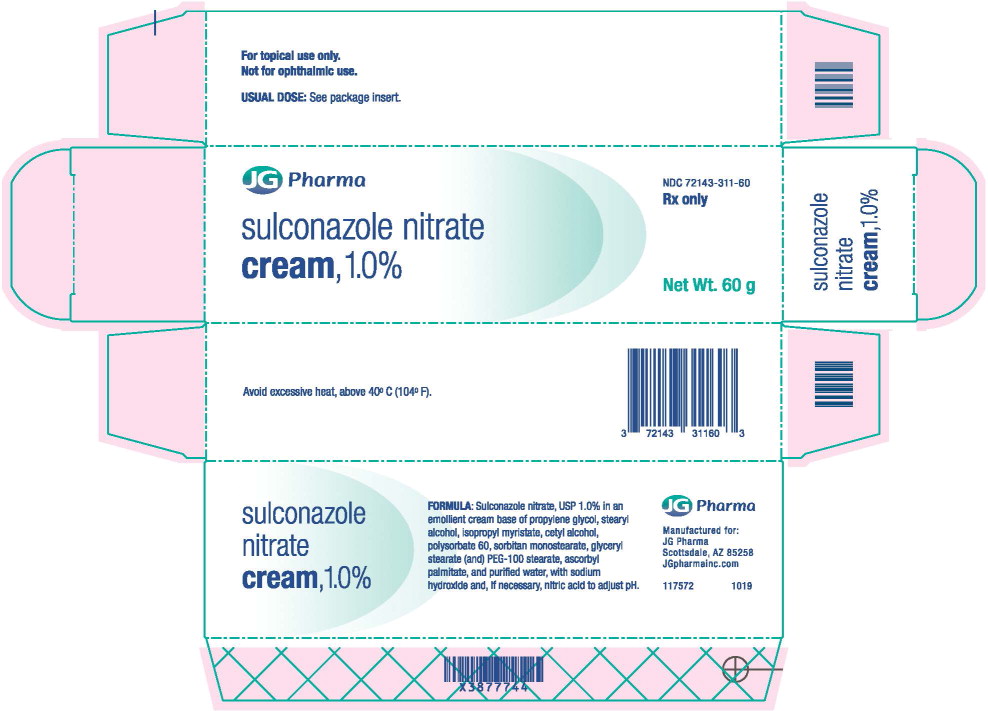
Sulconazole Nitrate 10 mg/g Cream
🆔 Identity & classification
Where does this data come from?
🏷️ RxNorm drug class
This medicine belongs to the Azole Antifungal class.
Where does this data come from?
🏭 Manufacturer & labeler
Where does this data come from?
🩺 Clinical
Sulconazole is used to treat skin infections such as athlete's foot (cream only), jock itch, and ringworm. This medication is sometimes prescribed for other uses; ask your doctor or pharmacist for more information.
Read the full MedlinePlus article ↗- Sulconazole treats common fungal skin infections — specifically jock itch (tinea cruris), ringworm on the body (tinea corporis), and tinea versicolor, which causes patchy skin disc...
- Most people start to feel relief — less itching or irritation — within a few days of starting treatment. You should notice visible improvement to your skin within about a week. Tha...
- If you've ever had a reaction to sulconazole specifically — or to any ingredient in the product — you should not use it. Make sure to tell your doctor or pharmacist about any past...
- Can I use this if I'm allergic to other antifungals?
Patient education
Supplement & herbal interactions
Where does this data come from?
Ask a licensed pharmacist directly — free, answered by our team.
🧪 Inactive Ingredients / Excipients
Inactive ingredients, also called excipients, are components of the drug product other than the active ingredient. They may include fillers, dyes, coatings, preservatives, flavors, or other formulation ingredients.
💡 Tap an ingredient (hover on desktop) to see what it is and why it’s used.
-
UNII QN83US2B0N
Ascorbyl palmitate is a fat-soluble form of vitamin C used as an antioxidant in medicines. It prevents oils and fats in the product from breaking down and becoming less stable over time.
-
UNII 936JST6JCN
Cetyl alcohol is a waxy, fatty substance derived from plant or animal sources. It acts as an emulsifier and thickener in medicines, helping blend oil and water components and giving products a smooth, creamy texture.
-
UNII 230OU9XXE4
A waxy substance made from glycerin and stearic acid that acts as an emulsifier to blend oily and watery ingredients together. It also helps thicken and stabilize the medicine's texture.
-
UNII 0RE8K4LNJS
Isopropyl myristate is an oily liquid made from coconut or palm oil. It's used in medicines as an emollient and penetration enhancer to help the medicine absorb through skin or improve spreadability in topical products.
-
UNII 411VRN1TV4
Nitric acid is a strong chemical used in small amounts during drug manufacturing to adjust and maintain the proper acid-base balance of a medicine, ensuring stability and correct formulation.
-
UNII YD01N1999R
A waxy substance made from polyethylene glycol and stearic acid. It helps mix oil and water-based ingredients together and serves as an emulsifier and solubilizer in liquid and semi-solid medicines.
-
UNII CAL22UVI4M
A synthetic emulsifier derived from sorbitol and fatty acids. It helps mix oil and water-based ingredients together and improves the texture and stability of the medicine.
-
UNII 6DC9Q167V3
Propylene glycol is a clear liquid derived from petroleum or vegetable sources. It acts as a solvent, humectant, and preservative in medicines, helping dissolve active ingredients and maintain product stability.
-
UNII 55X04QC32I
A strong alkaline chemical used to adjust and maintain the pH balance of liquid medicines. It helps keep the medicine stable and ensures it stays effective during storage.
-
UNII NVZ4I0H58X
A waxy substance made from sorbitol and stearic acid. It acts as an emulsifier and stabilizer, helping keep oil and water mixed together and preventing separation in the medicine.
-
UNII 2KR89I4H1Y
Stearyl alcohol is a waxy, fatty substance derived from natural oils or made synthetically. It acts as an emulsifier and thickener in medicines, helping mix ingredients together and give the product the right texture.
-
UNII 059QF0KO0R
Water is a liquid solvent that dissolves and mixes ingredients together in liquid medicines, syrups, and injections. It helps distribute the active drug evenly throughout the product.
12 inactive ingredients listed in the exact product block matched to this NDC.
Where does this data come from?
ingredient classCode="IACT" elements from the exact product block matched by this NDC. Label-section narrative from DailyMed / the openFDA label index is shown separately when available.Inactive ingredient FAQ
Are inactive ingredients the same for every manufacturer?
Why might an inactive ingredient be missing?
Can inactive ingredients matter?
💲 Pricing
A drug doesn't have one price. Each row is a different public payment system, and none is what you'd pay at the counter — that depends on your insurance. The ⓘ on each row explains what it measures.
| Price system | Per g | Per package |
|---|---|---|
| Retail pharmacies payNADAC · weekly | Not in the retail survey — common for institutional, discontinued, or low-volume packs. | |
| Medicaid paysCMS SDUD · 12 mo | No recent Medicaid claims on file for this NDC — rare and low-volume NDCs are suppressed in the public data. | |
| Medicare drug plans payPart D · quarterly | No Part D plan price is available for this NDC in our data. | |
Where does this data come from?
🔁 Therapeutic equivalents
| Product | Labeler | Pack | NADAC/unit | TE | Status | Price vs. this |
|---|---|---|---|---|---|---|
| Exelderm 10 mg/g 69489-0711-60 | Journey | 1 tube | — | — | FDA listed | — |
| Sulconazole Nitrate 10 mg/gthis 72143-0311-60 | JG | 1 tube | — | — | FDA listed | — |
Where does this data come from?
⏳ Availability & generic status
We did not find an FDA-approved generic match for this exact strength, form and route.
Where does this data come from?
📊 Medicare Part D spend CMS · PART D · 2026 (Q1)
🔬 Reported adverse events (FAERS)
Top reported reactions
Age at onset
Reporter sex
Serious outcomes
Where does this data come from?
📦 Packaging — all sizes for this product
| Package NDC | Description | Marketing start | Status |
|---|---|---|---|
| 72143-0311-60 You're viewing this | 1 TUBE in 1 CARTON (72143-311-60) / 60 g in 1 TUBE | 2020-02-04 | Active |
🧭 About this NDC listing & data coverage
What data is (and isn’t) available for this NDC — tap to expand
| NDC identity (package / product / labeler codes) | ✓ Available |
| Labeler | ✓ Available |
| Product & package description | ✓ Available |
| Marketing category & status | ✓ Available |
| Active ingredient / dosage form / route | ✓ Available |
| FDA label (SPL via DailyMed) | ✓ Available |
| Package photos | ✓ Available |
| Inactive ingredients (structured) | ✓ Available |
| NADAC pharmacy acquisition price (CMS) | — Not published for this NDC CMS publishes NADAC only for NDCs reported in its retail-pharmacy survey. |
| Orange Book / therapeutic-equivalence data | — Not published for this NDC Applies only to products approved under an NDA/ANDA; many listings are out of scope. |
| HCPCS J-code billing crosswalk | — Not published for this NDC Most self-administered / retail products have no J-code — that is normal. |
| Medicaid utilization (CMS SDUD) | — Not published for this NDC CMS reports utilization only for NDCs with Medicaid claims above its privacy threshold. |
Questions about this listing
Why is there no price listed?
Is the NDC printed on the package the same as the 11-digit billing NDC?
What do the three segments of this NDC mean?
Is this package still being marketed?
Who lists this product with the FDA?
Do I need a prescription for this product?
Where does this data come from?
📄 Full prescribing information FDA SPL
🎯 Indications and Usage ▾
INDICATIONS AND USAGE SULCONAZOLE NITRATE cream 1.0% is an antifungal agent indicated for the treatment of tinea pedis (athlete's foot), tinea cruris, and tinea corporis caused by Trichophyton rubrum, Trichophyton mentagro- phytes, Epidermophyton floccosum , and Microsporum canis ,* and for the treatment of tinea versicolor.
⏱️ Dosage and Administration ▾
DOSAGE AND ADMINISTRATION A small amount of cream should be gently massaged into the affected and surrounding skin areas once or twice daily, except in tinea pedis, where administration should be twice daily. Early relief of symptoms is experienced by the majority of patients and clinical improvement may be seen fairly soon after treatment is begun; however, tinea corporis/cruris and tinea versicolor should be treated for 3 weeks and tinea pedis for 4 weeks to reduce the possibility of recurrence. If significant clinical improvement is not seen after 4 to 6 weeks of treatment, an alternate diagnosis should be considered.
⛔ Contraindications ▾
CONTRAINDICATIONS SULCONAZOLE NITRATE cream 1.0% is contraindicated in patients who have a history of hypersensitivity to any of its ingredients.
🤒 Adverse Reactions ▾
ADVERSE REACTIONS There were no systemic effects and only infrequent cutaneous adverse reactions in 1185 patients treated with sulconazole nitrate cream in controlled clinical trials. Approximately 3% of these patients reported itching, 3% burning or stinging, and 1% redness. These complaints did not usually interfere with treatment.
🤰 Pregnancy ▾
Pregnancy There are no adequate and well-controlled studies in pregnant women. Sulconazole nitrate should be used during pregnancy only if clearly needed. Sulconazole nitrate has been shown to be embryotoxic in rats when given in doses of 125 times the adult human dose (in mg/kg).
The drug was not teratogenic in rats or rabbits at oral doses of 50 mg/kg/day. Sulconazole nitrate given orally to rats at a dose 125 times the human dose resulted in prolonged gestation and dystocia. Several females died during the prenatal period, most likely due to labor complications.
🧒 Pediatric Use ▾
Pediatric Use Safety and effectiveness in children have not been established.
🧓 Geriatric Use ▾
Geriatric Use Clinical studies of SULCONAZOLE NITRATE cream 1.0%, did not include sufficient numbers of patients aged 65 years and over to determine whether they respond differently than younger patients. Other reported clinical experience has not identified differences in responses between elderly and younger patients.
🧬 Clinical Pharmacology ▾
CLINICAL PHARMACOLOGY Sulconazole nitrate is an imidazole derivative with broad-spectrum antifungal activity that inhibits the growth in vitro of the common pathogenic dermatophytes, including Trichophyton rubrum, Trichophyton mentagro- phytes, Epidermophyton floccosum and Microsporum canis . It also inhibits ( in vitro ) the organism responsible for tinea versicolor, Malassezia furfur . Sulconazole nitrate has been shown to be active in vitro against the following microorganisms, although clinical efficacy has not been established: Candida albicans and certain gram-positive bacteria.
A modified Draize test showed no allergic contact dermatitis and a phototoxicity study showed no phototoxic or photoallergic reaction to sulconazole nitrate cream. Maximization tests with sulconazole nitrate cream showed no evidence of contact sensitization or irritation.
📦 How Supplied / Storage and Handling ▾
HOW SUPPLIED SULCONAZOLE NITRATE cream 1.0% is a smooth, glossy white to off-white cream having a slight characteristic odor. It is supplied as follows: 60 g tube - NDC 72143-311-60 Avoid excessive heat, above 40° C (104° F). To report SUSPECTED ADVERSE REACTIONS, contact the FDA at 1-800-FDA-1088 or www.fda.gov/medwatch . Manufactured for: JG Pharma Scottsdale, AZ 85258 www.JGPharmainc.com 141079 September 2019
📋 Description ▾
DESCRIPTION SULCONAZOLE NITRATE cream 1.0% is a broad-spectrum antifungal agent intended for topical application. Sulconazole nitrate, USP, the active ingredient in SULCONAZOLE NITRATE cream, is an imidazole derivative with in vitro antifungal and antiyeast activity. Its chemical name is (±)-1-[2,4-Dichloro-β-[( p -chlorobenzyl)thio] phenethyl]imidazole mononitrate and it has the following chemical structure: Sulconazole nitrate, USP is a white to off-white crystalline powder with a molecular weight of 460.77.
It is freely soluble in pyridine; slightly soluble in ethanol, acetone, and chloroform; and very slightly soluble in water. It has a melting point of about 130°C. SULCONAZOLE NITRATE cream contains sulconazole nitrate, USP 10 mg/g in an emollient cream base consisting of propylene glycol, stearyl alcohol, isopropyl myristate, cetyl alcohol, polysorbate 60, sorbitan monostearate, glyceryl stearate (and) PEG-100 stearate, ascorbyl palmitate, and purified water, with sodium hydroxide and/or nitric acid added to adjust the pH.
Chemical Structure
💬 Information for Patients ▾
Information for Patients Patients should be told to use SULCONAZOLE NITRATE cream as directed by the physician, to use it externally only, and to avoid contact with the eyes.