
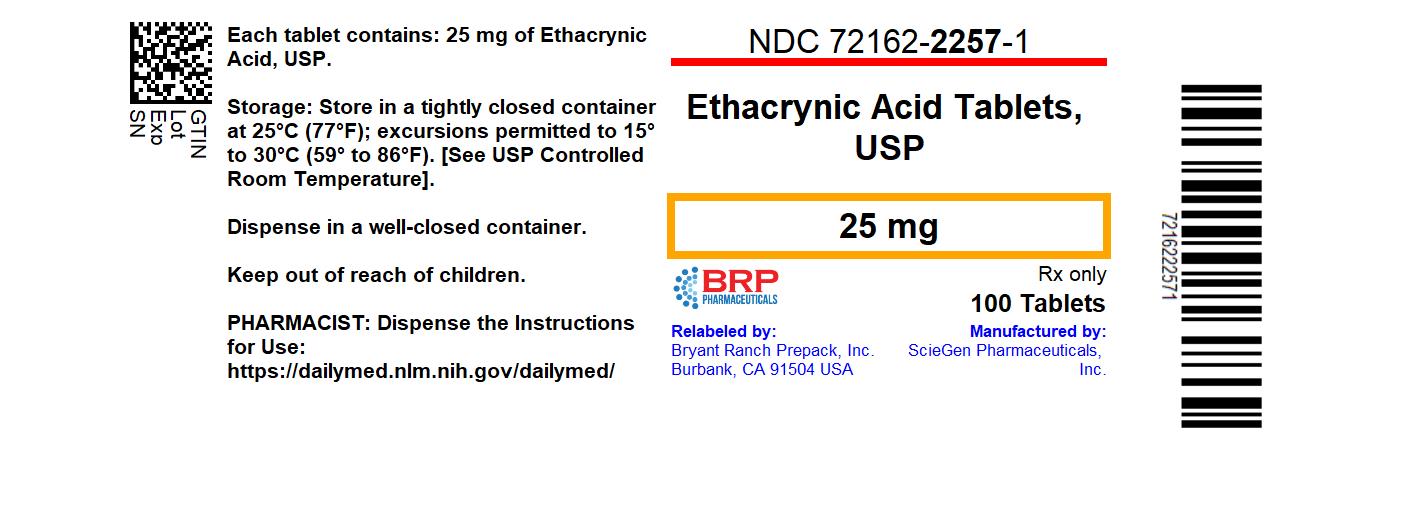
Ethacrynic Acid 25 mg Tablet, 100-count — NDC 72162-2257-1 (Billing 72162-2257-01)
This is a package of 100 tablets of Ethacrynic Acid 25 mg Tablet from Bryant Ranch Prepack, marketed since Aug 2019 and currently FDA-listed. It is this product's only package size.
NDC database record
One package, one record: these facts belong to NDC 72162-2257-1 alone.
- Record
- FDA NDC Directory package listing · Human prescription drug
- Code segments
- 72162 labeler · 2257 product · 1 package
- Package marketed since
- Aug 27, 2019
- Sample package
- No — commercial package
- Listing certified through
- Dec 31, 2026
- Billing quantity
- 100 EA per package
- Barcode (UPC-A, from the NDC)
- 3 7216222571 4
- FDA record last changed
- Jul 24, 2026
Identity & classification
Regulatory identifiers FDA, NLM and CMS codes for this package
Drug-database identifiers Medi-Span GPI and First Databank GCN / HICL / AHFS classification
- GSN (GCN sequence number): 008201
- GCN: 34910
- HICL (First Databank): 003659
- AHFS class code: 24:36.08.00
- RxCUI (RxNorm): 1251903
Where does this data come from?
- FDA openFDA NDC Directory · synced Oct 1, 2026
- FDA label on DailyMed · label index refreshed Oct 5, 2026
- RxNorm (NLM RxNav) · catalog refreshed Oct 1, 2026
- Medi-Span GPI (licensed)
- First Databank (licensed) · refreshed Oct 1, 2026
RxNorm drug class
This medicine belongs to the Loop Diuretic class.
Where does this data come from?
- RxClass (NLM) · catalog refreshed Oct 1, 2026
Clinical
- It's a strong diuretic — a water pill — used when milder diuretics aren't cutting it. Most commonly, you'd be prescribed it for fluid buildup (edema) related to congestive heart fa...
- What is ethacrynic acid actually used for?
- Take it by mouth after a meal — food helps reduce stomach upset. Your prescriber will tell you whether to take it once a day, twice a day, or on an every-other-day schedule. Start...
- How should I take my ethacrynic acid tablet?
Patient education
Supplement & herbal interactions
Some supplements/herbs that may interact with Ethacrynic Acid — tap one for details:
Ethacrynic Acid may be associated with lower levels of 8 nutrients — worth a chat with your pharmacist, not a cause for alarm.
Where does this data come from?
- MedlinePlus (NLM) · refreshed Oct 1, 2026
- FDA label on DailyMed · label index refreshed Oct 5, 2026
Ask a licensed pharmacist directly — free, answered by our team.
Pricing
A drug doesn't have one price. Each row is a different public payment system, and none is what you'd pay at the counter — that depends on your insurance. The ⓘ on each row explains what it measures.
| Price system | Per each | Per package |
|---|---|---|
| Retail pharmacies payNADAC · weekly | Not in the retail survey — common for institutional, discontinued, or low-volume packs. | |
| Medicaid paysCMS SDUD · 12 mo | No recent Medicaid claims on file for this NDC — rare and low-volume NDCs are suppressed in the public data. | |
| Medicare drug plans payPart D · Q2 2026 | $1.66 | $166.41 / 100 tablets |
Where does this data come from?
- CMS NADAC weekly file
- CMS ASP pricing files · refreshed Sep 20, 2026
- CMS Medicaid State Drug Utilization Data · refreshed Oct 5, 2026
- CMS Part D plan pricing files · refreshed Sep 24, 2026
- VA National Acquisition Center price file
Packaging — all sizes for this product
| Package NDC | Description | Marketing start | Marketing end | Status |
|---|---|---|---|---|
| 72162-2257-01 You're viewing this Main listing | 100 TABLET in 1 BOTTLE | 2019-08-27 | — | Active |
Therapeutic equivalents
| Product | Labeler | Pack | NADAC/unit | TE | Status | Price vs. this |
|---|---|---|---|---|---|---|
| Ethacrynic Acid 25 mg 00832-1690-11 | Upsher-Smith | 100 tablets | $0.807 | AB | Availability likely | — |
| Ethacrynic Acid 25 mg 42799-0405-01 | Edenbridge | 100 tablets | $0.807 | AB | Availability likely | — |
| Ethacrynic Acid 25 mg 68180-0159-01 | Lupin | 100 tablets | $0.807 | AB | Availability likely | — |
| Ethacrynic Acid 25 mg 69238-1126-01 | Amneal | 100 tablets | $0.807 | AB | Availability likely | — |
| ethacrynic acid 25 mg 68682-0011-10 | Oceanside | 100 tablets | $1.614 | AB | FDA listed | — |
| Edecrin 25 mg 25010-0215-15 | Bausch | 100 tablets | — | AB | FDA listed | — |
| Ethacrynic Acid 25 mg 50228-0334-01 | ScieGen | 1000 tablets | — | AB | FDA listed | — |
| Ethacrynic acid 25 mg 52817-0367-10 | TRUPHARMA | 100 tablets | — | AB | FDA listed | — |
| Ethacrynic Acid 25 mg 60760-0773-30 | St. | 30 tablets | — | AB | FDA listed | — |
| Ethacrynic Acid 25 mgthis 72162-2257-01 | Bryant | 100 tablets | — | AB | FDA listed | — |
Where does this data come from?
- FDA openFDA NDC Directory · synced Oct 1, 2026
- FDA Orange Book · refreshed Oct 3, 2026
- CMS NADAC weekly file
Availability & generic status
This product is an FDA-approved generic. Other versions of the same drug are listed under Therapeutic equivalents, least expensive first.
Where does this data come from?
- FDA Orange Book · refreshed Oct 3, 2026
Inactive Ingredients / Excipients
Inactive ingredients, also called excipients, are components of the drug product other than the active ingredient. They may include fillers, dyes, coatings, preservatives, flavors, or other formulation ingredients.
Where does this data come from?
IACT rows and label-wide narrative are kept separate; availability and product-level specificity depend on the submitted label.- FDA label on DailyMed · label index refreshed Oct 5, 2026
- FDA openFDA NDC Directory · synced Oct 1, 2026
Inactive ingredient FAQ
Are inactive ingredients the same for every manufacturer?
Why might an inactive ingredient be missing?
Can inactive ingredients matter?
Manufacturer & labeler
More NDCs from Bryant Ranch Prepack labeler code 72162
- Sodium Sulfacetamide 9% and Sulfur 4.5% Cleanser 90 mg/g; 45 mg/g Liquid NDC 72162-2250-2
- Dextroamphetamine Saccharate, Amphetamine Aspartate, Dextroamphetamine Sulfate and 5 mg; 5 mg; 5 mg; 5 mg Tablet NDC 72162-2251-1
- Regular Strength Pain Relief Acetaminophen 325 mg Tablet NDC 72162-2252-1
- Celecoxib 100 mg Capsule NDC 72162-2254-5
- Stool Softener Docusate Sodium 100 mg Capsule, Liquid Filled NDC 72162-2255-1
- Doxycycline Hyclate 20 mg Tablet NDC 72162-2256-1
- Halobetasol Propionate .5 mg/g Ointment NDC 72162-2258-2
- Metronidazole 7.5 mg/g Cream NDC 72162-2259-2
- Nifedipine 60 mg Tablet, Extended Release NDC 72162-2260-1
- Nifedipine 90 mg Tablet, Extended Release NDC 72162-2261-1
- Prochlorperazine Maleate 10 mg Tablet NDC 72162-2262-1
- Rocuronium 50 mg/5mL Injection, Solution NDC 72162-2263-2
Where does this data come from?
- FDA openFDA NDC Directory · synced Oct 1, 2026
- Drugs@FDA
Full prescribing information FDA SPL
🎯 Indications and Usage ▾
INDICATIONS AND USAGE Ethacrynic Acid Tablets, USP are indicated for treatment of edema when an agent with greater diuretic potential than those commonly employed is required. Treatment of the edema associated with congestive heart failure, cirrhosis of the liver, and renal disease, including the nephrotic syndrome. Short-term management of ascites due to malignancy, idiopathic edema, and lymphedema.
Short-term management of hospitalized pediatric patients, other than infants, with congenital heart disease or the nephrotic syndrome.
⏱️ Dosage and Administration ▾
DOSAGE AND ADMINISTRATION Dosage must be regulated carefully to prevent a more rapid or substantial loss of fluid or electrolyte than is indicated or necessary. The magnitude of diuresis and natriuresis is largely dependent on the degree of fluid accumulation present in the patient. Similarly, the extent of potassium excretion is determined in large measure by the presence and magnitude of aldosteronism.
Oral Use Ethacrynic Acid Tablets, USP are available for oral use as 25 mg tablets. Dosage: To Initiate Diuresis In Adults: The smallest dose required to produce gradual weight loss (about 1 pound to 2 pounds per day) is recommended. Onset of diuresis usually occurs at 50 mg to 100 mg for adults.
After diuresis has been achieved, the minimally effective dose (usually from 50 mg to 200 mg daily) may be given on a continuous or intermittent dosage schedule. Dosage adjustments are usually in 25 mg to 50 mg increments to avoid derangement of water and electrolyte excretion. The patient should be weighed under standard conditions before and during the institution of diuretic therapy with this compound.
Small alterations in dose should effectively prevent a massive diuretic response. The following schedule may be helpful in determining the smallest effective dose. Day 1 — 50 mg once daily after a meal Day 2 — 50 mg twice daily after meals, if necessary Day 3 — 100 mg in the morning and 50 mg to 100 mg following the afternoon or evening meal, depending upon response to the morning dose.
A few patients may require initial and maintenance doses as high as 200 mg twice daily. These higher doses, which should be achieved gradually, are most often required in patients with severe, refractory edema. In Pediatric Patients (excluding infants, see CONTRAINDICATIONS ) : The initial dose should be 25 mg.
Careful stepwise increments in dosage of 25 mg should be made to achieve effective maintenance. Maintenance Therapy It is usually possible to reduce the dosage and frequency of administration once dry weight has been achieved. Ethacrynic Acid Tablets, USP may be given intermittently after an effective diuresis is obtained with the regimen outlined above.
Dosage may be on an alternate daily schedule or more prolonged periods of diuretic therapy may be interspersed with rest periods. Such an intermittent dosage schedule allows time for correction of any electrolyte imbalance and may provide a more efficient diuretic response. The chloruretic effect of this agent may give rise to retention of bicarbonate and a metabolic alkalosis.
This may be corrected by giving chloride (ammonium chloride or arginine chloride). Ammonium chloride should not be given to cirrhotic patients. Ethacrynic Acid Tablets, USP has additive effects when used with other diuretics.
For example, a patient who is on maintenance dosage of an oral diuretic may require additional intermittent diuretic therapy, such as an organomercurial, for the maintenance of basal weight. The intermittent use of Ethacrynic Acid Tablets, USP orally may eliminate the need for injections of organomercurials. Small doses of Ethacrynic Acid Tablets, USP may be added to existing diuretic regimens to maintain basal weight.
This drug may potentiate the action of carbonic anhydrase inhibitors, with augmentation of natriuresis and kaliuresis. Therefore, when adding ethacrynic acid the initial dose and changes of dose should be in 25 mg increments, to avoid electrolyte depletion. Rarely, patients who failed to respond to ethacrynic acid have responded to older established agents.
While many patients do not require supplemental potassium, the use of potassium chloride or potassium sparing agents, or both, during treatment with Ethacrynic Acid Tablets, USP is advisable, especially in cirrhotic or nephrotic patients and in patients receiving digitalis. Salt liberalization usually prevents the development of hyponatremia and hypochloremia. During treatment with Ethacrynic Acid Tablets, USP salt may be liberalize… [Excerpted — this section continues on DailyMed.]
⛔ Contraindications ▾
CONTRAINDICATIONS All diuretics, including ethacrynic acid, are contraindicated in anuria. If increasing electrolyte imbalance, azotemia, and/or oliguria occur during treatment of severe, progressive renal disease, the diuretic should be discontinued. In a few patients this diuretic has produced severe, watery diarrhea.
If this occurs, it should be discontinued and not used again. Until further experience in infants is accumulated, therapy with oral and parenteral ethacrynic acid is contraindicated. Hypersensitivity to any component of this product.
⚠️ Warnings ▾
WARNINGS The effects of ethacrynic acid on electrolytes are related to its renal pharmacologic activity and are dose dependent. The possibility of profound electrolyte and water loss may be avoided by weighing the patient throughout the treatment period, by careful adjustment of dosage, by initiating treatment with small doses, and by using the drug on an intermittent schedule when possible. When excessive diuresis occurs, the drug should be withdrawn until homeostasis is restored.
When excessive electrolyte loss occurs, the dosage should be reduced or the drug temporarily withdrawn. Initiation of diuretic therapy with ethacrynic acid in the cirrhotic patient with ascites is best carried out in the hospital. When maintenance therapy has been established, the individual can be satisfactorily followed as an outpatient.
Ethacrynic acid should be given with caution to patients with advanced cirrhosis of the liver, particularly those with a history of previous episodes of electrolyte imbalance or hepatic encephalopathy. Like other diuretics it may precipitate hepatic coma and death. Too vigorous a diuresis, as evidenced by rapid and excessive weight loss, may induce an acute hypotensive episode.
In elderly cardiac patients, rapid contraction of plasma volume and the resultant hemoconcentration should be avoided to prevent the development of thromboembolic episodes, such as cerebral vascular thromboses and pulmonary emboli which may be fatal. Excessive loss of potassium in patients receiving digitalis glycosides may precipitate digitalis toxicity. Care should also be exercised in patients receiving potassium-depleting steroids.
A number of possibly drug-related deaths have occurred in critically ill patients refractory to other diuretics. These generally have fallen into two categories: (1) patients with severe myocardial disease who have been receiving digitalis and presumably developed acute hypokalemia with fatal arrhythmia; (2) patients with severely decompensated hepatic cirrhosis with ascites, with or without accompanying encephalopathy, who were in electrolyte imbalance and died because of intensification of the electrolyte defect. Deafness, tinnitus, and vertigo with a sense of fullness in the ears have occurred, most frequently in patients with severe impairment of renal function.
These symptoms have been associated most often with intravenous administration and with doses in excess of those recommended. The deafness has usually been reversible and of short duration (one to 24 hours). However, in some patients the hearing loss has been permanent.
A number of these patients were also receiving drugs known to be ototoxic. Ethacrynic acid may increase the ototoxic potential of other drugs (see PRECAUTIONS , Drug Interactions) . Lithium generally should not be given with diuretics (see PRECAUTIONS , Drug Interactions) .
🤒 Adverse Reactions ▾
ADVERSE REACTIONS Gastrointestinal Anorexia, malaise, abdominal discomfort or pain, dysphagia, nausea, vomiting, and diarrhea have occurred. These are more frequent with large doses or after one to three months of continuous therapy. A few patients have had sudden onset of profuse, watery diarrhea.
Discontinue Ethacrynic Acid Tablets, USP if diarrhea is severe and do not give it again. Gastrointestinal bleeding has occurred in some patients. Rarely, acute pancreatitis has been reported.
Metabolic Reversible hyperuricemia and acute gout have been reported. Acute symptomatic hypoglycemia with convulsions occurred in two uremic patients who received doses above those recommended. Hyperglycemia has been reported.
Rarely, jaundice and abnormal liver function tests have been reported in seriously ill patients receiving multiple drug therapy, including Ethacrynic Acid Tablets, USP. Hematologic Agranulocytosis or severe neutropenia has been reported in a few critically ill patients also receiving agents known to produce this effect. Thrombocytopenia has been reported rarely.
Henoch-Schönlein purpura has been reported rarely in patients with rheumatic heart disease receiving multiple drug therapy, including Ethacrynic Acid Tablets, USP. Special Senses (see WARNINGS ) Deafness, tinnitus and vertigo with a sense of fullness in the ears, and blurred vision have occurred. Central Nervous System Headache, fatigue, apprehension, confusion.
Miscellaneous Skin rash, fever, chills, hematuria.
🔄 Drug Interactions ▾
Drug Interactions Lithium generally should not be given with diuretics because they reduce its renal clearance and add a high risk of lithium toxicity. Read circulars for lithium preparations before use of such concomitant therapy. Ethacrynic acid may increase the ototoxic potential of other drugs such as aminoglycoside and some cephalosporin antibiotics.
Their concurrent use should be avoided. A number of drugs, including ethacrynic acid, have been shown to displace warfarin from plasma protein; a reduction in the usual anticoagulant dosage may be required in patients receiving both drugs. In some patients, the administration of a non-steroidal anti-inflammatory agent can reduce the diuretic, natriuretic, and antihypertensive effects of loop, potassium-sparing and thiazide diuretics.
Therefore, when ethacrynic acid and non-steroidal anti-inflammatory agents are used concomitantly, the patient should be observed closely to determine if the desired effect of the diuretic is obtained.
🤰 Pregnancy ▾
Pregnancy Pregnancy Category B: Reproduction studies in the mouse and rabbit at doses up to 50 times the human dose showed no evidence of external abnormalities of the fetus due to ethacrynic acid. In a two-litter study in the dog and rat, oral doses of 5 mg/kg/day or 20 mg/kg/day (2½ or 10 times the human dose), respectively, did not interfere with pregnancy or with growth and development of the pups. Although there was reduction in the mean body weights of the fetuses in a teratogenic study in the rat at a dose level of 100 mg/kg (50 times the human dose), there was no effect on mortality or postnatal development.
Functional and morphologic abnormalities were not observed. There are, however, no adequate and well-controlled studies in pregnant women. Since animal reproduction studies are not always predictive of human response, ethacrynic acid should be used during pregnancy only if clearly needed.
🧒 Pediatric Use ▾
Pediatric Use There are no well-controlled clinical trials in pediatric patients. The information on oral dosing in pediatric patients, other than infants, is supported by evidence from empiric use in this age group. For information on oral use in pediatric patients, other than infants, see INDICATIONS AND USAGE and DOSAGE AND ADMINISTRATION . Safety and effectiveness of oral and parenteral use in infants have not been established (see CONTRAINDICATIONS ).
🧓 Geriatric Use ▾
Geriatric Use Of the total number of subjects in clinical studies of ethacrynic acid, approximately 224 patients (21%) were 65 to 74 years of age, while approximately 100 patients (9%) were 75 years of age and over. No overall differences in safety or effectiveness were observed between these subjects and younger subjects, and other reported clinical experience has not identified differences in responses between the elderly and younger patients, but greater sensitivity of some older individuals cannot be ruled out. (See WARNINGS .) This drug is known to be substantially excreted by the kidney, and the risk of toxic reactions to this drug may be greater in patients with impaired renal function.
Because elderly patients are more likely to have decreased renal function, care should be taken in dose selection, and it may be useful to monitor renal function. (See CONTRAINDICATIONS .)
🆘 Overdosage ▾
OVERDOSAGE Overdosage may lead to excessive diuresis with electrolyte depletion and dehydration. In the event of overdosage, symptomatic and supportive measures should be employed. Emesis should be induced or gastric lavage performed.
Correct dehydration, electrolyte imbalance, hepatic coma, and hypotension by established procedures. If required, give oxygen or artificial respiration for respiratory impairment. In the mouse, the oral LD 50 of ethacrynic acid is 627 mg/kg.
🧬 Clinical Pharmacology ▾
CLINICAL PHARMACOLOGY Pharmacokinetics and Metabolism Ethacrynic acid acts on the ascending limb of the loop of Henle and on the proximal and distal tubules. Urinary output is usually dose dependent and related to the magnitude of fluid accumulation. Water and electrolyte excretion may be increased several times over that observed with thiazide diuretics, since ethacrynic acid inhibits reabsorption of a much greater proportion of filtered sodium than most other diuretic agents.
Therefore, ethacrynic acid is effective in many patients who have significant degrees of renal insufficiency (see WARNINGS concerning deafness ) . Ethacrynic acid has little or no effect on glomerular filtration or on renal blood flow, except following pronounced reductions in plasma volume when associated with rapid diuresis. The electrolyte excretion pattern of ethacrynic acid varies from that of the thiazides and mercurial diuretics.
Initial sodium and chloride excretion is usually substantial and chloride loss exceeds that of sodium. With prolonged administration, chloride excretion declines, and potassium and hydrogen ion excretion may increase. Ethacrynic acid is effective whether or not there is clinical acidosis or alkalosis.
Although ethacrynic acid, in carefully controlled studies in animals and experimental subjects, produces a more favorable sodium/potassium excretion ratio than the thiazides, in patients with increased diuresis excessive amounts of potassium may be excreted. Onset of action is rapid, usually within 30 minutes after an oral dose of ethacrynic acid. After oral use, diuresis peaks in about 2 hours and lasts about 6 to 8 hours.
The sulfhydryl binding propensity of ethacrynic acid differs somewhat from that of the organomercurials. Its mode of action is not by carbonic anhydrase inhibition. Ethacrynic acid does not cross the blood-brain barrier.
📦 How Supplied / Storage and Handling ▾
HOW SUPPLIED Ethacrynic Acid Tablets, USP 25 mg, are white, capsule shaped scored (functional scoring) tablets debossed with 'SG' on scored side and '334' on the other side and supplied as NDC 72162-2257-1: 100 Tablets in a BOTTLE Storage Store in a tightly closed container at 25°C (77°F); excursions permitted to 15° to 30°C (59° to 86°F) [See USP Controlled Room Temperature]. Repackaged/Relabeled by: Bryant Ranch Prepack, Inc. Burbank, CA 91504
📋 Description ▾
DESCRIPTION Ethacrynic acid is an unsaturated ketone derivative of an aryloxyacetic acid. It is designated chemically as [2,3-dichloro-4-(2-methylene-1-oxobutyl)phenoxy] acetic acid, and has a molecular weight of 303.14. Ethacrynic acid is a white, or practically white, odor less or practically odorless, crystalline powder, freely soluble in alcohol, chloroform and ether, very slightly soluble in water.
Its empirical formula is C 13 H 12 Cl 2 O 4 and its structural formula is: Ethacrynic Acid Tablets USP are supplied as 25 mg tablets for oral use. The tablets contain the following inactive ingredients: lactose monohydrate, pregelatinized starch (corn), colloidal silicon dioxide, talc and calcium stearate. FDA approved dissolution specification differs from the USP dissolution specification.
⚠️ Precautions ▾
PRECAUTIONS General Weakness, muscle cramps, paresthesias, thirst, anorexia, and signs of hyponatremia, hypokalemia, and/or hypochloremic alkalosis may occur following vigorous or excessive diuresis and these may be accentuated by rigid salt restriction. Rarely, tetany has been reported following vigorous diuresis. During therapy with ethacrynic acid, liberalization of salt intake and supplementary potassium chloride are often necessary.
When a metabolic alkalosis may be anticipated, e.g., in cirrhosis with ascites, the use of potassium chloride or a potassium-sparing agent before and during therapy with ethacrynic acid may mitigate or prevent the hypokalemia. Loop diuretics have been shown to increase the urinary excretion of magnesium; this may result in hypomagnesemia. The safety and efficacy of ethacrynic acid in hypertension have not been established.
However, the dosage of coadministered antihypertensive agents may require adjustment. Orthostatic hypotension may occur in patients receiving other antihypertensive agents when given ethacrynic acid. Ethacrynic acid has little or no effect on glomerular filtration or on renal blood flow, except following pronounced reductions in plasma volume when associated with rapid diuresis.
A transient increase in serum urea nitrogen may occur. Usually, this is readily reversible when the drug is discontinued. As with other diuretics used in the treatment of renal edema, hypoproteinemia may reduce responsiveness to ethacrynic acid and the use of salt-poor albumin should be considered.
A number of drugs, including ethacrynic acid, have been shown to displace warfarin from plasma protein; a reduction in the usual anticoagulant dosage may be required in patients receiving both drugs. Ethacrynic acid may increase the risk of gastric hemorrhage associated with corticosteroid treatment. Laboratory Tests Frequent serum electrolyte, CO 2 and BUN determinations should be performed early in therapy and periodically thereafter during active diuresis.
Any electrolyte abnormalities should be corrected or the drug temporarily withdrawn. Increases in blood glucose and alterations in glucose tolerance tests have been observed in patients receiving ethacrynic acid. Drug Interactions Lithium generally should not be given with diuretics because they reduce its renal clearance and add a high risk of lithium toxicity.
Read circulars for lithium preparations before use of such concomitant therapy. Ethacrynic acid may increase the ototoxic potential of other drugs such as aminoglycoside and some cephalosporin antibiotics. Their concurrent use should be avoided.
A number of drugs, including ethacrynic acid, have been shown to displace warfarin from plasma protein; a reduction in the usual anticoagulant dosage may be required in patients receiving both drugs. In some patients, the administration of a non-steroidal anti-inflammatory agent can reduce the diuretic, natriuretic, and antihypertensive effects of loop, potassium-sparing and thiazide diuretics. Therefore, when ethacrynic acid and non-steroidal anti-inflammatory agents are used concomitantly, the patient should be observed closely to determine if the desired effect of the diuretic is obtained.
Carcinogenesis, Mutagenesis, Impairment of Fertility There was no evidence of a tumorigenic effect in a 79-week oral chronic toxicity study in rats at doses up to 45 times the human dose. Ethacrynic acid had no effect on fertility in a two-litter study in rats or a two-generation study in mice at 10 times the human dose. Pregnancy Pregnancy Category B: Reproduction studies in the mouse and rabbit at doses up to 50 times the human dose showed no evidence of external abnormalities of the fetus due to ethacrynic acid.
In a two-litter study in the dog and rat, oral doses of 5 mg/kg/day or 20 mg/kg/day (2½ or 10 times the human dose), respectively, did not interfere with pregnancy or with growth and development of the pups. Although there was reduction in the mean body… [Excerpted — this section continues on DailyMed.]
🍼 Nursing Mothers ▾
Nursing Mothers It is not known whether this drug is excreted in human milk. Because many drugs are excreted in human milk and because of the potential for serious adverse reactions in nursing infants from ethacrynic acid, a decision should be made whether to discontinue nursing or to discontinue the drug, taking into account the importance of the drug to the mother.
🧬 Pharmacokinetics ▾
Pharmacokinetics and Metabolism Ethacrynic acid acts on the ascending limb of the loop of Henle and on the proximal and distal tubules. Urinary output is usually dose dependent and related to the magnitude of fluid accumulation. Water and electrolyte excretion may be increased several times over that observed with thiazide diuretics, since ethacrynic acid inhibits reabsorption of a much greater proportion of filtered sodium than most other diuretic agents.
Therefore, ethacrynic acid is effective in many patients who have significant degrees of renal insufficiency (see WARNINGS concerning deafness ) . Ethacrynic acid has little or no effect on glomerular filtration or on renal blood flow, except following pronounced reductions in plasma volume when associated with rapid diuresis. The electrolyte excretion pattern of ethacrynic acid varies from that of the thiazides and mercurial diuretics.
Initial sodium and chloride excretion is usually substantial and chloride loss exceeds that of sodium. With prolonged administration, chloride excretion declines, and potassium and hydrogen ion excretion may increase. Ethacrynic acid is effective whether or not there is clinical acidosis or alkalosis.
Although ethacrynic acid, in carefully controlled studies in animals and experimental subjects, produces a more favorable sodium/potassium excretion ratio than the thiazides, in patients with increased diuresis excessive amounts of potassium may be excreted. Onset of action is rapid, usually within 30 minutes after an oral dose of ethacrynic acid. After oral use, diuresis peaks in about 2 hours and lasts about 6 to 8 hours.
The sulfhydryl binding propensity of ethacrynic acid differs somewhat from that of the organomercurials. Its mode of action is not by carbonic anhydrase inhibition. Ethacrynic acid does not cross the blood-brain barrier.
📄 Carcinogenesis, Mutagenesis, Impairment of Fertility ▾
Carcinogenesis, Mutagenesis, Impairment of Fertility There was no evidence of a tumorigenic effect in a 79-week oral chronic toxicity study in rats at doses up to 45 times the human dose. Ethacrynic acid had no effect on fertility in a two-litter study in rats or a two-generation study in mice at 10 times the human dose.
📄 Package Label / Principal Display Panel ▾
Ethacrynic Acid 25mg Tablet Label
Medicare Part D spend CMS · PART D · 2026 (Q1)
About this NDC listing & data coverage
What data is (and isn’t) available for this NDC — tap to expand
| NDC identity (package / product / labeler codes) | ✓ Available |
| Labeler | ✓ Available |
| Product & package description | ✓ Available |
| Marketing category & status | ✓ Available |
| Active ingredient / dosage form / route | ✓ Available |
| FDA label (SPL via DailyMed) | ✓ Available |
| Package photos | ✓ Available |
| Inactive ingredients (structured) | — Not published for this NDC The labeler did not submit a structured excipient list, or no SPL is available. |
| NADAC pharmacy acquisition price (CMS) | — Not published for this NDC CMS publishes NADAC only for NDCs reported in its retail-pharmacy survey. |
| Orange Book / therapeutic-equivalence data | ✓ Available |
| HCPCS J-code billing crosswalk | — Not published for this NDC Most self-administered / retail products have no J-code — that is normal. |
| Medicaid utilization (CMS SDUD) | — Not published for this NDC CMS reports utilization only for NDCs with Medicaid claims above its privacy threshold. |