
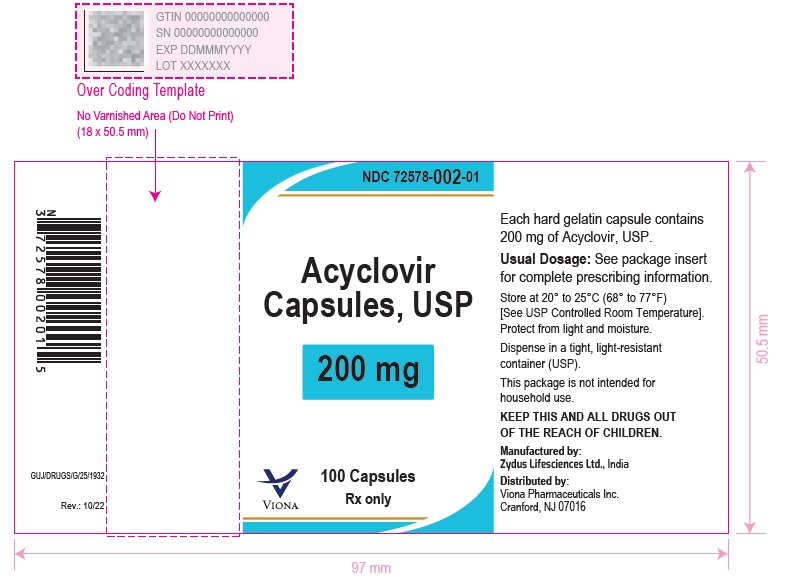
acyclovir 200 mg Capsule, 100-count — NDC 72578-002-01 (Billing 72578-0002-01)
This is a package of 100 capsules of acyclovir 200 mg Capsule from Viona Pharmaceuticals Inc, marketed since Aug 2019 and currently FDA-listed; retail pharmacies pay about $0.0977 per capsule (NADAC). It is the main listing for this product, which comes in 5 package sizes.
Identity & classification
Regulatory identifiers FDA, NLM and CMS codes for this package
Drug-database identifiers Medi-Span GPI and First Databank GCN / HICL / AHFS classification
- GSN (GCN sequence number): 009630
- GCN: 43790
- GPI-14 (Medi-Span): 12405010000110
- HICL (First Databank): 004183
- AHFS class code: 08:18.32.00
- RxCUI (RxNorm): 197310
Where does this data come from?
- FDA openFDA NDC Directory · synced Oct 1, 2026
- FDA label on DailyMed · label index refreshed Oct 1, 2026
- RxNorm (NLM RxNav) · catalog refreshed Oct 1, 2026
- Medi-Span GPI (licensed)
- First Databank (licensed) · refreshed Oct 1, 2026
RxNorm drug class
This medicine belongs to the Herpesvirus Nucleoside Analog DNA Polymerase Inhibitor class.
Where does this data come from?
- RxClass (NLM) · catalog refreshed Oct 1, 2026
Clinical
Acyclovir is used to treat viral infections like chickenpox, herpes zoster (shingles) and genital herpes (a sexually transmitted disease). Acyclovir is in a class of medications called antivirals. It works by stopping the spread of the virus in the body. Acyclovir will not cure herpes infections and may not stop the spread of herpes virus to other people.
Read the full MedlinePlus article ↗- Acyclovir treats infections caused by herpes-family viruses. Oral forms treat shingles, genital herpes and chickenpox. Creams, ointments, the eye ointment, the buccal tablet and th...
- As early as possible. For cold sores, that means at the first tingling, itching or burning. For genital herpes recurrences, start at the first sign of an outbreak. Early treatment...
- The most common ones are headache, nausea and belly pain. Some people also get vomiting, dizziness or fatigue. These are usually manageable, but tell me if they bother you.
- Call right away for confusion, hallucinations, seizures or unusual drowsiness. Also call if you urinate much less than usual, which can signal kidney trouble. Any allergic reaction...
Patient education
Supplement & herbal interactions
Some supplements/herbs that may interact with Acyclovir — tap one for details:
Where does this data come from?
- MedlinePlus (NLM) · refreshed Oct 1, 2026
- FDA label on DailyMed · label index refreshed Oct 1, 2026
Ask a licensed pharmacist directly — free, answered by our team.
Pricing
A drug doesn't have one price. Each row is a different public payment system, and none is what you'd pay at the counter — that depends on your insurance. The ⓘ on each row explains what it measures.
| Price system | Per ea | Per package |
|---|---|---|
| Retail pharmacies payNADAC · weekly | $0.098 | $9.77 / 100 capsules |
| Medicaid paysCMS SDUD · 12 mo | $0.2145 | $21.45 / 100 capsules |
| Medicare drug plans payPart D · Q2 2026 | $0.1791 | $17.91 / 100 capsules |
| Medicare Part B allowsASP · J8499 | No ASP payment limit on file for J8499 this quarter. | |
Where does this data come from?
- CMS NADAC weekly file · file of Sep 30, 2026
- CMS ASP pricing files · refreshed Sep 20, 2026
- CMS Medicaid State Drug Utilization Data · through Q1 2026
- CMS Part D plan pricing files · refreshed Sep 24, 2026
- VA National Acquisition Center price file
Billing & reimbursement
Where does this data come from?
- CMS ASP NDC-HCPCS crosswalk · refreshed Sep 22, 2026
- DMEPDAC NDC-HCPCS crosswalk
- openFDA NSDE billing units · refreshed Sep 7, 2026
Packaging — all sizes for this product
| Package NDC | Description | Per unit | Per pack | Marketing start | Marketing end | Status |
|---|---|---|---|---|---|---|
| 72578-0002-01 You're viewing this Main listing | 100 CAPSULE in 1 BOTTLE | $0.0977 / ea | $9.77 | 2019-08-23 | — | Active |
| 72578-0002-05 72578-002-05 | 500 CAPSULE in 1 BOTTLE | $0.0977 / ea | $48.87 | 2019-08-23 | — | Active |
| 72578-0002-06 72578-002-06 | 30 CAPSULE in 1 BOTTLE | — | — | 2019-08-23 | — | Active |
| 72578-0002-10 72578-002-10 | 1000 CAPSULE in 1 BOTTLE | — | — | 2019-08-23 | — | Active |
| 72578-0002-16 72578-002-16 | 90 CAPSULE in 1 BOTTLE | — | — | 2019-08-23 | — | Active |
You're viewing one of 5 pack sizes for this product.
This pack has the lowest per-ea cost of the 2 priced pack sizes ($0.0977 NADAC).
In Medicaid, this is the most-dispensed pack of this product — about 90% of fills over the last four reported quarters. See all packs ↓
Pack size FAQ
What quantity is in this package?
How does this package differ from NDC 72578-0002-06?
What NDC number is used to bill for this package of acyclovir 200 mg Capsule?
Prices are the latest CMS NADAC pharmacy acquisition cost per NDC; per-pack figures are per-unit × pack quantity, shown only when the pack is denominated in the same measure NADAC prices.
Therapeutic equivalents
| Product | Labeler | Pack | NADAC/unit | TE | Status | Price vs. this |
|---|---|---|---|---|---|---|
| Acyclovir 200 mg 00904-5789-61 | Major | 100 capsules | $0.097 | AB | Discontinued | +0% |
| Acyclovir 200 mg 00904-7519-61 | Major | 100 capsules | $0.098 | AB | Availability likely | — |
| Acyclovir 200 mg 23155-0229-01 | Heritage | 100 capsules | $0.098 | AB | Availability likely | — |
| Acyclovir 200 mg 23155-0962-01 | Avet | 100 capsules | $0.098 | AB | Availability likely | — |
| Acyclovir 200 mg 61442-0114-01 | Carlsbad | 100 capsules | $0.098 | AB | Availability likely | — |
| Acyclovir 200 mg 62135-0039-50 | Chartwell | 50 capsules | $0.098 | AB | Availability likely | — |
| Acyclovir 200 mg 69076-0146-01 | Quinn | 100 capsules | $0.098 | AB | Availability likely | — |
| Acyclovir 200 mg 71921-0146-01 | Florida | 100 capsules | $0.098 | AB | Availability likely | — |
| Acyclovir 200 mg 72241-0028-05 | Modavar | 100 capsules | $0.098 | AB | Availability likely | — |
| acyclovir 200 mgthis 72578-0002-01 | Viona | 100 capsules | $0.098 | AB | Availability likely | — |
| Acyclovir 200 mg 75834-0124-01 | Nivagen | 100 capsules | $0.105 | AB | Discontinued | +8% |
| Acyclovir 200 mg 50090-5610-00 | A-S | 25 capsules | — | AB | FDA listed | — |
| acyclovir 200 mg 50090-7216-00 | A-S | 25 capsules | — | AB | FDA listed | — |
| Acyclovir 200 mg 51407-0852-01 | Golden | 100 capsules | — | AB | FDA listed | — |
| acyclovir 200 mg 51655-0965-52 | Northwind | 30 capsules | — | AB | FDA listed | — |
| Acyclovir 200 mg 55154-0199-00 | Cardinal | 10 capsules | — | AB | FDA listed | — |
| Acyclovir 200 mg 55154-7629-00 | Cardinal | 10 capsules | — | AB | Discontinued | — |
| Acyclovir 200 mg 60505-0042-05 | Apotex | 500 capsules | — | AB | Discontinued | — |
| Acyclovir 200 mg 63629-2009-01 | Bryant | 500 capsules | — | AB | FDA listed | — |
| acyclovir 200 mg 65841-0829-01 | Zydus | 100 capsules | — | AB | FDA listed | — |
| Acyclovir 200 mg 68071-2299-03 | NuCare | 30 capsules | — | AB | FDA listed | — |
| Acyclovir 200 mg 68071-2526-03 | NuCare | 30 capsules | — | AB | FDA listed | — |
| Acyclovir 200 mg 69117-0039-01 | YILING | 100 capsules | — | AB | FDA listed | — |
| acyclovir 200 mg 70518-3436-00 | REMEDYREPACK | 30 capsules | — | AB | FDA listed | — |
| Acyclovir 200 mg 71205-0209-30 | Proficient | 30 capsules | — | AB | FDA listed | — |
| Acyclovir 200 mg 71205-0243-30 | Proficient | 30 capsules | — | AB | FDA listed | — |
| Acyclovir 200 mg 71205-0578-30 | Proficient | 30 capsules | — | AB | FDA listed | — |
| Acyclovir 200 mg 71209-0004-05 | Cadila | 100 capsules | — | AB | FDA listed | — |
| Acyclovir 200 mg 71335-0280-00 | Bryant | 90 capsules | — | AB | FDA listed | — |
| Acyclovir 200 mg 71335-0470-00 | Bryant | 90 capsules | — | AB | FDA listed | — |
| Acyclovir 200 mg 71335-1290-00 | Bryant | 90 capsules | — | AB | FDA listed | — |
| acyclovir 200 mg 71335-2261-00 | Bryant | 90 capsules | — | AB | FDA listed | — |
| Acyclovir 200 mg 72162-1704-00 | Bryant | 120 capsules | — | AB | FDA listed | — |
| Acyclovir 200 mg 72162-1908-00 | Bryant | 30 capsules | — | AB | FDA listed | — |
| acyclovir 200 mg 72789-0536-50 | PD-Rx | 50 capsules | — | AB | FDA listed | — |
| acyclovir 200 mg 82804-0245-30 | Proficient | 30 capsules | — | AB | FDA listed | — |
Where does this data come from?
- FDA openFDA NDC Directory · synced Oct 1, 2026
- FDA Orange Book · refreshed Sep 3, 2026
- CMS NADAC weekly file · file of Sep 30, 2026
Availability & generic status
This product is an FDA-approved generic. Other versions of the same drug are listed under Therapeutic equivalents, least expensive first.
Where does this data come from?
- FDA Orange Book · refreshed Sep 3, 2026
What it looks like
Where does this data come from?
- FDA label on DailyMed · label index refreshed Oct 1, 2026
Inactive Ingredients / Excipients
Inactive ingredients, also called excipients, are components of the drug product other than the active ingredient. They may include fillers, dyes, coatings, preservatives, flavors, or other formulation ingredients.
💡 Tap an ingredient (hover on desktop) to see what it is and why it’s used.
-
UNII H3R47K3TBD
FD&C Blue No. 1 is a synthetic blue dye approved for use in foods and medicines. It serves as a colorant to give the medication its distinctive appearance and help with product identification.
-
UNII PN2ZH5LOQY
A synthetic red dye approved by the FDA for use in foods, medicines, and cosmetics. It serves as a colorant to make tablets, capsules, and liquids visually distinctive for product identification.
-
UNII 2G86QN327L
Gelatin is a protein derived from animal collagen, commonly used in medicines as a gelling agent and capsule material. It helps create soft or hard capsule shells that hold and release medication, and can also thicken liquid formulations.
-
UNII EWQ57Q8I5X
Lactose monohydrate is a natural sugar derived from milk. It serves as a filler and binder in tablets and capsules, helping create the proper size, texture, and consistency of the medicine.
-
UNII 70097M6I30
Magnesium stearate is a salt made from magnesium and stearic acid, a fatty substance. It's used in tablets and capsules as a lubricant and glidant to help ingredients flow smoothly during manufacturing and prevent sticking.
-
UNII 368GB5141J
A detergent and foaming agent derived from coconut or palm oil. In medications, it helps break down and mix oil and water-based ingredients, aids in tablet disintegration, and improves how the drug dissolves and spreads in the mouth or digestive system.
-
UNII O8232NY3SJ
A plant-based carbohydrate derived from corn kernels. It acts as a filler to add bulk, a binder to hold ingredients together, and a disintegrant to help the tablet break apart in your stomach for absorption.
-
UNII 15FIX9V2JP
Titanium dioxide is a bright white mineral powder commonly used as a colorant and opacifying agent. It makes pills and tablets white or lighter in color and helps make coatings non-transparent.
8 inactive ingredients listed in the exact product block matched to this NDC.
Where does this data come from?
ingredient classCode="IACT" elements from the exact product block matched by this NDC. Label-section narrative from DailyMed / the openFDA label index is shown separately when available.- FDA label on DailyMed · label index refreshed Oct 1, 2026
- FDA openFDA NDC Directory · synced Oct 1, 2026
Inactive ingredient FAQ
Are inactive ingredients the same for every manufacturer?
Why might an inactive ingredient be missing?
Can inactive ingredients matter?
Manufacturer & labeler
Where does this data come from?
- FDA openFDA NDC Directory · synced Oct 1, 2026
- Drugs@FDA
Full prescribing information FDA SPL
🎯 Indications and Usage ▾
INDICATIONS AND USAGE Herpes Zoster Infections: Acyclovir capsules are indicated for the acute treatment of herpes zoster (shingles). Genital Herpes: Acyclovir capsules are indicated for the treatment of initial episodes and the management of recurrent episodes of genital herpes. Chickenpox: Acyclovir capsules are indicated for the treatment of chickenpox (varicella).
⏱️ Dosage and Administration ▾
DOSAGE AND ADMINISTRATION Acute Treatment of Herpes Zoster: 800 mg every 4 hours orally, 5 times daily for 7 to 10 days. Genital Herpes: Treatment of Initial Genital Herpes: 200 mg every 4 hours, 5 times daily for 10 days. Chronic Suppressive Therapy for Recurrent Disease: 400 mg 2 times daily for up to 12 months, followed by re-evaluation.
Alternative regimens have included doses ranging from 200 mg 3 times daily to 200 mg 5 times daily. The frequency and severity of episodes of untreated genital herpes may change over time. After 1 year of therapy, the frequency and severity of the patient’s genital herpes infection should be re-evaluated to assess the need for continuation of therapy with acyclovir.
Intermittent Therapy: 200 mg every 4 hours, 5 times daily for 5 days. Therapy should be initiated at the earliest sign or symptom (prodrome) of recurrence. Treatment of Chickenpox: Children (2 years of age and older): 20 mg/kg per dose orally 4 times daily (80 mg/kg/day) for 5 days.
Children over 40 kg should receive the adult dose for chickenpox. Adults and Children over 40 kg: 800 mg 4 times daily for 5 days. Intravenous acyclovir is indicated for the treatment of varicella-zoster infections in immunocompromised patients.
When therapy is indicated, it should be initiated at the earliest sign or symptom of chickenpox. There is no information about the efficacy of therapy initiated more than 24 hours after onset of signs and symptoms. Patients With Acute or Chronic Renal Impairment: In patients with renal impairment, the dose of Acyclovir Capsules should be modified as shown in Table 3.
Table 3. Dosage Modification for Renal Impairment Normal Dosage Regimen Creatinine Clearance (mL/min/1.73 m 2 ) Adjusted Dosage Regimen Dose (mg) Dosing Interval 200 mg every 4 hours >10 200 every 4 hours, 5x daily 0 to 10 200 every 12 hours 400 mg every 12 hours >10 400 every 12 hours 0 to 10 200 every 12 hours 800 mg every 4 hours >25 800 every 4 hours, 5x daily 10 to 25 800 every 8 hours 0 to 10 800 every 12 hours Hemodialysis: For patients who require hemodialysis, the mean plasma half-life of acyclovir during hemodialysis is approximately 5 hours.
This results in a 60% decrease in plasma concentrations following a 6-hour dialysis period. Therefore, the patient’s dosing schedule should be adjusted so that an additional dose is administered after each dialysis. Peritoneal Dialysis: No supplemental dose appears to be necessary after adjustment of the dosing interval.
⛔ Contraindications ▾
CONTRAINDICATIONS Acyclovir capsules are contraindicated in patients who have had a demonstrated clinically significant hypersensitivity reaction [e.g., anaphylaxis, severe cutaneous adverse reactions (SCARs)] to acyclovir, valacyclovir, or any component of the formulation (see WARNINGS and ADVERSE REACTIONS ).
⚠️ Warnings ▾
WARNINGS Acyclovir capsules are intended for oral ingestion only. Renal failure, in some cases resulting in death, has been observed with acyclovir therapy (see ADVERSE REACTIONS: Observed During Clinical Practice and OVERDOSAGE ). Thrombotic thrombocytopenic purpura/hemolytic uremic syndrome (TTP/HUS), which has resulted in death, has occurred in immunocompromised patients receiving acyclovir therapy.
Severe cutaneous adverse reactions (SCARs), including acute generalized exanthematous pustulosis (AGEP), drug reaction with eosinophilia and systemic symptoms (DRESS), Stevens-Johnson syndrome (SJS), toxic epidermal necrolysis (TEN), and erythema multiforme (EM) have been reported with acyclovir (see CONTRAINDICATIONS and ADVERSE REACTIONS ). Discontinue acyclovir capsules immediately if a painful rash with mucosal involvement or a progressive severe rash develops. Closely monitor clinical status and initiate appropriate therapy.
Acyclovir capsules are contraindicated in patients who have developed SCARs with the use of acyclovir or valacyclovir, or any component of the formulation (see CONTRAINDICATIONS and ADVERSE REACTIONS ).
🤒 Adverse Reactions ▾
ADVERSE REACTIONS Herpes Simplex: Short-Term Administration: The most frequent adverse events reported during clinical trials of treatment of genital herpes with acyclovir 200 mg administered orally 5 times daily every 4 hours for 10 days were nausea and/or vomiting in 8 of 298 patient treatments (2.7%). Nausea and/or vomiting occurred in 2 of 287 (0.7%) patients who received placebo. Long-Term Administration: The most frequent adverse events reported in a clinical trial for the prevention of recurrences with continuous administration of 400 mg (two 200-mg capsules) 2 times daily for 1 year in 586 patients treated with acyclovir were nausea (4.8%) and diarrhea (2.4%).
The 589 control patients receiving intermittent treatment of recurrences with acyclovir for 1 year reported diarrhea (2.7%), nausea (2.4%), and headache (2.2%). Herpes Zoster: The most frequent adverse event reported during 3 clinical trials of treatment of herpes zoster (shingles) with 800 mg of oral acyclovir 5 times daily for 7 to 10 days in 323 patients was malaise (11.5%). The 323 placebo recipients reported malaise (11.1%).
Chickenpox: The most frequent adverse event reported during 3 clinical trials of treatment of chickenpox with oral acyclovir at doses of 10 to 20 mg/kg 4 times daily for 5 to 7 days or 800 mg 4 times daily for 5 days in 495 patients was diarrhea (3.2%). The 498 patients receiving placebo reported diarrhea (2.2%). Observed During Clinical Practice: In addition to adverse events reported from clinical trials, the following events have been identified during post-approval use of acyclovir.
Because they are reported voluntarily from a population of unknown size, estimates of frequency cannot be made. These events have been chosen for inclusion due to either their seriousness, frequency of reporting, potential causal connection to acyclovir, or a combination of these factors. General: Anaphylaxis, angioedema, fever, headache, pain, peripheral edema.
Nervous: Aggressive behavior, agitation, ataxia, coma, confusion, decreased consciousness, delirium, dizziness, dysarthria, encephalopathy, hallucinations, paresthesia, psychosis, seizure, somnolence, tremors. These symptoms may be marked, particularly in older adults or in patients with renal impairment (see PRECAUTIONS ). Digestive: Diarrhea, gastrointestinal distress, nausea.
Hematologic and Lymphatic: Anemia, leukocytoclastic vasculitis, leukopenia, lymphadenopathy, thrombocytopenia. Hepatobiliary Tract and Pancreas: Elevated liver function tests, hepatitis, hyperbilirubinemia, jaundice. Musculoskeletal: Myalgia.
Skin and Subcutaneous Tissue Disorders: Stevens-Johnson Syndrome (SJS), toxic epidermal necrolysis (TEN), acute generalized exanthematous pustulosis (AGEP), and drug reaction with eosinophilia and systemic symptoms (DRESS), erythema multiforme (EM), rashes including photosensitivity, alopecia, pruritus, urticaria (see CONTRAINDICATIONS and WARNINGS ). Special Senses: Visual abnormalities. Urogenital: Renal failure, renal pain (may be associated with renal failure), elevated blood urea nitrogen, elevated creatinine, hematuria (see WARNINGS ).
To report SUSPECTED ADVERSE REACTIONS, contact Viona Pharmaceuticals Inc. at 1-888-304-5011 or FDA at 1-800-FDA-1088 or www.fda.gov/medwatch.
🆘 Overdosage ▾
OVERDOSAGE Overdoses involving ingestion of up to 100 capsules (20 g) have been reported. Adverse events that have been reported in association with overdosage include agitation, coma, seizures, and lethargy. Precipitation of acyclovir in renal tubules may occur when the solubility (2.5 mg/mL) is exceeded in the intratubular fluid.
Overdosage has been reported following bolus injections or inappropriately high doses and in patients whose fluid and electrolyte balance were not properly monitored. This has resulted in elevated BUN and serum creatinine and subsequent renal failure. In the event of acute renal failure and anuria, the patient may benefit from hemodialysis until renal function is restored (see DOSAGE AND ADMINISTRATION ).
🧬 Clinical Pharmacology ▾
CLINICAL PHARMACOLOGY Pharmacokinetics: The pharmacokinetics of acyclovir after oral administration have been evaluated in healthy volunteers and in immunocompromised patients with herpes simplex or varicella-zoster virus infection. Acyclovir pharmacokinetic parameters are summarized in Table 1. Table 1.
Acyclovir Pharmacokinetic Characteristics (Range) * Bioavailability decreases with increasing dose. Parameter Range Plasma protein binding 9% to 33% Plasma elimination half-life 2.5 to 3.3 hr Average oral bioavailability 10% to 20% * In one multiple-dose, crossover study in healthy subjects (n = 23), it was shown that increases in plasma acyclovir concentrations were less than dose proportional with increasing dose, as shown in Table 2. The decrease in bioavailability is a function of the dose and not the dosage form.
Table 2. Acyclovir Peak and Trough Concentrations at Steady State Parameter 200 mg 400 mg 800 mg C S S m a x 0.83 mcg/mL 1.21 mcg/mL 1.61 mcg/mL C S S t r o u g h 0.46 mcg/mL 0.63 mcg/mL 0.83 mcg/mL There was no effect of food on the absorption of acyclovir (n = 6); therefore, Acyclovir Capsules may be administered with or without food. The only known urinary metabolite is 9-[(carboxymethoxy)methyl]guanine.
Special Populations: Adults With Impaired Renal Function: The half-life and total body clearance of acyclovir are dependent on renal function. A dosage adjustment is recommended for patients with reduced renal function (see DOSAGE AND ADMINISTRATION ). Geriatrics: Acyclovir plasma concentrations are higher in geriatric patients compared with younger adults, in part due to age-related changes in renal function.
Dosage reduction may be required in geriatric patients with underlying renal impairment (see PRECAUTIONS: Geriatric Use ). Pediatrics: In general, the pharmacokinetics of acyclovir in pediatric patients is similar to that of adults. Mean half-life after oral doses of 300 mg/m 2 and 600 mg/m 2 in pediatric patients aged 7 months to 7 years was 2.6 hours (range 1.59 to 3.74 hours).
Drug Interactions: Coadministration of probenecid with intravenous acyclovir has been shown to increase the mean acyclovir half-life and the area under the concentration-time curve. Urinary excretion and renal clearance were correspondingly reduced. Clinical Trials: Initial Genital Herpes: Double-blind, placebo-controlled studies have demonstrated that orally administered acyclovir significantly reduced the duration of acute infection and duration of lesion healing.
The duration of pain and new lesion formation was decreased in some patient groups. Recurrent Genital Herpes: Double-blind, placebo-controlled studies in patients with frequent recurrences (6 or more episodes per year) have shown that orally administered acyclovir given daily for 4 months to 10 years prevented or reduced the frequency and/or severity of recurrences in greater than 95% of patients. In a study of patients who received acyclovir 400 mg twice daily for 3 years, 45%, 52%, and 63% of patients remained free of recurrences in the first, second, and third years, respectively.
Serial analyses of the 3-month recurrence rates for the patients showed that 71% to 87% were recurrence free in each quarter. Herpes Zoster Infections: In a double-blind, placebo-controlled study of immunocompetent patients with localized cutaneous zoster infection, acyclovir (800 mg 5 times daily for 10 days) shortened the times to lesion scabbing, healing, and complete cessation of pain, and reduced the duration of viral shedding and the duration of new lesion formation. In a similar double-blind, placebo-controlled study, acyclovir (800 mg 5 times daily for 7 days) shortened the times to complete lesion scabbing, healing, and cessation of pain; reduced the duration of new lesion formation; and reduced the prevalence of localized zoster-associated neurologic symptoms (paresthesia, dysesthesia, or hyperesthesia).
Treatment was begun within 72 hours of rash onset and was most effective i… [Excerpted — this section continues on DailyMed.]
📦 How Supplied / Storage and Handling ▾
HOW SUPPLIED Acyclovir Capsules USP, 200 mg are white to off-white powder filled in size "1" empty hard gelatin capsules with blue opaque colored cap imprinted with '668' in black ink and white opaque colored body and are supplied as follows: NDC 72578-002-06 in bottles of 30 capsules NDC 72578-002-16 in bottles of 90 capsules NDC 72578-002-01 in bottles of 100 capsules NDC 72578-002-05 in bottles of 500 capsules NDC 72578-002-10 in bottles of 1000 capsules Storage Store at 20° to 25°C (68° to 77°F) [See USP Controlled Room Temperature] .
Protect from light and moisture. Dispense in a tight, light-resistant container (USP). Call your doctor for medical advice about side effects.
You may report side effects to FDA at 1-800-FDA-1088. Manufactured by: Zydus Lifesciences Ltd., India Distributed by: Viona Pharmaceuticals Inc. Cranford, NJ 07016 Rev.: 11/25
📋 Description ▾
DESCRIPTION Acyclovir is a synthetic nucleoside analogue active against herpesviruses. Acyclovir capsules are formulation for oral administration. Acyclovir is a white or almost white, crystalline powder with the molecular formula C 8 H 11 N 5 O 3 and a molecular weight of 225.20.
It is soluble in diluted hydrochloric acid; slightly soluble in water and insoluble in alcohol. The pka’s of acyclovir are 2.27 and 9.25. The chemical name of acyclovir is 2-amino-1,9-dihydro-9-[(2-hydroxyethoxy)methyl]- 6H- purin-6-one; it has the following structural formula: Each acyclovir capsule intended for oral administration contains 200 mg of acyclovir.
In addition, each capsule contains the following inactive ingredients: corn starch, FD & C blue # 1, FD & C red # 3, gelatin, lactose monohydrate, magnesium stearate, sodium lauryl sulfate and titanium dioxide. Each capsule is printed with black pharmaceutical ink which contains black iron oxide, butyl alcohol, dehydrated alcohol, isopropyl alcohol, potassium hydroxide, propylene glycol, shellac and strong ammonia solution. figure
⚠️ Precautions ▾
PRECAUTIONS Dosage adjustment is recommended when administering acyclovir to patients with renal impairment (see DOSAGE AND ADMINISTRATION ). Caution should also be exercised when administering acyclovir to patients receiving potentially nephrotoxic agents since this may increase the risk of renal dysfunction and/or the risk of reversible central nervous system symptoms such as those that have been reported in patients treated with intravenous acyclovir. Adequate hydration should be maintained.
Information for Patients: Patients are instructed to consult with their physician if they experience severe or troublesome adverse reactions, they become pregnant or intend to become pregnant, they intend to breastfeed while taking orally administered acyclovir, or they have any other questions. Patients should be advised to maintain adequate hydration. Herpes Zoster: There are no data on treatment initiated more than 72 hours after onset of the zoster rash.
Patients should be advised to initiate treatment as soon as possible after a diagnosis of herpes zoster. Genital Herpes Infections: Patients should be informed that acyclovir is not a cure for genital herpes. There are no data evaluating whether acyclovir will prevent transmission of infection to others.
Because genital herpes is a sexually transmitted disease, patients should avoid contact with lesions or intercourse when lesions and/or symptoms are present to avoid infecting partners. Genital herpes can also be transmitted in the absence of symptoms through asymptomatic viral shedding. If medical management of a genital herpes recurrence is indicated, patients should be advised to initiate therapy at the first sign or symptom of an episode.
Chickenpox: Chickenpox in otherwise healthy children is usually a self-limited disease of mild to moderate severity. Adolescents and adults tend to have more severe disease. Treatment was initiated within 24 hours of the typical chickenpox rash in the controlled studies, and there is no information regarding the effects of treatment begun later in the disease course.
Severe Cutaneous Adverse Reactions: Inform patients that severe skin reactions including acute generalized exanthematous pustulosis (AGEP), drug reaction with eosinophilia and systemic symptoms (DRESS), Stevens-Johnson syndrome (SJS), toxic epidermal necrolysis (TEN), and erythema multiforme (EM) have been reported with acyclovir. Advise patients to immediately contact their healthcare provider if they develop a rash. Instruct patients to immediately stop taking acyclovir and seek medical attention if a painful rash with mucosal involvement develops (see CONTRAINDICATIONS and WARNINGS ).
Drug Interactions: See CLINICAL PHARMACOLOGY: Pharmacokinetics . Carcinogenesis , Mutagenesis , Impairment of Fertility: The data presented below include references to peak steady-state plasma acyclovir concentrations observed in humans treated with 800 mg given orally 5 times a day (dosing appropriate for treatment of herpes zoster) or 200 mg given orally 5 times a day (dosing appropriate for treatment of genital herpes). Plasma drug concentrations in animal studies are expressed as multiples of human exposure to acyclovir at the higher and lower dosing schedules (see CLINICAL PHARMACOLOGY: Pharmacokinetics ).
Acyclovir was tested in lifetime bioassays in rats and mice at single daily doses of up to 450 mg/kg administered by gavage. There was no statistically significant difference in the incidence of tumors between treated and control animals, nor did acyclovir shorten the latency of tumors. Maximum plasma concentrations were 3 to 6 times human levels in the mouse bioassay and 1 to 2 times human levels in the rat bioassay.
Acyclovir was tested in 16 in vitro and in vivo genetic toxicity assays. Acyclovir was positive in 5 of the assays. Acyclovir did not impair fertility or reproduction in mice (450 mg/kg/day, p.o.) or in rats (25 mg/kg/day, s.c.).
In the mouse study, plasma levels were 9 to 18 t… [Excerpted — this section continues on DailyMed.]
📄 Package Label / Principal Display Panel ▾
PACKAGE LABEL.PRINCIPAL DISPLAY PANEL NDC 72578-002-01 Acyclovir Capsules, USP 200 mg Rx only 100 Capsules Viona figure