
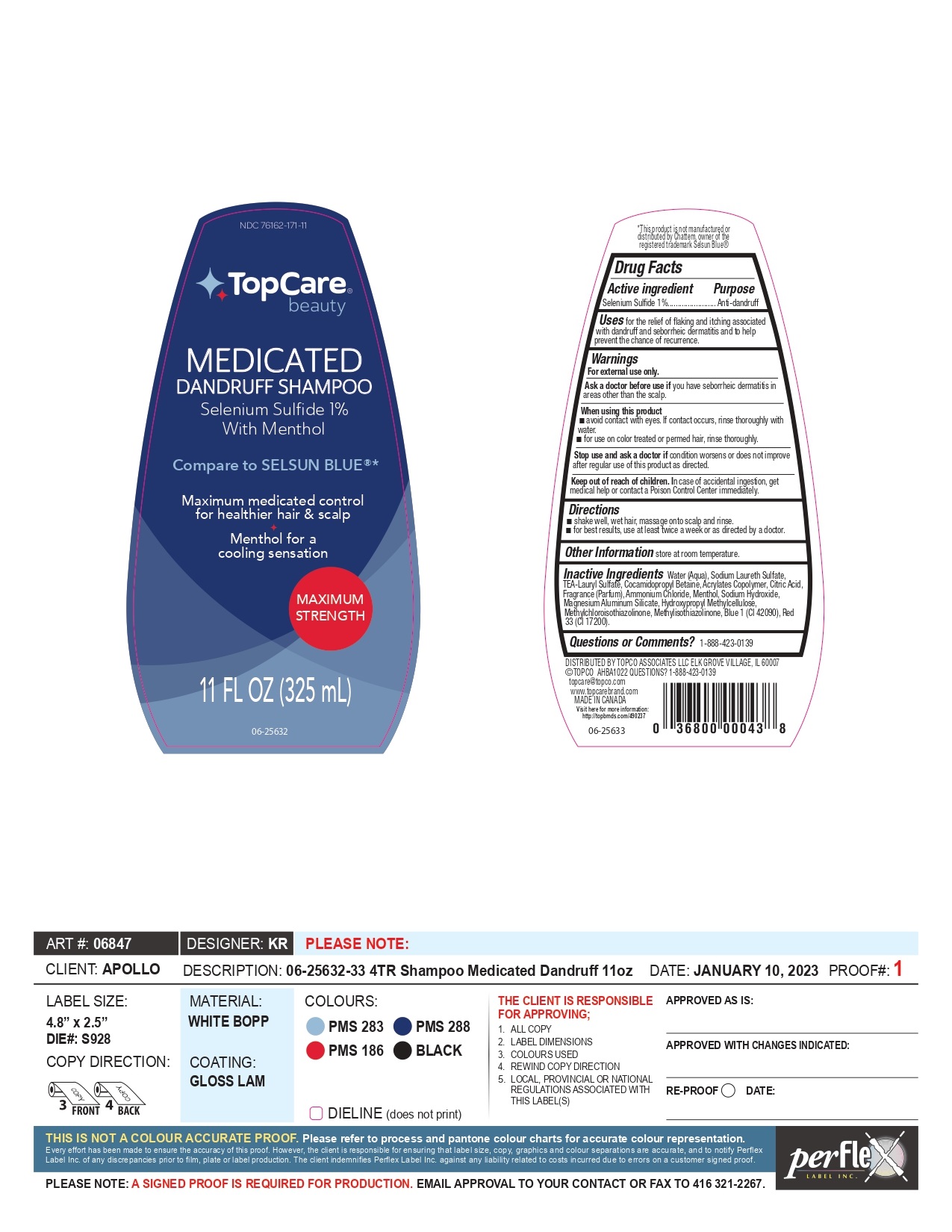
Topco Associates Selenium Sulfide 10 mg/mL Shampoo, 325 mL — NDC 76162-171-11 (Billing 76162-0171-11)
This is a package of 325 mL of Topco Associates Selenium Sulfide 10 mg/mL Shampoo from Topco Associates, marketed since May 2023 and currently FDA-listed. It is this product's only package size.
Identity & classification
Regulatory identifiers FDA, NLM and CMS codes for this package
- RxCUI (RxNorm): 204642
Where does this data come from?
- FDA openFDA NDC Directory · synced Oct 1, 2026
- FDA label on DailyMed · label index refreshed Oct 1, 2026
- RxNorm (NLM RxNav) · catalog refreshed Oct 1, 2026
- Medi-Span GPI (licensed)
- First Databank (licensed) · refreshed Oct 1, 2026
RxNorm drug class
This medicine belongs to the Other antifungals for topical use class.
Where does this data come from?
- RxClass (NLM) · catalog refreshed Oct 1, 2026
Clinical
- It's used on the scalp to relieve flaking and itching from dandruff and seborrheic dermatitis. It also helps keep those problems from coming back. Some products also list relief of...
- Most labels say to use it at least twice a week for best results, or as your doctor directs. Some say you can use it every time you shampoo for maximum control. Check your own prod...
- Some people get skin irritation, or oily or dry hair and scalp. Hair discoloration and a bit more hair shedding have been reported occasionally. Rinsing thoroughly after use helps...
- Keep it out of your eyes and away from the genital area, since it can cause irritation and burning. Don't use it on broken or inflamed skin. If you get it in your eyes, rinse well...
Patient education
Supplement & herbal interactions
Where does this data come from?
- MedlinePlus (NLM) · refreshed Oct 1, 2026
- FDA label on DailyMed · label index refreshed Oct 1, 2026
Ask a licensed pharmacist directly — free, answered by our team.
Pricing
A drug doesn't have one price. Each row is a different public payment system, and none is what you'd pay at the counter — that depends on your insurance. The ⓘ on each row explains what it measures.
| Price system | Per g | Per package |
|---|---|---|
| Retail pharmacies payNADAC · weekly | Not in the retail survey — common for institutional, discontinued, or low-volume packs. | |
| Medicaid paysCMS SDUD · 12 mo | No recent Medicaid claims on file for this NDC — rare and low-volume NDCs are suppressed in the public data. | |
| Medicare drug plans payPart D · quarterly | No Part D plan price is available for this NDC in our data. | |
Where does this data come from?
- CMS NADAC weekly file
- CMS ASP pricing files · refreshed Sep 20, 2026
- CMS Medicaid State Drug Utilization Data · refreshed Oct 2, 2026
- CMS Part D plan pricing files · refreshed Sep 24, 2026
- VA National Acquisition Center price file
Packaging — all sizes for this product
| Package NDC | Description | Marketing start | Marketing end | Status |
|---|---|---|---|---|
| 76162-0171-11 You're viewing this Main listing | 325 mL in 1 BOTTLE, PLASTIC | 2023-05-04 | — | Active |
Therapeutic equivalents
Where does this data come from?
- FDA openFDA NDC Directory · synced Oct 1, 2026
- FDA Orange Book · refreshed Sep 3, 2026
- CMS NADAC weekly file
Availability & generic status
FDA-approved generic versions are listed, and recent pricing/market data suggests they may be available — see Therapeutic equivalents.
Where does this data come from?
- FDA Orange Book · refreshed Sep 3, 2026
Inactive Ingredients / Excipients
Inactive ingredients, also called excipients, are components of the drug product other than the active ingredient. They may include fillers, dyes, coatings, preservatives, flavors, or other formulation ingredients.
💡 Tap an ingredient (hover on desktop) to see what it is and why it’s used.
-
UNII 01Q9PC255D
Ammonium chloride is a white crystalline salt used in medicines as a buffer and pH adjuster. It helps maintain the proper acidity level of a product to keep the active ingredient stable and effective.
-
UNII 2968PHW8QP
A weak organic acid derived from citrus fruits or made through fermentation. It works as a buffer to control pH, a preservative to extend shelf life, and a flavoring agent in medications.
-
UNII 5OCF3O11KX
A plant-derived surfactant made from coconut oil. It helps mix oil and water ingredients together in the formulation and can improve how the medicine spreads or feels on the skin.
-
UNII 9DBA0SBB0L
A synthetic red dye derived from coal tar used as a colorant in medicines and cosmetics. It gives tablets, capsules, and liquids their red or pink appearance for identification and visual appeal.
-
UNII H3R47K3TBD
FD&C Blue No. 1 is a synthetic blue dye approved for use in foods and medicines. It serves as a colorant to give the medication its distinctive appearance and help with product identification.
-
UNII 329LCV5BTF
A blend of fragrance compounds used to add pleasant smell to the medicine. Fragrances mask bitter or unpleasant tastes and odors, making the medication easier to take.
-
UNII 3NXW29V3WO
Hypromellose is a plant-based thickener made from cellulose. It's used in medicines as a binder to hold ingredients together, a coating for tablets, and a thickener for liquids.
-
UNII 6M3P64V0NC
A fine powder made from magnesium, aluminum, and silicon compounds. It absorbs moisture and helps keep medicine ingredients from clumping or separating, so the product stays stable and flows smoothly during manufacturing.
-
UNII L7T10EIP3A
A cooling compound from mint plants used as a flavoring agent and to create a fresh sensation in medicines. It helps mask bitter tastes and improve how the product feels in the mouth.
-
UNII T967IEU43C
A synthetic polymer made from methacrylic acid and ethyl acrylate. It forms a protective coating on tablets and capsules to control how and where the medicine dissolves in the digestive system.
-
UNII DEL7T5QRPN
A synthetic preservative that kills bacteria and fungi. It's added to medications to prevent microbial growth and extend shelf life, especially in liquid or topical formulations.
-
UNII 229D0E1QFA
Methylisothiazolinone is a synthetic chemical preservative that prevents bacterial and fungal growth in liquid medicines and topical products. It helps keep the medication safe and extends shelf life during storage.
-
UNII 55X04QC32I
A strong alkaline chemical used to adjust and maintain the pH balance of liquid medicines. It helps keep the medicine stable and ensures it stays effective during storage.
-
UNII BPV390UAP0
Sodium laureth sulfate is a mild detergent and surfactant derived from coconut oil or petroleum. It helps mix oil and water in formulations and is often used as a cleaning or foaming agent in topical products like shampoos and cleansers.
-
UNII E8458C1KAA
A synthetic detergent and cleansing agent derived from lauric acid. It helps break down oils and improve how active ingredients mix into the formula, and may also serve as a foaming or emulsifying agent in topical preparations.
-
UNII 059QF0KO0R
Water is a liquid solvent that dissolves and mixes ingredients together in liquid medicines, syrups, and injections. It helps distribute the active drug evenly throughout the product.
16 inactive ingredients listed in the exact product block matched to this NDC.
Label-section wording can be broader than the structured product block and may mention additional formulation ingredients.
Where does this data come from?
ingredient classCode="IACT" elements from the exact product block matched by this NDC. Label-section narrative from DailyMed / the openFDA label index is shown separately when available.- FDA label on DailyMed · label index refreshed Oct 1, 2026
- FDA openFDA NDC Directory · synced Oct 1, 2026
Inactive ingredient FAQ
Are inactive ingredients the same for every manufacturer?
Why might an inactive ingredient be missing?
Can inactive ingredients matter?
Manufacturer & labeler
Where does this data come from?
- FDA openFDA NDC Directory · synced Oct 1, 2026
- Drugs@FDA
FDA label — Drug Facts FDA SPL
🎯 Indications and Usage ▾
for the relief of flaking and itching associated with dandruff and seborrheic dermatitis and to help prevent the chance of recurrence.
⏱️ Dosage and Administration ▾
■ shake well, wet hair, massage onto scalp and rinse. ■ for best results, use at least twice a week or as directed by a doctor.
⚠️ Warnings ▾
For external use only. Ask a doctor before use if you have seborrheic dermatitis in areas other than the scalp. ■ avoid contact with eyes. If contact occurs, rinse thoroughly with water. ■ for use on color treated or permed hair, rinse thoroughly.
Stop use and ask a doctor if condition worsens or does not improve after regular use of this product as directed. Keep out of reach of children. In case of accidental ingestion, get medical help or contact a Poison Control Center immediately.
📦 Storage and Handling ▾
store at room temperature.
🧪 Active Ingredient ▾
Selenium Sulfide 1%
🧪 Inactive Ingredients ▾
Water (Aqua), Sodium Laureth Sulfate, TEA-Lauryl Sulfate, Cocamidopropyl Betaine, Acrylates Copolymer, Citric Acid, Fragrance (Parfum), Ammonium Chloride, Menthol, Sodium Hydroxide, Magnesium Aluminum Silicate, Hydroxypropyl Methylcellulose, Methylchloroisothiazolinone, Methylisothiazolinone, Blue 1 (CI 42090), Red 33 (CI 17200).
🎯 Purpose ▾
anti dandruff
Medicare Part D spend CMS · PART D · 2026 (Q1)
About this NDC listing & data coverage
What data is (and isn’t) available for this NDC — tap to expand
| NDC identity (package / product / labeler codes) | ✓ Available |
| Labeler | ✓ Available |
| Product & package description | ✓ Available |
| Marketing category & status | ✓ Available |
| Active ingredient / dosage form / route | ✓ Available |
| FDA label (SPL via DailyMed) | ✓ Available |
| Package photos | ✓ Available |
| Inactive ingredients (structured) | ✓ Available |
| NADAC pharmacy acquisition price (CMS) | — Not published for this NDC CMS publishes NADAC only for NDCs reported in its retail-pharmacy survey. |
| Orange Book / therapeutic-equivalence data | — Not published for this NDC Applies only to products approved under an NDA/ANDA; many listings are out of scope. |
| HCPCS J-code billing crosswalk | — Not published for this NDC Most self-administered / retail products have no J-code — that is normal. |
| Medicaid utilization (CMS SDUD) | — Not published for this NDC CMS reports utilization only for NDCs with Medicaid claims above its privacy threshold. |