
Mirtazapine 45 mg Tablet, Orally Disintegrating, 30-count — NDC 76483-112-00 (Billing 76483-0112-00)
This is a package of 30 tablets of Mirtazapine 45 mg Tablet, Orally Disintegrating from SQUARE PHARMACEUTICALS LIMITED, marketed since Nov 2022 and currently FDA-listed. It is this product's only package size.
NDC database record
One package, one record: these facts belong to NDC 76483-112-00 alone.
- Record
- FDA NDC Directory package listing · Human prescription drug
- Code segments
- 76483 labeler · 112 product · 00 package
- Package marketed since
- Nov 15, 2022
- Sample package
- No — commercial package
- Listing certified through
- Dec 31, 2026
- Barcode (UPC-A, from the NDC)
- 3 7648311200 5
- FDA record last changed
- Jul 24, 2026
Identity & classification
Regulatory identifiers FDA, NLM and CMS codes for this package
- RxCUI (RxNorm): 283406
Where does this data come from?
- FDA openFDA NDC Directory · synced Oct 1, 2026
- FDA label on DailyMed · label index refreshed Oct 3, 2026
- RxNorm (NLM RxNav) · catalog refreshed Oct 1, 2026
- Medi-Span GPI (licensed)
- First Databank (licensed) · refreshed Oct 1, 2026
RxNorm drug class
This medicine belongs to the Other antidepressants class.
Where does this data come from?
- RxClass (NLM) · catalog refreshed Oct 1, 2026
Clinical
Mirtazapine is used to treat depression. Mirtazapine is in a class of medications called antidepressants. It works by increasing certain types of activity in the brain to maintain mental balance.
Read the full MedlinePlus article ↗- It treats major depressive disorder (MDD) in adults. It's an antidepressant that may raise norepinephrine and serotonin activity in the brain. Your prescriber will check over time...
- Most people take it once a day, preferably in the evening before bed, since it commonly causes sleepiness. Food doesn't change how well it's absorbed. Follow your prescriber's dire...
- When should I take it, and does food matter?
- Sleepiness is the big one, along with dry mouth, increased appetite, weight gain, constipation, and dizziness. Be careful driving until you know how it affects you. Call your docto...
Patient education
Supplement & herbal interactions
Some supplements/herbs that may interact with Mirtazapine — tap one for details:
Mirtazapine may be associated with lower levels of 1 nutrient — worth a chat with your pharmacist, not a cause for alarm.
Where does this data come from?
- MedlinePlus (NLM) · refreshed Oct 1, 2026
- FDA label on DailyMed · label index refreshed Oct 3, 2026
Ask a licensed pharmacist directly — free, answered by our team.
Pricing
A drug doesn't have one price. Each row is a different public payment system, and none is what you'd pay at the counter — that depends on your insurance. The ⓘ on each row explains what it measures.
| Price system | Per each | Per package |
|---|---|---|
| Retail pharmacies payNADAC · weekly | Not in the retail survey — common for institutional, discontinued, or low-volume packs. | |
| Medicaid paysCMS SDUD · 12 mo | No recent Medicaid claims on file for this NDC — rare and low-volume NDCs are suppressed in the public data. | |
| Medicare drug plans payPart D · Q2 2026 | $0.6361 | $19.08 / 30 tablets |
Where does this data come from?
- CMS NADAC weekly file
- CMS ASP pricing files · refreshed Sep 20, 2026
- CMS Medicaid State Drug Utilization Data · refreshed Oct 4, 2026
- CMS Part D plan pricing files · refreshed Sep 24, 2026
- VA National Acquisition Center price file
Packaging — all sizes for this product
| Package NDC | Description | Marketing start | Marketing end | Status |
|---|---|---|---|---|
| 76483-0112-00 You're viewing this Main listing | 30 TABLET, ORALLY DISINTEGRATING in 1 CARTON | 2022-11-15 | — | Active |
Therapeutic equivalents
| Product | Labeler | Pack | NADAC/unit | TE | Status | Price vs. this |
|---|---|---|---|---|---|---|
| Mirtazapine 45 mg 57237-0013-06 | Rising | 6 tablets | $0.408 | AB | Availability likely | — |
| Mirtazapine 45 mg 72578-0105-84 | Viona | 30 tablets | $0.408 | AB | Availability likely | — |
| Mirtazapine 45 mg 65862-0023-01 | Aurobindo | 100 tablets | — | AB | FDA listed | — |
| Mirtazapine 45 mgthis 76483-0112-00 | SQUARE | 30 tablets | — | AB | FDA listed | — |
| Remeronsoltab 45 mg 78206-0159-01 | Organon | 6 tablets | — | AB | FDA listed | — |
Where does this data come from?
- FDA openFDA NDC Directory · synced Oct 1, 2026
- FDA Orange Book · refreshed Oct 3, 2026
- CMS NADAC weekly file
Availability & generic status
This product is an FDA-approved generic. Other versions of the same drug are listed under Therapeutic equivalents, least expensive first.
Where does this data come from?
- FDA Orange Book · refreshed Oct 3, 2026
What it looks like
Where does this data come from?
- FDA label on DailyMed · label index refreshed Oct 3, 2026
Inactive Ingredients / Excipients
Inactive ingredients, also called excipients, are components of the drug product other than the active ingredient. They may include fillers, dyes, coatings, preservatives, flavors, or other formulation ingredients.
💡 Tap an ingredient (hover on desktop) to see what it is and why it’s used.
-
UNII H4N855PNZ1
Alpha-tocopherol is a form of vitamin E, a fat-soluble antioxidant derived from natural or synthetic sources. In medicines, it prevents oils and fats from breaking down and becoming rancid, protecting the product's stability and shelf life.
-
UNII XF417D3PSL
Anhydrous citric acid is a sour, crystalline powder derived from citric acid with water removed. In medicines, it acts as a buffer to control pH, adds tartness to improve taste, and helps tablets disintegrate.
-
UNII Z0H242BBR1
Aspartame is an artificial sweetener made from amino acids. It's added to medicines to improve taste, making bitter or unpleasant-tasting drugs easier to take.
-
UNII 2S7830E561
Crospovidone is a synthetic polymer derived from povidone. It acts as a disintegrant, helping the tablet or capsule break apart quickly in the stomach so the active ingredient can be absorbed.
-
UNII 70097M6I30
Magnesium stearate is a salt made from magnesium and stearic acid, a fatty substance. It's used in tablets and capsules as a lubricant and glidant to help ingredients flow smoothly during manufacturing and prevent sticking.
-
UNII 7CVR7L4A2D
A starch-derived carbohydrate produced by breaking down corn, potato, or tapioca starch. It functions as a filler and binder to give the medicine bulk and texture, and sometimes as a mild sweetener or texture enhancer in powders and tablets.
-
UNII 3OWL53L36A
A natural sugar alcohol derived from seaweed or synthesized in the lab. It's used as a filler to add bulk, a sweetener in sugar-free formulas, and a disintegrant to help tablets break apart in the stomach.
-
UNII OP1R32D61U
Microcrystalline cellulose is a purified form of cellulose, a natural fiber from plant sources. It acts as a binder and filler in tablets and capsules, helping hold ingredients together and give the medicine its shape and size.
-
UNII U725QWY32X
Povidone K30 is a synthetic polymer made from petroleum. It acts as a binder to hold tablet ingredients together and as a disintegrant to help the tablet break apart in the stomach so the medicine can be absorbed.
-
UNII ETJ7Z6XBU4
Silicon dioxide is a naturally occurring mineral used as a glidant and anti-caking agent. It helps powder ingredients flow smoothly and prevents clumping during manufacturing and storage.
-
UNII 7CV7WJK4UI
Sodium stearyl fumarate is a synthetic compound made from stearyl alcohol and fumaric acid. It acts as a lubricant and glidant in tablets and capsules, helping ingredients flow smoothly during manufacturing and preventing sticking.
11 inactive ingredients listed in the exact product block matched to this NDC.
Where does this data come from?
ingredient classCode="IACT" elements from the exact product block matched by this NDC. Label-section narrative from DailyMed / the openFDA label index is shown separately when available.- FDA label on DailyMed · label index refreshed Oct 3, 2026
- FDA openFDA NDC Directory · synced Oct 1, 2026
Inactive ingredient FAQ
Are inactive ingredients the same for every manufacturer?
Why might an inactive ingredient be missing?
Can inactive ingredients matter?
Manufacturer & labeler
More NDCs from SQUARE PHARMACEUTICALS LIMITED labeler code 76483
- Aripiprazole 15 mg Tablet, Orally Disintegrating NDC 76483-101-00
- Aripiprazole 20 mg Tablet, Orally Disintegrating NDC 76483-102-00
- Aripiprazole 30 mg Tablet, Orally Disintegrating NDC 76483-103-00
- calcium chloride 100 mg/mL Injection, Solution NDC 76483-108-02
- Mirtazapine 15 mg Tablet, Orally Disintegrating NDC 76483-110-00
- Mirtazapine 30 mg Tablet, Orally Disintegrating NDC 76483-111-00
Where does this data come from?
- FDA openFDA NDC Directory · synced Oct 1, 2026
- Drugs@FDA
Full prescribing information FDA SPL
📄 Package Label / Principal Display Panel ▾
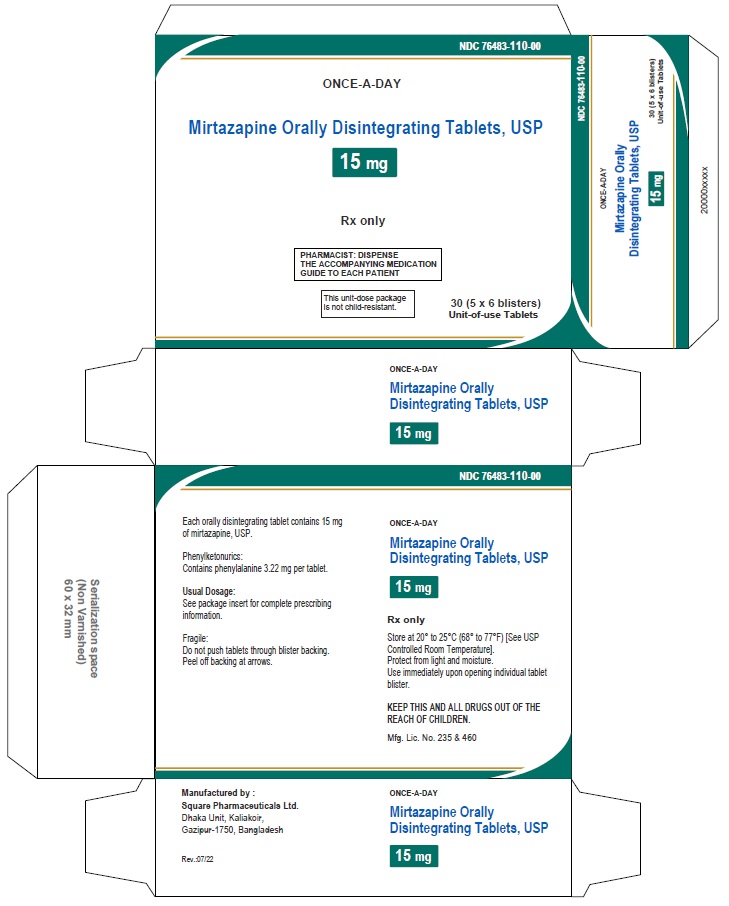
PACKAGE LABEL.PRINCIPAL DISPLAY PANEL NDC 76483-110-00 in unit-dose blister cartons of 30 (5 x 6 blisters) Unit-of-use Tablets Mirtazapine Orally Disintegrating Tablets USP, 15 mg Rx only 30 Tablets NDC 76483-111-00 in unit-dose blister cartons of 30 (5 x 6 blisters) Unit-of-use Tablets Mirtazapine Orally Disintegrating Tablets USP, 30 mg Rx only 30 Tablets NDC 76483-112-00 in unit-dose blister cartons of 30 (5 x 6 blisters) Unit-of-use Tablets Mirtazapine Orally Disintegrating Tablets USP, 45 mg Rx only 30 Tablets Mirtazapine Orally Disintegrating Tablets USP, 15 mg Mirtazapine Orally Disintegrating Tablets USP, 30 mg Mirtazapine Orally Disintegrating Tablets USP, 45 mg
Medicare Part D spend CMS · PART D · 2026 (Q1)
About this NDC listing & data coverage
What data is (and isn’t) available for this NDC — tap to expand
| NDC identity (package / product / labeler codes) | ✓ Available |
| Labeler | ✓ Available |
| Product & package description | ✓ Available |
| Marketing category & status | ✓ Available |
| Active ingredient / dosage form / route | ✓ Available |
| FDA label (SPL via DailyMed) | ✓ Available |
| Package photos | ✓ Available |
| Inactive ingredients (structured) | ✓ Available |
| NADAC pharmacy acquisition price (CMS) | — Not published for this NDC CMS publishes NADAC only for NDCs reported in its retail-pharmacy survey. |
| Orange Book / therapeutic-equivalence data | ✓ Available |
| HCPCS J-code billing crosswalk | — Not published for this NDC Most self-administered / retail products have no J-code — that is normal. |
| Medicaid utilization (CMS SDUD) | — Not published for this NDC CMS reports utilization only for NDCs with Medicaid claims above its privacy threshold. |