
ANTICHOLIUM physostigmine salicylate .4 mg/mL Injection — NDC 81284-831-05 (Billing 81284-0831-05)
This is a package of ANTICHOLIUM physostigmine salicylate .4 mg/mL Injection from Provepharm Inc., marketed since Oct 2023 and currently FDA-listed. It is this product's only package size.
NDC database record
One package, one record: these facts belong to NDC 81284-831-05 alone.
- Record
- FDA NDC Directory package listing · Human prescription drug
- Code segments
- 81284 labeler · 831 product · 05 package
- Package marketed since
- Oct 5, 2023
- Sample package
- No — commercial package
- Listing certified through
- Dec 31, 2026
- Barcode (UPC-A, from the NDC)
- 3 8128483105 5
- FDA record last changed
- Jul 24, 2026
Identity & classification
Regulatory identifiers FDA, NLM and CMS codes for this package
Drug-database identifiers Medi-Span GPI and First Databank GCN / HICL / AHFS classification
- GSN (GCN sequence number): 028623
- GCN: 00459
- HICL (First Databank): 001985
- AHFS class code: 12:04.00.00
- RxCUI (RxNorm): 2666367
Where does this data come from?
- FDA openFDA NDC Directory · synced Oct 8, 2026
- FDA label on DailyMed · label index refreshed Oct 6, 2026
- RxNorm (NLM RxNav) · catalog refreshed Oct 1, 2026
- Medi-Span GPI (licensed)
- First Databank (licensed) · refreshed Oct 8, 2026
RxNorm drug class
This medicine belongs to the Parasympathomimetics class.
Where does this data come from?
- RxClass (NLM) · catalog refreshed Oct 1, 2026
Clinical
This is an intravenous injection containing physostigmine salicylate, a cholinesterase inhibitor. Physostigmine is typically used to reverse the effects of certain anticholinergic substances and medications by increasing levels of the neurotransmitter acetylcholine in the body. This product is marketed without an approved FDA application and is available for use during drug shortages.
Patient education
Supplement & herbal interactions
Where does this data come from?
- MedlinePlus (NLM) · refreshed Oct 1, 2026
- FDA label on DailyMed · label index refreshed Oct 6, 2026
Ask a licensed pharmacist directly — free, answered by our team.
Pricing
A drug doesn't have one price. Each row is a different public payment system, and none is what you'd pay at the counter — that depends on your insurance. The ⓘ on each row explains what it measures.
| Price system | Per each | Per package |
|---|---|---|
| Retail pharmacies payNADAC · weekly | Not in the retail survey — common for institutional, discontinued, or low-volume packs. | |
| Medicaid paysCMS SDUD · 12 mo | No recent Medicaid claims on file for this NDC — rare and low-volume NDCs are suppressed in the public data. | |
| Medicare drug plans payPart D · quarterly | No Part D plan price is available for this NDC in our data. | |
Where does this data come from?
- CMS NADAC weekly file
- CMS ASP pricing files · refreshed Sep 20, 2026
- CMS Medicaid State Drug Utilization Data · refreshed Oct 8, 2026
- CMS Part D plan pricing files · refreshed Sep 24, 2026
- VA National Acquisition Center price file
Packaging — all sizes for this product
| Package NDC | Description | Marketing start | Marketing end | Status |
|---|---|---|---|---|
| 81284-0831-05 You're viewing this Main listing | 5 AMPULE in 1 CARTON / 5 mL in 1 AMPULE | 2023-10-05 | — | Active |
Therapeutic equivalents
| Product | Labeler | Pack | NADAC/unit | TE | Status | Price vs. this |
|---|---|---|---|---|---|---|
| Anticholium .4 mg/mLthis 81284-0831-05 | Provepharm | 5 ampules | — | — | FDA listed | — |
Where does this data come from?
- FDA openFDA NDC Directory · synced Oct 8, 2026
- FDA Orange Book · refreshed Oct 3, 2026
- CMS NADAC weekly file
Availability & generic status
We did not find an FDA-approved generic match for this exact strength, form and route.
Where does this data come from?
- FDA Orange Book · refreshed Oct 3, 2026
Inactive Ingredients / Excipients
Inactive ingredients, also called excipients, are components of the drug product other than the active ingredient. They may include fillers, dyes, coatings, preservatives, flavors, or other formulation ingredients.
💡 Tap an ingredient (hover on desktop) to see what it is and why it’s used.
-
UNII MP1J8420LU
A salt derived from edetic acid that binds to trace metals in medicines. It serves as a chelating agent and preservative to prevent metal-catalyzed breakdown of the drug and extend shelf life.
-
UNII QTT17582CB
A strong acid used to adjust and maintain the proper pH level in liquid medicines, ensuring stability and preventing breakdown of active ingredients.
-
UNII 55X04QC32I
A strong alkaline chemical used to adjust and maintain the pH balance of liquid medicines. It helps keep the medicine stable and ensures it stays effective during storage.
-
UNII 059QF0KO0R
Water is a liquid solvent that dissolves and mixes ingredients together in liquid medicines, syrups, and injections. It helps distribute the active drug evenly throughout the product.
4 inactive ingredients listed in the exact product block matched to this NDC.
Where does this data come from?
ingredient classCode="IACT" elements from the exact product block matched by this NDC. Label-section narrative from DailyMed / the openFDA label index is shown separately when available.- FDA label on DailyMed · label index refreshed Oct 6, 2026
- FDA openFDA NDC Directory · synced Oct 8, 2026
Inactive ingredient FAQ
Are inactive ingredients the same for every manufacturer?
Why might an inactive ingredient be missing?
Can inactive ingredients matter?
Manufacturer & labeler
More NDCs from Provepharm Inc. labeler code 81284
- Phenylephrine hydrochloride 10 mg/mL Injection NDC 81284-212-10
- Phenylephrine hydrochloride 10 mg/mL Injection NDC 81284-213-01
- BLUDIGO indigotindisulfonate sodium 8 mg/mL Injection NDC 81284-315-05
- Dihydroergotamine Mesylate 1 mg/mL Injection, Solution NDC 81284-411-05
- tranexamic acid 100 mg/mL Injection, Solution NDC 81284-611-10
- tranexamic acid 100 mg/mL Injection, Solution NDC 81284-612-10
Where does this data come from?
- FDA openFDA NDC Directory · synced Oct 8, 2026
- Drugs@FDA
Full prescribing information FDA SPL
🎯 Indications and Usage ▾
Indications: ANTICHOLIUM ® is indicated for: 1. the use as an antidote and/or antagonist in case of intoxication with and/or overdose of: alcohol tropane alkaloids (hyoscyamine, atropine, scopolamine, as e.g. in brugmansia, datura, atropa belladonna) amanita pantherina and amanita muscaria tricyclic antidepressants (amitriptyline, imipramine, trimipramine, clomipramine, doxepine) antiemetics/antihistamines (phenothiazine, thioridazine, chlorpromazine, promethazine, diphenhydramine, dimenhydrinate) neuroleptic drugs (especially butyrophenones) benzodiazepines tolterodine, oxybutynine amantadine, diphenhydramine baclofen 4-hydroxybutyric acid (GHB) inhalation anesthetics ketamine 3-quinuclidinyl benzilate 2. the treatment of postoperative disorders: Central anticholinergic syndrome (CAS) Delayed postoperative awakening Shivering
⏱️ Dosage and Administration ▾
Dosage and Administration: Use in adults: For the treatment of postoperative awakening disorders: Slowly inject physostigmine intravenously at a dose of 0.04 mg/kg bodyweight (approx. 1 mg/min), the maximum individual dose is 2 mg. In case of insufficient effect, give subsequent injections after 5 to 20 minutes at the earliest, after a positive evaluation of the effect of the first injection.
In cases of intoxication: Adults: Slowly inject 0.04 mg/kg bodyweight (2 mg) of physostigmine salicylate intravenously and subsequently inject 1-4 mg every 20 minutes. Repeat the effective dose if the intoxication symptoms recur, also in the form of a continuous infusion if deemed useful. Use in children and adolescents: In cases of intoxication: Infants: Start with a low dose of 0.5 mg of physostigmine salicylate administered intravenously, repeat this dose every 5 minutes up to the overall dose of 2 mg, as long as the toxic, anticholinergic symptoms continue to persist, and no cholinergic symptoms occur.
Method of administration: Intravenously slowly or as brief infusion in 50 ml physiological saline solution over 10-15 minutes. A general criterion for adequate physostigmine dosing is the recognizable recovery of mental abilities and responsiveness (e.g. specifying name, address, date).
💊 Dosage Forms and Strengths ▾
Composition: Anticholium is available in 5 mL ampules, each mL containing 0.4 mg physostigmine salicylate in a vehicle composed of sodium edetate (Ph. Eur.) and water for injection.
⛔ Contraindications ▾
Contraindications: ANTICHOLIUM ® should not be used in the presence of hypersensitivity to physostigmine salicylate, bronchial asthma, ulcers associated with tissue destruction (gangrene), coronary heart disease, constipation (mechanical obstipation), mechanical ischuria (urinary retention), hereditary form of muscle atrophy (myotonic dystrophy), closed traumatic brain injuries, intestinal obstruction, spasms in the urinary tract collection system, inactivation of nerve and muscle cells after administration of drugs to relax the muscles (depolarization block after depolarizing muscle relaxants), in case of intoxication due to “irreversibly acting” cholinesterase inhibitors (drugs used to treat dementia), intoxication with phosphoric acid esters or barbiturates.
⚠️ Warnings and Cautions ▾
Precautions: Talk to your doctor before you are given ANTICHOLIUM ® if you suffer from diabetes mellitus, slowed heart rate (bradycardia), disturbances of the atrioventricular conduction system, Parkinson’s disease or ulcerative colitis. Hypersensitivity reactions may occur after administration of this medicine. These reactions may vary individually and may also cause life-threatening conditions.
It is recommended to have emergency medication and medical aids ready. A risk/benefit analysis should be performed, and discontinuation of treatment should be considered. Acute cardiac arrest may be possible during treatment with tricyclic antidepressants; therefore, Anticholium should only be considered as an antidote for this indication while the patient has continuous ECG monitoring.
🤒 Adverse Reactions ▾
Adverse Reactions: Like all medicines, ANTICHOLIUM ® can cause side effects, although not everybody gets them. System organ class Frequency: Unknown Immune system disorders Hypersensitivity reactions Endocrine disorders Hypersalivation Heart diseases Changes of the heart rate (both bradycardia and tachycardia), sinoatrial block Vascular diseases Low blood pressure (hypotension) Respiratory, thoracic and mediastinal disorders Spasms of the respiratory tract (broncho spasms) Gastrointestinal disorders Nausea, vomiting Skin and subcutaneous tissue disorders Sweating
🔄 Drug Interactions ▾
Interactions: Tell your doctor or pharmacist if you are taking/ using, have recently taken/used or intend to take/ use any other medicines. In case of simultaneous administration of other cholinesterase inhibitors (e.g. medicines for the treatment of dementia), caution should be exercised because of the potentiating effect. In intoxication with depolarizing muscle relaxants of the suxamethonium type, ANTICHOLIUM ® is contraindicated!
👥 Use in Specific Populations ▾
Usage in pregnancy: Pregnancy and breast-feeding Pregnancy: There is no experience with the use of ANTICHOLIUM ® in pregnant women. Physostigmine, the active substance contained in ANTICHOLIUM ® , passes into the placenta. Animal studies are insufficient with respect to effects on pregnancy, embryonal/foetal development, birth and postnatal development.
The potential risk for humans is unknown. For this reason, ANTICHOLIUM ® may only be administered to pregnant women if deemed absolutely necessary by the attending doctor. Breast-feeding: There is no experience with the use of ANTICHOLIUM ® during breastfeeding.
It is not known whether physostigmine, the active substance contained in ANTICHOLIUM ® , is excreted in human breast milk. For this reason, ANTICHOLIUM ® may only be used during breastfeeding if deemed absolutely necessary by the attending doctor.
🤰 Pregnancy ▾
Pregnancy: There is no experience with the use of ANTICHOLIUM ® in pregnant women. Physostigmine, the active substance contained in ANTICHOLIUM ® , passes into the placenta. Animal studies are insufficient with respect to effects on pregnancy, embryonal/foetal development, birth and postnatal development.
The potential risk for humans is unknown. For this reason, ANTICHOLIUM ® may only be administered to pregnant women if deemed absolutely necessary by the attending doctor.
🆘 Overdosage ▾
Overdosage: Intravenous administration of atropine up to normalization of the symptoms. Normally, half the amount of the administered physostigmine salicylate is sufficient. In case of intoxication, measures to prevent absorption are to be started immediately (such as gastric lavage, administration of medicinal charcoal and laxatives).
The following information is intended for healthcare professionals: Overdose emergency measures, symptoms, antidotes In cases of intoxication, measures to prevent absorption such as gastric lavage, administration of medicinal charcoal and laxatives are to be started immediately. An overdose of ANTICHOLIUM ® can cause bradycardia, hypersalivation, vomiting, and generalized tonic-clonic seizures. Patients should be closely monitored by ECG.
📦 How Supplied / Storage and Handling ▾
How Supplied: ANTICHOLIUM ® is a clear, colorless to slightly reddish solution in glass ampules. Pack containing 5 ampules with 5 ml.
📦 Storage and Handling ▾
Storage Conditions: Store this medicine protected from light in the outer packaging, not above 25°C. In undamaged container: 3 years The infusion solution should be used immediately after preparation. Keep this medicine out of the reach of children. Do not use this medicine after the expiry date which is stated on the carton/label after EXP. The expiry date refers to the last day of that month.
📄 Package Label / Principal Display Panel ▾
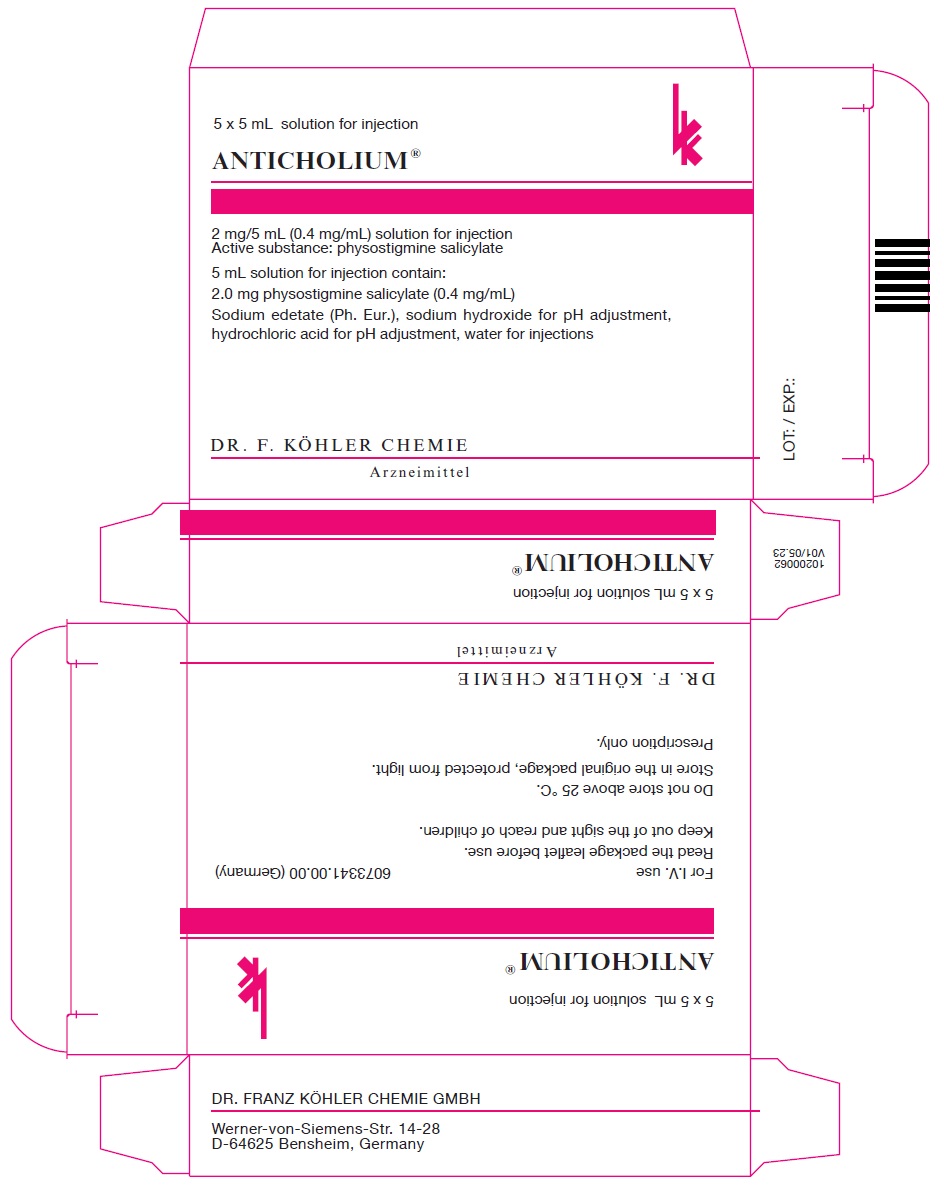
PRINCIPAL DISPLAY PANEL - 5 x 5 mL Carton ANTICHOLIUM ® 2 mg/5 mL (0.4 mg/mL) solution for injection Active substance: physostigmine salicylate 5 mL solution for injection contain: 2.0 mg physostigmine salicylate (0.4 mg/mL) Sodium edetate (Ph. Eur.), sodium hydroxide for pH adjustment, hydrochloric acid for pH adjustment, water for injections DR. F. KÖHLER CHEMIE Arzneimittel Carton
PRINCIPAL DISPLAY PANEL - 5 mL Ampule 5 mL solution for injection ANTICHOLIUM ® 2 mg/5 mL (0.4 mg/mL) solution for injection Active substance: physostigmine salicylate For I.V. use DR. FRANZ KÖHLER CHEMIE GMBH Werner-von-Siemens-Str. 14-28 D-64625 Bensheim, Germany LOT: / EXP.: V01/05.23 Ampule
About this NDC listing & data coverage
Listed without an FDA application
This product's marketing category indicates it is marketed without an approved FDA application (no NDA, ANDA, or BLA on file). Having an NDC does not by itself establish FDA approval — the NDC Directory is a listing system, not an approval decision. Approval-linked data such as Orange Book therapeutic-equivalence ratings therefore does not apply.
What data is (and isn’t) available for this NDC — tap to expand
| NDC identity (package / product / labeler codes) | ✓ Available |
| Labeler | ✓ Available |
| Product & package description | ✓ Available |
| Marketing category & status | ✓ Available |
| Active ingredient / dosage form / route | ✓ Available |
| FDA label (SPL via DailyMed) | ✓ Available |
| Package photos | ✓ Available |
| Inactive ingredients (structured) | ✓ Available |
| NADAC pharmacy acquisition price (CMS) | — Not published for this NDC CMS publishes NADAC only for NDCs reported in its retail-pharmacy survey. |
| Orange Book / therapeutic-equivalence data | — Not published for this NDC Applies only to products approved under an NDA/ANDA; many listings are out of scope. |
| HCPCS J-code billing crosswalk | — Not published for this NDC Most self-administered / retail products have no J-code — that is normal. |
| Medicaid utilization (CMS SDUD) | — Not published for this NDC CMS reports utilization only for NDCs with Medicaid claims above its privacy threshold. |