
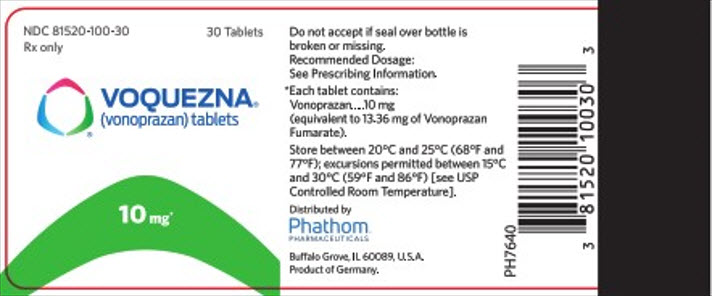
Voquezna vonoprazan fumarate 13.36 mg Tablet, 30-count — NDC 81520-100-30 (Billing 81520-0100-30)
This is a package of 30 tablets of Voquezna vonoprazan fumarate 13.36 mg Tablet from Phathom Pharmaceuticals Inc., marketed since Nov 2023 and currently FDA-listed; retail pharmacies pay about $22.40 per tablet (NADAC). It is this product's only package size.
NDC database record
One package, one record: these facts belong to NDC 81520-100-30 alone.
- Record
- FDA NDC Directory package listing · Human prescription drug
- Code segments
- 81520 labeler · 100 product · 30 package
- Package marketed since
- Nov 10, 2023
- Sample package
- No — commercial package
- Listing certified through
- Dec 31, 2027
- Billing quantity
- 30 EA per package
- Barcode (UPC)
- 0381520100303, 0381520200300
- Medicaid fills, this package
- 23,800 prescriptions in the last four reported quarters
- FDA record last changed
- Jul 24, 2026
Identity & classification
Regulatory identifiers FDA, NLM and CMS codes for this package
Drug-database identifiers Medi-Span GPI and First Databank GCN / HICL / AHFS classification
- GSN (GCN sequence number): 084066
- GCN: 53199
- HICL (First Databank): 048007
- AHFS class code: 56:28.18.00
- RxCUI (RxNorm): 2604800
Where does this data come from?
- FDA openFDA NDC Directory · synced Oct 1, 2026
- FDA label on DailyMed · label index refreshed Oct 5, 2026
- RxNorm (NLM RxNav) · catalog refreshed Oct 1, 2026
- Medi-Span GPI (licensed)
- First Databank (licensed) · refreshed Oct 1, 2026
RxNorm drug class
This medicine belongs to the Proton pump inhibitors class.
Where does this data come from?
- RxClass (NLM) · catalog refreshed Oct 1, 2026
Clinical
Vonoprazan is used to heal and maintain healing of erosive esophagitis (acid-related damage to the esophagus [tube that runs from the throat to the stomach]) treat heartburn in combination with other medications to eliminate Helicobacter pylori (a bacteria that causes ulcers) Vonoprazan is in a class of medications called potassium-competitive acid blockers (PCAB). It works by decreasing the amount of acid made in the stomach.
Read the full MedlinePlus article ↗Patient education
Supplement & herbal interactions
Where does this data come from?
- MedlinePlus (NLM) · refreshed Oct 1, 2026
- FDA label on DailyMed · label index refreshed Oct 5, 2026
Ask a licensed pharmacist directly — free, answered by our team.
Pricing
A drug doesn't have one price. Each row is a different public payment system, and none is what you'd pay at the counter — that depends on your insurance. The ⓘ on each row explains what it measures.
| Price system | Per ea | Per package |
|---|---|---|
| Retail pharmacies payNADAC · weekly | $22.397 | $671.90 / 30 tablets |
| Medicaid paysCMS SDUD · 12 mo | $22.09 | $662.77 / 30 tablets |
| Medicare drug plans payPart D · Q2 2026 | $23.76 | $712.76 / 30 tablets |
Where does this data come from?
- CMS NADAC weekly file · file of Sep 30, 2026
- CMS ASP pricing files · refreshed Sep 20, 2026
- CMS Medicaid State Drug Utilization Data · through Q1 2026
- CMS Part D plan pricing files · refreshed Sep 24, 2026
- VA National Acquisition Center price file
Packaging — all sizes for this product
| Package NDC | Description | Marketing start | Marketing end | Status |
|---|---|---|---|---|
| 81520-0100-30 You're viewing this Main listing | 30 TABLET in 1 BOTTLE, PLASTIC | 2023-11-10 | — | Active |
Therapeutic equivalents
| Product | Labeler | Pack | NADAC/unit | TE | Status | Price vs. this |
|---|---|---|---|---|---|---|
| Voquezna 13.36 mgthis 81520-0100-30 | Phathom | 30 tablets | $22.397 | — | Availability likely | — |
Where does this data come from?
- FDA openFDA NDC Directory · synced Oct 1, 2026
- FDA Orange Book · refreshed Oct 3, 2026
- CMS NADAC weekly file · file of Sep 30, 2026
Availability & generic status
We did not find an FDA-approved generic match for this exact strength, form and route. Patent/protection dates below may affect future generic timing.
Why the date isn’t exact: Generic timing can change because patents may be challenged, settled, licensed, added, removed, or worked around with a narrower label — and FDA approval does not always mean a pharmacy can get the generic today.
🛈 What do these terms mean?
- Patent
- Legal protection listed in the Orange Book that may delay generic approval or launch. Issued by the U.S. Patent & Trademark Office.
- Substance patent
- Covers the active drug molecule itself — the hardest to design around. A generic generally can’t launch until it expires.
- Formulation (product) patent
- Covers a specific formulation or dosage form. A generic can sometimes work around it with a different formulation.
- Method-of-use patent
- A patent covering one specific approved use of the drug — not necessarily the whole molecule. A generic can sometimes launch with a “skinny label” that carves out the protected use and keeps the others.
- Skinny label
- A generic label that omits a still-patented use when the FDA allows it — letting a generic reach the market for the unprotected uses.
- Exclusivity
- FDA-granted marketing protection, separate from patents — e.g. 5-yr new chemical entity, 7-yr orphan drug, or a +6-month pediatric extension.
- Paragraph IV
- A generic applicant’s formal challenge to a listed patent. It can potentially lead to earlier generic entry, but often involves litigation or a settlement.
- RLD / RS
- Reference Listed Drug — the brand product the FDA uses as the reference for generic applications. Reference Standard — the product the FDA expects generics to compare against in bioequivalence testing.
- TE / AB rating
- FDA therapeutic-equivalence rating. An AB rating generally means the FDA considers a generic therapeutically equivalent to — and substitutable for — the brand.
- LOE (loss of exclusivity)
- The latest patent or exclusivity currently listed — the loss-of-exclusivity / latest-listed-protection date shown on this page. Paragraph-IV challenges and settlements can move the real date earlier; FDA approval and a manufacturer’s decision to market can move it later.
Built from the FDA Orange Book. The bars above are scaled to each protection’s expiry; the red LOE marker is the last one to lapse.
| Patent | Type | Use code | Expires |
|---|---|---|---|
| US 9186411 ↗ | Drug product | — | Aug 11, 2030 |
| US 7977488 ↗ | Drug substance | — | Apr 10, 2030 |
| US 7977488 ↗ | Drug substance | — | Apr 10, 2030 |
| US 9186411 ↗ | Drug product | — | Aug 11, 2030 |
| Code | What it grants | Expires |
|---|---|---|
| I-948 | New indication (3-year) | Jul 17, 2027 |
| NCE | New Chemical Entity (5-year) | May 3, 2027 |
| NP | New Product | Nov 1, 2026 |
| NCE | New Chemical Entity (5-year) | May 3, 2027 |
| NP | New Product | Nov 1, 2026 |
| GAIN | Qualified Infectious Disease Product (+5-year) | May 3, 2032 |
| GAIN | Qualified Infectious Disease Product (+5-year) | May 3, 2032 |
Is there a generic version of VOQUEZNA 10 MG TABLET?
The FDA approved a generic — why can’t I get it at my pharmacy yet?
Why do different websites show different generic release dates?
What does “FDA listed” mean?
What does a patent or protection date mean here?
What does “current Orange Book estimate” mean?
Can a generic come out before the last patent expires?
Can a generic come out after the listed dates?
What is the difference between patents and exclusivity?
Why are there multiple patent dates?
Where does this data come from?
- FDA Orange Book · refreshed Oct 3, 2026
What it looks like
Where does this data come from?
- FDA label on DailyMed · label index refreshed Oct 5, 2026
Inactive Ingredients / Excipients
Inactive ingredients, also called excipients, are components of the drug product other than the active ingredient. They may include fillers, dyes, coatings, preservatives, flavors, or other formulation ingredients.
💡 Tap an ingredient (hover on desktop) to see what it is and why it’s used.
-
UNII PQ6CK8PD0R
Ascorbic acid, also known as vitamin C, is a white crystalline powder. It serves as an antioxidant to prevent degradation of other ingredients and may also function as a preservative in the formulation.
-
UNII M28OL1HH48
Croscarmellose sodium is a plant-based substance derived from cellulose. It acts as a disintegrant, helping tablets and capsules break down quickly in the digestive system so the medicine can be absorbed.
-
UNII EX438O2MRT
Ferric oxide yellow is a naturally occurring iron compound used as a colorant in medications. It gives tablets, capsules, and other forms a yellow or golden hue for identification and appearance.
-
UNII 88XHZ13131
Fumaric acid is an organic acid used in medications as a buffer and pH regulator. It helps maintain the proper acidity level in the medicine and may aid in tablet disintegration.
-
UNII 9XZ8H6N6OH
A plant-based cellulose derivative used as a binder to hold tablet ingredients together, a thickener in liquids, and a coating agent to control how fast the medicine dissolves.
-
UNII 3NXW29V3WO
Hypromellose is a plant-based thickener made from cellulose. It's used in medicines as a binder to hold ingredients together, a coating for tablets, and a thickener for liquids.
-
UNII 70097M6I30
Magnesium stearate is a salt made from magnesium and stearic acid, a fatty substance. It's used in tablets and capsules as a lubricant and glidant to help ingredients flow smoothly during manufacturing and prevent sticking.
-
UNII 3OWL53L36A
A natural sugar alcohol derived from seaweed or synthesized in the lab. It's used as a filler to add bulk, a sweetener in sugar-free formulas, and a disintegrant to help tablets break apart in the stomach.
-
UNII OP1R32D61U
Microcrystalline cellulose is a purified form of cellulose, a natural fiber from plant sources. It acts as a binder and filler in tablets and capsules, helping hold ingredients together and give the medicine its shape and size.
-
UNII Q662QK8M3B
Polyethylene glycol 8000 is a synthetic polymer made from ethylene oxide. It acts as a binder and filler in tablets and capsules, helping hold ingredients together and add bulk to the medicine.
-
UNII 15FIX9V2JP
Titanium dioxide is a bright white mineral powder commonly used as a colorant and opacifying agent. It makes pills and tablets white or lighter in color and helps make coatings non-transparent.
11 inactive ingredients listed in the exact product block matched to this NDC.
Where does this data come from?
ingredient classCode="IACT" elements from the exact product block matched by this NDC. Label-section narrative from DailyMed / the openFDA label index is shown separately when available.- FDA label on DailyMed · label index refreshed Oct 5, 2026
- FDA openFDA NDC Directory · synced Oct 1, 2026
Inactive ingredient FAQ
Are inactive ingredients the same for every manufacturer?
Why might an inactive ingredient be missing?
Can inactive ingredients matter?
Manufacturer & labeler
More NDCs from Phathom Pharmaceuticals Inc. labeler code 81520
Where does this data come from?
- FDA openFDA NDC Directory · synced Oct 1, 2026
- Drugs@FDA
Full prescribing information FDA SPL
🎯 Indications and Usage ▾
1 INDICATIONS AND USAGE VOQUEZNA is indicated: for healing of all grades of erosive esophagitis and relief of heartburn associated with erosive esophagitis in adults. to maintain healing of all grades of erosive esophagitis and relief of heartburn associated with erosive esophagitis in adults. for the relief of heartburn associated with non-erosive gastroesophageal reflux disease in adults. in combination with amoxicillin and clarithromycin for the treatment of Helicobacter pylori ( H. pylori ) infection in adults. in combination with amoxicillin for the treatment of H. pylori infection in adults.
VOQUEZNA is a potassium-competitive acid blocker indicated: for healing of all grades of erosive esophagitis and relief of heartburn associated with erosive esophagitis in adults. ( 1 ) to maintain healing of all grades of erosive esophagitis and relief of heartburn associated with erosive esophagitis in adults. ( 1 ) for the relief of heartburn associated with non-erosive gastroesophageal reflux disease in adults.
( 1 ) in combination with amoxicillin and clarithromycin for the treatment of Helicobacter pylori (H. pylori) infection in adults. ( 1 ) in combination with amoxicillin for the treatment of H. pylori infection in adults. ( 1 )
⏱️ Dosage and Administration ▾
2 DOSAGE AND ADMINISTRATION Recommended Dosage : Healing of Erosive Esophagitis: 20 mg once daily for 8 weeks. ( 2.1 ) Maintenance of Healed Erosive Esophagitis: 10 mg once daily for up to 6 months. ( 2.1 ) Relief of Heartburn Associated with Non-Erosive Gastroesophageal Reflux Disease: 10 mg once daily for 4 weeks.
( 2.1 ) Treatment of H. pylori Infection: see full prescribing information. ( 2.1 ) See also full prescribing information for the recommended dosage by indication for patients with renal or hepatic impairment. ( 2.2 , 2.3 ) Administration Instructions : Take with or without food.
( 2.4 ) Swallow whole; do not chew or crush. ( 2.4 )
2.1Recommended Dosage Healing of Erosive Esophagitis The recommended adult oral dosage is VOQUEZNA 20 mg once daily for 8 weeks for the treatment of healing of erosive esophagitis and relief of associated heartburn. Maintenance of Healed Erosive Esophagitis The recommended adult oral dosage is VOQUEZNA 10 mg once daily for up to 6 months for the maintenance of healed erosive esophagitis and relief of associated heartburn. Relief of Heartburn Associated with Non-Erosive Gastroesophageal Reflux Disease The recommended adult oral dosage is VOQUEZNA 10 mg once daily for 4 weeks.
Treatment of H. pylori Infection Triple Therapy: The recommended adult oral dosage is VOQUEZNA 20 mg plus amoxicillin 1,000 mg plus clarithromycin 500 mg, each given twice daily (in the morning and evening, 12 hours apart) for 14 days. Dual Therapy: The recommended adult oral dose is VOQUEZNA 20 mg given twice daily (in the morning and evening) plus amoxicillin 1,000 mg three times daily (in the morning, mid-day, and evening) for 14 days. Also refer to the amoxicillin and clarithromycin full prescribing information.
2.2Recommended Dosage in Patients with Renal Impairment Healing of Erosive Esophagitis The recommended dosage of VOQUEZNA in adult patients with renal impairment is described in Table 1 below [see Use in Specific Populations (8.6) and Clinical Pharmacology (12.3) ] . Table 1: Recommended VOQUEZNA Dosage in Patients with Renal Impairment: Healing of Erosive Esophagitis Estimated glomerular filtration rate (GFR) Recommended Dosage 30 mL/minute or greater 20 mg once daily Less than 30 mL/minute 10 mg once daily Maintenance of Healed Erosive Esophagitis or Relief of Heartburn Associated with Non-Erosive Gastroesophageal Reflux Disease The recommended dosage of VOQUEZNA in adult patients with renal impairment is the same as for adult patients with normal renal function [see Dosage and Administration (2.1) ] .
Treatment of H. pylori Infection The recommended dosage of VOQUEZNA in adult patients with renal impairment is described in Table 2 below [see Use in Specific Populations (8.6) and Clinical Pharmacology (12.3) ]. Table 2: Recommended VOQUEZNA Dosage in Patients with Renal Impairment: Treatment of H. pylori Infection Also refer to the Dosage and Administration section of the amoxicillin and clarithromycin prescribing information for dosage recommendations in patients with renal impairment. Estimated GFR Recommended Dosage 30 mL/minute or greater 20 mg twice daily Less than 30 mL/minute Use is not recommended
2.3Recommended Dosage in Patients with Hepatic Impairment Healing of Erosive Esophagitis The recommended dosage of VOQUEZNA in adult patients with hepatic impairment is described in Table 3 below [see Use in Specific Populations (8.7) and Clinical Pharmacology (12.3) ] . Table 3: Recommended VOQUEZNA Dosage in Patients with Hepatic Impairment: Healing of Erosive Esophagitis Classification Recommended Dosage Child-Pugh Class A 20 mg once daily Child-Pugh Class B 10 mg once daily Child-Pugh Class C 10 mg once daily Maintenance of Healed Erosive Esophagitis or Relief of Heartburn Associated with Non-Erosive Gastroesophageal Reflux Disease The recommended dosage of VOQUEZNA in adult patients with hepatic impairment is the same as for patients with normal hepatic function [see Dosage and Administration (… [Excerpted — this section continues on DailyMed.]
💊 Dosage Forms and Strengths ▾
3 DOSAGE FORMS AND STRENGTHS Tablets: 10 mg of vonoprazan: pale yellow, oval, film-coated tablets debossed V10 on one side and plain on the other side. 20 mg of vonoprazan: pale red, oval, film-coated tablets debossed V20 on one side and plain on the other side. Tablets: 10 mg and 20 mg of vonoprazan. ( 3 )
⛔ Contraindications ▾
4 CONTRAINDICATIONS VOQUEZNA is contraindicated in patients with a known hypersensitivity to vonoprazan or any component of VOQUEZNA. Reactions have included anaphylactic shock [see Adverse Reactions (6.2) and Description (11) ] . VOQUEZNA is contraindicated with rilpivirine-containing products [see Drug Interactions (7) ] .
For information about contraindications of antibacterial agents (clarithromycin and amoxicillin) indicated in combination with VOQUEZNA, refer to the Contraindications section of the corresponding prescribing information. Known hypersensitivity to vonoprazan or any component of VOQUEZNA. ( 4 ) Rilpivirine-containing products.
( 4 , 7 )
⚠️ Warnings and Cautions ▾
5 WARNINGS AND PRECAUTIONS Gastric Malignancy : Symptomatic response to treatment does not preclude the presence of gastric malignancy; consider additional follow-up and diagnostic testing. ( 5.1 ) Acute Tubulointerstitial Nephritis : Discontinue treatment and evaluate patients. ( 5.2 ) Clostridioides difficile -Associated Diarrhea (CDAD) : May be associated with an increased risk; use the shortest duration of treatment appropriate to the condition.
( 5.3 ) Bone Fracture, including Osteoporosis-related Fracture : Use the shortest duration of treatment appropriate to the condition. ( 5.4 ) Severe Cutaneous Adverse Reactions : Discontinue at the first signs or symptoms of severe cutaneous adverse reactions or other signs of hypersensitivity and consider further evaluation. ( 5.5 ) Vitamin B12 (Cobalamin) Deficiency : Long-term use may lead to malabsorption or deficiency; consider further workup if clinical symptoms are present.
( 5.6 ) Hypomagnesemia and Mineral Metabolism : Hypomagnesemia may lead to hypocalcemia and/or hypokalemia. Consider monitoring magnesium and calcium levels in at-risk patients, or if there is concomitant use of digoxin or other drugs that cause hypomagnesemia. ( 5.7 ) Interactions with Investigations for Neuroendocrine Tumors : Increased chromogranin A (CgA) levels may interfere with diagnostic investigations; temporarily stop VOQUEZNA at least 4 weeks before assessing CgA levels.
( 5.8 , 7 ) Fundic Gland Polyps : Risk increases with long-term use; use the shortest duration of treatment appropriate to the condition. ( 5.9 )
5.1Presence of Gastric Malignancy In adults, symptomatic response to therapy with VOQUEZNA does not preclude the presence of gastric malignancy. Consider additional follow-up and diagnostic testing in patients who have a suboptimal response or an early symptomatic relapse after completing treatment with VOQUEZNA. In older patients, also consider endoscopy.
5.2Acute Tubulointerstitial Nephritis Acute tubulointerstitial nephritis (TIN) has been reported with VOQUEZNA [see Adverse Reactions (6.1) ] . If suspected, discontinue VOQUEZNA and evaluate patients with suspected acute TIN.
5.3Clostridioides difficile -Associated Diarrhea Published observational studies suggest that proton pump inhibitors (PPIs) may be associated with an increased risk of Clostridioides difficile -associated diarrhea (CDAD), especially in hospitalized patients. VOQUEZNA, another drug that blocks the proton pump to inhibit gastric acid production, may also increase the risk of CDAD. Consider CDAD in patients with diarrhea that does not improve [see Adverse Reactions (6.2) ] .
Use the shortest duration of VOQUEZNA appropriate to the condition being treated. CDAD has been reported with use of nearly all antibacterial agents. For more information specific to antibacterial agents (clarithromycin and amoxicillin) indicated for use in combination with VOQUEZNA, refer to the Warnings and Precautions section of the corresponding prescribing information.
5.4Bone Fracture Several published observational studies suggest that PPI therapy may be associated with an increased risk for osteoporosis-related fractures of the hip, wrist, or spine. The risk of fracture was increased in patients who received high-dose, defined as multiple daily doses, and long-term therapy (a year or longer). Bone fracture, including osteoporosis-related fracture, has also been reported with vonoprazan.
Use the shortest duration of VOQUEZNA appropriate to the condition being treated [see Dosage and Administration (2.1) ]. Patients at risk for osteoporosis-related fractures should be managed according to the established treatment guidelines .
5.5Severe Cutaneous Adverse Reactions Severe cutaneous adverse reactions, including Stevens-Johnson syndrome (SJS) and toxic epidermal necrolysis (TEN) have been reported with VOQUEZNA [see Adverse Reactions (6.2) ] . Discontinue VOQUEZNA at the first signs or symptoms of severe cutaneous adverse reactions or… [Excerpted — this section continues on DailyMed.]
🤒 Adverse Reactions ▾
6 ADVERSE REACTIONS The following serious adverse reactions are described elsewhere in labeling: Acute Tubulointerstitial Nephritis [see Warnings and Precautions (5.2) ] Clostridioides difficile -Associated Diarrhea [see Warnings and Precautions (5.3) ] Bone Fracture [see Warnings and Precautions (5.4) ] Severe Cutaneous Adverse Reactions [see Warnings and Precautions (5.5) ] Vitamin B12 (Cobalamin) Deficiency [see Warnings and Precautions (5.6) ] Hypomagnesemia and Mineral Metabolism [see Warnings and Precautions (5.7) ] Fundic Gland Polyps [see Warnings and Precautions (5.9) ] Most common adverse reactions in VOQUEZNA-treated patients are: Healing of Erosive Esophagitis (≥2%): gastritis, diarrhea, abdominal distension, abdominal pain, and nausea.
( 6.1 ) Maintenance of Healed Erosive Esophagitis (≥3%): gastritis, abdominal pain, dyspepsia, hypertension, and urinary tract infection. ( 6.1 ) Relief of Heartburn Associated with Non-Erosive Gastroesophageal Reflux Disease (≥2%): abdominal pain, constipation, diarrhea, nausea, and urinary tract infection. ( 6.1 ) Treatment of H. pylori Infection (≥2%): diarrhea, dysgeusia, vulvovaginal candidiasis, abdominal pain, headache, hypertension, and nasopharyngitis.
( 6.1 ) To report SUSPECTED ADVERSE REACTIONS, contact Phathom Pharmaceuticals, Inc. at toll-free phone 1-888-775-7428 or FDA at 1-800-FDA-1088 or www.fda.gov/medwatch.
6.1Clinical Trials Experience Because clinical trials are conducted under widely varying conditions, adverse reaction rates observed in the clinical trials of a drug cannot be directly compared to rates in the clinical trials of another drug and may not reflect the rates observed in practice. Healing of Erosive Esophagitis and Maintenance of Healed Erosive Esophagitis The safety of VOQUEZNA was evaluated in a randomized, active-controlled, double-blind two phase trial for the healing of erosive esophagitis (2 to 8 weeks) and maintenance of healed erosive esophagitis (through 24 weeks) conducted in the United States and Europe [see Clinical Studies (14.1) , (14.2) ] .
Adverse reactions reported in at least 2% of patients in the VOQUEZNA 20 mg once daily arm in the healing phase are presented in Table 5 . Table 5: Adverse Reactions Reported in at least 2% of patients in the VOQUEZNA arm. in a Clinical Trial of Adult Patients with All Grades of Erosive Esophagitis The trial was not designed to support comparative claims for VOQUEZNA for the adverse reactions reported in this table. (2 to 8 Week Healing Phase) Adverse Reactions VOQUEZNA 20 mg Once Daily N=514 % Lansoprazole 30 mg Once Daily N=510 % Gastritis Represents a grouped term and includes related terms.
3 2 Diarrhea 2 3 Abdominal distension 2 1 Abdominal pain 2 1 Nausea 2 1 Adverse reactions reported in at least 3% of patients in the VOQUEZNA 10 mg once daily arm of the maintenance phase are shown in Table 6 . Table 6: Adverse Reactions Reported in at least 3% of patients in the VOQUEZNA arm. in a Clinical Trial of Adult Patients with All Grades of Erosive Esophagitis The trial was not designed to support comparative claims for VOQUEZNA for the adverse reactions reported in this table. (24 Week Maintenance Phase) Adverse Reactions VOQUEZNA 10 mg Once Daily N=296 % Lansoprazole 15 mg Once Daily N=297 % Gastritis Represents a grouped term and includes related terms.
6 3 Abdominal pain 4 2 Dyspepsia 4 3 Hypertension 3 2 Urinary tract infection 3 2 COVID-19 COVID-19 was reported in the healing phase in 11 (2%) VOQUEZNA-treated patients and 9 (2%) lansoprazole-treated patients, and in the maintenance phase in 18 (6%) VOQUEZNA-treated patients and 20 (7%) lansoprazole-treated patients. Other Clinical Trials of Erosive Esophagitis Adverse reactions reported in the United States trial were similar to those reported in 4 additional randomized, active-controlled, double-blind studies of vonoprazan compared to lansoprazole conducted outside of the United States (two 8-week trials of healing of erosive esophagitis an… [Excerpted — this section continues on DailyMed.]
🔄 Drug Interactions ▾
7 DRUG INTERACTIONS Table 9 and Table 10 include drugs with clinically important drug interactions and interaction with diagnostics when administered concomitantly with VOQUEZNA and instructions for preventing or managing them. These recommendations are based on either drug interaction trials or predicted interactions due to the expected magnitude of interaction and potential for serious adverse reactions or loss of efficacy [see Clinical Pharmacology (12.3) ] . Consult the labeling of concomitantly used drugs to obtain further information about interactions with vonoprazan.
Table 9: Drug Interactions Affecting Drugs Co-Administered with VOQUEZNA and Interactions with Diagnostics Drugs Dependent on Gastric pH for Absorption Antiretrovirals Clinical Effect Vonoprazan reduces intragastric acidity [see Clinical Pharmacology (12.2) ], which may alter the absorption of antiretroviral drugs, leading to changes in the safety and/or effectiveness. Prevention or Management Rilpivirine-containing products Concomitant use with VOQUEZNA is contraindicated . Atazanavir Avoid concomitant use with VOQUEZNA.
Nelfinavir Other antiretrovirals See the prescribing information of other antiretroviral drugs dependent on gastric pH for absorption prior to concomitant use with VOQUEZNA. Other Drugs (e.g., iron salts, erlotinib, dasatinib, nilotinib, mycophenolate mofetil, ketoconazole/itraconazole) Clinical Effect Vonoprazan reduces intragastric acidity [see Clinical Pharmacology (12.2) ] , which may decrease the absorption of drugs reducing their effectiveness. Prevention or Management See the prescribing information for other drugs dependent on gastric pH for absorption.
Combination Therapy with Clarithromycin and/or Amoxicillin Clinical Effect Concomitant administration of clarithromycin with other drugs can lead to serious adverse reactions, including potentially fatal arrhythmias, and is contraindicated. Amoxicillin also has drug interactions. Prevention or Management See Contraindications and Warnings and Precautions in the prescribing information for clarithromycin.
See Drug Interactions in the prescribing information for amoxicillin. Certain CYP3A Substrates Where Minimal Concentration Changes May Lead to Serious Toxicities Clinical Effect Vonoprazan is a weak CYP3A inhibitor [see Clinical Pharmacology (12.3) ] . Vonoprazan may increase exposure of CYP3A4 substrates, which may increase the risk of adverse reactions related to these substrates.
Prevention or Management Frequently monitor concentrations and/or adverse reactions related to the substrate drugs when used with VOQUEZNA. Dosage reduction of substrate drugs may be needed. See prescribing information for the relevant substrate drugs.
CYP2C19 Substrates (e.g., clopidogrel, citalopram, cilostazol) Clinical Effect Vonoprazan is a CYP2C19 inhibitor [see Clinical Pharmacology (12.3) ] . Vonoprazan may reduce plasma concentrations of the active metabolite of clopidogrel and may cause reduction in platelet inhibition. Vonoprazan may increase exposure of CYP2C19 substrate drugs (e.g., citalopram, cilostazol).
Prevention or Management Clopidogrel Carefully monitor the efficacy of clopidogrel and consider alternative anti-platelet therapy. Citalopram and Cilostazol Carefully monitor patients for adverse reactions associated with citalopram and cilostazol. See the prescribing information for dosage adjustments.
Chromogranin Test for Neuroendocrine Tumors Clinical Effect Vonoprazan reduces intragastric acidity [see Clinical Pharmacology (12.2) ] , which increases CgA levels and may cause false positive results in diagnostic investigations for neuroendocrine tumors . Prevention or Management Assess CgA levels at least 4 weeks after stopping VOQUEZNA treatment and repeat the test if initial CgA levels are high. If serial tests are performed (e.g., for monitoring), use the same commercial laboratory for testing, as reference ranges between tests may vary.
Interaction with Secretin Stimulation Test C… [Excerpted — this section continues on DailyMed.]
👥 Use in Specific Populations ▾
8 USE IN SPECIFIC POPULATIONS
8.1Pregnancy Pregnancy Exposure Registry There is a pregnancy exposure registry that monitors pregnancy outcomes in women exposed to VOQUEZNA during pregnancy. Healthcare providers are encouraged to register patients by calling 1-866-609-1612 or visiting https://voqueznapregnancyregistry.com/ . Risk Summary There are no adequate and well-controlled studies of vonoprazan in pregnant women.
Available data from pharmacovigilance reports with vonoprazan-containing products used in pregnant women are not sufficient to evaluate for a drug-associated risk for major birth defects, miscarriage, or other adverse maternal or fetal outcomes. In pregnant rats, no adverse effects were noted after oral administration of vonoprazan during organogenesis at approximately 27-times the maximum recommended human dose (MRHD), based on AUC exposure comparisons. In a pre- and postnatal development (PPND) study, pups from dams orally administered vonoprazan during organogenesis and through lactation exhibited liver discoloration, which, in follow-up mechanistic animal studies, was associated with necrosis, fibrosis, and hemorrhage at a dose approximately 22-times the MRHD, based on AUC comparisons that were likely attributable to exposure during lactation [see Use in Specific Populations (8.2) ] .
These effects were not observed at the next lower dose in this study, which was approximately equal to the MRHD, based on AUC comparison; however, they were seen at clinically relevant exposures in dose range-finding studies in rats (see Data) . The background risks of major birth defects and miscarriage for the indicated population are unknown. All pregnancies have a background risk of birth defects, loss, or other adverse outcomes.
In the United States general population, the estimated background risk of major birth defects and miscarriage in clinically recognized pregnancies is 2% to 4% and 15% to 20%, respectively. Data Animal Data Pregnant rats were orally administered vonoprazan at doses of 30, 100, or 300 mg/kg/day (7-, 27-, 130-times the MRHD based on AUC comparison at the same doses from unmated female rats from separate studies) during the period of organogenesis from gestation day (GD) 6 to 17. During maternal dosing, one high-dose female died and decreased body weight and food consumption occurred at the middle and highest doses.
No embryo-fetal lethality was observed but decreased fetal body weight was observed in the highest dose group. Fetal abnormalities were limited to the 300 mg/kg/day and included ventricular septal defect and mal-positioned subclavian artery in fetuses in a majority (15/19) of litters, as well as tail abnormalities and small anal opening. No adverse embryo-fetal effects were observed at the 100 mg/kg/day.
Pregnant rabbits were orally administered vonoprazan at doses of 3, 10, or 30 mg/kg/day (0.04-, 1.5-, 10-times the MRHD based on AUC comparison) during the period of organogenesis from GD 6 to 18. Two animals aborted at the highest dose and decreased body weight and food consumption occurred at the mid and high doses. No embryo-fetal mortality or toxicity occurred.
There were no external, visceral, or skeletal abnormalities. In a PPND study, pregnant female rats were orally administered vonoprazan at doses of 1, 3, 10, or 100 mg/kg/day (0.01-, 0.18-, 1.1-, 22-times the MRHD based on AUC comparison) from GD 6 to lactation day (LD) 21. Decreased body weight gain and food consumption were present in dams at the highest dose during lactation.
Decreased body weight gain compared to controls was observed in the offspring from dams in the high dose group. Liver discoloration occurred in offspring from the high dose group at LD 4 but was not present in animals examined after weaning. Similarly, in dose range-finding studies in rats and follow-up mechanistic animal studies, the liver discoloration was observed and characterized as necrosis, fibrosis, and hemorrhage at equal to or greater than clinic… [Excerpted — this section continues on DailyMed.]
🤰 Pregnancy ▾
8.1Pregnancy Pregnancy Exposure Registry There is a pregnancy exposure registry that monitors pregnancy outcomes in women exposed to VOQUEZNA during pregnancy. Healthcare providers are encouraged to register patients by calling 1-866-609-1612 or visiting https://voqueznapregnancyregistry.com/ . Risk Summary There are no adequate and well-controlled studies of vonoprazan in pregnant women.
Available data from pharmacovigilance reports with vonoprazan-containing products used in pregnant women are not sufficient to evaluate for a drug-associated risk for major birth defects, miscarriage, or other adverse maternal or fetal outcomes. In pregnant rats, no adverse effects were noted after oral administration of vonoprazan during organogenesis at approximately 27-times the maximum recommended human dose (MRHD), based on AUC exposure comparisons. In a pre- and postnatal development (PPND) study, pups from dams orally administered vonoprazan during organogenesis and through lactation exhibited liver discoloration, which, in follow-up mechanistic animal studies, was associated with necrosis, fibrosis, and hemorrhage at a dose approximately 22-times the MRHD, based on AUC comparisons that were likely attributable to exposure during lactation [see Use in Specific Populations (8.2) ] .
These effects were not observed at the next lower dose in this study, which was approximately equal to the MRHD, based on AUC comparison; however, they were seen at clinically relevant exposures in dose range-finding studies in rats (see Data) . The background risks of major birth defects and miscarriage for the indicated population are unknown. All pregnancies have a background risk of birth defects, loss, or other adverse outcomes.
In the United States general population, the estimated background risk of major birth defects and miscarriage in clinically recognized pregnancies is 2% to 4% and 15% to 20%, respectively. Data Animal Data Pregnant rats were orally administered vonoprazan at doses of 30, 100, or 300 mg/kg/day (7-, 27-, 130-times the MRHD based on AUC comparison at the same doses from unmated female rats from separate studies) during the period of organogenesis from gestation day (GD) 6 to 17. During maternal dosing, one high-dose female died and decreased body weight and food consumption occurred at the middle and highest doses.
No embryo-fetal lethality was observed but decreased fetal body weight was observed in the highest dose group. Fetal abnormalities were limited to the 300 mg/kg/day and included ventricular septal defect and mal-positioned subclavian artery in fetuses in a majority (15/19) of litters, as well as tail abnormalities and small anal opening. No adverse embryo-fetal effects were observed at the 100 mg/kg/day.
Pregnant rabbits were orally administered vonoprazan at doses of 3, 10, or 30 mg/kg/day (0.04-, 1.5-, 10-times the MRHD based on AUC comparison) during the period of organogenesis from GD 6 to 18. Two animals aborted at the highest dose and decreased body weight and food consumption occurred at the mid and high doses. No embryo-fetal mortality or toxicity occurred.
There were no external, visceral, or skeletal abnormalities. In a PPND study, pregnant female rats were orally administered vonoprazan at doses of 1, 3, 10, or 100 mg/kg/day (0.01-, 0.18-, 1.1-, 22-times the MRHD based on AUC comparison) from GD 6 to lactation day (LD) 21. Decreased body weight gain and food consumption were present in dams at the highest dose during lactation.
Decreased body weight gain compared to controls was observed in the offspring from dams in the high dose group. Liver discoloration occurred in offspring from the high dose group at LD 4 but was not present in animals examined after weaning. Similarly, in dose range-finding studies in rats and follow-up mechanistic animal studies, the liver discoloration was observed and characterized as necrosis, fibrosis, and hemorrhage at equal to or greater than clinically relevant exposures based… [Excerpted — this section continues on DailyMed.]
🧒 Pediatric Use ▾
8.4Pediatric Use The safety and effectiveness of VOQUEZNA have not been established in pediatric patients.
🧓 Geriatric Use ▾
8.5Geriatric Use There were 200 patients aged 65 years and older in the clinical trial for healing and maintenance of healed erosive esophagitis [see Clinical Studies (14.1) ] . Of the total number of vonoprazan-treated patients, there were 93 (18%) patients aged 65 years of age and older and 10 (2%) patients aged 75 years of age and older. There were 139 patients aged 65 years and older in the clinical trial for the relief of heartburn associated with non-erosive gastroesophageal reflux disease [see Clinical Studies (14.3) ] .
Of the total number of vonoprazan-treated patients, there were 93 (18%) patients aged 65 years of age and older and 14 (3%) patients aged 75 years of age and older. There were 218 patients aged 65 years and older in the clinical trial for the treatment of H. pylori infection [see Clinical Studies (14.4) ] . Of the total number of vonoprazan-treated patients, there were 153 (22%) patients aged 65 years of age and older and 18 (3%) patients aged 75 years of age and older.
No overall differences in safety or effectiveness were observed between these patients and younger adult patients, and other reported clinical experience has not identified differences in responses between the geriatric and younger adult patients, but greater sensitivity of some older individuals cannot be ruled out. No clinically meaningful differences in the pharmacokinetics of vonoprazan are predicted in patients 65 years of age and older compared to younger adult patients [see Clinical Pharmacology (12.3) ] .
🧬 Clinical Pharmacology ▾
12 CLINICAL PHARMACOLOGY
12.1Mechanism of Action Vonoprazan suppresses basal and stimulated gastric acid secretion at the secretory surface of the gastric parietal cell through inhibition of the H + , K + -ATPase enzyme system in a potassium-competitive manner. Because this enzyme is regarded as the acid (proton) pump within the parietal cell, vonoprazan has been characterized as a type of gastric proton-pump inhibitor, in that it blocks the final step of acid production. Vonoprazan does not require activation by acid.
Vonoprazan may selectively concentrate in the parietal cells in both the resting and stimulated states. Vonoprazan binds to the active pumps in a noncovalent and reversible manner.
12.2Pharmacodynamics Antisecretory Activity Following a single 10 mg or 20 mg dose of vonoprazan, the onset of the antisecretory effect, as measured by intragastric pH, occurs within 2 to 3 hours. The elevated intragastric pH levels compared to placebo increase with dose and are maintained for over 24 hours after dosing. The inhibitory effect of vonoprazan on acid secretion increases with repeated daily dosing and steady state is achieved by Day 4.
The antisecretory effect of vonoprazan decreases following drug discontinuation although intragastric pH remained elevated compared to placebo for 24 to 48 hours following the dose on Day 7. The effects of vonoprazan 10 mg or 20 mg once daily for 7 days on 24-hour intragastric pH in healthy subjects are shown in Table 11 . Table 11: Effect of VOQUEZNA 10 mg or 20 mg Once Daily on 24-Hour Intragastric pH at Baseline and on Days 1 and 7 in Healthy Subjects Parameter VOQUEZNA 10 mg Once Daily (N=9) VOQUEZNA 20 mg Once Daily (N=9) Baseline Day 1 Day 7 Baseline Day 1 Day 7 Mean Intragastric pH 2.0 3.7 4.6 1.9 4.5 5.9 % Time Intragastric pH>4 (hours) 6.8 (2 h) 43.1 (10 h) 60.2 (14 h) 7.4 (2 h) 62.7 (15 h) 85.2 (20 h) % Time Intragastric pH>6 (hours) 1.3 (<1 h) 20.7 (5 h) 34.3 (8 h) 0.9 (<1 h) 29.0 (7 h) 57.8 (14 h) Cardiac Electrophysiology At a single dose of 120 mg (6-times the maximum recommended dose), vonoprazan does not prolong the QT interval to any clinically relevant extent.
Serum Gastrin Effects The effect of vonoprazan on serum gastrin concentrations was evaluated in clinical trials for the healing of erosive esophagitis, maintenance of healed erosive esophagitis, and relief of heartburn associated with non-erosive gastroesophageal reflux disease [see Clinical Studies (14) ] . In patients with erosive esophagitis treated with VOQUEZNA 20 mg once daily, the mean fasting gastrin levels at Week 2 increased from baseline and levels were similar at Week 2 and Week 8. During maintenance treatment for healed erosive esophagitis with VOQUEZNA 10 mg once daily, the mean gastrin levels remained elevated and returned to normal within 4 weeks of discontinuation of treatment.
In patients with non-erosive gastroesophageal reflux disease treated with VOQUEZNA 10 mg once daily, the mean fasting gastrin levels increased from baseline, remained elevated during treatment, and returned to normal within 4 weeks of discontinuation of treatment. Increased gastrin causes enterochromaffin-like cell hyperplasia and increased serum CgA levels. The increased CgA levels may cause false positive results in diagnostic investigations for neuroendocrine tumors [see Warnings and Precautions (5.8) and Drug Interactions (7) ] .
Enterochromaffin-Like Cell (ECL) Effects Human gastric biopsy specimens were obtained from 135 patients treated with vonoprazan 10 mg or 20 mg once daily for up to 260 weeks. An increase in the incidence of hyperplasia of the parietal cells and G-cells was observed, which is consistent with the pharmacological action of a potassium-competitive acid blocker. No neoplastic changes were observed [see Nonclinical Toxicology (13.1) , (13.2) ] .
12.3Pharmacokinetics Steady state pharmacokinetic (PK) parameters for vonoprazan 10 mg or 20 mg following once daily administration and vonoprazan 20 mg foll… [Excerpted — this section continues on DailyMed.]
🧬 Mechanism of Action ▾
12.1Mechanism of Action Vonoprazan suppresses basal and stimulated gastric acid secretion at the secretory surface of the gastric parietal cell through inhibition of the H + , K + -ATPase enzyme system in a potassium-competitive manner. Because this enzyme is regarded as the acid (proton) pump within the parietal cell, vonoprazan has been characterized as a type of gastric proton-pump inhibitor, in that it blocks the final step of acid production. Vonoprazan does not require activation by acid.
Vonoprazan may selectively concentrate in the parietal cells in both the resting and stimulated states. Vonoprazan binds to the active pumps in a noncovalent and reversible manner.
📦 How Supplied / Storage and Handling ▾
16 HOW SUPPLIED/STORAGE AND HANDLING VOQUEZNA (vonoprazan) tablets: 10 mg of vonoprazan: pale yellow, oval, film-coated tablets debossed V10 on one side and plain on the other side. Bottles of 30 (NDC 81520-100-30). 20 mg of vonoprazan: pale red, oval, film-coated tablets debossed V20 on one side and plain on the other side.
Bottles of 30 (NDC 81520-200-30). Store between 20°C and 25°C (68°F and 77°F); excursions permitted between 15°C and 30°C (59°F and 86°F) [see USP Controlled Room Temperature].
📦 Storage and Handling ▾
Store between 20°C and 25°C (68°F and 77°F); excursions permitted between 15°C and 30°C (59°F and 86°F) [see USP Controlled Room Temperature].
📋 Description ▾
11 DESCRIPTION Vonoprazan (as the fumarate), is a potassium-competitive acid blocker. Chemically, it is 1 H -pyrrole-3-methanamine, 5-(2-fluorophenyl)- N -methyl-1-(3-pyridinylsulfonyl)-, (2 E) -2-butenedioate (1:1). Its empirical formula is C 17 H 16 FN 3 O 2 S•C 4 H 4 O 4 with a molecular weight of 461.5.
Vonoprazan fumarate has the following structure: Vonoprazan fumarate is white to nearly white crystals or crystalline powder, which melts at 194.8°C. Vonoprazan fumarate is soluble in dimethyl sulfoxide; sparingly soluble in N,N –dimethylacetamide, slightly soluble in N,N -dimethylformamide, methanol, and water; very slightly soluble in ethanol (99.5%); and practically insoluble in 2-propanol, acetone, 1-octanol, and acetonitrile. VOQUEZNA (vonoprazan) tablets are available in two dosage strengths for oral administration: 10 mg of vonoprazan (equivalent to 13.36 mg of vonoprazan fumarate) and 20 mg of vonoprazan (equivalent to 26.72 mg of vonoprazan fumarate).
Each film-coated tablet contains the following inactive ingredients: ascorbic acid, croscarmellose sodium, ferric oxide red (only in 20 mg tablets), ferric oxide yellow (only in 10 mg tablets), fumaric acid, hydroxypropyl cellulose, hypromellose, magnesium stearate, mannitol, microcrystalline cellulose, polyethylene glycol 8000, and titanium dioxide. Chemical structure
💬 Information for Patients ▾
17 PATIENT COUNSELING INFORMATION Advise the patient to read the FDA-approved patient labeling (Patient Information). Advise patients of the following: Acute Tubulointerstitial Nephritis To call their healthcare provider if they experience signs and/or symptoms associated with acute tubulointerstitial nephritis [see Warnings and Precautions (5.2) ]. Clostridioides difficile -Associated Diarrhea To immediately call their healthcare provider if they experience diarrhea that does not improve [see Warnings and Precautions (5.3) ] .
Bone Fracture To report any fractures, especially of the hip, wrist, or spine, to their healthcare provider [see Warnings and Precautions (5.4) ]. Severe Cutaneous Adverse Reactions To discontinue VOQUEZNA and report to their healthcare provider at first appearance of a severe cutaneous adverse reaction or other sign of hypersensitivity [see Warnings and Precautions (5.5) ]. Vitamin B12 (Cobalamin) Deficiency To report any clinical symptoms that may be associated with Vitamin B12 deficiency to their healthcare provider, if they have been receiving VOQUEZNA long-term [see Warnings and Precautions (5.6) ] .
Hypomagnesemia and Mineral Metabolism To report any clinical symptoms that may be associated with hypomagnesemia, hypocalcemia, and/or hypokalemia to their healthcare provider [see Warnings and Precautions (5.7) ] . Drug Interactions To report to their healthcare provider if they start treatment with rilpivirine-containing products [see Contraindications (4) ] . Pregnancy Advise patients that there is a pregnancy exposure registry that monitors pregnancy outcomes in women exposed to VOQUEZNA during pregnancy [see Use in Specific Populations (8.1) ] .
Important Administration Instructions VOQUEZNA can be taken with or without food [see Dosage and Administration (2) and Clinical Pharmacology (12.3) ] . Swallow VOQUEZNA tablets whole; do not chew or crush the tablet. Missed doses: For the healing or maintenance of healed erosive esophagitis or for the relief of heartburn associated with non-erosive gastroesophageal reflux disease: If a dose is missed, administer VOQUEZNA as soon as possible within 12 hours after the missed dose.
If more than 12 hours have passed, skip the missed dose and take your next dose at your regularly scheduled time [see Dosage and Administration (2) ] . For the treatment of H. pylori infection: If a dose is missed, administer VOQUEZNA as soon as possible within 4 hours after the missed dose. If more than 4 hours have passed, skip the missed dose and administer your next dose at the regularly scheduled time.
Continue the normal dosing schedule until the treatment is completed [see Dosage and Administration (2) ] .
🧬 Pharmacokinetics ▾
12.3Pharmacokinetics Steady state pharmacokinetic (PK) parameters for vonoprazan 10 mg or 20 mg following once daily administration and vonoprazan 20 mg following twice daily administration from data collected across multiple studies are summarized in Table 12 . Table 12: Mean (%CV) Steady State Pharmacokinetic Parameters For Vonoprazan Following Once or Twice Daily Dosing PK Parameter Vonoprazan 10 mg Vonoprazan 20 mg Once Daily (N=30) Once Daily (N=68) Twice Daily (N=32) T max (h) median (min, max) 1.5 (0.75, 3.0) 2.0 (0.75, 5.0) 3.0 (1.0-6.0) C max (ng/mL) 11.7 (27.5) 26.1 (35.2) 37.8 (36.1) AUC (hr*ng/mL) 92.9 (33.1) AUC 0-24h 230.9 (41.3) 272.5 (30.5) AUC 0-12h t 1/2z (h) 7.7 (27.1) 7.9 (22.6) 6.8 (22.7) CL/F (L/h) 120.2 (35.2) 100.2 (38.3) 81.3 (35.7) V z /F (L) 1270.7 (26.6) 1114.0 (39.6) 782.7 (34.4) C max = Maximum plasma concentration; AUC 0-24h = Area under the plasma concentration-time curve from time 0 to end of the 24-hour dosing interval; AUC 0-12h = Area under the plasma concentration-time curve from time 0 to the end of the 12-hour dosing interval; T max = Time to reach C max, t 1/2 = Elimination half-life, CL/F = Apparent oral clearance, V z /F = Apparent oral volume of distribution Absorption Vonoprazan exhibits time-independent pharmacokinetics and steady state concentrations are achieved by Day 3 to 4.
After multiple doses of vonoprazan ranging from 10 to 40 mg (twice the maximum recommended dose) once daily for 7 days in healthy subjects, C max and area under the plasma concentration-time curve (AUC) values for vonoprazan increased in an approximately dose-proportional manner. There is little accumulation in plasma after once daily multiple doses, with an accumulation index ratio of less than 1.2 based on AUC for doses ranging from 10 to 40 mg (twice the maximum recommended dose). Steady state plasma exposure of vonoprazan following 20 mg twice daily dosing (AUC 0-12h = 273 hr*ng/mL, N=10) was approximately 1.8-fold higher compared to the mean estimate from the same subjects on Day 1 (AUC 0-12h = 155 hr*ng/mL, N=10).
Effect of Food In a food effect study in healthy subjects (N=24) who received vonoprazan 20 mg, a high-fat meal resulted in a 5% increase in C max , a 15% increase in AUC, and a delay in median T max of 2 hours. These changes are not considered to be clinically significant [see Dosage and Administration (2.4) ] . Distribution Plasma protein binding of vonoprazan ranged from 85 to 88% in healthy subjects and was independent of concentration from 0.1 to 10 mcg/mL.
Elimination Metabolism Vonoprazan is metabolized to inactive metabolites via multiple pathways by a combination of cytochrome P450 (CYP) isoforms (predominantly CYP3A4/5, CYP2C19, CYP2D6, and CYP2B6) along with sulfo- and glucuronosyl-transferases. CYP2C19 and CYP2D6 polymorphisms have been evaluated in clinical studies and there were no clinically meaningful differences in the pharmacokinetics of vonoprazan based on either CYP2C19 or CYP2D6 metabolizer status. Excretion Following oral administration of radiolabeled vonoprazan, approximately 67% of the radiolabeled dose (8% as unchanged vonoprazan) was recovered in urine and 31% (1.4% as unchanged vonoprazan) was recovered in feces.
Specific Populations Geriatric Patients No clinically meaningful differences in the pharmacokinetics of vonoprazan are predicted in patients 65 years of age and older compared to younger adult patients. Sex, Race, or Ethnicity There were no clinically significant differences in the pharmacokinetics of vonoprazan based on sex or race/ethnicity. Patients with Renal impairment The pharmacokinetics of vonoprazan administered as a single 20 mg dose in patients with mild [eGFR 60 to <90 mL/min/1.73 m 2 (N=8)], moderate [eGFR 30 to <60 mL/min/1.73 m 2 (N=8)], or severe [eGFR 15 to <30 mL/min/1.73 m 2 (N=8)] renal impairment were compared to those with normal renal function [eGFR ≥90 mL/min/1.73 m 2 (N=13)].
Compared to subjects with normal renal function, system… [Excerpted — this section continues on DailyMed.]
🧬 Pharmacodynamics ▾
12.2Pharmacodynamics Antisecretory Activity Following a single 10 mg or 20 mg dose of vonoprazan, the onset of the antisecretory effect, as measured by intragastric pH, occurs within 2 to 3 hours. The elevated intragastric pH levels compared to placebo increase with dose and are maintained for over 24 hours after dosing. The inhibitory effect of vonoprazan on acid secretion increases with repeated daily dosing and steady state is achieved by Day 4.
The antisecretory effect of vonoprazan decreases following drug discontinuation although intragastric pH remained elevated compared to placebo for 24 to 48 hours following the dose on Day 7. The effects of vonoprazan 10 mg or 20 mg once daily for 7 days on 24-hour intragastric pH in healthy subjects are shown in Table 11 . Table 11: Effect of VOQUEZNA 10 mg or 20 mg Once Daily on 24-Hour Intragastric pH at Baseline and on Days 1 and 7 in Healthy Subjects Parameter VOQUEZNA 10 mg Once Daily (N=9) VOQUEZNA 20 mg Once Daily (N=9) Baseline Day 1 Day 7 Baseline Day 1 Day 7 Mean Intragastric pH 2.0 3.7 4.6 1.9 4.5 5.9 % Time Intragastric pH>4 (hours) 6.8 (2 h) 43.1 (10 h) 60.2 (14 h) 7.4 (2 h) 62.7 (15 h) 85.2 (20 h) % Time Intragastric pH>6 (hours) 1.3 (<1 h) 20.7 (5 h) 34.3 (8 h) 0.9 (<1 h) 29.0 (7 h) 57.8 (14 h) Cardiac Electrophysiology At a single dose of 120 mg (6-times the maximum recommended dose), vonoprazan does not prolong the QT interval to any clinically relevant extent.
Serum Gastrin Effects The effect of vonoprazan on serum gastrin concentrations was evaluated in clinical trials for the healing of erosive esophagitis, maintenance of healed erosive esophagitis, and relief of heartburn associated with non-erosive gastroesophageal reflux disease [see Clinical Studies (14) ] . In patients with erosive esophagitis treated with VOQUEZNA 20 mg once daily, the mean fasting gastrin levels at Week 2 increased from baseline and levels were similar at Week 2 and Week 8. During maintenance treatment for healed erosive esophagitis with VOQUEZNA 10 mg once daily, the mean gastrin levels remained elevated and returned to normal within 4 weeks of discontinuation of treatment.
In patients with non-erosive gastroesophageal reflux disease treated with VOQUEZNA 10 mg once daily, the mean fasting gastrin levels increased from baseline, remained elevated during treatment, and returned to normal within 4 weeks of discontinuation of treatment. Increased gastrin causes enterochromaffin-like cell hyperplasia and increased serum CgA levels. The increased CgA levels may cause false positive results in diagnostic investigations for neuroendocrine tumors [see Warnings and Precautions (5.8) and Drug Interactions (7) ] .
Enterochromaffin-Like Cell (ECL) Effects Human gastric biopsy specimens were obtained from 135 patients treated with vonoprazan 10 mg or 20 mg once daily for up to 260 weeks. An increase in the incidence of hyperplasia of the parietal cells and G-cells was observed, which is consistent with the pharmacological action of a potassium-competitive acid blocker. No neoplastic changes were observed [see Nonclinical Toxicology (13.1) , (13.2) ] .
🔬 Clinical Studies ▾
14 CLINICAL STUDIES
14.1Healing of Erosive Esophagitis and Relief of Heartburn The effectiveness and safety of VOQUEZNA was evaluated in a randomized, active-controlled, double-blind, eight-week study conducted in the United States and Europe in 1024 adult patients with endoscopically confirmed erosive esophagitis (NCT04124926). Severity of the disease was classified based on the Los Angeles (LA) Classification Grading System (Grades A through D). Patients were randomized to one of the following treatment groups: VOQUEZNA 20 mg once daily or lansoprazole 30 mg once daily for 2 to 8 weeks.
Patients who were positive for H. pylori infection or who had Barrett's esophagus and/or definite dysplastic changes in the esophagus at baseline were excluded from the study. Based on the LA Classification, 66% of patients had mild erosive esophagitis (Grades A or B) and 34% of patients had moderate to severe erosive esophagitis (Grades C or D) prior to randomization. Patients in the trial had a mean age of 51 years (range 18 to 84 years), 53% were female, 12% identified as Hispanic or Latino, 91% identified as White, 6% as Black or African American, and 3% identified as another racial group.
Healing of erosive esophagitis was assessed at Week 2 and Week 8 and resolution of heartburn symptoms was evaluated daily over the 8-week period. If endoscopic healing of erosive esophagitis was confirmed at Week 2, the patient entered the maintenance phase of the study. If endoscopic healing was not confirmed at Week 2, the patient continued to receive randomized treatment until Week 8.
Only patients with confirmed endoscopic healing entered the maintenance phase. All endoscopies were centrally read and adjudicated. Healing of All Grades of Erosive Esophagitis The primary endpoint was endoscopically confirmed complete healing of all grades of erosive esophagitis at Week 2 or Week 8, as shown in Table 13 .
Table 13: Rates of Healing of All LA Grades of Erosive Esophagitis in Adults at Week 2 or Week 8 Timepoint Treatment Group Treatment Difference (95% Confidence Interval) VOQUEZNA 20 mg Once Daily Lansoprazole 30 mg Once Daily N=514 % N=510 % Week 2 or 8 93 85 8 Demonstrated non-inferiority to lansoprazole. (4.5, 12.2) Week 2 74 68 Healing of Erosive Esophagitis in Subgroups with LA Grade C or D Esophagitis For the secondary endpoint of complete healing of erosive esophagitis at Week 2, superiority was demonstrated in the subgroup of patients with LA Grade C or D disease, 70% of 177 VOQUEZNA-treated patients and 53% of 174 lansoprazole-treated patients achieved healing (18% treatment difference; 95% CI 7.4, 27.4).
Complete healing of erosive esophagitis at either Week 2 or Week 8 in the subgroup of patients with LA Grade C or D disease was 92% in patients treated with VOQUEZNA and 72% in patients treated with lansoprazole. This endpoint was not statistically significant under the prespecified multiple testing procedure. Relief of Heartburn in Patients with Erosive Esophagitis During the Healing Phase The percentage of 24-hour heartburn-free days through Week 8 was evaluated as a secondary endpoint and results are shown in Table 14 .
Table 14: Percentage of 24-Hour Heartburn-Free Days in Adults with Erosive Esophagitis Through Week 8 Parameter Treatment Group Treatment Difference (95% Confidence Interval) VOQUEZNA 20 mg Once Daily N=514 % Lansoprazole 30 mg Once Daily N=510 % Mean ± SD 67 ± 35 64 ± 35 3 Demonstrated non-inferiority to lansoprazole. (-1.6, 7.0) Median 81 78 Other Healing of Erosive Esophagitis Studies Two additional randomized, active-controlled, double-blind studies conducted outside of the United States, of similar design to the United States trial, also demonstrated non-inferiority of vonoprazan 20 mg once daily compared to lansoprazole 30 mg once daily for the primary endpoint of healing of all grades of erosive esophagitis by Week 8.
14.2Maintenance of Healed Erosive Esophagitis and Relief of Heartburn Patients who completed the h… [Excerpted — this section continues on DailyMed.]
🧪 Nonclinical Toxicology ▾
13 NONCLINICAL TOXICOLOGY
13.1Carcinogenesis, Mutagenesis, Impairment of Fertility Carcinogenicity In a 24-month carcinogenicity study in mice, vonoprazan at daily oral doses of 6, 20, 60, and 200 mg/kg/day (approximately 0.4-, 4-, 19-, and 93-times the MRHD based on AUC) produced hyperplasia of neuroendocrine cells, gastropathy, and benign and/or malignant neuroendocrine cell tumors (carcinoids) in the stomach at all doses in males and at 60 mg/kg/day and greater in females. In the liver, increased incidences of hepatocellular adenoma and carcinomas were observed at doses of 20 mg/kg/day and greater in males and 60 mg/kg/day and greater in females.
In a 24-month carcinogenicity study in Sprague-Dawley rats, vonoprazan at daily oral doses of 5, 15, 50, and 150 mg/kg/day (approximately 0.6-, 4-, 19-, and 65-times the MRHD based on AUC) produced benign and/or malignant neuroendocrine cell tumors in the stomach in both male and female rats at doses of 5 mg/kg/day or more. Increased incidence of hepatocellular adenoma and carcinomas and hepatocholangiocellular adenomas and carcinomas were observed at doses of 50 and 150 mg/kg/day. In both mice and rats, neuroendocrine tumors in the stomach occurred in association with neuroendocrine hyperplasia, and gastropathy in the stomach and increased plasma gastrin concentrations that are consistent with inhibition of gastric acid secretion.
Carcinoid tumors have also been observed in rats subjected to fundectomy or long-term treatment with PPIs or high doses of H 2 -receptor antagonists. Mutagenesis Vonoprazan was negative for mutagenicity in the in vitro Ames test, in an in vitro clastogenicity assay in Chinese Hamster cells and in vivo in a rat bone marrow micronucleus study. Impairment of Fertility Vonoprazan at oral doses up to 300 mg/kg/day in rats (approximately 133-times the MRHD based on AUC from a separate study in nonpregnant animals administered the same dose) was found to have no effect on fertility and reproductive performance.
Elongation of the estrous cycle was observed in rats at doses equivalent to 133-times the MRHD, based on AUC.
13.2Animal Toxicology and/or Pharmacology During lifetime exposure of mice and rats dosed daily with up to 200 mg/kg/day and 150 mg/kg/day of vonoprazan, respectively, increases in gastrin levels and marked neuroendocrine hyperplasia and gastropathy were observed, followed by formation of carcinoid tumors [see Nonclinical Toxicology (13.1) ] . This finding is considered to be a rodent-specific phenomenon.
📄 Carcinogenesis, Mutagenesis, Impairment of Fertility ▾
13.1Carcinogenesis, Mutagenesis, Impairment of Fertility Carcinogenicity In a 24-month carcinogenicity study in mice, vonoprazan at daily oral doses of 6, 20, 60, and 200 mg/kg/day (approximately 0.4-, 4-, 19-, and 93-times the MRHD based on AUC) produced hyperplasia of neuroendocrine cells, gastropathy, and benign and/or malignant neuroendocrine cell tumors (carcinoids) in the stomach at all doses in males and at 60 mg/kg/day and greater in females. In the liver, increased incidences of hepatocellular adenoma and carcinomas were observed at doses of 20 mg/kg/day and greater in males and 60 mg/kg/day and greater in females.
In a 24-month carcinogenicity study in Sprague-Dawley rats, vonoprazan at daily oral doses of 5, 15, 50, and 150 mg/kg/day (approximately 0.6-, 4-, 19-, and 65-times the MRHD based on AUC) produced benign and/or malignant neuroendocrine cell tumors in the stomach in both male and female rats at doses of 5 mg/kg/day or more. Increased incidence of hepatocellular adenoma and carcinomas and hepatocholangiocellular adenomas and carcinomas were observed at doses of 50 and 150 mg/kg/day. In both mice and rats, neuroendocrine tumors in the stomach occurred in association with neuroendocrine hyperplasia, and gastropathy in the stomach and increased plasma gastrin concentrations that are consistent with inhibition of gastric acid secretion.
Carcinoid tumors have also been observed in rats subjected to fundectomy or long-term treatment with PPIs or high doses of H 2 -receptor antagonists. Mutagenesis Vonoprazan was negative for mutagenicity in the in vitro Ames test, in an in vitro clastogenicity assay in Chinese Hamster cells and in vivo in a rat bone marrow micronucleus study. Impairment of Fertility Vonoprazan at oral doses up to 300 mg/kg/day in rats (approximately 133-times the MRHD based on AUC from a separate study in nonpregnant animals administered the same dose) was found to have no effect on fertility and reproductive performance.
Elongation of the estrous cycle was observed in rats at doses equivalent to 133-times the MRHD, based on AUC.
📄 Patient Package Insert ▾
This Patient Information has been approved by the U.S. Food and Drug Administration. Revised: 11/2025 PATIENT INFORMATION VOQUEZNA ® (voe kwez nah) (vonoprazan) tablets, for oral use What is VOQUEZNA?
VOQUEZNA is a prescription medicine called a potassium-competitive acid blocker. VOQUEZNA reduces the amount of acid in your stomach. VOQUEZNA is used in adults: for 8 weeks to heal acid-related damage to the lining of the esophagus (called erosive esophagitis) and for relief of heartburn related to erosive esophagitis. for up to 6 months to maintain healing of erosive esophagitis and for relief of heartburn related to erosive esophagitis. for 4 weeks for relief of heartburn related to gastroesophageal reflux disease. for 14 days with the antibiotics amoxicillin and clarithromycin to treat an infection caused by bacteria called Helicobacter pylori (H. pylori) . for 14 days with the antibiotic amoxicillin to treat an infection caused by bacteria called H. pylori .
It is not known if VOQUEZNA is safe and effective in children. Do not take VOQUEZNA if you are: allergic to vonoprazan or any of the ingredients in VOQUEZNA. See the end of this Patient Information leaflet for a complete list of ingredients in VOQUEZNA.
Allergic reaction symptoms may include trouble breathing, rash, itching, and swelling of your face, lips, tongue, or throat. taking a medicine that contains rilpivirine (EDURANT, JULUCA, ODEFSEY, COMPLERA) used to treat HIV-1 (Human Immunodeficiency Virus). Before taking VOQUEZNA, tell your healthcare provider about all of your medical conditions, including if you: have low magnesium, calcium, or potassium in your blood or you are taking a medicine to increase urine (diuretic). have kidney problems. have liver problems. are pregnant, think you may be pregnant, or plan to become pregnant.
It is not known if VOQUEZNA will harm your unborn baby. Pregnancy Exposure Registry: There is a pregnancy registry for women who take VOQUEZNA during pregnancy. The purpose of this registry is to collect information about the health of you and your baby.
If you are pregnant or become pregnant during treatment with VOQUEZNA, talk to your healthcare provider about how you can join this pregnancy registry or you can enroll in the registry by calling 1-866-609-1612 or visiting https://voqueznapregnancyregistry.com/ . are breastfeeding or plan to breastfeed. You and your healthcare provider should decide if you will take VOQUEZNA while breastfeeding. Tell your healthcare provider about all the medicines you take, including prescription and over-the-counter medicines, vitamins, and herbal supplements.
Keep a list of them to show your healthcare provider and pharmacist when you get a new medicine. VOQUEZNA may affect how other medicines work, and other medicines may affect how VOQUEZNA works. How should I take VOQUEZNA?
Take VOQUEZNA exactly as your healthcare provider tells you to take it. Do not change your dose or stop taking VOQUEZNA without talking to your healthcare provider first. Take VOQUEZNA with or without food.
Swallow VOQUEZNA tablets whole. Do not chew or crush the tablet. For the treatment of erosive esophagitis or the relief of heartburn related to gastroesophageal reflux disease: If you miss a dose of VOQUEZNA, take it as soon as possible within 12 hours after the missed dose.
If more than 12 hours have passed, skip the missed dose and take the next dose at the regularly scheduled time. For the treatment of H. pylori infection: If you miss a dose of VOQUEZNA, take it as soon as possible within 4 hours after the missed dose. If more than 4 hours have passed, skip the missed dose and take the next dose at the regularly scheduled time.
Continue your regular dosing schedule until the treatment is completed. What are the possible side effects of VOQUEZNA? VOQUEZNA may cause serious side effects, including: A type of kidney problem (acute tubulointerstitial nephritis).
Some people who take VOQUEZNA may develop a kidney problem called… [Excerpted — this section continues on DailyMed.]
📄 Package Label / Principal Display Panel ▾
PRINCIPAL DISPLAY PANEL - 10 mg Tablet Bottle Label NDC 81520-100-30 30 Tablets Rx only VOQUEZNA ® (vonoprazan) tablets 10 mg* For oral use PRINCIPAL DISPLAY PANEL - 10 mg Tablet Bottle Label
PRINCIPAL DISPLAY PANEL - 20 mg Tablet Bottle Label NDC 81520-200-30 30 Tablets Rx only VOQUEZNA ® (vonoprazan) tablets 20 mg* For oral use PRINCIPAL DISPLAY PANEL - 20 mg Tablet Bottle Label