
Qlosi Pilocarpine Hydrochloride 4 mg/mL Solution, 20 vials — NDC 83661-018-20 (Billing 83661-0018-20)
This is a package of 20 vials of Qlosi Pilocarpine Hydrochloride 4 mg/mL Solution from Orasis Pharmaceuticals, Inc., marketed since Oct 2024 and currently FDA-listed.
NDC database record
One package, one record: these facts belong to NDC 83661-018-20 alone.
- Record
- FDA NDC Directory package listing · Human prescription drug
- Code segments
- 83661 labeler · 018 product · 20 package
- Package marketed since
- Jan 15, 2025
- Sample package
- No — commercial package
- Listing certified through
- Dec 31, 2026
- Barcode (UPC)
- 0383661018301
- FDA record last changed
- Jul 24, 2026
Identity & classification
Regulatory identifiers FDA, NLM and CMS codes for this package
Drug-database identifiers Medi-Span GPI and First Databank GCN / HICL / AHFS classification
- GSN (GCN sequence number): 085410
- GCN: 54887
- HICL (First Databank): 005198
- AHFS class code: 12:04.00.00
- RxCUI (RxNorm): 2695439
Where does this data come from?
- FDA openFDA NDC Directory · synced Oct 1, 2026
- FDA label on DailyMed · label index refreshed Oct 3, 2026
- RxNorm (NLM RxNav) · catalog refreshed Oct 1, 2026
- Medi-Span GPI (licensed)
- First Databank (licensed) · refreshed Oct 1, 2026
RxNorm drug class
This medicine belongs to the Cholinergic Receptor Agonist class.
Where does this data come from?
- RxClass (NLM) · catalog refreshed Oct 1, 2026
Clinical
Pilocarpine ophthalmic is used to treat glaucoma (a condition in which increased pressure in the eye can lead to gradual loss of vision) and ocular hypertension (a condition which causes increased pressure in the eye). Pilocarpine ophthalmic is also used to prevent or reduce increased pressure in the eye during and after certain types of laser eye surgery. It is also used during an eye exam to constrict (close) the pupil (the black part of the eye through which you see). Pilocarpine ophthalmic (Vuity, Qlosi) is used to treat presbyopia (a condition in which the lens of the eye loses its abilit...
Read the full MedlinePlus article ↗- It depends on the product. Eye drops are used for glaucoma, raised eye pressure or presbyopia, depending on the brand. Tablets treat dry mouth from head and neck radiation or Sjogr...
- Eye drops go in the eye and tablets are swallowed. Schedules vary by product, so follow your prescriber and your label. For dry mouth, it can take weeks to know if the tablets are...
- With tablets, sweating is the most common, along with nausea, runny nose, diarrhea and chills. Eye forms can blur your vision, especially at night. Call your doctor if effects are...
- Use extra caution. Tablets should not be used with uncontrolled asthma. With controlled asthma, COPD, chronic bronchitis or significant heart disease, you would need close supervis...
Patient education
Supplement & herbal interactions
Where does this data come from?
- MedlinePlus (NLM) · refreshed Oct 1, 2026
- FDA label on DailyMed · label index refreshed Oct 3, 2026
Ask a licensed pharmacist directly — free, answered by our team.
Pricing
A drug doesn't have one price. Each row is a different public payment system, and none is what you'd pay at the counter — that depends on your insurance. The ⓘ on each row explains what it measures.
| Price system | Per mL | Per package |
|---|---|---|
| Retail pharmacies payNADAC · weekly | Not in the retail survey — common for institutional, discontinued, or low-volume packs. | |
| Medicaid paysCMS SDUD · 12 mo | No recent Medicaid claims on file for this NDC — rare and low-volume NDCs are suppressed in the public data. | |
| Medicare drug plans payPart D · quarterly | No Part D plan price is available for this NDC in our data. | |
Where does this data come from?
- CMS NADAC weekly file
- CMS ASP pricing files · refreshed Sep 20, 2026
- CMS Medicaid State Drug Utilization Data · refreshed Oct 4, 2026
- CMS Part D plan pricing files · refreshed Sep 24, 2026
- VA National Acquisition Center price file
Packaging — all sizes for this product
| Package NDC | Description | Marketing start | Marketing end | Status |
|---|---|---|---|---|
| 83661-0018-10 83661-018-10 Main listing | 10 VIAL, SINGLE-USE in 1 BOX / .4 mL in 1 VIAL, SINGLE-USE | 2025-01-15 | — | Active |
| 83661-0018-20 You're viewing this | 20 VIAL, SINGLE-USE in 1 BOX / .4 mL in 1 VIAL, SINGLE-USE | 2025-01-15 | — | Active |
| 83661-0018-30 83661-018-30 | 30 VIAL, SINGLE-USE in 1 BOX / .4 mL in 1 VIAL, SINGLE-USE | 2024-10-15 | — | Active |
| 83661-0018-60 83661-018-60 | 60 VIAL, SINGLE-USE in 1 BOX / .4 mL in 1 VIAL, SINGLE-USE | 2025-01-15 | — | Active |
Pack size FAQ
What quantity is in this package?
How does this package differ from NDC 83661-0018-10?
What NDC number is used to bill for this package of Qlosi Pilocarpine Hydrochloride 4 mg/mL Solution?
Therapeutic equivalents
| Product | Labeler | Pack | NADAC/unit | TE | Status | Price vs. this |
|---|---|---|---|---|---|---|
| Qlosi 4 mg/mLthis 83661-0018-20 | Orasis | 20 vials | — | — | FDA listed | — |
Where does this data come from?
- FDA openFDA NDC Directory · synced Oct 1, 2026
- FDA Orange Book · refreshed Oct 3, 2026
- CMS NADAC weekly file
Availability & generic status
FDA-approved generic versions are listed, and recent pricing/market data suggests they may be available — see Therapeutic equivalents.
Why the date isn’t exact: Generic timing can change because patents may be challenged, settled, licensed, added, removed, or worked around with a narrower label — and FDA approval does not always mean a pharmacy can get the generic today.
🛈 What do these terms mean?
- Patent
- Legal protection listed in the Orange Book that may delay generic approval or launch. Issued by the U.S. Patent & Trademark Office.
- Substance patent
- Covers the active drug molecule itself — the hardest to design around. A generic generally can’t launch until it expires.
- Formulation (product) patent
- Covers a specific formulation or dosage form. A generic can sometimes work around it with a different formulation.
- Method-of-use patent
- A patent covering one specific approved use of the drug — not necessarily the whole molecule. A generic can sometimes launch with a “skinny label” that carves out the protected use and keeps the others.
- Skinny label
- A generic label that omits a still-patented use when the FDA allows it — letting a generic reach the market for the unprotected uses.
- Exclusivity
- FDA-granted marketing protection, separate from patents — e.g. 5-yr new chemical entity, 7-yr orphan drug, or a +6-month pediatric extension.
- Paragraph IV
- A generic applicant’s formal challenge to a listed patent. It can potentially lead to earlier generic entry, but often involves litigation or a settlement.
- RLD / RS
- Reference Listed Drug — the brand product the FDA uses as the reference for generic applications. Reference Standard — the product the FDA expects generics to compare against in bioequivalence testing.
- TE / AB rating
- FDA therapeutic-equivalence rating. An AB rating generally means the FDA considers a generic therapeutically equivalent to — and substitutable for — the brand.
- LOE (loss of exclusivity)
- The latest patent or exclusivity currently listed — the loss-of-exclusivity / latest-listed-protection date shown on this page. Paragraph-IV challenges and settlements can move the real date earlier; FDA approval and a manufacturer’s decision to market can move it later.
Built from the FDA Orange Book. The bars above are scaled to each protection’s expiry; the red LOE marker is the last one to lapse.
| Patent | Type | Use code | Expires |
|---|---|---|---|
| US 11129812 ↗ | Method of use | U-3741 | Aug 18, 2037 |
| US 10639297 ↗ | Method of use | U-3741 | Aug 18, 2037 |
| US 11974986 ↗ | Method of use | U-3741 | Aug 18, 2037 |
| US 9867810 ↗ | Method of use | U-3741 | Aug 18, 2037 |
| Code | What it grants | Expires |
|---|---|---|
| NP | New Product | Oct 17, 2026 |
Is there a generic version of QLOSI 0.4% DROPS?
The FDA approved a generic — why can’t I get it at my pharmacy yet?
Why do different websites show different generic release dates?
What does “FDA listed” mean?
What does a patent or protection date mean here?
What does “current Orange Book estimate” mean?
Can a generic come out before the last patent expires?
Can a generic come out after the listed dates?
What is the difference between patents and exclusivity?
Why are there multiple patent dates?
Where does this data come from?
- FDA Orange Book · refreshed Oct 3, 2026
Inactive Ingredients / Excipients
Inactive ingredients, also called excipients, are components of the drug product other than the active ingredient. They may include fillers, dyes, coatings, preservatives, flavors, or other formulation ingredients.
💡 Tap an ingredient (hover on desktop) to see what it is and why it’s used.
-
UNII 7FLD91C86K
Edetate disodium is a chemical compound that binds and removes certain metal ions. In medicines, it acts as a preservative and stabilizer by preventing metals like calcium from interfering with the product's shelf life and consistency.
-
UNII YSE9PPT4TH
Hyaluronate sodium is a natural carbohydrate that holds moisture. It's used in medicines as a lubricant, thickener, and moisture-retaining agent to improve texture and delivery of the active ingredient.
-
UNII QTT17582CB
A strong acid used to adjust and maintain the proper pH level in liquid medicines, ensuring stability and preventing breakdown of active ingredients.
-
UNII RN3152OP35
Hypromellose is a plant-based thickener and film-former derived from cellulose. In medicines, it's used to create coatings on tablets and capsules, control how fast the drug dissolves, and improve the product's texture and stability.
-
UNII 451W47IQ8X
Sodium chloride is common table salt. It's used in medicines as a buffer to maintain proper pH, as a filler to add bulk, or to adjust the osmotic balance in liquid formulations.
-
UNII 55X04QC32I
A strong alkaline chemical used to adjust and maintain the pH balance of liquid medicines. It helps keep the medicine stable and ensures it stays effective during storage.
-
UNII 059QF0KO0R
Water is a liquid solvent that dissolves and mixes ingredients together in liquid medicines, syrups, and injections. It helps distribute the active drug evenly throughout the product.
7 inactive ingredients listed in the exact product block matched to this NDC.
Where does this data come from?
ingredient classCode="IACT" elements from the exact product block matched by this NDC. Label-section narrative from DailyMed / the openFDA label index is shown separately when available.- FDA label on DailyMed · label index refreshed Oct 3, 2026
- FDA openFDA NDC Directory · synced Oct 1, 2026
Inactive ingredient FAQ
Are inactive ingredients the same for every manufacturer?
Why might an inactive ingredient be missing?
Can inactive ingredients matter?
Manufacturer & labeler
Where does this data come from?
- FDA openFDA NDC Directory · synced Oct 1, 2026
- Drugs@FDA
Full prescribing information FDA SPL
🎯 Indications and Usage ▾
1 INDICATIONS AND USAGE QLOSI is indicated for the treatment of presbyopia in adults. QLOSI is a cholinergic agonist indicated for the treatment of presbyopia in adults. ( 1 )
⏱️ Dosage and Administration ▾
2 DOSAGE AND ADMINISTRATION Instill one drop of QLOSI in each eye. This can be repeated a second time after 2 to 3 hours for an effect up to 8 hours. QLOSI can be administered on a daily basis, or as needed, up to twice each day.
If more than one topical ophthalmic medication is being used, the medicines must be administered at least 5 minutes apart. Discard single-patient-use vial after use. Instill one drop of QLOSI in each eye.
This can be repeated a second time after 2 to 3 hours for an effect up to 8 hours. QLOSI can be administered on a daily basis, or as needed, up to twice each day. ( 2 )
💊 Dosage Forms and Strengths ▾
3 DOSAGE FORMS AND STRENGTHS QLOSI is a clear, colorless to slightly yellowish ophthalmic solution containing pilocarpine hydrochloride 0.4% (4 mg /mL) in a single-patient-use vial. Ophthalmic solution: pilocarpine hydrochloride 0.4% (4 mg/mL) in a single-patient-use vial. ( 3 )
⛔ Contraindications ▾
4 CONTRAINDICATIONS QLOSI is contraindicated in patients with known hypersensitivity to the active ingredient or to any of the excipients. Hypersensitivity ( 4 )
⚠️ Warnings and Cautions ▾
5 WARNINGS AND PRECAUTIONS Blurred Vision : Advise patients to not drive or operate machinery if vision is not clear (e.g., blurred vision). Exercise caution in night driving and other hazardous occupations in poor illumination. ( 5.1 ) Risk of Retinal Detachment : Rare cases of retinal detachment have been reported with miotics.
Examination of the retina is advised in all patients prior to initiation of therapy. Advise patients to seek immediate medical care with sudden onset of flashes of lights, floaters, or vision loss. ( 5.2 ) Iritis : Caution is advised in patients with iritis.
( 5.3 )
5.1Blurred Vision Miotics, including QLOSI, may cause accommodative spasm. Advise patients to not drive or operate machinery if vision is not clear (e.g., blurred vision). In addition, patients may experience temporary dim or dark vision with miotics, including QLOSI. Advise patients to exercise caution in night driving and other hazardous activities in poor illumination.
5.2Risk of Retinal Detachment Rare cases of retinal detachment have been reported with miotics when used in susceptible individuals and those with pre-existing retinal disease. Examination of the retina is advised in all patients prior to the initiation of therapy. Advise patients to seek immediate medical care with sudden onset of flashes of lights, floaters, or vision loss.
5.3Iritis QLOSI is not recommended to be used when iritis is present because adhesions (synechiae) may form between the iris and the lens.
5.4Contact Lens Wear Contact lens wearers should be advised to remove their lenses prior to the instillation of QLOSI and to wait 10 minutes after dosing before reinserting their contact lenses.
5.5Potential for Eye Injury or Contamination To prevent eye injury or contamination, avoid touching the tip of the single-patient-use vial to the eye or to any other surface.
🤒 Adverse Reactions ▾
6 ADVERSE REACTIONS Most common adverse reactions (5% to 8%) are instillation site pain and headaches. ( 6.1 ) To report SUSPECTED ADVERSE REACTIONS, contact Orasis Pharmaceuticals Inc. at 1-866-ORASIS1 or FDA at 1-800-FDA-1088 or www.fda.gov/medwatch.
6.1Clinical Trials Experience Because clinical trials are conducted under widely varying conditions, adverse reaction rates observed in the clinical trials of a drug cannot be directly compared to rates in the clinical trials of another drug and may not reflect the rates observed in practice. QLOSI was evaluated in 309 patients with presbyopia in two randomized, double-masked, vehicle-controlled studies (NEAR-1 and NEAR-2) of 15 days duration. The most commonly reported treatment-related adverse events in 5-8% of patients were instillation site pain, and headache.
Ocular adverse reaction reported in 2-5% of patients was blurred vision. The majority of the adverse events were mild, transient and self-resolving.
👥 Use in Specific Populations ▾
8 USE IN SPECIFIC POPULATIONS
8.1Pregnancy Risk Summary There are no adequate and well-controlled studies of QLOSI administration in pregnant women to inform a drug associated risk. Oral administration of pilocarpine to pregnant rats throughout organogenesis and lactation did not produce adverse effects at clinically relevant doses. Data Animal Data In embryofetal development studies, oral administration of pilocarpine to pregnant rats throughout organogenesis produced maternal toxicity, skeletal anomalies and reduction in fetal body weight at 90 mg/kg/day (approximately 1200-fold higher than the maximum recommended human ophthalmic dose [MRHOD] of 0.012mg/kg/day, on a mg/m 2 basis).
In peri-/postnatal study in rats, oral administration of pilocarpine during late gestation through lactation increased stillbirths at a dose of 36 mg/kg/day (approximately 475-fold higher than the MRHOD of 0.012mg/kg/day, on a mg/m 2 basis). Decreased neonatal survival and reduced mean body weight of pups were observed at ≥18mg/kg/day (approximately 240-fold higher than the MRHOD of 0.012mg/kg/day, on a mg/m 2 basis).
8.2Lactation Risk Summary There are no data on the presence of pilocarpine in human milk, the effects on breastfed infants, or the effects on milk production to inform the risk of QLOSI to an infant during lactation. Pilocarpine and/or its metabolites are excreted in the milk of lactating rats following single oral administration. Systemic levels of pilocarpine following topical ocular administration are low [see Clinical Pharmacology (12.3) ], and it is not known whether measurable levels of pilocarpine would be present in maternal milk following ocular administration of QLOSI.
The developmental and health benefits of breastfeeding should be considered along with the mother's clinical need for QLOSI and any potential adverse effects on the breastfed child from QLOSI. Data Animal Data Following a single oral administration of 14 C-pilocarpine to lactating rats, the radioactivity concentrations in milk were similar to those in plasma. Peak concentrations were observed at 0.5 h, with both milk and plasma levels declining at similar rates, but still detectable at 24 h.
8.4Pediatric Use Presbyopia is an age-related condition which does not appear in the pediatric population.
8.5Geriatric Use Clinical studies of QLOSI did not include subjects aged 65 and over to determine whether they respond differently from younger subjects. Other reported clinical experience with ophthalmic pilocarpine solutions have not identified overall differences in safety between elderly and younger patients. Safety and effectiveness have not been established in patients over the age of 65.
🤰 Pregnancy ▾
8.1Pregnancy Risk Summary There are no adequate and well-controlled studies of QLOSI administration in pregnant women to inform a drug associated risk. Oral administration of pilocarpine to pregnant rats throughout organogenesis and lactation did not produce adverse effects at clinically relevant doses. Data Animal Data In embryofetal development studies, oral administration of pilocarpine to pregnant rats throughout organogenesis produced maternal toxicity, skeletal anomalies and reduction in fetal body weight at 90 mg/kg/day (approximately 1200-fold higher than the maximum recommended human ophthalmic dose [MRHOD] of 0.012mg/kg/day, on a mg/m 2 basis).
In peri-/postnatal study in rats, oral administration of pilocarpine during late gestation through lactation increased stillbirths at a dose of 36 mg/kg/day (approximately 475-fold higher than the MRHOD of 0.012mg/kg/day, on a mg/m 2 basis). Decreased neonatal survival and reduced mean body weight of pups were observed at ≥18mg/kg/day (approximately 240-fold higher than the MRHOD of 0.012mg/kg/day, on a mg/m 2 basis).
🧒 Pediatric Use ▾
8.4Pediatric Use Presbyopia is an age-related condition which does not appear in the pediatric population.
🧓 Geriatric Use ▾
8.5Geriatric Use Clinical studies of QLOSI did not include subjects aged 65 and over to determine whether they respond differently from younger subjects. Other reported clinical experience with ophthalmic pilocarpine solutions have not identified overall differences in safety between elderly and younger patients. Safety and effectiveness have not been established in patients over the age of 65.
🆘 Overdosage ▾
10 OVERDOSAGE Systemic toxicity following topical ocular administration of pilocarpine is rare, but occasionally patients who are sensitive may develop sweating and gastrointestinal overactivity. Accidental ingestion can produce sweating, salivation, nausea, tremors and slowing of the pulse and a decrease in blood pressure. In moderate overdosage, spontaneous recovery is to be expected and is aided by intravenous fluids to compensate for dehydration.
For patients demonstrating severe poisoning, atropine, the pharmacologic antagonist to pilocarpine, should be used.
🧬 Clinical Pharmacology ▾
12 CLINICAL PHARMACOLOGY
12.1Mechanism of Action Pilocarpine hydrochloride is a cholinergic muscarinic agonist which activates muscarinic receptors located at smooth muscles such as the iris sphincter muscle and ciliary muscle. QLOSI contracts the iris sphincter muscle, constricting the pupil to enhance the depth of focus and improve near visual acuity while maintaining some pupillary response to light.
12.3Pharmacokinetics Systemic absorption of pilocarpine was evaluated in 12 healthy subjects following QLOSI administration (2 doses daily in each eye, 2 hours apart, for 8 days). The overall median T max in plasma after Day 8 dosing was 2.20 hr and the mean (SD) overall plasma C max and AUC 0-t after Day 8 dosing were 897.2 (287.2) pg/mL and 2699 (741.4) hr*pg/mL, respectively. The mean T 1/2 after Day 8 dosing was 3.96 hr.
🧬 Mechanism of Action ▾
12.1Mechanism of Action Pilocarpine hydrochloride is a cholinergic muscarinic agonist which activates muscarinic receptors located at smooth muscles such as the iris sphincter muscle and ciliary muscle. QLOSI contracts the iris sphincter muscle, constricting the pupil to enhance the depth of focus and improve near visual acuity while maintaining some pupillary response to light.
📦 How Supplied / Storage and Handling ▾
16 HOW SUPPLIED/ STORAGE AND HANDLING
16.1How Supplied QLOSI is supplied as a sterile, clear, colorless to slightly yellowish and slightly viscous ophthalmic solution in configurations of 5 single-patient-use vials of 0.4 mL fill. Each single-patient-use vial is comprised of transparent low-density polyethylene (LDPE). 5 single-patient-use vials are packaged in a foil pouch.
QLOSI is supplied in: NDC 83661-018-10: carton box of 10 single-patient-use vials (2 pouches containing 5 vials) NDC 83661-018-20: carton box of 20 single-patient-use vials (4 pouches containing 5 vials) NDC 83661-018-30: carton box of 30 single-patient-use vials (6 pouches containing 5 vials) NDC 83661-018-60: carton box of 60 single-patient-use vials (12 pouches containing 5 vials)
16.2Storage Store refrigerated at 36°F to 46°F (2°C to 8°C). Once a pouch is open, the single-patient-use vials may be stored at room temperature [up to 77°F (25°C)] and used within 30 days. Store unused product away from light. Discard opened vials after use.
📦 Storage and Handling ▾
16.2Storage Store refrigerated at 36°F to 46°F (2°C to 8°C). Once a pouch is open, the single-patient-use vials may be stored at room temperature [up to 77°F (25°C)] and used within 30 days. Store unused product away from light. Discard opened vials after use.
📋 Description ▾
11 DESCRIPTION QLOSI (pilocarpine hydrochloride ophthalmic solution) 0.4% is a sterile, clear, colorless to slightly yellowish and slightly viscous ophthalmic solution for topical ophthalmic use which has a pH between 5.1-6.1. The structural formula of pilocarpine hydrochloride is: The chemical name for pilocarpine hydrochloride is: 2(3 H )-Furanone, 3-ethyldihydro-4-[(1-methyl-1 H -imidazol-5-yl)- methyl]-monohydrochloride, (3 S -cis). Its molecular weight is 244.72 g/mol and its molecular formula is C 11 H 16 N 2 O 2 ∙ HCl.
Each mL contains 0.4% (4 mg) of pilocarpine hydrochloride as the active ingredient, equivalent to 0.3% (3.4 mg) of pilocarpine free-base. The inactive ingredients in QLOSI are: hypromellose, sodium chloride, sodium hyaluronate, edetate disodium dihydrate, water for injection, and may also include sodium hydroxide and/or hydrochloric acid for pH adjustment. QLOSI does not contain an anti-microbial preservative.
Chemical Structure
💬 Information for Patients ▾
17 PATIENT COUNSELING INFORMATION Night Driving QLOSI may cause temporary dim or dark vision. Advise patients to exercise caution with night driving and when hazardous activities are undertaken in poor illumination. Blurred Vision Temporary problems when changing focus between near objects and distant objects may occur.
Advise patients to not drive or use machinery if vision is not clear. When to Seek Physician Advice Advise patients to seek immediate medical care with sudden onset of flashing lights, floaters, or vision loss [see Warnings and Precautions (5.2) ]. Contact Lens Wear Advise patients to remove contact lenses prior to the instillation of QLOSI.
Wait 10 minutes after dosing before reinserting contact lenses. Potential for Eye Injury or Contamination Advise patients to avoid touching the tip of the single-patient-use vial to the eye or to any other surface, in order to prevent eye injury or contamination. Concomitant Topical Ocular Therapy Advise patients if more than one topical ophthalmic medication is being used, the medicines must be administered at least 5 minutes apart.
Storage Information Store refrigerated at 36°F to 46°F (2°C to 8°C). Once a pouch is open, the single-patient-use vials may be stored at room temperature [up to 77°F (25°C)] and used within 30 days. Store unused product away from light.
Discard opened vials after use.
🧬 Pharmacokinetics ▾
12.3Pharmacokinetics Systemic absorption of pilocarpine was evaluated in 12 healthy subjects following QLOSI administration (2 doses daily in each eye, 2 hours apart, for 8 days). The overall median T max in plasma after Day 8 dosing was 2.20 hr and the mean (SD) overall plasma C max and AUC 0-t after Day 8 dosing were 897.2 (287.2) pg/mL and 2699 (741.4) hr*pg/mL, respectively. The mean T 1/2 after Day 8 dosing was 3.96 hr.
🔬 Clinical Studies ▾
14 CLINICAL STUDIES The efficacy of QLOSI for the treatment of presbyopia was demonstrated in two Phase 3, randomized, double-masked, vehicle-controlled studies, namely NEAR-1 (NCT04599933) and NEAR-2 (NCT04599972). A total of 613 participants aged 45 to 64 years old with presbyopia were randomized (309 to QLOSI group) in these two studies. Participants were instructed to instill one drop of QLOSI or vehicle, in each eye, once in the morning and to repeat the instillation 2 to 3 hours later.
Participants were treated for two weeks. Ophthalmic assessments were conducted on Day 1, 8 and 15 of the study at various timepoints. Responders demonstrated improvement by achieving a gain from baseline of 3 lines or more in near BDCVA at 40 centimeters without a loss of 1 line or more (≥ 5 letters) in BDCVA at 4 meters.
Overall, the percentages of responders were consistently higher in the QLOSI group than in the Vehicle group at each assessment day. Table 1: Primary and key secondary results from NEAR-1 and NEAR-2 studies: Percentage of Responders - Day 8 NEAR-1 NEAR-2 Assessment timing QLOSI N=155 Vehicle N=154 p-value QLOSI N=154 Vehicle N=150 p-value Abbreviations: N: number of participants in this study arm 1 hour post Dose 1 39% 17% <0.01 42% 21% <0.01 2 hours post Dose 1 39% 17% <0.01 40% 21% <0.01 1 hour post Dose 2 48% 16% <0.01 52% 17% <0.01 2 hours post Dose 2 39% 15% <0.01 46% 19% <0.01 Figure 1 presents the percentage of responders for each time point at Day 15.
(Standard analysis of pooled data NEAR-1 and NEAR-2) Abbreviations: HRS: hours; min: minutes This figure demonstrates the onset of the QLOSI effect on presbyopia, from 20 minutes post dose 1, and lasting up to 8 hours (i.e., 5 hours from the second dose). Figure 1
🧪 Nonclinical Toxicology ▾
13 NONCLINICAL TOXICOLOGY
13.1Carcinogenesis, Mutagenesis, Impairment of Fertility Carcinogenesis Lifetime oral carcinogenicity studies were conducted in CD-1 mice and Sprague-Dawley rats. Pilocarpine did not induce tumors in mice at any dosage level studies (up to 30 mg/kg/day; approximately 200-fold higher than the MRHOD of 0.012mg/kg/day, on a mg/m 2 basis). In rats, an oral dose of 18 mg/kg/day (approximately 240-fold higher than the MRHOD), resulted in a statistically significant increase in the incidence of benign pheochromocytomas in both male and female rats, and a statistically significant increase in the incidence of hepatocellular adenomas in female rats.
Mutagenesis Pilocarpine did not show any potential to cause genetic toxicity in a series of studies that included: 1) bacterial assays (Salmonella and E. coli) for reverse gene mutations; 2) an in vitro chromosome aberration assay in a Chinese hamster ovary cell line; 3) an in vivo chromosome aberration assay (micronucleus test) in mice; and 4) a primary DNA damage assay (unscheduled DNA synthesis) in rat hepatocyte primary cultures. Impairment of Fertility Pilocarpine oral administration to male and female rats at a dosage of 18 mg/kg/day (approximately 240-fold higher than the MRHOD of 0.012mg/kg/day, on a mg/m 2 basis) resulted in impaired reproductive function, including reduced fertility, decreased sperm motility, and morphological evidence of abnormal sperm.
It is unclear whether the reduction in fertility was due to effects on males, females, or both. In dogs, exposure to pilocarpine at a dosage of 3mg/kg/day for 6 months resulted in evidence of impaired spermatogenesis (approximately 135-fold higher than the MHROD of 0.012mg/kg/day, on a mg/m 2 basis).
📄 Carcinogenesis, Mutagenesis, Impairment of Fertility ▾
13.1Carcinogenesis, Mutagenesis, Impairment of Fertility Carcinogenesis Lifetime oral carcinogenicity studies were conducted in CD-1 mice and Sprague-Dawley rats. Pilocarpine did not induce tumors in mice at any dosage level studies (up to 30 mg/kg/day; approximately 200-fold higher than the MRHOD of 0.012mg/kg/day, on a mg/m 2 basis). In rats, an oral dose of 18 mg/kg/day (approximately 240-fold higher than the MRHOD), resulted in a statistically significant increase in the incidence of benign pheochromocytomas in both male and female rats, and a statistically significant increase in the incidence of hepatocellular adenomas in female rats.
Mutagenesis Pilocarpine did not show any potential to cause genetic toxicity in a series of studies that included: 1) bacterial assays (Salmonella and E. coli) for reverse gene mutations; 2) an in vitro chromosome aberration assay in a Chinese hamster ovary cell line; 3) an in vivo chromosome aberration assay (micronucleus test) in mice; and 4) a primary DNA damage assay (unscheduled DNA synthesis) in rat hepatocyte primary cultures. Impairment of Fertility Pilocarpine oral administration to male and female rats at a dosage of 18 mg/kg/day (approximately 240-fold higher than the MRHOD of 0.012mg/kg/day, on a mg/m 2 basis) resulted in impaired reproductive function, including reduced fertility, decreased sperm motility, and morphological evidence of abnormal sperm.
It is unclear whether the reduction in fertility was due to effects on males, females, or both. In dogs, exposure to pilocarpine at a dosage of 3mg/kg/day for 6 months resulted in evidence of impaired spermatogenesis (approximately 135-fold higher than the MHROD of 0.012mg/kg/day, on a mg/m 2 basis).
📄 Package Label / Principal Display Panel ▾
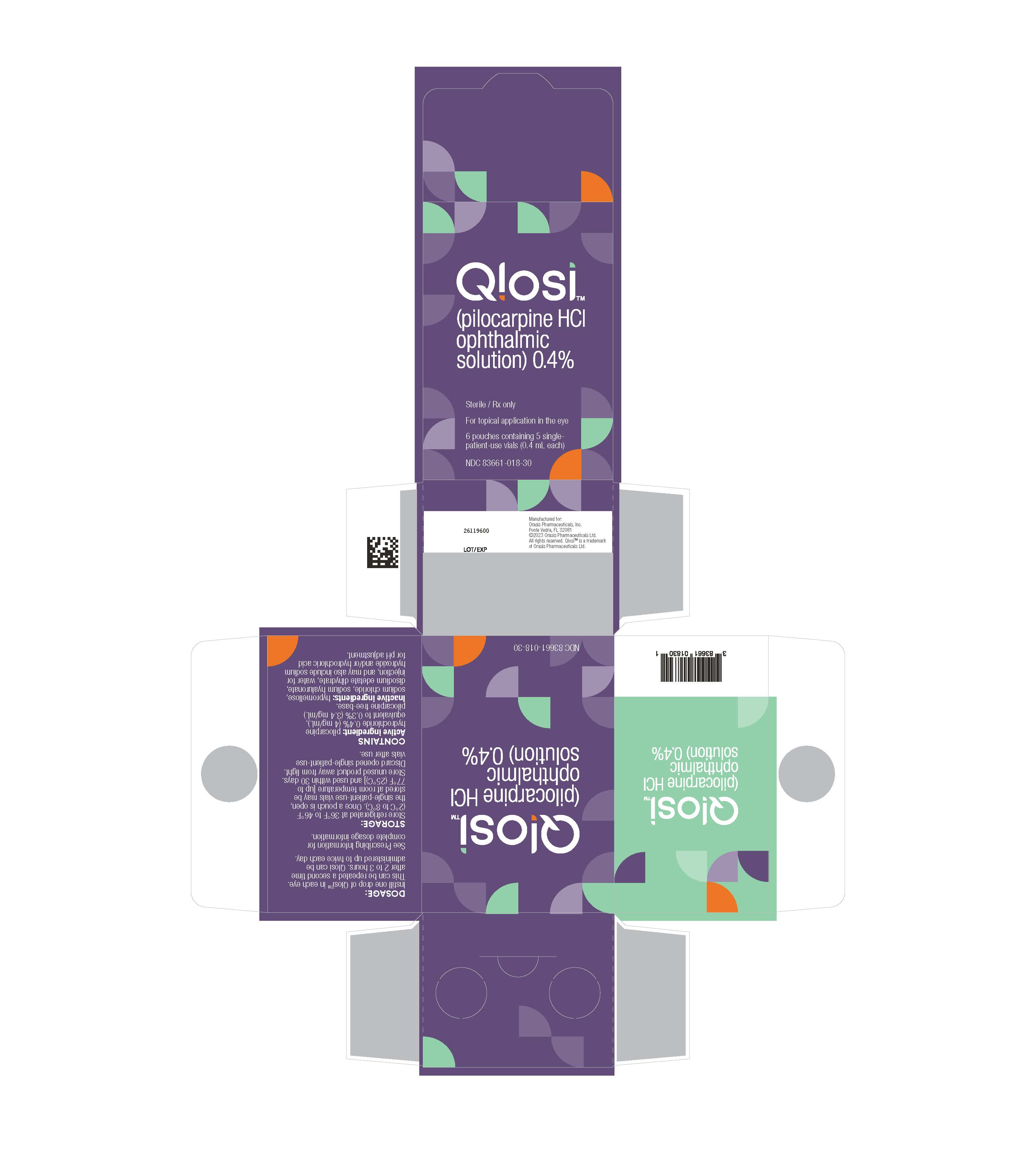
PRINCIPAL DISPLAY PANEL - 0.4 mL Vial Box Qlosi ™ (pilocarpine HCl ophthalmic solution) 0.4% Sterile / Rx only For topical application in the eye 6 pouches containing 5 single- patient-use vials (0.4 mL each) NDC 83661-018-30 Principal Display Panel qlosi-04
Reported adverse events (FAERS)
Top reported reactions
Age at onset
Reporter sex
Serious outcomes
Where does this data come from?
About this NDC listing & data coverage
What data is (and isn’t) available for this NDC — tap to expand
| NDC identity (package / product / labeler codes) | ✓ Available |
| Labeler | ✓ Available |
| Product & package description | ✓ Available |
| Marketing category & status | ✓ Available |
| Active ingredient / dosage form / route | ✓ Available |
| FDA label (SPL via DailyMed) | ✓ Available |
| Package photos | ✓ Available |
| Inactive ingredients (structured) | ✓ Available |
| NADAC pharmacy acquisition price (CMS) | — Not published for this NDC CMS publishes NADAC only for NDCs reported in its retail-pharmacy survey. |
| Orange Book / therapeutic-equivalence data | ✓ Available |
| HCPCS J-code billing crosswalk | — Not published for this NDC Most self-administered / retail products have no J-code — that is normal. |
| Medicaid utilization (CMS SDUD) | — Not published for this NDC CMS reports utilization only for NDCs with Medicaid claims above its privacy threshold. |