
Does 'Genius Mushrooms' Have Any Drug Interactions?
In our latest question and answer, our pharmacist discusses whether or not Genius Mushrooms has any drug interactions to be concerned about.


I'm taking Plavix and have been for a number of years. I am also diabetic and take some meds for that. I recently was told by a friend that I should try taking Genius mushrooms. It's a supplement. Does it interact in any way with Plavix?
Jan 10, 2023- Some mushrooms in this product, particularly reishi, may have mild blood-thinning effects that could increase bleeding risk if combined with blood-thinning medications like Plavix. Reishi and lion's mane may also lower blood sugar, so caution is advised if you take diabetes medications. The evidence for these interactions is mixed and often based on high doses or animal studies rather than large human studies.
Thanks so much for reaching out!
Genius Mushrooms is a dietary supplement product that contains three different types of mushrooms (I detail them in the next section). There are some theoretical drug interactions between these mushrooms and what you're taking but the evidence is fairly sparse and inconclusive.
What is important for you to know is that some studies suggest that mushrooms, like reishi, could potentially have antiplatelet effects and increase the risk of bleeding. However, this appears to be a relatively minor effect and most studies report it only occurs with very high doses.
Nevertheless, due to the seriousness of a potential bleeding episode occurring, you want to be cautious in combining dietary supplements with possible antiplatelet (i.e., blood-thinning) effects if you are already taking an antiplatelet or anticoagulant drug.
There are some other minor interactions as well that I talk about in the next sections.
What Does 'Genius Mushrooms' Contain?
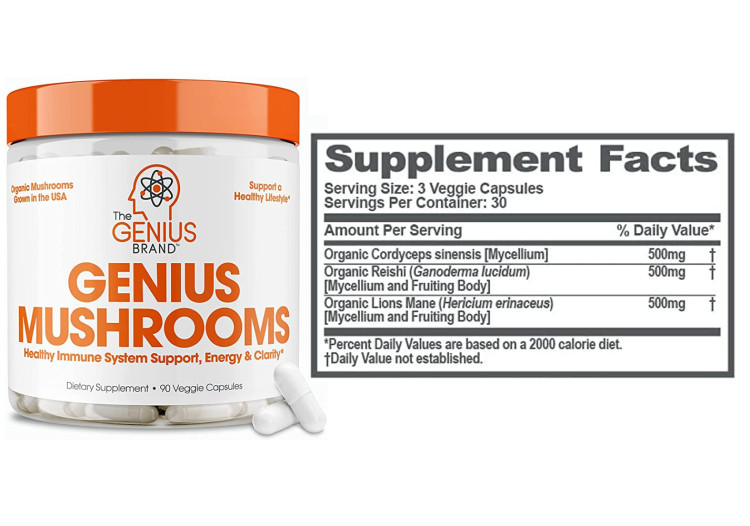
'Genius Mushrooms' contains the following:
- Organic Cordyceps Sinensis 500mg
- Organic Reishi 500mg
- Organic Lions Mane 500mg
All three of these are types of mushrooms belonging to different families. They are used medicinally and are purported to have various health benefits, such as an improvement in memory, athletic performance, cognition, and immune system function.
Potential Drug Interactions
Antiplatelets/Anticoagulants
Each of the mushrooms in 'Genius Mushrooms' has been linked to having antiplatelet effects, but the evidence, as stated in the opening to this answer, is mixed.
Reishi mushrooms, for example, contain adenosine, and at high enough doses, may act as an antiplatelet. One study found that doses of 3 grams per day of reishi mushrooms produced a mild antiplatelet effect, but another study, using 1.5 grams of mushrooms daily, did not notice an antiplatelet effect.
Similarly, some lab and animal studies suggest cordyceps and lion's mane may have antiplatelet effects, but there have been no large studies completed in humans.
Overall, most evidence suggests that all three of the mushrooms in 'Genius Mushrooms' may have a mild antiplatelet effect, but it likely isn't strong.
Regardless, there is certainly a chance that if you combine 'Genius Mushrooms' with a drug that thins your blood, you may be at a higher risk of bleeding episodes, and you should be aware of certain signs and symptoms, such as easy bruising, bleeding gums, and black and tarry stools.
You mentioned taking Plavix, and with that drug being an antiplatelet, 'Genius Mushrooms' should be used cautiously. Other antiplatelets/anticoagulants include (note: each hyperlink is a link to our drug-herbal interaction checker showing the interaction details):
Antidiabetic Agents
Reishi and lion's mane have also been reported as having mild antidiabetic effects and may lower blood sugar.
While they may not necessarily interact with any diabetes medication, they could in theory put you more at risk for low blood sugar, or 'hypoglycemia'. Therefore, 'Genius Mushrooms' should be used cautiously with drugs that lower blood sugar, such as:
The interaction here is likely to be clinically insignificant but nonetheless good to know about so you can monitor yourself for signs and symptoms of low blood sugar.
Final Words
I hope you found this answer information helpful! I know it was a lot, but when talking about dietary supplements, there generally is a lot of information to go over about what possibly could (or could not) happen.
I appreciate you reaching out and encourage you to do so again anytime.
References & sources
- A prospective, randomized, double-blind, placebo-controlled study of the platelet and global hemostatic effects of Ganoderma lucidum (Ling-Zhi) in healthy volunteers — PubMed
- The lack of antiplatelet effect of crude extracts from ganoderma lucidum on HIV-positive hemophiliacs — PubMed
- [Inhibitory effects of alcoholic extract of Cordyceps sinensis on abdominal aortic thrombus formation in rabbits] — PubMed
- Experimental and clinical studies on inhibitory effect of ganoderma lucidum on platelet aggregation — PubMed
Glossary — Terms in This Answer
- Dietary supplement
- A product containing vitamins, minerals, herbs, or other ingredients intended to supplement the diet and support health.
- Drug interactions
- Changes in how a medication works or how the body processes it when combined with another substance.
- Antiplatelet effects
- The ability to reduce the clotting ability of platelets, the blood cells responsible for forming clots.
- Anticoagulant
- A medication that prevents blood from clotting or slows down the clotting process.
- Adenosine
- A chemical compound naturally found in the body that can affect various functions including blood clotting.
- Antidiabetic effects
- The ability to help lower blood sugar levels in the body.
- Hypoglycemia
- A condition where blood sugar levels become dangerously low.
- Clinically insignificant
- A medical effect that is too small or minor to have a meaningful impact on a patient's health or treatment.
Dr. Brian Staiger, PharmD
Doctor of Pharmacy, board certified clinical pharmacist (BCPS), American Herbalist Guild, Medication Therapy Management certified
Brian Staiger, PharmD, BCPS, is a licensed pharmacist with more than 13 years of experience across retail pharmacy, clinical pharmacy, medication safety, pharmacy program development, and healthcare administration. He is the founder of HelloPharmacist.com, where he helps patients...
More answers from Brian →