
Acerola Extract Powder 500 mg Ingredients & Drug Interactions
What is this page for?
First and foremost: checking Acerola Extract Powder 500 mg against your medications. The heart of this page is the interaction checker and the full interaction report — how this product’s ingredients may interact with prescription and over-the-counter medicines you may be taking.
Around that, we add a pharmacist’s high-level view of the product as a whole — what’s inside, the evidence for its stated use, how transparent the label is, and what safety data exists — so you can see the full picture in one place. It’s educational information from our licensed clinical databases and the clinical staff at HelloPharmacist — not medical advice — and we don’t sell or endorse products. Our editorial policy
Acerola Extract Powder 500 mg is a dietary supplement by BulkSupplements.com with 1 active ingredient. Its ingredients are commonly taken for vitamin c source, immune support, antioxidant support.Based on those ingredients, 128 medications have a known interaction with it, the most serious rated moderate. The ingredients most likely to interact are Acerola Fruit Extract. Use the checker below to test your specific medication, or read the full HelloPharmacist Interaction Report.
Check Your Meds Against Acerola Extract Powder 500 mg by BulkSupplements.com
Ask about any prescription or over-the-counter medication and we check it for interactions with Acerola Extract Powder 500 mg by BulkSupplements.com — and tell you which ingredient is responsible.
AI summaries are generated from our interaction database for education only — always confirm with your pharmacist. How we use AI
Ask the Pharmacist
A licensed pharmacist will answer your question by email — free, usually within 24 hours.
Got it — thank you!
A licensed pharmacist will answer within 24 hours. Keep an eye on your email (worth checking spam, just in case).
HelloPharmacist Scorecard of Acerola Extract Powder 500 mg by BulkSupplements.com
Our pharmacy team’s full take, with four database checks built into the cards below — a summary of what is known, not a grade of the product itself.
What’s inside
Full disclosure
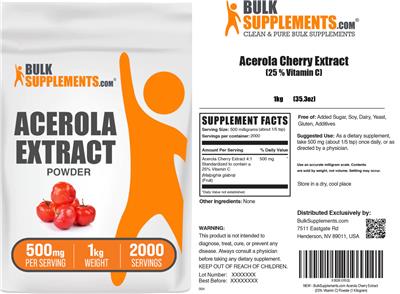
This product contains one active ingredient: acerola fruit extract at 500 mg per serving. Acerola is a tropical fruit that's naturally rich in vitamin C, and this extract concentrates that nutrient.
There are no other inactive ingredients (fillers or binders) listed.
Does it work?
Moderate evidence
The evidence we hold shows acerola is possibly effective for vitamin C deficiency. For other uses — common cold, atherosclerosis, and diarrhea — the evidence isn't strong enough to rate.
If your goal is addressing a documented low vitamin C level, this may help; for other purposes, the data we have doesn't support a clear benefit.
How safe is it?
Well-documented data
Acerola in food amounts or used as directed on labels is generally considered safe. That said, we know less about the safety of concentrated supplements like this one, so talk with your doctor before starting, especially if you're taking other medications.
Large doses of vitamin C (over 2000 mg daily) can cause osmotic diarrhea and stomach upset; theoretically this could happen with high doses of acerola. There's also a rare case report of an allergic reaction in someone with latex sensitivity and a history of oral allergy symptoms, though this is uncommon.
Meds to double-check
Moderate interaction found
Double-check this product if you take chemotherapy drugs (alkylating agents or antitumor antibiotics), estrogen-based medications including birth control pills and hormone replacement therapy, aspirin, warfarin, or aluminum salts. The chemotherapy interactions are rated Moderate; the others are Minor but still worth confirming with your pharmacist.
The bottom line
Scorecard at a glanceFully disclosed formula with some supporting evidence for its stated purpose. Moderate medication interactions have been identified, and safety information is well characterized.
Acerola is a straightforward vitamin C source, possibly helpful if you're deficient. If you're on chemotherapy, hormonal contraceptives, warfarin, or other medications, check with your pharmacist first — there are documented interactions to review.
For most other uses, the evidence isn't yet established.
Educational only — not medical advice; always confirm with your pharmacist. Our editorial policy · How we use AI
Assessment coverage: 1 of 1 active ingredient matched to our full ingredient reviews (monographs). Based on the product label dated Feb 23, 2025.
This Scorecard evaluates available label information, ingredient evidence, and known medication-safety considerations. It does not independently verify product identity, purity, potency, contamination, or manufacturing quality. How these ratings are computed
General information
Key facts about Acerola Extract Powder 500 mg, straight from the product label.
| Brand | BulkSupplements.com |
|---|---|
| Barcode (UPC) | X002KU9SQL |
| Net contents | 1 Kilogram(s); 35.3 Ounce(s) |
| Market status | On market |
| Date entered into DSLD | Feb 23, 2025 |
| DSLD ID | 329658 |
| Product type | Botanical |
| Supplement form | Powder |
| Dietary claims / uses | Nutrient, All Other, Structure/Function |
| Intended target group(s) | Adult (18 - 50 Years), Gluten Free, Dairy Free |
Everything in this section is reproduced from the manufacturer’s own product label — it’s the label speaking, not HelloPharmacist. We show it so you can see exactly what the maker states; we don’t verify or endorse those statements.
Supplement Facts
The label details for Acerola Extract Powder 500 mg by BulkSupplements.com, sourced from the NIH Dietary Supplement Label Database.
Supplement Facts
| Ingredient | Amount | % DV |
|---|---|---|
| Acerola Fruit Extract | 500 mg | -- |
Tap any ingredient to jump to its full detail below.
These statements are the manufacturer’s wording, reproduced from the product label — the label is saying it, not HelloPharmacist. We don’t verify or endorse them.
Formula
Acerola Extract Powder 500 mg per serving Acerola Cherry Extract (25% Vitamin C)
Brand IP Statement(s)
Bulksupplements.com Clean & pure bulk supplements
FDA Disclaimer Statement
Warning: This product is not intended to diagnose, treat, cure, or prevent any disease.
Precautions
Always consult a physician before taking any dietary supplement.
Keep out of reach of children.
Formulation
Free of: Added sugar, soy, dairy, yeast, gluten, additives
Suggested/Recommended/Usage/Directions
Suggested use: As a dietary supplement, take 500 mg (about 1/5 tsp) once daily, or as directed by a physician.
General Statements
Use an accurate milligram scale.
New
Storage
Contents are sold by weight, not volume. Settling may occur. Store in a dry, cool place
Is this label outdated? Report a formula or label change and our pharmacy team will review it.
Acerola Extract Powder 500 mg by BulkSupplements.com label
The label scan from the NIH Dietary Supplement Label Database. Tap to enlarge.
Label images are published by the NIH Dietary Supplement Label Database for the version of this product on file. Always read your actual product label.
View the full label (PDF)The Ingredients in Acerola Extract Powder 500 mg by BulkSupplements.com
This is the 1 active ingredient this product is made of. Select it to open its full monograph.
Serving size500 mg Dosage formPowder Servings per container2000 Amounts shown are per serving.
Acerola Fruit Extract
Interacts with128 drugs
Acerola is a small tropical fruit prized for its very high natural vitamin C content, and it is mostly used as a food-based source of vitamin C and an...
Acerola Fruit Extract monograph & interactionsAcerola Extract Powder 500 mg by BulkSupplements.com Drug Interactions
HelloPharmacist Interaction Report
Acerola Extract Powder by BulkSupplements.com contains one active ingredient — acerola fruit extract, which is rich in vitamin C — and it does have documented interactions with medications.
The most serious concern is with chemotherapy drugs. Acerola's antioxidant effects may theoretically reduce how well alkylating agents and antitumor antibiotics (chemotherapy drugs that work by generating free radicals) perform, and both interactions are rated Moderate severity.
Read the full breakdown — every affected drug type, severity by severity
Beyond chemotherapy, acerola may cause Minor interactions with estrogen-containing medications (including birth control pills and hormone replacement therapy), where it might increase estrogenic effects. It may also theoretically slow the clearance of aspirin, interact with aluminum-containing products, and reduce warfarin (a blood thinner) effectiveness — though the vitamin C content in acerola is likely too low for these last three to cause clinically meaningful problems.
Altogether, these interactions span 128 individual medications. If you're on any prescription medication — especially chemotherapy, hormonal contraceptives, hormone therapy, aspirin, warfarin, or aluminum-based products — run your exact medications through the checker below before starting this supplement.
Check your own medications below · Editorial policy · How we use AI
Want to check YOUR meds against Acerola Extract Powder 500 mg?
Ask about interactions with your drugs in plain English — “Can I take it with lisinopril?” — and we find you the answer in seconds, ingredient by ingredient.
Go to the checkerIngredients driving the most interactions
Individual Drug Interactions
The ingredients in Acerola Extract Powder 500 mg interact with 128 drugs. Click any drug to see the details.
1 of the 1 ingredient in Acerola Extract Powder 500 mg interact with drugs. Each result below shows which ingredient is responsible. Acerola Fruit Extract
AltretamineHexalen
How Altretamine interacts with Acerola Extract Powder 500 mg — through 1 ingredient. Tap an ingredient for the detail:
Acerola Fruit ExtractAlkylating Agents Moderate
Interaction Summary
Theoretically, the antioxidant effects of acerola might reduce the effectiveness of alkylating agents.
Read the full Acerola Fruit Extract + Altretamine interactionBendamustineBelrapzo, Treanda, Vivimusta
How Bendamustine interacts with Acerola Extract Powder 500 mg — through 1 ingredient. Tap an ingredient for the detail:
Acerola Fruit ExtractAlkylating Agents Moderate
Interaction Summary
Theoretically, the antioxidant effects of acerola might reduce the effectiveness of alkylating agents.
Read the full Acerola Fruit Extract + Bendamustine interactionBendamustine HydrochlorideBendeka
How Bendamustine Hydrochloride interacts with Acerola Extract Powder 500 mg — through 1 ingredient. Tap an ingredient for the detail:
Acerola Fruit ExtractAlkylating Agents Moderate
Interaction Summary
Theoretically, the antioxidant effects of acerola might reduce the effectiveness of alkylating agents.
Read the full Acerola Fruit Extract + Bendamustine Hydrochloride interactionBleomycinBlenoxane
How Bleomycin interacts with Acerola Extract Powder 500 mg — through 1 ingredient. Tap an ingredient for the detail:
Acerola Fruit ExtractAntitumor Antibiotics Moderate
Interaction Summary
Theoretically, the antioxidant effects of acerola might reduce the effectiveness of antitumor antibiotics.
Read the full Acerola Fruit Extract + Bleomycin interactionBusulfanBusulfex, Myleran
How Busulfan interacts with Acerola Extract Powder 500 mg — through 1 ingredient. Tap an ingredient for the detail:
Acerola Fruit ExtractAlkylating Agents Moderate
Interaction Summary
Theoretically, the antioxidant effects of acerola might reduce the effectiveness of alkylating agents.
Read the full Acerola Fruit Extract + Busulfan interactionCarboplatinParaplatin
How Carboplatin interacts with Acerola Extract Powder 500 mg — through 1 ingredient. Tap an ingredient for the detail:
Acerola Fruit ExtractAlkylating Agents Moderate
Interaction Summary
Theoretically, the antioxidant effects of acerola might reduce the effectiveness of alkylating agents.
Read the full Acerola Fruit Extract + Carboplatin interactionCarmustineBiCNU, Gliadel, Gliadel Wafer
How Carmustine interacts with Acerola Extract Powder 500 mg — through 1 ingredient. Tap an ingredient for the detail:
Acerola Fruit ExtractAlkylating Agents Moderate
Interaction Summary
Theoretically, the antioxidant effects of acerola might reduce the effectiveness of alkylating agents.
Read the full Acerola Fruit Extract + Carmustine interactionChlorambucilLeukeran
How Chlorambucil interacts with Acerola Extract Powder 500 mg — through 1 ingredient. Tap an ingredient for the detail:
Acerola Fruit ExtractAlkylating Agents Moderate
Interaction Summary
Theoretically, the antioxidant effects of acerola might reduce the effectiveness of alkylating agents.
Read the full Acerola Fruit Extract + Chlorambucil interactionCisplatinPlatinol-AQ
How Cisplatin interacts with Acerola Extract Powder 500 mg — through 1 ingredient. Tap an ingredient for the detail:
Acerola Fruit ExtractAlkylating Agents Moderate
Interaction Summary
Theoretically, the antioxidant effects of acerola might reduce the effectiveness of alkylating agents.
Read the full Acerola Fruit Extract + Cisplatin interactionCyclophosphamideCytoxan, Neosar
How Cyclophosphamide interacts with Acerola Extract Powder 500 mg — through 1 ingredient. Tap an ingredient for the detail:
Acerola Fruit ExtractAlkylating Agents Moderate
Interaction Summary
Theoretically, the antioxidant effects of acerola might reduce the effectiveness of alkylating agents.
Read the full Acerola Fruit Extract + Cyclophosphamide interactionDacarbazineDTIC-Dome
How Dacarbazine interacts with Acerola Extract Powder 500 mg — through 1 ingredient. Tap an ingredient for the detail:
Acerola Fruit ExtractAlkylating Agents Moderate
Interaction Summary
Theoretically, the antioxidant effects of acerola might reduce the effectiveness of alkylating agents.
Read the full Acerola Fruit Extract + Dacarbazine interactionDactinomycinCosmegan, Cosmegen
How Dactinomycin interacts with Acerola Extract Powder 500 mg — through 1 ingredient. Tap an ingredient for the detail:
Acerola Fruit ExtractAntitumor Antibiotics Moderate
Interaction Summary
Theoretically, the antioxidant effects of acerola might reduce the effectiveness of antitumor antibiotics.
Read the full Acerola Fruit Extract + Dactinomycin interactionDaunorubicin CitrateDaunoXome
How Daunorubicin Citrate interacts with Acerola Extract Powder 500 mg — through 1 ingredient. Tap an ingredient for the detail:
Acerola Fruit ExtractAntitumor Antibiotics Moderate
Interaction Summary
Theoretically, the antioxidant effects of acerola might reduce the effectiveness of antitumor antibiotics.
Read the full Acerola Fruit Extract + Daunorubicin Citrate interactionDaunorubicin HydrochlorideCerubidine
How Daunorubicin Hydrochloride interacts with Acerola Extract Powder 500 mg — through 1 ingredient. Tap an ingredient for the detail:
Acerola Fruit ExtractAntitumor Antibiotics Moderate
Interaction Summary
Theoretically, the antioxidant effects of acerola might reduce the effectiveness of antitumor antibiotics.
Read the full Acerola Fruit Extract + Daunorubicin Hydrochloride interactionDaunorubicin, CytarabineVyxeos
How Daunorubicin, Cytarabine interacts with Acerola Extract Powder 500 mg — through 1 ingredient. Tap an ingredient for the detail:
Acerola Fruit ExtractAntitumor Antibiotics Moderate
Interaction Summary
Theoretically, the antioxidant effects of acerola might reduce the effectiveness of antitumor antibiotics.
Read the full Acerola Fruit Extract + Daunorubicin, Cytarabine interactionDoripenemDoribax
How Doripenem interacts with Acerola Extract Powder 500 mg — through 1 ingredient. Tap an ingredient for the detail:
Acerola Fruit ExtractAntitumor Antibiotics Moderate
Interaction Summary
Theoretically, the antioxidant effects of acerola might reduce the effectiveness of antitumor antibiotics.
Read the full Acerola Fruit Extract + Doripenem interactionDoxorubicinAdriamycin, Caelyx, Doxil, Myocet, Rubex
How Doxorubicin interacts with Acerola Extract Powder 500 mg — through 1 ingredient. Tap an ingredient for the detail:
Acerola Fruit ExtractAntitumor Antibiotics Moderate
Interaction Summary
Theoretically, the antioxidant effects of acerola might reduce the effectiveness of antitumor antibiotics.
Read the full Acerola Fruit Extract + Doxorubicin interactionEpirubicinEllence
How Epirubicin interacts with Acerola Extract Powder 500 mg — through 1 ingredient. Tap an ingredient for the detail:
Acerola Fruit ExtractAntitumor Antibiotics Moderate
Interaction Summary
Theoretically, the antioxidant effects of acerola might reduce the effectiveness of antitumor antibiotics.
Read the full Acerola Fruit Extract + Epirubicin interactionEstramustine Phosphate SodiumEmcyt
How Estramustine Phosphate Sodium interacts with Acerola Extract Powder 500 mg — through 1 ingredient. Tap an ingredient for the detail:
Acerola Fruit ExtractAlkylating Agents Moderate
Interaction Summary
Theoretically, the antioxidant effects of acerola might reduce the effectiveness of alkylating agents.
Read the full Acerola Fruit Extract + Estramustine Phosphate Sodium interactionIdarubicinIdamycin
How Idarubicin interacts with Acerola Extract Powder 500 mg — through 1 ingredient. Tap an ingredient for the detail:
Acerola Fruit ExtractAntitumor Antibiotics Moderate
Interaction Summary
Theoretically, the antioxidant effects of acerola might reduce the effectiveness of antitumor antibiotics.
Read the full Acerola Fruit Extract + Idarubicin interactionIfosfamideIfex
How Ifosfamide interacts with Acerola Extract Powder 500 mg — through 1 ingredient. Tap an ingredient for the detail:
Acerola Fruit ExtractAlkylating Agents Moderate
Interaction Summary
Theoretically, the antioxidant effects of acerola might reduce the effectiveness of alkylating agents.
Read the full Acerola Fruit Extract + Ifosfamide interactionLomustineCeenu
How Lomustine interacts with Acerola Extract Powder 500 mg — through 1 ingredient. Tap an ingredient for the detail:
Acerola Fruit ExtractAlkylating Agents Moderate
Interaction Summary
Theoretically, the antioxidant effects of acerola might reduce the effectiveness of alkylating agents.
Read the full Acerola Fruit Extract + Lomustine interactionLurbinectedinZepzelca
How Lurbinectedin interacts with Acerola Extract Powder 500 mg — through 1 ingredient. Tap an ingredient for the detail:
Acerola Fruit ExtractAlkylating Agents Moderate
Interaction Summary
Theoretically, the antioxidant effects of acerola might reduce the effectiveness of alkylating agents.
Read the full Acerola Fruit Extract + Lurbinectedin interactionMechlorethamine HydrochlorideValchlor
How Mechlorethamine Hydrochloride interacts with Acerola Extract Powder 500 mg — through 1 ingredient. Tap an ingredient for the detail:
Acerola Fruit ExtractAlkylating Agents Moderate
Interaction Summary
Theoretically, the antioxidant effects of acerola might reduce the effectiveness of alkylating agents.
Read the full Acerola Fruit Extract + Mechlorethamine Hydrochloride interactionMelphalanAlkeran, Hepzato
How Melphalan interacts with Acerola Extract Powder 500 mg — through 1 ingredient. Tap an ingredient for the detail:
Acerola Fruit ExtractAlkylating Agents Moderate
Interaction Summary
Theoretically, the antioxidant effects of acerola might reduce the effectiveness of alkylating agents.
Read the full Acerola Fruit Extract + Melphalan interactionMelphalan FlufenamidePepaxto
How Melphalan Flufenamide interacts with Acerola Extract Powder 500 mg — through 1 ingredient. Tap an ingredient for the detail:
Acerola Fruit ExtractAlkylating Agents Moderate
Interaction Summary
Theoretically, the antioxidant effects of acerola might reduce the effectiveness of alkylating agents.
Read the full Acerola Fruit Extract + Melphalan Flufenamide interactionMelphalan HydrochlorideEvomela
How Melphalan Hydrochloride interacts with Acerola Extract Powder 500 mg — through 1 ingredient. Tap an ingredient for the detail:
Acerola Fruit ExtractAlkylating Agents Moderate
Interaction Summary
Theoretically, the antioxidant effects of acerola might reduce the effectiveness of alkylating agents.
Read the full Acerola Fruit Extract + Melphalan Hydrochloride interactionMitomycinJelmyto, Mitosol, Mutamycin
How Mitomycin interacts with Acerola Extract Powder 500 mg — through 1 ingredient. Tap an ingredient for the detail:
Acerola Fruit ExtractAntitumor Antibiotics Moderate
Interaction Summary
Theoretically, the antioxidant effects of acerola might reduce the effectiveness of antitumor antibiotics.
Read the full Acerola Fruit Extract + Mitomycin interactionMitomycin CMitozytrex
How Mitomycin C interacts with Acerola Extract Powder 500 mg — through 1 ingredient. Tap an ingredient for the detail:
Acerola Fruit ExtractAntitumor Antibiotics Moderate
Interaction Summary
Theoretically, the antioxidant effects of acerola might reduce the effectiveness of antitumor antibiotics.
Read the full Acerola Fruit Extract + Mitomycin C interactionMitoxantroneNovantrone
How Mitoxantrone interacts with Acerola Extract Powder 500 mg — through 1 ingredient. Tap an ingredient for the detail:
Acerola Fruit ExtractAntitumor Antibiotics Moderate
Interaction Summary
Theoretically, the antioxidant effects of acerola might reduce the effectiveness of antitumor antibiotics.
Read the full Acerola Fruit Extract + Mitoxantrone interactionEach ingredient & the kinds of drugs it affects
For each ingredient in Acerola Extract Powder 500 mg with known interactions, here are the types of medications it can affect. Open any type for the detail — or search your exact drug in the checker above.
Acerola Fruit Extract
Alkylating Agents
Theoretically, the antioxidant effects of acerola might reduce the effectiveness of alkylating agents.
Acerola contains vitamin C, an antioxidant. There is concern that antioxidants might reduce the activity of chemotherapy drugs that generate free radicals, such as alkylating agents. In contrast, other researchers theorize that antioxidants might make alkylating chemotherapy more effective by reducing oxidative stress that could interfere with apoptosis (cell death) of cancer cells. More evidence is needed to determine what effect, if any, antioxidants such as vitamin C have on chemotherapy.
Antitumor Antibiotics
Theoretically, the antioxidant effects of acerola might reduce the effectiveness of antitumor antibiotics.
Acerola contains vitamin C, an antioxidant. There is concern that antioxidants might reduce the activity of chemotherapy drugs that generate free radicals, such as antitumor antibiotics. In contrast, other researchers theorize that antioxidants might make antitumor antibiotic chemotherapy more effective by reducing oxidative stress that could interfere with apoptosis (cell death) of cancer cells. More evidence is needed to determine what effects, if any, antioxidants such as vitamin C have on antitumor antibiotic chemotherapy.
Aluminum
Theoretically, concomitant use of acerola with aluminum salts might increase the amount of aluminum absorbed.
Acerola contains vitamin C. It is thought that vitamin C chelates aluminum, keeping it in solution and available for absorption. In people with normal renal function, urinary excretion of aluminum likely increases, making aluminum retention and toxicity unlikely. However, patients with renal failure who take aluminum-containing compounds, such as phosphate binders, should avoid acerola in doses that provide more vitamin C than the recommended dietary allowances.
Aspirin
Theoretically, acerola might reduce the clearance of aspirin; however, its vitamin C content is likely too low to produce clinically significant effects.
Acerola contains vitamin C. It has been suggested that acidification of the urine by vitamin C can decrease the urinary excretion of salicylates, increasing plasma salicylate levels. However, short-term use of up to 6 grams daily of vitamin C does not seem to affect urinary pH or salicylate excretion. The vitamin C content of acerola is typically about 2000 mg per 100 grams. Thus, a clinically significant interaction between acerola and aspirin is unlikely.
Estrogens
Theoretically, concomitant use of acerola with estrogens might increase estrogenic effects.
Acerola contains vitamin C. Increases in plasma estrogen levels of up to 55% have occurred under some circumstances when vitamin C is taken concurrently with oral contraceptives or hormone replacement therapy, including topical products. It is suggested that vitamin C prevents oxidation of estrogen in the tissues, regenerates oxidized estrogen, and reduces sulfate conjugation of estrogen in the gut wall. When tissue levels of vitamin C are high, these processes are already maximized and supplemental vitamin C does not have any effect on estrogen levels. However, increases in plasma estrogen levels may occur when women who are deficient in vitamin C take supplements.
Warfarin (Coumadin)
Theoretically, acerola might reduce the effectiveness of warfarin; however, its vitamin C content is likely too low to produce clinically significant effects.
Acerola contains vitamin C. High doses of vitamin C may reduce the response to warfarin, possibly by causing diarrhea and reducing warfarin absorption. This occurred in two people who took up to 16 grams daily of vitamin C, and resulted in decreased prothrombin time. Lower doses of 5-10 grams daily of vitamin C can also reduce warfarin absorption, but this does not seem to be clinically significant. The vitamin C content of acerola is typically about 2000 mg per 100 grams. Thus, a clinically significant interaction between acerola and warfarin is unlikely.
Brand information
Manufacturer and brand details for Acerola Extract Powder 500 mg, from the product label.
BulkSupplements.com
See all BulkSupplements.com products- Name
- BulkSupplements.com
- Street Address
- 7511 Eastgate Rd
- City
- Henderson
- State
- NV
- ZipCode
- 89011
- Web Address
- BulkSupplements.com
Acerola Extract Powder 500 mg by BulkSupplements.com: Common Questions
Does Acerola Extract Powder 500 mg by BulkSupplements.com interact with any medications?
How can one product interact with so many drugs?
Where does this information come from?
Will acerola help with the common cold?
Can I take this if I'm pregnant or breastfeeding?
What side effects might acerola cause?
Is this safe to use long-term?
Written and reviewed by the HelloPharmacist editorial staff. Our editorial policy
Not sure if Acerola Extract Powder 500 mg is safe with your meds?
Our pharmacists answer your medication & supplement questions — free.
Label information is sourced from the NIH Dietary Supplement Label Database and reflects the product version on file; always read your actual product label. This page is for education only and is not a substitute for professional medical advice. Confirm with your pharmacist or doctor before combining supplements and medications.
The Full Monographs Behind Acerola Extract Powder 500 mg’s Ingredients
Every ingredient we hold a full HelloPharmacist monograph for — uses, evidence, safety, and the complete interaction list.
Sources & How We Checked
Acerola Extract Powder 500 mg's label data comes from the NIH Dietary Supplement Label Database; the ingredient interaction data is from the Natural Medicines database, reviewed by our pharmacists.
- NIH Dietary Supplement Label Database (DSLD) — The official product label on file for this supplement.
- Natural Medicines (Therapeutic Research Center) — Evidence-graded clinical reference behind the ingredient interaction data.
Content is written and reviewed by licensed HelloPharmacist pharmacists. See our data sources and editorial standards for how this information is built and checked.
The 20 references behind this product’s interaction data
Every citation that drives the interaction findings for this product’s ingredients, from the evidence-graded Natural Medicines (TRC Healthcare) database. Open an ingredient to browse its citations — links open the study on PubMed or the publisher’s site.
Acerola 20 references
- Back DJ, Breckenridge AM, MacIver M, et al. Interaction of ethinyloestradiol with ascorbic acid in man. Br Med J (Clin Res Ed) 1981;282:1516.
- Morris JC, Beeley L, Ballantine N. Interaction of ethinyloestradiol with ascorbic acid in man [letter]. Br Med J (Clin Res Ed) 1981;283:503.
- Labriola D, Livingston R. Possible interactions between dietary antioxidants and chemotherapy. Oncology 1999;13:1003-8.
- Hansten PD, Horn JR. Drug Interactions Analysis and Management. Vancouver, WA: Applied Therapeutics Inc., 1997 and updates.
- Food and Nutrition Board, Institute of Medicine. Dietary Reference Intakes for Vitamin C, Vitamin E, Selenium, and Carotenoids. Washington, DC: National Academy Press, 2000. Available at: http://www.nap.edu/books/0309069351/html/.
- Rosenthal G. Interaction of ascorbic acid and warfarin. JAMA 1971;215:1671. DOI
- Hume R, Johnstone JM, Weyers E. Interaction of ascorbic acid and warfarin. JAMA 1972;219:1479. DOI
- Smith EC, Skalski RJ, Johnson GC, Rossi GV. Interaction of ascorbic acid and warfarin. JAMA 1972;221:1166. DOI
- Domingo JL, Gomez M, Llobet JM, Richart C. Effect of ascorbic acid on gastrointestinal aluminum absorption (letter). Lancet 1991;338:1467.
- Domingo JL, Gomez M, Llobet JM, Corbella J. Influence of some dietary constituents on aluminum absorption and retention in rats. Kidney Int 1991;39:598-601. PubMed
- Partridge NA, Regnier FE, White JL, Hem SL. Influence of dietary constituents on intestinal absorption of aluminum. Kidney Int 1989;35:1413-7. PubMed
- Mc Leod DC, Nahata MC. Inefficacy of ascorbic acid as a urinary acidifier (letter). N Engl J Med 1977;296:1413. DOI
- Hansten PD, Hayton WL. Effect of antacid and ascorbic acid on serum salicylate concentration. J Clin Pharmacol 1980;20:326-31. PubMed
- Vihtamaki T, Parantainen J, Koivisto AM, et al. Oral ascorbic acid increases plasma oestradiol during postmenopausal hormone replacement therapy. Maturitas 2002;42:129-35. PubMed
- Feetam CL, Leach RH, Meynell MJ. Lack of a clinically important interaction between warfarin and ascorbic acid. Toxicol Appl Pharmacol 1975;31:544-7. PubMed
- Weintraub M, Griner PF. Warfarin and ascorbic acid: lack of evidence for a drug interaction. Toxicol Appl Pharmacol 1974;28:53-6. PubMed
- Prasad KN. Rationale for using high-dose multiple dietary antioxidants as an adjunct to radiation therapy and chemotherapy. J Nutr 2004;134:3182S-3S. PubMed
- Conklin KA. Cancer chemotherapy and antioxidants. J Nutr 2004;134:3201S-3204S. PubMed
- Denadai R, Souza FM, Valle MR. Fecal impaction by rectal acerola bezoar. Indian J Pediatr 2013;80(5):432-3. PubMed
- Raulf-Heimsoth M, Stark R, Sander I, et al. Anaphylactic reaction to apple juice containing acerola: cross-reactivity to latex due to prohevein. J Allergy Clin Immunol 2002;109(4):715-6. PubMed
Parts of this content are provided by the Therapeutic Research Center, LLC.
DISCLAIMER: Currently this does not check for drug-drug interactions. This is not an all-inclusive comprehensive list of potential interactions and is for informational purposes only. Not all interactions are known or well-reported in the scientific literature, and new interactions are continually being reported. Input is needed from a qualified healthcare provider including a pharmacist before starting any therapy. Application of clinical judgment is necessary.
© 2021 Therapeutic Research Center, LLC