
Ayur-Pro B Ingredients & Drug Interactions
What is this page for?
First and foremost: checking Ayur-Pro B against your medications. The heart of this page is the interaction checker and the full interaction report — how this product’s ingredients may interact with prescription and over-the-counter medicines you may be taking.
Around that, we add a pharmacist’s high-level view of the product as a whole — what’s inside, the evidence for its stated use, how transparent the label is, and what safety data exists — so you can see the full picture in one place. It’s educational information from our licensed clinical databases and the clinical staff at HelloPharmacist — not medical advice — and we don’t sell or endorse products. Our editorial policy
Ayur-Pro B is a dietary supplement by Douglas Laboratories with 1 active ingredient. Its ingredients are commonly taken for constipation, irritable bowel syndrome (ibs), diarrhea.Based on those ingredients, 182 medications have a known interaction with it, the most serious rated moderate. The ingredients most likely to interact are Lactobacillus Sporogenes. Use the checker below to test your specific medication, or read the full HelloPharmacist Interaction Report.
Check Your Meds Against Ayur-Pro B by Douglas Laboratories
Ask about any prescription or over-the-counter medication and we check it for interactions with Ayur-Pro B by Douglas Laboratories — and tell you which ingredient is responsible.
AI summaries are generated from our interaction database for education only — always confirm with your pharmacist. How we use AI
Ask the Pharmacist
A licensed pharmacist will answer your question by email — free, usually within 24 hours.
Got it — thank you!
A licensed pharmacist will answer within 24 hours. Keep an eye on your email (worth checking spam, just in case).
HelloPharmacist Scorecard of Ayur-Pro B by Douglas Laboratories
Our pharmacy team’s full take, with four database checks built into the cards below — a summary of what is known, not a grade of the product itself.
What’s inside
Full disclosure
Ayur-Pro B contains one active ingredient: Lactobacillus Sporogenes, a probiotic (live beneficial bacteria) intended to support digestive health. The capsule also holds inactive ingredients — gelatin, cellulose, and vegetable stearate — which are common binders and capsule material.
Does it work?
Moderate evidence
The evidence for this probiotic is mixed. It's rated possibly effective for constipation and irritable bowel syndrome (IBS), meaning some evidence supports its use but more research is needed to be certain.
For antibiotic-associated diarrhea, athletic performance, cancer, and nonalcoholic fatty liver disease, we don't have enough reliable evidence in our data to rate whether it works.
How safe is it?
Well-documented data
Bacillus Coagulans is generally well tolerated in healthy adults, though product quality and safety data vary across brands. There isn't enough reliable safety information overall, so talk to your doctor or pharmacist before starting it.
One concern: live probiotic organisms can theoretically cause serious infection in people who are severely ill, immunocompromised, or have central venous catheters — but this risk is rare in people with intact immune systems. Reports of harm in otherwise healthy people are uncommon.
Meds to double-check
Moderate interaction found
Before taking Ayur-Pro B, check your antibiotic medications with the search tool on this page. Antibiotics can reduce the probiotic's effectiveness, so you'll likely need to space them apart — your doctor or pharmacist can help you find the right timing.
The bottom line
Scorecard at a glanceFully disclosed formula with some supporting evidence behind its ingredients' uses. Moderate medication interactions have been identified, and safety information is well characterized.
If you have constipation or IBS and no serious immune problems or indwelling catheters, this probiotic may be worth discussing with your doctor. The main caution is avoiding antibiotics at the same time — timing matters.
Talk with your own doctor or pharmacist about whether Ayur-Pro B fits your situation and how to take it safely with any other medications or conditions you have.
Educational only — not medical advice; always confirm with your pharmacist. Our editorial policy · How we use AI
Assessment coverage: 1 of 1 active ingredient matched to our full ingredient reviews (monographs). Based on the product label dated Jun 1, 2012.
This Scorecard evaluates available label information, ingredient evidence, and known medication-safety considerations. It does not independently verify product identity, purity, potency, contamination, or manufacturing quality. How these ratings are computed
General information
Key facts about Ayur-Pro B, straight from the product label.
| Brand | Douglas Laboratories |
|---|---|
| Net contents | 90 Capsule(s) |
| Market status | On market |
| Date entered into DSLD | Jun 1, 2012 |
| DSLD ID | 9014 |
| Product type | Non-nutrient/non-botanical |
| Supplement form | Capsule |
| Dietary claims / uses | All Other |
| Intended target group(s) | Adult (18 - 50 Years), Dairy Free, Sugar Free |
Everything in this section is reproduced from the manufacturer’s own product label — it’s the label speaking, not HelloPharmacist. We show it so you can see exactly what the maker states; we don’t verify or endorse those statements.
Supplement Facts
The label details for Ayur-Pro B by Douglas Laboratories, sourced from the NIH Dietary Supplement Label Database.
Supplement Facts
| Ingredient | Amount | % DV |
|---|---|---|
| Lactobacillus Sporogenes | 35 mg | -- |
Other ingredients: Gelatin, Cellulose, Vegetable Stearate
Tap any ingredient to jump to its full detail below.
These statements are the manufacturer’s wording, reproduced from the product label — the label is saying it, not HelloPharmacist. We don’t verify or endorse them.
FDA Statement of Identity
A Dietary Supplement
Suggested/Recommended/Usage/Directions
Suggested Usage: As a dietary supplement, adults take 1 capsule daily or as directed by your healthcare professional.
Precautions
KEEP OUT OF REACH OF CHILDREN.
Tamper resistant package, do not use if outer seal is missing.
Storage
For optimal storage conditions, store in a cool, dry place. (59(0)-77(0)F/15(0)-25(0)C) (35-65% relative humidity)
Stable at room temperature.
General Statements
Providing over 500 million organisms per gram.
General
Formula #7668
Formulation
This product contains NO yeast, wheat gluten, soy protein, milk/dairy, corn, sodium, sugar, starch, artificial coloring, preservatives or flavoring.
Is this label outdated? Report a formula or label change and our pharmacy team will review it.
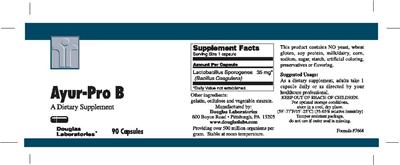
Ayur-Pro B by Douglas Laboratories label
The label scan from the NIH Dietary Supplement Label Database. Tap to enlarge.
Label images are published by the NIH Dietary Supplement Label Database for the version of this product on file. Always read your actual product label.
View the full label (PDF)The Ingredients in Ayur-Pro B by Douglas Laboratories
This is the 1 active ingredient this product is made of. Select it to open its full monograph.
Serving size1 Capsule(s) Dosage formCapsule Amounts shown are per serving.
Lactobacillus Sporogenes
Interacts with182 drugs
Bacillus coagulans is a spore-forming probiotic that survives stomach acid well and may help with some digestive problems such as IBS, constipation, a...
Lactobacillus Sporogenes monograph & interactionsOther (inactive) ingredients: Gelatin, Cellulose, Vegetable Stearate. These complete the product’s ingredient list but are not active constituents.
Ayur-Pro B by Douglas Laboratories Drug Interactions
HelloPharmacist Interaction Report
Ayur-Pro B by Douglas Laboratories contains one active ingredient, Lactobacillus Sporogenes (also known as Bacillus Coagulans), a probiotic.
It does interact with one category of medications: antibiotics. Taking antibiotics at the same time as this product may reduce how well the probiotic works, because antibiotics can kill the live organisms in the supplement.
The recommendation is to space them apart — ask your doctor or pharmacist for the right timing.
Read the full breakdown — every affected drug type, severity by severity
Although we've checked the data for this ingredient, the interaction spans 182 individual medications across the antibiotic class. Before you start Ayur-Pro B, run your specific antibiotics through the medication checker on this page to see which ones apply to you.
Check your own medications below · Editorial policy · How we use AI
Want to check YOUR meds against Ayur-Pro B?
Ask about interactions with your drugs in plain English — “Can I take it with lisinopril?” — and we find you the answer in seconds, ingredient by ingredient.
Go to the checkerIngredients driving the most interactions
Individual Drug Interactions
The ingredients in Ayur-Pro B interact with 182 drugs. Click any drug to see the details.
1 of the 1 ingredient in Ayur-Pro B interact with drugs. Each result below shows which ingredient is responsible. Lactobacillus Sporogenes
AmikacinAmikin, Arikayce
How Amikacin interacts with Ayur-Pro B — through 1 ingredient. Tap an ingredient for the detail:
Lactobacillus SporogenesAntibiotic Drugs Moderate
Interaction Summary
Theoretically, taking antibiotics with Bacillus coagulans might decrease the effectiveness of B.
Read the full Lactobacillus Sporogenes + Amikacin interactionAmoxicillinAmix, Amoram, Amoxident, Amoxil Capsules, Amoxil Injection, Galenamox +3 more
How Amoxicillin interacts with Ayur-Pro B — through 1 ingredient. Tap an ingredient for the detail:
Lactobacillus SporogenesAntibiotic Drugs Moderate
Interaction Summary
Theoretically, taking antibiotics with Bacillus coagulans might decrease the effectiveness of B.
Read the full Lactobacillus Sporogenes + Amoxicillin interactionAmoxicillin VeterinaryBiomox
How Amoxicillin Veterinary interacts with Ayur-Pro B — through 1 ingredient. Tap an ingredient for the detail:
Lactobacillus SporogenesAntibiotic Drugs Moderate
Interaction Summary
Theoretically, taking antibiotics with Bacillus coagulans might decrease the effectiveness of B.
Read the full Lactobacillus Sporogenes + Amoxicillin Veterinary interactionAmoxicillin, Clavulanate PotassiumAugmentin, Augmentin '125/31 SF', Augmentin '250/62 SF', Augmentin XR, Augmentin-Duo 400/57, Clavulin
How Amoxicillin, Clavulanate Potassium interacts with Ayur-Pro B — through 1 ingredient. Tap an ingredient for the detail:
Lactobacillus SporogenesAntibiotic Drugs Moderate
Interaction Summary
Theoretically, taking antibiotics with Bacillus coagulans might decrease the effectiveness of B.
Read the full Lactobacillus Sporogenes + Amoxicillin, Clavulanate Potassium interactionAmoxicillin, Omeprazole Magnesium, RifabutinTalicia
How Amoxicillin, Omeprazole Magnesium, Rifabutin interacts with Ayur-Pro B — through 1 ingredient. Tap an ingredient for the detail:
Lactobacillus SporogenesAntibiotic Drugs Moderate
Interaction Summary
Theoretically, taking antibiotics with Bacillus coagulans might decrease the effectiveness of B.
Read the full Lactobacillus Sporogenes + Amoxicillin, Omeprazole Magnesium, Rifabutin interactionAmphotericin, TetracyclineMysteclin-F
How Amphotericin, Tetracycline interacts with Ayur-Pro B — through 1 ingredient. Tap an ingredient for the detail:
Lactobacillus SporogenesAntibiotic Drugs Moderate
Interaction Summary
Theoretically, taking antibiotics with Bacillus coagulans might decrease the effectiveness of B.
Read the full Lactobacillus Sporogenes + Amphotericin, Tetracycline interactionAmpicillinOmnipen, Omnipen-N, Penbritin, Principen, Rimacillin
How Ampicillin interacts with Ayur-Pro B — through 1 ingredient. Tap an ingredient for the detail:
Lactobacillus SporogenesAntibiotic Drugs Moderate
Interaction Summary
Theoretically, taking antibiotics with Bacillus coagulans might decrease the effectiveness of B.
Read the full Lactobacillus Sporogenes + Ampicillin interactionAmpicillin, SulbactamUnasyn
How Ampicillin, Sulbactam interacts with Ayur-Pro B — through 1 ingredient. Tap an ingredient for the detail:
Lactobacillus SporogenesAntibiotic Drugs Moderate
Interaction Summary
Theoretically, taking antibiotics with Bacillus coagulans might decrease the effectiveness of B.
Read the full Lactobacillus Sporogenes + Ampicillin, Sulbactam interactionAvibactam Sodium, CeftazidimeAvycaz
How Avibactam Sodium, Ceftazidime interacts with Ayur-Pro B — through 1 ingredient. Tap an ingredient for the detail:
Lactobacillus SporogenesAntibiotic Drugs Moderate
Interaction Summary
Theoretically, taking antibiotics with Bacillus coagulans might decrease the effectiveness of B.
Read the full Lactobacillus Sporogenes + Avibactam Sodium, Ceftazidime interactionAzithromycinAzasite, Zithromax, Zmax
How Azithromycin interacts with Ayur-Pro B — through 1 ingredient. Tap an ingredient for the detail:
Lactobacillus SporogenesAntibiotic Drugs Moderate
Interaction Summary
Theoretically, taking antibiotics with Bacillus coagulans might decrease the effectiveness of B.
Read the full Lactobacillus Sporogenes + Azithromycin interactionAztreonamAzactam
How Aztreonam interacts with Ayur-Pro B — through 1 ingredient. Tap an ingredient for the detail:
Lactobacillus SporogenesAntibiotic Drugs Moderate
Interaction Summary
Theoretically, taking antibiotics with Bacillus coagulans might decrease the effectiveness of B.
Read the full Lactobacillus Sporogenes + Aztreonam interactionBacampicillinPenglobe
How Bacampicillin interacts with Ayur-Pro B — through 1 ingredient. Tap an ingredient for the detail:
Lactobacillus SporogenesAntibiotic Drugs Moderate
Interaction Summary
Theoretically, taking antibiotics with Bacillus coagulans might decrease the effectiveness of B.
Read the full Lactobacillus Sporogenes + Bacampicillin interactionBacitracinBaci-IM, Baciguent, Bacitracin Ointment
How Bacitracin interacts with Ayur-Pro B — through 1 ingredient. Tap an ingredient for the detail:
Lactobacillus SporogenesAntibiotic Drugs Moderate
Interaction Summary
Theoretically, taking antibiotics with Bacillus coagulans might decrease the effectiveness of B.
Read the full Lactobacillus Sporogenes + Bacitracin interactionBenznidazoleBenznidazole
How Benznidazole interacts with Ayur-Pro B — through 1 ingredient. Tap an ingredient for the detail:
Lactobacillus SporogenesAntibiotic Drugs Moderate
Interaction Summary
Theoretically, taking antibiotics with Bacillus coagulans might decrease the effectiveness of B.
Read the full Lactobacillus Sporogenes + Benznidazole interactionBismuth Subsalicylate, Metronidazole, TetracyclineHelidac
How Bismuth Subsalicylate, Metronidazole, Tetracycline interacts with Ayur-Pro B — through 1 ingredient. Tap an ingredient for the detail:
Lactobacillus SporogenesAntibiotic Drugs Moderate
Interaction Summary
Theoretically, taking antibiotics with Bacillus coagulans might decrease the effectiveness of B.
Read the full Lactobacillus Sporogenes + Bismuth Subsalicylate, Metronidazole, Tetracycline interactionCapreomycinCapastat
How Capreomycin interacts with Ayur-Pro B — through 1 ingredient. Tap an ingredient for the detail:
Lactobacillus SporogenesAntibiotic Drugs Moderate
Interaction Summary
Theoretically, taking antibiotics with Bacillus coagulans might decrease the effectiveness of B.
Read the full Lactobacillus Sporogenes + Capreomycin interactionCarbenicillin Indanyl SodiumGeocillin
How Carbenicillin Indanyl Sodium interacts with Ayur-Pro B — through 1 ingredient. Tap an ingredient for the detail:
Lactobacillus SporogenesAntibiotic Drugs Moderate
Interaction Summary
Theoretically, taking antibiotics with Bacillus coagulans might decrease the effectiveness of B.
Read the full Lactobacillus Sporogenes + Carbenicillin Indanyl Sodium interactionCefaclorCeclor, Ceclor CD
How Cefaclor interacts with Ayur-Pro B — through 1 ingredient. Tap an ingredient for the detail:
Lactobacillus SporogenesAntibiotic Drugs Moderate
Interaction Summary
Theoretically, taking antibiotics with Bacillus coagulans might decrease the effectiveness of B.
Read the full Lactobacillus Sporogenes + Cefaclor interactionCefadroxilCef-Tab, Duricef, Ultracef
How Cefadroxil interacts with Ayur-Pro B — through 1 ingredient. Tap an ingredient for the detail:
Lactobacillus SporogenesAntibiotic Drugs Moderate
Interaction Summary
Theoretically, taking antibiotics with Bacillus coagulans might decrease the effectiveness of B.
Read the full Lactobacillus Sporogenes + Cefadroxil interactionCefamandoleMandol
How Cefamandole interacts with Ayur-Pro B — through 1 ingredient. Tap an ingredient for the detail:
Lactobacillus SporogenesAntibiotic Drugs Moderate
Interaction Summary
Theoretically, taking antibiotics with Bacillus coagulans might decrease the effectiveness of B.
Read the full Lactobacillus Sporogenes + Cefamandole interactionCefazolinAncef
How Cefazolin interacts with Ayur-Pro B — through 1 ingredient. Tap an ingredient for the detail:
Lactobacillus SporogenesAntibiotic Drugs Moderate
Interaction Summary
Theoretically, taking antibiotics with Bacillus coagulans might decrease the effectiveness of B.
Read the full Lactobacillus Sporogenes + Cefazolin interactionCefdinirOmnicef
How Cefdinir interacts with Ayur-Pro B — through 1 ingredient. Tap an ingredient for the detail:
Lactobacillus SporogenesAntibiotic Drugs Moderate
Interaction Summary
Theoretically, taking antibiotics with Bacillus coagulans might decrease the effectiveness of B.
Read the full Lactobacillus Sporogenes + Cefdinir interactionCefditoren PivoxilSpectracef
How Cefditoren Pivoxil interacts with Ayur-Pro B — through 1 ingredient. Tap an ingredient for the detail:
Lactobacillus SporogenesAntibiotic Drugs Moderate
Interaction Summary
Theoretically, taking antibiotics with Bacillus coagulans might decrease the effectiveness of B.
Read the full Lactobacillus Sporogenes + Cefditoren Pivoxil interactionCefepimeMaxipime
How Cefepime interacts with Ayur-Pro B — through 1 ingredient. Tap an ingredient for the detail:
Lactobacillus SporogenesAntibiotic Drugs Moderate
Interaction Summary
Theoretically, taking antibiotics with Bacillus coagulans might decrease the effectiveness of B.
Read the full Lactobacillus Sporogenes + Cefepime interactionCefiderocol Sulfate TosylateFetroja
How Cefiderocol Sulfate Tosylate interacts with Ayur-Pro B — through 1 ingredient. Tap an ingredient for the detail:
Lactobacillus SporogenesAntibiotic Drugs Moderate
Interaction Summary
Theoretically, taking antibiotics with Bacillus coagulans might decrease the effectiveness of B.
Read the full Lactobacillus Sporogenes + Cefiderocol Sulfate Tosylate interactionCefiximeSuprax
How Cefixime interacts with Ayur-Pro B — through 1 ingredient. Tap an ingredient for the detail:
Lactobacillus SporogenesAntibiotic Drugs Moderate
Interaction Summary
Theoretically, taking antibiotics with Bacillus coagulans might decrease the effectiveness of B.
Read the full Lactobacillus Sporogenes + Cefixime interactionCefmetazoleZefazone
How Cefmetazole interacts with Ayur-Pro B — through 1 ingredient. Tap an ingredient for the detail:
Lactobacillus SporogenesAntibiotic Drugs Moderate
Interaction Summary
Theoretically, taking antibiotics with Bacillus coagulans might decrease the effectiveness of B.
Read the full Lactobacillus Sporogenes + Cefmetazole interactionCefonicidMonocid
How Cefonicid interacts with Ayur-Pro B — through 1 ingredient. Tap an ingredient for the detail:
Lactobacillus SporogenesAntibiotic Drugs Moderate
Interaction Summary
Theoretically, taking antibiotics with Bacillus coagulans might decrease the effectiveness of B.
Read the full Lactobacillus Sporogenes + Cefonicid interactionCefoperazoneCefobid
How Cefoperazone interacts with Ayur-Pro B — through 1 ingredient. Tap an ingredient for the detail:
Lactobacillus SporogenesAntibiotic Drugs Moderate
Interaction Summary
Theoretically, taking antibiotics with Bacillus coagulans might decrease the effectiveness of B.
Read the full Lactobacillus Sporogenes + Cefoperazone interactionCefotaximeClaforan
How Cefotaxime interacts with Ayur-Pro B — through 1 ingredient. Tap an ingredient for the detail:
Lactobacillus SporogenesAntibiotic Drugs Moderate
Interaction Summary
Theoretically, taking antibiotics with Bacillus coagulans might decrease the effectiveness of B.
Read the full Lactobacillus Sporogenes + Cefotaxime interactionEach ingredient & the kinds of drugs it affects
For each ingredient in Ayur-Pro B with known interactions, here are the types of medications it can affect. Open any type for the detail — or search your exact drug in the checker above.
Lactobacillus Sporogenes
Antibiotic Drugs
Theoretically, taking antibiotics with Bacillus coagulans might decrease the effectiveness of B. coagulans.
B. coagulans preparations usually contain live and active organisms. Therefore, simultaneously taking antibiotics might kill a significant number of the organisms. Tell patients to separate administration of antibiotics and B. coagulans preparations by at least two hours.
Brand information
Manufacturer and brand details for Ayur-Pro B, from the product label.
Douglas Laboratories
See all Douglas Laboratories products- Name
- Douglas Laboratories
- Street Address
- 600 Boyce Road
- City
- Pittsburgh
- State
- PA
- ZipCode
- 15205
- Web Address
- www.douglaslabs.com
Ayur-Pro B by Douglas Laboratories: Common Questions
Does Ayur-Pro B by Douglas Laboratories interact with any medications?
How can one product interact with so many drugs?
Where does this information come from?
Can I take this probiotic while I'm on antibiotics?
Does this product actually work for IBS or constipation?
Is this safe for me if I have a weakened immune system?
Can I take this while I'm pregnant or breastfeeding?
What's in the capsule besides the probiotic?
Written and reviewed by the HelloPharmacist editorial staff. Our editorial policy
Not sure if Ayur-Pro B is safe with your meds?
Our pharmacists answer your medication & supplement questions — free.
Label information is sourced from the NIH Dietary Supplement Label Database and reflects the product version on file; always read your actual product label. This page is for education only and is not a substitute for professional medical advice. Confirm with your pharmacist or doctor before combining supplements and medications.
The Full Monographs Behind Ayur-Pro B’s Ingredients
Every ingredient we hold a full HelloPharmacist monograph for — uses, evidence, safety, and the complete interaction list.
Sources & How We Checked
Ayur-Pro B's label data comes from the NIH Dietary Supplement Label Database; the ingredient interaction data is from the Natural Medicines database, reviewed by our pharmacists.
- NIH Dietary Supplement Label Database (DSLD) — The official product label on file for this supplement.
- Natural Medicines (Therapeutic Research Center) — Evidence-graded clinical reference behind the ingredient interaction data.
Content is written and reviewed by licensed HelloPharmacist pharmacists. See our data sources and editorial standards for how this information is built and checked.
The 20 references behind this product’s interaction data
Every citation that drives the interaction findings for this product’s ingredients, from the evidence-graded Natural Medicines (TRC Healthcare) database. Open an ingredient to browse its citations — links open the study on PubMed or the publisher’s site.
Bacillus Coagulans 20 references
- Saxelin M, Chuang NH, Chassy B, et al. Lactobacilli and bacteremia in southern Finland 1989-1992. Clin Infect Dis 1996;22:564-6. PubMed
- Tynkkynen S, Singh KV, Varmanen P. Vancomycin resistance factor of Lactobacillus rhamnosus GG in relation to enterococcal vancomycin resistance (van) genes. Int J Food Microbiol 1998;41:195-204. PubMed
- Klein G, Zill E, Schindler R, et al. Peritonitis associated with vancomycin-resistant Lactobacillus rhamnosus in a continuous ambulatory peritoneal dialysis patient; organism identification, antibiotic therapy, and case report. J Clin Microbiol 1998;36:
- Kalima P, Masterton RG, Roddie PH, et al. Lactobacillus rhamnosus infection in a child following bone marrow transplant. J Infect 1996;32:165-7. PubMed
- Goldin BR. Health Benefits of probiotics. Br J Nutr 1998;80:S203-7. DOI
- Rautio M, Jousimies-Somer H, Kauma H, et al. Liver abscess due to Lactobacillus rhamnosus strain indistinguishable from L. rhamnosus strain GG. Clin Infect Dis 1999;28:1159-60.
- MacGregor G, Smith AJ, Thakker B, Kinsella J. Yoghurt biotherapy: contraindicated in immunosuppressed patients? Postgrad Med J 2002;78:366-7. PubMed
- Land MH, Rouster-Stevens K, Woods CR, et al. Lactobacillus sepsis associated with probiotic therapy. Pediatrics 2005;115:178-81.
- De Groote MA, Frank DN, Dowell E, et al. Lactobacillus rhamnosus GG bacteremia associated with probiotic use in a child with short gut syndrome. Pediatr Infect Dis J 2005;24:278-80. PubMed
- Vahabnezhad E, Mochon AB, Wozniak LJ, Ziring DA. Lactobacillus bacteremia associated with probiotic use in a pediatric patient with ulcerative colitis. J Clin Gastroenterol. 2013;47(5):437-9. PubMed
- Pruccoli G, Silvestro E, Pace Napoleone C, Aidala E, Garazzino S, Scolfaro C. Are probiotics safe? Bifidobacterium bacteremia in a child with severe heart failure. Infez Med. 2019;27(2):175-178.
- Sendil S, Shrimanker I, Mansoora Q, Goldman J, Nookala VK. Lactobacillus rhamnosus bacteremia in an immunocompromised renal transplant patient. Cureus. 2020;12(2):e6887. PubMed
- Albarillo FS, Shah U, Joyce C, Slade D. Lactobacillus rhamnosus Infection: A single-center 4-year descriptive analysis. J Glob Infect Dis. 2020;12(3):119-123. PubMed
- Pasala S, Singer L, Arshad T, Roach K. Lactobacillus endocarditis in a healthy patient with probiotic use. IDCases. 2020;22:e00915. PubMed
- Agrawal S, Tuchman ES, Bruce MJ, Theodorou ME. Fatal Lactobacillus endocarditis in a patient with transcatheter aortic valve replacement. BMJ Case Rep. 2020;13(11):e236835.
- Antoun M, Hattab Y, Akhrass FA, Hamilton LD. Uncommon pathogen, Lactobacillus, causing infective endocarditis: Case report and review. Case Rep Infect Dis. 2020;2020:8833948. PubMed
- Rossi F, Amadoro C, Gasperi M, Colavita G. Lactobacilli infection case reports in the last three years and safety implications. Nutrients. 2022;14(6):1178. PubMed
- Franko B, Vaillant M, Recule C, Vautrin E, et al. Lactobacillus paracasei endocarditis in a consumer of probiotics. Med Mal Infect. 2013;43(4):171-3. PubMed
- Campbell RE, Miller A, Afroze A. Native valve endocarditis secondary to Lactobacillus paracasei bacteremia. Consultant. 2020;60(9):27-8. DOI
- Kato K, Funabashi N, Takaoka H, et al. Lactobacillus paracasei endocarditis in a consumer of probiotics with advanced and severe bicuspid aortic valve stenosis complicated with diffuse left ventricular mid-layer fibrosis. Int J Cardiol. 2016;224:157-161. PubMed
Parts of this content are provided by the Therapeutic Research Center, LLC.
DISCLAIMER: Currently this does not check for drug-drug interactions. This is not an all-inclusive comprehensive list of potential interactions and is for informational purposes only. Not all interactions are known or well-reported in the scientific literature, and new interactions are continually being reported. Input is needed from a qualified healthcare provider including a pharmacist before starting any therapy. Application of clinical judgment is necessary.
© 2021 Therapeutic Research Center, LLC