
Beet Root Capsules 1500 mg Ingredients & Drug Interactions
by tnvitamins
What is this page for?
First and foremost: checking Beet Root Capsules 1500 mg against your medications. The heart of this page is the interaction checker and the full interaction report — how this product’s ingredients may interact with prescription and over-the-counter medicines you may be taking.
Around that, we add a pharmacist’s high-level view of the product as a whole — what’s inside, the evidence for its stated use, how transparent the label is, and what safety data exists — so you can see the full picture in one place. It’s educational information from our licensed clinical databases and the clinical staff at HelloPharmacist — not medical advice — and we don’t sell or endorse products. Our editorial policy
Beet Root Capsules 1500 mg is a dietary supplement by tnvitamins with 1 active ingredient. Its ingredients are commonly taken for high blood pressure, exercise and athletic performance, heart and circulation support.Based on those ingredients, 861 medications have a known interaction with it, the most serious rated moderate. The ingredients most likely to interact are Beet Root Extract. Use the checker below to test your specific medication, or read the full HelloPharmacist Interaction Report.
Check Your Meds Against Beet Root Capsules 1500 mg by tnvitamins
Ask about any prescription or over-the-counter medication and we check it for interactions with Beet Root Capsules 1500 mg by tnvitamins — and tell you which ingredient is responsible.
AI summaries are generated from our interaction database for education only — always confirm with your pharmacist. How we use AI
Ask the Pharmacist
A licensed pharmacist will answer your question by email — free, usually within 24 hours.
Got it — thank you!
A licensed pharmacist will answer within 24 hours. Keep an eye on your email (worth checking spam, just in case).
HelloPharmacist Scorecard of Beet Root Capsules 1500 mg by tnvitamins
Our pharmacy team’s full take, with four database checks built into the cards below — a summary of what is known, not a grade of the product itself.
What’s inside
Full disclosure
This supplement contains one active ingredient: beet root extract at 1500 mg per capsule. Beet is a vegetable root that's also used medicinally in concentrated form to support athletic performance and muscle recovery.
The capsule also includes inactive ingredients—gelatin, rice flour, magnesium stearate, and silica—which are fillers, binders, and capsule material.
Does it work?
Moderate evidence
Beet root extract is possibly effective for athletic performance and for exercise-induced muscle soreness (the achiness that follows intense workouts). For chronic obstructive pulmonary disease (COPD), the evidence currently suggests it's possibly ineffective.
The data we hold is insufficient to rate it for dyslipidemia (abnormal blood fat levels) or cognitive function.
How safe is it?
Well-documented data
Beet is widely eaten as food and is generally well tolerated by most adults. The concentrated supplement form, however, lacks robust safety data—so use caution if you choose it.
In short-term medicinal use, beet seems well tolerated, and red or black stools are the most common side effects and are not harmful. Serious side effects are rare but possible with large amounts: low blood calcium (hypocalcemia) and kidney damage have been reported.
One case noted black stools and nausea in an older adult taking beet pills alongside blood thinners, though the risk of serious bleeding was judged low. For pregnancy and breastfeeding, safety data is not on file.
Meds to double-check
Moderate interaction found
Check your blood pressure medications and any drug that's a CYP3A4 substrate (including many statins, heart medications, and immune drugs) before taking this supplement—beet may raise their levels in your blood. Also confirm any CYP1A2 substrates with your pharmacist, as beet may reduce how well they work.
Your doctor or pharmacist can review your exact list.
The bottom line
Scorecard at a glanceFully disclosed formula with some supporting evidence behind its ingredients' uses. Moderate medication interactions have been identified, and safety information is well characterized.
If you're an athlete or recovering from intense exercise and want to explore beet's role in performance and muscle soreness, this product is possibly effective for that. The main caution is its interactions with blood pressure drugs and a large group of medications broken down by your liver (CYP3A4 substrates).
Before starting, talk with your own doctor or pharmacist about your medications and whether this product fits your routine.
Educational only — not medical advice; always confirm with your pharmacist. Our editorial policy · How we use AI
Assessment coverage: 1 of 1 active ingredient matched to our full ingredient reviews (monographs). Based on the product label dated Jun 20, 2024.
This Scorecard evaluates available label information, ingredient evidence, and known medication-safety considerations. It does not independently verify product identity, purity, potency, contamination, or manufacturing quality. How these ratings are computed
General information
Key facts about Beet Root Capsules 1500 mg, straight from the product label.
| Brand | tnvitamins |
|---|---|
| Barcode (UPC) | X002K0UV1R |
| Net contents | 100 Capsule(s) |
| Market status | On market |
| Date entered into DSLD | Jun 20, 2024 |
| DSLD ID | 314538 |
| Product type | Botanical |
| Supplement form | Capsule |
| Dietary claims / uses | All Other |
| Intended target group(s) | Adult (18 - 50 Years), Gluten Free, Dairy Free, Sugar Free |
Everything in this section is reproduced from the manufacturer’s own product label — it’s the label speaking, not HelloPharmacist. We show it so you can see exactly what the maker states; we don’t verify or endorse those statements.
Supplement Facts
The label details for Beet Root Capsules 1500 mg by tnvitamins, sourced from the NIH Dietary Supplement Label Database.
Supplement Facts
| Ingredient | Amount | % DV |
|---|---|---|
| Beet Root Extract | 1500 mg | -- |
Other ingredients: Gelatin, Rice Flour, Magnesium Stearate, Silica
Tap any ingredient to jump to its full detail below.
These statements are the manufacturer’s wording, reproduced from the product label — the label is saying it, not HelloPharmacist. We don’t verify or endorse them.
Formula
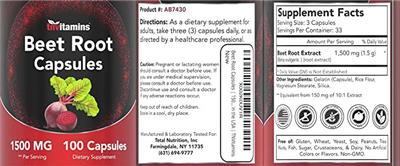
Beet Root Capsules 1500mg per serving Equivalent from 150 mg of 10:1 extract
FDA Statement of Identity
Dietary Supplement
Suggested/Recommended/Usage/Directions
Directions: As a dietary supplement for adults, take three (3) capsules daily, or as directed by a healthcare professional.
Precautions
Caution: Pregnant or lactating women should consult a doctor before use.
If you are under medical supervision, please consult a doctor before use. Discontinue use and consult a doctor if any adverse reactions occur.
Keep out of reach of children.
Storage
Store in a cool, dry place.
General Statements
New
Formulation
In the USA
100% Natural
Non GMO Gluten free Nuts free Free of: Gluten, wheat, yeast, soy, peanuts, tree nuts, fish, sugar, crustaceans, & dairy. No artificial colors or flavors. Non-GMO.
Seals/Symbols
Packaged & Lab Tested in the USA
Is this label outdated? Report a formula or label change and our pharmacy team will review it.
Beet Root Capsules 1500 mg by tnvitamins label
The label scan from the NIH Dietary Supplement Label Database. Tap to enlarge.
Label images are published by the NIH Dietary Supplement Label Database for the version of this product on file. Always read your actual product label.
View the full label (PDF)The Ingredients in Beet Root Capsules 1500 mg by tnvitamins
This is the 1 active ingredient this product is made of. Select it to open its full monograph.
Serving size3 Capsule(s) Dosage formCapsule Servings per container33 Amounts shown are per serving.
Beet Root Extract
Interacts with861 drugs
Beet, especially beetroot juice, is a nitrate-rich food that may modestly lower blood pressure and slightly improve exercise performance in some peopl...
Beet Root Extract monograph & interactionsOther (inactive) ingredients: Gelatin, Rice Flour, Magnesium Stearate, Silica. These complete the product’s ingredient list but are not active constituents.
Beet Root Capsules 1500 mg by tnvitamins Drug Interactions
HelloPharmacist Interaction Report
Beet Root Capsules 1500 mg by tnvitamins interacts with medications through its beet root extract, most notably CYP3A4 substrates—a large group of drugs.
The active compound betanin appears to inhibit how your body breaks down these medications, potentially raising their levels in your bloodstream and the risk of side effects. This is a Moderate-severity concern that spans a wide range of common drugs.
Read the full breakdown — every affected drug type, severity by severity
The product also interacts with blood pressure medications (Antihypertensive Drugs). Beet contains nitrates, which relax blood vessel walls and can lower blood pressure.
The concern here is Minor severity—one clinical study found no significant blood pressure drop from concentrated beetroot juice, but smaller studies suggest the effect may still occur in some people.
Additionally, beet theoretically may reduce the effectiveness of CYP1A2 substrates (medications your body breaks down via a different enzyme pathway), though this is rated Minor. Altogether, these interactions span 862 individual medications.
Before you start this supplement, check your exact medications with the tool below. If you take any blood pressure drugs, CYP3A4 substrates (a category that includes statins, certain heart and immune medications, and many others), or medications metabolized by CYP1A2, confirm with your own doctor or pharmacist that this product is right for you.
Check your own medications below · Editorial policy · How we use AI
Want to check YOUR meds against Beet Root Capsules 1500 mg?
Ask about interactions with your drugs in plain English — “Can I take it with lisinopril?” — and we find you the answer in seconds, ingredient by ingredient.
Go to the checkerIngredients driving the most interactions
Individual Drug Interactions
The ingredients in Beet Root Capsules 1500 mg interact with 861 drugs. Click any drug to see the details.
1 of the 1 ingredient in Beet Root Capsules 1500 mg interact with drugs. Each result below shows which ingredient is responsible. Beet Root Extract
DoxorubicinAdriamycin, Caelyx, Doxil, Myocet, Rubex
How Doxorubicin interacts with Beet Root Capsules 1500 mg — through 1 ingredient. Tap an ingredient for the detail:
Beet Root ExtractCytochrome P450 3a4 (cyp3a4) Substrates Moderate
Interaction Summary
Theoretically, beet might increase the levels of CYP3A4 substrates.
Read the full Beet Root Extract + Doxorubicin interactionDronabinolMarinol, Syndros
How Dronabinol interacts with Beet Root Capsules 1500 mg — through 1 ingredient. Tap an ingredient for the detail:
Beet Root ExtractCytochrome P450 3a4 (cyp3a4) Substrates Moderate
Interaction Summary
Theoretically, beet might increase the levels of CYP3A4 substrates.
Read the full Beet Root Extract + Dronabinol interactionDronedaroneMultaq
How Dronedarone interacts with Beet Root Capsules 1500 mg — through 1 ingredient. Tap an ingredient for the detail:
Beet Root ExtractCytochrome P450 3a4 (cyp3a4) Substrates Moderate
Interaction Summary
Theoretically, beet might increase the levels of CYP3A4 substrates.
Read the full Beet Root Extract + Dronedarone interactionDrospirenoneDrospirenone
How Drospirenone interacts with Beet Root Capsules 1500 mg — through 1 ingredient. Tap an ingredient for the detail:
Beet Root ExtractCytochrome P450 3a4 (cyp3a4) Substrates Moderate
Interaction Summary
Theoretically, beet might increase the levels of CYP3A4 substrates.
Read the full Beet Root Extract + Drospirenone interactionDrospirenone, EstetrolNextstellis
How Drospirenone, Estetrol interacts with Beet Root Capsules 1500 mg — through 1 ingredient. Tap an ingredient for the detail:
Beet Root ExtractCytochrome P450 3a4 (cyp3a4) Substrates, Cytochrome P450 1a2 (cyp1a2) Substrates Moderate
Interaction Summary
Theoretically, beet might increase the levels of CYP3A4 substrates.
Read the full Beet Root Extract + Drospirenone, Estetrol interactionDrospirenone, Ethinyl EstradiolAngeliq, Gianvi, Yasmin
How Drospirenone, Ethinyl Estradiol interacts with Beet Root Capsules 1500 mg — through 1 ingredient. Tap an ingredient for the detail:
Beet Root ExtractCytochrome P450 1a2 (cyp1a2) Substrates, Cytochrome P450 3a4 (cyp3a4) Substrates Moderate
Interaction Summary
Theoretically, beet might decrease the levels and clinical effects of CYP1A2 substrates.
Read the full Beet Root Extract + Drospirenone, Ethinyl Estradiol interactionDutasterideAvodart
How Dutasteride interacts with Beet Root Capsules 1500 mg — through 1 ingredient. Tap an ingredient for the detail:
Beet Root ExtractCytochrome P450 3a4 (cyp3a4) Substrates Moderate
Interaction Summary
Theoretically, beet might increase the levels of CYP3A4 substrates.
Read the full Beet Root Extract + Dutasteride interactionDutasteride, TamsulosinJalyn
How Dutasteride, Tamsulosin interacts with Beet Root Capsules 1500 mg — through 1 ingredient. Tap an ingredient for the detail:
Beet Root ExtractCytochrome P450 3a4 (cyp3a4) Substrates Moderate
Interaction Summary
Theoretically, beet might increase the levels of CYP3A4 substrates.
Read the full Beet Root Extract + Dutasteride, Tamsulosin interactionDuvelisibCopiktra
How Duvelisib interacts with Beet Root Capsules 1500 mg — through 1 ingredient. Tap an ingredient for the detail:
Beet Root ExtractCytochrome P450 3a4 (cyp3a4) Substrates Moderate
Interaction Summary
Theoretically, beet might increase the levels of CYP3A4 substrates.
Read the full Beet Root Extract + Duvelisib interactionEfavirenzSustiva
How Efavirenz interacts with Beet Root Capsules 1500 mg — through 1 ingredient. Tap an ingredient for the detail:
Beet Root ExtractCytochrome P450 3a4 (cyp3a4) Substrates Moderate
Interaction Summary
Theoretically, beet might increase the levels of CYP3A4 substrates.
Read the full Beet Root Extract + Efavirenz interactionEfavirenz, Lamivudine, Tenofovir Disoproxil FumarateSymfi
How Efavirenz, Lamivudine, Tenofovir Disoproxil Fumarate interacts with Beet Root Capsules 1500 mg — through 1 ingredient. Tap an ingredient for the detail:
Beet Root ExtractCytochrome P450 3a4 (cyp3a4) Substrates Moderate
Interaction Summary
Theoretically, beet might increase the levels of CYP3A4 substrates.
Read the full Beet Root Extract + Efavirenz, Lamivudine, Tenofovir Disoproxil Fumarate interactionEffientPrasugrel
How Effient interacts with Beet Root Capsules 1500 mg — through 1 ingredient. Tap an ingredient for the detail:
Beet Root ExtractCytochrome P450 3a4 (cyp3a4) Substrates Moderate
Interaction Summary
Theoretically, beet might increase the levels of CYP3A4 substrates.
Read the full Beet Root Extract + Effient interactionElagolix SodiumOrilissa
How Elagolix Sodium interacts with Beet Root Capsules 1500 mg — through 1 ingredient. Tap an ingredient for the detail:
Beet Root ExtractCytochrome P450 3a4 (cyp3a4) Substrates Moderate
Interaction Summary
Theoretically, beet might increase the levels of CYP3A4 substrates.
Read the full Beet Root Extract + Elagolix Sodium interactionElagolix, Estradiol Norethindrone Acetate, ElagolixOriahnn
How Elagolix, Estradiol Norethindrone Acetate, Elagolix interacts with Beet Root Capsules 1500 mg — through 1 ingredient. Tap an ingredient for the detail:
Beet Root ExtractCytochrome P450 3a4 (cyp3a4) Substrates Moderate
Interaction Summary
Theoretically, beet might increase the levels of CYP3A4 substrates.
Read the full Beet Root Extract + Elagolix, Estradiol Norethindrone Acetate, Elagolix interactionElbasvir, GrazoprevirZepatier
How Elbasvir, Grazoprevir interacts with Beet Root Capsules 1500 mg — through 1 ingredient. Tap an ingredient for the detail:
Beet Root ExtractCytochrome P450 3a4 (cyp3a4) Substrates Moderate
Interaction Summary
Theoretically, beet might increase the levels of CYP3A4 substrates.
Read the full Beet Root Extract + Elbasvir, Grazoprevir interactionElexacaftor, Tezacaftor, IvacaftorTrikafta
How Elexacaftor, Tezacaftor, Ivacaftor interacts with Beet Root Capsules 1500 mg — through 1 ingredient. Tap an ingredient for the detail:
Beet Root ExtractCytochrome P450 3a4 (cyp3a4) Substrates Moderate
Interaction Summary
Theoretically, beet might increase the levels of CYP3A4 substrates.
Read the full Beet Root Extract + Elexacaftor, Tezacaftor, Ivacaftor interactionEliglustatCerdelga
How Eliglustat interacts with Beet Root Capsules 1500 mg — through 1 ingredient. Tap an ingredient for the detail:
Beet Root ExtractCytochrome P450 3a4 (cyp3a4) Substrates Moderate
Interaction Summary
Theoretically, beet might increase the levels of CYP3A4 substrates.
Read the full Beet Root Extract + Eliglustat interactionElvitegravirVitekta
How Elvitegravir interacts with Beet Root Capsules 1500 mg — through 1 ingredient. Tap an ingredient for the detail:
Beet Root ExtractCytochrome P450 3a4 (cyp3a4) Substrates Moderate
Interaction Summary
Theoretically, beet might increase the levels of CYP3A4 substrates.
Read the full Beet Root Extract + Elvitegravir interactionElvitegravir, Cobicistat, Emtricitabine, Tenofovir Disoproxil FumarateStribild
How Elvitegravir, Cobicistat, Emtricitabine, Tenofovir Disoproxil Fumarate interacts with Beet Root Capsules 1500 mg — through 1 ingredient. Tap an ingredient for the detail:
Beet Root ExtractCytochrome P450 3a4 (cyp3a4) Substrates Moderate
Interaction Summary
Theoretically, beet might increase the levels of CYP3A4 substrates.
Read the full Beet Root Extract + Elvitegravir, Cobicistat, Emtricitabine, Tenofovir Disoproxil Fumarate interactionEmtricitabine, Rilpivirine, TenofovirComplera
How Emtricitabine, Rilpivirine, Tenofovir interacts with Beet Root Capsules 1500 mg — through 1 ingredient. Tap an ingredient for the detail:
Beet Root ExtractCytochrome P450 3a4 (cyp3a4) Substrates Moderate
Interaction Summary
Theoretically, beet might increase the levels of CYP3A4 substrates.
Read the full Beet Root Extract + Emtricitabine, Rilpivirine, Tenofovir interactionEmtricitabine, Rilpivirine, Tenofovir AlafenamideOdefsey
How Emtricitabine, Rilpivirine, Tenofovir Alafenamide interacts with Beet Root Capsules 1500 mg — through 1 ingredient. Tap an ingredient for the detail:
Beet Root ExtractCytochrome P450 3a4 (cyp3a4) Substrates Moderate
Interaction Summary
Theoretically, beet might increase the levels of CYP3A4 substrates.
Read the full Beet Root Extract + Emtricitabine, Rilpivirine, Tenofovir Alafenamide interactionEnalapril Maleate, FelodipineLexxel
How Enalapril Maleate, Felodipine interacts with Beet Root Capsules 1500 mg — through 1 ingredient. Tap an ingredient for the detail:
Beet Root ExtractAntihypertensive Drugs, Cytochrome P450 3a4 (cyp3a4) Substrates Moderate
Interaction Summary
Beet and beetroot contain nitrates, which can cause vasodilation, potentially leading to lower blood pressure.
Read the full Beet Root Extract + Enalapril Maleate, Felodipine interactionEnasidenibIdhifa
How Enasidenib interacts with Beet Root Capsules 1500 mg — through 1 ingredient. Tap an ingredient for the detail:
Beet Root ExtractCytochrome P450 3a4 (cyp3a4) Substrates, Cytochrome P450 1a2 (cyp1a2) Substrates Moderate
Interaction Summary
Theoretically, beet might increase the levels of CYP3A4 substrates.
Read the full Beet Root Extract + Enasidenib interactionEncorafenibBraftovi
How Encorafenib interacts with Beet Root Capsules 1500 mg — through 1 ingredient. Tap an ingredient for the detail:
Beet Root ExtractCytochrome P450 3a4 (cyp3a4) Substrates Moderate
Interaction Summary
Theoretically, beet might increase the levels of CYP3A4 substrates.
Read the full Beet Root Extract + Encorafenib interactionEnfortumab Vedotin-ejfvPadcev
How Enfortumab Vedotin-ejfv interacts with Beet Root Capsules 1500 mg — through 1 ingredient. Tap an ingredient for the detail:
Beet Root ExtractCytochrome P450 3a4 (cyp3a4) Substrates Moderate
Interaction Summary
Theoretically, beet might increase the levels of CYP3A4 substrates.
Read the full Beet Root Extract + Enfortumab Vedotin-ejfv interactionEnsartinibEnsacove
How Ensartinib interacts with Beet Root Capsules 1500 mg — through 1 ingredient. Tap an ingredient for the detail:
Beet Root ExtractCytochrome P450 3a4 (cyp3a4) Substrates Moderate
Interaction Summary
Theoretically, beet might increase the levels of CYP3A4 substrates.
Read the full Beet Root Extract + Ensartinib interactionEntrectinibRozlytrek
How Entrectinib interacts with Beet Root Capsules 1500 mg — through 1 ingredient. Tap an ingredient for the detail:
Beet Root ExtractCytochrome P450 3a4 (cyp3a4) Substrates Moderate
Interaction Summary
Theoretically, beet might increase the levels of CYP3A4 substrates.
Read the full Beet Root Extract + Entrectinib interactionEravacyclineXerava
How Eravacycline interacts with Beet Root Capsules 1500 mg — through 1 ingredient. Tap an ingredient for the detail:
Beet Root ExtractCytochrome P450 3a4 (cyp3a4) Substrates Moderate
Interaction Summary
Theoretically, beet might increase the levels of CYP3A4 substrates.
Read the full Beet Root Extract + Eravacycline interactionErdafitinibBalversa
How Erdafitinib interacts with Beet Root Capsules 1500 mg — through 1 ingredient. Tap an ingredient for the detail:
Beet Root ExtractCytochrome P450 3a4 (cyp3a4) Substrates Moderate
Interaction Summary
Theoretically, beet might increase the levels of CYP3A4 substrates.
Read the full Beet Root Extract + Erdafitinib interactionErgotamine Tartrate (prescription Drug)Ergomar Sublingual, Ergostat SL
How Ergotamine Tartrate (prescription Drug) interacts with Beet Root Capsules 1500 mg — through 1 ingredient. Tap an ingredient for the detail:
Beet Root ExtractCytochrome P450 3a4 (cyp3a4) Substrates Moderate
Interaction Summary
Theoretically, beet might increase the levels of CYP3A4 substrates.
Read the full Beet Root Extract + Ergotamine Tartrate (prescription Drug) interactionEach ingredient & the kinds of drugs it affects
For each ingredient in Beet Root Capsules 1500 mg with known interactions, here are the types of medications it can affect. Open any type for the detail — or search your exact drug in the checker above.
Beet Root Extract
Cytochrome P450 3A4 (Cyp3A4) Substrates
Theoretically, beet might increase the levels of CYP3A4 substrates.
In vitro research suggests that betanin, the major pigment in beet, competitively inhibits CYP3A4 in a dose-dependent manner similarly to strong CYP3A4 inhibitor ketoconazole.
Antihypertensive Drugs
Beet and beetroot contain nitrates, which can cause vasodilation, potentially leading to lower blood pressure. However, a study published in the European Journal of Clinical Nutrition using concentrated beetroot juice found no significant impact on blood pressure or heart rate in different age groups. Other small clinical studies suggest that while beet consumption might transiently lower blood pressure due to vessel dilation, there's no consistent evidence of a lasting effect. Overall, the theoretical risk of reduced blood pressure due to beet's nitrate content exists, but studies generally indicate a low and temporary impact rather than a sustained decrease.
Cytochrome P450 1A2 (Cyp1A2) Substrates
Theoretically, beet might decrease the levels and clinical effects of CYP1A2 substrates.
In vitro research suggests that beet induces CYP1A2 enzymes.
Brand information
Manufacturer and brand details for Beet Root Capsules 1500 mg, from the product label.
tnvitamins
See all tnvitamins products- Name
- Total Nutrition, Inc.
- City
- Farmingdale
- State
- NY
- ZipCode
- 11735
- Phone Number
- (631) 694-4777
Beet Root Capsules 1500 mg by tnvitamins: Common Questions
Does Beet Root Capsules 1500 mg by tnvitamins interact with any medications?
How can one product interact with so many drugs?
Where does this information come from?
Will beet capsules make my urine or stool red?
Can I take this if I'm on blood pressure medication?
Does beet root extract actually improve athletic performance?
Is it safe to take this long-term?
Are there any serious side effects I should worry about?
Can I take this while breastfeeding?
Written and reviewed by the HelloPharmacist editorial staff. Our editorial policy
Not sure if Beet Root Capsules 1500 mg is safe with your meds?
Our pharmacists answer your medication & supplement questions — free.
Label information is sourced from the NIH Dietary Supplement Label Database and reflects the product version on file; always read your actual product label. This page is for education only and is not a substitute for professional medical advice. Confirm with your pharmacist or doctor before combining supplements and medications.
The Full Monographs Behind Beet Root Capsules 1500 mg’s Ingredients
Every ingredient we hold a full HelloPharmacist monograph for — uses, evidence, safety, and the complete interaction list.
Sources & How We Checked
Beet Root Capsules 1500 mg's label data comes from the NIH Dietary Supplement Label Database; the ingredient interaction data is from the Natural Medicines database, reviewed by our pharmacists.
- NIH Dietary Supplement Label Database (DSLD) — The official product label on file for this supplement.
- Natural Medicines (Therapeutic Research Center) — Evidence-graded clinical reference behind the ingredient interaction data.
Content is written and reviewed by licensed HelloPharmacist pharmacists. See our data sources and editorial standards for how this information is built and checked.
The 14 references behind this product’s interaction data
Every citation that drives the interaction findings for this product’s ingredients, from the evidence-graded Natural Medicines (TRC Healthcare) database. Open an ingredient to browse its citations — links open the study on PubMed or the publisher’s site.
Beet 14 references
- Gruenwald J, Brendler T, Jaenicke C. PDR for Herbal Medicines. 1st ed. Montvale, NJ: Medical Economics Company, Inc., 1998.
- Clifford T, Berntzen B, Davison GW, et al. Effects of beetroot juice on recovery of muscle function and performance between bouts of repeated sprint exercise. Nutrients 2016;8. pii: E506. PubMed
- Siervo M, Lara J, Ogbonmwan I, Mathers JC. Inorganic nitrate and beetroot juice supplementation reduces blood pressure in adults: a systematic review and meta-analysis. J Nutr 2013;143:818-26. PubMed
- Clifford T, Howatson G, West DJ, Stevenson EJ. Beetroot juice is more beneficial than sodium nitrate for attenuating muscle pain after strenuous eccentric-bias exercise. Appl Physiol Nutr Metab. 2017;42(11):1185-1191. PubMed
- Clifford T, Bell O, West DJ, Howatson G, Stevenson EJ. The effects of beetroot juice supplementation on indices of muscle damage following eccentric exercise. Eur J Appl Physiol. 2016;116(2):353-62. PubMed
- Wylie LJ, Kelly J, Bailey SJ, et al. Beetroot juice and exercise: pharmacodynamic and dose-response relationships. J Appl Physiol (1985). 2013;115(3):325-36. PubMed
- Garnacho-Castaño MV, Palau-Salvà G, Cuenca E, et al. Effects of a single dose of beetroot juice on cycling time trial performance at ventilatory thresholds intensity in male triathletes. J Int Soc Sports Nutr. 2018;15(1):49. PubMed
- Rasica L, Porcelli S, Marzorati M, et al. Ergogenic effects of beetroot juice supplementation during severe-intensity exercise in obese adolescents. Am J Physiol Regul Integr Comp Physiol. 2018;315(3):R453-R460. PubMed
- Henrohn D, Björkstrand K, Lundberg JO, et al. Effects of oral supplementation with nitrate-rich beetroot juice in patients with pulmonary arterial hypertension-results from BEET-PAH, an exploratory randomized, double-blind, placebo-controlled, crosso
- Serra-Payá N, Garnacho-Castaño MV, Sánchez-Nuño S, et al. The relationship between resistance exercise performance and ventilatory efficiency after beetroot juice intake in well-trained athletes. Nutrients 2021;13(4):1094. PubMed
- Haron MH, Dale O, Martin K, et al. Evaluation of the Herb-Drug Interaction Potential of Commonly Used Botanicals on the US Market with Regard to PXR- and AhR-Mediated Influences on CYP3A4 and CYP1A2. J Diet Suppl 2022. PubMed
- Hemmatinafar M, Zaremoayedi L, Koushkie Jahromi M, et al. Effect of Beetroot Juice Supplementation on Muscle Soreness and Performance Recovery after Exercise-Induced Muscle Damage in Female Volleyball Players. Nutrients 2023;15(17):3763. PubMed
- Lim SH, Bae S, Lee HS, Han HK, Choi CI. Effect of Betanin, the Major Pigment of Red Beetroot (Beta vulgaris L.), on the Activity of Recombinant Human Cytochrome P450 Enzymes. Pharmaceuticals (Basel) 2023;16(9):1224. PubMed
- Oscherwitz M, Tamayo RM, Heudebert A, Centor R. A Case of Pseudo-Hematochezia from Beet Supplement Ingestion. Am J Med 2023;136(9):e177-e178. PubMed
Parts of this content are provided by the Therapeutic Research Center, LLC.
DISCLAIMER: Currently this does not check for drug-drug interactions. This is not an all-inclusive comprehensive list of potential interactions and is for informational purposes only. Not all interactions are known or well-reported in the scientific literature, and new interactions are continually being reported. Input is needed from a qualified healthcare provider including a pharmacist before starting any therapy. Application of clinical judgment is necessary.
© 2021 Therapeutic Research Center, LLC