
Calamus Root Mint Flavor Ingredients & Drug Interactions
by TerraVita
What is this page for?
First and foremost: checking Calamus Root Mint Flavor against your medications. The heart of this page is the interaction checker and the full interaction report — how this product’s ingredients may interact with prescription and over-the-counter medicines you may be taking.
Around that, we add a pharmacist’s high-level view of the product as a whole — what’s inside, the evidence for its stated use, how transparent the label is, and what safety data exists — so you can see the full picture in one place. It’s educational information from our licensed clinical databases and the clinical staff at HelloPharmacist — not medical advice — and we don’t sell or endorse products. Our editorial policy
Calamus Root Mint Flavor is a dietary supplement by TerraVita with 1 active ingredient. Its ingredients are commonly taken for digestive upset and gas, loss of appetite, memory and focus (traditional).Based on those ingredients, 1,117 medications have a known interaction with it, the most serious rated moderate. The ingredients most likely to interact are Calamus Root Glycerite Liquid Extract. Use the checker below to test your specific medication, or read the full HelloPharmacist Interaction Report.
Check Your Meds Against Calamus Root Mint Flavor by TerraVita
Ask about any prescription or over-the-counter medication and we check it for interactions with Calamus Root Mint Flavor by TerraVita — and tell you which ingredient is responsible.
AI summaries are generated from our interaction database for education only — always confirm with your pharmacist. How we use AI
Ask the Pharmacist
A licensed pharmacist will answer your question by email — free, usually within 24 hours.
Got it — thank you!
A licensed pharmacist will answer within 24 hours. Keep an eye on your email (worth checking spam, just in case).
HelloPharmacist Scorecard of Calamus Root Mint Flavor by TerraVita
Our pharmacy team’s full take, with four database checks built into the cards below — a summary of what is known, not a grade of the product itself.
What’s inside
Full disclosure
This product contains one active ingredient: calamus root glycerite liquid extract. Glycerin and mint flavor are inactive ingredients that make up the rest of the formulation.
Does it work?
Couldn't assess
The evidence we hold does not establish effectiveness for any claimed use of calamus. The facts list several conditions — bronchitis, anorexia nervosa, asthma, and cancer — but rate them all as "Insufficient Reliable Evidence To Rate." That means the data available is too thin or inconsistent to say whether it works for these purposes.
How safe is it?
Well-documented data
Calamus carries serious safety concerns. The adverse effects data flags nausea and vomiting as the most common side effects with oral use, and warns that calamus is likely unsafe because it may cause cancer — specifically because one of its compounds, beta-asarone, increases cancer risk.
Rare serious effects include intestinal paralysis and a rapid heartbeat. Additionally, some forms of calamus contain beta-asarone, which the FDA has banned from food because of cancer risk.
Pregnancy and breastfeeding are not safe times to use this product. The safety rating is "Likely Unsafe" for both — calamus may affect the uterus, contains potentially toxic compounds, and lacks safety data in nursing.
Meds to double-check
Moderate interaction found
Before taking this product, check with your doctor or pharmacist if you take sedatives or sleep aids, blood pressure medications, antidepressants (especially MAOIs), any drug metabolized by your liver (a very large group), medications for bladder or nerve conditions, or heartburn medication. Calamus interacts with all of these at Moderate or Minor severity and may raise drug levels or weaken their effects.
The bottom line
Scorecard at a glanceFully disclosed formula with no assessable stated purpose. Moderate medication interactions have been identified, and safety information is well characterized.
Calamus root is not a supplement we'd generally recommend because of cancer risk from one of its natural compounds, serious interactions with many common medications, and lack of proven effectiveness for its claimed uses. If you're pregnant, breastfeeding, or take any regular medications — especially for sleep, anxiety, blood pressure, or depression — do not take this product without talking it through with your doctor or pharmacist first.
Educational only — not medical advice; always confirm with your pharmacist. Our editorial policy · How we use AI
Assessment coverage: 1 of 1 active ingredient matched to our full ingredient reviews (monographs). Based on the product label dated Nov 22, 2022.
This Scorecard evaluates available label information, ingredient evidence, and known medication-safety considerations. It does not independently verify product identity, purity, potency, contamination, or manufacturing quality. How these ratings are computed
General information
Key facts about Calamus Root Mint Flavor, straight from the product label.
Everything in this section is reproduced from the manufacturer’s own product label — it’s the label speaking, not HelloPharmacist. We show it so you can see exactly what the maker states; we don’t verify or endorse those statements.
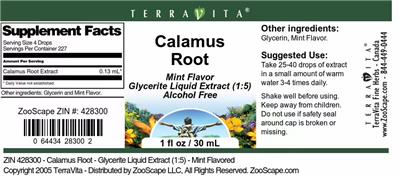
Supplement Facts
The label details for Calamus Root Mint Flavor by TerraVita, sourced from the NIH Dietary Supplement Label Database.
Supplement Facts
| Ingredient | Amount | % DV |
|---|---|---|
| Calamus Root Glycerite Liquid Extract | 0.13 mL | -- |
Other ingredients: Glycerin, Mint Flavor
Tap any ingredient to jump to its full detail below.
These statements are the manufacturer’s wording, reproduced from the product label — the label is saying it, not HelloPharmacist. We don’t verify or endorse them.
Brand IP Statement(s)
Copyright 2005 TerraVita - Distributed by ZooScape LLC, All Rights Reserved.
Formula
Glycerite liquid extract (1:5)
Mint flavored
Formulation
Alcohol free
Suggested/Recommended/Usage/Directions
Suggested Use: Take 25-40 drops of extract in a small amount of warm water 3-4 times daily. Shake well before using.
Precautions
Keep away from children.
Do not use if safety seal around cap is broken or missing.
Is this label outdated? Report a formula or label change and our pharmacy team will review it.
Calamus Root Mint Flavor by TerraVita label
The label scan from the NIH Dietary Supplement Label Database. Tap to enlarge.
Label images are published by the NIH Dietary Supplement Label Database for the version of this product on file. Always read your actual product label.
View the full label (PDF)The Ingredients in Calamus Root Mint Flavor by TerraVita
This is the 1 active ingredient this product is made of. Select it to open its full monograph.
Serving size25 Drop(s) Dosage formLiquid Servings per container227 Amounts shown are per serving.
Calamus Root Glycerite Liquid Extract
Interacts with1,117 drugs
Calamus is a swamp plant with a long history in Ayurvedic and traditional Chinese medicine, mostly for digestive and nervous-system complaints. Howeve...
Calamus Root Glycerite Liquid Extract monograph & interactionsOther (inactive) ingredients: Glycerin, Mint Flavor. These complete the product’s ingredient list but are not active constituents.
Calamus Root Mint Flavor by TerraVita Drug Interactions
HelloPharmacist Interaction Report
Calamus Root Mint Flavor by TerraVita contains a single active ingredient — calamus root glycerite extract — that interacts with a broad range of medications.
The most serious concerns involve central nervous system depressants (sedatives, sleeping pills, anxiety medications), where calamus could add to their sedative effects and increase drowsiness or impairment. This is a Moderate severity interaction.
Read the full breakdown — every affected drug type, severity by severity
Calamus also interacts with blood pressure medications (antihypertensive drugs) at Moderate severity — it may lower blood pressure further and increase the risk of dizziness or lightheadedness. Additionally, calamus inhibits two liver enzymes responsible for breaking down many prescription drugs: CYP2D6 and CYP3A4 substrates.
These interactions are also Moderate and can raise drug levels in your bloodstream, potentially increasing side effects. Anticholinergic drugs and cholinergic drugs (used for bladder or nerve conditions) may lose effectiveness or have their effects heightened, respectively.
MAOIs (older antidepressants) carry a Moderate interaction risk, and H2-blockers (heartburn medications) may become less effective — a Minor interaction.
Altogether, these interactions span 1,118 individual medications. Because calamus touches so many drug pathways, check every prescription and over-the-counter medication you take with the search tool on this page before starting this product.
If you take anything regularly — especially sedatives, blood pressure pills, antidepressants, or heartburn medication — talk with your doctor or pharmacist first.
Check your own medications below · Editorial policy · How we use AI
Want to check YOUR meds against Calamus Root Mint Flavor?
Ask about interactions with your drugs in plain English — “Can I take it with lisinopril?” — and we find you the answer in seconds, ingredient by ingredient.
Go to the checkerIngredients driving the most interactions
Individual Drug Interactions
The ingredients in Calamus Root Mint Flavor interact with 1,117 drugs. Click any drug to see the details.
1 of the 1 ingredient in Calamus Root Mint Flavor interact with drugs. Each result below shows which ingredient is responsible. Calamus Root Glycerite Liquid Extract
Ado-trastuzumab EmtansineKadcyla
How Ado-trastuzumab Emtansine interacts with Calamus Root Mint Flavor — through 1 ingredient. Tap an ingredient for the detail:
Calamus Root Glycerite Liquid ExtractCytochrome P450 3a4 (cyp3a4) Substrates Moderate
Interaction Summary
Theoretically, taking calamus with drugs metabolized by CYP3A4 might increase drug levels and potentially increase the risk of adverse effects.
Read the full Calamus Root Glycerite Liquid Extract + Ado-trastuzumab Emtansine interactionAbemaciclibVerzenio
How Abemaciclib interacts with Calamus Root Mint Flavor — through 1 ingredient. Tap an ingredient for the detail:
Calamus Root Glycerite Liquid ExtractCytochrome P450 3a4 (cyp3a4) Substrates Moderate
Interaction Summary
Theoretically, taking calamus with drugs metabolized by CYP3A4 might increase drug levels and potentially increase the risk of adverse effects.
Read the full Calamus Root Glycerite Liquid Extract + Abemaciclib interactionAbiraterone
How Abiraterone interacts with Calamus Root Mint Flavor — through 1 ingredient. Tap an ingredient for the detail:
Calamus Root Glycerite Liquid ExtractCytochrome P450 3a4 (cyp3a4) Substrates Moderate
Interaction Summary
Theoretically, taking calamus with drugs metabolized by CYP3A4 might increase drug levels and potentially increase the risk of adverse effects.
Read the full Calamus Root Glycerite Liquid Extract + Abiraterone interactionAbiraterone AcetateYonsa, Zytiga
How Abiraterone Acetate interacts with Calamus Root Mint Flavor — through 1 ingredient. Tap an ingredient for the detail:
Calamus Root Glycerite Liquid ExtractCytochrome P450 3a4 (cyp3a4) Substrates Moderate
Interaction Summary
Theoretically, taking calamus with drugs metabolized by CYP3A4 might increase drug levels and potentially increase the risk of adverse effects.
Read the full Calamus Root Glycerite Liquid Extract + Abiraterone Acetate interactionAcalabrutinibCalquence
How Acalabrutinib interacts with Calamus Root Mint Flavor — through 1 ingredient. Tap an ingredient for the detail:
Calamus Root Glycerite Liquid ExtractCytochrome P450 3a4 (cyp3a4) Substrates Moderate
Interaction Summary
Theoretically, taking calamus with drugs metabolized by CYP3A4 might increase drug levels and potentially increase the risk of adverse effects.
Read the full Calamus Root Glycerite Liquid Extract + Acalabrutinib interactionAcebutololRhotral, Sectral
How Acebutolol interacts with Calamus Root Mint Flavor — through 1 ingredient. Tap an ingredient for the detail:
Calamus Root Glycerite Liquid ExtractAntihypertensive Drugs Moderate
Interaction Summary
Theoretically, taking calamus with other antihypertensive medications might increase the risk of hypotension.
Read the full Calamus Root Glycerite Liquid Extract + Acebutolol interactionAcepromazineAtravet
How Acepromazine interacts with Calamus Root Mint Flavor — through 1 ingredient. Tap an ingredient for the detail:
Calamus Root Glycerite Liquid ExtractCns Depressants, Anticholinergic Drugs Moderate
Interaction Summary
Theoretically, concurrent use of CNS depressants and calamus might have an additive effect and increase the risk of sedative effects.
Read the full Calamus Root Glycerite Liquid Extract + Acepromazine interactionAcetaminophen, Aspirin, CaffeineExcedrin, Excedrin Extra Strength, Excedrin Migraine
How Acetaminophen, Aspirin, Caffeine interacts with Calamus Root Mint Flavor — through 1 ingredient. Tap an ingredient for the detail:
Calamus Root Glycerite Liquid ExtractCytochrome P450 3a4 (cyp3a4) Substrates Moderate
Interaction Summary
Theoretically, taking calamus with drugs metabolized by CYP3A4 might increase drug levels and potentially increase the risk of adverse effects.
Read the full Calamus Root Glycerite Liquid Extract + Acetaminophen, Aspirin, Caffeine interactionAcetaminophen, Butalbital, CaffeineEsgic, Esgic Plus, Fiogesic, Fioricet, Repan, Tecnal +1 more
How Acetaminophen, Butalbital, Caffeine interacts with Calamus Root Mint Flavor — through 1 ingredient. Tap an ingredient for the detail:
Calamus Root Glycerite Liquid ExtractCytochrome P450 3a4 (cyp3a4) Substrates Moderate
Interaction Summary
Theoretically, taking calamus with drugs metabolized by CYP3A4 might increase drug levels and potentially increase the risk of adverse effects.
Read the full Calamus Root Glycerite Liquid Extract + Acetaminophen, Butalbital, Caffeine interactionAcetaminophen, Butalbital, Caffeine, CodeineEsgic with Codeine, Fioricet w/ Codeine
How Acetaminophen, Butalbital, Caffeine, Codeine interacts with Calamus Root Mint Flavor — through 1 ingredient. Tap an ingredient for the detail:
Calamus Root Glycerite Liquid ExtractCytochrome P450 2d6 (cyp2d6) Substrates, Cytochrome P450 3a4 (cyp3a4) Substrates +1 Moderate
Interaction Summary
Theoretically, taking calamus with drugs metabolized by CYP2D6 might increase drug levels and potentially increase the risk of adverse effects.
Read the full Calamus Root Glycerite Liquid Extract + Acetaminophen, Butalbital, Caffeine, Codeine interactionAcetaminophen, Butalbital, CodeineBancap w/ Codeine
How Acetaminophen, Butalbital, Codeine interacts with Calamus Root Mint Flavor — through 1 ingredient. Tap an ingredient for the detail:
Calamus Root Glycerite Liquid ExtractCns Depressants, Cytochrome P450 2d6 (cyp2d6) Substrates Moderate
Interaction Summary
Theoretically, concurrent use of CNS depressants and calamus might have an additive effect and increase the risk of sedative effects.
Read the full Calamus Root Glycerite Liquid Extract + Acetaminophen, Butalbital, Codeine interactionAcetaminophen, Butalbital, Codeine PhosphatePhrenilin #3
How Acetaminophen, Butalbital, Codeine Phosphate interacts with Calamus Root Mint Flavor — through 1 ingredient. Tap an ingredient for the detail:
Calamus Root Glycerite Liquid ExtractCns Depressants, Cytochrome P450 2d6 (cyp2d6) Substrates Moderate
Interaction Summary
Theoretically, concurrent use of CNS depressants and calamus might have an additive effect and increase the risk of sedative effects.
Read the full Calamus Root Glycerite Liquid Extract + Acetaminophen, Butalbital, Codeine Phosphate interactionAcetaminophen, Caffeine, Chlorpheniramine, Hydrocodone, PhenylephrineHycomine Compound
How Acetaminophen, Caffeine, Chlorpheniramine, Hydrocodone, Phenylephrine interacts with Calamus Root Mint Flavor — through 1 ingredient. Tap an ingredient for the detail:
Calamus Root Glycerite Liquid ExtractCytochrome P450 3a4 (cyp3a4) Substrates, Cns Depressants +2 Moderate
Interaction Summary
Theoretically, taking calamus with drugs metabolized by CYP3A4 might increase drug levels and potentially increase the risk of adverse effects.
Read the full Calamus Root Glycerite Liquid Extract + Acetaminophen, Caffeine, Chlorpheniramine, Hydrocodone, Phenylephrine interactionAcetaminophen, Caffeine, CodeineGesic C15, Gesic C30, Gesic C8, Lenoltec 1, Lenoltec 2, Lenoltec 3 +1 more
How Acetaminophen, Caffeine, Codeine interacts with Calamus Root Mint Flavor — through 1 ingredient. Tap an ingredient for the detail:
Calamus Root Glycerite Liquid ExtractCns Depressants, Cytochrome P450 3a4 (cyp3a4) Substrates +1 Moderate
Interaction Summary
Theoretically, concurrent use of CNS depressants and calamus might have an additive effect and increase the risk of sedative effects.
Read the full Calamus Root Glycerite Liquid Extract + Acetaminophen, Caffeine, Codeine interactionAcetaminophen, Caffeine, Codeine, SalicylamideCodalan No.1, Codalan No.2, Codalan No.3
How Acetaminophen, Caffeine, Codeine, Salicylamide interacts with Calamus Root Mint Flavor — through 1 ingredient. Tap an ingredient for the detail:
Calamus Root Glycerite Liquid ExtractCns Depressants, Cytochrome P450 2d6 (cyp2d6) Substrates +1 Moderate
Interaction Summary
Theoretically, concurrent use of CNS depressants and calamus might have an additive effect and increase the risk of sedative effects.
Read the full Calamus Root Glycerite Liquid Extract + Acetaminophen, Caffeine, Codeine, Salicylamide interactionAcetaminophen, Caffeine, DihydrocodeineDHC Plus, Panlor DC, Panlor SS
How Acetaminophen, Caffeine, Dihydrocodeine interacts with Calamus Root Mint Flavor — through 1 ingredient. Tap an ingredient for the detail:
Calamus Root Glycerite Liquid ExtractCytochrome P450 2d6 (cyp2d6) Substrates, Cytochrome P450 3a4 (cyp3a4) Substrates +1 Moderate
Interaction Summary
Theoretically, taking calamus with drugs metabolized by CYP2D6 might increase drug levels and potentially increase the risk of adverse effects.
Read the full Calamus Root Glycerite Liquid Extract + Acetaminophen, Caffeine, Dihydrocodeine interactionAcetaminophen, Caffeine, IsomethepteneMigralam
How Acetaminophen, Caffeine, Isometheptene interacts with Calamus Root Mint Flavor — through 1 ingredient. Tap an ingredient for the detail:
Calamus Root Glycerite Liquid ExtractCytochrome P450 3a4 (cyp3a4) Substrates Moderate
Interaction Summary
Theoretically, taking calamus with drugs metabolized by CYP3A4 might increase drug levels and potentially increase the risk of adverse effects.
Read the full Calamus Root Glycerite Liquid Extract + Acetaminophen, Caffeine, Isometheptene interactionAcetaminophen, Caffeine, PyrilamineMidol Max Strength Menstrual
How Acetaminophen, Caffeine, Pyrilamine interacts with Calamus Root Mint Flavor — through 1 ingredient. Tap an ingredient for the detail:
Calamus Root Glycerite Liquid ExtractCytochrome P450 3a4 (cyp3a4) Substrates, Anticholinergic Drugs Moderate
Interaction Summary
Theoretically, taking calamus with drugs metabolized by CYP3A4 might increase drug levels and potentially increase the risk of adverse effects.
Read the full Calamus Root Glycerite Liquid Extract + Acetaminophen, Caffeine, Pyrilamine interactionAcetaminophen, Chlorpheniramine Maleate, Dextromethorphan HbrVicks Formula 44M Cough, Cold & Flu Relief
How Acetaminophen, Chlorpheniramine Maleate, Dextromethorphan Hbr interacts with Calamus Root Mint Flavor — through 1 ingredient. Tap an ingredient for the detail:
Calamus Root Glycerite Liquid ExtractCytochrome P450 2d6 (cyp2d6) Substrates, Cytochrome P450 3a4 (cyp3a4) Substrates +1 Moderate
Interaction Summary
Theoretically, taking calamus with drugs metabolized by CYP2D6 might increase drug levels and potentially increase the risk of adverse effects.
Read the full Calamus Root Glycerite Liquid Extract + Acetaminophen, Chlorpheniramine Maleate, Dextromethorphan Hbr interactionAcetaminophen, Chlorpheniramine, Codeine, PhenylephrineColrex
How Acetaminophen, Chlorpheniramine, Codeine, Phenylephrine interacts with Calamus Root Mint Flavor — through 1 ingredient. Tap an ingredient for the detail:
Calamus Root Glycerite Liquid ExtractCytochrome P450 3a4 (cyp3a4) Substrates, Anticholinergic Drugs +2 Moderate
Interaction Summary
Theoretically, taking calamus with drugs metabolized by CYP3A4 might increase drug levels and potentially increase the risk of adverse effects.
Read the full Calamus Root Glycerite Liquid Extract + Acetaminophen, Chlorpheniramine, Codeine, Phenylephrine interactionAcetaminophen, Chlorpheniramine, DextromethorphanCoricidin II Extra Strength Cold and Flu
How Acetaminophen, Chlorpheniramine, Dextromethorphan interacts with Calamus Root Mint Flavor — through 1 ingredient. Tap an ingredient for the detail:
Calamus Root Glycerite Liquid ExtractCytochrome P450 2d6 (cyp2d6) Substrates, Cytochrome P450 3a4 (cyp3a4) Substrates +1 Moderate
Interaction Summary
Theoretically, taking calamus with drugs metabolized by CYP2D6 might increase drug levels and potentially increase the risk of adverse effects.
Read the full Calamus Root Glycerite Liquid Extract + Acetaminophen, Chlorpheniramine, Dextromethorphan interactionAcetaminophen, Chlorpheniramine, Dextromethorphan HydrobromideCoricidin HBP Maximum Strength Flu
How Acetaminophen, Chlorpheniramine, Dextromethorphan Hydrobromide interacts with Calamus Root Mint Flavor — through 1 ingredient. Tap an ingredient for the detail:
Calamus Root Glycerite Liquid ExtractAnticholinergic Drugs, Cytochrome P450 3a4 (cyp3a4) Substrates +1 Moderate
Interaction Summary
Theoretically, concurrent use of anticholinergic drugs and calamus might decrease the effectiveness of the anticholinergic drug.
Read the full Calamus Root Glycerite Liquid Extract + Acetaminophen, Chlorpheniramine, Dextromethorphan Hydrobromide interactionAcetaminophen, Chlorpheniramine, Dextromethorphan, PhenylpropanolamineMulti Symptom Cold Relief
How Acetaminophen, Chlorpheniramine, Dextromethorphan, Phenylpropanolamine interacts with Calamus Root Mint Flavor — through 1 ingredient. Tap an ingredient for the detail:
Calamus Root Glycerite Liquid ExtractCytochrome P450 3a4 (cyp3a4) Substrates, Cytochrome P450 2d6 (cyp2d6) Substrates +1 Moderate
Interaction Summary
Theoretically, taking calamus with drugs metabolized by CYP3A4 might increase drug levels and potentially increase the risk of adverse effects.
Read the full Calamus Root Glycerite Liquid Extract + Acetaminophen, Chlorpheniramine, Dextromethorphan, Phenylpropanolamine interactionAcetaminophen, Chlorpheniramine, Dextromethorphan, PseudoephedrineChildren's Tylenol Cold Plus Cough, Tylenol Cold Ex Strength
How Acetaminophen, Chlorpheniramine, Dextromethorphan, Pseudoephedrine interacts with Calamus Root Mint Flavor — through 1 ingredient. Tap an ingredient for the detail:
Calamus Root Glycerite Liquid ExtractAnticholinergic Drugs, Cytochrome P450 2d6 (cyp2d6) Substrates +1 Moderate
Interaction Summary
Theoretically, concurrent use of anticholinergic drugs and calamus might decrease the effectiveness of the anticholinergic drug.
Read the full Calamus Root Glycerite Liquid Extract + Acetaminophen, Chlorpheniramine, Dextromethorphan, Pseudoephedrine interactionAcetaminophen, Chlorpheniramine, Guaifenesin, Phenylephrine, SalicylamideRhinogesic GG
How Acetaminophen, Chlorpheniramine, Guaifenesin, Phenylephrine, Salicylamide interacts with Calamus Root Mint Flavor — through 1 ingredient. Tap an ingredient for the detail:
Calamus Root Glycerite Liquid ExtractCytochrome P450 3a4 (cyp3a4) Substrates, Anticholinergic Drugs Moderate
Interaction Summary
Theoretically, taking calamus with drugs metabolized by CYP3A4 might increase drug levels and potentially increase the risk of adverse effects.
Read the full Calamus Root Glycerite Liquid Extract + Acetaminophen, Chlorpheniramine, Guaifenesin, Phenylephrine, Salicylamide interactionAcetaminophen, Chlorpheniramine, PhenylephrineAlka-Seltzer PLUS, Histex SR, Protid
How Acetaminophen, Chlorpheniramine, Phenylephrine interacts with Calamus Root Mint Flavor — through 1 ingredient. Tap an ingredient for the detail:
Calamus Root Glycerite Liquid ExtractAnticholinergic Drugs, Cytochrome P450 3a4 (cyp3a4) Substrates Moderate
Interaction Summary
Theoretically, concurrent use of anticholinergic drugs and calamus might decrease the effectiveness of the anticholinergic drug.
Read the full Calamus Root Glycerite Liquid Extract + Acetaminophen, Chlorpheniramine, Phenylephrine interactionAcetaminophen, Chlorpheniramine, Phenylephrine, SalicylamideRhinogesic, Rhinogesic JR
How Acetaminophen, Chlorpheniramine, Phenylephrine, Salicylamide interacts with Calamus Root Mint Flavor — through 1 ingredient. Tap an ingredient for the detail:
Calamus Root Glycerite Liquid ExtractAnticholinergic Drugs, Cytochrome P450 3a4 (cyp3a4) Substrates Moderate
Interaction Summary
Theoretically, concurrent use of anticholinergic drugs and calamus might decrease the effectiveness of the anticholinergic drug.
Read the full Calamus Root Glycerite Liquid Extract + Acetaminophen, Chlorpheniramine, Phenylephrine, Salicylamide interactionAcetaminophen, Chlorpheniramine, PhenylpropanolamineAlumadrine, Conex, Sinadrin Max Strength, Sinulin
How Acetaminophen, Chlorpheniramine, Phenylpropanolamine interacts with Calamus Root Mint Flavor — through 1 ingredient. Tap an ingredient for the detail:
Calamus Root Glycerite Liquid ExtractCytochrome P450 3a4 (cyp3a4) Substrates, Anticholinergic Drugs Moderate
Interaction Summary
Theoretically, taking calamus with drugs metabolized by CYP3A4 might increase drug levels and potentially increase the risk of adverse effects.
Read the full Calamus Root Glycerite Liquid Extract + Acetaminophen, Chlorpheniramine, Phenylpropanolamine interactionAcetaminophen, Chlorpheniramine, Phenylpropanolamine, OpiumHista-Derfule
How Acetaminophen, Chlorpheniramine, Phenylpropanolamine, Opium interacts with Calamus Root Mint Flavor — through 1 ingredient. Tap an ingredient for the detail:
Calamus Root Glycerite Liquid ExtractAnticholinergic Drugs, Cytochrome P450 3a4 (cyp3a4) Substrates +1 Moderate
Interaction Summary
Theoretically, concurrent use of anticholinergic drugs and calamus might decrease the effectiveness of the anticholinergic drug.
Read the full Calamus Root Glycerite Liquid Extract + Acetaminophen, Chlorpheniramine, Phenylpropanolamine, Opium interactionAcetaminophen, Chlorpheniramine, Phenylpropanolamine, PhenyltoloxamineNorel Plus
How Acetaminophen, Chlorpheniramine, Phenylpropanolamine, Phenyltoloxamine interacts with Calamus Root Mint Flavor — through 1 ingredient. Tap an ingredient for the detail:
Calamus Root Glycerite Liquid ExtractAnticholinergic Drugs, Cytochrome P450 3a4 (cyp3a4) Substrates Moderate
Interaction Summary
Theoretically, concurrent use of anticholinergic drugs and calamus might decrease the effectiveness of the anticholinergic drug.
Read the full Calamus Root Glycerite Liquid Extract + Acetaminophen, Chlorpheniramine, Phenylpropanolamine, Phenyltoloxamine interactionEach ingredient & the kinds of drugs it affects
For each ingredient in Calamus Root Mint Flavor with known interactions, here are the types of medications it can affect. Open any type for the detail — or search your exact drug in the checker above.
Calamus Root Glycerite Liquid Extract
Anticholinergic Drugs
Theoretically, concurrent use of anticholinergic drugs and calamus might decrease the effectiveness of the anticholinergic drug.
In vitro evidence shows that calamus can inhibit acetylcholinesterase (AChE).
Antihypertensive Drugs
Theoretically, taking calamus with other antihypertensive medications might increase the risk of hypotension.
Animal research shows that calamus decreases the rate and strength of the heartbeat, which might lower blood pressure. use with caution.
Cholinergic Drugs
Theoretically, concurrent use of cholinergic drugs and calamus might have an additive effect and increase the risk of cholinergic effects.
In vitro evidence shows that calamus can inhibit acetylcholinesterase (AChE).
Cns Depressants
Theoretically, concurrent use of CNS depressants and calamus might have an additive effect and increase the risk of sedative effects.
Animal research shows that calamus is a CNS depressant and increases gamma-aminobutyric acid levels.
Cytochrome P450 2D6 (Cyp2D6) Substrates
Theoretically, taking calamus with drugs metabolized by CYP2D6 might increase drug levels and potentially increase the risk of adverse effects.
In vitro research shows that calamus extract inhibits CYP2D6 enzyme.
Cytochrome P450 3A4 (Cyp3A4) Substrates
Theoretically, taking calamus with drugs metabolized by CYP3A4 might increase drug levels and potentially increase the risk of adverse effects.
In vitro research shows that calamus extract inhibits CYP3A4 enzyme.
Monoamine Oxidase Inhibitors (Maois)
Theoretically, calamus might potentiate the effects and adverse effects of MAOIs.
Some reports suggest that calamus increases the effects of MAOIs.
Antacids
Theoretically, taking calamus might reduce the effectiveness of antacids.
Some research suggests that calamus lowers gastric pH.
H2-Blockers
Theoretically, taking calamus might reduce the effectiveness of H2-blockers.
Some research suggests that calamus lowers gastric pH.
Proton Pump Inhibitors (Ppis)
Theoretically, taking calamus might reduce the effectiveness of PPIs.
Some research suggests that calamus lowers gastric pH.
Brand information
Manufacturer and brand details for Calamus Root Mint Flavor, from the product label.
TerraVita
See all TerraVita products- Name
- ZooScape LLC
- Phone Number
- 844-449-0444
- Web Address
- www.ZooScape.com
Calamus Root Mint Flavor by TerraVita: Common Questions
Does Calamus Root Mint Flavor by TerraVita interact with any medications?
How can one product interact with so many drugs?
Where does this information come from?
Does calamus root actually work for anything?
What are the most common side effects?
Is it safe to use while pregnant or nursing?
Why does the FDA care about beta-asarone?
Will this interact with my blood pressure medication?
What's the difference between glycerite and other forms?
Written and reviewed by the HelloPharmacist editorial staff. Our editorial policy
Not sure if Calamus Root Mint Flavor is safe with your meds?
Our pharmacists answer your medication & supplement questions — free.
Label information is sourced from the NIH Dietary Supplement Label Database and reflects the product version on file; always read your actual product label. This page is for education only and is not a substitute for professional medical advice. Confirm with your pharmacist or doctor before combining supplements and medications.
The Full Monographs Behind Calamus Root Mint Flavor’s Ingredients
Every ingredient we hold a full HelloPharmacist monograph for — uses, evidence, safety, and the complete interaction list.
Sources & How We Checked
Calamus Root Mint Flavor's label data comes from the NIH Dietary Supplement Label Database; the ingredient interaction data is from the Natural Medicines database, reviewed by our pharmacists.
- NIH Dietary Supplement Label Database (DSLD) — The official product label on file for this supplement.
- Natural Medicines (Therapeutic Research Center) — Evidence-graded clinical reference behind the ingredient interaction data.
Content is written and reviewed by licensed HelloPharmacist pharmacists. See our data sources and editorial standards for how this information is built and checked.
The 13 references behind this product’s interaction data
Every citation that drives the interaction findings for this product’s ingredients, from the evidence-graded Natural Medicines (TRC Healthcare) database. Open an ingredient to browse its citations — links open the study on PubMed or the publisher’s site.
Calamus 13 references
- Newall CA, Anderson LA, Philpson JD. Herbal Medicine: A Guide for Healthcare Professionals. London, UK: The Pharmaceutical Press, 1996.
- Brinker F. Herb Contraindications and Drug Interactions. 2nd ed. Sandy, OR: Eclectic Medical Publications, 1998.
- Brinker F. Herb Contraindications and Drug Interactions. Sandy, OR: Eclectic Medical Publ, 1997.
- Shoba, F. G. and Thomas, M. Study of antidiarrhoeal activity of four medicinal plants in castor-oil induced diarrhoea. J Ethnopharmacol 2001;76(1):73-76. PubMed
- Koo, B. S., Park, K. S., Ha, J. H., Park, J. H., Lim, J. C., and Lee, D. U. Inhibitory effects of the fragrance inhalation of essential oil from Acorus gramineus on central nervous system. Biol Pharm.Bull. 2003;26(7):978-982. PubMed
- Oh, M. H., Houghton, P. J., Whang, W. K., and Cho, J. H. Screening of Korean herbal medicines used to improve cognitive function for anti-cholinesterase activity. Phytomedicine 2004;11(6):544-548. PubMed
- Panchal, G. M., Venkatakrishna-Bhatt, H., Doctor, R. B., and Vajpayee, S. Pharmacology of Acorus calamus L. Indian J Exp.Biol 1989;27(6):561-567.
- Vargas, C. P., Wolf, L. R., Gamm, S. R., and Koontz, K. Getting to the root (Acorus calamus) of the problem. J Toxicol Clin Toxicol 1998;36(3):259-260.
- Pandit S, Mukherjee PK, Ponnusankar S, Venkatesh M, Srikanth N. Metabolism mediated interaction of a-asarone and Acorus calamus with CYP3A4 and CYP2D6. Fitoterapia 2011;82(3):369-74.
- Sharma V, Singh I, Chaudhary P. Acorus calamus (The Healing Plant): a review on its medicinal potential, micropropagation and conservation. Nat Prod Res. 2014;28(18):1454-66.
- Björnstad K, Helander A, Hultén P, Beck O. Bioanalytical investigation of asarone in connection with Acorus calamus oil intoxications. J Anal Toxicol 2009;33(9):604-9. PubMed
- Federal Register. Volume 33, Page 6967. U.S. Government Publishing Office. http://api.fdsys.gov/link?collection=fr&volume=33&page=6967. Accessed May 23, 2018.
- Electronic Code of Federal Regulations. Title 21. Part 189 - Substances Prohibited From Use in Human Food. Available at: https://www.ecfr.gov/cgi-bin/text-idx?SID=259fa8a1284cad42676075c8425c7333&mc=true&node=pt21.3.189&rgn=div5.
Parts of this content are provided by the Therapeutic Research Center, LLC.
DISCLAIMER: Currently this does not check for drug-drug interactions. This is not an all-inclusive comprehensive list of potential interactions and is for informational purposes only. Not all interactions are known or well-reported in the scientific literature, and new interactions are continually being reported. Input is needed from a qualified healthcare provider including a pharmacist before starting any therapy. Application of clinical judgment is necessary.
© 2021 Therapeutic Research Center, LLC