
Common Ivy Mint Flavor Ingredients & Drug Interactions
by TerraVita
What is this page for?
First and foremost: checking Common Ivy Mint Flavor against your medications. The heart of this page is the interaction checker and the full interaction report — how this product’s ingredients may interact with prescription and over-the-counter medicines you may be taking.
Around that, we add a pharmacist’s high-level view of the product as a whole — what’s inside, the evidence for its stated use, how transparent the label is, and what safety data exists — so you can see the full picture in one place. It’s educational information from our licensed clinical databases and the clinical staff at HelloPharmacist — not medical advice — and we don’t sell or endorse products. Our editorial policy
Common Ivy Mint Flavor is a dietary supplement by TerraVita with 1 active ingredient. Its ingredients are commonly taken for cough and chest congestion, bronchitis, asthma symptoms.Based on those ingredients, 281 medications have a known interaction with it, the most serious rated moderate. The ingredients most likely to interact are Common Ivy Glycerite Liquid Extract. Use the checker below to test your specific medication, or read the full HelloPharmacist Interaction Report.
Check Your Meds Against Common Ivy Mint Flavor by TerraVita
Ask about any prescription or over-the-counter medication and we check it for interactions with Common Ivy Mint Flavor by TerraVita — and tell you which ingredient is responsible.
AI summaries are generated from our interaction database for education only — always confirm with your pharmacist. How we use AI
Ask the Pharmacist
A licensed pharmacist will answer your question by email — free, usually within 24 hours.
Got it — thank you!
A licensed pharmacist will answer within 24 hours. Keep an eye on your email (worth checking spam, just in case).
HelloPharmacist Scorecard of Common Ivy Mint Flavor by TerraVita
Our pharmacy team’s full take, with four database checks built into the cards below — a summary of what is known, not a grade of the product itself.
What’s inside
Full disclosure
This product contains one active ingredient: Common Ivy Glycerite Liquid Extract, a concentrated liquid form of English ivy leaves. The ingredient is suspended in glycerin and flavored with mint, both inactive ingredients that carry no medicinal role—glycerin acts as a preservative and sweetener, and the mint flavor makes the liquid easier to take.
Does it work?
Not established
The evidence for Common Ivy isn't established in the data we hold. Our records note insufficient reliable evidence to rate its use for bronchitis, respiratory tract infections, gout, spasticity, and neuropathic pain.
If you're considering this product for one of these conditions, talk with your pharmacist or doctor about whether the evidence supports it for your situation.
How safe is it?
Well-documented data
Standardized leaf-extract products like this one are generally well tolerated when taken orally. The most common side effects reported in trials are abdominal pain, diarrhea, nausea, and vomiting; a small number of people have also reported skin irritation.
The raw plant itself is toxic and can cause poisoning or severe skin reactions, but this extract product is processed and standardized. During pregnancy, there isn't enough reliable safety information, so it's best avoided.
While breastfeeding, safety data isn't available—talk with your doctor or pharmacist before using it.
Meds to double-check
Moderate interaction found
Before you take this product, check any medications you're on that are broken down by your liver's CYP2C19, CYP2D6, or CYP2C8 enzymes—that includes many antidepressants, heart medications, and other common drugs. These are Moderate-severity theoretical interactions: no human cases have been reported yet, but the risk is plausible enough to verify your specific medications here first.
The bottom line
Scorecard at a glanceFully disclosed formula with no established evidence rating for its marketed use. Moderate medication interactions have been identified, and safety information is well characterized.
This product might be worth considering if you're looking at Common Ivy for respiratory or musculoskeletal support, but the evidence for its effectiveness isn't clear. The main caution is the theoretical risk it could raise levels of medications your liver breaks down—check your exact medications on this page before starting.
If you're pregnant or breastfeeding, skip it unless your doctor says otherwise.
Educational only — not medical advice; always confirm with your pharmacist. Our editorial policy · How we use AI
Assessment coverage: 1 of 1 active ingredient matched to our full ingredient reviews (monographs). Based on the product label dated Dec 13, 2022.
This Scorecard evaluates available label information, ingredient evidence, and known medication-safety considerations. It does not independently verify product identity, purity, potency, contamination, or manufacturing quality. How these ratings are computed
General information
Key facts about Common Ivy Mint Flavor, straight from the product label.
Everything in this section is reproduced from the manufacturer’s own product label — it’s the label speaking, not HelloPharmacist. We show it so you can see exactly what the maker states; we don’t verify or endorse those statements.
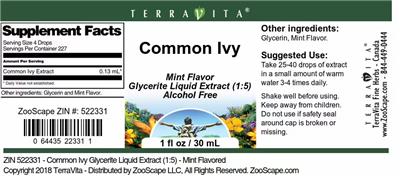
Supplement Facts
The label details for Common Ivy Mint Flavor by TerraVita, sourced from the NIH Dietary Supplement Label Database.
Supplement Facts
| Ingredient | Amount | % DV |
|---|---|---|
| Common Ivy Glycerite Liquid Extract | 0.13 mL | -- |
Other ingredients: Glycerin, Mint Flavor
Tap any ingredient to jump to its full detail below.
These statements are the manufacturer’s wording, reproduced from the product label — the label is saying it, not HelloPharmacist. We don’t verify or endorse them.
Brand IP Statement(s)
Copyright 2018 TerraVita - Distributed by ZooScape LLC, All Rights Reserved.
Formula
Mint flavored Glycerite liquid extract (1:5)
Formulation
Alcohol free
Suggested/Recommended/Usage/Directions
Suggested Use: Take 25-40 drops of extract in a small amount of warm water 3-4 times daily. Shake well before using.
Precautions
Keep away from children.
Do not use if safety seal around cap is broken or missing.
Is this label outdated? Report a formula or label change and our pharmacy team will review it.
Common Ivy Mint Flavor by TerraVita label
The label scan from the NIH Dietary Supplement Label Database. Tap to enlarge.
Label images are published by the NIH Dietary Supplement Label Database for the version of this product on file. Always read your actual product label.
View the full label (PDF)The Ingredients in Common Ivy Mint Flavor by TerraVita
This is the 1 active ingredient this product is made of. Select it to open its full monograph.
Serving size25 Drop(s) Dosage formLiquid Servings per container227 Amounts shown are per serving.
Common Ivy Glycerite Liquid Extract
Interacts with281 drugs
English ivy leaf extract is most commonly used in cough and cold syrups to help loosen mucus and ease coughing, and it is a popular ingredient in many...
Common Ivy Glycerite Liquid Extract monograph & interactionsOther (inactive) ingredients: Glycerin, Mint Flavor. These complete the product’s ingredient list but are not active constituents.
Common Ivy Mint Flavor by TerraVita Drug Interactions
HelloPharmacist Interaction Report
Common Ivy Mint Flavor by TerraVita contains one active ingredient—Common Ivy Glycerite Liquid Extract—that shows theoretical interactions with several groups of medications in laboratory studies.
The ingredient appears to inhibit three liver enzymes (CYP2C19, CYP2D6, and CYP2C8) that break down many drugs, which means it might raise the levels of medications processed by these pathways. So far, no actual cases of this happening in people have been reported.
Read the full breakdown — every affected drug type, severity by severity
These theoretical interactions span Moderate severity and affect a broad range of medication types—including certain antidepressants, heart rhythm drugs, and some cancer medications, among many others. Because the research is only from lab work and not confirmed in humans, the real risk isn't yet clear.
Altogether, these interactions span 277 individual medications.
Before you start this product, use the medication checker below to look up any prescriptions or over-the-counter drugs you take. If your medication is processed by CYP2C19, CYP2D6, or CYP2C8, run it through first—your pharmacist can tell you whether it's safe to combine.
Check your own medications below · Editorial policy · How we use AI
Want to check YOUR meds against Common Ivy Mint Flavor?
Ask about interactions with your drugs in plain English — “Can I take it with lisinopril?” — and we find you the answer in seconds, ingredient by ingredient.
Go to the checkerIngredients driving the most interactions
Individual Drug Interactions
The ingredients in Common Ivy Mint Flavor interact with 281 drugs. Click any drug to see the details.
1 of the 1 ingredient in Common Ivy Mint Flavor interact with drugs. Each result below shows which ingredient is responsible. Common Ivy Glycerite Liquid Extract
AbrocitinibCibinqo
How Abrocitinib interacts with Common Ivy Mint Flavor — through 1 ingredient. Tap an ingredient for the detail:
Common Ivy Glycerite Liquid ExtractCytochrome P450 2c19 (cyp2c19) Substrates Moderate
Interaction Summary
Theoretically, English ivy might increase the levels of drugs metabolized by CYP2C19.
Read the full Common Ivy Glycerite Liquid Extract + Abrocitinib interactionAcetaminophen, Butalbital, Caffeine, CodeineEsgic with Codeine, Fioricet w/ Codeine
How Acetaminophen, Butalbital, Caffeine, Codeine interacts with Common Ivy Mint Flavor — through 1 ingredient. Tap an ingredient for the detail:
Common Ivy Glycerite Liquid ExtractCytochrome P450 2d6 (cyp2d6) Substrates Moderate
Interaction Summary
Theoretically, English ivy might increase the levels of drugs metabolized by CYP2D6.
Read the full Common Ivy Glycerite Liquid Extract + Acetaminophen, Butalbital, Caffeine, Codeine interactionAcetaminophen, Butalbital, CodeineBancap w/ Codeine
How Acetaminophen, Butalbital, Codeine interacts with Common Ivy Mint Flavor — through 1 ingredient. Tap an ingredient for the detail:
Common Ivy Glycerite Liquid ExtractCytochrome P450 2d6 (cyp2d6) Substrates Moderate
Interaction Summary
Theoretically, English ivy might increase the levels of drugs metabolized by CYP2D6.
Read the full Common Ivy Glycerite Liquid Extract + Acetaminophen, Butalbital, Codeine interactionAcetaminophen, Butalbital, Codeine PhosphatePhrenilin #3
How Acetaminophen, Butalbital, Codeine Phosphate interacts with Common Ivy Mint Flavor — through 1 ingredient. Tap an ingredient for the detail:
Common Ivy Glycerite Liquid ExtractCytochrome P450 2d6 (cyp2d6) Substrates Moderate
Interaction Summary
Theoretically, English ivy might increase the levels of drugs metabolized by CYP2D6.
Read the full Common Ivy Glycerite Liquid Extract + Acetaminophen, Butalbital, Codeine Phosphate interactionAcetaminophen, Caffeine, Chlorpheniramine, Hydrocodone, PhenylephrineHycomine Compound
How Acetaminophen, Caffeine, Chlorpheniramine, Hydrocodone, Phenylephrine interacts with Common Ivy Mint Flavor — through 1 ingredient. Tap an ingredient for the detail:
Common Ivy Glycerite Liquid ExtractCytochrome P450 2d6 (cyp2d6) Substrates Moderate
Interaction Summary
Theoretically, English ivy might increase the levels of drugs metabolized by CYP2D6.
Read the full Common Ivy Glycerite Liquid Extract + Acetaminophen, Caffeine, Chlorpheniramine, Hydrocodone, Phenylephrine interactionAcetaminophen, Caffeine, CodeineGesic C15, Gesic C30, Gesic C8, Lenoltec 1, Lenoltec 2, Lenoltec 3 +1 more
How Acetaminophen, Caffeine, Codeine interacts with Common Ivy Mint Flavor — through 1 ingredient. Tap an ingredient for the detail:
Common Ivy Glycerite Liquid ExtractCytochrome P450 2d6 (cyp2d6) Substrates Moderate
Interaction Summary
Theoretically, English ivy might increase the levels of drugs metabolized by CYP2D6.
Read the full Common Ivy Glycerite Liquid Extract + Acetaminophen, Caffeine, Codeine interactionAcetaminophen, Caffeine, Codeine, SalicylamideCodalan No.1, Codalan No.2, Codalan No.3
How Acetaminophen, Caffeine, Codeine, Salicylamide interacts with Common Ivy Mint Flavor — through 1 ingredient. Tap an ingredient for the detail:
Common Ivy Glycerite Liquid ExtractCytochrome P450 2d6 (cyp2d6) Substrates Moderate
Interaction Summary
Theoretically, English ivy might increase the levels of drugs metabolized by CYP2D6.
Read the full Common Ivy Glycerite Liquid Extract + Acetaminophen, Caffeine, Codeine, Salicylamide interactionAcetaminophen, Caffeine, DihydrocodeineDHC Plus, Panlor DC, Panlor SS
How Acetaminophen, Caffeine, Dihydrocodeine interacts with Common Ivy Mint Flavor — through 1 ingredient. Tap an ingredient for the detail:
Common Ivy Glycerite Liquid ExtractCytochrome P450 2d6 (cyp2d6) Substrates Moderate
Interaction Summary
Theoretically, English ivy might increase the levels of drugs metabolized by CYP2D6.
Read the full Common Ivy Glycerite Liquid Extract + Acetaminophen, Caffeine, Dihydrocodeine interactionAcetaminophen, Chlorpheniramine Maleate, Dextromethorphan HbrVicks Formula 44M Cough, Cold & Flu Relief
How Acetaminophen, Chlorpheniramine Maleate, Dextromethorphan Hbr interacts with Common Ivy Mint Flavor — through 1 ingredient. Tap an ingredient for the detail:
Common Ivy Glycerite Liquid ExtractCytochrome P450 2d6 (cyp2d6) Substrates Moderate
Interaction Summary
Theoretically, English ivy might increase the levels of drugs metabolized by CYP2D6.
Read the full Common Ivy Glycerite Liquid Extract + Acetaminophen, Chlorpheniramine Maleate, Dextromethorphan Hbr interactionAcetaminophen, Chlorpheniramine, Codeine, PhenylephrineColrex
How Acetaminophen, Chlorpheniramine, Codeine, Phenylephrine interacts with Common Ivy Mint Flavor — through 1 ingredient. Tap an ingredient for the detail:
Common Ivy Glycerite Liquid ExtractCytochrome P450 2d6 (cyp2d6) Substrates Moderate
Interaction Summary
Theoretically, English ivy might increase the levels of drugs metabolized by CYP2D6.
Read the full Common Ivy Glycerite Liquid Extract + Acetaminophen, Chlorpheniramine, Codeine, Phenylephrine interactionAcetaminophen, Chlorpheniramine, DextromethorphanCoricidin II Extra Strength Cold and Flu
How Acetaminophen, Chlorpheniramine, Dextromethorphan interacts with Common Ivy Mint Flavor — through 1 ingredient. Tap an ingredient for the detail:
Common Ivy Glycerite Liquid ExtractCytochrome P450 2d6 (cyp2d6) Substrates Moderate
Interaction Summary
Theoretically, English ivy might increase the levels of drugs metabolized by CYP2D6.
Read the full Common Ivy Glycerite Liquid Extract + Acetaminophen, Chlorpheniramine, Dextromethorphan interactionAcetaminophen, Chlorpheniramine, Dextromethorphan HydrobromideCoricidin HBP Maximum Strength Flu
How Acetaminophen, Chlorpheniramine, Dextromethorphan Hydrobromide interacts with Common Ivy Mint Flavor — through 1 ingredient. Tap an ingredient for the detail:
Common Ivy Glycerite Liquid ExtractCytochrome P450 2d6 (cyp2d6) Substrates Moderate
Interaction Summary
Theoretically, English ivy might increase the levels of drugs metabolized by CYP2D6.
Read the full Common Ivy Glycerite Liquid Extract + Acetaminophen, Chlorpheniramine, Dextromethorphan Hydrobromide interactionAcetaminophen, Chlorpheniramine, Dextromethorphan, PhenylpropanolamineMulti Symptom Cold Relief
How Acetaminophen, Chlorpheniramine, Dextromethorphan, Phenylpropanolamine interacts with Common Ivy Mint Flavor — through 1 ingredient. Tap an ingredient for the detail:
Common Ivy Glycerite Liquid ExtractCytochrome P450 2d6 (cyp2d6) Substrates Moderate
Interaction Summary
Theoretically, English ivy might increase the levels of drugs metabolized by CYP2D6.
Read the full Common Ivy Glycerite Liquid Extract + Acetaminophen, Chlorpheniramine, Dextromethorphan, Phenylpropanolamine interactionAcetaminophen, Chlorpheniramine, Dextromethorphan, PseudoephedrineChildren's Tylenol Cold Plus Cough, Tylenol Cold Ex Strength
How Acetaminophen, Chlorpheniramine, Dextromethorphan, Pseudoephedrine interacts with Common Ivy Mint Flavor — through 1 ingredient. Tap an ingredient for the detail:
Common Ivy Glycerite Liquid ExtractCytochrome P450 2d6 (cyp2d6) Substrates Moderate
Interaction Summary
Theoretically, English ivy might increase the levels of drugs metabolized by CYP2D6.
Read the full Common Ivy Glycerite Liquid Extract + Acetaminophen, Chlorpheniramine, Dextromethorphan, Pseudoephedrine interactionAcetaminophen, Chlorzoxazone, CodeineAcetazone Forte C8, Parafon Forte C8
How Acetaminophen, Chlorzoxazone, Codeine interacts with Common Ivy Mint Flavor — through 1 ingredient. Tap an ingredient for the detail:
Common Ivy Glycerite Liquid ExtractCytochrome P450 2d6 (cyp2d6) Substrates Moderate
Interaction Summary
Theoretically, English ivy might increase the levels of drugs metabolized by CYP2D6.
Read the full Common Ivy Glycerite Liquid Extract + Acetaminophen, Chlorzoxazone, Codeine interactionAcetaminophen, CodeineTylenol No.3, Tylenol w/ Codeine
How Acetaminophen, Codeine interacts with Common Ivy Mint Flavor — through 1 ingredient. Tap an ingredient for the detail:
Common Ivy Glycerite Liquid ExtractCytochrome P450 2d6 (cyp2d6) Substrates Moderate
Interaction Summary
Theoretically, English ivy might increase the levels of drugs metabolized by CYP2D6.
Read the full Common Ivy Glycerite Liquid Extract + Acetaminophen, Codeine interactionAcetaminophen, Codeine, DoxylamineMersyndol
How Acetaminophen, Codeine, Doxylamine interacts with Common Ivy Mint Flavor — through 1 ingredient. Tap an ingredient for the detail:
Common Ivy Glycerite Liquid ExtractCytochrome P450 2d6 (cyp2d6) Substrates Moderate
Interaction Summary
Theoretically, English ivy might increase the levels of drugs metabolized by CYP2D6.
Read the full Common Ivy Glycerite Liquid Extract + Acetaminophen, Codeine, Doxylamine interactionAcetaminophen, Codeine, MethocarbamolAcetaminophen, Codeine, Methocarbamol, Robaxacet 8
How Acetaminophen, Codeine, Methocarbamol interacts with Common Ivy Mint Flavor — through 1 ingredient. Tap an ingredient for the detail:
Common Ivy Glycerite Liquid ExtractCytochrome P450 2d6 (cyp2d6) Substrates Moderate
Interaction Summary
Theoretically, English ivy might increase the levels of drugs metabolized by CYP2D6.
Read the full Common Ivy Glycerite Liquid Extract + Acetaminophen, Codeine, Methocarbamol interactionAcetaminophen, DextromethorphanTylenol Cough Ex Strength
How Acetaminophen, Dextromethorphan interacts with Common Ivy Mint Flavor — through 1 ingredient. Tap an ingredient for the detail:
Common Ivy Glycerite Liquid ExtractCytochrome P450 2d6 (cyp2d6) Substrates Moderate
Interaction Summary
Theoretically, English ivy might increase the levels of drugs metabolized by CYP2D6.
Read the full Common Ivy Glycerite Liquid Extract + Acetaminophen, Dextromethorphan interactionAcetaminophen, Dextromethorphan, Doxylamine, PseudoephedrineVicks NyQuil
How Acetaminophen, Dextromethorphan, Doxylamine, Pseudoephedrine interacts with Common Ivy Mint Flavor — through 1 ingredient. Tap an ingredient for the detail:
Common Ivy Glycerite Liquid ExtractCytochrome P450 2d6 (cyp2d6) Substrates Moderate
Interaction Summary
Theoretically, English ivy might increase the levels of drugs metabolized by CYP2D6.
Read the full Common Ivy Glycerite Liquid Extract + Acetaminophen, Dextromethorphan, Doxylamine, Pseudoephedrine interactionAcetaminophen, Dextromethorphan, Guaifenesin, PhenylephrineConar-A
How Acetaminophen, Dextromethorphan, Guaifenesin, Phenylephrine interacts with Common Ivy Mint Flavor — through 1 ingredient. Tap an ingredient for the detail:
Common Ivy Glycerite Liquid ExtractCytochrome P450 2d6 (cyp2d6) Substrates Moderate
Interaction Summary
Theoretically, English ivy might increase the levels of drugs metabolized by CYP2D6.
Read the full Common Ivy Glycerite Liquid Extract + Acetaminophen, Dextromethorphan, Guaifenesin, Phenylephrine interactionAcetaminophen, Dextromethorphan, Guaifenesin, PhenylpropanolamineAnatuss
How Acetaminophen, Dextromethorphan, Guaifenesin, Phenylpropanolamine interacts with Common Ivy Mint Flavor — through 1 ingredient. Tap an ingredient for the detail:
Common Ivy Glycerite Liquid ExtractCytochrome P450 2d6 (cyp2d6) Substrates Moderate
Interaction Summary
Theoretically, English ivy might increase the levels of drugs metabolized by CYP2D6.
Read the full Common Ivy Glycerite Liquid Extract + Acetaminophen, Dextromethorphan, Guaifenesin, Phenylpropanolamine interactionAcetaminophen, Dextromethorphan, Guaifenesin, PseudoephedrineRobitussin Cold, Severe Cold, Suphedrine Cold/Cough
How Acetaminophen, Dextromethorphan, Guaifenesin, Pseudoephedrine interacts with Common Ivy Mint Flavor — through 1 ingredient. Tap an ingredient for the detail:
Common Ivy Glycerite Liquid ExtractCytochrome P450 2d6 (cyp2d6) Substrates Moderate
Interaction Summary
Theoretically, English ivy might increase the levels of drugs metabolized by CYP2D6.
Read the full Common Ivy Glycerite Liquid Extract + Acetaminophen, Dextromethorphan, Guaifenesin, Pseudoephedrine interactionAcetaminophen, Dextromethorphan, Phenylpropanolamine, PyrilamineTheracaps
How Acetaminophen, Dextromethorphan, Phenylpropanolamine, Pyrilamine interacts with Common Ivy Mint Flavor — through 1 ingredient. Tap an ingredient for the detail:
Common Ivy Glycerite Liquid ExtractCytochrome P450 2d6 (cyp2d6) Substrates Moderate
Interaction Summary
Theoretically, English ivy might increase the levels of drugs metabolized by CYP2D6.
Read the full Common Ivy Glycerite Liquid Extract + Acetaminophen, Dextromethorphan, Phenylpropanolamine, Pyrilamine interactionAcetaminophen, Dextromethorphan, PseudoephedrineAlka-Seltzer PLUS Flu Liquid Gels, Non Aspirin Cold Caps, Tylenol Cold, Tylenol Flu Daytime Ex Strength, Tylenol Flu Ex Strength
How Acetaminophen, Dextromethorphan, Pseudoephedrine interacts with Common Ivy Mint Flavor — through 1 ingredient. Tap an ingredient for the detail:
Common Ivy Glycerite Liquid ExtractCytochrome P450 2d6 (cyp2d6) Substrates Moderate
Interaction Summary
Theoretically, English ivy might increase the levels of drugs metabolized by CYP2D6.
Read the full Common Ivy Glycerite Liquid Extract + Acetaminophen, Dextromethorphan, Pseudoephedrine interactionAcetaminophen, HydrocodoneAnexsia, Anodynos DHC, Azdone, Co-Gesic, Doucet, Lorcet +9 more
How Acetaminophen, Hydrocodone interacts with Common Ivy Mint Flavor — through 1 ingredient. Tap an ingredient for the detail:
Common Ivy Glycerite Liquid ExtractCytochrome P450 2d6 (cyp2d6) Substrates Moderate
Interaction Summary
Theoretically, English ivy might increase the levels of drugs metabolized by CYP2D6.
Read the full Common Ivy Glycerite Liquid Extract + Acetaminophen, Hydrocodone interactionAcetaminophen, MeperidineDemerol APAP
How Acetaminophen, Meperidine interacts with Common Ivy Mint Flavor — through 1 ingredient. Tap an ingredient for the detail:
Common Ivy Glycerite Liquid ExtractCytochrome P450 2d6 (cyp2d6) Substrates Moderate
Interaction Summary
Theoretically, English ivy might increase the levels of drugs metabolized by CYP2D6.
Read the full Common Ivy Glycerite Liquid Extract + Acetaminophen, Meperidine interactionAcetaminophen, OxycodonePercocet, Roxicet, Tylox, Xartemis XR
How Acetaminophen, Oxycodone interacts with Common Ivy Mint Flavor — through 1 ingredient. Tap an ingredient for the detail:
Common Ivy Glycerite Liquid ExtractCytochrome P450 2d6 (cyp2d6) Substrates Moderate
Interaction Summary
Theoretically, English ivy might increase the levels of drugs metabolized by CYP2D6.
Read the full Common Ivy Glycerite Liquid Extract + Acetaminophen, Oxycodone interactionAcetaminophen, PropoxypheneDarvocet-N 100, Darvocet-N 50, E-Lor, Wygesic
How Acetaminophen, Propoxyphene interacts with Common Ivy Mint Flavor — through 1 ingredient. Tap an ingredient for the detail:
Common Ivy Glycerite Liquid ExtractCytochrome P450 2d6 (cyp2d6) Substrates Moderate
Interaction Summary
Theoretically, English ivy might increase the levels of drugs metabolized by CYP2D6.
Read the full Common Ivy Glycerite Liquid Extract + Acetaminophen, Propoxyphene interactionAerosphere Budesonide, Formoterol Fumarate, GlycopyrrolateBreztri
How Aerosphere Budesonide, Formoterol Fumarate, Glycopyrrolate interacts with Common Ivy Mint Flavor — through 1 ingredient. Tap an ingredient for the detail:
Common Ivy Glycerite Liquid ExtractCytochrome P450 2c19 (cyp2c19) Substrates, Cytochrome P450 2d6 (cyp2d6) Substrates Moderate
Interaction Summary
Theoretically, English ivy might increase the levels of drugs metabolized by CYP2C19.
Read the full Common Ivy Glycerite Liquid Extract + Aerosphere Budesonide, Formoterol Fumarate, Glycopyrrolate interactionEach ingredient & the kinds of drugs it affects
For each ingredient in Common Ivy Mint Flavor with known interactions, here are the types of medications it can affect. Open any type for the detail — or search your exact drug in the checker above.
Common Ivy Glycerite Liquid Extract
Cytochrome P450 2C19 (Cyp2C19) Substrates
Theoretically, English ivy might increase the levels of drugs metabolized by CYP2C19.
In vitro research shows that English ivy inhibits CYP2C19 enzymes. So far, this interaction has not been reported in humans.
Cytochrome P450 2C8 (Cyp2C8) Substrates
Theoretically, English ivy might increase the levels of drugs metabolized by CYP2C8.
In vitro research shows that English ivy inhibits CYP2C8 enzymes. So far, this interaction has not been reported in humans.
Cytochrome P450 2D6 (Cyp2D6) Substrates
Theoretically, English ivy might increase the levels of drugs metabolized by CYP2D6.
In vitro research shows that English ivy inhibits CYP2D6 enzymes. So far, this interaction has not been reported in humans.
Brand information
Manufacturer and brand details for Common Ivy Mint Flavor, from the product label.
TerraVita
See all TerraVita products- Name
- ZooScape LLC
- Phone Number
- 844-449-0444
- Web Address
- www.ZooScape.com
Common Ivy Mint Flavor by TerraVita: Common Questions
Does Common Ivy Mint Flavor by TerraVita interact with any medications?
How can one product interact with so many drugs?
Where does this information come from?
What does this product actually do?
Is this safe to take every day?
Can I take it while pregnant or nursing?
What's the difference between this extract and the raw plant?
Why do I need to check my medications?
Written and reviewed by the HelloPharmacist editorial staff. Our editorial policy
Not sure if Common Ivy Mint Flavor is safe with your meds?
Our pharmacists answer your medication & supplement questions — free.
Label information is sourced from the NIH Dietary Supplement Label Database and reflects the product version on file; always read your actual product label. This page is for education only and is not a substitute for professional medical advice. Confirm with your pharmacist or doctor before combining supplements and medications.
The Full Monographs Behind Common Ivy Mint Flavor’s Ingredients
Every ingredient we hold a full HelloPharmacist monograph for — uses, evidence, safety, and the complete interaction list.
Sources & How We Checked
Common Ivy Mint Flavor's label data comes from the NIH Dietary Supplement Label Database; the ingredient interaction data is from the Natural Medicines database, reviewed by our pharmacists.
- NIH Dietary Supplement Label Database (DSLD) — The official product label on file for this supplement.
- Natural Medicines (Therapeutic Research Center) — Evidence-graded clinical reference behind the ingredient interaction data.
Content is written and reviewed by licensed HelloPharmacist pharmacists. See our data sources and editorial standards for how this information is built and checked.
The 13 references behind this product’s interaction data
Every citation that drives the interaction findings for this product’s ingredients, from the evidence-graded Natural Medicines (TRC Healthcare) database. Open an ingredient to browse its citations — links open the study on PubMed or the publisher’s site.
English Ivy 13 references
- Schulz V, Hansel R, Tyler VE. Rational Phytotherapy: A Physician's Guide to Herbal Medicine. Terry C. Telger, transl. 3rd ed. Berlin, GER: Springer, 1998.
- Fazio S, Pouso J, Dolinsky D, et al. Tolerance, safety and efficacy of Hedera helix extract in inflammatory bronchial diseases under clinical practice conditions: a prospective, open, multicentre postmarketing study in 9657 patients. Phytomedicine 2009;16 PubMed
- García M, Fernández E, Navarro JA, et al. Allergic contact dermatitis from Hedera helix L. Contact Dermatitis 1995;33(2):133-4.
- Hausen BM, Brohan J, Konig WA, et al. Allergic and irritant contact dermatitis from falcarinol and didehydrofalcarinol in common ivy (Hedera helix L.). Contact Dermatitis 1987;17(1):1-9.
- Mitchell, J. C. Allergic contact dermatitis from Hedera helix and Brassaia actinophylla (Araliaceae). Contact Dermatitis 1981;7(3):158-159.
- Boyle J, Harman RM. Contact dermatitis to Hedera helix (common ivy). Contact Dermatitis 1985;12(2):111-112. PubMed
- Yesudian PD, Franks A. Contact dermatitis from Hedera helix in a husband and wife. Contact Dermatitis 2002;46(2):125-126.
- Bregnbak D, Menné T, Johansen JD. Airborne contact dermatitis caused by common ivy (Hedera helix L. ssp. helix). Contact Dermatitis. 2015;72(4):243-4.
- Jones JM, White IR, White JM, McFadden JP. Allergic contact dermatitis to English ivy (Hedera helix)--a case series. Contact Dermatitis. 2009 Mar;60(3):179-80.
- Lurquin E, Swinnen I, Goossens A. Allergic contact dermatitis caused by Hedera helix arborescens and not by Hedera helix L. Contact Dermatitis. 2012;66(6):352-3.
- Paulsen E, Christensen LP, Andersen KE. Dermatitis from common ivy (Hedera helix L. subsp. helix) in Europe: past, present, and future. Contact Dermatitis. 2010;62(4):201-9.
- Rehman SU, Kim IS, Choi MS, Kim SH, Zhang Y, Yoo HH. Time-dependent Inhibition of CYP2C8 and CYP2C19 by Hedera helix Extracts, A Traditional Respiratory Herbal Medicine. Molecules. 2017;22(7). PubMed
- Kruttschnitt E, Wegener T, Zahner C, Henzen-Bücking S. Assessment of the Efficacy and Safety of Ivy Leaf (Hedera helix) Cough Syrup Compared with Acetylcysteine in Adults and Children with Acute Bronchitis. Evid Based Complement Alternat Med. 2020 May 4;2
Parts of this content are provided by the Therapeutic Research Center, LLC.
DISCLAIMER: Currently this does not check for drug-drug interactions. This is not an all-inclusive comprehensive list of potential interactions and is for informational purposes only. Not all interactions are known or well-reported in the scientific literature, and new interactions are continually being reported. Input is needed from a qualified healthcare provider including a pharmacist before starting any therapy. Application of clinical judgment is necessary.
© 2021 Therapeutic Research Center, LLC