
Glucomannan & Chicory Root (FOS) Mint Flavor Ingredients & Drug Interactions
by TerraVita
What is this page for?
First and foremost: checking Glucomannan & Chicory Root (FOS) Mint Flavor against your medications. The heart of this page is the interaction checker and the full interaction report — how this product’s ingredients may interact with prescription and over-the-counter medicines you may be taking.
Around that, we add a pharmacist’s high-level view of the product as a whole — what’s inside, the evidence for its stated use, how transparent the label is, and what safety data exists — so you can see the full picture in one place. It’s educational information from our licensed clinical databases and the clinical staff at HelloPharmacist — not medical advice — and we don’t sell or endorse products. Our editorial policy
Glucomannan & Chicory Root (FOS) Mint Flavor is a dietary supplement by TerraVita with 1 active ingredient. Its ingredients are commonly taken for weight loss and appetite control, constipation, high cholesterol.Based on those ingredients, 2,050 medications have a known interaction with it, the most serious rated moderate. The ingredients most likely to interact are Glucomannan & Chicory Root Glycerite Liquid Extract. Use the checker below to test your specific medication, or read the full HelloPharmacist Interaction Report.
Check Your Meds Against Glucomannan & Chicory Root (FOS) Mint Flavor by TerraVita
Ask about any prescription or over-the-counter medication and we check it for interactions with Glucomannan & Chicory Root (FOS) Mint Flavor by TerraVita — and tell you which ingredient is responsible.
AI summaries are generated from our interaction database for education only — always confirm with your pharmacist. How we use AI
Ask the Pharmacist
A licensed pharmacist will answer your question by email — free, usually within 24 hours.
Got it — thank you!
A licensed pharmacist will answer within 24 hours. Keep an eye on your email (worth checking spam, just in case).
HelloPharmacist Scorecard of Glucomannan & Chicory Root (FOS) Mint Flavor by TerraVita
Our pharmacy team’s full take, with four database checks built into the cards below — a summary of what is known, not a grade of the product itself.
What’s inside
Low disclosure
This product contains 2 active ingredients: glucomannan, a soluble fiber that absorbs water and swells in your digestive tract, and chicory root glycerite liquid extract. The inactive ingredients are glycerin and mint flavor.
Glucomannan works by adding bulk to your stool and is often used to help with constipation and to support blood sugar and cholesterol levels. Chicory root is traditionally used in herbal medicine, though the evidence for its benefits is still being studied.
Does it work?
Moderate evidence
Glucomannan is possibly effective for constipation, high blood sugar (diabetes), and high cholesterol (hyperlipidemia). The evidence for its use in high blood pressure is insufficient to rate.
Chicory root's effectiveness for the conditions it's used for—including neonatal jaundice, fatty liver disease, joint health, indigestion, high cholesterol, and others—is insufficient in the data we hold; the evidence isn't established for those uses.
How safe is it?
Well-documented data
Glucomannan is generally well tolerated when you drink plenty of water with it, but it can cause abdominal pain, bloating, constipation, diarrhea, gas, nausea, and vomiting—especially at doses over 3 grams daily. Rarely, it may cause choking or blockage in your throat or intestines if taken without enough liquid.
There isn't enough safety data for pregnancy; talk to your doctor before using it while pregnant. Little is known about its safety while breastfeeding, so caution is advised.
Chicory root is generally well tolerated in food amounts but may cause gas and can trigger allergies in people sensitive to the daisy family (ragweed, chrysanthemums, marigolds, and similar plants). The safety data suggests chicory in medicinal amounts may stimulate the uterus, so it's best avoided during pregnancy.
There isn't enough reliable safety information to recommend medicinal amounts while breastfeeding.
Meds to double-check
Moderate interaction found
Check these medication types before taking this product: oral drugs in general (glucomannan may slow their absorption), and antidiabetes medications (chicory may increase the risk of low blood sugar). Use the search tool on this page to verify your exact medications.
The bottom line
Scorecard at a glanceFormula with limited ingredient disclosure with some supporting evidence behind its ingredients' uses. Moderate medication interactions have been identified, and safety information is well characterized.
This product may help with constipation and possibly support blood sugar and cholesterol, but its effect on how your body absorbs other medications is a real concern. If you take any prescription drugs—especially diabetes medications—check them against the interaction tool on this page or talk with your pharmacist or doctor before starting.
It's not suitable for pregnancy in medicinal amounts, and you'll want to ask your healthcare provider about use while breastfeeding.
Educational only — not medical advice; always confirm with your pharmacist. Our editorial policy · How we use AI
Assessment coverage: 2 of 2 active ingredients matched to our full ingredient reviews (monographs). Based on the product label dated Dec 13, 2022.
This Scorecard evaluates available label information, ingredient evidence, and known medication-safety considerations. It does not independently verify product identity, purity, potency, contamination, or manufacturing quality. How these ratings are computed
General information
Key facts about Glucomannan & Chicory Root (FOS) Mint Flavor, straight from the product label.
Everything in this section is reproduced from the manufacturer’s own product label — it’s the label speaking, not HelloPharmacist. We show it so you can see exactly what the maker states; we don’t verify or endorse those statements.
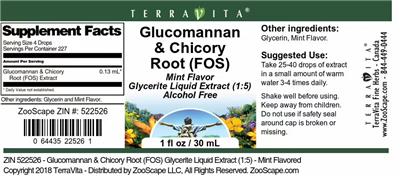
Supplement Facts
The label details for Glucomannan & Chicory Root (FOS) Mint Flavor by TerraVita, sourced from the NIH Dietary Supplement Label Database.
Supplement Facts
| Ingredient | Amount | % DV |
|---|---|---|
| Glucomannan | 0 NP | -- |
| Glucomannan & Chicory Root Glycerite Liquid Extract | 0.13 mL | -- |
| Chicory Root Glycerite Liquid Extract | 0 NP | -- |
Other ingredients: Glycerin, Mint Flavor
Tap any ingredient to jump to its full detail below.
These statements are the manufacturer’s wording, reproduced from the product label — the label is saying it, not HelloPharmacist. We don’t verify or endorse them.
Brand IP Statement(s)
Copyright 2018 TerraVita - Distributed by ZooScape LLC, All Rights Reserved.
Formula
Mint flavored Glycerite liquid extract (1:5)
Formulation
Alcohol free
Suggested/Recommended/Usage/Directions
Suggested Use: Take 25-40 drops of extract in a small amount of warm water 3-4 times daily. Shake well before using.
Precautions
Keep away from children.
Do not use if safety seal around cap is broken or missing.
Is this label outdated? Report a formula or label change and our pharmacy team will review it.
Glucomannan & Chicory Root (FOS) Mint Flavor by TerraVita label
The label scan from the NIH Dietary Supplement Label Database. Tap to enlarge.
Label images are published by the NIH Dietary Supplement Label Database for the version of this product on file. Always read your actual product label.
View the full label (PDF)The Ingredients in Glucomannan & Chicory Root (FOS) Mint Flavor by TerraVita
This is the 1 active ingredient this product is made of. Select it to open its full monograph.
Serving size25 Drop(s) Dosage formLiquid Servings per container227 Amounts shown are per serving.
Glucomannan & Chicory Root Glycerite Liquid Extract
Interacts with2,022 drugs
Glucomannan is a soluble fiber from the konjac root that swells into a gel in your stomach, which may help with mild weight loss, constipation, and mo...
Glucomannan & Chicory Root Glycerite Liquid Extract monograph & interactionsOther (inactive) ingredients: Glycerin, Mint Flavor. These complete the product’s ingredient list but are not active constituents.
Glucomannan & Chicory Root (FOS) Mint Flavor by TerraVita Drug Interactions
HelloPharmacist Interaction Report
Glucomannan & Chicory Root (FOS) Mint Flavor by TerraVita interacts with medications through both its glucomannan and chicory root content.
The most serious concern is a Moderate interaction: glucomannan may reduce how your body absorbs oral drugs by slowing their passage through your gut. A small study showed this effect with the diabetes medication glyburide.
Altogether, these interactions span 2,051 individual medications.
Read the full breakdown — every affected drug type, severity by severity
Chicory root presents a separate Moderate interaction with antidiabetes drugs—it may theoretically increase the risk of low blood sugar (hypoglycemia) when combined with diabetes medications, based on animal and lab research showing chicory has blood-sugar-lowering effects.
Because glucomannan's effect on drug absorption is broad and unpredictable, you'll want to check your exact medications with the search tool below before starting this product. If you take any prescription drugs—especially diabetes medications or anything else taken by mouth—run them through first.
Check your own medications below · Editorial policy · How we use AI
Want to check YOUR meds against Glucomannan & Chicory Root (FOS) Mint Flavor?
Ask about interactions with your drugs in plain English — “Can I take it with lisinopril?” — and we find you the answer in seconds, ingredient by ingredient.
Go to the checkerIngredients driving the most interactions
Individual Drug Interactions
The ingredients in Glucomannan & Chicory Root (FOS) Mint Flavor interact with 2,050 drugs. Click any drug to see the details.
1 of the 1 ingredient in Glucomannan & Chicory Root (FOS) Mint Flavor interact with drugs. Each result below shows which ingredient is responsible. Glucomannan & Chicory Root Glycerite Liquid Extract
"phentolamineOraVerse, Rogitine, Ryzumvi
How "phentolamine interacts with Glucomannan & Chicory Root (FOS) Mint Flavor — through 1 ingredient. Tap an ingredient for the detail:
Glucomannan & Chicory Root Glycerite Liquid ExtractOral Drugs Moderate
Interaction Summary
Theoretically, glucomannan may decrease absorption of drugs taken orally.
Read the full Glucomannan & Chicory Root Glycerite Liquid Extract + "phentolamine interaction6-mercaptopurinePurinethol
How 6-mercaptopurine interacts with Glucomannan & Chicory Root (FOS) Mint Flavor — through 1 ingredient. Tap an ingredient for the detail:
Glucomannan & Chicory Root Glycerite Liquid ExtractOral Drugs Moderate
Interaction Summary
Theoretically, glucomannan may decrease absorption of drugs taken orally.
Read the full Glucomannan & Chicory Root Glycerite Liquid Extract + 6-mercaptopurine interactionAbacavirZiagen
How Abacavir interacts with Glucomannan & Chicory Root (FOS) Mint Flavor — through 1 ingredient. Tap an ingredient for the detail:
Glucomannan & Chicory Root Glycerite Liquid ExtractOral Drugs Moderate
Interaction Summary
Theoretically, glucomannan may decrease absorption of drugs taken orally.
Read the full Glucomannan & Chicory Root Glycerite Liquid Extract + Abacavir interactionAbacavir Sulfate, Dolutegravir, LamivudineTriumeq
How Abacavir Sulfate, Dolutegravir, Lamivudine interacts with Glucomannan & Chicory Root (FOS) Mint Flavor — through 1 ingredient. Tap an ingredient for the detail:
Glucomannan & Chicory Root Glycerite Liquid ExtractOral Drugs Moderate
Interaction Summary
Theoretically, glucomannan may decrease absorption of drugs taken orally.
Read the full Glucomannan & Chicory Root Glycerite Liquid Extract + Abacavir Sulfate, Dolutegravir, Lamivudine interactionAbacavir, LamivudineEpzicom
How Abacavir, Lamivudine interacts with Glucomannan & Chicory Root (FOS) Mint Flavor — through 1 ingredient. Tap an ingredient for the detail:
Glucomannan & Chicory Root Glycerite Liquid ExtractOral Drugs Moderate
Interaction Summary
Theoretically, glucomannan may decrease absorption of drugs taken orally.
Read the full Glucomannan & Chicory Root Glycerite Liquid Extract + Abacavir, Lamivudine interactionAbciximabReoPro
How Abciximab interacts with Glucomannan & Chicory Root (FOS) Mint Flavor — through 1 ingredient. Tap an ingredient for the detail:
Glucomannan & Chicory Root Glycerite Liquid ExtractOral Drugs Moderate
Interaction Summary
Theoretically, glucomannan may decrease absorption of drugs taken orally.
Read the full Glucomannan & Chicory Root Glycerite Liquid Extract + Abciximab interactionAbemaciclibVerzenio
How Abemaciclib interacts with Glucomannan & Chicory Root (FOS) Mint Flavor — through 1 ingredient. Tap an ingredient for the detail:
Glucomannan & Chicory Root Glycerite Liquid ExtractOral Drugs Moderate
Interaction Summary
Theoretically, glucomannan may decrease absorption of drugs taken orally.
Read the full Glucomannan & Chicory Root Glycerite Liquid Extract + Abemaciclib interactionAbiraterone
How Abiraterone interacts with Glucomannan & Chicory Root (FOS) Mint Flavor — through 1 ingredient. Tap an ingredient for the detail:
Glucomannan & Chicory Root Glycerite Liquid ExtractOral Drugs Moderate
Interaction Summary
Theoretically, glucomannan may decrease absorption of drugs taken orally.
Read the full Glucomannan & Chicory Root Glycerite Liquid Extract + Abiraterone interactionAbiraterone AcetateYonsa, Zytiga
How Abiraterone Acetate interacts with Glucomannan & Chicory Root (FOS) Mint Flavor — through 1 ingredient. Tap an ingredient for the detail:
Glucomannan & Chicory Root Glycerite Liquid ExtractOral Drugs Moderate
Interaction Summary
Theoretically, glucomannan may decrease absorption of drugs taken orally.
Read the full Glucomannan & Chicory Root Glycerite Liquid Extract + Abiraterone Acetate interactionAbrocitinibCibinqo
How Abrocitinib interacts with Glucomannan & Chicory Root (FOS) Mint Flavor — through 1 ingredient. Tap an ingredient for the detail:
Glucomannan & Chicory Root Glycerite Liquid ExtractOral Drugs Moderate
Interaction Summary
Theoretically, glucomannan may decrease absorption of drugs taken orally.
Read the full Glucomannan & Chicory Root Glycerite Liquid Extract + Abrocitinib interactionAcalabrutinibCalquence
How Acalabrutinib interacts with Glucomannan & Chicory Root (FOS) Mint Flavor — through 1 ingredient. Tap an ingredient for the detail:
Glucomannan & Chicory Root Glycerite Liquid ExtractOral Drugs Moderate
Interaction Summary
Theoretically, glucomannan may decrease absorption of drugs taken orally.
Read the full Glucomannan & Chicory Root Glycerite Liquid Extract + Acalabrutinib interactionAcamprosateCampral
How Acamprosate interacts with Glucomannan & Chicory Root (FOS) Mint Flavor — through 1 ingredient. Tap an ingredient for the detail:
Glucomannan & Chicory Root Glycerite Liquid ExtractOral Drugs Moderate
Interaction Summary
Theoretically, glucomannan may decrease absorption of drugs taken orally.
Read the full Glucomannan & Chicory Root Glycerite Liquid Extract + Acamprosate interactionAcarboseGlucobay, Prandase, Precose
How Acarbose interacts with Glucomannan & Chicory Root (FOS) Mint Flavor — through 2 ingredients. Tap an ingredient for the detail:
Chicory Root Glycerite Liquid ExtractAntidiabetes Drugs Moderate
Interaction Summary
Theoretically, chicory might increase the risk of hypoglycemia when taken with antidiabetes drugs.
Read the full Chicory Root Glycerite Liquid Extract + Acarbose interactionGlucomannan & Chicory Root Glycerite Liquid ExtractOral Drugs Moderate
Interaction Summary
Theoretically, glucomannan may decrease absorption of drugs taken orally.
Read the full Glucomannan & Chicory Root Glycerite Liquid Extract + Acarbose interactionAcebutololRhotral, Sectral
How Acebutolol interacts with Glucomannan & Chicory Root (FOS) Mint Flavor — through 1 ingredient. Tap an ingredient for the detail:
Glucomannan & Chicory Root Glycerite Liquid ExtractOral Drugs Moderate
Interaction Summary
Theoretically, glucomannan may decrease absorption of drugs taken orally.
Read the full Glucomannan & Chicory Root Glycerite Liquid Extract + Acebutolol interactionAcenocoumarolSintrom
How Acenocoumarol interacts with Glucomannan & Chicory Root (FOS) Mint Flavor — through 1 ingredient. Tap an ingredient for the detail:
Glucomannan & Chicory Root Glycerite Liquid ExtractOral Drugs Moderate
Interaction Summary
Theoretically, glucomannan may decrease absorption of drugs taken orally.
Read the full Glucomannan & Chicory Root Glycerite Liquid Extract + Acenocoumarol interactionAcepromazineAtravet
How Acepromazine interacts with Glucomannan & Chicory Root (FOS) Mint Flavor — through 1 ingredient. Tap an ingredient for the detail:
Glucomannan & Chicory Root Glycerite Liquid ExtractOral Drugs Moderate
Interaction Summary
Theoretically, glucomannan may decrease absorption of drugs taken orally.
Read the full Glucomannan & Chicory Root Glycerite Liquid Extract + Acepromazine interactionAcetaminophenChildren's Tylenol, Children's Tylenol Meltaways, Tylenol, Tylenol Ex Strength
How Acetaminophen interacts with Glucomannan & Chicory Root (FOS) Mint Flavor — through 1 ingredient. Tap an ingredient for the detail:
Glucomannan & Chicory Root Glycerite Liquid ExtractOral Drugs Moderate
Interaction Summary
Theoretically, glucomannan may decrease absorption of drugs taken orally.
Read the full Glucomannan & Chicory Root Glycerite Liquid Extract + Acetaminophen interactionAcetaminophen, AspirinGemnisyn
How Acetaminophen, Aspirin interacts with Glucomannan & Chicory Root (FOS) Mint Flavor — through 1 ingredient. Tap an ingredient for the detail:
Glucomannan & Chicory Root Glycerite Liquid ExtractOral Drugs Moderate
Interaction Summary
Theoretically, glucomannan may decrease absorption of drugs taken orally.
Read the full Glucomannan & Chicory Root Glycerite Liquid Extract + Acetaminophen, Aspirin interactionAcetaminophen, Aspirin, CaffeineExcedrin, Excedrin Extra Strength, Excedrin Migraine
How Acetaminophen, Aspirin, Caffeine interacts with Glucomannan & Chicory Root (FOS) Mint Flavor — through 1 ingredient. Tap an ingredient for the detail:
Glucomannan & Chicory Root Glycerite Liquid ExtractOral Drugs Moderate
Interaction Summary
Theoretically, glucomannan may decrease absorption of drugs taken orally.
Read the full Glucomannan & Chicory Root Glycerite Liquid Extract + Acetaminophen, Aspirin, Caffeine interactionAcetaminophen, Brompheniramine, PhenylpropanolamineDimetapp Cold and Flu
How Acetaminophen, Brompheniramine, Phenylpropanolamine interacts with Glucomannan & Chicory Root (FOS) Mint Flavor — through 1 ingredient. Tap an ingredient for the detail:
Glucomannan & Chicory Root Glycerite Liquid ExtractOral Drugs Moderate
Interaction Summary
Theoretically, glucomannan may decrease absorption of drugs taken orally.
Read the full Glucomannan & Chicory Root Glycerite Liquid Extract + Acetaminophen, Brompheniramine, Phenylpropanolamine interactionAcetaminophen, ButalbitalAxocet, Bancap, Bucet, Butex Forte, Esgic CF, Orbivan CF +5 more
How Acetaminophen, Butalbital interacts with Glucomannan & Chicory Root (FOS) Mint Flavor — through 1 ingredient. Tap an ingredient for the detail:
Glucomannan & Chicory Root Glycerite Liquid ExtractOral Drugs Moderate
Interaction Summary
Theoretically, glucomannan may decrease absorption of drugs taken orally.
Read the full Glucomannan & Chicory Root Glycerite Liquid Extract + Acetaminophen, Butalbital interactionAcetaminophen, Butalbital, CaffeineEsgic, Esgic Plus, Fiogesic, Fioricet, Repan, Tecnal +1 more
How Acetaminophen, Butalbital, Caffeine interacts with Glucomannan & Chicory Root (FOS) Mint Flavor — through 1 ingredient. Tap an ingredient for the detail:
Glucomannan & Chicory Root Glycerite Liquid ExtractOral Drugs Moderate
Interaction Summary
Theoretically, glucomannan may decrease absorption of drugs taken orally.
Read the full Glucomannan & Chicory Root Glycerite Liquid Extract + Acetaminophen, Butalbital, Caffeine interactionAcetaminophen, Butalbital, Caffeine, CodeineEsgic with Codeine, Fioricet w/ Codeine
How Acetaminophen, Butalbital, Caffeine, Codeine interacts with Glucomannan & Chicory Root (FOS) Mint Flavor — through 1 ingredient. Tap an ingredient for the detail:
Glucomannan & Chicory Root Glycerite Liquid ExtractOral Drugs Moderate
Interaction Summary
Theoretically, glucomannan may decrease absorption of drugs taken orally.
Read the full Glucomannan & Chicory Root Glycerite Liquid Extract + Acetaminophen, Butalbital, Caffeine, Codeine interactionAcetaminophen, Butalbital, CodeineBancap w/ Codeine
How Acetaminophen, Butalbital, Codeine interacts with Glucomannan & Chicory Root (FOS) Mint Flavor — through 1 ingredient. Tap an ingredient for the detail:
Glucomannan & Chicory Root Glycerite Liquid ExtractOral Drugs Moderate
Interaction Summary
Theoretically, glucomannan may decrease absorption of drugs taken orally.
Read the full Glucomannan & Chicory Root Glycerite Liquid Extract + Acetaminophen, Butalbital, Codeine interactionAcetaminophen, Butalbital, Codeine PhosphatePhrenilin #3
How Acetaminophen, Butalbital, Codeine Phosphate interacts with Glucomannan & Chicory Root (FOS) Mint Flavor — through 1 ingredient. Tap an ingredient for the detail:
Glucomannan & Chicory Root Glycerite Liquid ExtractOral Drugs Moderate
Interaction Summary
Theoretically, glucomannan may decrease absorption of drugs taken orally.
Read the full Glucomannan & Chicory Root Glycerite Liquid Extract + Acetaminophen, Butalbital, Codeine Phosphate interactionAcetaminophen, Caffeine, Chlorpheniramine, Hydrocodone, PhenylephrineHycomine Compound
How Acetaminophen, Caffeine, Chlorpheniramine, Hydrocodone, Phenylephrine interacts with Glucomannan & Chicory Root (FOS) Mint Flavor — through 1 ingredient. Tap an ingredient for the detail:
Glucomannan & Chicory Root Glycerite Liquid ExtractOral Drugs Moderate
Interaction Summary
Theoretically, glucomannan may decrease absorption of drugs taken orally.
Read the full Glucomannan & Chicory Root Glycerite Liquid Extract + Acetaminophen, Caffeine, Chlorpheniramine, Hydrocodone, Phenylephrine interactionAcetaminophen, Caffeine, CodeineGesic C15, Gesic C30, Gesic C8, Lenoltec 1, Lenoltec 2, Lenoltec 3 +1 more
How Acetaminophen, Caffeine, Codeine interacts with Glucomannan & Chicory Root (FOS) Mint Flavor — through 1 ingredient. Tap an ingredient for the detail:
Glucomannan & Chicory Root Glycerite Liquid ExtractOral Drugs Moderate
Interaction Summary
Theoretically, glucomannan may decrease absorption of drugs taken orally.
Read the full Glucomannan & Chicory Root Glycerite Liquid Extract + Acetaminophen, Caffeine, Codeine interactionAcetaminophen, Caffeine, Codeine, SalicylamideCodalan No.1, Codalan No.2, Codalan No.3
How Acetaminophen, Caffeine, Codeine, Salicylamide interacts with Glucomannan & Chicory Root (FOS) Mint Flavor — through 1 ingredient. Tap an ingredient for the detail:
Glucomannan & Chicory Root Glycerite Liquid ExtractOral Drugs Moderate
Interaction Summary
Theoretically, glucomannan may decrease absorption of drugs taken orally.
Read the full Glucomannan & Chicory Root Glycerite Liquid Extract + Acetaminophen, Caffeine, Codeine, Salicylamide interactionAcetaminophen, Caffeine, DihydrocodeineDHC Plus, Panlor DC, Panlor SS
How Acetaminophen, Caffeine, Dihydrocodeine interacts with Glucomannan & Chicory Root (FOS) Mint Flavor — through 1 ingredient. Tap an ingredient for the detail:
Glucomannan & Chicory Root Glycerite Liquid ExtractOral Drugs Moderate
Interaction Summary
Theoretically, glucomannan may decrease absorption of drugs taken orally.
Read the full Glucomannan & Chicory Root Glycerite Liquid Extract + Acetaminophen, Caffeine, Dihydrocodeine interactionAcetaminophen, Caffeine, IsomethepteneMigralam
How Acetaminophen, Caffeine, Isometheptene interacts with Glucomannan & Chicory Root (FOS) Mint Flavor — through 1 ingredient. Tap an ingredient for the detail:
Glucomannan & Chicory Root Glycerite Liquid ExtractOral Drugs Moderate
Interaction Summary
Theoretically, glucomannan may decrease absorption of drugs taken orally.
Read the full Glucomannan & Chicory Root Glycerite Liquid Extract + Acetaminophen, Caffeine, Isometheptene interactionEach ingredient & the kinds of drugs it affects
For each ingredient in Glucomannan & Chicory Root (FOS) Mint Flavor with known interactions, here are the types of medications it can affect. Open any type for the detail — or search your exact drug in the checker above.
Glucomannan & Chicory Root Glycerite Liquid Extract
Oral Drugs
Theoretically, glucomannan may decrease absorption of drugs taken orally.
Due to its viscosity and bulking effects, there is concern that glucomannan can decrease the absorption of oral drugs. A small clinical study in healthy volunteers shows that taking glyburide 2.5 mg plus glucomannan 3.9 grams with breakfast reduces plasma levels of glyburide when compared with breakfast and glyburide alone. In addition, animal research demonstrates this effect on amoxicillin, but shows increased absorption of metronidazole. This mouse model also demonstrates that metronidazole elimination is prolonged, but amoxicillin elimination is enhanced by 38%; glucomannan may also affect the distribution of some drugs. To avoid changes in absorption, take glucomannan 30-60 minutes after taking oral drugs.
Brand information
Manufacturer and brand details for Glucomannan & Chicory Root (FOS) Mint Flavor, from the product label.
TerraVita
See all TerraVita products- Name
- ZooScape LLC
- Phone Number
- 844-449-0444
- Web Address
- www.ZooScape.com
Glucomannan & Chicory Root (FOS) Mint Flavor by TerraVita: Common Questions
Does Glucomannan & Chicory Root (FOS) Mint Flavor by TerraVita interact with any medications?
How can one product interact with so many drugs?
Where does this information come from?
Does this work for constipation?
Can I take this if I'm pregnant?
Will this help with blood sugar?
What side effects might I experience?
Is this safe to take with my other medications?
Can I use this while breastfeeding?
Written and reviewed by the HelloPharmacist editorial staff. Our editorial policy
Not sure if Glucomannan & Chicory Root (FOS) Mint Flavor is safe with your meds?
Our pharmacists answer your medication & supplement questions — free.
Label information is sourced from the NIH Dietary Supplement Label Database and reflects the product version on file; always read your actual product label. This page is for education only and is not a substitute for professional medical advice. Confirm with your pharmacist or doctor before combining supplements and medications.
The Full Monographs Behind Glucomannan & Chicory Root (FOS) Mint Flavor’s Ingredients
Every ingredient we hold a full HelloPharmacist monograph for — uses, evidence, safety, and the complete interaction list.
Glucomannan
Interacts with 2,022 drugsGlucomannan is a soluble fiber from the konjac root that swells into a gel in your stomach, which may help with mild weight loss, constipation, and modestly lowering cholesterol. It is gener...
Read the full Glucomannan monograph → Herb & supplement monographChicory
Interacts with 86 drugsChicory is best known as a caffeine-free coffee substitute and as a source of inulin, a soluble prebiotic fiber that may support digestion and regularity. Strong human evidence for most othe...
Read the full Chicory monograph →Sources & How We Checked
Glucomannan & Chicory Root (FOS) Mint Flavor's label data comes from the NIH Dietary Supplement Label Database; the ingredient interaction data is from the Natural Medicines database, reviewed by our pharmacists.
- NIH Dietary Supplement Label Database (DSLD) — The official product label on file for this supplement.
- Natural Medicines (Therapeutic Research Center) — Evidence-graded clinical reference behind the ingredient interaction data.
Content is written and reviewed by licensed HelloPharmacist pharmacists. See our data sources and editorial standards for how this information is built and checked.
The 28 references behind this product’s interaction data
Every citation that drives the interaction findings for this product’s ingredients, from the evidence-graded Natural Medicines (TRC Healthcare) database. Open an ingredient to browse its citations — links open the study on PubMed or the publisher’s site.
Glucomannan 15 references
- Henry DA, Mitchell AS, Aylward J, et al. Glucomannan and risk of oesophageal obstruction. Br Med J 1986;292:591-2. PubMed
- Shima K, Tanaka A, Ikegami H, et al. Effect of dietary fiber, glucomannan, on absorption of sulfonylurea in man. Horm Metab Res 1983;15:1-3. PubMed
- Villaverde, A. F., Benlloch, S., Berenguer, M., Miguel, Rayon J., Pina, R., and Berenguer, J. Acute hepatitis of cholestatic type possibly associated with the use of glucomannan (amorphophalus konjac). J Hepatol. 2004;41(6):1061-1062. PubMed
- Yoshida, M., Vanstone, C. A., Parsons, W. D., Zawistowski, J., and Jones, P. J. Effect of plant sterols and glucomannan on lipids in individuals with and without type II diabetes. Eur.J Clin Nutr. 2006;60(4):529-537. PubMed
- Wood, R. J., Fernandez, M. L., Sharman, M. J., Silvestre, R., Greene, C. M., Zern, T. L., Shrestha, S., Judelson, D. A., Gomez, A. L., Kraemer, W. J., and Volek, J. S. Effects of a carbohydrate-restricted diet with and without supplemental soluble fiber
- Vanderbeek, P. B., Fasano, C., O'Malley, G., and Hornstein, J. Esophageal obstruction from a hygroscopic pharmacobezoar containing glucomannan. Clin Toxicol.(Phila) 2007;45(1):80-82. PubMed
- Bernstein, J. A., Crandall, M. S., and Floyd, R. Respiratory sensitization of a food manufacturing worker to konjac glucomannan. J Asthma 2007;44(8):675-680. PubMed
- Shichijo, K., Kobayashi, Y., Fueki, R., Shimoyama, K., and Masaya, M. [2 cases of konjac bronchial asthma found outside the "konnyaku" producing district]. Arerugi 1969;18(2):97-100.
- Carabin IG, Lyon MR, Wood S, et al. Supplementation of the diet with the functional fiber PolyGlycoplex is well tolerated by healthy subjects in a clinical trial. Nutr J 2009;8:9. PubMed
- Lyon MR, Reichert RG. The effect of a novel viscous polysaccharide along with lifestyle changes on short-term weight loss and associated risk factors in overweight and obese adults: an observational retrospective clinical program analysis. Altern Med Rev
- Lyon M, Wood S, Pelletier X, et al. Effects of a 3-month supplementation with a novel soluble highly viscous polysaccharide on anthropometry and blood lipids in nondieting overweight or obese adults. J Hum Nutr Diet 2011;24(4):351-9. PubMed
- Han Y, Zhang L, Liu XQ, Zhao ZJ, Lv LX. Effect of glucomannan on functional constipation in children: a systematic review and meta-analysis of randomised controlled trials. Asia Pac J Clin Nutr 2017;26(3):471-7.
- Health Canada Safety Alert. Health Canada Advises Canadians that natural health products containing glucomannan may cause serious choking if used with insufficient fluid. January 29, 2010. Alert # RA-110003825. https://healthycanadians.gc.ca/recall-alert-
- Mortensen A, Aguilar F, Crebelli, et al. EFSA Panel on Food Additives and Nutrient Sources added to Food. Re-evaluation of konjac gum (E 425 i) and konjac glucomannan (E425 ii) as food additives. EFSA Journal 2017;15(6):4864.
- Zhang Y, Aldamarany WAS, Song G, et al. Influence of konjac glucomannan and its derivatives on the oral pharmacokinetics of antimicrobial agent in antibiotics cocktails: Keep vigilant on dietary fiber supplement. Int J Biol Macromol 2023;251:126306. PubMed
Chicory 13 references
- Brinker F. Herb Contraindications and Drug Interactions. 2nd ed. Sandy, OR: Eclectic Medical Publications, 1998.
- Stone-Dorshow T, Levitt MD. Gaseous response to ingestion of a poorly absorbed fructo-oligosaccharide sweetener. Am J Clin Nutr 1987;46:61-5. PubMed
- Briet F, et al. Symptomatic response to varying levels of fructo-oligosaccharides consumed occasionally or regularly. Eur J Clin Nutr 1995;49:501-7.
- Bouhnik Y, Vahedi K, Achour L, et al. Short-chain fructo-oligosaccharide administration dose-dependently increases fecal bifidobacteria in healthy humans. J Nutr 1999;129:113-6. PubMed
- Cummings JH, Macfarlane GT, Englyst HN. Prebiotic digestion and fermentation. Am J Clin Nutr 2001;73:415S-420S. PubMed
- Cadot, P., Kochuyt, A. M., van Ree, R., and Ceuppens, J. L. Oral allergy syndrome to chicory associated with birch pollen allergy. Int.Arch.Allergy Immunol. 2003;131(1):19-24. PubMed
- Friis, B., Hjorth, N., Vail, J. T., Jr., and Mitchell, J. C. Occupational contact dermatitis from Cichorium (chicory, endive) and Lactuca (lettuce). Contact Dermatitis 1975;1(5):311-313.
- Nemery, B. and Demedts, M. Occupational asthma in a chicory grower. Lancet 3-25-1989;1(8639):672-673. PubMed
- Pirson F, Detry B, Pilette C. Occupational rhinoconjunctivitis and asthma caused by chicory and oral allergy syndrome associated with bet v 1-related protein. J Investig Allergol Clin Immunol 2009;19(4):306-10.
- Willi R, Pfab F, Huss-Marp J, et al. Contact anaphylaxis and protein contact dermatitis in a cook handling chicory leaves. Contact Dermatitis 2009;60(4):226-7. PubMed
- Street RA, Sidana J, Prinsloo G. Cichorium intybus: traditional uses, phytochemistry, pharmacology, and toxicology. Evid Based Complement Alternat Med 2013;2013:579319.
- Bonnema AL, Kolberg LW, Thomas W, Slavin JL. Gastrointestinal tolerance of chicory inulin products. J Am Diet Assoc 2010;110(6):865-8. PubMed
- Devi Kt R, Sivalingam N. Cichorium intybus attenuates Streptozotocin-induced pancreatic ß-cell damage by inhibiting NF-?B activation and oxidative stress. J Appl Biomed 2020;18(2-3):70-9. PubMed
Parts of this content are provided by the Therapeutic Research Center, LLC.
DISCLAIMER: Currently this does not check for drug-drug interactions. This is not an all-inclusive comprehensive list of potential interactions and is for informational purposes only. Not all interactions are known or well-reported in the scientific literature, and new interactions are continually being reported. Input is needed from a qualified healthcare provider including a pharmacist before starting any therapy. Application of clinical judgment is necessary.
© 2021 Therapeutic Research Center, LLC