
Herbal Tooth & Gum Powder Ingredients & Drug Interactions
by Christopher's Original Formulas
What is this page for?
First and foremost: checking Herbal Tooth & Gum Powder against your medications. The heart of this page is the interaction checker and the full interaction report — how this product’s ingredients may interact with prescription and over-the-counter medicines you may be taking.
Around that, we add a pharmacist’s high-level view of the product as a whole — what’s inside, the evidence for its stated use, how transparent the label is, and what safety data exists — so you can see the full picture in one place. It’s educational information from our licensed clinical databases and the clinical staff at HelloPharmacist — not medical advice — and we don’t sell or endorse products. Our editorial policy
Herbal Tooth & Gum Powder is a dietary supplement by Christopher's Original Formulas with 8 active ingredients. Its ingredients are commonly taken for sore throat and cough, heartburn and acid reflux, digestive upset and ibs.Based on those ingredients, 2,143 medications have a known interaction with it, the most serious rated moderate. The ingredients most likely to interact are Slippery Elm, Clove, Peppermint. Use the checker below to test your specific medication, or read the full HelloPharmacist Interaction Report.
Check Your Meds Against Herbal Tooth & Gum Powder by Christopher's Original Formulas
Ask about any prescription or over-the-counter medication and we check it for interactions with Herbal Tooth & Gum Powder by Christopher's Original Formulas — and tell you which ingredient is responsible.
AI summaries are generated from our interaction database for education only — always confirm with your pharmacist. How we use AI
Ask the Pharmacist
A licensed pharmacist will answer your question by email — free, usually within 24 hours.
Got it — thank you!
A licensed pharmacist will answer within 24 hours. Keep an eye on your email (worth checking spam, just in case).
HelloPharmacist Scorecard of Herbal Tooth & Gum Powder by Christopher's Original Formulas
Our pharmacy team’s full take, with four database checks built into the cards below — a summary of what is known, not a grade of the product itself.
What’s inside
Low disclosure
This powder contains 8 ingredients, including several well-known botanicals. Slippery elm, clove, peppermint, stevia, horsetail (listed as shavegrass), bayberry, white oak, and prickly ash are the active ingredients; there are no inactive fillers or excipients listed.
Each plays a traditional role in mouth and gum care, though the strength of the evidence for their effectiveness varies widely.
Does it work?
Not established
The evidence for most ingredients in this product is sparse. Peppermint is likely effective for irritable bowel syndrome (IBS) and possibly effective for indigestion (dyspepsia), nausea from chemotherapy, and some other gastrointestinal uses—but there's no established evidence specifically for tooth or gum health.
Clove is possibly effective for ventilator-associated pneumonia in clinical settings, which is not relevant to at-home use. For slippery elm, clove for cough and pain, stevia for blood sugar or blood pressure, and horsetail for hair loss or bladder control, the evidence we hold is insufficient to rate them.
Bayberry and white oak have no effectiveness data on file. The traditional use of these ingredients in mouth care is long-standing, but robust clinical evidence for this specific combination is lacking.
How safe is it?
Well-documented data
Slippery elm is generally well tolerated for short-term use, though high-quality safety data are limited; the pollen and bark extracts can cause skin irritation, contact dermatitis, or hives in some people. Bayberry carries more caution—large amounts may irritate your stomach, and it's best avoided in pregnancy and while breastfeeding due to insufficient safety data.
Clove as a food spice is safe, but concentrated oil or medicinal doses can be irritating or toxic; as little as 5–10 mL of clove oil has caused toxicity in children. Peppermint tea and culinary amounts are generally safe, but concentrated oil should be used carefully and avoided in concentrated doses unless your provider approves; oral use can cause abdominal pain, heartburn, nausea, or anal burning in some people.
White oak and horsetail are best used short-term only; horsetail's crude form contains thiaminase, which can lead to thiamine deficiency with prolonged use, and both are best avoided during pregnancy and breastfeeding. Stevia in purified food amounts is generally recognized as safe, though whole-leaf or high-dose supplements lack long-term safety data.
Prickly ash safety data are not on file.
Meds to double-check
Moderate interaction found
Before taking this product, double-check with your pharmacist if you take antidiabetes drugs (risk of low blood sugar from clove and horsetail, Moderate), any drugs your liver metabolizes via CYP3A4, CYP2D6, CYP2C9, CYP2C19, or CYP1A2 pathways (Moderate, from clove and peppermint), diuretic drugs (Moderate, from horsetail), lithium (Moderate, from horsetail and stevia), HIV medications like efavirenz or nucleoside reverse transcriptase inhibitors (Moderate, from horsetail), cyclosporine (Moderate, from peppermint), blood thinners (Minor, from clove), or blood pressure medications (Minor, from stevia). Altogether, these interactions span 2,124 individual medications.
No interactions are documented for bayberry, white oak, or prickly ash, though we could not check prickly ash.
The bottom line
Scorecard at a glanceFormula with limited ingredient disclosure with no established evidence rating for its marketed use. Moderate medication interactions have been identified, and safety information is well characterized.
If you take any medications—especially diabetes drugs, blood thinners, blood pressure drugs, lithium, cyclosporine, or HIV antiretrovirals—check this product against your exact prescriptions using the tool on this page before you start. The ingredients are used traditionally for oral health, but clinical evidence for this formula is limited.
A pharmacist or your doctor can help you weigh whether it's right for you and whether it conflicts with what you're taking.
Educational only — not medical advice; always confirm with your pharmacist. Our editorial policy · How we use AI
Assessment coverage: 8 of 8 active ingredients matched to our full ingredient reviews (monographs). Based on the product label dated May 21, 2025.
This Scorecard evaluates available label information, ingredient evidence, and known medication-safety considerations. It does not independently verify product identity, purity, potency, contamination, or manufacturing quality. How these ratings are computed
General information
Key facts about Herbal Tooth & Gum Powder, straight from the product label.
| Brand | Christopher's Original Formulas |
|---|---|
| Barcode (UPC) | 084783893189 |
| Net contents | 2 Ounce(s) |
| Market status | On market |
| Date entered into DSLD | May 21, 2025 |
| DSLD ID | 329267 |
| Product type | Botanical |
| Supplement form | Powder |
| Dietary claims / uses | All Other, Structure/Function |
| Intended target group(s) | Adult (18 - 50 Years) |
Everything in this section is reproduced from the manufacturer’s own product label — it’s the label speaking, not HelloPharmacist. We show it so you can see exactly what the maker states; we don’t verify or endorse those statements.
Supplement Facts
The label details for Herbal Tooth & Gum Powder by Christopher's Original Formulas, sourced from the NIH Dietary Supplement Label Database.
Supplement Facts
| Ingredient | Amount | % DV |
|---|---|---|
| Slippery Elm | 0 NP | -- |
| Proprietary Blend | 0 NP | -- |
| Bayberry | 0 NP | -- |
| Clove | 0 NP | -- |
| Prickly Ash | 0 NP | -- |
| White Oak | 0 NP | -- |
| Peppermint | 0 NP | -- |
| Stevia | 0 NP | -- |
| Shavegrass | 0 NP | -- |
Tap any ingredient to jump to its full detail below.
These statements are the manufacturer’s wording, reproduced from the product label — the label is saying it, not HelloPharmacist. We don’t verify or endorse them.
Suggested/Recommended/Usage/Directions
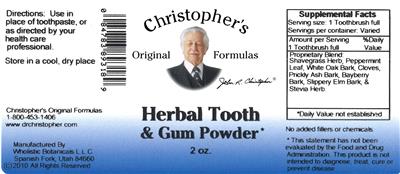
Directions: Use in place of toothpaste, or as directed by your health care professional.
Storage
Store in a cool, dry place
Brand IP Statement(s)
Copyright 2010 All rights reserved
General Statements
Christopher's Original Formulas 1-800-453-1406 www.drchristopher.com John R. Christopher
Formulation
No added fillers or chemicals
FDA Disclaimer Statement
This statement has not been evaluated by the Food and Drug Administration. This product is not intended to diagnose, treat, cure or prevent disease.
Is this label outdated? Report a formula or label change and our pharmacy team will review it.
Herbal Tooth & Gum Powder by Christopher's Original Formulas label
The label scan from the NIH Dietary Supplement Label Database. Tap to enlarge.
Label images are published by the NIH Dietary Supplement Label Database for the version of this product on file. Always read your actual product label.
View the full label (PDF)The Ingredients in Herbal Tooth & Gum Powder by Christopher's Original Formulas
These are the 8 active ingredients this product is made of. Select any to open its full monograph.
Serving size1 Toothbrush Full(s) Dosage formPowder Amounts shown are per serving.
Most supplement products combine several ingredients, and a medication can interact with the product through any one of them. Each ingredient below shows whether it has known drug interactions.
Proprietary Blend
- › Slippery Elm
- › Bayberry
- › Clove
- › Prickly Ash
- › White Oak
- › Peppermint
- › Stevia
- › Shavegrass
Herbal Tooth & Gum Powder by Christopher's Original Formulas Drug Interactions
HelloPharmacist Interaction Report
Christopher's Original Formulas Herbal Tooth & Gum Powder contains several ingredients with documented interactions.
The most serious is horsetail (shavegrass), which carries Moderate-severity interactions with antidiabetes drugs—it may lower blood sugar and raise the risk of low blood sugar (hypoglycemia), so dosing adjustments might be needed if you take insulin or oral diabetes medications.
Read the full breakdown — every affected drug type, severity by severity
Clove and peppermint both interact with a broad range of drugs that your liver metabolizes through several pathways (CYP2D6, CYP1A2, CYP3A4, and CYP2C9 substrates). In lab studies, their active compounds can slow how your body breaks down these medications, potentially raising their levels and side effects.
Clove also carries a Moderate risk with antidiabetes drugs and a Minor risk with blood thinners (anticoagulants). Peppermint carries Moderate interactions with cyclosporine and CYP2C19 substrates, and a Minor interaction with CYP1A2 substrates.
Slippery elm carries a Moderate interaction with oral drugs generally—its mucilage may slow their absorption and lower their levels in your bloodstream.
Stevia has Minor interactions with blood pressure drugs and antidiabetes drugs. Horsetail also interacts with diuretic drugs (water pills), lithium, and certain HIV medications (NRTIs and efavirenz)—it may interfere with their effectiveness or increase potassium loss.
Bayberry, white oak, and prickly ash either carry no documented interactions we could check or show none in our data. Run your exact medications through the interaction checker on this page before you start.
Check your own medications below · Editorial policy · How we use AI
Want to check YOUR meds against Herbal Tooth & Gum Powder?
Ask about interactions with your drugs in plain English — “Can I take it with lisinopril?” — and we find you the answer in seconds, ingredient by ingredient.
Go to the checkerIngredients driving the most interactions
Individual Drug Interactions
The ingredients in Herbal Tooth & Gum Powder interact with 2,143 drugs. Click any drug to see the details.
6 of the 8 ingredients in Herbal Tooth & Gum Powder interact with drugs. Each result below shows which ingredient is responsible. Slippery Elm Clove Peppermint Stevia Shavegrass Prickly Ash
"phentolamineOraVerse, Rogitine, Ryzumvi
How "phentolamine interacts with Herbal Tooth & Gum Powder — through 1 ingredient. Tap an ingredient for the detail:
Slippery ElmOral Drugs Moderate
Interaction Summary
Theoretically, slippery elm may slow the absorption and reduce serum levels of oral drugs.
Read the full Slippery Elm + "phentolamine interaction6-mercaptopurinePurinethol
How 6-mercaptopurine interacts with Herbal Tooth & Gum Powder — through 1 ingredient. Tap an ingredient for the detail:
Slippery ElmOral Drugs Moderate
Interaction Summary
Theoretically, slippery elm may slow the absorption and reduce serum levels of oral drugs.
Read the full Slippery Elm + 6-mercaptopurine interactionAdo-trastuzumab EmtansineKadcyla
How Ado-trastuzumab Emtansine interacts with Herbal Tooth & Gum Powder — through 2 ingredients. Tap an ingredient for the detail:
PeppermintCytochrome P450 3a4 (cyp3a4) Substrates Moderate
Interaction Summary
Theoretically, peppermint might increase the levels of CYP3A4 substrates.
Read the full Peppermint + Ado-trastuzumab Emtansine interactionCloveCytochrome P450 3a4 (cyp3a4) Substrates Moderate
Interaction Summary
Theoretically, concomitant use of clove may increase levels of drugs metabolized by CYP3A4.
Read the full Clove + Ado-trastuzumab Emtansine interactionAbacavirZiagen
How Abacavir interacts with Herbal Tooth & Gum Powder — through 1 ingredient. Tap an ingredient for the detail:
Slippery ElmOral Drugs Moderate
Interaction Summary
Theoretically, slippery elm may slow the absorption and reduce serum levels of oral drugs.
Read the full Slippery Elm + Abacavir interactionAbacavir Sulfate, Dolutegravir, LamivudineTriumeq
How Abacavir Sulfate, Dolutegravir, Lamivudine interacts with Herbal Tooth & Gum Powder — through 2 ingredients. Tap an ingredient for the detail:
ShavegrassNucleoside Reverse Transcriptase Inhibitors (nrtis) Moderate
Interaction Summary
Theoretically, horsetail might decrease the levels and clinical effects of NRTIs.
Read the full Shavegrass + Abacavir Sulfate, Dolutegravir, Lamivudine interactionSlippery ElmOral Drugs Moderate
Interaction Summary
Theoretically, slippery elm may slow the absorption and reduce serum levels of oral drugs.
Read the full Slippery Elm + Abacavir Sulfate, Dolutegravir, Lamivudine interactionAbacavir, LamivudineEpzicom
How Abacavir, Lamivudine interacts with Herbal Tooth & Gum Powder — through 2 ingredients. Tap an ingredient for the detail:
Slippery ElmOral Drugs Moderate
Interaction Summary
Theoretically, slippery elm may slow the absorption and reduce serum levels of oral drugs.
Read the full Slippery Elm + Abacavir, Lamivudine interactionShavegrassNucleoside Reverse Transcriptase Inhibitors (nrtis) Moderate
Interaction Summary
Theoretically, horsetail might decrease the levels and clinical effects of NRTIs.
Read the full Shavegrass + Abacavir, Lamivudine interactionAbciximabReoPro
How Abciximab interacts with Herbal Tooth & Gum Powder — through 2 ingredients. Tap an ingredient for the detail:
Slippery ElmOral Drugs Moderate
Interaction Summary
Theoretically, slippery elm may slow the absorption and reduce serum levels of oral drugs.
Read the full Slippery Elm + Abciximab interactionCloveAnticoagulant/antiplatelet Drugs Minor
Interaction Summary
Theoretically, clove oil may increase the risk of bleeding if used with anticoagulant or antiplatelet drugs.
Read the full Clove + Abciximab interactionAbemaciclibVerzenio
How Abemaciclib interacts with Herbal Tooth & Gum Powder — through 3 ingredients. Tap an ingredient for the detail:
Slippery ElmOral Drugs Moderate
Interaction Summary
Theoretically, slippery elm may slow the absorption and reduce serum levels of oral drugs.
Read the full Slippery Elm + Abemaciclib interactionPeppermintCytochrome P450 3a4 (cyp3a4) Substrates Moderate
Interaction Summary
Theoretically, peppermint might increase the levels of CYP3A4 substrates.
Read the full Peppermint + Abemaciclib interactionCloveCytochrome P450 3a4 (cyp3a4) Substrates Moderate
Interaction Summary
Theoretically, concomitant use of clove may increase levels of drugs metabolized by CYP3A4.
Read the full Clove + Abemaciclib interactionAbiraterone
How Abiraterone interacts with Herbal Tooth & Gum Powder — through 3 ingredients. Tap an ingredient for the detail:
CloveCytochrome P450 3a4 (cyp3a4) Substrates Moderate
Interaction Summary
Theoretically, concomitant use of clove may increase levels of drugs metabolized by CYP3A4.
Read the full Clove + Abiraterone interactionSlippery ElmOral Drugs Moderate
Interaction Summary
Theoretically, slippery elm may slow the absorption and reduce serum levels of oral drugs.
Read the full Slippery Elm + Abiraterone interactionPeppermintCytochrome P450 3a4 (cyp3a4) Substrates Moderate
Interaction Summary
Theoretically, peppermint might increase the levels of CYP3A4 substrates.
Read the full Peppermint + Abiraterone interactionAbiraterone AcetateYonsa, Zytiga
How Abiraterone Acetate interacts with Herbal Tooth & Gum Powder — through 3 ingredients. Tap an ingredient for the detail:
PeppermintCytochrome P450 3a4 (cyp3a4) Substrates Moderate
Interaction Summary
Theoretically, peppermint might increase the levels of CYP3A4 substrates.
Read the full Peppermint + Abiraterone Acetate interactionCloveCytochrome P450 3a4 (cyp3a4) Substrates Moderate
Interaction Summary
Theoretically, concomitant use of clove may increase levels of drugs metabolized by CYP3A4.
Read the full Clove + Abiraterone Acetate interactionSlippery ElmOral Drugs Moderate
Interaction Summary
Theoretically, slippery elm may slow the absorption and reduce serum levels of oral drugs.
Read the full Slippery Elm + Abiraterone Acetate interactionAbrocitinibCibinqo
How Abrocitinib interacts with Herbal Tooth & Gum Powder — through 3 ingredients. Tap an ingredient for the detail:
Slippery ElmOral Drugs Moderate
Interaction Summary
Theoretically, slippery elm may slow the absorption and reduce serum levels of oral drugs.
Read the full Slippery Elm + Abrocitinib interactionPeppermintCytochrome P450 2c9 (cyp2c9) Substrates, Cytochrome P450 2c19 (cyp2c19) Substrates Moderate
Interaction Summary
Theoretically, peppermint might increase the levels of CYP2C9 substrates.
Read the full Peppermint + Abrocitinib interactionCloveAnticoagulant/antiplatelet Drugs, Cytochrome P450 2c9 (cyp2c9) Substrates Moderate
Interaction Summary
Theoretically, clove oil may increase the risk of bleeding if used with anticoagulant or antiplatelet drugs.
Read the full Clove + Abrocitinib interactionAcalabrutinibCalquence
How Acalabrutinib interacts with Herbal Tooth & Gum Powder — through 3 ingredients. Tap an ingredient for the detail:
CloveCytochrome P450 3a4 (cyp3a4) Substrates Moderate
Interaction Summary
Theoretically, concomitant use of clove may increase levels of drugs metabolized by CYP3A4.
Read the full Clove + Acalabrutinib interactionSlippery ElmOral Drugs Moderate
Interaction Summary
Theoretically, slippery elm may slow the absorption and reduce serum levels of oral drugs.
Read the full Slippery Elm + Acalabrutinib interactionPeppermintCytochrome P450 3a4 (cyp3a4) Substrates Moderate
Interaction Summary
Theoretically, peppermint might increase the levels of CYP3A4 substrates.
Read the full Peppermint + Acalabrutinib interactionAcamprosateCampral
How Acamprosate interacts with Herbal Tooth & Gum Powder — through 1 ingredient. Tap an ingredient for the detail:
Slippery ElmOral Drugs Moderate
Interaction Summary
Theoretically, slippery elm may slow the absorption and reduce serum levels of oral drugs.
Read the full Slippery Elm + Acamprosate interactionAcarboseGlucobay, Prandase, Precose
How Acarbose interacts with Herbal Tooth & Gum Powder — through 4 ingredients. Tap an ingredient for the detail:
CloveAntidiabetes Drugs Moderate
Interaction Summary
Theoretically, concomitant use of clove extracts with antidiabetes drugs might increase the risk of hypoglycemia.
Read the full Clove + Acarbose interactionShavegrassAntidiabetes Drugs Moderate
Interaction Summary
Theoretically, taking horsetail with antidiabetes drugs might increase the risk of hypoglycemia.
Read the full Shavegrass + Acarbose interactionSlippery ElmOral Drugs Moderate
Interaction Summary
Theoretically, slippery elm may slow the absorption and reduce serum levels of oral drugs.
Read the full Slippery Elm + Acarbose interactionSteviaAntidiabetes Drugs Minor
Interaction Summary
Theoretically, stevia might increase the risk for hypoglycemia when combined with antidiabetes drugs.
Read the full Stevia + Acarbose interactionAcebutololRhotral, Sectral
How Acebutolol interacts with Herbal Tooth & Gum Powder — through 2 ingredients. Tap an ingredient for the detail:
Slippery ElmOral Drugs Moderate
Interaction Summary
Theoretically, slippery elm may slow the absorption and reduce serum levels of oral drugs.
Read the full Slippery Elm + Acebutolol interactionSteviaAntihypertensive Drugs Minor
Interaction Summary
Theoretically, combining stevia or stevia constituents with antihypertensive agents might increase the risk of hypotension.
Read the full Stevia + Acebutolol interactionAcenocoumarolSintrom
How Acenocoumarol interacts with Herbal Tooth & Gum Powder — through 2 ingredients. Tap an ingredient for the detail:
Slippery ElmOral Drugs Moderate
Interaction Summary
Theoretically, slippery elm may slow the absorption and reduce serum levels of oral drugs.
Read the full Slippery Elm + Acenocoumarol interactionCloveAnticoagulant/antiplatelet Drugs Minor
Interaction Summary
Theoretically, clove oil may increase the risk of bleeding if used with anticoagulant or antiplatelet drugs.
Read the full Clove + Acenocoumarol interactionAcepromazineAtravet
How Acepromazine interacts with Herbal Tooth & Gum Powder — through 1 ingredient. Tap an ingredient for the detail:
Slippery ElmOral Drugs Moderate
Interaction Summary
Theoretically, slippery elm may slow the absorption and reduce serum levels of oral drugs.
Read the full Slippery Elm + Acepromazine interactionAcetaminophenChildren's Tylenol, Children's Tylenol Meltaways, Tylenol, Tylenol Ex Strength
How Acetaminophen interacts with Herbal Tooth & Gum Powder — through 3 ingredients. Tap an ingredient for the detail:
Slippery ElmOral Drugs Moderate
Interaction Summary
Theoretically, slippery elm may slow the absorption and reduce serum levels of oral drugs.
Read the full Slippery Elm + Acetaminophen interactionCloveCytochrome P450 1a2 (cyp1a2) Substrates Moderate
Interaction Summary
Theoretically, concomitant use of clove may increase levels of drugs metabolized by CYP1A2.
Read the full Clove + Acetaminophen interactionPeppermintCytochrome P450 1a2 (cyp1a2) Substrates Minor
Interaction Summary
Theoretically, peppermint might increase the levels of CYP1A2 substrates.
Read the full Peppermint + Acetaminophen interactionAcetaminophen, AspirinGemnisyn
How Acetaminophen, Aspirin interacts with Herbal Tooth & Gum Powder — through 3 ingredients. Tap an ingredient for the detail:
CloveCytochrome P450 1a2 (cyp1a2) Substrates, Anticoagulant/antiplatelet Drugs Moderate
Interaction Summary
Theoretically, concomitant use of clove may increase levels of drugs metabolized by CYP1A2.
Read the full Clove + Acetaminophen, Aspirin interactionSlippery ElmOral Drugs Moderate
Interaction Summary
Theoretically, slippery elm may slow the absorption and reduce serum levels of oral drugs.
Read the full Slippery Elm + Acetaminophen, Aspirin interactionPeppermintCytochrome P450 1a2 (cyp1a2) Substrates Minor
Interaction Summary
Theoretically, peppermint might increase the levels of CYP1A2 substrates.
Read the full Peppermint + Acetaminophen, Aspirin interactionAcetaminophen, Aspirin, CaffeineExcedrin, Excedrin Extra Strength, Excedrin Migraine
How Acetaminophen, Aspirin, Caffeine interacts with Herbal Tooth & Gum Powder — through 3 ingredients. Tap an ingredient for the detail:
Slippery ElmOral Drugs Moderate
Interaction Summary
Theoretically, slippery elm may slow the absorption and reduce serum levels of oral drugs.
Read the full Slippery Elm + Acetaminophen, Aspirin, Caffeine interactionPeppermintCytochrome P450 1a2 (cyp1a2) Substrates, Cytochrome P450 3a4 (cyp3a4) Substrates Moderate
Interaction Summary
Theoretically, peppermint might increase the levels of CYP1A2 substrates.
Read the full Peppermint + Acetaminophen, Aspirin, Caffeine interactionCloveAnticoagulant/antiplatelet Drugs, Cytochrome P450 1a2 (cyp1a2) Substrates +1 Moderate
Interaction Summary
Theoretically, clove oil may increase the risk of bleeding if used with anticoagulant or antiplatelet drugs.
Read the full Clove + Acetaminophen, Aspirin, Caffeine interactionAcetaminophen, Brompheniramine, PhenylpropanolamineDimetapp Cold and Flu
How Acetaminophen, Brompheniramine, Phenylpropanolamine interacts with Herbal Tooth & Gum Powder — through 3 ingredients. Tap an ingredient for the detail:
CloveCytochrome P450 1a2 (cyp1a2) Substrates Moderate
Interaction Summary
Theoretically, concomitant use of clove may increase levels of drugs metabolized by CYP1A2.
Read the full Clove + Acetaminophen, Brompheniramine, Phenylpropanolamine interactionSlippery ElmOral Drugs Moderate
Interaction Summary
Theoretically, slippery elm may slow the absorption and reduce serum levels of oral drugs.
Read the full Slippery Elm + Acetaminophen, Brompheniramine, Phenylpropanolamine interactionPeppermintCytochrome P450 1a2 (cyp1a2) Substrates Minor
Interaction Summary
Theoretically, peppermint might increase the levels of CYP1A2 substrates.
Read the full Peppermint + Acetaminophen, Brompheniramine, Phenylpropanolamine interactionAcetaminophen, ButalbitalAxocet, Bancap, Bucet, Butex Forte, Esgic CF, Orbivan CF +5 more
How Acetaminophen, Butalbital interacts with Herbal Tooth & Gum Powder — through 3 ingredients. Tap an ingredient for the detail:
Slippery ElmOral Drugs Moderate
Interaction Summary
Theoretically, slippery elm may slow the absorption and reduce serum levels of oral drugs.
Read the full Slippery Elm + Acetaminophen, Butalbital interactionCloveCytochrome P450 1a2 (cyp1a2) Substrates Moderate
Interaction Summary
Theoretically, concomitant use of clove may increase levels of drugs metabolized by CYP1A2.
Read the full Clove + Acetaminophen, Butalbital interactionPeppermintCytochrome P450 1a2 (cyp1a2) Substrates Minor
Interaction Summary
Theoretically, peppermint might increase the levels of CYP1A2 substrates.
Read the full Peppermint + Acetaminophen, Butalbital interactionAcetaminophen, Butalbital, CaffeineEsgic, Esgic Plus, Fiogesic, Fioricet, Repan, Tecnal +1 more
How Acetaminophen, Butalbital, Caffeine interacts with Herbal Tooth & Gum Powder — through 3 ingredients. Tap an ingredient for the detail:
CloveCytochrome P450 1a2 (cyp1a2) Substrates, Cytochrome P450 3a4 (cyp3a4) Substrates Moderate
Interaction Summary
Theoretically, concomitant use of clove may increase levels of drugs metabolized by CYP1A2.
Read the full Clove + Acetaminophen, Butalbital, Caffeine interactionSlippery ElmOral Drugs Moderate
Interaction Summary
Theoretically, slippery elm may slow the absorption and reduce serum levels of oral drugs.
Read the full Slippery Elm + Acetaminophen, Butalbital, Caffeine interactionPeppermintCytochrome P450 3a4 (cyp3a4) Substrates, Cytochrome P450 1a2 (cyp1a2) Substrates Moderate
Interaction Summary
Theoretically, peppermint might increase the levels of CYP3A4 substrates.
Read the full Peppermint + Acetaminophen, Butalbital, Caffeine interactionAcetaminophen, Butalbital, Caffeine, CodeineEsgic with Codeine, Fioricet w/ Codeine
How Acetaminophen, Butalbital, Caffeine, Codeine interacts with Herbal Tooth & Gum Powder — through 3 ingredients. Tap an ingredient for the detail:
PeppermintCytochrome P450 1a2 (cyp1a2) Substrates, Cytochrome P450 3a4 (cyp3a4) Substrates Moderate
Interaction Summary
Theoretically, peppermint might increase the levels of CYP1A2 substrates.
Read the full Peppermint + Acetaminophen, Butalbital, Caffeine, Codeine interactionCloveCytochrome P450 3a4 (cyp3a4) Substrates, Cytochrome P450 2d6 (cyp2d6) Substrates +1 Moderate
Interaction Summary
Theoretically, concomitant use of clove may increase levels of drugs metabolized by CYP3A4.
Read the full Clove + Acetaminophen, Butalbital, Caffeine, Codeine interactionSlippery ElmOral Drugs Moderate
Interaction Summary
Theoretically, slippery elm may slow the absorption and reduce serum levels of oral drugs.
Read the full Slippery Elm + Acetaminophen, Butalbital, Caffeine, Codeine interactionAcetaminophen, Butalbital, CodeineBancap w/ Codeine
How Acetaminophen, Butalbital, Codeine interacts with Herbal Tooth & Gum Powder — through 3 ingredients. Tap an ingredient for the detail:
Slippery ElmOral Drugs Moderate
Interaction Summary
Theoretically, slippery elm may slow the absorption and reduce serum levels of oral drugs.
Read the full Slippery Elm + Acetaminophen, Butalbital, Codeine interactionCloveCytochrome P450 1a2 (cyp1a2) Substrates, Cytochrome P450 2d6 (cyp2d6) Substrates Moderate
Interaction Summary
Theoretically, concomitant use of clove may increase levels of drugs metabolized by CYP1A2.
Read the full Clove + Acetaminophen, Butalbital, Codeine interactionPeppermintCytochrome P450 1a2 (cyp1a2) Substrates Minor
Interaction Summary
Theoretically, peppermint might increase the levels of CYP1A2 substrates.
Read the full Peppermint + Acetaminophen, Butalbital, Codeine interactionAcetaminophen, Butalbital, Codeine PhosphatePhrenilin #3
How Acetaminophen, Butalbital, Codeine Phosphate interacts with Herbal Tooth & Gum Powder — through 3 ingredients. Tap an ingredient for the detail:
CloveCytochrome P450 2d6 (cyp2d6) Substrates, Cytochrome P450 1a2 (cyp1a2) Substrates Moderate
Interaction Summary
Theoretically, concomitant use of clove may increase levels of drugs metabolized by CYP2D6.
Read the full Clove + Acetaminophen, Butalbital, Codeine Phosphate interactionSlippery ElmOral Drugs Moderate
Interaction Summary
Theoretically, slippery elm may slow the absorption and reduce serum levels of oral drugs.
Read the full Slippery Elm + Acetaminophen, Butalbital, Codeine Phosphate interactionPeppermintCytochrome P450 1a2 (cyp1a2) Substrates Minor
Interaction Summary
Theoretically, peppermint might increase the levels of CYP1A2 substrates.
Read the full Peppermint + Acetaminophen, Butalbital, Codeine Phosphate interactionAcetaminophen, Caffeine, Chlorpheniramine, Hydrocodone, PhenylephrineHycomine Compound
How Acetaminophen, Caffeine, Chlorpheniramine, Hydrocodone, Phenylephrine interacts with Herbal Tooth & Gum Powder — through 3 ingredients. Tap an ingredient for the detail:
PeppermintCytochrome P450 1a2 (cyp1a2) Substrates, Cytochrome P450 3a4 (cyp3a4) Substrates Moderate
Interaction Summary
Theoretically, peppermint might increase the levels of CYP1A2 substrates.
Read the full Peppermint + Acetaminophen, Caffeine, Chlorpheniramine, Hydrocodone, Phenylephrine interactionSlippery ElmOral Drugs Moderate
Interaction Summary
Theoretically, slippery elm may slow the absorption and reduce serum levels of oral drugs.
Read the full Slippery Elm + Acetaminophen, Caffeine, Chlorpheniramine, Hydrocodone, Phenylephrine interactionCloveCytochrome P450 1a2 (cyp1a2) Substrates, Cytochrome P450 3a4 (cyp3a4) Substrates +1 Moderate
Interaction Summary
Theoretically, concomitant use of clove may increase levels of drugs metabolized by CYP1A2.
Read the full Clove + Acetaminophen, Caffeine, Chlorpheniramine, Hydrocodone, Phenylephrine interactionAcetaminophen, Caffeine, CodeineGesic C15, Gesic C30, Gesic C8, Lenoltec 1, Lenoltec 2, Lenoltec 3 +1 more
How Acetaminophen, Caffeine, Codeine interacts with Herbal Tooth & Gum Powder — through 3 ingredients. Tap an ingredient for the detail:
CloveCytochrome P450 2d6 (cyp2d6) Substrates, Cytochrome P450 1a2 (cyp1a2) Substrates +1 Moderate
Interaction Summary
Theoretically, concomitant use of clove may increase levels of drugs metabolized by CYP2D6.
Read the full Clove + Acetaminophen, Caffeine, Codeine interactionSlippery ElmOral Drugs Moderate
Interaction Summary
Theoretically, slippery elm may slow the absorption and reduce serum levels of oral drugs.
Read the full Slippery Elm + Acetaminophen, Caffeine, Codeine interactionPeppermintCytochrome P450 1a2 (cyp1a2) Substrates, Cytochrome P450 3a4 (cyp3a4) Substrates Moderate
Interaction Summary
Theoretically, peppermint might increase the levels of CYP1A2 substrates.
Read the full Peppermint + Acetaminophen, Caffeine, Codeine interactionAcetaminophen, Caffeine, Codeine, SalicylamideCodalan No.1, Codalan No.2, Codalan No.3
How Acetaminophen, Caffeine, Codeine, Salicylamide interacts with Herbal Tooth & Gum Powder — through 3 ingredients. Tap an ingredient for the detail:
PeppermintCytochrome P450 3a4 (cyp3a4) Substrates, Cytochrome P450 1a2 (cyp1a2) Substrates Moderate
Interaction Summary
Theoretically, peppermint might increase the levels of CYP3A4 substrates.
Read the full Peppermint + Acetaminophen, Caffeine, Codeine, Salicylamide interactionCloveCytochrome P450 1a2 (cyp1a2) Substrates, Cytochrome P450 2d6 (cyp2d6) Substrates +1 Moderate
Interaction Summary
Theoretically, concomitant use of clove may increase levels of drugs metabolized by CYP1A2.
Read the full Clove + Acetaminophen, Caffeine, Codeine, Salicylamide interactionSlippery ElmOral Drugs Moderate
Interaction Summary
Theoretically, slippery elm may slow the absorption and reduce serum levels of oral drugs.
Read the full Slippery Elm + Acetaminophen, Caffeine, Codeine, Salicylamide interactionAcetaminophen, Caffeine, DihydrocodeineDHC Plus, Panlor DC, Panlor SS
How Acetaminophen, Caffeine, Dihydrocodeine interacts with Herbal Tooth & Gum Powder — through 3 ingredients. Tap an ingredient for the detail:
PeppermintCytochrome P450 1a2 (cyp1a2) Substrates, Cytochrome P450 3a4 (cyp3a4) Substrates Moderate
Interaction Summary
Theoretically, peppermint might increase the levels of CYP1A2 substrates.
Read the full Peppermint + Acetaminophen, Caffeine, Dihydrocodeine interactionSlippery ElmOral Drugs Moderate
Interaction Summary
Theoretically, slippery elm may slow the absorption and reduce serum levels of oral drugs.
Read the full Slippery Elm + Acetaminophen, Caffeine, Dihydrocodeine interactionCloveCytochrome P450 3a4 (cyp3a4) Substrates, Cytochrome P450 2d6 (cyp2d6) Substrates +1 Moderate
Interaction Summary
Theoretically, concomitant use of clove may increase levels of drugs metabolized by CYP3A4.
Read the full Clove + Acetaminophen, Caffeine, Dihydrocodeine interactionEach ingredient & the kinds of drugs it affects
For each ingredient in Herbal Tooth & Gum Powder with known interactions, here are the types of medications they can affect. Open any type for the detail — or search your exact drug in the checker above.
Slippery Elm
Oral Drugs
Theoretically, slippery elm may slow the absorption and reduce serum levels of oral drugs.
Slippery elm inner bark contains mucilage, which may interfere with the absorption of orally administered drugs.
Clove
Antidiabetes Drugs
Theoretically, concomitant use of clove extracts with antidiabetes drugs might increase the risk of hypoglycemia.
Clinical and laboratory research suggest that polyphenol extracts from clove flower buds might lower blood glucose levels. Dosing adjustments for insulin or oral hypoglycemic agents may be necessary when taken with clove. Monitor blood glucose levels closely.
Cytochrome P450 1A2 (Cyp1A2) Substrates
Theoretically, concomitant use of clove may increase levels of drugs metabolized by CYP1A2.
In vitro research shows that eugenol, the principal constituent of clove, can inhibit CYP1A2 in a dose-dependent manner,. This effect has not been reported in humans.
Cytochrome P450 2C9 (Cyp2C9) Substrates
Theoretically, concomitant use of clove may increase levels of drugs metabolized by CYP2C9.
In vitro research shows that eugenol, the principal constituent of clove, inhibits CYP2C9 in a dose-dependent manner. This effect has not been reported in humans.
Cytochrome P450 2D6 (Cyp2D6) Substrates
Theoretically, concomitant use of clove may increase levels of drugs metabolized by CYP2D6.
In vitro research shows that eugenol, the principal constituent of clove, can inhibit CYP2D6 in a dose-dependent manner. This effect has not been reported in humans.
Cytochrome P450 3A4 (Cyp3A4) Substrates
Theoretically, concomitant use of clove may increase levels of drugs metabolized by CYP3A4.
In vitro research shows that eugenol, the principal constituent of clove, can inhibit CYP3A4 in a dose-dependent manner. This effect has not been reported in humans.
Anticoagulant/Antiplatelet Drugs
Theoretically, clove oil may increase the risk of bleeding if used with anticoagulant or antiplatelet drugs.
Laboratory research suggests that eugenol, a constituent of clove, has antiplatelet activity. This interaction has not been reported in humans.
Ibuprofen (Advil, Others)
Theoretically, topical application of clove oil with ibuprofen might increase the absorption and side effects of topical ibuprofen.
Laboratory research shows that topical application of clove oil increases the absorption of topical ibuprofen. This interaction has not been reported in humans.
Peppermint
Cyclosporine (Neoral, Sandimmune)
Theoretically, peppermint oil might increase the levels and adverse effects of cyclosporine.
In animal research, peppermint oil inhibits cyclosporine metabolism and increases cyclosporine levels. Inhibition of cytochrome P450 3A4 (CYP3A4) may be partially responsible for this interaction. An interaction between peppermint oil and cyclosporine has not been reported in humans.
Cytochrome P450 2C19 (Cyp2C19) Substrates
Theoretically, peppermint might increase the levels of CYP2C19 substrates.
In vitro research shows that peppermint oil inhibits CYP2C19. So far, this interaction has not been reported in humans.
Cytochrome P450 2C9 (Cyp2C9) Substrates
Theoretically, peppermint might increase the levels of CYP2C9 substrates.
In vitro research shows that peppermint oil inhibits CYP2C9. So far, this interaction has not been reported in humans.
Cytochrome P450 3A4 (Cyp3A4) Substrates
Theoretically, peppermint might increase the levels of CYP3A4 substrates.
Clinical research in healthy volunteers shows that a single dose of peppermint oil 600 mg inhibits CYP3A4 enzymes and increases the AUC of felodipine, a CYP3A4 substrate. However, in vitro research suggests that peppermint oil only inhibits CYP3A4 at very high concentrations.
Cytochrome P450 1A2 (Cyp1A2) Substrates
Theoretically, peppermint might increase the levels of CYP1A2 substrates.
In vitro and animal research shows that peppermint oil and peppermint leaf inhibit CYP1A2. However, in clinical research, peppermint tea did not significantly affect the metabolism of caffeine, a CYP1A2 substrate. It is possible that the 6-day duration of treatment may have been too short to identify a difference.
Stevia
Lithium
Theoretically, stevia might decrease clearance and increase levels of lithium.
Animal research suggests that stevia extracts might have diuretic activity. Theoretically, increased reabsorption of lithium along with sodium might reduce excretion and increase levels of lithium.
Antidiabetes Drugs
Theoretically, stevia might increase the risk for hypoglycemia when combined with antidiabetes drugs.
Preliminary clinical research in patients with type 2 diabetes suggests that taking a single dose of stevia extract 1000 mg reduces postprandial blood glucose levels when taken with a meal. However, other clinical research in patients with type 1 or type 2 diabetes suggests that taking stevioside 250 mg three times daily does not significantly affect blood glucose levels or glycated hemoglobin (HbA1C) after three months of treatment.
Antihypertensive Drugs
Theoretically, combining stevia or stevia constituents with antihypertensive agents might increase the risk of hypotension.
Stevia extract and stevioside might lower blood pressure in patients with hypertension. However, other clinical research suggests that stevioside does not significantly lower blood pressure in patients with hypertension.
Shavegrass
Antidiabetes Drugs
Theoretically, taking horsetail with antidiabetes drugs might increase the risk of hypoglycemia.
Equisetum myriochaetum has demonstrated hypoglycemic activity in clinical research. In an animal diabetic model, Equisetum giganteum had hypoglycemic effects. It is unclear whether other horsetail species have hypoglycemic effects.
Diuretic Drugs
Theoretically, taking horsetail with diuretic drugs might increase potassium loss and the risk of hypokalemia.
Laboratory research shows that various species of horsetail have diuretic properties. Due to its diuretic effects, there has been concern that taking horsetail along with potassium-depleting diuretics might increase the risk for hypokalemia. However, pharmacokinetic research in humans shows that taking horsetail 900 mg daily for 4 days does not affect urinary excretion of electrolytes, including potassium and sodium, despite having a diuretic effect similar to taking hydrochlorothiazide 25 mg daily. It is unclear if taking horsetail for a longer duration would affect electrolyte levels. Until more is known, use with caution.
Efavirenz (Sustiva)
Theoretically, horsetail might decrease the levels and clinical effects of efavirenz.
In two case reports, patients were found to have detectable viral loads when taking horsetail-containing supplements along with an antiretroviral regimen that included efavirenz. In one case, the antiretroviral regimen included zidovudine, lamivudine, and efavirenz; in the other case, the regimen consisted of emtricitabine, tenofovir disoproxil fumarate, and efavirenz. One month after discontinuing horsetail, the viral loads became undetectable in both cases. The exact mechanism of this interaction is unknown. It is also unclear if this interaction is specific to efavirenz or if it is related to various components of antiretroviral therapy.
Lithium
Theoretically, horsetail might increase the levels and adverse effects of lithium.
Animal research suggests that horsetail has diuretic properties. Theoretically, due to these potential diuretic effects, horsetail might reduce excretion and increase levels of lithium. The dose of lithium might need to be decreased.
Nucleoside Reverse Transcriptase Inhibitors (Nrtis)
Theoretically, horsetail might decrease the levels and clinical effects of NRTIs.
In two case reports, patients were found to have detectable viral loads when taking horsetail-containing supplements along with an antiretroviral therapy. In one case, the antiretroviral regimen included zidovudine, lamivudine, and efavirenz; in the other case, the regimen consisted of emtricitabine, tenofovir disoproxil fumarate, and efavirenz. One month after discontinuing the supplement, the viral loads became undetectable in both cases. The exact mechanism of these interactions is unknown. It is also unclear if these interactions are specific to NRTIs or if they are related to various components of antiretroviral therapy.
Prickly Ash
Antacids
Theoretically, northern prickly ash might decrease the effectiveness of antacids.
There are reports that northern prickly ash increases stomach acid.
H2-Blockers
Theoretically, northern prickly ash might decrease the effectiveness of H2-blockers.
There are reports that northern prickly ash increases stomach acid.
Proton Pump Inhibitors (Ppis)
Theoretically, northern prickly ash might decrease the effectiveness of PPIs.
There are reports that northern prickly ash increases stomach acid.
Brand information
Manufacturer and brand details for Herbal Tooth & Gum Powder, from the product label.
Christopher's Original Formulas
See all Christopher's Original Formulas products- Name
- Wholistic Botanicals L.L.C.
- City
- Spanish Fork
- State
- UT
- ZipCode
- 84660
- Phone Number
- 1-800-453-1406
- Web Address
- www.drchristopher.com
Herbal Tooth & Gum Powder by Christopher's Original Formulas: Common Questions
Does Herbal Tooth & Gum Powder by Christopher's Original Formulas interact with any medications?
How can one product interact with so many drugs?
Where does this information come from?
Is this safe to use if I'm pregnant or breastfeeding?
Can this powder cause side effects?
Does this actually work for teeth and gums?
What is slippery elm in this powder supposed to do?
Is this safe to use long-term?
Can I use this if I take lithium?
Written and reviewed by the HelloPharmacist editorial staff. Our editorial policy
Not sure if Herbal Tooth & Gum Powder is safe with your meds?
Our pharmacists answer your medication & supplement questions — free.
Label information is sourced from the NIH Dietary Supplement Label Database and reflects the product version on file; always read your actual product label. This page is for education only and is not a substitute for professional medical advice. Confirm with your pharmacist or doctor before combining supplements and medications.
The Full Monographs Behind Herbal Tooth & Gum Powder’s Ingredients
Every ingredient we hold a full HelloPharmacist monograph for — uses, evidence, safety, and the complete interaction list.
Slippery Elm
Interacts with 2,022 drugsSlippery elm is a traditional herbal remedy made from the inner bark of a North American elm tree, used mainly to soothe sore throats and irritated digestive tracts. Its mucilage can coat an...
Read the full Slippery Elm monograph → Herb & supplement monographBayberry
Bayberry is a traditional herb used mainly as an astringent for diarrhea, sore throats, and minor skin or gum problems, but there is very little modern human research to confirm it works. It...
Read the full Bayberry monograph → Herb & supplement monographClove
Interacts with 979 drugsClove is a common cooking spice that is also used in traditional medicine, especially as a topical numbing agent for tooth pain thanks to its main compound, eugenol. Food amounts are general...
Read the full Clove monograph → Herb & supplement monographNorthern Prickly Ash
Interacts with 36 drugsNorthern Prickly Ash is a North American shrub whose bark and berries have a long history in folk medicine, especially for toothache, joint pain, and sluggish digestion. Modern scientific ev...
Read the full Northern Prickly Ash monograph → Herb & supplement monographWhite Oak
White oak bark is a traditional herbal remedy rich in tannins, used mostly as a tea or skin wash for diarrhea, sore throat, and minor skin problems. Solid human evidence is very limited, and...
Read the full White Oak monograph → Herb & supplement monographPeppermint
Interacts with 798 drugsPeppermint is a popular herb with the best evidence supporting enteric-coated peppermint oil for easing IBS symptoms. It is generally well tolerated for most adults, but it can cause heartbu...
Read the full Peppermint monograph → Herb & supplement monographStevia
Interacts with 259 drugsStevia is a plant-based, calorie-free sweetener that is widely used as a sugar alternative and is considered safe in normal food amounts by major regulators. Purified stevia extracts have a...
Read the full Stevia monograph → Herb & supplement monographHorsetail
Interacts with 188 drugsHorsetail is a traditional herb most often used as a mild diuretic and for hair, nail, and bone support, but high-quality human evidence is limited. It can cause thiamine (vitamin B1) loss w...
Read the full Horsetail monograph →Sources & How We Checked
Herbal Tooth & Gum Powder's label data comes from the NIH Dietary Supplement Label Database; the ingredient interaction data is from the Natural Medicines database, reviewed by our pharmacists.
- NIH Dietary Supplement Label Database (DSLD) — The official product label on file for this supplement.
- Natural Medicines (Therapeutic Research Center) — Evidence-graded clinical reference behind the ingredient interaction data.
Content is written and reviewed by licensed HelloPharmacist pharmacists. See our data sources and editorial standards for how this information is built and checked.
The 101 references behind this product’s interaction data
Every citation that drives the interaction findings for this product’s ingredients, from the evidence-graded Natural Medicines (TRC Healthcare) database. Open an ingredient to browse its citations — links open the study on PubMed or the publisher’s site.
Slippery Elm 3 references
- The Review of Natural Products by Facts and Comparisons. St. Louis, MO: Wolters Kluwer Co., 1999.
- Brinker F. Herb Contraindications and Drug Interactions. 2nd ed. Sandy, OR: Eclectic Medical Publications, 1998.
- Czarnecki D, Nixon R, Bekhor P, and et al. Delayed prolonged contact urticaria from the elm tree. Contact Dermatitis 1993;28:196-197. PubMed
Bayberry 3 references
- Newall CA, Anderson LA, Philpson JD. Herbal Medicine: A Guide for Healthcare Professionals. London, UK: The Pharmaceutical Press, 1996.
- Foster S, Tyler VE. Tyler's Honest Herbal: A Sensible Guide to the Use of Herbs and Related Remedies. 3rd ed., Binghamton, NY: Haworth Herbal Press, 1993.
- The Review of Natural Products by Facts and Comparisons. St. Louis, MO: Wolters Kluwer Co., 1999.
Clove 26 references
- The Review of Natural Products by Facts and Comparisons. St. Louis, MO: Wolters Kluwer Co., 1999.
- Electronic Code of Federal Regulations. Title 21. Part 182 -- Substances Generally Recognized As Safe. Available at: https://www.accessdata.fda.gov/scripts/cdrh/cfdocs/cfcfr/CFRSearch.cfm?CFRPart=182
- Kanerva L, Estlander T, Jolanki R. Occupational allergic contact dermatitis from spices. Contact Dermatitis 1996;35:157-62. PubMed
- Chen SJ, Wang MH, Chen IJ. Antiplatelet and calcium inhibitory properties of eugenol and sodium eugenol acetate. Gen Pharmacol 1996;27:629-33. PubMed
- Malson JL, Lee EM, Murty R, et al. Clove cigarette smoking: biochemical, physiological, and subjective effects. Pharmacol Biochem Behav 2003;74:739-45. PubMed
- Kirsch CM, Yenokida GG, Jensen WA, et al. Non-cardiogenic pulmonary oedema due to the intravenous administration of clove oil. Thorax 1990;45:235-6. PubMed
- Pallares, D. E. Link between clove cigarettes and urticaria? Postgrad.Med 10-1-1999;106(4):153. PubMed
- Barnard, D. R. Repellency of essential oils to mosquitoes (Diptera: Culicidae). J Med Entomol. 1999;36(5):625-629. PubMed
- Sanchez-Perez, J. and Garcia-Diez, A. Occupational allergic contact dermatitis from eugenol, oil of cinnamon and oil of cloves in a physiotherapist. Contact Dermatitis 1999;41(6):346-347. PubMed
- Andersen, K. E., Johansen, J. D., Bruze, M., Frosch, P. J., Goossens, A., Lepoittevin, J. P., Rastogi, S., White, I., and Menne, T. The time-dose-response relationship for elicitation of contact dermatitis in isoeugenol allergic individuals. Toxicol.Appl PubMed
- Alqareer, A., Alyahya, A., and Andersson, L. The effect of clove and benzocaine versus placebo as topical anesthetics. J Dent 2006;34(10):747-750. PubMed
- Lane, B. W., Ellenhorn, M. J., Hulbert, T. V., and McCarron, M. Clove oil ingestion in an infant. Hum.Exp Toxicol. 1991;10(4):291-294. PubMed
- Quirce, S., Fernandez-Nieto, M., del, Pozo, V, Sastre, B., and Sastre, J. Occupational asthma and rhinitis caused by eugenol in a hairdresser. Allergy 2008;63(1):137-138. PubMed
- Srivastava, K. C. and Malhotra, N. Acetyl eugenol, a component of oil of cloves (Syzygium aromaticum L.) inhibits aggregation and alters arachidonic acid metabolism in human blood platelets. Prostaglandins Leukot.Essent.Fatty Acids 1991;42(1):73-81. PubMed
- Dyrbye, B. A., Dubois, L., Vink, R., and Horn, J. A patient with clove oil intoxication. Anaesth.Intensive Care 2012;40(2):365-366.
- Guidotti, T. L., Laing, L., and Prakash, U. B. Clove cigarettes. The basis for concern regarding health effects. West J Med 1989;151(2):220-228.
- Anonymous. Evaluation of the health hazard of clove cigarettes. Council on Scientific Affairs. JAMA 12-23-1988;260(24):3641-3644. DOI
- Romaguera, C., Alomar, A., Camarasa, J. M., Garcia, Bravo B., Garcia, Perez A., Grimalt, F., Guerra, P., Lopez, Gorretcher B., Pascual, A. M., Miranda, A., and . Contact dermatitis in children. Contact Dermatitis 1985;12(5):283-284. PubMed
- Hackett, P. H., Rodriguez, G., and Roach, R. C. Clove cigarettes and high-altitude pulmonary edema. JAMA 6-28-1985;253(24):3551-3552. DOI
- Isaacs, G. Permanent local anaesthesia and anhidrosis after clove oil spillage. Lancet 4-16-1983;1(8329):882. PubMed
- Saeed, S. A. and Gilani, A. H. Antithrombotic activity of clove oil. J Pak Med Assoc 1994;44(5):112-115.
- Hartnoll, G., Moore, D., and Douek, D. Near fatal ingestion of oil of cloves. Arch.Dis Child 1993;69(3):392-393. PubMed
- Srivastava, K. C. Antiplatelet principles from a food spice clove (Syzygium aromaticum L) [corrected]. Prostaglandins Leukot.Essent.Fatty Acids 1993;48(5):363-372.
- Jiang Q, Wu Y, Zhang H, et al. Development of essential oils as skin permeation enhancers: penetration enhancement effect and mechanism of action. Pharmaceutical Biol. 2017;55(1):1592-1600. PubMed
- Mohan R, Jose S, Mulakkal J, Karpinsky-Semper D, Swick AG, Krishnakumar IM. Water-soluble polyphenol-rich clove extract lowers pre- and post-prandial blood glucose levels in healthy and prediabetic volunteers: an open label pilot study. BMC Complement Alt PubMed
- Alharbi NFM, Ahad A, Bin Jardan YA, Al-Jenoobi FI. Effect of eugenol on cytochrome P450 1A2, 2C9, 2D6, and 3A4 activity in human liver microsomes. Saudi Pharm J 2024;32(7):102118. PubMed
Northern Prickly Ash 2 references
- McGuffin M, Hobbs C, Upton R, Goldberg A, eds. American Herbal Products Association's Botanical Safety Handbook. Boca Raton, FL: CRC Press, LLC 1997.
- Brinker F. Herb Contraindications and Drug Interactions. 2nd ed. Sandy, OR: Eclectic Medical Publications, 1998.
See these in context on the Northern Prickly Ash monograph →
White Oak 2 references
Peppermint 41 references
- Liu JH, Chen GH, Yeh HZ, et al. Enteric-coated peppermint-oil capsules in the treatment of irritable bowel syndrome: a prospective, randomized trial. J Gastroenterol 1997;32:765-8. PubMed
- Pittler MH, Ernst E. Peppermint oil for irritable bowel syndrome: a critical review and metaanalysis. Am J Gastroenterol 1998;93:1131-5. PubMed
- Kline RM, Kline JJ, Di Palma J, Barbero GJ. Enteric-coated, pH-dependent peppermint oil capsules for the treatment of irritable bowel syndrome in children. J Pediatr 2001;138:125-8. PubMed
- Madisch A, Heydenreich CJ, Wieland V, et al. Treatment of functional dyspepsia with a fixed peppermint oil and caraway oil combination preparation as compared to cisapride. A multicenter, reference-controlled, double-blind equivalence study. Arzneimittel
- May B, Kuntz HD, Kieser M, Kohler S. Efficacy of a fixed peppermint oil/caraway oil combination in non-ulcer dyspepsia. Arzneimittelforschung 1996;46:1149-53.
- Micklefield GH, Greving I, May B. Effects of peppermint oil and caraway oil on gastroduodenal motility. Phytother Res 2000;14:20-3. DOI
- Morton CA, Garioch J, Todd P, et al. Contact sensitivity to menthol and peppermint in patients with intra-oral symptoms. Contact Dermatitis 1995;32:281-4. PubMed
- May B, Kohler S, Schneider B. Efficacy and tolerability of a fixed combination of peppermint oil and caraway oil in patients suffering from functional dyspepsia. Aliment Pharmacol Ther 2000;14:1671-7. PubMed
- Nash P, Gould SR, Bernardo DE. Peppermint oil does not relieve the pain of irritable bowel syndrome. Br J Clin Pract 1986;40:292-3. DOI
- Rees WD, Evans BK, Rhodes J. Treating irritable bowel syndrome with peppermint oil. Br Med J 1979;2:835-6. PubMed
- Davies SJ, Harding LM, Baranowski AP. A novel treatment of postherpetic neuralgia using peppermint oil. Clin J Pain 2002;18:200-2. PubMed
- Weston CF. Anal burning and peppermint oil. Postgrad Med J 1987;63:717. PubMed
- Dresser GK, Wacher V, Wong S, et al. Evaluation of peppermint oil and ascorbyl palmitate as inhibitors of cytochrome P4503A4 activity in vitro and in vivo. Clin Pharmacol Ther 2002;72:247-55. PubMed
- Wacher VJ, Wong S, Wong HT. Peppermint oil enhances cyclosporine oral bioavailability in rats: comparison with D-alpha-tocopheryl poly(ethylene glycol 1000) succinate (TPGS) and ketoconazole. J Pharm Sci 2002;91:77-90.
- Lawson MJ, Knight RE, Tran K, et al. Failure of enteric-coated peppermint oil in the irritable bowel syndrome: a randomized double-blind crossover study. J Gastroenterol Hepatol 1988;3:235-8. DOI
- Unger M, Frank A. Simultaneous determination of the inhibitory potency of herbal extracts on the activity of six major cytochrome P450 enzymes using liquid chromatography/mass spectrometry and automated online extraction. Rapid Commun Mass Spectrom 2004;1 PubMed
- Maliakal PP, Wanwimolruk S. Effect of herbal teas on hepatic drug metabolizing enzymes in rats. J Pharm Pharmacol 2001;53:1323-9. PubMed
- Rogers SN, Pahor AL. A form of stomatitis induced by excessive peppermint consumption. Dent Update 1995;22:36-7.
- Cappello G, Spezzaferro M, Grossi L, et al. Peppermint oil (Mintoil) in the treatment of irritable bowel syndrome: a prospective double blind placebo-controlled randomized trial. Dig Liver Dis 2007;39:530-6. PubMed
- Moghadam BK, Gier R, and Thurlow T. Extensive oral mucosal ulcerations caused by misuse of a commercial mouthwash. Cutis 1999;64:131-134.
- Andersen, K. E. Contact allergy to toothpaste flavors. Contact Dermatitis 1978;4(4):195-198. PubMed
- Barnard, D. R. Repellency of essential oils to mosquitoes (Diptera: Culicidae). J Med Entomol. 1999;36(5):625-629. PubMed
- Tamir, S., Davidovich, Z., Attal, P., and Eliashar, R. Peppermint oil chemical burn. Otolaryngol.Head Neck Surg. 2005;133(5):801-802. PubMed
- Kalavala, M., Hughes, T. M., Goodwin, R. G., Anstey, A. V., and Stone, N. M. Allergic contact dermatitis to peppermint foot spray. Contact Dermatitis 2007;57(1):57-58. PubMed
- Vermaat, H., van Meurs, T., Rustemeyer, T., Bruynzeel, D. P., and Kirtschig, G. Vulval allergic contact dermatitis due to peppermint oil in herbal tea. Contact Dermatitis 2008;58(6):364-365. PubMed
- Merat, S., Khalili, S., Mostajabi, P., Ghorbani, A., Ansari, R., and Malekzadeh, R. The effect of enteric-coated, delayed-release peppermint oil on irritable bowel syndrome. Dig.Dis.Sci. 2010;55(5):1385-1390. PubMed
- Tran, A., Pratt, M., and DeKoven, J. Acute allergic contact dermatitis of the lips from peppermint oil in a lip balm. Dermatitis 2010;21(2):111-115. DOI
- Hitz, Lindenmuller, I and Lambrecht, J. T. Oral care. Curr Probl.Dermatol 2011;40:107-115.
- Shavakhi, A., Ardestani, S. K., Taki, M., Goli, M., and Keshteli, A. H. Premedication with peppermint oil capsules in colonoscopy: a double blind placebo-controlled randomized trial study. Acta Gastroenterol Belg 2012;75(3):349-353.
- Lech, Y., Olesen, K. M., Hey, H., Rask-Pedersen, E., Vilien, M., and Ostergaard, O. [Treatment of irritable bowel syndrome with peppermint oil. A double- blind study with a placebo]. Ugeskr.Laeger 10-3-1988;150(40):2388-2389.
- Parys, B. T. Chemical burns resulting from contact with peppermint oil mar: a case report. Burns Incl.Therm.Inj. 1983;9(5):374-375. PubMed
- Bayat R, Borici-Mazi R. A case of anaphylaxis to peppermint. Allergy Asthma Clin Immunol. 2014;10(1):6. PubMed
- Rich G, Shah A, Koloski N, et al. A randomized placebo-controlled trial on the effects of Menthacarin, a proprietary peppermint- and caraway-oil-preparation, on symptoms and quality of life in patients with functional dyspepsia. Neurogastroenterol Motil 2 PubMed
- Douros A, Bronder E, Andersohn F, et al. Herb-Induced Liver Injury in the Berlin Case-Control Surveillance Study. Int J Mol Sci 2016;17(1). PubMed
- Begas E, Tsioutsiouliti A, Kouvaras E, et al. Effects of peppermint tea consumption on the activities of CYP1A2, CYP2A6, Xanthine Oxidase, N-acetyltranferase-2 and UDP-glucuronosyltransferases-1A1/1A6 in healthy volunteers. Food Chem Toxicol 2017;100:80-9 PubMed
- Cash BD, Epstein MS, Shah SM. A Novel Delivery System of Peppermint Oil Is an Effective Therapy for Irritable Bowel Syndrome Symptoms. Dig Dis Sci 2016;61(2):560-71. PubMed
- Elsaie LT, El Mohsen AM, Ibrahim IM, Mohey-Eddin MH, Elsaie ML. Effectiveness of topical peppermint oil on symptomatic treatment of chronic pruritus. Clin Cosmet Investig Dermatol 2016;9:333-8. PubMed
- Wu J, Xu R, Zhan R, et al. Effective symptomatic treatment for severe and intractable pruritus associated with severe burn-induced hypertrophic scars: A prospective, multicenter, controlled trial. Burns 2016;42(5):1059-66. PubMed
- Weerts ZZRM, Masclee AAM, Witteman BJM, et al. Efficacy and safety of peppermint oil in a randomized, double-blind trial of patients with irritable bowel syndrome. Gastroenterology. 2020;158(1):123-136. PubMed
- Nee J, Ballou S, Kelley JM, et al. Peppermint Oil Treatment for Irritable Bowel Syndrome: A Randomized Placebo-Controlled Trial. Am J Gastroenterol 2021;116(11):2279-2285. PubMed
- Ingrosso MR, Ianiro G, Nee J, et al. Systematic review and meta-analysis: efficacy of peppermint oil in irritable bowel syndrome. Aliment Pharmacol Ther 2022;56(6):932-41. PubMed
Stevia 10 references
- Chan P, Xu DY, Liu JC, et al. The effect of stevioside on blood pressure and plasma catecholamines in spontaneously hypertensive rats. Life Sci 1998;63:1679-84. PubMed
- Melis MS. A crude extract of Stevia rebaudiana increases the renal plasma flow of normal and hypertensive rats. Braz J Med Biol Res 1996;29:669-75.
- Melis MS. Chronic administration of aqueous extract of Stevia rebaudiana in rats: renal effects. J Ethnopharmacol 1995;47:129-34. PubMed
- Melis MS, Sainati AR. Effect of calcium and verapamil on renal function of rats during treatment with stevioside. J Ethnopharmacol 1991;33:257-622. PubMed
- Hsieh MH, Chan P, Sue YM, et al. Efficacy and tolerability of oral stevioside in patients with mild essential hypertension: a two-year, randomized, placebo-controlled study. Clin Ther 2003;25:2797-808. PubMed
- Chan P, Tomlinson B, Chen YJ, et al. A double-blind placebo-controlled study of the effectiveness and tolerability of oral stevioside in human hypertension. Br J Clin Pharmacol 2000;50:215-20. PubMed
- Gregersen S, Jeppesen PB, Holst JJ, Hermansen K. Antihyperglycemic effects of stevioside in type 2 diabetic subjects. Metabolism 2004;53:73-6. PubMed
- Barriocanal LA, Palacios M, Benitez G, et al. Apparent lack of pharmacological effect of steviol glycosides used as sweeteners in humans. A pilot study of repeated exposures in some normotensive and hypotensive individuals and in Type 1 and Type 2 diabeti
- Ferri LA, Alves-Do-Prado W, Yamada SS, et al. Investigation of the antihypertensive effect of oral crude stevioside in patients with mild essential hypertension. Phytother Res 2006;20:732-6. PubMed
- Almiron-Roig E, Navas-Carretero S, Castelnuovo G, et al. Impact of acute consumption of beverages containing plant-based or alternative sweetener blends on postprandial appetite, food intake, metabolism, and gastro-intestinal symptoms: Results of the SWEE
Horsetail 14 references
- Sudan BJ. Seborrhoeic dermatitis induced by nicotine of horsetails (Equisetum arvense L.). Contact Dermatitis 1985;13:201-2.
- Perez Gutierrez RM, Laguna GY, Walkowski A. Diuretic activity of Mexican equisetum. J Ethnopharmacol 1985;14:269-72. PubMed
- Lemus I, Garcia R, Erazo S, et al. Diuretic activity of an Equisetum bogotense tea (Platero herb): evaluation in healthy volunteers. J Ethnopharmacol 1996;54:55-8. PubMed
- Revilla MC, Andrade-Cetto A, Islas S, Wiedenfeld H. Hypoglycemic effect of Equisetum myriochaetum aerial parts on type 2 diabetic patients. J Ethnopharmacol 2002;81:117-20. PubMed
- Tiktinskii, O. L. and Bablumian, I. A. [Therapeutic action of Java tea and field horsetail in uric acid diathesis]. Urol.Nefrol.(Mosk) 1983;3(1):47-50.
- Henderson JA, Evans EV, and McIntosh RA. The antithiamine action of Equisetum. J Amer Vet Med Assoc 1952;120:375-378.
- Carneiro DM, Freire RC, Honório TC, Zoghaib I, Cardoso FF, Tresvenzol LM, de Paula JR, Sousa AL, Jardim PC, da Cunha LC. Randomized, Double-Blind Clinical Trial to Assess the Acute Diuretic Effect of Equisetum arvense (Field Horsetail) in Healthy Voluntee
- Klnçalp S, Ekiz F, Basar Ö, Coban S, Yüksel O. Equisetum arvense (Field Horsetail)-induced liver injury. Eur J Gastroenterol Hepatol. 2012 Feb;24(2):213-4. PubMed
- Ortega García JA, Angulo MG, Sobrino-Najul EJ, Soldin OP, Mira AP, Martínez-Salcedo E, Claudio L. Prenatal exposure of a girl with autism spectrum disorder to 'horsetail' (Equisetum arvense) herbal remedy and alcohol: a case report. J Med Case Rep. 2011 M PubMed
- Cordova E, Morganti L, Rodriguez C. Possible Drug-Herb Interaction between Herbal Supplement Containing Horsetail (Equisetum arvense) and Antiretroviral Drugs. J Int Assoc Provid AIDS Care. 2017;16(1):11-13.
- García Gavilán MD, Moreno García AM, Rosales Zabal JM, Navarro Jarabo JM, Sánchez Cantos A. Case of drug-induced acute pancreatitis produced by horsetail infusions. Rev Esp Enferm Dig. 2017 Apr;109(4):301-304. PubMed
- Vieira GT, de Oliveira TT, Carneiro MAA, et al. Antidiabetic effect of Equisetum giganteum L. extract on alloxan-diabetic rabbit. J Ethnopharmacol. 2020;260:112898. PubMed
- Health Canada. Organism-Equisetum arvense. Available at: http://webprod.hc-sc.gc.ca/nhpid-bdipsn/ingredReq.do?id=6117&lang=eng. Accessed 21-July 2021.
- Bates D, Duong TB, Kheyson S, Moore K. Hyponatremia Secondary to Decreased Oral Intake and SIADH and Possibly Exacerbated by Horsetail (Equisetum arvense). Can J Hosp Pharm 2021;74(4):386-389. PubMed
Parts of this content are provided by the Therapeutic Research Center, LLC.
DISCLAIMER: Currently this does not check for drug-drug interactions. This is not an all-inclusive comprehensive list of potential interactions and is for informational purposes only. Not all interactions are known or well-reported in the scientific literature, and new interactions are continually being reported. Input is needed from a qualified healthcare provider including a pharmacist before starting any therapy. Application of clinical judgment is necessary.
© 2021 Therapeutic Research Center, LLC