
Horsetail 400 mg Ingredients & Drug Interactions
by Solaray
What is this page for?
First and foremost: checking Horsetail 400 mg against your medications. The heart of this page is the interaction checker and the full interaction report — how this product’s ingredients may interact with prescription and over-the-counter medicines you may be taking.
Around that, we add a pharmacist’s high-level view of the product as a whole — what’s inside, the evidence for its stated use, how transparent the label is, and what safety data exists — so you can see the full picture in one place. It’s educational information from our licensed clinical databases and the clinical staff at HelloPharmacist — not medical advice — and we don’t sell or endorse products. Our editorial policy
Horsetail 400 mg is a dietary supplement by Solaray with 2 active ingredients. Its ingredients are commonly taken for fluid retention (mild diuretic), urinary and bladder concerns, hair, skin, and nail support.Based on those ingredients, 188 medications have a known interaction with it, the most serious rated moderate. The ingredients most likely to interact are Horsetail. Use the checker below to test your specific medication, or read the full HelloPharmacist Interaction Report.
Check Your Meds Against Horsetail 400 mg by Solaray
Ask about any prescription or over-the-counter medication and we check it for interactions with Horsetail 400 mg by Solaray — and tell you which ingredient is responsible.
AI summaries are generated from our interaction database for education only — always confirm with your pharmacist. How we use AI
Ask the Pharmacist
A licensed pharmacist will answer your question by email — free, usually within 24 hours.
Got it — thank you!
A licensed pharmacist will answer within 24 hours. Keep an eye on your email (worth checking spam, just in case).
HelloPharmacist Scorecard of Horsetail 400 mg by Solaray
Our pharmacy team’s full take, with four database checks built into the cards below — a summary of what is known, not a grade of the product itself.
What’s inside
Full disclosure
This product contains 2 active ingredients: horsetail and silica (a mineral form of silicon). Horsetail is the aerial part of the plant—the above-ground stems and branches—supplied as an extract.
Silica is included for its mineral content. The capsule also contains cellulose and magnesium stearate as inactive ingredients (binder and flow agent).
Does it work?
Not established
For silica, clinical evidence suggests it may be possibly effective for osteoporosis, though the data isn't conclusive. For hair loss (androgenic alopecia), dental health (peri-implantitis), and for horsetail's uses in urinary incontinence, obesity, and tonsillitis, the evidence isn't established in our data—meaning we don't have reliable clinical evidence to know whether these claims hold up.
How safe is it?
Well-documented data
Silica is generally well tolerated in food and supplements, though long-term safety at high doses isn't well studied. Horsetail is approved for short-term use in healthy adults, but long-term safety is unclear and unverified products carry real risks.
The most common side effects from horsetail are abdominal bloating, increased bowel movements, and nausea. Crude horsetail contains thiaminase, which can cause thiamine (vitamin B1) deficiency with prolonged use—though Canadian products are required to be certified thiaminase-free.
Rarely, a patient developed a skin rash (seborrheic dermatitis) after topical horsetail, thought to be caused by its nicotine content. During pregnancy, silica safety data advises against use; for horsetail, there isn't enough safety data, so the data advises against it as well.
While breastfeeding, silica safety has not been established and should be avoided; horsetail also lacks sufficient safety data and should be avoided. Talk with your doctor or pharmacist before use if you're pregnant or nursing.
Meds to double-check
Moderate interaction found
Before you take this, double-check with your pharmacist if you're on nucleoside reverse transcriptase inhibitors (NRTIs) or efavirenz (antiretroviral drugs for HIV), antidiabetes drugs, diuretics (water pills), or lithium. Horsetail may interfere with how these work or increase your risk of low blood sugar or mineral imbalances.
The bottom line
Scorecard at a glanceFully disclosed formula with no established evidence rating for its marketed use. Moderate medication interactions have been identified, and safety information is well characterized.
This product may be worth a conversation if you're interested in bone health, but only if you don't take antiretroviral drugs, antidiabetes medications, diuretics, or lithium. Short-term use in healthy adults seems generally well tolerated, though long-term safety isn't well studied.
Always check your exact medications with the tool on this page before starting, and avoid it during pregnancy and breastfeeding.
Educational only — not medical advice; always confirm with your pharmacist. Our editorial policy · How we use AI
Assessment coverage: 2 of 2 active ingredients matched to our full ingredient reviews (monographs). Based on the product label dated Apr 24, 2025.
This Scorecard evaluates available label information, ingredient evidence, and known medication-safety considerations. It does not independently verify product identity, purity, potency, contamination, or manufacturing quality. How these ratings are computed
General information
Key facts about Horsetail 400 mg, straight from the product label.
| Brand | Solaray |
|---|---|
| Barcode (UPC) | 076280366662 |
| Net contents | 60 VegCap(s) |
| Market status | On market |
| Date entered into DSLD | Apr 24, 2025 |
| DSLD ID | 325992 |
| Product type | Other Combinations |
| Supplement form | Capsule |
| Dietary claims / uses | Nutrient, All Other, Structure/Function |
| Intended target group(s) | Adult (18 - 50 Years) |
Everything in this section is reproduced from the manufacturer’s own product label — it’s the label speaking, not HelloPharmacist. We show it so you can see exactly what the maker states; we don’t verify or endorse those statements.
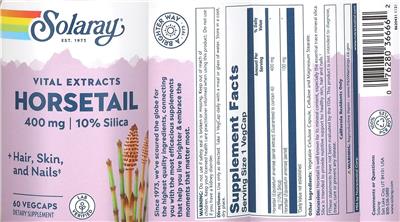
Supplement Facts
The label details for Horsetail 400 mg by Solaray, sourced from the NIH Dietary Supplement Label Database.
Supplement Facts
| Ingredient | Amount | % DV |
|---|---|---|
| Silica | 40 mg | -- |
| Horsetail | 100 mg | -- |
| Horsetail Aerial Parts Extract | 100 mg | -- |
Other ingredients: Cellulose, Magnesium Stearate
Tap any ingredient to jump to its full detail below.
These statements are the manufacturer’s wording, reproduced from the product label — the label is saying it, not HelloPharmacist. We don’t verify or endorse them.
Brand IP Statement(s)
Solaray Est. 1973 A Brighter Way 1973
Formula
10% Silica
Discussion: Horsetail is well known for its mineral content, especially the essential trace of mineral silica. Silica is intended to provide nutritive support for healthy skin, hair and nails.
Formulation
+ Hair, skin, and nails
Since 1973, we've scoured the globe for the highest quality ingredients, connecting you with the most efficacious supplements that help you live brighter & embrace the moments that matter most.
FDA Statement of Identity
Dietary Supplement
Seals/Symbols
Lab Verified
Precautions
Warning: Do not use if safety seal is broken or missing.
Keep out of reach of children.
Keep your licensed health care practitioner informed when using this product.
Do not use if you have a kidney disorder.
California Residents only Warning: Reproductive harm - www.P65Warnings.ca.gov
Suggested/Recommended/Usage/Directions
Directions: Use only as directed. Take 1 VegCap daily with a meal or glass of water.
Storage
Store in a cool, dry place.
FDA Disclaimer Statement
These statements have not been evaluated by the FDA. This product is not intended to diagnose, treat, cure or prevent any disease.
General Statements
100% PCR Bottles
Vital extracts
Is this label outdated? Report a formula or label change and our pharmacy team will review it.
Horsetail 400 mg by Solaray label
The label scan from the NIH Dietary Supplement Label Database. Tap to enlarge.
Label images are published by the NIH Dietary Supplement Label Database for the version of this product on file. Always read your actual product label.
View the full label (PDF)The Ingredients in Horsetail 400 mg by Solaray
These are the 2 active ingredients this product is made of. Select any to open its full monograph.
Serving size1 VegCap(s) Dosage formCapsule Servings per container60 Amounts shown are per serving.
Most supplement products combine several ingredients, and a medication can interact with the product through any one of them. Each ingredient below shows whether it has known drug interactions.
Horsetail
Interacts with188 drugs
Horsetail is a traditional herb most often used as a mild diuretic and for hair, nail, and bone support, but high-quality human evidence is limited. I...
Horsetail monograph & interactionsHorsetail Aerial Parts Extract
Interacts with188 drugs
Horsetail is a traditional herb most often used as a mild diuretic and for hair, nail, and bone support, but high-quality human evidence is limited. I...
Horsetail Aerial Parts Extract monograph & interactions- › Silica
Other (inactive) ingredients: Cellulose, Magnesium Stearate. These complete the product’s ingredient list but are not active constituents.
Horsetail 400 mg by Solaray Drug Interactions
HelloPharmacist Interaction Report
Solaray's Horsetail 400 mg contains horsetail, which has documented interactions with several medication types.
The most serious concern is with nucleoside reverse transcriptase inhibitors (NRTIs) and efavirenz — antiretroviral drugs for HIV. Case reports show patients taking horsetail supplements alongside these drugs developed detectable viral loads, suggesting horsetail may reduce how well these medications work.
The dose of your antiretroviral regimen might need adjustment if you're considering this product.
Read the full breakdown — every affected drug type, severity by severity
Horsetail also interacts with antidiabetes drugs (Moderate severity), where it might theoretically increase the risk of low blood sugar (hypoglycemia). It pairs with diuretic drugs (water pills) and lithium — horsetail's own diuretic properties may cause potassium loss when combined with potassium-depleting diuretics, or may increase lithium levels in your blood, raising the risk of side effects.
The other ingredient, silica (from horsetail), has no documented interactions in our data. Altogether, these interactions span 186 individual medications.
Use the medication checker on this page to look up your exact drugs before starting.
Check your own medications below · Editorial policy · How we use AI
Want to check YOUR meds against Horsetail 400 mg?
Ask about interactions with your drugs in plain English — “Can I take it with lisinopril?” — and we find you the answer in seconds, ingredient by ingredient.
Go to the checkerIngredients driving the most interactions
Individual Drug Interactions
The ingredients in Horsetail 400 mg interact with 188 drugs. Click any drug to see the details.
1 of the 2 ingredients in Horsetail 400 mg interact with drugs. Each result below shows which ingredient is responsible. Horsetail
Abacavir Sulfate, Dolutegravir, LamivudineTriumeq
How Abacavir Sulfate, Dolutegravir, Lamivudine interacts with Horsetail 400 mg — through 1 ingredient. Tap an ingredient for the detail:
Horsetail Aerial Parts ExtractNucleoside Reverse Transcriptase Inhibitors (nrtis) Moderate
Interaction Summary
Theoretically, horsetail might decrease the levels and clinical effects of NRTIs.
Read the full Horsetail Aerial Parts Extract + Abacavir Sulfate, Dolutegravir, Lamivudine interactionAbacavir, LamivudineEpzicom
How Abacavir, Lamivudine interacts with Horsetail 400 mg — through 1 ingredient. Tap an ingredient for the detail:
Horsetail Aerial Parts ExtractNucleoside Reverse Transcriptase Inhibitors (nrtis) Moderate
Interaction Summary
Theoretically, horsetail might decrease the levels and clinical effects of NRTIs.
Read the full Horsetail Aerial Parts Extract + Abacavir, Lamivudine interactionAcarboseGlucobay, Prandase, Precose
How Acarbose interacts with Horsetail 400 mg — through 1 ingredient. Tap an ingredient for the detail:
Horsetail Aerial Parts ExtractAntidiabetes Drugs Moderate
Interaction Summary
Theoretically, taking horsetail with antidiabetes drugs might increase the risk of hypoglycemia.
Read the full Horsetail Aerial Parts Extract + Acarbose interactionAcetaminophen, Caffeine, PyrilamineMidol Max Strength Menstrual
How Acetaminophen, Caffeine, Pyrilamine interacts with Horsetail 400 mg — through 1 ingredient. Tap an ingredient for the detail:
Horsetail Aerial Parts ExtractDiuretic Drugs Moderate
Interaction Summary
Theoretically, taking horsetail with diuretic drugs might increase potassium loss and the risk of hypokalemia.
Read the full Horsetail Aerial Parts Extract + Acetaminophen, Caffeine, Pyrilamine interactionAcetaminophen, Pamabrom, PyrilamineMidol Max Strength PMS, Pamprin, Pamprin ES
How Acetaminophen, Pamabrom, Pyrilamine interacts with Horsetail 400 mg — through 1 ingredient. Tap an ingredient for the detail:
Horsetail Aerial Parts ExtractDiuretic Drugs Moderate
Interaction Summary
Theoretically, taking horsetail with diuretic drugs might increase potassium loss and the risk of hypokalemia.
Read the full Horsetail Aerial Parts Extract + Acetaminophen, Pamabrom, Pyrilamine interactionAcetazolamideAk-Zol, Diamox
How Acetazolamide interacts with Horsetail 400 mg — through 1 ingredient. Tap an ingredient for the detail:
Horsetail Aerial Parts ExtractDiuretic Drugs Moderate
Interaction Summary
Theoretically, taking horsetail with diuretic drugs might increase potassium loss and the risk of hypokalemia.
Read the full Horsetail Aerial Parts Extract + Acetazolamide interactionAcetohexamideDymelor
How Acetohexamide interacts with Horsetail 400 mg — through 1 ingredient. Tap an ingredient for the detail:
Horsetail Aerial Parts ExtractAntidiabetes Drugs Moderate
Interaction Summary
Theoretically, taking horsetail with antidiabetes drugs might increase the risk of hypoglycemia.
Read the full Horsetail Aerial Parts Extract + Acetohexamide interactionAdefovirHepsera
How Adefovir interacts with Horsetail 400 mg — through 1 ingredient. Tap an ingredient for the detail:
Horsetail Aerial Parts ExtractNucleoside Reverse Transcriptase Inhibitors (nrtis) Moderate
Interaction Summary
Theoretically, horsetail might decrease the levels and clinical effects of NRTIs.
Read the full Horsetail Aerial Parts Extract + Adefovir interactionAlbiglutideTanzeum
How Albiglutide interacts with Horsetail 400 mg — through 1 ingredient. Tap an ingredient for the detail:
Horsetail Aerial Parts ExtractAntidiabetes Drugs Moderate
Interaction Summary
Theoretically, taking horsetail with antidiabetes drugs might increase the risk of hypoglycemia.
Read the full Horsetail Aerial Parts Extract + Albiglutide interactionAlogliptinNesina
How Alogliptin interacts with Horsetail 400 mg — through 1 ingredient. Tap an ingredient for the detail:
Horsetail Aerial Parts ExtractAntidiabetes Drugs Moderate
Interaction Summary
Theoretically, taking horsetail with antidiabetes drugs might increase the risk of hypoglycemia.
Read the full Horsetail Aerial Parts Extract + Alogliptin interactionAlogliptin, MetforminKazano
How Alogliptin, Metformin interacts with Horsetail 400 mg — through 1 ingredient. Tap an ingredient for the detail:
Horsetail Aerial Parts ExtractAntidiabetes Drugs Moderate
Interaction Summary
Theoretically, taking horsetail with antidiabetes drugs might increase the risk of hypoglycemia.
Read the full Horsetail Aerial Parts Extract + Alogliptin, Metformin interactionAlogliptin, PioglitazoneOseni
How Alogliptin, Pioglitazone interacts with Horsetail 400 mg — through 1 ingredient. Tap an ingredient for the detail:
Horsetail Aerial Parts ExtractAntidiabetes Drugs Moderate
Interaction Summary
Theoretically, taking horsetail with antidiabetes drugs might increase the risk of hypoglycemia.
Read the full Horsetail Aerial Parts Extract + Alogliptin, Pioglitazone interactionAmiloride, HydrochlorothiazideAmil-Co, Amilzide, Moduret 25, Moduretic
How Amiloride, Hydrochlorothiazide interacts with Horsetail 400 mg — through 1 ingredient. Tap an ingredient for the detail:
Horsetail Aerial Parts ExtractDiuretic Drugs Moderate
Interaction Summary
Theoretically, taking horsetail with diuretic drugs might increase potassium loss and the risk of hypokalemia.
Read the full Horsetail Aerial Parts Extract + Amiloride, Hydrochlorothiazide interactionAmmonium ChlorideAmmonium Chloride
How Ammonium Chloride interacts with Horsetail 400 mg — through 1 ingredient. Tap an ingredient for the detail:
Horsetail Aerial Parts ExtractDiuretic Drugs Moderate
Interaction Summary
Theoretically, taking horsetail with diuretic drugs might increase potassium loss and the risk of hypokalemia.
Read the full Horsetail Aerial Parts Extract + Ammonium Chloride interactionAntidiabetes, Dipeptidyl Peptidase-4 (dpp-iv) InhibitorGlyxambi
How Antidiabetes, Dipeptidyl Peptidase-4 (dpp-iv) Inhibitor interacts with Horsetail 400 mg — through 1 ingredient. Tap an ingredient for the detail:
Horsetail Aerial Parts ExtractAntidiabetes Drugs Moderate
Interaction Summary
Theoretically, taking horsetail with antidiabetes drugs might increase the risk of hypoglycemia.
Read the full Horsetail Aerial Parts Extract + Antidiabetes, Dipeptidyl Peptidase-4 (dpp-iv) Inhibitor interactionAtenolol, ChlortalidoneAtenixCo, Tenoret 50, Totaretic
How Atenolol, Chlortalidone interacts with Horsetail 400 mg — through 1 ingredient. Tap an ingredient for the detail:
Horsetail Aerial Parts ExtractDiuretic Drugs Moderate
Interaction Summary
Theoretically, taking horsetail with diuretic drugs might increase potassium loss and the risk of hypokalemia.
Read the full Horsetail Aerial Parts Extract + Atenolol, Chlortalidone interactionAtenolol, ChlorthalidoneTenoretic
How Atenolol, Chlorthalidone interacts with Horsetail 400 mg — through 1 ingredient. Tap an ingredient for the detail:
Horsetail Aerial Parts ExtractDiuretic Drugs Moderate
Interaction Summary
Theoretically, taking horsetail with diuretic drugs might increase potassium loss and the risk of hypokalemia.
Read the full Horsetail Aerial Parts Extract + Atenolol, Chlorthalidone interactionAzilsartan, ChlorthalidoneEdarbyclor
How Azilsartan, Chlorthalidone interacts with Horsetail 400 mg — through 1 ingredient. Tap an ingredient for the detail:
Horsetail Aerial Parts ExtractDiuretic Drugs Moderate
Interaction Summary
Theoretically, taking horsetail with diuretic drugs might increase potassium loss and the risk of hypokalemia.
Read the full Horsetail Aerial Parts Extract + Azilsartan, Chlorthalidone interactionBenazepril, HydrochlorothiazideLotensin HCT
How Benazepril, Hydrochlorothiazide interacts with Horsetail 400 mg — through 1 ingredient. Tap an ingredient for the detail:
Horsetail Aerial Parts ExtractDiuretic Drugs Moderate
Interaction Summary
Theoretically, taking horsetail with diuretic drugs might increase potassium loss and the risk of hypokalemia.
Read the full Horsetail Aerial Parts Extract + Benazepril, Hydrochlorothiazide interactionBendroflumethiazideAprinox, Naturetin, Neo-NaClex
How Bendroflumethiazide interacts with Horsetail 400 mg — through 1 ingredient. Tap an ingredient for the detail:
Horsetail Aerial Parts ExtractDiuretic Drugs Moderate
Interaction Summary
Theoretically, taking horsetail with diuretic drugs might increase potassium loss and the risk of hypokalemia.
Read the full Horsetail Aerial Parts Extract + Bendroflumethiazide interactionBendroflumethiazide, NadololCorzide
How Bendroflumethiazide, Nadolol interacts with Horsetail 400 mg — through 1 ingredient. Tap an ingredient for the detail:
Horsetail Aerial Parts ExtractDiuretic Drugs Moderate
Interaction Summary
Theoretically, taking horsetail with diuretic drugs might increase potassium loss and the risk of hypokalemia.
Read the full Horsetail Aerial Parts Extract + Bendroflumethiazide, Nadolol interactionBendroflumethiazide, PotassiumCentyl K, Neo-NaClex-K
How Bendroflumethiazide, Potassium interacts with Horsetail 400 mg — through 1 ingredient. Tap an ingredient for the detail:
Horsetail Aerial Parts ExtractDiuretic Drugs Moderate
Interaction Summary
Theoretically, taking horsetail with diuretic drugs might increase potassium loss and the risk of hypokalemia.
Read the full Horsetail Aerial Parts Extract + Bendroflumethiazide, Potassium interactionBendroflumethiazide, Rauwolfia SerpentinaRauzide
How Bendroflumethiazide, Rauwolfia Serpentina interacts with Horsetail 400 mg — through 1 ingredient. Tap an ingredient for the detail:
Horsetail Aerial Parts ExtractDiuretic Drugs Moderate
Interaction Summary
Theoretically, taking horsetail with diuretic drugs might increase potassium loss and the risk of hypokalemia.
Read the full Horsetail Aerial Parts Extract + Bendroflumethiazide, Rauwolfia Serpentina interactionBenzthiazideExna
How Benzthiazide interacts with Horsetail 400 mg — through 1 ingredient. Tap an ingredient for the detail:
Horsetail Aerial Parts ExtractDiuretic Drugs Moderate
Interaction Summary
Theoretically, taking horsetail with diuretic drugs might increase potassium loss and the risk of hypokalemia.
Read the full Horsetail Aerial Parts Extract + Benzthiazide interactionBisoprolol, HydrochlorothiazideZiac
How Bisoprolol, Hydrochlorothiazide interacts with Horsetail 400 mg — through 1 ingredient. Tap an ingredient for the detail:
Horsetail Aerial Parts ExtractDiuretic Drugs Moderate
Interaction Summary
Theoretically, taking horsetail with diuretic drugs might increase potassium loss and the risk of hypokalemia.
Read the full Horsetail Aerial Parts Extract + Bisoprolol, Hydrochlorothiazide interactionBumetanideBurinex
How Bumetanide interacts with Horsetail 400 mg — through 1 ingredient. Tap an ingredient for the detail:
Horsetail Aerial Parts ExtractDiuretic Drugs Moderate
Interaction Summary
Theoretically, taking horsetail with diuretic drugs might increase potassium loss and the risk of hypokalemia.
Read the full Horsetail Aerial Parts Extract + Bumetanide interactionBumetanide, PotassiumBurinex K
How Bumetanide, Potassium interacts with Horsetail 400 mg — through 1 ingredient. Tap an ingredient for the detail:
Horsetail Aerial Parts ExtractDiuretic Drugs Moderate
Interaction Summary
Theoretically, taking horsetail with diuretic drugs might increase potassium loss and the risk of hypokalemia.
Read the full Horsetail Aerial Parts Extract + Bumetanide, Potassium interactionCaffeine, Potassium Salicylate, SalicylamideTrim-Elim
How Caffeine, Potassium Salicylate, Salicylamide interacts with Horsetail 400 mg — through 1 ingredient. Tap an ingredient for the detail:
Horsetail Aerial Parts ExtractDiuretic Drugs Moderate
Interaction Summary
Theoretically, taking horsetail with diuretic drugs might increase potassium loss and the risk of hypokalemia.
Read the full Horsetail Aerial Parts Extract + Caffeine, Potassium Salicylate, Salicylamide interactionCanagliflozinInvokana
How Canagliflozin interacts with Horsetail 400 mg — through 1 ingredient. Tap an ingredient for the detail:
Horsetail Aerial Parts ExtractAntidiabetes Drugs Moderate
Interaction Summary
Theoretically, taking horsetail with antidiabetes drugs might increase the risk of hypoglycemia.
Read the full Horsetail Aerial Parts Extract + Canagliflozin interactionCanagliflozin, MetforminInvokamet
How Canagliflozin, Metformin interacts with Horsetail 400 mg — through 1 ingredient. Tap an ingredient for the detail:
Horsetail Aerial Parts ExtractAntidiabetes Drugs Moderate
Interaction Summary
Theoretically, taking horsetail with antidiabetes drugs might increase the risk of hypoglycemia.
Read the full Horsetail Aerial Parts Extract + Canagliflozin, Metformin interactionEach ingredient & the kinds of drugs it affects
For each ingredient in Horsetail 400 mg with known interactions, here are the types of medications it can affect. Open any type for the detail — or search your exact drug in the checker above.
Horsetail
Antidiabetes Drugs
Theoretically, taking horsetail with antidiabetes drugs might increase the risk of hypoglycemia.
Equisetum myriochaetum has demonstrated hypoglycemic activity in clinical research. In an animal diabetic model, Equisetum giganteum had hypoglycemic effects. It is unclear whether other horsetail species have hypoglycemic effects.
Diuretic Drugs
Theoretically, taking horsetail with diuretic drugs might increase potassium loss and the risk of hypokalemia.
Laboratory research shows that various species of horsetail have diuretic properties. Due to its diuretic effects, there has been concern that taking horsetail along with potassium-depleting diuretics might increase the risk for hypokalemia. However, pharmacokinetic research in humans shows that taking horsetail 900 mg daily for 4 days does not affect urinary excretion of electrolytes, including potassium and sodium, despite having a diuretic effect similar to taking hydrochlorothiazide 25 mg daily. It is unclear if taking horsetail for a longer duration would affect electrolyte levels. Until more is known, use with caution.
Efavirenz (Sustiva)
Theoretically, horsetail might decrease the levels and clinical effects of efavirenz.
In two case reports, patients were found to have detectable viral loads when taking horsetail-containing supplements along with an antiretroviral regimen that included efavirenz. In one case, the antiretroviral regimen included zidovudine, lamivudine, and efavirenz; in the other case, the regimen consisted of emtricitabine, tenofovir disoproxil fumarate, and efavirenz. One month after discontinuing horsetail, the viral loads became undetectable in both cases. The exact mechanism of this interaction is unknown. It is also unclear if this interaction is specific to efavirenz or if it is related to various components of antiretroviral therapy.
Lithium
Theoretically, horsetail might increase the levels and adverse effects of lithium.
Animal research suggests that horsetail has diuretic properties. Theoretically, due to these potential diuretic effects, horsetail might reduce excretion and increase levels of lithium. The dose of lithium might need to be decreased.
Nucleoside Reverse Transcriptase Inhibitors (Nrtis)
Theoretically, horsetail might decrease the levels and clinical effects of NRTIs.
In two case reports, patients were found to have detectable viral loads when taking horsetail-containing supplements along with an antiretroviral therapy. In one case, the antiretroviral regimen included zidovudine, lamivudine, and efavirenz; in the other case, the regimen consisted of emtricitabine, tenofovir disoproxil fumarate, and efavirenz. One month after discontinuing the supplement, the viral loads became undetectable in both cases. The exact mechanism of these interactions is unknown. It is also unclear if these interactions are specific to NRTIs or if they are related to various components of antiretroviral therapy.
Brand information
Manufacturer and brand details for Horsetail 400 mg, from the product label.
Horsetail 400 mg by Solaray: Common Questions
Does Horsetail 400 mg by Solaray interact with any medications?
How can one product interact with so many drugs?
Where does this information come from?
Will horsetail help my hair loss?
What are the most common side effects?
Is it safe to take long-term?
Can I take this if I'm pregnant or breastfeeding?
Does this product contain thiaminase?
Written and reviewed by the HelloPharmacist editorial staff. Our editorial policy
Not sure if Horsetail 400 mg is safe with your meds?
Our pharmacists answer your medication & supplement questions — free.
Label information is sourced from the NIH Dietary Supplement Label Database and reflects the product version on file; always read your actual product label. This page is for education only and is not a substitute for professional medical advice. Confirm with your pharmacist or doctor before combining supplements and medications.
The Full Monographs Behind Horsetail 400 mg’s Ingredients
Every ingredient we hold a full HelloPharmacist monograph for — uses, evidence, safety, and the complete interaction list.
Horsetail
Interacts with 188 drugsHorsetail is a traditional herb most often used as a mild diuretic and for hair, nail, and bone support, but high-quality human evidence is limited. It can cause thiamine (vitamin B1) loss w...
Read the full Horsetail monograph → Herb & supplement monographSilicon
Silicon is a trace mineral found in the body and in foods like oats, barley, and certain fruits and vegetables, and it is popular in supplements for hair, skin, nail, and bone health. Some s...
Read the full Silicon monograph →Sources & How We Checked
Horsetail 400 mg's label data comes from the NIH Dietary Supplement Label Database; the ingredient interaction data is from the Natural Medicines database, reviewed by our pharmacists.
- NIH Dietary Supplement Label Database (DSLD) — The official product label on file for this supplement.
- Natural Medicines (Therapeutic Research Center) — Evidence-graded clinical reference behind the ingredient interaction data.
Content is written and reviewed by licensed HelloPharmacist pharmacists. See our data sources and editorial standards for how this information is built and checked.
The 33 references behind this product’s interaction data
Every citation that drives the interaction findings for this product’s ingredients, from the evidence-graded Natural Medicines (TRC Healthcare) database. Open an ingredient to browse its citations — links open the study on PubMed or the publisher’s site.
Silicon 19 references
- Food and Nutrition Board, Institute of Medicine. Dietary Reference Intakes for Vitamin A, Vitamin K, Arsenic, Boron, Chromium, Copper, Iodine, Iron, Manganese, Molybdenum, Nickel, Silicon, Vanadium, and Zinc. Washington, DC: National Academy Press, 2002.
- Jugdaohsingh R, Anderson SH, Tucker KL, et al. Dietary silicon intake and absorption. Am J Clin Nutr 2002;75:887-93. PubMed
- Ichiyanagi O, Sasagawa I, Adachi Y, et al. Silica urolithiasis without magnesium trisilicate intake. Urol Int 1998;61:39-42. PubMed
- Levison DA, Crocker PR, Banim S, Wallace DM. Silica stones in the urinary bladder. Lancet 1982;1:704-5. PubMed
- Lee MH, Lee YH, Hsu TH, et al. Silica stone--development due to long time oral trisilicate intake. Scand J Urol Nephrol 1993;27:267-9. PubMed
- Cruz Guerra, N. A., Gomez Garcia, M. A., Lovaco, Castellano F., Saez Garrido, J. C., Garcia, Cuerpo E., and Escudero, Barrilero A. [Silica urolithiasis: report of a new case]. Actas Urol.Esp 2000;24(2):202-204.
- Merget, R., Bauer, T., Kupper, H. U., Philippou, S., Bauer, H. D., Breitstadt, R., and Bruening, T. Health hazards due to the inhalation of amorphous silica. Arch Toxicol. 2002;75(11-12):625-634. PubMed
- Khuder, S. A., Peshimam, A. Z., and Agraharam, S. Environmental risk factors for rheumatoid arthritis. Rev Environ Health 2002;17(4):307-315. PubMed
- McLaughlin, J. K., Chow, W. H., and Levy, L. S. Amorphous silica: a review of health effects from inhalation exposure with particular reference to cancer. J Toxicol.Environ Health 4-25-1997;50(6):553-566. DOI
- Pelucchi, C., Pira, E., Piolatto, G., Coggiola, M., Carta, P., and La, Vecchia C. Occupational silica exposure and lung cancer risk: a review of epidemiological studies 1996-2005. Ann.Oncol. 2006;17(7):1039-1050. PubMed
- Gillissen, A., Gessner, C., Hammerschmidt, S., Hoheisel, G., and Wirtz, H. [Health significance of inhaled particles]. Dtsch.Med Wochenschr. 3-24-2006;131(12):639-644.
- Hu, J. F., Qu, H., and Wang, J. Z. [Meta analysis for relationship between exposure of free silicon dioxide and lung tumor]. Zhonghua Lao.Dong.Wei Sheng Zhi.Ye.Bing.Za Zhi. 2006;24(7):415-417.
- Jugdaohsingh, R. Silicon and bone health. J Nutr Health Aging 2007;11(2):99-110.
- Lacasse, Y., Martin, S., Gagne, D., and Lakhal, L. Dose-response meta-analysis of silica and lung cancer. Cancer Causes Control 2009;20(6):925-933. PubMed
- McCormic, Z. D., Khuder, S. S., Aryal, B. K., Ames, A. L., and Khuder, S. A. Occupational silica exposure as a risk factor for scleroderma: a meta-analysis. Int Arch Occup.Environ Health 2010;83(7):763-769. PubMed
- Haddad, F. S. and Kouyoumdjian, A. Silica stones in humans. Urol.Int 1986;41(1):70-76. PubMed
- Tervaert, J. W., Stegeman, C. A., and Kallenberg, C. G. Silicon exposure and vasculitis. Curr Opin.Rheumatol 1998;10(1):12-17. PubMed
- Steenland, K. and Stayner, L. Silica, asbestos, man-made mineral fibers, and cancer. Cancer Causes Control 1997;8(3):491-503. PubMed
- Boqué N, Valls RM, Pedret A, Puiggrós F, Arola L, Solà R. Relative absorption of silicon from different formulations of dietary supplements: a pilot randomized, double-blind, crossover post-prandial study. Sci Rep 2021;11(1):16479. PubMed
Horsetail 14 references
- Sudan BJ. Seborrhoeic dermatitis induced by nicotine of horsetails (Equisetum arvense L.). Contact Dermatitis 1985;13:201-2.
- Perez Gutierrez RM, Laguna GY, Walkowski A. Diuretic activity of Mexican equisetum. J Ethnopharmacol 1985;14:269-72. PubMed
- Lemus I, Garcia R, Erazo S, et al. Diuretic activity of an Equisetum bogotense tea (Platero herb): evaluation in healthy volunteers. J Ethnopharmacol 1996;54:55-8. PubMed
- Revilla MC, Andrade-Cetto A, Islas S, Wiedenfeld H. Hypoglycemic effect of Equisetum myriochaetum aerial parts on type 2 diabetic patients. J Ethnopharmacol 2002;81:117-20. PubMed
- Tiktinskii, O. L. and Bablumian, I. A. [Therapeutic action of Java tea and field horsetail in uric acid diathesis]. Urol.Nefrol.(Mosk) 1983;3(1):47-50.
- Henderson JA, Evans EV, and McIntosh RA. The antithiamine action of Equisetum. J Amer Vet Med Assoc 1952;120:375-378.
- Carneiro DM, Freire RC, Honório TC, Zoghaib I, Cardoso FF, Tresvenzol LM, de Paula JR, Sousa AL, Jardim PC, da Cunha LC. Randomized, Double-Blind Clinical Trial to Assess the Acute Diuretic Effect of Equisetum arvense (Field Horsetail) in Healthy Voluntee
- Klnçalp S, Ekiz F, Basar Ö, Coban S, Yüksel O. Equisetum arvense (Field Horsetail)-induced liver injury. Eur J Gastroenterol Hepatol. 2012 Feb;24(2):213-4. PubMed
- Ortega García JA, Angulo MG, Sobrino-Najul EJ, Soldin OP, Mira AP, Martínez-Salcedo E, Claudio L. Prenatal exposure of a girl with autism spectrum disorder to 'horsetail' (Equisetum arvense) herbal remedy and alcohol: a case report. J Med Case Rep. 2011 M PubMed
- Cordova E, Morganti L, Rodriguez C. Possible Drug-Herb Interaction between Herbal Supplement Containing Horsetail (Equisetum arvense) and Antiretroviral Drugs. J Int Assoc Provid AIDS Care. 2017;16(1):11-13.
- García Gavilán MD, Moreno García AM, Rosales Zabal JM, Navarro Jarabo JM, Sánchez Cantos A. Case of drug-induced acute pancreatitis produced by horsetail infusions. Rev Esp Enferm Dig. 2017 Apr;109(4):301-304. PubMed
- Vieira GT, de Oliveira TT, Carneiro MAA, et al. Antidiabetic effect of Equisetum giganteum L. extract on alloxan-diabetic rabbit. J Ethnopharmacol. 2020;260:112898. PubMed
- Health Canada. Organism-Equisetum arvense. Available at: http://webprod.hc-sc.gc.ca/nhpid-bdipsn/ingredReq.do?id=6117&lang=eng. Accessed 21-July 2021.
- Bates D, Duong TB, Kheyson S, Moore K. Hyponatremia Secondary to Decreased Oral Intake and SIADH and Possibly Exacerbated by Horsetail (Equisetum arvense). Can J Hosp Pharm 2021;74(4):386-389. PubMed
Parts of this content are provided by the Therapeutic Research Center, LLC.
DISCLAIMER: Currently this does not check for drug-drug interactions. This is not an all-inclusive comprehensive list of potential interactions and is for informational purposes only. Not all interactions are known or well-reported in the scientific literature, and new interactions are continually being reported. Input is needed from a qualified healthcare provider including a pharmacist before starting any therapy. Application of clinical judgment is necessary.
© 2021 Therapeutic Research Center, LLC