
Immune Respiratory Ingredients & Drug Interactions
What is this page for?
First and foremost: checking Immune Respiratory against your medications. The heart of this page is the interaction checker and the full interaction report — how this product’s ingredients may interact with prescription and over-the-counter medicines you may be taking.
Around that, we add a pharmacist’s high-level view of the product as a whole — what’s inside, the evidence for its stated use, how transparent the label is, and what safety data exists — so you can see the full picture in one place. It’s educational information from our licensed clinical databases and the clinical staff at HelloPharmacist — not medical advice — and we don’t sell or endorse products. Our editorial policy
Immune Respiratory is a dietary supplement by Vimerson Health with 7 active ingredients. Its ingredients are commonly taken for cough and chest congestion, sore throat, bronchitis and respiratory irritation.Based on those ingredients, 1,388 medications have a known interaction with it, the most serious rated moderate. The ingredients most likely to interact are Quercetin, Eucalyptus, Thyme leaf extract. Use the checker below to test your specific medication, or read the full HelloPharmacist Interaction Report.
Check Your Meds Against Immune Respiratory by Vimerson Health
Ask about any prescription or over-the-counter medication and we check it for interactions with Immune Respiratory by Vimerson Health — and tell you which ingredient is responsible.
AI summaries are generated from our interaction database for education only — always confirm with your pharmacist. How we use AI
Ask the Pharmacist
A licensed pharmacist will answer your question by email — free, usually within 24 hours.
Got it — thank you!
A licensed pharmacist will answer within 24 hours. Keep an eye on your email (worth checking spam, just in case).
HelloPharmacist Scorecard of Immune Respiratory by Vimerson Health
Our pharmacy team’s full take, with four database checks built into the cards below — a summary of what is known, not a grade of the product itself.
What’s inside
Full disclosure
This product has seven active ingredients. Mullein Leaf Extract and English Ivy Leaf Extract are herbal extracts traditionally used for respiratory support.
Quercetin is a plant compound (flavonoid) with antioxidant properties. Bromelain is an enzyme from pineapple that may help break down proteins.
Eucalyptus, Oregano Extract, and Thyme Leaf Extract are all herbal ingredients commonly used in respiratory and wellness formulas. The product also contains inactive ingredients—Hypromellose and Rice Extract Blend—which are fillers and binders that hold the capsule together.
Does it work?
Not established
The evidence for most of these ingredients is insufficient. For Mullein Leaf Extract, English Ivy Leaf Extract, Bromelain, Eucalyptus, Oregano Extract, and Thyme Leaf Extract, we don't have reliable data showing they work for bronchitis, respiratory tract infections, cough, or other respiratory conditions.
Quercetin has been rated Possibly Ineffective for athletic performance, and the rest of its claimed uses lack established evidence. This doesn't mean the ingredients won't help—it means the clinical studies aren't there yet to confirm it.
How safe is it?
Well-documented data
Most of these ingredients are generally well tolerated in the short term, but long-term safety isn't well studied. Mullein Leaf Extract can rarely cause a skin rash (dermatitis) from contact with the plant.
English Ivy Leaf Extract may cause stomach upset, diarrhea, nausea, vomiting, or skin irritation when taken by mouth. Bromelain can cause diarrhea, gas, and headache; it may also trigger allergic reactions in people sensitive to pineapple or airborne bromelain dust.
Eucalyptus is generally safe in diluted form, but the undiluted oil is toxic if swallowed—at very high doses it can cause serious effects like seizures, coma, and even death. Oregano and Thyme are safe as foods but less studied in concentrated supplement form.
During pregnancy, Mullein, English Ivy, Bromelain, and Eucalyptus are best avoided because safety data are lacking. Oregano is rated Possibly Unsafe in pregnancy.
Thyme is Likely Safe in pregnancy. For breastfeeding, safety data are limited or unknown for all ingredients except Eucalyptus and Thyme, which are Likely Safe.
Meds to double-check
Moderate interaction found
Before taking this product, double-check with your pharmacist if you take any blood thinners or antiplatelet drugs (warfarin, aspirin, clopidogrel) or any blood pressure, diabetes, or statin medications. Also flag any antibiotics (tetracyclines, quinolones), immune-suppressing drugs (cyclosporine), or drugs for inflammatory bowel disease (sulfasalazine).
The ingredient English Ivy, Eucalyptus, and Thyme can raise levels of many medications processed by your liver's P450 system—ask your pharmacist to run a check on your exact prescriptions.
The bottom line
Scorecard at a glanceFully disclosed formula with no established evidence rating for its marketed use. Moderate medication interactions have been identified, and safety information is well characterized.
This product may appeal to you if you're looking for herbal respiratory support and you don't take medications that interact with these ingredients. However, if you take blood thinners, diabetes drugs, or any medication that your liver processes through P450 enzymes, you need to check with your pharmacist first—the risks can be serious.
Talk to your pharmacist before you start, especially if you're pregnant, breastfeeding, or taking any prescription or over-the-counter medication.
Educational only — not medical advice; always confirm with your pharmacist. Our editorial policy · How we use AI
Assessment coverage: 7 of 7 active ingredients matched to our full ingredient reviews (monographs). Based on the product label dated Oct 24, 2024.
This Scorecard evaluates available label information, ingredient evidence, and known medication-safety considerations. It does not independently verify product identity, purity, potency, contamination, or manufacturing quality. How these ratings are computed
General information
Key facts about Immune Respiratory, straight from the product label.
| Brand | Vimerson Health |
|---|---|
| Barcode (UPC) | X002VZEKOP |
| Net contents | 60 Vegan Capsule(s) |
| Market status | On market |
| Date entered into DSLD | Oct 24, 2024 |
| DSLD ID | 315514 |
| Product type | Other Combinations |
| Supplement form | Capsule |
| Dietary claims / uses | All Other, Structure/Function |
| Intended target group(s) | Vegan, Vegetarian, Adult (18 - 50 Years), Gluten Free, Dairy Free |
Everything in this section is reproduced from the manufacturer’s own product label — it’s the label speaking, not HelloPharmacist. We show it so you can see exactly what the maker states; we don’t verify or endorse those statements.
Supplement Facts
The label details for Immune Respiratory by Vimerson Health, sourced from the NIH Dietary Supplement Label Database.
Supplement Facts
| Ingredient | Amount | % DV |
|---|---|---|
| Mullein leaf extract | 200 mg | -- |
| English Ivy Leaf Extract | 100 mg | -- |
| Quercetin | 100 mg | -- |
| Bromelain | 25 mg | -- |
| Eucalyptus | 200 mg | -- |
| Oregano extract | 250 mg | -- |
| Thyme leaf extract | 250 mg | -- |
Other ingredients: Hypromellose, Rice extract Blend
Tap any ingredient to jump to its full detail below.
These statements are the manufacturer’s wording, reproduced from the product label — the label is saying it, not HelloPharmacist. We don’t verify or endorse them.
Suggested/Recommended/Usage/Directions
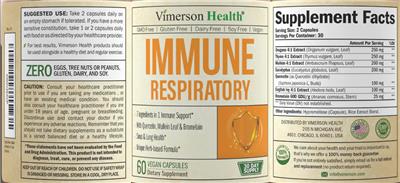
Suggested use: Take 2 capsules daily on an empty stomach if tolerated. If you have a more sensitive constitution, take 1 or 2 capsules daily with food or as directed by your healthcare provider. For best results, Vimerson Health products should be used alongside a healthy diet and regular exercise.
Formulation
Zero eggs, tree nuts or peanuts, gluten, dairy, and soy.
GMO free Gluten free Dairy free Soy free
Vegan
7 ingredients in 1 immune support Sinus & lung health Unique herb-based formula
Precautions
Caution: Consult your healthcare practitioner prior to use if you are taking any medications, or have an existing medical condition. You should also consult your healthcare practitioner if you are under 18 years of age, pregnant or breastfeeding.
Caution: Consult your healthcare practitioner prior to use if you are taking any medications, or have an existing medical condition. You should also consult your healthcare practitioner if you are under 18 years of age, pregnant or breastfeeding.
Discontinue use and contact your doctor if you experience any adverse reactions. Remember that you should not take dietary supplements as a substitute to a varied balanced diet or a healthy lifestyle.
Keep out of reach of children.
Do not use if safety wrap is damaged or missing.
FDA Disclaimer Statement
These statements have not been evaluated by the Food and Drug Administration. This product is not intended to diagnose, treat, cure or prevent any disease.
Storage
Store in a cool, dry place.
Formula
Immune Respiratory with Quercetin, Mullein Leaf & Bromelain
FDA Statement of Identity
Dietary Supplement
Seals/Symbols
GMP Certified Good Manufacturing Practice Made in the USA with Global Ingredients
General Statements
100% happiness guarantee We care about your health and your trust is important to us, that's why we offer a 100% money-back guarantee. If you're not entirely satisfied, simply email us for a full refund and replacement (no product return required).
30 day supply
Is this label outdated? Report a formula or label change and our pharmacy team will review it.
Immune Respiratory by Vimerson Health label
The label scan from the NIH Dietary Supplement Label Database. Tap to enlarge.
Label images are published by the NIH Dietary Supplement Label Database for the version of this product on file. Always read your actual product label.
View the full label (PDF)The Ingredients in Immune Respiratory by Vimerson Health
These are the 7 active ingredients this product is made of. Select any to open its full monograph.
Serving size1 Capsule(s) Dosage formCapsule Servings per container30 Amounts shown are per serving.
Most supplement products combine several ingredients, and a medication can interact with the product through any one of them. Each ingredient below shows whether it has known drug interactions.
Mullein leaf extract
Interacts with122 drugs
Mullein is a traditional herbal remedy most often used as a tea or syrup to soothe coughs, sore throats, and respiratory irritation. High-quality huma...
Mullein leaf extract monograph & interactionsEnglish Ivy Leaf Extract
Interacts with281 drugs
English ivy leaf extract is most commonly used in cough and cold syrups to help loosen mucus and ease coughing, and it is a popular ingredient in many...
English Ivy Leaf Extract monograph & interactionsQuercetin
Interacts with1,170 drugs
Quercetin is a plant flavonoid with antioxidant and anti-inflammatory properties found in many common foods and sold as a supplement. While early rese...
Quercetin monograph & interactionsBromelain
Interacts with141 drugs
Bromelain is a group of protein-digesting enzymes from pineapple that people take mainly for inflammation, swelling, and sinus problems. Some early st...
Bromelain monograph & interactionsEucalyptus
Interacts with880 drugs
Eucalyptus is best known for its strong-smelling oil used in vapor rubs, inhalants, and lozenges to ease coughs and congestion. It may provide mild, s...
Eucalyptus monograph & interactionsOregano extract
Interacts with208 drugs
Oregano is a common Mediterranean cooking herb that is also sold as a concentrated oil or supplement, often standardized for a compound called carvacr...
Oregano extract monograph & interactionsThyme leaf extract
Interacts with379 drugs
Thyme is a common kitchen herb that has long been used for coughs, sore throats, and digestive complaints. It is generally safe in the amounts found i...
Thyme leaf extract monograph & interactionsOther (inactive) ingredients: Hypromellose, Rice extract Blend. These complete the product’s ingredient list but are not active constituents.
Immune Respiratory by Vimerson Health Drug Interactions
HelloPharmacist Interaction Report
Immune Respiratory by Vimerson Health contains seven active ingredients, and several of them interact with medications.
The most serious concern is Quercetin, which has Moderate-severity interactions with blood thinners like warfarin—it may increase your bleeding risk by raising warfarin levels in your bloodstream.
Read the full breakdown — every affected drug type, severity by severity
English Ivy Leaf Extract, Eucalyptus, and Thyme Leaf Extract each interact with drugs your liver processes through a set of enzymes called cytochrome P450 systems (CYP2C19, CYP2D6, CYP2C8, CYP1A2, CYP2C9, and CYP3A4). When you take these ingredients, they can slow down how your body clears certain medications, potentially raising drug levels and side effects.
Quercetin adds more of this enzyme-blocking activity and also interacts specifically with losartan (a blood pressure drug), statins like pravastatin, the antibiotic quinolones, cyclosporine (an immune suppressant), sulfasalazine (for inflammatory bowel disease), and mitoxantrone (a cancer drug)—all Moderate severity.
Bromelain and Oregano Extract both carry Moderate-severity interactions with blood thinners and antiplatelet drugs, raising bleeding risk. Bromelain also has a Minor interaction with tetracycline antibiotics.
Mullein Leaf Extract has a Minor interaction with blood thinners. Altogether, these interactions span 1,367 individual medications.
Before you start this product, use the medication checker below to verify your exact prescriptions.
Check your own medications below · Editorial policy · How we use AI
Want to check YOUR meds against Immune Respiratory?
Ask about interactions with your drugs in plain English — “Can I take it with lisinopril?” — and we find you the answer in seconds, ingredient by ingredient.
Go to the checkerIngredients driving the most interactions
Individual Drug Interactions
The ingredients in Immune Respiratory interact with 1,388 drugs. Click any drug to see the details.
7 of the 7 ingredients in Immune Respiratory interact with drugs. Each result below shows which ingredient is responsible. Quercetin Eucalyptus Thyme leaf extract English Ivy Leaf Extract Oregano extract Bromelain Mullein leaf extract
Ado-trastuzumab EmtansineKadcyla
How Ado-trastuzumab Emtansine interacts with Immune Respiratory — through 2 ingredients. Tap an ingredient for the detail:
QuercetinCytochrome P450 3a4 (cyp3a4) Substrates Moderate
Interaction Summary
Theoretically, concomitant use might alter the effects and adverse effects of CYP3A4 substrates.
Read the full Quercetin + Ado-trastuzumab Emtansine interactionEucalyptusCytochrome P450 3a4 (cyp3a4) Substrates Moderate
Interaction Summary
Theoretically, eucalyptus might increase the levels of CYP3A4 substrates.
Read the full Eucalyptus + Ado-trastuzumab Emtansine interactionAbciximabReoPro
How Abciximab interacts with Immune Respiratory — through 4 ingredients. Tap an ingredient for the detail:
BromelainAnticoagulant/antiplatelet Drugs Moderate
Interaction Summary
Bromelain may have antiplatelet effects and may increase the risk of bleeding if used with anticoagulant or antiplatelet drugs.
Read the full Bromelain + Abciximab interactionThyme Leaf ExtractAnticoagulant/antiplatelet Drugs Moderate
Interaction Summary
Theoretically, thyme leaf extract might have additive effects with anticoagulant or antiplatelet drugs.
Read the full Thyme Leaf Extract + Abciximab interactionOregano ExtractAnticoagulant/antiplatelet Drugs Moderate
Interaction Summary
Theoretically, oregano might increase the risk of bleeding when taken with anticoagulant or antiplatelet drugs.
Read the full Oregano Extract + Abciximab interactionMullein Leaf ExtractAnticoagulant/antiplatelet Drugs Minor
Interaction Summary
Lab tests on extracts from different parts of common and dense-flowered mullein plants show that they do have some blood-thinning effects, as they increase the time it takes for blood to clot.
Read the full Mullein Leaf Extract + Abciximab interactionAbemaciclibVerzenio
How Abemaciclib interacts with Immune Respiratory — through 2 ingredients. Tap an ingredient for the detail:
QuercetinCytochrome P450 3a4 (cyp3a4) Substrates Moderate
Interaction Summary
Theoretically, concomitant use might alter the effects and adverse effects of CYP3A4 substrates.
Read the full Quercetin + Abemaciclib interactionEucalyptusCytochrome P450 3a4 (cyp3a4) Substrates Moderate
Interaction Summary
Theoretically, eucalyptus might increase the levels of CYP3A4 substrates.
Read the full Eucalyptus + Abemaciclib interactionAbiraterone
How Abiraterone interacts with Immune Respiratory — through 2 ingredients. Tap an ingredient for the detail:
EucalyptusCytochrome P450 3a4 (cyp3a4) Substrates Moderate
Interaction Summary
Theoretically, eucalyptus might increase the levels of CYP3A4 substrates.
Read the full Eucalyptus + Abiraterone interactionQuercetinCytochrome P450 3a4 (cyp3a4) Substrates Moderate
Interaction Summary
Theoretically, concomitant use might alter the effects and adverse effects of CYP3A4 substrates.
Read the full Quercetin + Abiraterone interactionAbiraterone AcetateYonsa, Zytiga
How Abiraterone Acetate interacts with Immune Respiratory — through 2 ingredients. Tap an ingredient for the detail:
EucalyptusCytochrome P450 3a4 (cyp3a4) Substrates Moderate
Interaction Summary
Theoretically, eucalyptus might increase the levels of CYP3A4 substrates.
Read the full Eucalyptus + Abiraterone Acetate interactionQuercetinCytochrome P450 3a4 (cyp3a4) Substrates Moderate
Interaction Summary
Theoretically, concomitant use might alter the effects and adverse effects of CYP3A4 substrates.
Read the full Quercetin + Abiraterone Acetate interactionAbrocitinibCibinqo
How Abrocitinib interacts with Immune Respiratory — through 7 ingredients. Tap an ingredient for the detail:
QuercetinCytochrome P450 2c9 (cyp2c9) Substrates Moderate
Interaction Summary
Theoretically, concomitant use might increase the levels and adverse effects of CYP2C9 substrates.
Read the full Quercetin + Abrocitinib interactionOregano ExtractAnticoagulant/antiplatelet Drugs Moderate
Interaction Summary
Theoretically, oregano might increase the risk of bleeding when taken with anticoagulant or antiplatelet drugs.
Read the full Oregano Extract + Abrocitinib interactionEnglish Ivy Leaf ExtractCytochrome P450 2c19 (cyp2c19) Substrates Moderate
Interaction Summary
Theoretically, English ivy might increase the levels of drugs metabolized by CYP2C19.
Read the full English Ivy Leaf Extract + Abrocitinib interactionEucalyptusCytochrome P450 2c19 (cyp2c19) Substrates, Cytochrome P450 2c9 (cyp2c9) Substrates Moderate
Interaction Summary
Theoretically, eucalyptus might increase the levels of CYP2C19 substrates.
Read the full Eucalyptus + Abrocitinib interactionBromelainAnticoagulant/antiplatelet Drugs Moderate
Interaction Summary
Bromelain may have antiplatelet effects and may increase the risk of bleeding if used with anticoagulant or antiplatelet drugs.
Read the full Bromelain + Abrocitinib interactionThyme Leaf ExtractAnticoagulant/antiplatelet Drugs Moderate
Interaction Summary
Theoretically, thyme leaf extract might have additive effects with anticoagulant or antiplatelet drugs.
Read the full Thyme Leaf Extract + Abrocitinib interactionMullein Leaf ExtractAnticoagulant/antiplatelet Drugs Minor
Interaction Summary
Lab tests on extracts from different parts of common and dense-flowered mullein plants show that they do have some blood-thinning effects, as they increase the time it takes for blood to clot.
Read the full Mullein Leaf Extract + Abrocitinib interactionAcalabrutinibCalquence
How Acalabrutinib interacts with Immune Respiratory — through 2 ingredients. Tap an ingredient for the detail:
EucalyptusCytochrome P450 3a4 (cyp3a4) Substrates Moderate
Interaction Summary
Theoretically, eucalyptus might increase the levels of CYP3A4 substrates.
Read the full Eucalyptus + Acalabrutinib interactionQuercetinP-glycoprotein Substrates, Cytochrome P450 3a4 (cyp3a4) Substrates Moderate
Interaction Summary
Theoretically, concomitant use might alter the effects and adverse effects of P-glycoprotein substrates.
Read the full Quercetin + Acalabrutinib interactionAcarboseGlucobay, Prandase, Precose
How Acarbose interacts with Immune Respiratory — through 3 ingredients. Tap an ingredient for the detail:
EucalyptusAntidiabetes Drugs Moderate
Interaction Summary
Theoretically, eucalyptus leaf might increase the risk of hypoglycemia.
Read the full Eucalyptus + Acarbose interactionOregano ExtractAntidiabetes Drugs Moderate
Interaction Summary
Theoretically, oregano might increase the risk for hypoglycemia when taken with antidiabetes drugs.
Read the full Oregano Extract + Acarbose interactionQuercetinAntidiabetes Drugs Moderate
Interaction Summary
Theoretically, concomitant use of quercetin and antidiabetes drugs might increase the risk of hypoglycemia.
Read the full Quercetin + Acarbose interactionAcebutololRhotral, Sectral
How Acebutolol interacts with Immune Respiratory — through 1 ingredient. Tap an ingredient for the detail:
QuercetinAntihypertensive Drugs Moderate
Interaction Summary
Theoretically, taking quercetin with antihypertensive drugs might increase the risk of hypotension.
Read the full Quercetin + Acebutolol interactionAcenocoumarolSintrom
How Acenocoumarol interacts with Immune Respiratory — through 4 ingredients. Tap an ingredient for the detail:
Oregano ExtractAnticoagulant/antiplatelet Drugs Moderate
Interaction Summary
Theoretically, oregano might increase the risk of bleeding when taken with anticoagulant or antiplatelet drugs.
Read the full Oregano Extract + Acenocoumarol interactionThyme Leaf ExtractAnticoagulant/antiplatelet Drugs Moderate
Interaction Summary
Theoretically, thyme leaf extract might have additive effects with anticoagulant or antiplatelet drugs.
Read the full Thyme Leaf Extract + Acenocoumarol interactionBromelainAnticoagulant/antiplatelet Drugs Moderate
Interaction Summary
Bromelain may have antiplatelet effects and may increase the risk of bleeding if used with anticoagulant or antiplatelet drugs.
Read the full Bromelain + Acenocoumarol interactionMullein Leaf ExtractAnticoagulant/antiplatelet Drugs Minor
Interaction Summary
Lab tests on extracts from different parts of common and dense-flowered mullein plants show that they do have some blood-thinning effects, as they increase the time it takes for blood to clot.
Read the full Mullein Leaf Extract + Acenocoumarol interactionAcepromazineAtravet
How Acepromazine interacts with Immune Respiratory — through 1 ingredient. Tap an ingredient for the detail:
Thyme Leaf ExtractAnticholinergic Drugs Moderate
Interaction Summary
Theoretically, concurrent use of anticholinergic drugs and thyme essential oil might reduce the effects of anticholinergic drugs.
Read the full Thyme Leaf Extract + Acepromazine interactionAcetaminophenChildren's Tylenol, Children's Tylenol Meltaways, Tylenol, Tylenol Ex Strength
How Acetaminophen interacts with Immune Respiratory — through 1 ingredient. Tap an ingredient for the detail:
EucalyptusCytochrome P450 1a2 (cyp1a2) Substrates Moderate
Interaction Summary
Theoretically, eucalyptus might increase the levels of CYP1A2 substrates.
Read the full Eucalyptus + Acetaminophen interactionAcetaminophen, AspirinGemnisyn
How Acetaminophen, Aspirin interacts with Immune Respiratory — through 6 ingredients. Tap an ingredient for the detail:
EucalyptusCytochrome P450 1a2 (cyp1a2) Substrates Moderate
Interaction Summary
Theoretically, eucalyptus might increase the levels of CYP1A2 substrates.
Read the full Eucalyptus + Acetaminophen, Aspirin interactionOregano ExtractAnticoagulant/antiplatelet Drugs Moderate
Interaction Summary
Theoretically, oregano might increase the risk of bleeding when taken with anticoagulant or antiplatelet drugs.
Read the full Oregano Extract + Acetaminophen, Aspirin interactionQuercetinOrganic Anion Transporter 3 (oat3) Substrates, Organic Anion Transporter 1 (oat1) Substrates Moderate
Interaction Summary
Theoretically, concomitant use might increase the effects and adverse effects of OAT3 substrates.
Read the full Quercetin + Acetaminophen, Aspirin interactionThyme Leaf ExtractAnticoagulant/antiplatelet Drugs Moderate
Interaction Summary
Theoretically, thyme leaf extract might have additive effects with anticoagulant or antiplatelet drugs.
Read the full Thyme Leaf Extract + Acetaminophen, Aspirin interactionBromelainAnticoagulant/antiplatelet Drugs Moderate
Interaction Summary
Bromelain may have antiplatelet effects and may increase the risk of bleeding if used with anticoagulant or antiplatelet drugs.
Read the full Bromelain + Acetaminophen, Aspirin interactionMullein Leaf ExtractAnticoagulant/antiplatelet Drugs Minor
Interaction Summary
Lab tests on extracts from different parts of common and dense-flowered mullein plants show that they do have some blood-thinning effects, as they increase the time it takes for blood to clot.
Read the full Mullein Leaf Extract + Acetaminophen, Aspirin interactionAcetaminophen, Aspirin, CaffeineExcedrin, Excedrin Extra Strength, Excedrin Migraine
How Acetaminophen, Aspirin, Caffeine interacts with Immune Respiratory — through 6 ingredients. Tap an ingredient for the detail:
BromelainAnticoagulant/antiplatelet Drugs Moderate
Interaction Summary
Bromelain may have antiplatelet effects and may increase the risk of bleeding if used with anticoagulant or antiplatelet drugs.
Read the full Bromelain + Acetaminophen, Aspirin, Caffeine interactionThyme Leaf ExtractAnticoagulant/antiplatelet Drugs Moderate
Interaction Summary
Theoretically, thyme leaf extract might have additive effects with anticoagulant or antiplatelet drugs.
Read the full Thyme Leaf Extract + Acetaminophen, Aspirin, Caffeine interactionOregano ExtractAnticoagulant/antiplatelet Drugs Moderate
Interaction Summary
Theoretically, oregano might increase the risk of bleeding when taken with anticoagulant or antiplatelet drugs.
Read the full Oregano Extract + Acetaminophen, Aspirin, Caffeine interactionEucalyptusCytochrome P450 1a2 (cyp1a2) Substrates, Cytochrome P450 3a4 (cyp3a4) Substrates Moderate
Interaction Summary
Theoretically, eucalyptus might increase the levels of CYP1A2 substrates.
Read the full Eucalyptus + Acetaminophen, Aspirin, Caffeine interactionQuercetinOrganic Anion Transporter 1 (oat1) Substrates, Organic Anion Transporter 3 (oat3) Substrates +1 Moderate
Interaction Summary
Theoretically, concomitant use might increase the effects and adverse effects of OAT1 substrates.
Read the full Quercetin + Acetaminophen, Aspirin, Caffeine interactionMullein Leaf ExtractAnticoagulant/antiplatelet Drugs Minor
Interaction Summary
Lab tests on extracts from different parts of common and dense-flowered mullein plants show that they do have some blood-thinning effects, as they increase the time it takes for blood to clot.
Read the full Mullein Leaf Extract + Acetaminophen, Aspirin, Caffeine interactionAcetaminophen, Brompheniramine, PhenylpropanolamineDimetapp Cold and Flu
How Acetaminophen, Brompheniramine, Phenylpropanolamine interacts with Immune Respiratory — through 1 ingredient. Tap an ingredient for the detail:
EucalyptusCytochrome P450 1a2 (cyp1a2) Substrates Moderate
Interaction Summary
Theoretically, eucalyptus might increase the levels of CYP1A2 substrates.
Read the full Eucalyptus + Acetaminophen, Brompheniramine, Phenylpropanolamine interactionAcetaminophen, ButalbitalAxocet, Bancap, Bucet, Butex Forte, Esgic CF, Orbivan CF +5 more
How Acetaminophen, Butalbital interacts with Immune Respiratory — through 1 ingredient. Tap an ingredient for the detail:
EucalyptusCytochrome P450 1a2 (cyp1a2) Substrates Moderate
Interaction Summary
Theoretically, eucalyptus might increase the levels of CYP1A2 substrates.
Read the full Eucalyptus + Acetaminophen, Butalbital interactionAcetaminophen, Butalbital, CaffeineEsgic, Esgic Plus, Fiogesic, Fioricet, Repan, Tecnal +1 more
How Acetaminophen, Butalbital, Caffeine interacts with Immune Respiratory — through 2 ingredients. Tap an ingredient for the detail:
EucalyptusCytochrome P450 1a2 (cyp1a2) Substrates, Cytochrome P450 3a4 (cyp3a4) Substrates Moderate
Interaction Summary
Theoretically, eucalyptus might increase the levels of CYP1A2 substrates.
Read the full Eucalyptus + Acetaminophen, Butalbital, Caffeine interactionQuercetinCytochrome P450 3a4 (cyp3a4) Substrates Moderate
Interaction Summary
Theoretically, concomitant use might alter the effects and adverse effects of CYP3A4 substrates.
Read the full Quercetin + Acetaminophen, Butalbital, Caffeine interactionAcetaminophen, Butalbital, Caffeine, CodeineEsgic with Codeine, Fioricet w/ Codeine
How Acetaminophen, Butalbital, Caffeine, Codeine interacts with Immune Respiratory — through 3 ingredients. Tap an ingredient for the detail:
QuercetinCytochrome P450 3a4 (cyp3a4) Substrates, Cytochrome P450 2d6 (cyp2d6) Substrates Moderate
Interaction Summary
Theoretically, concomitant use might alter the effects and adverse effects of CYP3A4 substrates.
Read the full Quercetin + Acetaminophen, Butalbital, Caffeine, Codeine interactionEucalyptusCytochrome P450 1a2 (cyp1a2) Substrates, Cytochrome P450 3a4 (cyp3a4) Substrates Moderate
Interaction Summary
Theoretically, eucalyptus might increase the levels of CYP1A2 substrates.
Read the full Eucalyptus + Acetaminophen, Butalbital, Caffeine, Codeine interactionEnglish Ivy Leaf ExtractCytochrome P450 2d6 (cyp2d6) Substrates Moderate
Interaction Summary
Theoretically, English ivy might increase the levels of drugs metabolized by CYP2D6.
Read the full English Ivy Leaf Extract + Acetaminophen, Butalbital, Caffeine, Codeine interactionAcetaminophen, Butalbital, CodeineBancap w/ Codeine
How Acetaminophen, Butalbital, Codeine interacts with Immune Respiratory — through 3 ingredients. Tap an ingredient for the detail:
English Ivy Leaf ExtractCytochrome P450 2d6 (cyp2d6) Substrates Moderate
Interaction Summary
Theoretically, English ivy might increase the levels of drugs metabolized by CYP2D6.
Read the full English Ivy Leaf Extract + Acetaminophen, Butalbital, Codeine interactionEucalyptusCytochrome P450 1a2 (cyp1a2) Substrates Moderate
Interaction Summary
Theoretically, eucalyptus might increase the levels of CYP1A2 substrates.
Read the full Eucalyptus + Acetaminophen, Butalbital, Codeine interactionQuercetinCytochrome P450 2d6 (cyp2d6) Substrates Moderate
Interaction Summary
Theoretically, concomitant use might increase the levels and adverse effects of CYP2D6 substrates.
Read the full Quercetin + Acetaminophen, Butalbital, Codeine interactionAcetaminophen, Butalbital, Codeine PhosphatePhrenilin #3
How Acetaminophen, Butalbital, Codeine Phosphate interacts with Immune Respiratory — through 3 ingredients. Tap an ingredient for the detail:
QuercetinCytochrome P450 2d6 (cyp2d6) Substrates Moderate
Interaction Summary
Theoretically, concomitant use might increase the levels and adverse effects of CYP2D6 substrates.
Read the full Quercetin + Acetaminophen, Butalbital, Codeine Phosphate interactionEucalyptusCytochrome P450 1a2 (cyp1a2) Substrates Moderate
Interaction Summary
Theoretically, eucalyptus might increase the levels of CYP1A2 substrates.
Read the full Eucalyptus + Acetaminophen, Butalbital, Codeine Phosphate interactionEnglish Ivy Leaf ExtractCytochrome P450 2d6 (cyp2d6) Substrates Moderate
Interaction Summary
Theoretically, English ivy might increase the levels of drugs metabolized by CYP2D6.
Read the full English Ivy Leaf Extract + Acetaminophen, Butalbital, Codeine Phosphate interactionAcetaminophen, Caffeine, Chlorpheniramine, Hydrocodone, PhenylephrineHycomine Compound
How Acetaminophen, Caffeine, Chlorpheniramine, Hydrocodone, Phenylephrine interacts with Immune Respiratory — through 4 ingredients. Tap an ingredient for the detail:
English Ivy Leaf ExtractCytochrome P450 2d6 (cyp2d6) Substrates Moderate
Interaction Summary
Theoretically, English ivy might increase the levels of drugs metabolized by CYP2D6.
Read the full English Ivy Leaf Extract + Acetaminophen, Caffeine, Chlorpheniramine, Hydrocodone, Phenylephrine interactionEucalyptusCytochrome P450 1a2 (cyp1a2) Substrates, Cytochrome P450 3a4 (cyp3a4) Substrates Moderate
Interaction Summary
Theoretically, eucalyptus might increase the levels of CYP1A2 substrates.
Read the full Eucalyptus + Acetaminophen, Caffeine, Chlorpheniramine, Hydrocodone, Phenylephrine interactionThyme Leaf ExtractAnticholinergic Drugs Moderate
Interaction Summary
Theoretically, concurrent use of anticholinergic drugs and thyme essential oil might reduce the effects of anticholinergic drugs.
Read the full Thyme Leaf Extract + Acetaminophen, Caffeine, Chlorpheniramine, Hydrocodone, Phenylephrine interactionQuercetinCytochrome P450 2d6 (cyp2d6) Substrates, Cytochrome P450 3a4 (cyp3a4) Substrates Moderate
Interaction Summary
Theoretically, concomitant use might increase the levels and adverse effects of CYP2D6 substrates.
Read the full Quercetin + Acetaminophen, Caffeine, Chlorpheniramine, Hydrocodone, Phenylephrine interactionAcetaminophen, Caffeine, CodeineGesic C15, Gesic C30, Gesic C8, Lenoltec 1, Lenoltec 2, Lenoltec 3 +1 more
How Acetaminophen, Caffeine, Codeine interacts with Immune Respiratory — through 3 ingredients. Tap an ingredient for the detail:
QuercetinCytochrome P450 3a4 (cyp3a4) Substrates, Cytochrome P450 2d6 (cyp2d6) Substrates Moderate
Interaction Summary
Theoretically, concomitant use might alter the effects and adverse effects of CYP3A4 substrates.
Read the full Quercetin + Acetaminophen, Caffeine, Codeine interactionEucalyptusCytochrome P450 3a4 (cyp3a4) Substrates, Cytochrome P450 1a2 (cyp1a2) Substrates Moderate
Interaction Summary
Theoretically, eucalyptus might increase the levels of CYP3A4 substrates.
Read the full Eucalyptus + Acetaminophen, Caffeine, Codeine interactionEnglish Ivy Leaf ExtractCytochrome P450 2d6 (cyp2d6) Substrates Moderate
Interaction Summary
Theoretically, English ivy might increase the levels of drugs metabolized by CYP2D6.
Read the full English Ivy Leaf Extract + Acetaminophen, Caffeine, Codeine interactionAcetaminophen, Caffeine, Codeine, SalicylamideCodalan No.1, Codalan No.2, Codalan No.3
How Acetaminophen, Caffeine, Codeine, Salicylamide interacts with Immune Respiratory — through 3 ingredients. Tap an ingredient for the detail:
English Ivy Leaf ExtractCytochrome P450 2d6 (cyp2d6) Substrates Moderate
Interaction Summary
Theoretically, English ivy might increase the levels of drugs metabolized by CYP2D6.
Read the full English Ivy Leaf Extract + Acetaminophen, Caffeine, Codeine, Salicylamide interactionEucalyptusCytochrome P450 1a2 (cyp1a2) Substrates, Cytochrome P450 3a4 (cyp3a4) Substrates Moderate
Interaction Summary
Theoretically, eucalyptus might increase the levels of CYP1A2 substrates.
Read the full Eucalyptus + Acetaminophen, Caffeine, Codeine, Salicylamide interactionQuercetinCytochrome P450 2d6 (cyp2d6) Substrates, Cytochrome P450 3a4 (cyp3a4) Substrates Moderate
Interaction Summary
Theoretically, concomitant use might increase the levels and adverse effects of CYP2D6 substrates.
Read the full Quercetin + Acetaminophen, Caffeine, Codeine, Salicylamide interactionAcetaminophen, Caffeine, DihydrocodeineDHC Plus, Panlor DC, Panlor SS
How Acetaminophen, Caffeine, Dihydrocodeine interacts with Immune Respiratory — through 3 ingredients. Tap an ingredient for the detail:
QuercetinCytochrome P450 3a4 (cyp3a4) Substrates, Cytochrome P450 2d6 (cyp2d6) Substrates Moderate
Interaction Summary
Theoretically, concomitant use might alter the effects and adverse effects of CYP3A4 substrates.
Read the full Quercetin + Acetaminophen, Caffeine, Dihydrocodeine interactionEucalyptusCytochrome P450 1a2 (cyp1a2) Substrates, Cytochrome P450 3a4 (cyp3a4) Substrates Moderate
Interaction Summary
Theoretically, eucalyptus might increase the levels of CYP1A2 substrates.
Read the full Eucalyptus + Acetaminophen, Caffeine, Dihydrocodeine interactionEnglish Ivy Leaf ExtractCytochrome P450 2d6 (cyp2d6) Substrates Moderate
Interaction Summary
Theoretically, English ivy might increase the levels of drugs metabolized by CYP2D6.
Read the full English Ivy Leaf Extract + Acetaminophen, Caffeine, Dihydrocodeine interactionAcetaminophen, Caffeine, IsomethepteneMigralam
How Acetaminophen, Caffeine, Isometheptene interacts with Immune Respiratory — through 2 ingredients. Tap an ingredient for the detail:
EucalyptusCytochrome P450 3a4 (cyp3a4) Substrates, Cytochrome P450 1a2 (cyp1a2) Substrates Moderate
Interaction Summary
Theoretically, eucalyptus might increase the levels of CYP3A4 substrates.
Read the full Eucalyptus + Acetaminophen, Caffeine, Isometheptene interactionQuercetinCytochrome P450 3a4 (cyp3a4) Substrates Moderate
Interaction Summary
Theoretically, concomitant use might alter the effects and adverse effects of CYP3A4 substrates.
Read the full Quercetin + Acetaminophen, Caffeine, Isometheptene interactionAcetaminophen, Caffeine, PyrilamineMidol Max Strength Menstrual
How Acetaminophen, Caffeine, Pyrilamine interacts with Immune Respiratory — through 3 ingredients. Tap an ingredient for the detail:
QuercetinCytochrome P450 3a4 (cyp3a4) Substrates Moderate
Interaction Summary
Theoretically, concomitant use might alter the effects and adverse effects of CYP3A4 substrates.
Read the full Quercetin + Acetaminophen, Caffeine, Pyrilamine interactionEucalyptusCytochrome P450 1a2 (cyp1a2) Substrates, Cytochrome P450 3a4 (cyp3a4) Substrates Moderate
Interaction Summary
Theoretically, eucalyptus might increase the levels of CYP1A2 substrates.
Read the full Eucalyptus + Acetaminophen, Caffeine, Pyrilamine interactionThyme Leaf ExtractAnticholinergic Drugs Moderate
Interaction Summary
Theoretically, concurrent use of anticholinergic drugs and thyme essential oil might reduce the effects of anticholinergic drugs.
Read the full Thyme Leaf Extract + Acetaminophen, Caffeine, Pyrilamine interactionAcetaminophen, Chlorpheniramine Maleate, Dextromethorphan HbrVicks Formula 44M Cough, Cold & Flu Relief
How Acetaminophen, Chlorpheniramine Maleate, Dextromethorphan Hbr interacts with Immune Respiratory — through 4 ingredients. Tap an ingredient for the detail:
Thyme Leaf ExtractAnticholinergic Drugs Moderate
Interaction Summary
Theoretically, concurrent use of anticholinergic drugs and thyme essential oil might reduce the effects of anticholinergic drugs.
Read the full Thyme Leaf Extract + Acetaminophen, Chlorpheniramine Maleate, Dextromethorphan Hbr interactionEucalyptusCytochrome P450 3a4 (cyp3a4) Substrates, Cytochrome P450 1a2 (cyp1a2) Substrates Moderate
Interaction Summary
Theoretically, eucalyptus might increase the levels of CYP3A4 substrates.
Read the full Eucalyptus + Acetaminophen, Chlorpheniramine Maleate, Dextromethorphan Hbr interactionQuercetinCytochrome P450 2d6 (cyp2d6) Substrates, Cytochrome P450 3a4 (cyp3a4) Substrates Moderate
Interaction Summary
Theoretically, concomitant use might increase the levels and adverse effects of CYP2D6 substrates.
Read the full Quercetin + Acetaminophen, Chlorpheniramine Maleate, Dextromethorphan Hbr interactionEnglish Ivy Leaf ExtractCytochrome P450 2d6 (cyp2d6) Substrates Moderate
Interaction Summary
Theoretically, English ivy might increase the levels of drugs metabolized by CYP2D6.
Read the full English Ivy Leaf Extract + Acetaminophen, Chlorpheniramine Maleate, Dextromethorphan Hbr interactionAcetaminophen, Chlorpheniramine, Codeine, PhenylephrineColrex
How Acetaminophen, Chlorpheniramine, Codeine, Phenylephrine interacts with Immune Respiratory — through 4 ingredients. Tap an ingredient for the detail:
EucalyptusCytochrome P450 1a2 (cyp1a2) Substrates, Cytochrome P450 3a4 (cyp3a4) Substrates Moderate
Interaction Summary
Theoretically, eucalyptus might increase the levels of CYP1A2 substrates.
Read the full Eucalyptus + Acetaminophen, Chlorpheniramine, Codeine, Phenylephrine interactionEnglish Ivy Leaf ExtractCytochrome P450 2d6 (cyp2d6) Substrates Moderate
Interaction Summary
Theoretically, English ivy might increase the levels of drugs metabolized by CYP2D6.
Read the full English Ivy Leaf Extract + Acetaminophen, Chlorpheniramine, Codeine, Phenylephrine interactionThyme Leaf ExtractAnticholinergic Drugs Moderate
Interaction Summary
Theoretically, concurrent use of anticholinergic drugs and thyme essential oil might reduce the effects of anticholinergic drugs.
Read the full Thyme Leaf Extract + Acetaminophen, Chlorpheniramine, Codeine, Phenylephrine interactionQuercetinCytochrome P450 2d6 (cyp2d6) Substrates, Cytochrome P450 3a4 (cyp3a4) Substrates Moderate
Interaction Summary
Theoretically, concomitant use might increase the levels and adverse effects of CYP2D6 substrates.
Read the full Quercetin + Acetaminophen, Chlorpheniramine, Codeine, Phenylephrine interactionAcetaminophen, Chlorpheniramine, DextromethorphanCoricidin II Extra Strength Cold and Flu
How Acetaminophen, Chlorpheniramine, Dextromethorphan interacts with Immune Respiratory — through 4 ingredients. Tap an ingredient for the detail:
QuercetinCytochrome P450 2d6 (cyp2d6) Substrates, Cytochrome P450 3a4 (cyp3a4) Substrates Moderate
Interaction Summary
Theoretically, concomitant use might increase the levels and adverse effects of CYP2D6 substrates.
Read the full Quercetin + Acetaminophen, Chlorpheniramine, Dextromethorphan interactionEnglish Ivy Leaf ExtractCytochrome P450 2d6 (cyp2d6) Substrates Moderate
Interaction Summary
Theoretically, English ivy might increase the levels of drugs metabolized by CYP2D6.
Read the full English Ivy Leaf Extract + Acetaminophen, Chlorpheniramine, Dextromethorphan interactionEucalyptusCytochrome P450 1a2 (cyp1a2) Substrates, Cytochrome P450 3a4 (cyp3a4) Substrates Moderate
Interaction Summary
Theoretically, eucalyptus might increase the levels of CYP1A2 substrates.
Read the full Eucalyptus + Acetaminophen, Chlorpheniramine, Dextromethorphan interactionThyme Leaf ExtractAnticholinergic Drugs Moderate
Interaction Summary
Theoretically, concurrent use of anticholinergic drugs and thyme essential oil might reduce the effects of anticholinergic drugs.
Read the full Thyme Leaf Extract + Acetaminophen, Chlorpheniramine, Dextromethorphan interactionAcetaminophen, Chlorpheniramine, Dextromethorphan HydrobromideCoricidin HBP Maximum Strength Flu
How Acetaminophen, Chlorpheniramine, Dextromethorphan Hydrobromide interacts with Immune Respiratory — through 4 ingredients. Tap an ingredient for the detail:
Thyme Leaf ExtractAnticholinergic Drugs Moderate
Interaction Summary
Theoretically, concurrent use of anticholinergic drugs and thyme essential oil might reduce the effects of anticholinergic drugs.
Read the full Thyme Leaf Extract + Acetaminophen, Chlorpheniramine, Dextromethorphan Hydrobromide interactionEucalyptusCytochrome P450 3a4 (cyp3a4) Substrates, Cytochrome P450 1a2 (cyp1a2) Substrates Moderate
Interaction Summary
Theoretically, eucalyptus might increase the levels of CYP3A4 substrates.
Read the full Eucalyptus + Acetaminophen, Chlorpheniramine, Dextromethorphan Hydrobromide interactionQuercetinCytochrome P450 3a4 (cyp3a4) Substrates, Cytochrome P450 2d6 (cyp2d6) Substrates Moderate
Interaction Summary
Theoretically, concomitant use might alter the effects and adverse effects of CYP3A4 substrates.
Read the full Quercetin + Acetaminophen, Chlorpheniramine, Dextromethorphan Hydrobromide interactionEnglish Ivy Leaf ExtractCytochrome P450 2d6 (cyp2d6) Substrates Moderate
Interaction Summary
Theoretically, English ivy might increase the levels of drugs metabolized by CYP2D6.
Read the full English Ivy Leaf Extract + Acetaminophen, Chlorpheniramine, Dextromethorphan Hydrobromide interactionEach ingredient & the kinds of drugs it affects
For each ingredient in Immune Respiratory with known interactions, here are the types of medications they can affect. Open any type for the detail — or search your exact drug in the checker above.
Quercetin
Antidiabetes Drugs
Theoretically, concomitant use of quercetin and antidiabetes drugs might increase the risk of hypoglycemia.
Clinical research suggests that a combination of quercetin, myricetin, and chlorogenic acid reduce levels of fasting glucose in patients with type 2 diabetes, including those already taking antidiabetes agents. The effect of quercetin alone is unknown.
Antihypertensive Drugs
Theoretically, taking quercetin with antihypertensive drugs might increase the risk of hypotension.
Quercetin can modestly decrease blood pressure in people with mild hypertension. Theoretically, it might have additive blood pressure lowering effects when used with antihypertensive drugs.
Cyclosporine (Neoral, Sandimmune)
Theoretically, concomitant use might increase the levels and adverse effects of cyclosporine.
A small study in healthy volunteers shows that pretreatment with quercetin increases plasma levels and prolongs the half-life of a single dose of cyclosporine, possibly due to inhibition of p-glycoprotein or cytochrome P450 3A4 (CYP3A4), which metabolizes cyclosporin.
Cytochrome P450 2C8 (Cyp2C8) Substrates
Theoretically, concomitant use might increase the levels and adverse effects of CYP2C8 substrates.
In vitro research shows that quercetin inhibits CYP2C8. Inhibition of paclitaxel (Taxol) metabolism via CYP2C8 has been reported in vitro. However, a small study in humans found no effect of quercetin on rosiglitazone (Avandia), which is also a CYP2C8 substrate.
Cytochrome P450 2C9 (Cyp2C9) Substrates
Theoretically, concomitant use might increase the levels and adverse effects of CYP2C9 substrates.
A small clinical study in healthy volunteers shows that taking quercetin 500 mg twice daily for 10 days prior to taking diclofenac, a CYP2C9 substrate, increases diclofenac plasma levels by 75% and prolongs the half-life by 32.5%. Animal research also shows that pretreatment with quercetin increases plasma levels and prolongs the half-life of losartan (Cozaar), a substrate of CYP2C9. Furthermore, laboratory research shows that quercetin inhibits CYP2C9.
Cytochrome P450 2D6 (Cyp2D6) Substrates
Theoretically, concomitant use might increase the levels and adverse effects of CYP2D6 substrates.
In vitro research show that quercetin inhibits CYP2D6. This effect has not been reported in humans.
Cytochrome P450 3A4 (Cyp3A4) Substrates
Theoretically, concomitant use might alter the effects and adverse effects of CYP3A4 substrates.
A small clinical study in healthy volunteers shows that pretreatment with quercetin increases plasma levels and prolongs the half-life of a single dose of cyclosporine (Neoral, Sandimmune), a substrate of CYP3A4. Animal research also shows that pretreatment with quercetin increases plasma levels and prolongs the half-life of losartan (Cozaar) and quetiapine (Seroquel), substrates of CYP3A4. Other laboratory research also shows that quercetin inhibits CYP3A4. However, one clinical study shows that quercetin can increase the metabolism of midazolam, a substrate of CYP3A4, and decrease serum concentrations of midazolam by about 24% in some healthy individuals, suggesting possible induction of CYP3A4.
Diclofenac (Voltaren, Others)
Theoretically, concomitant use might increase the levels and adverse effects of diclofenac.
A small clinical study in healthy volunteers shows that taking quercetin 500 mg twice daily for 10 days prior to taking diclofenac increases diclofenac plasma levels by 75% and prolongs the half-life by 32.5%. This is thought to be due to inhibition of CYP2C9 by quercetin.
Losartan (Cozaar)
Theoretically, concomitant use might increase the effects and adverse effects of losartan and decrease the effects of its active metabolite.
Animal research shows that pretreatment with quercetin increases plasma levels and prolongs the half-life of losartan (Cozaar) while decreasing plasma levels of losartan's active metabolite. This metabolite, which is around 10-fold more potent than losartan, is the result of cytochrome P450 (CYP) 2C9- and CYP3A4-mediated transformation of losartan. Additionally, in vitro research shows that quercetin may inhibit P-glycoprotein-mediated efflux of losartan from the intestines, resulting in increased absorption of losartan. These results suggest that concomitant use of quercetin and losartan might increase systemic exposure to losartan while also decreasing plasma concentrations of losartan's active and more potent metabolite.
Midazolam (Versed)
Theoretically, concomitant use might decrease the levels and effects of midazolam.
A small clinical study in healthy volunteers shows that quercetin can increase the metabolism of midazolam, with a decrease in AUC of about 24%.
Mitoxantrone
Theoretically, quercetin might increase the effects and adverse effects of mitoxantrone.
In vitro research shows that quercetin increases the intracellular accumulation and cytotoxicity of mitoxantrone, possibly through inhibition of breast cancer resistance protein (BCRP), of which mitoxantrone is a substrate. So far, this interaction has not been reported in humans.
Organic Anion Transporter 1 (Oat1) Substrates
Theoretically, concomitant use might increase the effects and adverse effects of OAT1 substrates.
In vitro research shows that quercetin is a strong non-competitive inhibitor of OAT1, with half-maximal inhibitory concentration (IC50) values less than 10 mcM. So far, this interaction has not been reported in humans.
Organic Anion Transporter 3 (Oat3) Substrates
Theoretically, concomitant use might increase the effects and adverse effects of OAT3 substrates.
In vitro research shows that quercetin is a strong non-competitive inhibitor of OAT3, with half-maximal inhibitory concentration (IC50) values as low as 0.75 mcM. So far, this interaction has not been reported in humans.
Organic Anion-Transporting Polypeptide Substrates (Oatp)
Theoretically, concomitant use might increase the effects and adverse effects of OATP substrates.
In vitro evidence shows that quercetin can inhibit organic anion-transporting peptide (OATP) 1B1-mediated uptake of estrone-3-sulfate and pravastatin. Furthermore, clinical research in healthy males shows that intake of quercetin along with pravastatin increases the AUC of pravastatin by 24%, prolongs its half-life by 14%, and decreases its apparent clearance by 18%, suggesting that quercetin modestly inhibits the uptake of pravastatin in hepatic cells.
P-Glycoprotein Substrates
Theoretically, concomitant use might alter the effects and adverse effects of P-glycoprotein substrates.
There is preliminary evidence that quercetin inhibits the gastrointestinal P-glycoprotein efflux pump, which might increase the bioavailability and serum levels of drugs transported by the pump. A small study in healthy volunteers reported that pretreatment with quercetin increased bioavailability and plasma levels after a single dose of cyclosporine (Neoral, Sandimmune). Also, two small studies have shown that quercetin might decrease the absorption of talinolol, a substrate transported by the gastrointestinal P-glycoprotein efflux pump. However, in another small study, several days of quercetin treatment did not significantly affect the pharmacokinetics of saquinavir (Invirase). The reason for these discrepancies is not entirely clear. Until more is known, use quercetin cautiously in combination with P-glycoprotein substrates.
Pravastatin (Pravachol)
Theoretically, concomitant use might increase the effects and adverse effects of pravastatin.
In vitro evidence shows that quercetin can inhibit OATP 1B1-mediated uptake of pravastatin. Also, preliminary clinical research in healthy males shows that intake of quercetin along with pravastatin increases the maximum concentration of pravastatin by 24%, prolongs its half-life by 14%, and decreases its apparent clearance by 18%, suggesting that quercetin modestly inhibits the uptake of pravastatin in hepatic cells.
Prazosin (Minipress)
Theoretically, quercetin might increase the effects and adverse effects of prazosin.
In vitro research shows that quercetin inhibits the transcellular efflux of prazosin, possibly through inhibition of breast cancer resistance protein (BCRP), of which prazosin is a substrate. BCRP is an ATP-binding cassette efflux transporter in the intestines, kidneys, and liver. So far, this interaction has not been reported in humans.
Quetiapine (Seroquel)
Theoretically, concomitant use might increase the effects and adverse effects of quetiapine.
Animal research shows that pretreatment with quercetin can increase plasma levels of quetiapine and prolong its clearance, possibly due to inhibition of cytochrome P450 3A4 (CYP3A4) by quercetin. Additionally, the brain-to-plasma ratio of quetiapine concentrations increased, possibly due to inhibition of P-glycoprotein at the blood-brain barrier. This interaction has not been reported in humans.
Quinolone Antibiotics
Theoretically, concomitant use might inhibit the effects of quinolone antibiotics.
In vitro, quercetin binds to the DNA gyrase site on bacteria, which may interfere with the activity of quinolone antibiotics.
Sulfasalazine (Azulfidine)
Theoretically, quercetin might increase the effects and adverse effects of sulfasalazine.
Animal research shows that quercetin increases the maximum serum concentration (Cmax) and area under the curve (AUC) of sulfasalazine, possibly through inhibition of breast cancer resistance protein (BCRP), of which sulfasalazine is a substrate. So far, this interaction has not been reported in humans.
Warfarin (Coumadin)
Theoretically, quercetin may increase the risk of bleeding if used with warfarin.
Animal and in vitro studies show that quercetin might increase serum levels of warfarin. Quercetin and warfarin have the same human serum albumin (HSA) binding site, and in vitro research shows that quercetin has stronger affinity for the HSA binding site and can theoretically displace warfarin, causing higher serum levels of warfarin. Animal research shows that taking quercetin for 2 weeks before initiating warfarin increases the maximum serum level of warfarin by 30%, the half-life by 10%, and the overall exposure by 63% when compared with control. Concomitant administration of quercetin and warfarin, without quercetin pre-treatment, also increased these measures, but to a lesser degree. Researchers theorize that inhibition of CYP3A4 by quercetin may explain these effects. So far, this interaction has not been reported in humans.
Eucalyptus
Amphetamines
Theoretically, inhaling eucalyptol may reduce the effectiveness of amphetamines.
Animal research suggests that inhaling eucalyptol may reduce the levels of amphetamines in the blood.
Antidiabetes Drugs
Theoretically, eucalyptus leaf might increase the risk of hypoglycemia.
Animal research suggests that eucalyptus leaf might have hypoglycemic activity, and might have additive effects when used with antidiabetes drugs.
Cytochrome P450 1A2 (Cyp1A2) Substrates
Theoretically, eucalyptus might increase the levels of CYP1A2 substrates.
In vitro research suggests that eucalyptus oil might inhibit CYP1A2, although this has not been reported in humans.
Cytochrome P450 2C19 (Cyp2C19) Substrates
Theoretically, eucalyptus might increase the levels of CYP2C19 substrates.
In vitro research suggests that eucalyptus oil might inhibit CYP2C19, although this has not been reported in humans.
Cytochrome P450 2C9 (Cyp2C9) Substrates
Theoretically, eucalyptus might increase the levels of CYP2C9 substrates.
In vitro research suggests that eucalyptus oil might inhibit CYP2C9, although this has not been reported in humans.
Cytochrome P450 3A4 (Cyp3A4) Substrates
Theoretically, eucalyptus might increase the levels of CYP3A4 substrates.
In vitro research suggests that eucalyptus oil might inhibit CYP3A4, although this has not been reported in humans.
Pentobarbital (Nembutal)
Theoretically, inhaling eucalyptol might reduce the effectiveness of pentobarbital.
Animal research suggests that inhaling eucalyptol reduces the level of pentobarbital that reaches the brain.
Thyme leaf extract
Anticholinergic Drugs
Theoretically, concurrent use of anticholinergic drugs and thyme essential oil might reduce the effects of anticholinergic drugs.
In vitro evidence suggests that thyme essential oil and specific essential oil constituents like thymohydroquinone and carvacrol can inhibit acetylcholinesterase (AChE). However, this effect has not been observed in humans.
Anticoagulant/Antiplatelet Drugs
Theoretically, thyme leaf extract might have additive effects with anticoagulant or antiplatelet drugs.
In vitro and animal research suggests that thyme leaf extract has antiplatelet effects. However, this effect has not been observed in humans.
Cholinergic Drugs
Theoretically, concurrent use of cholinergic drugs and thyme essential oil might cause additive cholinergic effects.
In vitro evidence suggests that thyme essential oil and specific essential oil constituents like thymohydroquinone and carvacrol can inhibit acetylcholinesterase (AChE). However, this effect has not been observed in humans.
Estrogens
Theoretically, thyme might competitively inhibit the effects of estrogen replacement therapy.
In vitro research shows that thyme has estrogen receptor-binding activity and phytoestrogen content. However, this effect has not been observed in humans.
English Ivy Leaf Extract
Cytochrome P450 2C19 (Cyp2C19) Substrates
Theoretically, English ivy might increase the levels of drugs metabolized by CYP2C19.
In vitro research shows that English ivy inhibits CYP2C19 enzymes. So far, this interaction has not been reported in humans.
Cytochrome P450 2C8 (Cyp2C8) Substrates
Theoretically, English ivy might increase the levels of drugs metabolized by CYP2C8.
In vitro research shows that English ivy inhibits CYP2C8 enzymes. So far, this interaction has not been reported in humans.
Cytochrome P450 2D6 (Cyp2D6) Substrates
Theoretically, English ivy might increase the levels of drugs metabolized by CYP2D6.
In vitro research shows that English ivy inhibits CYP2D6 enzymes. So far, this interaction has not been reported in humans.
Oregano extract
Anticoagulant/Antiplatelet Drugs
Theoretically, oregano might increase the risk of bleeding when taken with anticoagulant or antiplatelet drugs.
In vitro research shows that aristolochic acid isolated from oregano leaves has antithrombin activity. It has also been reported that oregano oil inhibits arachidonic acid-induced, and ADP-induced, platelet aggregation.
Antidiabetes Drugs
Theoretically, oregano might increase the risk for hypoglycemia when taken with antidiabetes drugs.
In vitro and animal research shows that oregano extracts might lower blood glucose levels.
Bromelain
Anticoagulant/Antiplatelet Drugs
Bromelain may have antiplatelet effects and may increase the risk of bleeding if used with anticoagulant or antiplatelet drugs.
There is one case report of a patient experiencing minor bruising while taking bromelain with naproxen. Bromelain is thought to have antiplatelet activity. Whether this interaction is of concern with topical bromelain is unclear. Interference with coagulation of burn wounds has been reported in a patient receiving bromelain-based enzymatic debridement. However, observational research has found that topical bromelain debridement is not associated with increases or decreases in laboratory markers of coagulation when compared with surgical debridement.
Tetracycline Antibiotics
Theoretically, bromelain might increase levels of tetracycline antibiotics.
Laboratory research suggests that bromelain might increase the absorption of tetracycline antibiotics. However, a study in healthy adults reported no difference in tetracycline plasma levels when a 500 mg dose was taken with or without bromelain 80 mg.
Mullein leaf extract
Anticoagulant/Antiplatelet Drugs
Lab tests on extracts from different parts of common and dense-flowered mullein plants show that they do have some blood-thinning effects, as they increase the time it takes for blood to clot. This is likely due to at least one of the known constituents of muellein, triterpenoid saponins. However, the effects appear to be mild and results have been inconsistent. Extracts from different plant parts have been show to have varying anticoagulant strengths, with water-based ones being more potent than alcohol-based extracts.
Brand information
Manufacturer and brand details for Immune Respiratory, from the product label.
Vimerson Health
See all Vimerson Health products- Name
- Vimerson Health
- Street Address
- 205 N Michigan Ave #810
- City
- Chicago
- State
- IL
- ZipCode
- 60601
Immune Respiratory by Vimerson Health: Common Questions
Does Immune Respiratory by Vimerson Health interact with any medications?
How can one product interact with so many drugs?
Where does this information come from?
Can I take this if I'm pregnant?
Can I take this while breastfeeding?
Does this product actually work for cough or bronchitis?
What's Bromelain and why is it in here?
I take warfarin. Is this safe?
What are the most common side effects I might notice?
Written and reviewed by the HelloPharmacist editorial staff. Our editorial policy
Not sure if Immune Respiratory is safe with your meds?
Our pharmacists answer your medication & supplement questions — free.
Label information is sourced from the NIH Dietary Supplement Label Database and reflects the product version on file; always read your actual product label. This page is for education only and is not a substitute for professional medical advice. Confirm with your pharmacist or doctor before combining supplements and medications.
The Full Monographs Behind Immune Respiratory’s Ingredients
Every ingredient we hold a full HelloPharmacist monograph for — uses, evidence, safety, and the complete interaction list.
Mullein
Interacts with 122 drugsMullein is a traditional herbal remedy most often used as a tea or syrup to soothe coughs, sore throats, and respiratory irritation. High-quality human studies are lacking, so its benefits a...
Read the full Mullein monograph → Herb & supplement monographEnglish Ivy
Interacts with 281 drugsEnglish ivy leaf extract is most commonly used in cough and cold syrups to help loosen mucus and ease coughing, and it is a popular ingredient in many European herbal products. Some research...
Read the full English Ivy monograph → Herb & supplement monographQuercetin
Interacts with 1,170 drugsQuercetin is a plant flavonoid with antioxidant and anti-inflammatory properties found in many common foods and sold as a supplement. While early research is interesting for allergies, blood...
Read the full Quercetin monograph → Herb & supplement monographBromelain
Interacts with 141 drugsBromelain is a group of protein-digesting enzymes from pineapple that people take mainly for inflammation, swelling, and sinus problems. Some early studies are promising, but the overall evi...
Read the full Bromelain monograph → Herb & supplement monographEucalyptus
Interacts with 880 drugsEucalyptus is best known for its strong-smelling oil used in vapor rubs, inhalants, and lozenges to ease coughs and congestion. It may provide mild, short-term relief of cold symptoms, but t...
Read the full Eucalyptus monograph → Herb & supplement monographOregano
Interacts with 208 drugsOregano is a common Mediterranean cooking herb that is also sold as a concentrated oil or supplement, often standardized for a compound called carvacrol. While lab studies suggest it may hav...
Read the full Oregano monograph → Herb & supplement monographThyme
Interacts with 379 drugsThyme is a common kitchen herb that has long been used for coughs, sore throats, and digestive complaints. It is generally safe in the amounts found in food, and some cough products that com...
Read the full Thyme monograph →Sources & How We Checked
Immune Respiratory's label data comes from the NIH Dietary Supplement Label Database; the ingredient interaction data is from the Natural Medicines database, reviewed by our pharmacists.
- NIH Dietary Supplement Label Database (DSLD) — The official product label on file for this supplement.
- Natural Medicines (Therapeutic Research Center) — Evidence-graded clinical reference behind the ingredient interaction data.
Content is written and reviewed by licensed HelloPharmacist pharmacists. See our data sources and editorial standards for how this information is built and checked.
The 113 references behind this product’s interaction data
Every citation that drives the interaction findings for this product’s ingredients, from the evidence-graded Natural Medicines (TRC Healthcare) database. Open an ingredient to browse its citations — links open the study on PubMed or the publisher’s site.
Mullein 2 references
- Castro AI, Carmona JB, Gonzales FG, Nestar OB. Occupational airborne dermatitis from gordolobo (Verbascum densiflorum). Contact Dermatitis 2006;55(5):301.
- Flores Echaiz C, Al Ali A, Cao AQ, Sasseville D. Simultaneous contact dermatitis caused by Asteraceae and Verbascum thapsus. Contact Dermatitis 2017;76(5):316-8.
English Ivy 13 references
- Schulz V, Hansel R, Tyler VE. Rational Phytotherapy: A Physician's Guide to Herbal Medicine. Terry C. Telger, transl. 3rd ed. Berlin, GER: Springer, 1998.
- Fazio S, Pouso J, Dolinsky D, et al. Tolerance, safety and efficacy of Hedera helix extract in inflammatory bronchial diseases under clinical practice conditions: a prospective, open, multicentre postmarketing study in 9657 patients. Phytomedicine 2009;16 PubMed
- García M, Fernández E, Navarro JA, et al. Allergic contact dermatitis from Hedera helix L. Contact Dermatitis 1995;33(2):133-4.
- Hausen BM, Brohan J, Konig WA, et al. Allergic and irritant contact dermatitis from falcarinol and didehydrofalcarinol in common ivy (Hedera helix L.). Contact Dermatitis 1987;17(1):1-9.
- Mitchell, J. C. Allergic contact dermatitis from Hedera helix and Brassaia actinophylla (Araliaceae). Contact Dermatitis 1981;7(3):158-159.
- Boyle J, Harman RM. Contact dermatitis to Hedera helix (common ivy). Contact Dermatitis 1985;12(2):111-112. PubMed
- Yesudian PD, Franks A. Contact dermatitis from Hedera helix in a husband and wife. Contact Dermatitis 2002;46(2):125-126.
- Bregnbak D, Menné T, Johansen JD. Airborne contact dermatitis caused by common ivy (Hedera helix L. ssp. helix). Contact Dermatitis. 2015;72(4):243-4.
- Jones JM, White IR, White JM, McFadden JP. Allergic contact dermatitis to English ivy (Hedera helix)--a case series. Contact Dermatitis. 2009 Mar;60(3):179-80.
- Lurquin E, Swinnen I, Goossens A. Allergic contact dermatitis caused by Hedera helix arborescens and not by Hedera helix L. Contact Dermatitis. 2012;66(6):352-3.
- Paulsen E, Christensen LP, Andersen KE. Dermatitis from common ivy (Hedera helix L. subsp. helix) in Europe: past, present, and future. Contact Dermatitis. 2010;62(4):201-9.
- Rehman SU, Kim IS, Choi MS, Kim SH, Zhang Y, Yoo HH. Time-dependent Inhibition of CYP2C8 and CYP2C19 by Hedera helix Extracts, A Traditional Respiratory Herbal Medicine. Molecules. 2017;22(7). PubMed
- Kruttschnitt E, Wegener T, Zahner C, Henzen-Bücking S. Assessment of the Efficacy and Safety of Ivy Leaf (Hedera helix) Cough Syrup Compared with Acetylcysteine in Adults and Children with Acute Bronchitis. Evid Based Complement Alternat Med. 2020 May 4;2
Quercetin 26 references
- Shoskes DA, Zeitlin SI, Shahed A, Rajfer J. Quercetin in men with category III chronic prostatitis: A preliminary prospective, double-blind, placebo-controlled trial. Urol 1999;54:960-3. PubMed
- Starvic B. Quercetin in our diet: from potent mutagen to probable anticarcinogen. Clin Biochem 1994;27:245-8. PubMed
- Ferry DR, Smith A, Malkhandi J, et al. Phase I clinical trial of the flavonoid quercetin: Pharmacokinetics and evidence for in vivo tyrosine kinase inhibition. Clin Cancer Res 1996;2:659-67..
- Obach RS. Inhibition of human cytochrome P450 enzymes by constituents of St. John's wort, an herbal preparation used in the treatment of depression. J Pharmacol Exp Ther 2000;294:88-95. DOI
- Edwards RL, Lyon T, Litwin SE, et al. Quercetin reduces blood pressure in hypertensive subjects. J Nutr 2007;137:2405-11.
- Kim KA, Park PW, Kim HK, et al. Effect of quercetin on the pharmacokinetics of rosiglitazone, a CYP2C8 substrate, in healthy subjects. J Clin Pharmacol 2005;45:941-6. PubMed
- DiCenzo R, Frerichs V, Larppanichpoonphol P, et al. Effect of quercetin on the plasma and intracellular concentrations of saquinavir in healthy adults. Pharmacotherapy 2006;26:1255-61. PubMed
- Choi JS, Choi BC, Choi KE. Effect of quercetin on the pharmacokinetics of oral cyclosporine. Am J Health Syst Pharm 2004;61:2406-9. PubMed
- Choi JS, Jo BW, Kim YC. Enhanced paclitaxel bioavailability after oral administration of paclitaxel or prodrug to rats pretreated with quercetin. Eur J Pharm Biopharm 2004;57:313-8. PubMed
- Vaclavikova R, Horsky S, Simek P, Gut I. Paclitaxel metabolism in rat and human liver microsomes is inhibited by phenolic antioxidants. Naunyn Schmiedebergs Arch Pharmacol 2003;368:200-9. PubMed
- Di Bari L, Ripoli S, Pradhan S, Salvadori P. Interactions between quercetin and warfarin for albumin binding: A new eye on food/drug interference. Chirality 2010;22:593-6. PubMed
- Lamson, D. W. and Brignall, M. S. Antioxidants and cancer, part 3: quercetin. Altern.Med.Rev. 2000;5(3):196-208.
- Duan KM, Wang SY, Ouyang W, Mao YM, Yang LJ. Effect of quercetin on CYP3A activity in Chinese healthy participants. J Clin Pharmacol 2012;52(6):940-6. PubMed
- Wang SY, Duan KM, Li Y, et al. Effect of quercetin on P-glycoprotein transport ability in Chinese healthy subjects. Eur J Clin Nutr 2013;67(4):390-4. PubMed
- Nguyen MA, Staubach P, Wolffram S, Langguth P. Effect of single-dose and short-term administration of quercetin on the pharmacokinetics of talinolol in humans - Implications for the evaluation of transporter-mediated flavonoid-drug interactions. Eur J Pha PubMed
- Wu LX, Guo CX, Chen WQ, et al. Inhibition of the organic anion-transporting polypeptide 1B1 by quercetin: an in vitro and in vivo assessment. Br J Clin Pharmacol 2012;73(5):750-7.
- Ahrens MJ, Thompson DL. Effect of emulin on blood glucose in type 2 diabetics. J Med Food. 2013;16(3):211-5. PubMed
- Larson A, Witman MA, Guo Y, et al. Acute, quercetin-induced reductions in blood pressure in hypertensive individuals are not secondary to lower plasma angiotensin-converting enzyme activity or endothelin-1: nitric oxide. Nutr Res. 2012;32(8):557-64. PubMed
- Bedada SK, Neerati P. Evaluation of the effect of quercetin treatment on CYP2C9 enzyme activity of diclofenac in healthy human volunteers. Phytother Res. 2018 Feb;32(2):305-311. doi: 10.1002/ptr.5978. PubMed
- Zhao Q, Wei J, Zhang H. Effects of quercetin on the pharmacokinetics of losartan and its metabolite EXP3174 in rats. Xenobiotica 2019;49(5):563-8. PubMed
- Bhutani P, Rajanna PK, Paul AT. Impact of quercetin on pharmacokinetics of quetiapine: insights from in-vivo studies in wistar rats. Xenobiotica. 2020:1-7.
- Li C, Wang X, Bi Y, et al. Potent Inhibitors of Organic Anion Transporters 1 and 3 From Natural Compounds and Their Protective Effect on Aristolochic Acid Nephropathy. Toxicol Sci. 2020;175(2):279-291. PubMed
- Ni Y, Duan Z, Zhou D, et al. Identification of Structural Features for the Inhibition of OAT3-Mediated Uptake of Enalaprilat by Selected Drugs and Flavonoids. Front Pharmacol. 2020;11:802. PubMed
- Song YK, Yoon JH, Woo JK, et al. Quercetin is a flavonoid breast cancer resistance protein inhibitor with an impact on the oral pharmacokinetics of sulfasalazine in rats. Pharmaceutics 2020;12(5):397. PubMed
- Ahmad E, Jahangir M, Ismail MA, et al. Influence of quercetin pretreatment on pharmacokinetics of warfarin in rats. Curr Drug Saf 2022. PubMed
- Nambiar A, Kellogg D 3rd, Justice J, et al. Senolytics dasatinib and quercetin in idiopathic pulmonary fibrosis: results of a phase I, single-blind, single-center, randomized, placebo-controlled pilot trial on feasibility and tolerability. EBioMedicine 20 PubMed
Bromelain 19 references
- Nettis E, Napoli G, Ferrannini A, Tursi A. IgE-mediated allergy to bromelain. Allergy 2001;56:257-8. PubMed
- Taussig SJ, Batkin S. Bromelain, the enzyme complex of pineapple (Ananas comosus) and its clinical application. An update. J Ethnopharmacol 1988;22:191-203.. PubMed
- Bradbrook ID, Morrison PJ, Rogers HJ. The effect of bromelain on the absorption of orally administered tetracycline. Br J Clin Pharmacol 1978;6:552-4. PubMed
- Bush TM, Rayburn KS, Holloway SW, et al. Adverse interactions between herbal and dietary substances and prescription medications: a clinical survey. Altern Ther Health Med 2007;13:30-5.
- Brien S, Lewith G, Walker AF, et al. Bromelain as an adjunctive treatment for moderate-to-severe osteoarthritis of the knee: a randomized placebo-controlled pilot study. QJM 2006;99:841-50. PubMed
- Mori S, Ojima Y, Hirose T, et al. The clinical effect of proteolytic enzyme containing bromelain and trypsin on urinary tract infection evaluated by double blind method. Acta Obstet Gynaecol Jpn 1972;19:147-53.
- Glaser D, Hilberg T. The influence of bromelain on platelet count and platelet activity in vitro. Platelets 2006;17:37-41. PubMed
- Heinicke R M, van der Wal L, Yokoyama M. Effect of bromelain (Ananase) on human platelet aggregation. Experientia 1972;28:844-5. PubMed
- Gailhofer, G., Wilders-Truschnig, M., Smolle, J., and Ludvan, M. Asthma caused by bromelain: an occupational allergy. Clin Allergy 1988;18(5):445-450. PubMed
- Mattei, O., Fabri, G., and Farina, G. [Occupational health experience regarding four cases of asthma due to bromelain (author's transl)]. Medicina del Lavoro 1979;70(5):404-409.
- Galleguillos, F. and Rodriguez, J. C. Asthma caused by bromelin inhalation. Clin Allergy 1978;8(1):21-24. PubMed
- Perez-Camo I, Quirce S, Duran MA, and et al. Latex allergy: evidence of cross-reactivity with papain and bromelain [abstract]. Allergy 1996;51(suppl 31):48.
- Martin GJ, Ehrenreich J, and Asbell N. Bromelain: pineapple proteases with anti-edema activity. Exp Med Surg 1962;20:227-247.
- Kasemsuk T, Saengpetch N, Sibmooh N, Unchern S. Improved WOMAC score following 16-week treatment with bromelain for knee osteoarthritis. Clin Rheumatol. 2016 Oct;35(10):2531-40. PubMed
- Kutlu Ö, DemirbaS A, Elmas ÖF, Güvenç U, Metin A. Fixed drug eruption: a new side effect of bromelain. Contact Dermatitis 2020. Online ahead of print. PubMed
- Shoham Y, Shapira E, Haik J, et al. Bromelain-based enzymatic debridement of chronic wounds: Results of a multicentre randomized controlled trial. Wound Repair Regen 2021;29(6):899-907. PubMed
- Pfister P, Garcia Wendel PD, Kim BS, et al. Coagulation side effects of enzymatic debridement in burned patients. Burns 2022. PubMed
- Hasham S, Riyat H, Fletcher A, O'Boyle CP, Alexander S. To bleed or not to bleed? Case series and discussion of haemorrhage risk with enzymatic debridement in burn injuries. Scars Burn Heal 2023;9:20595131231168333. PubMed
- Leelakanok N, Petchsomrit A, Janurai T, Saechan C, Sunsandee N. Efficacy and safety of bromelain: A systematic review and meta-analysis. Nutr Health 2023. PubMed
Eucalyptus 23 references
- Electronic Code of Federal Regulations. Title 21. Part 182 -- Substances Generally Recognized As Safe. Available at: https://www.accessdata.fda.gov/scripts/cdrh/cfdocs/cfcfr/CFRSearch.cfm?CFRPart=182
- Unger M, Frank A. Simultaneous determination of the inhibitory potency of herbal extracts on the activity of six major cytochrome P450 enzymes using liquid chromatography/mass spectrometry and automated online extraction. Rapid Commun Mass Spectrom 2004;1 PubMed
- De Vincenzi M, Silano M, De Vincenzi A, et al. Constituents of aromatic plants: eucalyptol. Fitoterapia 2002;73:269-75. PubMed
- Gray AM, Flatt PR. Antihyperglycemic actions of Eucalyptus globulus (Eucalyptus) are associated with pancreatic and extra-pancreatic effects in mice. J Nutr 1998;128:2319-23. PubMed
- Whitman BW, Ghazizadeh H. Eucalyptus oil: therapeutic and toxic aspects of pharmacology in humans and animals. J Paediatr Child Health 1994;30:190-1. PubMed
- Barker SC and Altman PM. An ex vivo, assessor blind, randomised, parallel group, comparative efficacy trial of the ovicidal activity of three pediculicides after a single application--melaleuca oil and lavender oil, eucalyptus oil and lemon tea tree oil,
- Vilaplana, J. and Romaguera, C. Allergic contact dermatitis due to eucalyptol in an anti-inflammatory cream. Contact Dermatitis 2000;43(2):118.
- Juergens, U. R. [Reducing the need for cortisone. Does eucalyptus oil work in asthma? (interview by Brigitte Moreano]. MMW.Fortschr Med 3-29-2001;143(13):14.
- Tascini, C., Ferranti, S., Gemignani, G., Messina, F., and Menichetti, F. Clinical microbiological case: fever and headache in a heavy consumer of eucalyptus extract. Clin Microbiol.Infect. 2002;8(7):437, 445-437, 446. PubMed
- Galdi, E., Perfetti, L., Calcagno, G., Marcotulli, M. C., and Moscato, G. Exacerbation of asthma related to Eucalyptus pollens and to herb infusion containing Eucalyptus. Monaldi Arch.Chest Dis. 2003;59(3):220-221.
- Spoerke, D. G., Vandenberg, S. A., Smolinske, S. C., Kulig, K., and Rumack, B. H. Eucalyptus oil: 14 cases of exposure. Vet Hum.Toxicol 1989;31(2):166-168.
- Jori, A., Bianchetti, A., Prestini, P. E., and Gerattini, S. Effect of eucalyptol (1,8-cineole) on the metabolism of other drugs in rats and in man. Eur.J Pharmacol 1970;9(3):362-366. PubMed
- Tibballs, J. Clinical effects and management of eucalyptus oil ingestion in infants and young children. Med J Aust 8-21-1995;163(4):177-180. PubMed
- Webb, N. J. and Pitt, W. R. Eucalyptus oil poisoning in childhood: 41 cases in south-east Queensland. J Paediatr.Child Health 1993;29(5):368-371. PubMed
- Gyldenløve M, Menné T, Thyssen JP. Eucalyptus contact allergy. Contact Dermatitis. 2014;71(5):303-304. PubMed
- Higgins C, Palmer A, Nixon R. Eucalyptus oil: contact allergy and safety. Contact Dermatitis. 2015;72(5):344-346. PubMed
- de Groot AC, Schmidt E. Eucalyptus oil and tea tree oil. Contact Dermatitis. 2015;73(6):381-386. PubMed
- Greive KA, Barnes TM. The efficacy of Australian essential oils for the treatment of head lice infestation in children: A randomised controlled trial. Australas J Dermatol. 2018;59(2):e99-e105. PubMed
- Paulsen E, Thormann H, Vestergaard L. Eucalyptus species as a cause of airborne allergic contact dermatitis. Contact Dermatitis. 2018;78(4):301-303.
- Mathew T, John SK, Kamath V, et al. Essential oil related seizures (EORS): A multi-center prospective study on essential oils and seizures in adults. Epilepsy Res. 2021;173:106626. PubMed
- Dudipala SC, Mandapuram P, Ch LK. Eucalyptus Oil-Induced Seizures in Children: Case Reports and Review of the Literature. J Neurosci Rural Pract 2021;12(1):112-115. PubMed
- Panda PK, Sharawat IK, Panda P, Dawman L, Kasinathan A. Clinico-laboratory characteristics and outcome of patients with eucalyptus oil-induced/provoked seizures: A case series and systematic review of the published patients. Trop Doct 2021;51(4):518-522. PubMed
- Sai Chandar D, Prashanthi M, Laxman Kumar C, Amith Kumar C. Eucalyptus Oil-Induced Seizures in Children: A Single-Center Prospective Study. Cureus 2021;13(3):e14109. PubMed
Oregano 12 references
- Brinker F. Herb Contraindications and Drug Interactions. 2nd ed. Sandy, OR: Eclectic Medical Publications, 1998.
- Benito M, Jorro G, Morales C, et al. Labiatae allergy: systemic reactions due to ingestion of oregano and thyme. Ann Allergy Asthma Immunol 1996;76:416-8. PubMed
- Chevallier A. Encyclopedia of Herbal Medicine. 2nd ed. New York, NY: DK Publ, Inc., 2000.
- Ciganda C, and Laborde A. Herbal infusions used for induced abortion. J Toxicol.Clin Toxicol. 2003;41:235-239. PubMed
- Futrell, J. M. and Rietschel, R. L. Spice allergy evaluated by results of patch tests. Cutis 1993;52(5):288-290.
- Tognolini, M., Barocelli, E., Ballabeni, V., Bruni, R., Bianchi, A., Chiavarini, M., and Impicciatore, M. Comparative screening of plant essential oils: phenylpropanoid moiety as basic core for antiplatelet activity. Life Sci. 2-23-2006;78(13):1419-1432. PubMed
- Goun, E., Cunningham, G., Solodnikov, S., Krasnykch, O., and Miles, H. Antithrombin activity of some constituents from Origanum vulgare. Fitoterapia 2002;73(7-8):692-694. PubMed
- Lemhadri, A., Zeggwagh, N. A., Maghrani, M., Jouad, H., and Eddouks, M. Anti-hyperglycaemic activity of the aqueous extract of Origanum vulgare growing wild in Tafilalet region. J Ethnopharmacol. 2004;92(2-3):251-256. PubMed
- McCue, P., Vattem, D., and Shetty, K. Inhibitory effect of clonal oregano extracts against porcine pancreatic amylase in vitro. Asia Pac.J Clin.Nutr. 2004;13(4):401-408.
- Ragi, J., Pappert, A., Rao, B., Havkin-Frenkel, D., and Milgraum, S. Oregano extract ointment for wound healing: a randomized, double-blind, petrolatum-controlled study evaluating efficacy. J.Drugs Dermatol. 2011;10(10):1168-1172.
- Singletary K. Oregano: overview of the literature on health benefits. Nutrition Today 2010;45(3):129-38.
- Silva MLAE, Lucarini R, Dos Santos FF, et al. Hypoglycemic effect of rosmarinic acid-rich infusion (RosCE) from Origanum vulgare in alloxan-induced diabetic rats. Nat Prod Res 2022;36(17):4525-4531.
Thyme 18 references
- Zava DT, Dollbaum CM, Blen M. Estrogen and progestin bioactivity of foods, herbs, and spices. Proc Soc Exp Biol Med 1998;217:369-78. PubMed
- Electronic Code of Federal Regulations. Title 21. Part 182 -- Substances Generally Recognized As Safe. Available at: https://www.accessdata.fda.gov/scripts/cdrh/cfdocs/cfcfr/CFRSearch.cfm?CFRPart=182
- Okazaki K, Kawazoe K, Takaishi Y. Human platelet aggregation inhibitors from thyme (Thymus vulgaris L.). Phytother Res 2002;16:398-9. .
- Spiewak R, Skorska C, Dutkiewicz J. Occupational airborne contact dermatitis caused by thyme dust. Contact Dermatitis 2001;44:235-9. . PubMed
- Ernst E, Marz R, Sieder C. A controlled multi-centre study of herbal versus synthetic secretolytic drugs for acute bronchitis. Phytomedicine 1997;4:287-93. PubMed
- Yamamoto J, Yamada K, Naemura A, et al. Testing various herbs for antithrombotic effect. Nutrition 2005;21(5):580-7. PubMed
- Tognolini, M., Barocelli, E., Ballabeni, V., Bruni, R., Bianchi, A., Chiavarini, M., and Impicciatore, M. Comparative screening of plant essential oils: phenylpropanoid moiety as basic core for antiplatelet activity. Life Sci. 2-23-2006;78(13):1419-1432. PubMed
- Mackiewicz, B., Skorska, C., Dutkiewicz, J., Michnar, M., Milanowski, J., Prazmo, Z., Krysinska-Traczyk, E., and Cisak, E. Allergic alveolitis due to herb dust exposure. Ann Agric Environ Med 1999;6(2):167-170.
- Martinez-Gonzalez, M. C., Goday Bujan, J. J., Martinez, Gomez W., and Fonseca, Capdevila E. Concomitant allergic contact dermatitis due to Rosmarinus officinalis (rosemary) and Thymus vulgaris (thyme). Contact Dermatitis 2007;56(1):49-50.
- Jukic, M., Politeo, O., Maksimovic, M., Milos, M., and Milos, M. In vitro acetylcholinesterase inhibitory properties of thymol, carvacrol and their derivatives thymoquinone and thymohydroquinone. Phytother.Res 2007;21(3):259-261.
- Marzian, O. [Treatment of acute bronchitis in children and adolescents. Non-interventional postmarketing surveillance study confirms the benefit and safety of a syrup made of extracts from thyme and ivy leaves]. MMW.Fortschr.Med 6-28-2007;149(27-28 Suppl
- Cuzzolin, L. and Benoni, G. Attitudes and knowledge toward natural products safety in the pharmacy setting: an Italian study. Phytother.Res 2009;23(7):1018-1023. PubMed
- Berova, N., Stransky, L., and Krasteva, M. Studies on contact dermatitis in stomatological staff. Dermatol.Monatsschr. 1990;176(1):15-18.
- Smeenk, G., Kerckhoffs, H. P., and Schreurs, P. H. Contact allergy to a reaction product in Hirudoid cream: an example of compound allergy. Br.J Dermatol. 1987;116(2):223-231.
- Le Roy, R., Grosshans, E., and Foussereau, J. [Investigation of contact allergies in 100 cases of ulcus cruris (author's transl)]. Derm.Beruf.Umwelt. 1981;29(6):168-170.
- Lorenzi, S., Placucci, F., Vincenzi, C., Bardazzi, F., and Tosti, A. Allergic contact dermatitis due to thymol. Contact Dermatitis 1995;33(6):439-440. PubMed
- Bahadoran P, Rokni FK, Fahami F. Investigating the therapeutic effect of vaginal cream containing garlic and thyme compared to clotrimazole cream for the treatment of mycotic vaginitis. Iran J Nurs Midwifery Res 2010;15(Suppl 1):343-9.
- Erol S, Aydin B, Dilli D, Okumus N, Zenciroglu A, Gündüz M. An interesting newborn case of fructose 1-6 diphosphatase deficiency triggered after thyme juice ingestion. Clin Lab. 2014;60(1):151-3. PubMed
Parts of this content are provided by the Therapeutic Research Center, LLC.
DISCLAIMER: Currently this does not check for drug-drug interactions. This is not an all-inclusive comprehensive list of potential interactions and is for informational purposes only. Not all interactions are known or well-reported in the scientific literature, and new interactions are continually being reported. Input is needed from a qualified healthcare provider including a pharmacist before starting any therapy. Application of clinical judgment is necessary.
© 2021 Therapeutic Research Center, LLC