
L-Tryptophan Ingredients & Drug Interactions
by Klaire Labs
What is this page for?
First and foremost: checking L-Tryptophan against your medications. The heart of this page is the interaction checker and the full interaction report — how this product’s ingredients may interact with prescription and over-the-counter medicines you may be taking.
Around that, we add a pharmacist’s high-level view of the product as a whole — what’s inside, the evidence for its stated use, how transparent the label is, and what safety data exists — so you can see the full picture in one place. It’s educational information from our licensed clinical databases and the clinical staff at HelloPharmacist — not medical advice — and we don’t sell or endorse products. Our editorial policy
L-Tryptophan is a dietary supplement by Klaire Labs with 1 active ingredient. Its ingredients are commonly taken for sleep problems, low mood and depression, anxiety.Based on those ingredients, 394 medications have a known interaction with it, the most serious rated major. The ingredients most likely to interact are L-Tryptophan. Use the checker below to test your specific medication, or read the full HelloPharmacist Interaction Report.
Check Your Meds Against L-Tryptophan by Klaire Labs
Ask about any prescription or over-the-counter medication and we check it for interactions with L-Tryptophan by Klaire Labs — and tell you which ingredient is responsible.
AI summaries are generated from our interaction database for education only — always confirm with your pharmacist. How we use AI
Ask the Pharmacist
A licensed pharmacist will answer your question by email — free, usually within 24 hours.
Got it — thank you!
A licensed pharmacist will answer within 24 hours. Keep an eye on your email (worth checking spam, just in case).
HelloPharmacist Scorecard of L-Tryptophan by Klaire Labs
Our pharmacy team’s full take, with four database checks built into the cards below — a summary of what is known, not a grade of the product itself.
What’s inside
Full disclosure
This product contains one active ingredient: L-tryptophan, an amino acid your body uses to make serotonin and other neurotransmitters. The capsule also holds inactive ingredients including hydroxypropyl methylcellulose (the capsule material), microcrystalline cellulose (a filler), ascorbyl palmitate (a preservative), and water.
Does it work?
Not established
The evidence for L-tryptophan's effectiveness is mixed and often limited. For depression, current data rates it as possibly ineffective.
For anxiety, athletic performance, teeth grinding (bruxism), and premenstrual dysphoric disorder, we don't have enough reliable evidence to know whether it works — the data we hold simply isn't established for those uses.
How safe is it?
Well-documented data
L-tryptophan is generally well tolerated, but common side effects include drowsiness, nausea, diarrhea, headache, heartburn, stomach pain, dry mouth, flatulence, lightheadedness, belching, visual blurring, and vomiting. There's one serious safety note to know: in 1989, more than 1,500 cases of a rare neurological disorder called eosinophilia-myalgia syndrome (EMS) were linked to contaminated L-tryptophan from a single Japanese manufacturer.
About 95% of those cases traced back to that source, and the FDA restricted over-the-counter L-tryptophan imports afterward. Modern products from reputable makers are generally considered safe, but the history warrants caution.
Don't use this product during pregnancy — there isn't enough safety data. The same applies to breastfeeding; safety is not established, so it's best avoided while nursing.
If you're pregnant or breastfeeding, talk to your doctor or pharmacist before considering it.
Meds to double-check
Major interaction found
Before taking this L-tryptophan, double-check any CNS depressants you're on (such as sleep aids, anxiety drugs, or opioids) — combining them could make you dangerously drowsy. Also review any serotonergic medications like antidepressants or migraine treatments, since L-tryptophan may amplify their effects and raise the risk of serotonin syndrome.
Use the search tool on this page to check your exact prescriptions.
The bottom line
Scorecard at a glanceFully disclosed formula with no established evidence rating for its marketed use. Major medication interactions have been identified, and safety information is well characterized.
L-Tryptophan may appeal to people looking for a natural way to support mood or sleep, but the effectiveness evidence is weak for most uses. It's not for you if you take sedating medications, antidepressants, or other serotonergic drugs — the interaction risks are real.
Check your medications with the tool on this page, and ask your pharmacist whether it's a fit for your situation.
Educational only — not medical advice; always confirm with your pharmacist. Our editorial policy · How we use AI
Assessment coverage: 1 of 1 active ingredient matched to our full ingredient reviews (monographs). Based on the product label dated Dec 21, 2024.
This Scorecard evaluates available label information, ingredient evidence, and known medication-safety considerations. It does not independently verify product identity, purity, potency, contamination, or manufacturing quality. How these ratings are computed
General information
Key facts about L-Tryptophan, straight from the product label.
| Brand | Klaire Labs |
|---|---|
| Barcode (UPC) | 817234010978 |
| Net contents | 90 Vegetarian Capsule(s) |
| Market status | On market |
| Date entered into DSLD | Dec 21, 2024 |
| DSLD ID | 322391 |
| Product type | Amino Acid/protein |
| Supplement form | Capsule |
| Dietary claims / uses | All Other |
| Intended target group(s) | Adult (18 - 50 Years), Gluten Free, Dairy Free |
Everything in this section is reproduced from the manufacturer’s own product label — it’s the label speaking, not HelloPharmacist. We show it so you can see exactly what the maker states; we don’t verify or endorse those statements.
Supplement Facts
The label details for L-Tryptophan by Klaire Labs, sourced from the NIH Dietary Supplement Label Database.
Supplement Facts
| Ingredient | Amount | % DV |
|---|---|---|
| L-Tryptophan | 2000 mg | -- |
Other ingredients: Hydroxypropyl Methylcellulose, Water, Ascorbyl Palmitate, Microcrystalline Cellulose
Tap any ingredient to jump to its full detail below.
These statements are the manufacturer’s wording, reproduced from the product label — the label is saying it, not HelloPharmacist. We don’t verify or endorse them.
Formulation
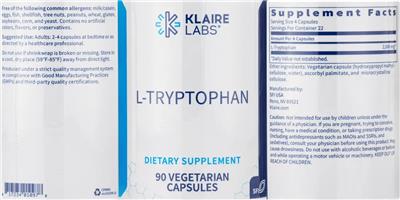
Free of the following common allergens: milk/casein, eggs, fish, shellfish, tree nuts, peanuts, wheat, gluten, soybeans, corn, and yeast. Contains no artificial colors, flavors, or preservatives.
Produced under a strict quality management system in compliance with Good Manufacturing Practices (GMPs) and third-party quality certifications.
Suggested/Recommended/Usage/Directions
Suggested Use: Adults: 2-4 capsules at bedtime or as directed by a healthcare professional.
Precautions
Do not use if shrinkwrap is broken or missing.
Caution: Not intended for use by children unless under the guidance of a physician.
If you are pregnant, trying to conceive, nursing, have a medical condition, or taking prescription drugs(including antidepressants such as MAOIs and SSRIs, and sedatives), consult your physician before using this product.
May cause drowsiness. Do not use with alcoholic beverages or before and while operating a motor vehicle or machinery.
Keep out of reach of children.
Storage
Store in a cool, dry place(59 degrees F-85 degrees F) away from direct light.
FDA Statement of Identity
Dietary supplement
General Statements
SFI
Is this label outdated? Report a formula or label change and our pharmacy team will review it.
L-Tryptophan by Klaire Labs label
The label scan from the NIH Dietary Supplement Label Database. Tap to enlarge.
Label images are published by the NIH Dietary Supplement Label Database for the version of this product on file. Always read your actual product label.
View the full label (PDF)The Ingredients in L-Tryptophan by Klaire Labs
This is the 1 active ingredient this product is made of. Select it to open its full monograph.
Serving size2 Capsule(s) Dosage formCapsule Servings per container22 Amounts shown are per serving.
L-Tryptophan
Interacts with394 drugs
L-tryptophan is an essential amino acid the body uses to make serotonin and melatonin, and people take it to support sleep and mood. The evidence for...
L-Tryptophan monograph & interactionsOther (inactive) ingredients: Hydroxypropyl Methylcellulose, Water, Ascorbyl Palmitate, Microcrystalline Cellulose. These complete the product’s ingredient list but are not active constituents.
L-Tryptophan by Klaire Labs Drug Interactions
HelloPharmacist Interaction Report
L-Tryptophan by Klaire Labs interacts with two important medication types.
The most serious concern is with CNS depressants (sedating drugs like benzodiazepines, opioids, and sleep aids) — combining them with L-tryptophan may cause additive sedative effects and increase drowsiness, which L-tryptophan can cause on its own.
Read the full breakdown — every affected drug type, severity by severity
L-Tryptophan also has a Moderate interaction with serotonergic drugs (antidepressants, certain pain medications, and migraine treatments). Because L-tryptophan is a building block for serotonin, pairing it with these medications might raise serotonin levels too high, potentially triggering serotonin syndrome — a serious condition marked by confusion, rapid heartbeat, high blood pressure, and muscle rigidity.
Altogether, these interactions span 394 individual medications. Before you start this supplement, use the medication checker below to look up any prescriptions you're taking.
Check your own medications below · Editorial policy · How we use AI
Want to check YOUR meds against L-Tryptophan?
Ask about interactions with your drugs in plain English — “Can I take it with lisinopril?” — and we find you the answer in seconds, ingredient by ingredient.
Go to the checkerIngredients driving the most interactions
Individual Drug Interactions
The ingredients in L-Tryptophan interact with 394 drugs. Click any drug to see the details.
1 of the 1 ingredient in L-Tryptophan interact with drugs. Each result below shows which ingredient is responsible. L-Tryptophan
Acetaminophen, Chlorpheniramine Maleate, Dextromethorphan HbrVicks Formula 44M Cough, Cold & Flu Relief
How Acetaminophen, Chlorpheniramine Maleate, Dextromethorphan Hbr interacts with L-Tryptophan — through 1 ingredient. Tap an ingredient for the detail:
L-tryptophanSerotonergic Drugs Moderate
Interaction Summary
Theoretically, combining L-tryptophan with serotonergic drugs might cause additive serotonergic effects.
Read the full L-tryptophan + Acetaminophen, Chlorpheniramine Maleate, Dextromethorphan Hbr interactionAcetaminophen, Chlorpheniramine, DextromethorphanCoricidin II Extra Strength Cold and Flu
How Acetaminophen, Chlorpheniramine, Dextromethorphan interacts with L-Tryptophan — through 1 ingredient. Tap an ingredient for the detail:
L-tryptophanSerotonergic Drugs Moderate
Interaction Summary
Theoretically, combining L-tryptophan with serotonergic drugs might cause additive serotonergic effects.
Read the full L-tryptophan + Acetaminophen, Chlorpheniramine, Dextromethorphan interactionAcetaminophen, Chlorpheniramine, Dextromethorphan HydrobromideCoricidin HBP Maximum Strength Flu
How Acetaminophen, Chlorpheniramine, Dextromethorphan Hydrobromide interacts with L-Tryptophan — through 1 ingredient. Tap an ingredient for the detail:
L-tryptophanSerotonergic Drugs Moderate
Interaction Summary
Theoretically, combining L-tryptophan with serotonergic drugs might cause additive serotonergic effects.
Read the full L-tryptophan + Acetaminophen, Chlorpheniramine, Dextromethorphan Hydrobromide interactionAcetaminophen, Chlorpheniramine, Dextromethorphan, PhenylpropanolamineMulti Symptom Cold Relief
How Acetaminophen, Chlorpheniramine, Dextromethorphan, Phenylpropanolamine interacts with L-Tryptophan — through 1 ingredient. Tap an ingredient for the detail:
L-tryptophanSerotonergic Drugs Moderate
Interaction Summary
Theoretically, combining L-tryptophan with serotonergic drugs might cause additive serotonergic effects.
Read the full L-tryptophan + Acetaminophen, Chlorpheniramine, Dextromethorphan, Phenylpropanolamine interactionAcetaminophen, Chlorpheniramine, Dextromethorphan, PseudoephedrineChildren's Tylenol Cold Plus Cough, Tylenol Cold Ex Strength
How Acetaminophen, Chlorpheniramine, Dextromethorphan, Pseudoephedrine interacts with L-Tryptophan — through 1 ingredient. Tap an ingredient for the detail:
L-tryptophanSerotonergic Drugs Moderate
Interaction Summary
Theoretically, combining L-tryptophan with serotonergic drugs might cause additive serotonergic effects.
Read the full L-tryptophan + Acetaminophen, Chlorpheniramine, Dextromethorphan, Pseudoephedrine interactionAcetaminophen, Chlorpheniramine, Guaifenesin, Phenylephrine, SalicylamideRhinogesic GG
How Acetaminophen, Chlorpheniramine, Guaifenesin, Phenylephrine, Salicylamide interacts with L-Tryptophan — through 1 ingredient. Tap an ingredient for the detail:
L-tryptophanSerotonergic Drugs Moderate
Interaction Summary
Theoretically, combining L-tryptophan with serotonergic drugs might cause additive serotonergic effects.
Read the full L-tryptophan + Acetaminophen, Chlorpheniramine, Guaifenesin, Phenylephrine, Salicylamide interactionAcetaminophen, Chlorpheniramine, PhenylephrineAlka-Seltzer PLUS, Histex SR, Protid
How Acetaminophen, Chlorpheniramine, Phenylephrine interacts with L-Tryptophan — through 1 ingredient. Tap an ingredient for the detail:
L-tryptophanSerotonergic Drugs Moderate
Interaction Summary
Theoretically, combining L-tryptophan with serotonergic drugs might cause additive serotonergic effects.
Read the full L-tryptophan + Acetaminophen, Chlorpheniramine, Phenylephrine interactionAcetaminophen, Chlorpheniramine, Phenylephrine, SalicylamideRhinogesic, Rhinogesic JR
How Acetaminophen, Chlorpheniramine, Phenylephrine, Salicylamide interacts with L-Tryptophan — through 1 ingredient. Tap an ingredient for the detail:
L-tryptophanSerotonergic Drugs Moderate
Interaction Summary
Theoretically, combining L-tryptophan with serotonergic drugs might cause additive serotonergic effects.
Read the full L-tryptophan + Acetaminophen, Chlorpheniramine, Phenylephrine, Salicylamide interactionAcetaminophen, Chlorpheniramine, PhenylpropanolamineAlumadrine, Conex, Sinadrin Max Strength, Sinulin
How Acetaminophen, Chlorpheniramine, Phenylpropanolamine interacts with L-Tryptophan — through 1 ingredient. Tap an ingredient for the detail:
L-tryptophanSerotonergic Drugs Moderate
Interaction Summary
Theoretically, combining L-tryptophan with serotonergic drugs might cause additive serotonergic effects.
Read the full L-tryptophan + Acetaminophen, Chlorpheniramine, Phenylpropanolamine interactionAcetaminophen, Chlorpheniramine, Phenylpropanolamine, PhenyltoloxamineNorel Plus
How Acetaminophen, Chlorpheniramine, Phenylpropanolamine, Phenyltoloxamine interacts with L-Tryptophan — through 1 ingredient. Tap an ingredient for the detail:
L-tryptophanSerotonergic Drugs Moderate
Interaction Summary
Theoretically, combining L-tryptophan with serotonergic drugs might cause additive serotonergic effects.
Read the full L-tryptophan + Acetaminophen, Chlorpheniramine, Phenylpropanolamine, Phenyltoloxamine interactionAcetaminophen, Chlorpheniramine, PseudoephedrineAlka-Seltzer PLUS Liquid Gels, Children's Tylenol Cold, Codimal, Comtrex, Extra Strength Tylenol Allergy Sinus, Lorsin +3 more
How Acetaminophen, Chlorpheniramine, Pseudoephedrine interacts with L-Tryptophan — through 1 ingredient. Tap an ingredient for the detail:
L-tryptophanSerotonergic Drugs Moderate
Interaction Summary
Theoretically, combining L-tryptophan with serotonergic drugs might cause additive serotonergic effects.
Read the full L-tryptophan + Acetaminophen, Chlorpheniramine, Pseudoephedrine interactionAcetaminophen, DextromethorphanTylenol Cough Ex Strength
How Acetaminophen, Dextromethorphan interacts with L-Tryptophan — through 1 ingredient. Tap an ingredient for the detail:
L-tryptophanSerotonergic Drugs Moderate
Interaction Summary
Theoretically, combining L-tryptophan with serotonergic drugs might cause additive serotonergic effects.
Read the full L-tryptophan + Acetaminophen, Dextromethorphan interactionAcetaminophen, Dextromethorphan, Doxylamine, PseudoephedrineVicks NyQuil
How Acetaminophen, Dextromethorphan, Doxylamine, Pseudoephedrine interacts with L-Tryptophan — through 1 ingredient. Tap an ingredient for the detail:
L-tryptophanSerotonergic Drugs Moderate
Interaction Summary
Theoretically, combining L-tryptophan with serotonergic drugs might cause additive serotonergic effects.
Read the full L-tryptophan + Acetaminophen, Dextromethorphan, Doxylamine, Pseudoephedrine interactionAcetaminophen, Dextromethorphan, Guaifenesin, PhenylephrineConar-A
How Acetaminophen, Dextromethorphan, Guaifenesin, Phenylephrine interacts with L-Tryptophan — through 1 ingredient. Tap an ingredient for the detail:
L-tryptophanSerotonergic Drugs Moderate
Interaction Summary
Theoretically, combining L-tryptophan with serotonergic drugs might cause additive serotonergic effects.
Read the full L-tryptophan + Acetaminophen, Dextromethorphan, Guaifenesin, Phenylephrine interactionAcetaminophen, Dextromethorphan, Guaifenesin, PhenylpropanolamineAnatuss
How Acetaminophen, Dextromethorphan, Guaifenesin, Phenylpropanolamine interacts with L-Tryptophan — through 1 ingredient. Tap an ingredient for the detail:
L-tryptophanSerotonergic Drugs Moderate
Interaction Summary
Theoretically, combining L-tryptophan with serotonergic drugs might cause additive serotonergic effects.
Read the full L-tryptophan + Acetaminophen, Dextromethorphan, Guaifenesin, Phenylpropanolamine interactionAcetaminophen, Dextromethorphan, Guaifenesin, PseudoephedrineRobitussin Cold, Severe Cold, Suphedrine Cold/Cough
How Acetaminophen, Dextromethorphan, Guaifenesin, Pseudoephedrine interacts with L-Tryptophan — through 1 ingredient. Tap an ingredient for the detail:
L-tryptophanSerotonergic Drugs Moderate
Interaction Summary
Theoretically, combining L-tryptophan with serotonergic drugs might cause additive serotonergic effects.
Read the full L-tryptophan + Acetaminophen, Dextromethorphan, Guaifenesin, Pseudoephedrine interactionAcetaminophen, Dextromethorphan, Phenylpropanolamine, PyrilamineTheracaps
How Acetaminophen, Dextromethorphan, Phenylpropanolamine, Pyrilamine interacts with L-Tryptophan — through 1 ingredient. Tap an ingredient for the detail:
L-tryptophanSerotonergic Drugs Moderate
Interaction Summary
Theoretically, combining L-tryptophan with serotonergic drugs might cause additive serotonergic effects.
Read the full L-tryptophan + Acetaminophen, Dextromethorphan, Phenylpropanolamine, Pyrilamine interactionAcetaminophen, Dextromethorphan, PseudoephedrineAlka-Seltzer PLUS Flu Liquid Gels, Non Aspirin Cold Caps, Tylenol Cold, Tylenol Flu Daytime Ex Strength, Tylenol Flu Ex Strength
How Acetaminophen, Dextromethorphan, Pseudoephedrine interacts with L-Tryptophan — through 1 ingredient. Tap an ingredient for the detail:
L-tryptophanSerotonergic Drugs Moderate
Interaction Summary
Theoretically, combining L-tryptophan with serotonergic drugs might cause additive serotonergic effects.
Read the full L-tryptophan + Acetaminophen, Dextromethorphan, Pseudoephedrine interactionAcetaminophen, Phenylephrine, ChlorpheniramineSuper Cold Tabs
How Acetaminophen, Phenylephrine, Chlorpheniramine interacts with L-Tryptophan — through 1 ingredient. Tap an ingredient for the detail:
L-tryptophanSerotonergic Drugs Moderate
Interaction Summary
Theoretically, combining L-tryptophan with serotonergic drugs might cause additive serotonergic effects.
Read the full L-tryptophan + Acetaminophen, Phenylephrine, Chlorpheniramine interactionAlmotriptanAlmogran, Axert
How Almotriptan interacts with L-Tryptophan — through 1 ingredient. Tap an ingredient for the detail:
L-tryptophanSerotonergic Drugs Moderate
Interaction Summary
Theoretically, combining L-tryptophan with serotonergic drugs might cause additive serotonergic effects.
Read the full L-tryptophan + Almotriptan interactionAlosetronLotronex
How Alosetron interacts with L-Tryptophan — through 1 ingredient. Tap an ingredient for the detail:
L-tryptophanSerotonergic Drugs Moderate
Interaction Summary
Theoretically, combining L-tryptophan with serotonergic drugs might cause additive serotonergic effects.
Read the full L-tryptophan + Alosetron interactionAmoxapineAsendin
How Amoxapine interacts with L-Tryptophan — through 1 ingredient. Tap an ingredient for the detail:
L-tryptophanSerotonergic Drugs Moderate
Interaction Summary
Theoretically, combining L-tryptophan with serotonergic drugs might cause additive serotonergic effects.
Read the full L-tryptophan + Amoxapine interactionAmphetamine Aspartate, Amphetamine Sulfate, Dextroamphetamine Saccharate, Dextroamphetamine SulfateAdderall, Adderall XR
How Amphetamine Aspartate, Amphetamine Sulfate, Dextroamphetamine Saccharate, Dextroamphetamine Sulfate interacts with L-Tryptophan — through 1 ingredient. Tap an ingredient for the detail:
L-tryptophanSerotonergic Drugs Moderate
Interaction Summary
Theoretically, combining L-tryptophan with serotonergic drugs might cause additive serotonergic effects.
Read the full L-tryptophan + Amphetamine Aspartate, Amphetamine Sulfate, Dextroamphetamine Saccharate, Dextroamphetamine Sulfate interactionAspirin, Chlorpheniramine, PhenylpropanolamineAlka-Seltzer Plus Cold
How Aspirin, Chlorpheniramine, Phenylpropanolamine interacts with L-Tryptophan — through 1 ingredient. Tap an ingredient for the detail:
L-tryptophanSerotonergic Drugs Moderate
Interaction Summary
Theoretically, combining L-tryptophan with serotonergic drugs might cause additive serotonergic effects.
Read the full L-tryptophan + Aspirin, Chlorpheniramine, Phenylpropanolamine interactionAtropine, Benzoic Acid, Hyoscyamine, Methenamine, Methylene Blue, PhenylAtrosept
How Atropine, Benzoic Acid, Hyoscyamine, Methenamine, Methylene Blue, Phenyl interacts with L-Tryptophan — through 1 ingredient. Tap an ingredient for the detail:
L-tryptophanSerotonergic Drugs Moderate
Interaction Summary
Theoretically, combining L-tryptophan with serotonergic drugs might cause additive serotonergic effects.
Read the full L-tryptophan + Atropine, Benzoic Acid, Hyoscyamine, Methenamine, Methylene Blue, Phenyl interactionAtropine, Benzoic Acid, Hyoscyamine, Methenamine, Methylene Blue, Phenyl SalicylateUrinary Antiseptic 2, Urised
How Atropine, Benzoic Acid, Hyoscyamine, Methenamine, Methylene Blue, Phenyl Salicylate interacts with L-Tryptophan — through 1 ingredient. Tap an ingredient for the detail:
L-tryptophanSerotonergic Drugs Moderate
Interaction Summary
Theoretically, combining L-tryptophan with serotonergic drugs might cause additive serotonergic effects.
Read the full L-tryptophan + Atropine, Benzoic Acid, Hyoscyamine, Methenamine, Methylene Blue, Phenyl Salicylate interactionAtropine, Chlorpheniramine, Hyoscyamine, Phenylephrine, Phenylpropanolamine, ScopolamineAtrohist Plus, Pro Tuss, Ru-tuss, Stahist
How Atropine, Chlorpheniramine, Hyoscyamine, Phenylephrine, Phenylpropanolamine, Scopolamine interacts with L-Tryptophan — through 1 ingredient. Tap an ingredient for the detail:
L-tryptophanSerotonergic Drugs Moderate
Interaction Summary
Theoretically, combining L-tryptophan with serotonergic drugs might cause additive serotonergic effects.
Read the full L-tryptophan + Atropine, Chlorpheniramine, Hyoscyamine, Phenylephrine, Phenylpropanolamine, Scopolamine interactionBelladonna Alkaloids, Chlorpheniramine, Phenylephrine, PhenylpropanolamineRespa ARM
How Belladonna Alkaloids, Chlorpheniramine, Phenylephrine, Phenylpropanolamine interacts with L-Tryptophan — through 1 ingredient. Tap an ingredient for the detail:
L-tryptophanSerotonergic Drugs Moderate
Interaction Summary
Theoretically, combining L-tryptophan with serotonergic drugs might cause additive serotonergic effects.
Read the full L-tryptophan + Belladonna Alkaloids, Chlorpheniramine, Phenylephrine, Phenylpropanolamine interactionBenzocaine, DextromethorphanTetra-Formula
How Benzocaine, Dextromethorphan interacts with L-Tryptophan — through 1 ingredient. Tap an ingredient for the detail:
L-tryptophanSerotonergic Drugs Moderate
Interaction Summary
Theoretically, combining L-tryptophan with serotonergic drugs might cause additive serotonergic effects.
Read the full L-tryptophan + Benzocaine, Dextromethorphan interactionBrexpiprazoleRexulti
How Brexpiprazole interacts with L-Tryptophan — through 1 ingredient. Tap an ingredient for the detail:
L-tryptophanSerotonergic Drugs Moderate
Interaction Summary
Theoretically, combining L-tryptophan with serotonergic drugs might cause additive serotonergic effects.
Read the full L-tryptophan + Brexpiprazole interactionEach ingredient & the kinds of drugs it affects
For each ingredient in L-Tryptophan with known interactions, here are the types of medications it can affect. Open any type for the detail — or search your exact drug in the checker above.
L-Tryptophan
Cns Depressants
Theoretically, concomitant use of L-tryptophan with CNS depressants might cause additive sedative effects.
Clinical research shows that L-tryptophan can cause fatigue and drowsiness.
Serotonergic Drugs
Theoretically, combining L-tryptophan with serotonergic drugs might cause additive serotonergic effects.
L-tryptophan is a precursor to serotonin. Theoretically, combining serotonergic drugs with L-tryptophan might increase the risk of serotonergic side effects, including serotonin syndrome and cerebral vasoconstrictive disorders.
Brand information
Manufacturer and brand details for L-Tryptophan, from the product label.
Klaire Labs
See all Klaire Labs products- Name
- SFI USA
- City
- Reno
- State
- NV
- ZipCode
- 89521
- Web Address
- Klaire.com
L-Tryptophan by Klaire Labs: Common Questions
Does L-Tryptophan by Klaire Labs interact with any medications?
How can one product interact with so many drugs?
Where does this information come from?
What does L-tryptophan do in the body?
Can I take this if I'm on an antidepressant?
Does L-tryptophan actually work for depression?
Is L-tryptophan safe now, given the past contamination issues?
Can I take this while breastfeeding?
What are the most common side effects?
Written and reviewed by the HelloPharmacist editorial staff. Our editorial policy
Not sure if L-Tryptophan is safe with your meds?
Our pharmacists answer your medication & supplement questions — free.
Label information is sourced from the NIH Dietary Supplement Label Database and reflects the product version on file; always read your actual product label. This page is for education only and is not a substitute for professional medical advice. Confirm with your pharmacist or doctor before combining supplements and medications.
The Full Monographs Behind L-Tryptophan’s Ingredients
Every ingredient we hold a full HelloPharmacist monograph for — uses, evidence, safety, and the complete interaction list.
Sources & How We Checked
L-Tryptophan's label data comes from the NIH Dietary Supplement Label Database; the ingredient interaction data is from the Natural Medicines database, reviewed by our pharmacists.
- NIH Dietary Supplement Label Database (DSLD) — The official product label on file for this supplement.
- Natural Medicines (Therapeutic Research Center) — Evidence-graded clinical reference behind the ingredient interaction data.
Content is written and reviewed by licensed HelloPharmacist pharmacists. See our data sources and editorial standards for how this information is built and checked.
The 18 references behind this product’s interaction data
Every citation that drives the interaction findings for this product’s ingredients, from the evidence-graded Natural Medicines (TRC Healthcare) database. Open an ingredient to browse its citations — links open the study on PubMed or the publisher’s site.
L-tryptophan 18 references
- Messiha FS. Fluoxetine: adverse effects and drug-drug interactions. J Toxicol Clin Toxicol 1993;31:603-30. PubMed
- Devoe LD, Castillo RA, Searle NS. Maternal dietary substrates and human fetal biophysical activity. The effects of tryptophan and glucose on fetal breathing movements. Am J Obstet Gynecol 1986;155:135-9. DOI
- Lieberman HR, Corkin S, Spring BJ. The effects of dietary neurotransmitter precursors on human behavior. Am J Clin Nutr 1985;42:366-70. PubMed
- U. S. Food and Drug Administration, Center for Food Safety and Applied Nutrition, Office of Nutritional Products, Labeling, and Dietary Supplements. Information Paper on L-Tryptophan and 5-hydroxy-L-tryptophan, February 2001.
- Sullivan EA, Kamb ML, Jones JL, et al. The natural history of eosinophilia-myalgia syndrome in a tryptophan-exposed cohort in South Carolina. Arch Intern Med 1996;156:973-9. DOI
- Philen RM, Hill RH, Flanders WD, et al. Tryptophan contaminants associated with eosinophilia-myalgia syndrome. Am J Epidemiol 1993;138:154-9. PubMed
- Bohme A, Wolter M, Hoelzer D. L-tryptophan-related eosinophilia-myalgia syndrome possibly associated with a chronic B-lymphocytic leukemia. Ann Hematol 1998;77:235-8. PubMed
- Singhal AB, Caviness VS, Begleiter AF, et al. Cerebral vasoconstriction and stroke after use of serotonergic drugs. Neurology 2002;58:130-3. PubMed
- Priori R, Conti F, Luan FL, et al. Chronic fatigue: a peculiar evolution of eosinophilia myalgia syndrome following treatment with L-tryptophan in four Italian adolescents. Eur J Pediatr 1994;153:344-6..
- Klein R, Berg PA. A comparative study on antibodies to nucleoli and 5-hydroxytryptamine in patients with fibromyalgia syndrome and tryptophan-induced eosinophilia-myalgia syndrome. Clin Investig 1994;72:541-9.. PubMed
- Simat TJ, Kleeberg KK, Muller B, Sierts A. Synthesis, formation, and occurrence of contaminants in biotechnologically manufactured L-tryptophan. Adv Exp Med Biol 1999;467:469-80.. PubMed
- Shaw K, Turner J, Del Mar C. Tryptophan and 5-hydroxytryptophan for depression. Cochrane Database Syst Rev 2002;(1):CD003198. PubMed
- Kilbourne EM, Philen RM, Kamb ML, Falk H. Tryptophan produced by Showa Denko and epidemic eosinophilia-myalgia syndrome. J Rheumatol Suppl 1996;46:81-8.
- Horwitz RI, Daniels SR. Bias or biology: evaluating the epidemiologic studies of L-tryptophan and the eosinophilia-myalgia syndrome. J Rheumatol Suppl 1996;46:60-72.
- Shapiro S. Epidemiologic studies of the association of L-tryptophan with the eosinophilia-myalgia syndrome: a critique. J Rheumatol Suppl 1996;46:44-58.
- Mayeno AN, Gleich GJ. The eosinophilia-myalgia syndrome: lessons from Germany. Mayo Clin Proc 1994;69:702-4. PubMed
- Carr L, Ruther E, Berg PA, Lehnert H. Eosinophilia-myalgia syndrome in Germany: an epidemiologic review. Mayo Clin Proc 1994;69:620-5. PubMed
- Ullrich SS, Fitzgerald PCE, Giesbertz P, Steinert RE, Horowitz M, Feinle-Bisset C. Effects of intragastric administration of tryptophan on the blood glucose response to a nutrient drink and energy intake, in lean and obese men. Nutrients 2018;10(4). pii: PubMed
Parts of this content are provided by the Therapeutic Research Center, LLC.
DISCLAIMER: Currently this does not check for drug-drug interactions. This is not an all-inclusive comprehensive list of potential interactions and is for informational purposes only. Not all interactions are known or well-reported in the scientific literature, and new interactions are continually being reported. Input is needed from a qualified healthcare provider including a pharmacist before starting any therapy. Application of clinical judgment is necessary.
© 2021 Therapeutic Research Center, LLC