
Methylene Blue Drops 1% Pharmaceutical Grade Ingredients & Drug Interactions
by Bluesun
What is this page for?
First and foremost: checking Methylene Blue Drops 1% Pharmaceutical Grade against your medications. The heart of this page is the interaction checker and the full interaction report — how this product’s ingredients may interact with prescription and over-the-counter medicines you may be taking.
Around that, we add a pharmacist’s high-level view of the product as a whole — what’s inside, the evidence for its stated use, how transparent the label is, and what safety data exists — so you can see the full picture in one place. It’s educational information from our licensed clinical databases and the clinical staff at HelloPharmacist — not medical advice — and we don’t sell or endorse products. Our editorial policy
Methylene Blue Drops 1% Pharmaceutical Grade is a dietary supplement by Bluesun with 1 active ingredient. Its ingredients are commonly taken for methemoglobinemia (a blood disorder), claimed energy or mental focus support, anti-aging or longevity claims.Based on those ingredients, 315 medications have a known interaction with it, the most serious rated moderate. The ingredients most likely to interact are Methylene Blue. Use the checker below to test your specific medication, or read the full HelloPharmacist Interaction Report.
Check Your Meds Against Methylene Blue Drops 1% Pharmaceutical Grade by Bluesun
Ask about any prescription or over-the-counter medication and we check it for interactions with Methylene Blue Drops 1% Pharmaceutical Grade by Bluesun — and tell you which ingredient is responsible.
AI summaries are generated from our interaction database for education only — always confirm with your pharmacist. How we use AI
Ask the Pharmacist
A licensed pharmacist will answer your question by email — free, usually within 24 hours.
Got it — thank you!
A licensed pharmacist will answer within 24 hours. Keep an eye on your email (worth checking spam, just in case).
HelloPharmacist Scorecard of Methylene Blue Drops 1% Pharmaceutical Grade by Bluesun
Our pharmacy team’s full take, with four database checks built into the cards below — a summary of what is known, not a grade of the product itself.
What’s inside
Full disclosure
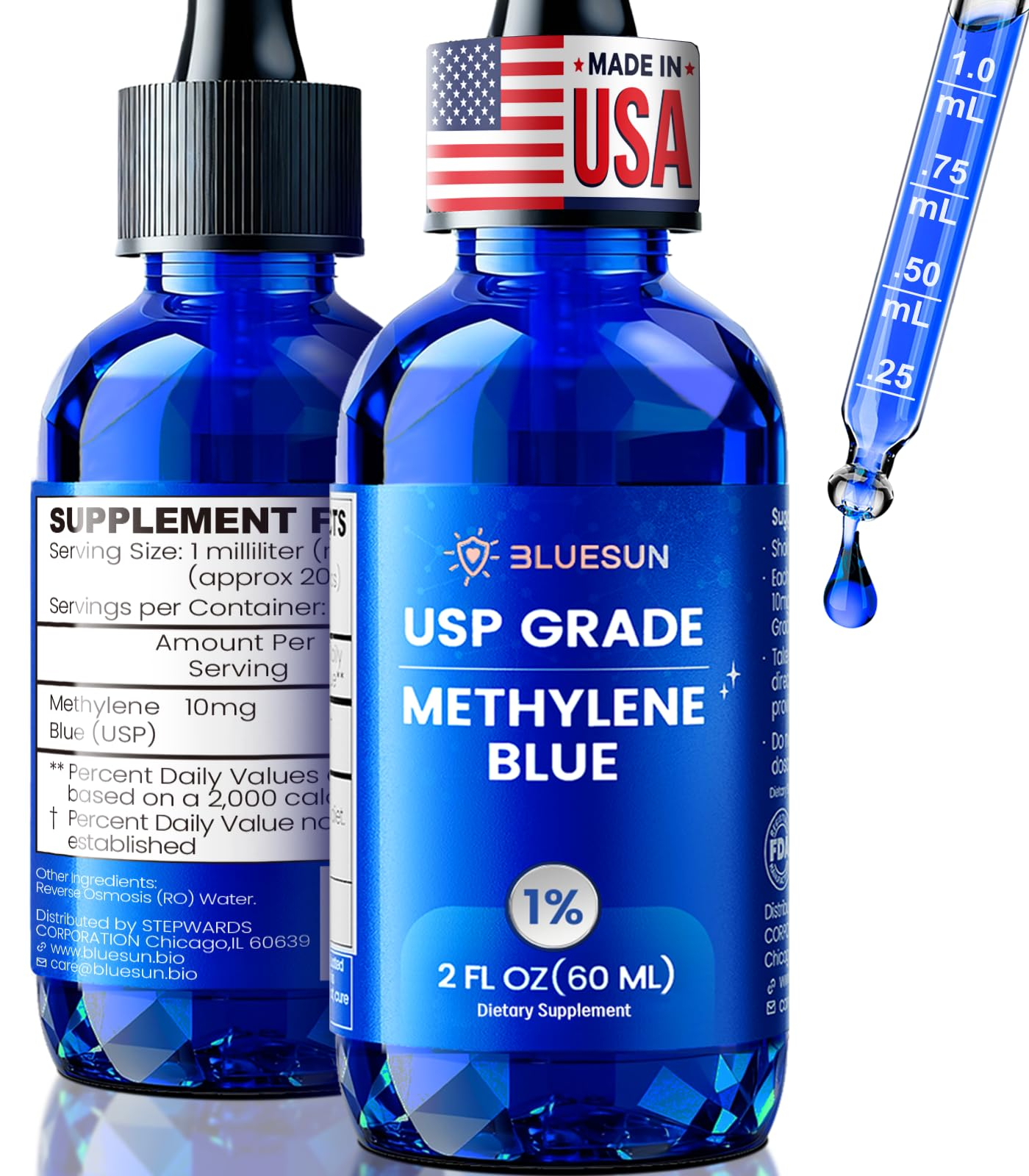
Methylene Blue Drops 1% is a single-ingredient liquid product containing one active ingredient: methylene blue, a pharmaceutical-grade compound. One inactive ingredient, Reverse-Vine, is also present in the formulation.
Does it work?
Couldn't assess
No effectiveness data is on file in our records for methylene blue in this product.
How safe is it?
Well-documented data
Methylene blue is a real drug with real risks and should not be self-dosed casually — it's designed for medical supervision. The product facts note that prescription-grade methylene blue is generally well tolerated when used as prescribed, but it's unclear how supplemental or non-prescription forms may affect side effect risk.
Oral use can cause abdominal pain, blue or green urine, diarrhea, trouble urinating, headache, nausea, and vomiting; less common oral side effects include hemolytic anemia (breakdown of red blood cells) and methemoglobinemia (a blood chemistry problem). Methylene blue should be avoided in pregnancy unless your doctor determines it is necessary, and there isn't enough safety information to recommend it while breastfeeding.
Meds to double-check
Moderate interaction found
Before taking this product, check with your doctor or pharmacist if you use anticholinergic drugs (Moderate severity) or serotonergic drugs like antidepressants, certain pain relievers, or anti-anxiety medications (Moderate severity). These are the two main medication types with documented interactions to this ingredient.
The bottom line
Scorecard at a glanceFully disclosed formula with no assessable stated purpose. Moderate medication interactions have been identified, and safety information is well characterized.
Methylene Blue Drops 1% carries documented Moderate-severity interactions with anticholinergic and serotonergic drugs, and it's a pharmaceutical compound that warrants medical oversight. If you take any prescription medication — especially antidepressants, anti-anxiety drugs, pain medications, or drugs that affect nerve signals — talk with your doctor or pharmacist before using this product.
Pregnant and breastfeeding individuals should discuss it with their healthcare provider.
Educational only — not medical advice; always confirm with your pharmacist. Our editorial policy · How we use AI
Assessment coverage: 1 of 1 active ingredient matched to our full ingredient reviews (monographs). Based on the product label dated Jul 17, 2026.
This Scorecard evaluates available label information, ingredient evidence, and known medication-safety considerations. It does not independently verify product identity, purity, potency, contamination, or manufacturing quality. How these ratings are computed
General information
Key facts about Methylene Blue Drops 1% Pharmaceutical Grade, straight from the product label.
| Brand | Bluesun |
|---|---|
| Net contents | 2 Fl Oz (60 mL) |
| Market status | On market |
| Added to our catalog | Jul 17, 2026 |
| Product type | Dietary Supplement |
| Supplement form | Liquid |
| Dietary claims / uses | Supports steady daily concentration, Supports peak cognitive performance, Sustained, vibrant energy |
Everything in this section is reproduced from the manufacturer’s own product label — it’s the label speaking, not HelloPharmacist. We show it so you can see exactly what the maker states; we don’t verify or endorse those statements.
Supplement Facts
The label details for Methylene Blue Drops 1% Pharmaceutical Grade by Bluesun, compiled by our pharmacy team from the manufacturer's label.
Tap any ingredient to jump to its full detail below.
These statements are the manufacturer’s wording, reproduced from the product label — the label is saying it, not HelloPharmacist. We don’t verify or endorse them.
Warnings
This product should be used under the guidance of a healthcare professional. It is not recommended for individuals with glucose-6-phosphate dehydrogenase (G6PD) deficiency or those taking serotonergic medications (e.g., SSRIs, SNRIs, MAOIs) due to the risk of serotonin syndrome. It is not suitable for pregnant or breastfeeding women. Common side effects may include blue urine and skin discoloration. Potent blue dye—stains instantly. Blue discoloration of the mouth, teeth, and urine is normal and fades naturally. Please consult your doctor before use.
Suggested Use
Begin with 1-2 drops in your daily beverage to smoothly adapt your body. Gradually adjust your serving size. Consult a healthcare professional to determine the appropriate number of drops for your daily use.
Marketing
Gradually adjust your serving size to support steady, daily concentration.*
Maintain your ideal drop count to support peak cognitive performance.*
Incorporate into your everyday wellness habit for sustained, vibrant energy.*
Other
Statements regarding dietary supplements have not been evaluated by the FDA and are not intended to diagnose, treat, cure, or prevent any disease or health condition.
Allergen Information: Formulated with methylene blue in a pure solution, this product is free from common allergens such as gluten, dairy, and nuts.
Is this label outdated? Report a formula or label change and our pharmacy team will review it.
Methylene Blue Drops 1% Pharmaceutical Grade by Bluesun label
The product's label imagery, on file with our pharmacy team. Tap to enlarge.
Label images reflect the product version on file with our pharmacy team. Always read your actual product label.
The Ingredients in Methylene Blue Drops 1% Pharmaceutical Grade by Bluesun
This is the 1 active ingredient this product is made of. Select it to open its full monograph.
Serving size1 mL (approx 20 drops) Dosage formLiquid Servings per container60 Amounts shown are per serving.
Methylene Blue
Interacts with315 drugs
Methylene blue is a synthetic dye that is an FDA-approved prescription medicine for a rare blood disorder called methemoglobinemia, and it is also use...
Methylene Blue monograph & interactionsOther (inactive) ingredients: Reverse-Vine. These complete the product’s ingredient list but are not active constituents.
Methylene Blue Drops 1% Pharmaceutical Grade by Bluesun Drug Interactions
HelloPharmacist Interaction Report
Methylene Blue Drops 1% by Bluesun does interact with medications.
The ingredient methylene blue poses a Moderate-severity risk with anticholinergic drugs (medications that block certain nerve signals) — concomitant use can amplify anticholinergic effects and adverse effects, and a case report documented anticholinergic syndrome with symptoms including fever, dry mouth, and pupil dilation in a critically ill patient treated with methylene blue.
Read the full breakdown — every affected drug type, severity by severity
Methylene blue also carries a Moderate-severity interaction with serotonergic drugs (antidepressants, some pain and anti-anxiety medications, and others that affect serotonin). It inhibits an enzyme your liver uses to break down serotonin, which can cause additive serotonergic effects and, in rare cases, serotonin syndrome — a serious condition.
This risk has been reported with intravenous or intrapulmonary use and has included fatalities in patients taking certain serotonergic drugs; it hasn't been reported with oral supplemental forms, but caution is warranted.
Altogether, these interactions span 315 individual medications. Before you start these drops, run your exact medications through the checker on this page or talk with your doctor or pharmacist about whether this product is right for you.
Check your own medications below · Editorial policy · How we use AI
Want to check YOUR meds against Methylene Blue Drops 1% Pharmaceutical Grade?
Ask about interactions with your drugs in plain English — “Can I take it with lisinopril?” — and we find you the answer in seconds, ingredient by ingredient.
Go to the checkerIngredients driving the most interactions
Individual Drug Interactions
The ingredients in Methylene Blue Drops 1% Pharmaceutical Grade interact with 315 drugs. Click any drug to see the details.
1 of the 1 ingredient in Methylene Blue Drops 1% Pharmaceutical Grade interact with drugs. Each result below shows which ingredient is responsible. Methylene Blue
Aclidinium BromideTudorza Pressair
How Aclidinium Bromide interacts with Methylene Blue Drops 1% Pharmaceutical Grade — through 1 ingredient. Tap an ingredient for the detail:
Methylene BlueAnticholinergic Drugs Moderate
Interaction Summary
Concomitant use may increase anticholinergic effects and adverse effects.
Read the full Methylene Blue + Aclidinium Bromide interactionAclidinium Bromide, Formoterol Fumarate DihydrateDuaklir Pressair
How Aclidinium Bromide, Formoterol Fumarate Dihydrate interacts with Methylene Blue Drops 1% Pharmaceutical Grade — through 1 ingredient. Tap an ingredient for the detail:
Methylene BlueAnticholinergic Drugs Moderate
Interaction Summary
Concomitant use may increase anticholinergic effects and adverse effects.
Read the full Methylene Blue + Aclidinium Bromide, Formoterol Fumarate Dihydrate interactionAerosphere Budesonide, Formoterol Fumarate, GlycopyrrolateBreztri
How Aerosphere Budesonide, Formoterol Fumarate, Glycopyrrolate interacts with Methylene Blue Drops 1% Pharmaceutical Grade — through 1 ingredient. Tap an ingredient for the detail:
Methylene BlueAnticholinergic Drugs Moderate
Interaction Summary
Concomitant use may increase anticholinergic effects and adverse effects.
Read the full Methylene Blue + Aerosphere Budesonide, Formoterol Fumarate, Glycopyrrolate interactionAlmotriptanAlmogran, Axert
How Almotriptan interacts with Methylene Blue Drops 1% Pharmaceutical Grade — through 1 ingredient. Tap an ingredient for the detail:
Methylene BlueSerotonergic Drugs Moderate
Interaction Summary
Combining serotonergic drugs with methylene blue can cause additive serotonergic effects, including serotonin syndrome.
Read the full Methylene Blue + Almotriptan interactionAlosetronLotronex
How Alosetron interacts with Methylene Blue Drops 1% Pharmaceutical Grade — through 1 ingredient. Tap an ingredient for the detail:
Methylene BlueSerotonergic Drugs Moderate
Interaction Summary
Combining serotonergic drugs with methylene blue can cause additive serotonergic effects, including serotonin syndrome.
Read the full Methylene Blue + Alosetron interactionAmantadineGocovri, Osmolex ER, Symmetrel
How Amantadine interacts with Methylene Blue Drops 1% Pharmaceutical Grade — through 1 ingredient. Tap an ingredient for the detail:
Methylene BlueAnticholinergic Drugs Moderate
Interaction Summary
Concomitant use may increase anticholinergic effects and adverse effects.
Read the full Methylene Blue + Amantadine interactionAminoglutethimideCytadren
How Aminoglutethimide interacts with Methylene Blue Drops 1% Pharmaceutical Grade — through 1 ingredient. Tap an ingredient for the detail:
Methylene BlueAnticholinergic Drugs Moderate
Interaction Summary
Concomitant use may increase anticholinergic effects and adverse effects.
Read the full Methylene Blue + Aminoglutethimide interactionAmitriptylineElavil
How Amitriptyline interacts with Methylene Blue Drops 1% Pharmaceutical Grade — through 1 ingredient. Tap an ingredient for the detail:
Methylene BlueAnticholinergic Drugs, Serotonergic Drugs Moderate
Interaction Summary
Concomitant use may increase anticholinergic effects and adverse effects.
Read the full Methylene Blue + Amitriptyline interactionAmitriptyline, ChlordiazepoxideLimbitrol DS
How Amitriptyline, Chlordiazepoxide interacts with Methylene Blue Drops 1% Pharmaceutical Grade — through 1 ingredient. Tap an ingredient for the detail:
Methylene BlueAnticholinergic Drugs, Serotonergic Drugs Moderate
Interaction Summary
Concomitant use may increase anticholinergic effects and adverse effects.
Read the full Methylene Blue + Amitriptyline, Chlordiazepoxide interactionAmitriptyline, PerphenazineEtrafon, Etrafon-A, Etrafon-Forte, Triavil
How Amitriptyline, Perphenazine interacts with Methylene Blue Drops 1% Pharmaceutical Grade — through 1 ingredient. Tap an ingredient for the detail:
Methylene BlueSerotonergic Drugs, Anticholinergic Drugs Moderate
Interaction Summary
Combining serotonergic drugs with methylene blue can cause additive serotonergic effects, including serotonin syndrome.
Read the full Methylene Blue + Amitriptyline, Perphenazine interactionAmoxapineAsendin
How Amoxapine interacts with Methylene Blue Drops 1% Pharmaceutical Grade — through 1 ingredient. Tap an ingredient for the detail:
Methylene BlueSerotonergic Drugs Moderate
Interaction Summary
Combining serotonergic drugs with methylene blue can cause additive serotonergic effects, including serotonin syndrome.
Read the full Methylene Blue + Amoxapine interactionAmphetamine Aspartate, Amphetamine Sulfate, Dextroamphetamine Saccharate, Dextroamphetamine SulfateAdderall, Adderall XR
How Amphetamine Aspartate, Amphetamine Sulfate, Dextroamphetamine Saccharate, Dextroamphetamine Sulfate interacts with Methylene Blue Drops 1% Pharmaceutical Grade — through 1 ingredient. Tap an ingredient for the detail:
Methylene BlueSerotonergic Drugs Moderate
Interaction Summary
Combining serotonergic drugs with methylene blue can cause additive serotonergic effects, including serotonin syndrome.
Read the full Methylene Blue + Amphetamine Aspartate, Amphetamine Sulfate, Dextroamphetamine Saccharate, Dextroamphetamine Sulfate interactionAripiprazoleAbilify, Abilify Maintena, Abilify Mycite
How Aripiprazole interacts with Methylene Blue Drops 1% Pharmaceutical Grade — through 1 ingredient. Tap an ingredient for the detail:
Methylene BlueSerotonergic Drugs Moderate
Interaction Summary
Combining serotonergic drugs with methylene blue can cause additive serotonergic effects, including serotonin syndrome.
Read the full Methylene Blue + Aripiprazole interactionAripiprazole LauroxilAristada, Aristada Initio Kit
How Aripiprazole Lauroxil interacts with Methylene Blue Drops 1% Pharmaceutical Grade — through 1 ingredient. Tap an ingredient for the detail:
Methylene BlueSerotonergic Drugs Moderate
Interaction Summary
Combining serotonergic drugs with methylene blue can cause additive serotonergic effects, including serotonin syndrome.
Read the full Methylene Blue + Aripiprazole Lauroxil interactionAspirin, Chlorpheniramine, PhenylpropanolamineAlka-Seltzer Plus Cold
How Aspirin, Chlorpheniramine, Phenylpropanolamine interacts with Methylene Blue Drops 1% Pharmaceutical Grade — through 1 ingredient. Tap an ingredient for the detail:
Methylene BlueSerotonergic Drugs, Anticholinergic Drugs Moderate
Interaction Summary
Combining serotonergic drugs with methylene blue can cause additive serotonergic effects, including serotonin syndrome.
Read the full Methylene Blue + Aspirin, Chlorpheniramine, Phenylpropanolamine interactionAspirin, Diphenhydramine, PhenylpropanolamineAlka Seltzer Plus Night Time Effervescent
How Aspirin, Diphenhydramine, Phenylpropanolamine interacts with Methylene Blue Drops 1% Pharmaceutical Grade — through 1 ingredient. Tap an ingredient for the detail:
Methylene BlueAnticholinergic Drugs Moderate
Interaction Summary
Concomitant use may increase anticholinergic effects and adverse effects.
Read the full Methylene Blue + Aspirin, Diphenhydramine, Phenylpropanolamine interactionAtropineSal-Tropine
How Atropine interacts with Methylene Blue Drops 1% Pharmaceutical Grade — through 1 ingredient. Tap an ingredient for the detail:
Methylene BlueAnticholinergic Drugs Moderate
Interaction Summary
Concomitant use may increase anticholinergic effects and adverse effects.
Read the full Methylene Blue + Atropine interactionAtropine Methyl Nitrate, Digestive EnzymesFestalan
How Atropine Methyl Nitrate, Digestive Enzymes interacts with Methylene Blue Drops 1% Pharmaceutical Grade — through 1 ingredient. Tap an ingredient for the detail:
Methylene BlueAnticholinergic Drugs Moderate
Interaction Summary
Concomitant use may increase anticholinergic effects and adverse effects.
Read the full Methylene Blue + Atropine Methyl Nitrate, Digestive Enzymes interactionAtropine SulfateAtropine Sulfate, Isopto Atropine
How Atropine Sulfate interacts with Methylene Blue Drops 1% Pharmaceutical Grade — through 1 ingredient. Tap an ingredient for the detail:
Methylene BlueAnticholinergic Drugs Moderate
Interaction Summary
Concomitant use may increase anticholinergic effects and adverse effects.
Read the full Methylene Blue + Atropine Sulfate interactionAtropine, Benzoic Acid, Hyoscyamine, Methenamine, Methylene Blue, PhenylAtrosept
How Atropine, Benzoic Acid, Hyoscyamine, Methenamine, Methylene Blue, Phenyl interacts with Methylene Blue Drops 1% Pharmaceutical Grade — through 1 ingredient. Tap an ingredient for the detail:
Methylene BlueAnticholinergic Drugs, Serotonergic Drugs Moderate
Interaction Summary
Concomitant use may increase anticholinergic effects and adverse effects.
Read the full Methylene Blue + Atropine, Benzoic Acid, Hyoscyamine, Methenamine, Methylene Blue, Phenyl interactionAtropine, Benzoic Acid, Hyoscyamine, Methenamine, Methylene Blue, Phenyl SalicylateUrinary Antiseptic 2, Urised
How Atropine, Benzoic Acid, Hyoscyamine, Methenamine, Methylene Blue, Phenyl Salicylate interacts with Methylene Blue Drops 1% Pharmaceutical Grade — through 1 ingredient. Tap an ingredient for the detail:
Methylene BlueSerotonergic Drugs, Anticholinergic Drugs Moderate
Interaction Summary
Combining serotonergic drugs with methylene blue can cause additive serotonergic effects, including serotonin syndrome.
Read the full Methylene Blue + Atropine, Benzoic Acid, Hyoscyamine, Methenamine, Methylene Blue, Phenyl Salicylate interactionAtropine, Chlorpheniramine, Hyoscyamine, Phenylephrine, Phenylpropanolamine, ScopolamineAtrohist Plus, Pro Tuss, Ru-tuss, Stahist
How Atropine, Chlorpheniramine, Hyoscyamine, Phenylephrine, Phenylpropanolamine, Scopolamine interacts with Methylene Blue Drops 1% Pharmaceutical Grade — through 1 ingredient. Tap an ingredient for the detail:
Methylene BlueAnticholinergic Drugs, Serotonergic Drugs Moderate
Interaction Summary
Concomitant use may increase anticholinergic effects and adverse effects.
Read the full Methylene Blue + Atropine, Chlorpheniramine, Hyoscyamine, Phenylephrine, Phenylpropanolamine, Scopolamine interactionAtropine, DifenoxinMotofen
How Atropine, Difenoxin interacts with Methylene Blue Drops 1% Pharmaceutical Grade — through 1 ingredient. Tap an ingredient for the detail:
Methylene BlueAnticholinergic Drugs Moderate
Interaction Summary
Concomitant use may increase anticholinergic effects and adverse effects.
Read the full Methylene Blue + Atropine, Difenoxin interactionAtropine, DiphenoxylateLofene, Lomotil
How Atropine, Diphenoxylate interacts with Methylene Blue Drops 1% Pharmaceutical Grade — through 1 ingredient. Tap an ingredient for the detail:
Methylene BlueAnticholinergic Drugs Moderate
Interaction Summary
Concomitant use may increase anticholinergic effects and adverse effects.
Read the full Methylene Blue + Atropine, Diphenoxylate interactionAtropine, Hyoscyamine, PhenobarbitalHypnaldyne
How Atropine, Hyoscyamine, Phenobarbital interacts with Methylene Blue Drops 1% Pharmaceutical Grade — through 1 ingredient. Tap an ingredient for the detail:
Methylene BlueAnticholinergic Drugs Moderate
Interaction Summary
Concomitant use may increase anticholinergic effects and adverse effects.
Read the full Methylene Blue + Atropine, Hyoscyamine, Phenobarbital interactionAtropine, Hyoscyamine, Phenobarbital, ScopolamineBarbidonna No. 2, Belladonna Phenobarbital
How Atropine, Hyoscyamine, Phenobarbital, Scopolamine interacts with Methylene Blue Drops 1% Pharmaceutical Grade — through 1 ingredient. Tap an ingredient for the detail:
Methylene BlueAnticholinergic Drugs Moderate
Interaction Summary
Concomitant use may increase anticholinergic effects and adverse effects.
Read the full Methylene Blue + Atropine, Hyoscyamine, Phenobarbital, Scopolamine interactionAtropine, Hyoscyamine, ScopolamineColytrol
How Atropine, Hyoscyamine, Scopolamine interacts with Methylene Blue Drops 1% Pharmaceutical Grade — through 1 ingredient. Tap an ingredient for the detail:
Methylene BlueAnticholinergic Drugs Moderate
Interaction Summary
Concomitant use may increase anticholinergic effects and adverse effects.
Read the full Methylene Blue + Atropine, Hyoscyamine, Scopolamine interactionAtropine, Hyoscyamine, Scopolamine, PhenobarbitalBarbeloid, Donnatal #2, Donphen
How Atropine, Hyoscyamine, Scopolamine, Phenobarbital interacts with Methylene Blue Drops 1% Pharmaceutical Grade — through 1 ingredient. Tap an ingredient for the detail:
Methylene BlueAnticholinergic Drugs Moderate
Interaction Summary
Concomitant use may increase anticholinergic effects and adverse effects.
Read the full Methylene Blue + Atropine, Hyoscyamine, Scopolamine, Phenobarbital interactionAtropine, PhenobarbitalAnthrocol
How Atropine, Phenobarbital interacts with Methylene Blue Drops 1% Pharmaceutical Grade — through 1 ingredient. Tap an ingredient for the detail:
Methylene BlueAnticholinergic Drugs Moderate
Interaction Summary
Concomitant use may increase anticholinergic effects and adverse effects.
Read the full Methylene Blue + Atropine, Phenobarbital interactionAtropine, MeperidineAtropine, Meperidine
How Atropine, Meperidine interacts with Methylene Blue Drops 1% Pharmaceutical Grade — through 1 ingredient. Tap an ingredient for the detail:
Methylene BlueAnticholinergic Drugs, Serotonergic Drugs Moderate
Interaction Summary
Concomitant use may increase anticholinergic effects and adverse effects.
Read the full Methylene Blue + Atropine, Meperidine interactionEach ingredient & the kinds of drugs it affects
For each ingredient in Methylene Blue Drops 1% Pharmaceutical Grade with known interactions, here are the types of medications it can affect. Open any type for the detail — or search your exact drug in the checker above.
Methylene Blue
Anticholinergic Drugs
Concomitant use may increase anticholinergic effects and adverse effects. In a case report, a critically-ill male in his mid-60s developed a toxicological process attributed to anticholinergic syndrome following treatment with methylene blue for vasoplegia. Symptoms included anhidrosis, fever, lactic acidosis, mucosal dryness, and pupil dilation. Potential exacerbating factors included renal failure and use of fentanyl intra-operatively.
Serotonergic Drugs
Combining serotonergic drugs with methylene blue can cause additive serotonergic effects, including serotonin syndrome. Methylene blue inhibits monoamine oxidase A. Intravenous or intrapulmonary use has resulted in serotonin syndrome, including reported fatalities, in patients taking some serotonergic drugs. This effect has not been reported with oral methylene blue. However, tell patients to avoid taking methylene blue with serotonergic drugs.
Brand information
Manufacturer and brand details for Methylene Blue Drops 1% Pharmaceutical Grade, from the product label.
Bluesun
See all Bluesun productsMethylene Blue Drops 1% Pharmaceutical Grade by Bluesun: Common Questions
Does Methylene Blue Drops 1% Pharmaceutical Grade by Bluesun interact with any medications?
How can one product interact with so many drugs?
Where does this information come from?
What is methylene blue, and why would I take it?
Is methylene blue safe to use while I'm pregnant?
Can I use methylene blue while breastfeeding?
What side effects might I experience if I take this orally?
Why does the product say methylene blue is 'pharmaceutical grade'?
What if I'm taking an antidepressant — should I avoid this?
Written and reviewed by the HelloPharmacist editorial staff. Our editorial policy
Not sure if Methylene Blue Drops 1% Pharmaceutical Grade is safe with your meds?
Our pharmacists answer your medication & supplement questions — free.
Label information is sourced from the NIH Dietary Supplement Label Database and reflects the product version on file; always read your actual product label. This page is for education only and is not a substitute for professional medical advice. Confirm with your pharmacist or doctor before combining supplements and medications.
The Full Monographs Behind Methylene Blue Drops 1% Pharmaceutical Grade’s Ingredients
Every ingredient we hold a full HelloPharmacist monograph for — uses, evidence, safety, and the complete interaction list.
Sources & How We Checked
Methylene Blue Drops 1% Pharmaceutical Grade's label data was compiled by the HelloPharmacist pharmacy team from the manufacturer's product label; the ingredient interaction data is from the Natural Medicines database, reviewed by our pharmacists.
- Natural Medicines (Therapeutic Research Center) — Evidence-graded clinical reference behind the ingredient interaction data.
Content is written and reviewed by licensed HelloPharmacist pharmacists. See our data sources and editorial standards for how this information is built and checked.
The 60 references behind this product’s interaction data
Every citation that drives the interaction findings for this product’s ingredients, from the evidence-graded Natural Medicines (TRC Healthcare) database. Open an ingredient to browse its citations — links open the study on PubMed or the publisher’s site.
Methylene Blue 60 references
- Chebolu E, Gnirke M, St Francis H, Soghoian S, Su MK. Extravasation with methylthioninium chloride. Clin Toxicol (Phila) 2024;62(11):776-778. PubMed
- Walter-Sack I, Rengelshausen J, Oberwittler H, et al. High absolute bioavailability of methylene blue given as an aqueous oral formulation. Eur J Clin Pharmacol. 2009;65(2):179-89. PubMed
- Akazawa M, Wu YH, Liu WM. Allergy-like reactions to methylene blue following laparoscopic chromopertubation: A systematic review of the literature. Eur J Obstet Gynecol Reprod Biol 2019;238:58-62. PubMed
- Aldeghaither S, Deschênes PJF, Samoukovic G. Anticholinergic Toxidrome as a Possible Explanation for Methylene Blue Toxicity. Am J Case Rep 2023;24:e941453. PubMed
- Liao YP, Hung DZ, Yang DY. Hemolytic anemia after methylene blue therapy for aniline-induced methemoglobinemia. Vet Hum Toxicol 2002;44(1):19-21.
- Bilgin H, Ozcan B, Bilgin T. Methemoglobinemia induced by methylene blue pertubation during laparoscopy. Acta Anaesthesiol Scand 1998;42(5):594-5. PubMed
- Kirlangitis JJ, Middaugh RE, Zablocki A, Rodriquez F. False indication of arterial oxygen desaturation and methemoglobinemia following injection of methylene blue in urological surgery. Mil Med 1990;155(6):260-2. DOI
- Porat R, Gilbert S, Magilner D. Methylene blue-induced phototoxicity: an unrecognized complication. Pediatrics 1996;97(5):717-21. DOI
- Honoré PJ, Deianova N, Loret G, Hemelsoet D. An easily overlooked cause of toxic encephalopathy: methylene blue in a patient on an SSRI. Acta Neurol Belg 2018;118(1):121-122. PubMed
- McRobb CM, Holt DW. Methylene blue-induced methemoglobinemia during cardiopulmonary bypass? A case report and literature review. J Extra Corpor Technol 2008;40(3):206-14. DOI
- Donaldson CJ, Sequeira Campos M, El-Sayed M. Inadvertent foetal exposure to methylene blue in the first trimester. J Obstet Gynaecol 2020;40(4):573-574. PubMed
- Vanhinsbergh L, Uthaya S, Bain BJ. Methylene blue-induced Heinz body hemolytic anemia in a premature neonate. Am J Hematol 2018;93(5):716-717.
- Repici A, Di Stefano AF, Radicioni MM, Jas V, Moro L, Danese S. Methylene blue MMX tablets for chromoendoscopy. Safety tolerability and bioavailability in healthy volunteers. Contemp Clin Trials 2012;33(2):260-7. PubMed
- Lee DC, Valente JH. Methylene blue dye-induced knee effusion. Am J Emerg Med 1999;17(7):739-40. PubMed
- Albert M, Lessin MS, Gilchrist BF. Methylene blue: dangerous dye for neonates. J Pediatr Surg 2003;38(8):1244-5. PubMed
- Giladi AM, Kasten SJ. Anaphylactic-like reaction to methylene blue: case report and review of perioperative hypersensitivity reactions. Plast Reconstr Surg 2012;130(1):98e-105e. PubMed
- Bleicher RJ, Kloth DD, Robinson D, Axelrod P. Inflammatory cutaneous adverse effects of methylene blue dye injection for lymphatic mapping/sentinel lymphadenectomy. J Surg Oncol 2009;99(6):356-60. PubMed
- George M. Methylene-blue-induced hyperbilirubinemia and phototoxicity in a neonate. Clin Pediatr (Phila) 2000;39(11):659-61.
- Lam CW, Wong SY. A case of green urine due to a traditional Chinese medicine containing methylene blue. N Z Med J 2010;123(1312):71-6.
- Teknos D, Ramcharan A, Oluwole SF. Pulmonary edema associated with methylene blue dye administration during sentinel lymph node biopsy. J Natl Med Assoc 2008;100(12):1483-4. PubMed
- Huang WH, Li MJ. Postoperative Serotonin Syndrome Following Administration of Preoperative Intrapulmonary Methylene Blue and Intraoperative Granisetron: A Case Report. Am J Case Rep 2022;23:e936317. PubMed
- Basta MN. Postoperative Serotonin Syndrome Following Methylene Blue Administration for Vasoplegia After Cardiac Surgery: A Case Report and Review of the Literature. Semin Cardiothorac Vasc Anesth 2021;25(1):51-56. PubMed
- Gilbert B, Akamune IE. A Case of Serotonin Syndrome Caused by the Concomitant Utilization of Methylene Blue and Venlafaxine in an Oncological Patient. J Pharm Pract 2020;33(5):705-707. PubMed
- Hashmi AT, Gupta SS, Shankar S, Seneviratne C, Yoon TS, Kupfer Y. Life-Threatening Serotonin Syndrome Due to Methylene Blue-Citalopram Interaction. Am J Ther 2019;26(6):e740-e741. PubMed
- Pelletier JP, Transue S, Snyder EL. Pathogen inactivation techniques. Best Pract Res Clin Haematol. 2006;19(1):205-42. PubMed
- Francescangeli J, Vaida S, Bonavia AS. Perioperative Diagnosis and Treatment of Serotonin Syndrome Following Administration of Methylene Blue. Am J Case Rep 2016;17:347-51. PubMed
- Hencken L, To L, Ly N, Morgan JA. Serotonin Syndrome Following Methylene Blue Administration for Vasoplegic Syndrome. J Card Surg 2016;31(4):208-10. PubMed
- Wolvetang T, Janse R, Ter Horst M. Serotonin Syndrome After Methylene Blue Administration During Cardiac Surgery: A Case Report and Review. J Cardiothorac Vasc Anesth 2016;30(4):1042-5. PubMed
- Smith CJ, Wang D, Sgambelluri A, Kramer RS, Gagnon DJ. Serotonin syndrome following methylene blue administration during cardiothoracic surgery. J Pharm Pract 2015;28(2):207-11. PubMed
- Top WM, Gillman PK, de Langen CJ, Kooy A. Fatal methylene blue associated serotonin toxicity. Neth J Med 2014;72(3):179-81.
- McDonnell AM, Rybak I, Wadleigh M, Fisher DC. Suspected serotonin syndrome in a patient being treated with methylene blue for ifosfamide encephalopathy. J Oncol Pharm Pract 2012;18(4):436-9. PubMed
- Grubb KJ, Kennedy JL, Bergin JD, Groves DS, Kern JA. The role of methylene blue in serotonin syndrome following cardiac transplantation: a case report and review of the literature. J Thorac Cardiovasc Surg 2012;144(5):e113-6. PubMed
- Sanei ZS, Shahrahmani F, Khaleghi Manesh B, et al. Methylene blue for COVID-19 ARDS: insights from a randomized Clinical Trial. Naunyn Schmiedebergs Arch Pharmacol 2025;398(2):1915-1924. PubMed
- Hamidi-Alamdari D, Hafizi-Lotfabadi S, Bagheri-Moghaddam A, et al. METHYLENE BLUE FOR TREATMENT OF HOSPITALIZED COVID-19 PATIENTS: A RANDOMIZED, CONTROLLED, OPEN-LABEL CLINICAL TRIAL, PHASE 2. Rev Invest Clin 2021;73(3):190-198. PubMed
- Alamdari DH, Moghaddam AB, Amini S, et al. Application of methylene blue -vitamin C -N-acetyl cysteine for treatment of critically ill COVID-19 patients, report of a phase-I clinical trial. Eur J Pharmacol 2020;885:173494. PubMed
- Guo X, Ding W, Liu L, Yang S. Intradiscal Methylene Blue Injection for Discogenic Low Back Pain: A Meta-Analysis. Pain Pract 2019;19(1):118-129. PubMed
- Deng M, Huang H, Ma YG, Zhou Y, Chen Q, Xie P. Intradiskal Injection of Methylene Blue for Discogenic Back Pain: A Meta-Analysis of Randomized Controlled Trials. J Neurol Surg A Cent Eur Neurosurg 2021;82(2):161-165. PubMed
- Farrokhi MR, Lotfi M, Masoudi MS, Gholami M. Effects of methylene blue on postoperative low-back pain and functional outcomes after lumbar open discectomy: a triple-blind, randomized placebo-controlled trial. J Neurosurg Spine 2016;24(1):7-15. View abstra PubMed
- Wilcock GK, Gauthier S, Frisoni GB, et al. Potential of Low Dose Leuco-Methylthioninium Bis(Hydromethanesulphonate) (LMTM) Monotherapy for Treatment of Mild Alzheimer's Disease: Cohort Analysis as Modified Primary Outcome in a Phase III Clinical Trial. J PubMed
- Rodriguez P, Zhou W, Barrett DW, et al. Multimodal Randomized Functional MR Imaging of the Effects of Methylene Blue in the Human Brain. Radiology 2016;281(2):516-526. PubMed
- Rodriguez P, Singh AP, Malloy KE, et al. Methylene blue modulates functional connectivity in the human brain. Brain Imaging Behav 2017;11(3):640-648. PubMed
- Wischik CM, Staff RT, Wischik DJ, et al. Tau aggregation inhibitor therapy: an exploratory phase 2 study in mild or moderate Alzheimer's disease. J Alzheimers Dis 2015;44(2):705-20. PubMed
- Baddeley TC, McCaffrey J, Storey JM, et al. Complex disposition of methylthioninium redox forms determines efficacy in tau aggregation inhibitor therapy for Alzheimer's disease. J Pharmacol Exp Ther 2015;352(1):110-8. PubMed
- Alda M, McKinnon M, Blagdon R, et al. Methylene blue treatment for residual symptoms of bipolar disorder: randomised crossover study. Br J Psychiatry 2017;210(1):54-60. PubMed
- Zhang Z, Zhu Z, Liu H, Chen J, Jin C, Zhang X. A Prospective, Randomized, Controlled Trial of Methylene Blue Injection for Costal Cartilage Harvest Postoperative Analgesia. Aesthet Surg J 2025;45(2):NP65-NP70. PubMed
- Soliman M, Salah M, Fadel M, Nasr M, El-Azab H. Contrasting the efficacy of pulsed dye laser and photodynamic methylene blue nanoemulgel therapy in treating acne vulgaris. Arch Dermatol Res 2021;313(3):173-180. PubMed
- Alves RO, Urzedo LOR, de Toledo PTA. Antimicrobial Photodynamic Therapy in Onychomycosis Management: A Systematic Review of Clinical Trials. Photodiagnosis Photodyn Ther. 2025:104640. PubMed
- Naylor GJ, Martin B, Hopwood SE, Watson Y. A two-year double-blind crossover trial of the prophylactic effect of methylene blue in manic-depressive psychosis. Biol Psychiatry 1986;21(10):915-20.
- Telch MJ, Bruchey AK, Rosenfield D, et al. Effects of post-session administration of methylene blue on fear extinction and contextual memory in adults with claustrophobia. Am J Psychiatry 2014;171(10):1091-8. PubMed
- Jia W, Li Q, Ni J, Zhang Y, Wu L, Xu L. Efficacy and safety of methylene blue injection for intractable idiopathic pruritus ani: a single-arm metaanalysis and systematic review. Tech Coloproctol 2023;27(10):813-825. PubMed
- Xue H, Thaivalappil A, Cao K. The Potentials of Methylene Blue as an Anti-Aging Drug. Cells 2021;10(12):3379. PubMed
- Wickramasinghe D, Wickramasinghe N, Samarasekera N, Warusavitarne J. The effect of local infiltration of methylene blue on posthemorrhoidectomy pain: A systematic review and meta-analysis. Curr Probl Surg 2025;67:101752. PubMed
- Gureev AP, Sadovnikova IS, Popov VN. Molecular Mechanisms of the Neuroprotective Effect of Methylene Blue. Biochemistry (Mosc) 2022;87(9):940-956. PubMed
- Isaev NK, Genrikhs EE, Stelmashook EV. Methylene blue and its potential in the treatment of traumatic brain injury, brain ischemia, and Alzheimer's disease. Rev Neurosci 2024;35(5):585-595. PubMed
- Tariq B, Simon SR, Pilz W, Maxim A, Kremer B, Baijens LWJ. Evaluating the safety of oral methylene blue during swallowing assessment: a systematic review. Eur Arch Otorhinolaryngol 2021;278(9):3155-3169. PubMed
- US Food and Drug Administration (FDA). PROVAYBLUE® (methylene blue) Prescribing Information. January 2024. Available at: https://www.accessdata.fda.gov/drugsatfda_docs/label/2024/204630s021lbl.pdf. Accessed July 16, 2025
- Gauthier S, Feldman HH, Schneider LS, et al. Efficacy and safety of tau-aggregation inhibitor therapy in patients with mild or moderate Alzheimer's disease: a randomised, controlled, double-blind, parallel-arm, phase 3 trial. Lancet. 2016;388(10062):2873- PubMed
- Lu G, Nagbanshi M, Goldau N, et al. Efficacy and safety of methylene blue in the treatment of malaria: a systematic review. BMC Med. 2018;16(1):59. PubMed
- Pelgrims J, De Vos F, Van den Brande J, et al. Methylene blue in the treatment and prevention of ifosfamide-induced encephalopathy: report of 12 cases and a review of the literature. Br J Cancer. 2000;82(2):291-4. PubMed
- Khokhar RS, Aqil M, Al-Zahrani T, Gelidan A, Al Khayal K. Novel management of methylene blue extravasation: A case report and review of literature. Saudi J Anaesth. 2015;9(2):211-3. PubMed
Parts of this content are provided by the Therapeutic Research Center, LLC.
DISCLAIMER: Currently this does not check for drug-drug interactions. This is not an all-inclusive comprehensive list of potential interactions and is for informational purposes only. Not all interactions are known or well-reported in the scientific literature, and new interactions are continually being reported. Input is needed from a qualified healthcare provider including a pharmacist before starting any therapy. Application of clinical judgment is necessary.
© 2021 Therapeutic Research Center, LLC