
Oregon Grape 400 mg Ingredients & Drug Interactions
What is this page for?
First and foremost: checking Oregon Grape 400 mg against your medications. The heart of this page is the interaction checker and the full interaction report — how this product’s ingredients may interact with prescription and over-the-counter medicines you may be taking.
Around that, we add a pharmacist’s high-level view of the product as a whole — what’s inside, the evidence for its stated use, how transparent the label is, and what safety data exists — so you can see the full picture in one place. It’s educational information from our licensed clinical databases and the clinical staff at HelloPharmacist — not medical advice — and we don’t sell or endorse products. Our editorial policy
Oregon Grape 400 mg is a dietary supplement by Signature Supplements with 1 active ingredient. Its ingredients are commonly taken for psoriasis (topical), eczema and other skin conditions, digestive upset.Based on those ingredients, 1,219 medications have a known interaction with it, the most serious rated moderate. The ingredients most likely to interact are Oregon Grape. Use the checker below to test your specific medication, or read the full HelloPharmacist Interaction Report.
Check Your Meds Against Oregon Grape 400 mg by Signature Supplements
Ask about any prescription or over-the-counter medication and we check it for interactions with Oregon Grape 400 mg by Signature Supplements — and tell you which ingredient is responsible.
AI summaries are generated from our interaction database for education only — always confirm with your pharmacist. How we use AI
Ask the Pharmacist
A licensed pharmacist will answer your question by email — free, usually within 24 hours.
Got it — thank you!
A licensed pharmacist will answer within 24 hours. Keep an eye on your email (worth checking spam, just in case).
HelloPharmacist Scorecard of Oregon Grape 400 mg by Signature Supplements
Our pharmacy team’s full take, with four database checks built into the cards below — a summary of what is known, not a grade of the product itself.
What’s inside
Full disclosure
This product contains one active ingredient: Oregon grape at 400 mg per capsule. Oregon grape is a plant whose root and stem contain berberine, a compound that research suggests may affect your liver's ability to break down certain medications and may influence blood sugar, bleeding, and blood pressure.
The capsule also includes two inactive ingredients—cellulose and diatomaceous earth—which are fillers and binders that help form the capsule.
Does it work?
Moderate evidence
Oregon grape is rated possibly effective for psoriasis based on available evidence. For atopic dermatitis (eczema), gastroesophageal reflux disease (GERD), and peptic ulcers, the evidence is insufficient to establish whether it works—we don't have enough reliable data yet to say either way.
How safe is it?
Well-documented data
Oral Oregon grape is less well studied than its topical form, so it should be approached carefully. Berberine-containing plants are traditionally avoided in pregnancy, and you should not use this product if you are pregnant.
Because berberine may pass into breast milk and reach infants, avoid use while breastfeeding. When applied to skin, Oregon grape may cause itching, burning, or irritation in some people.
Meds to double-check
Moderate interaction found
Before taking Oregon grape, double-check with your pharmacist if you take blood thinners or antiplatelet drugs (warfarin, aspirin, clopidogrel)—this is the most serious concern. Also flag any CNS depressants (opioids, benzodiazepines, sleep aids), blood pressure medications, diabetes drugs, medications broken down by your liver (CYP2D6, CYP2C9, or CYP3A4 substrates—your pharmacist can identify these), or cyclosporine.
The bottom line
Scorecard at a glanceFully disclosed formula with some supporting evidence behind its ingredients' uses. Moderate medication interactions have been identified, and safety information is well characterized.
Oregon grape is worth considering if you have psoriasis and want to explore supplement options. If you take blood thinners, blood pressure medications, diabetes drugs, sleep aids, or immunosuppressants, you need to check this product with your pharmacist first.
Pregnant or breastfeeding? Skip it.
Talk with your pharmacist or doctor before starting, especially if you're on any prescription medications.
Educational only — not medical advice; always confirm with your pharmacist. Our editorial policy · How we use AI
Assessment coverage: 1 of 1 active ingredient matched to our full ingredient reviews (monographs). Based on the product label dated Sep 25, 2025.
This Scorecard evaluates available label information, ingredient evidence, and known medication-safety considerations. It does not independently verify product identity, purity, potency, contamination, or manufacturing quality. How these ratings are computed
General information
Key facts about Oregon Grape 400 mg, straight from the product label.
| Brand | Signature Supplements |
|---|---|
| Net contents | 100 Capsule(s) |
| Market status | On market |
| Date entered into DSLD | Sep 25, 2025 |
| DSLD ID | 338879 |
| Product type | Botanical |
| Supplement form | Capsule |
| Dietary claims / uses | All Other, Structure/Function |
| Intended target group(s) | Adult (18 - 50 Years), Women (not pregnant or lactating), Gluten Free, Dairy Free, Sugar Free |
Everything in this section is reproduced from the manufacturer’s own product label — it’s the label speaking, not HelloPharmacist. We show it so you can see exactly what the maker states; we don’t verify or endorse those statements.
Supplement Facts
The label details for Oregon Grape 400 mg by Signature Supplements, sourced from the NIH Dietary Supplement Label Database.
Supplement Facts
| Ingredient | Amount | % DV |
|---|---|---|
| Oregon Grape | 800 mg | -- |
Other ingredients: Cellulose, Diatomaceous Earth
Tap any ingredient to jump to its full detail below.
These statements are the manufacturer’s wording, reproduced from the product label — the label is saying it, not HelloPharmacist. We don’t verify or endorse them.
Formulation
Contains no: Chemical Fillers or Binders, Artificial coloring, artificial flavor, preservatives, yeast, corn, milk or milk derivatives, lactose, salt, sodium, soy, sugar, gluten, starch or wheat.
From a GMP Facility
FDA Statement of Identity
Dietary Supplement
Formula
Berberis aquifolium
Suggested/Recommended/Usage/Directions
Directions: For adults, take two (2) capsules daily, more if needed.
Precautions
As a reminder, discuss the supplements and medications you take with your health care providers. Warning: Not intended for use by pregnant or nursing women. If you are taking any medications, consult your doctor before use.
Keep out of reach of children.
Storage
Store in a dry place and avoid excessive heat
FDA Disclaimer Statement
This statement has not been evaluated by the Food and Drug Administration. This product is not intended to diagnose, treat, cure or prevent any disease.
Is this label outdated? Report a formula or label change and our pharmacy team will review it.
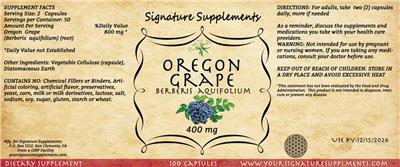
Oregon Grape 400 mg by Signature Supplements label
The label scan from the NIH Dietary Supplement Label Database. Tap to enlarge.
Label images are published by the NIH Dietary Supplement Label Database for the version of this product on file. Always read your actual product label.
View the full label (PDF)The Ingredients in Oregon Grape 400 mg by Signature Supplements
This is the 1 active ingredient this product is made of. Select it to open its full monograph.
Serving size2 Capsule(s) Dosage formCapsule Servings per container50 Amounts shown are per serving.
Oregon Grape
Interacts with1,219 drugs
Oregon grape is a shrub whose root contains berberine and related compounds. The strongest (though still modest) evidence is for topical creams that m...
Oregon Grape monograph & interactionsOther (inactive) ingredients: Cellulose, Diatomaceous Earth. These complete the product’s ingredient list but are not active constituents.
Oregon Grape 400 mg by Signature Supplements Drug Interactions
HelloPharmacist Interaction Report
Oregon Grape 400 mg by Signature Supplements has documented interactions with a substantial number of medications.
The most serious concern is with blood thinners and antiplatelet drugs (blood clot preventers): berberine, the active compound in Oregon grape, can reduce platelet clumping, which may increase bleeding risk when combined with these drugs.
Read the full breakdown — every affected drug type, severity by severity
Oregon grape may also raise levels of several types of drugs your liver processes. It can slow the breakdown of medications metabolized by three major liver enzymes (CYP2D6, CYP2C9, and CYP3A4), potentially raising their effects in your bloodstream.
Additionally, it may increase sedation if you take CNS depressants (sleep aids, sedatives, opioids), lower your blood pressure excessively when combined with blood pressure medications, raise the risk of low blood sugar (hypoglycemia) with diabetes drugs, and amplify the effects of cyclosporine, an immunosuppressant.
Altogether, these interactions span 1,203 individual medications. Use the medication checker on this page to look up your exact prescriptions before starting Oregon grape.
Check your own medications below · Editorial policy · How we use AI
Want to check YOUR meds against Oregon Grape 400 mg?
Ask about interactions with your drugs in plain English — “Can I take it with lisinopril?” — and we find you the answer in seconds, ingredient by ingredient.
Go to the checkerIngredients driving the most interactions
Individual Drug Interactions
The ingredients in Oregon Grape 400 mg interact with 1,219 drugs. Click any drug to see the details.
1 of the 1 ingredient in Oregon Grape 400 mg interact with drugs. Each result below shows which ingredient is responsible. Oregon Grape
Ado-trastuzumab EmtansineKadcyla
How Ado-trastuzumab Emtansine interacts with Oregon Grape 400 mg — through 1 ingredient. Tap an ingredient for the detail:
Oregon GrapeCytochrome P450 3a4 (cyp3a4) Substrates Moderate
Interaction Summary
Theoretically, Oregon grape might increase serum levels of drugs metabolized by CYP3A4.
Read the full Oregon Grape + Ado-trastuzumab Emtansine interactionAbciximabReoPro
How Abciximab interacts with Oregon Grape 400 mg — through 1 ingredient. Tap an ingredient for the detail:
Oregon GrapeAnticoagulant/antiplatelet Drugs Moderate
Interaction Summary
Theoretically, Oregon grape might increase the risk of bleeding when taken with anticoagulant or antiplatelet drugs.
Read the full Oregon Grape + Abciximab interactionAbemaciclibVerzenio
How Abemaciclib interacts with Oregon Grape 400 mg — through 1 ingredient. Tap an ingredient for the detail:
Oregon GrapeCytochrome P450 3a4 (cyp3a4) Substrates Moderate
Interaction Summary
Theoretically, Oregon grape might increase serum levels of drugs metabolized by CYP3A4.
Read the full Oregon Grape + Abemaciclib interactionAbiraterone
How Abiraterone interacts with Oregon Grape 400 mg — through 1 ingredient. Tap an ingredient for the detail:
Oregon GrapeCytochrome P450 3a4 (cyp3a4) Substrates Moderate
Interaction Summary
Theoretically, Oregon grape might increase serum levels of drugs metabolized by CYP3A4.
Read the full Oregon Grape + Abiraterone interactionAbiraterone AcetateYonsa, Zytiga
How Abiraterone Acetate interacts with Oregon Grape 400 mg — through 1 ingredient. Tap an ingredient for the detail:
Oregon GrapeCytochrome P450 3a4 (cyp3a4) Substrates Moderate
Interaction Summary
Theoretically, Oregon grape might increase serum levels of drugs metabolized by CYP3A4.
Read the full Oregon Grape + Abiraterone Acetate interactionAbrocitinibCibinqo
How Abrocitinib interacts with Oregon Grape 400 mg — through 1 ingredient. Tap an ingredient for the detail:
Oregon GrapeAnticoagulant/antiplatelet Drugs, Cytochrome P450 2c9 (cyp2c9) Substrates Moderate
Interaction Summary
Theoretically, Oregon grape might increase the risk of bleeding when taken with anticoagulant or antiplatelet drugs.
Read the full Oregon Grape + Abrocitinib interactionAcalabrutinibCalquence
How Acalabrutinib interacts with Oregon Grape 400 mg — through 1 ingredient. Tap an ingredient for the detail:
Oregon GrapeP-glycoprotein Substrates, Cytochrome P450 3a4 (cyp3a4) Substrates Moderate
Interaction Summary
Theoretically, Oregon grape might increase serum levels of drugs that are P-glycoprotein (P-gp) substrates.
Read the full Oregon Grape + Acalabrutinib interactionAcarboseGlucobay, Prandase, Precose
How Acarbose interacts with Oregon Grape 400 mg — through 1 ingredient. Tap an ingredient for the detail:
Oregon GrapeAntidiabetes Drugs Moderate
Interaction Summary
Theoretically, Oregon grape might increase the risk of hypoglycemia when taken with antidiabetes drugs.
Read the full Oregon Grape + Acarbose interactionAcebutololRhotral, Sectral
How Acebutolol interacts with Oregon Grape 400 mg — through 1 ingredient. Tap an ingredient for the detail:
Oregon GrapeAntihypertensive Drugs Moderate
Interaction Summary
Theoretically, Oregon grape might increase the risk of hypotension when taken with antihypertensive drugs.
Read the full Oregon Grape + Acebutolol interactionAcenocoumarolSintrom
How Acenocoumarol interacts with Oregon Grape 400 mg — through 1 ingredient. Tap an ingredient for the detail:
Oregon GrapeAnticoagulant/antiplatelet Drugs Moderate
Interaction Summary
Theoretically, Oregon grape might increase the risk of bleeding when taken with anticoagulant or antiplatelet drugs.
Read the full Oregon Grape + Acenocoumarol interactionAcepromazineAtravet
How Acepromazine interacts with Oregon Grape 400 mg — through 1 ingredient. Tap an ingredient for the detail:
Oregon GrapeCns Depressants Moderate
Interaction Summary
Theoretically, Oregon grape might increase the sedative effects of CNS depressants.
Read the full Oregon Grape + Acepromazine interactionAcetaminophen, AspirinGemnisyn
How Acetaminophen, Aspirin interacts with Oregon Grape 400 mg — through 1 ingredient. Tap an ingredient for the detail:
Oregon GrapeAnticoagulant/antiplatelet Drugs Moderate
Interaction Summary
Theoretically, Oregon grape might increase the risk of bleeding when taken with anticoagulant or antiplatelet drugs.
Read the full Oregon Grape + Acetaminophen, Aspirin interactionAcetaminophen, Aspirin, CaffeineExcedrin, Excedrin Extra Strength, Excedrin Migraine
How Acetaminophen, Aspirin, Caffeine interacts with Oregon Grape 400 mg — through 1 ingredient. Tap an ingredient for the detail:
Oregon GrapeCytochrome P450 3a4 (cyp3a4) Substrates, Anticoagulant/antiplatelet Drugs Moderate
Interaction Summary
Theoretically, Oregon grape might increase serum levels of drugs metabolized by CYP3A4.
Read the full Oregon Grape + Acetaminophen, Aspirin, Caffeine interactionAcetaminophen, Butalbital, CaffeineEsgic, Esgic Plus, Fiogesic, Fioricet, Repan, Tecnal +1 more
How Acetaminophen, Butalbital, Caffeine interacts with Oregon Grape 400 mg — through 1 ingredient. Tap an ingredient for the detail:
Oregon GrapeCytochrome P450 3a4 (cyp3a4) Substrates Moderate
Interaction Summary
Theoretically, Oregon grape might increase serum levels of drugs metabolized by CYP3A4.
Read the full Oregon Grape + Acetaminophen, Butalbital, Caffeine interactionAcetaminophen, Butalbital, Caffeine, CodeineEsgic with Codeine, Fioricet w/ Codeine
How Acetaminophen, Butalbital, Caffeine, Codeine interacts with Oregon Grape 400 mg — through 1 ingredient. Tap an ingredient for the detail:
Oregon GrapeCytochrome P450 3a4 (cyp3a4) Substrates, Cns Depressants +1 Moderate
Interaction Summary
Theoretically, Oregon grape might increase serum levels of drugs metabolized by CYP3A4.
Read the full Oregon Grape + Acetaminophen, Butalbital, Caffeine, Codeine interactionAcetaminophen, Butalbital, CodeineBancap w/ Codeine
How Acetaminophen, Butalbital, Codeine interacts with Oregon Grape 400 mg — through 1 ingredient. Tap an ingredient for the detail:
Oregon GrapeCytochrome P450 2d6 (cyp2d6) Substrates, Cns Depressants Moderate
Interaction Summary
Theoretically, Oregon grape might increase serum levels of drugs metabolized by CYP2D6.
Read the full Oregon Grape + Acetaminophen, Butalbital, Codeine interactionAcetaminophen, Butalbital, Codeine PhosphatePhrenilin #3
How Acetaminophen, Butalbital, Codeine Phosphate interacts with Oregon Grape 400 mg — through 1 ingredient. Tap an ingredient for the detail:
Oregon GrapeCns Depressants, Cytochrome P450 2d6 (cyp2d6) Substrates Moderate
Interaction Summary
Theoretically, Oregon grape might increase the sedative effects of CNS depressants.
Read the full Oregon Grape + Acetaminophen, Butalbital, Codeine Phosphate interactionAcetaminophen, Caffeine, Chlorpheniramine, Hydrocodone, PhenylephrineHycomine Compound
How Acetaminophen, Caffeine, Chlorpheniramine, Hydrocodone, Phenylephrine interacts with Oregon Grape 400 mg — through 1 ingredient. Tap an ingredient for the detail:
Oregon GrapeCns Depressants, Cytochrome P450 3a4 (cyp3a4) Substrates +1 Moderate
Interaction Summary
Theoretically, Oregon grape might increase the sedative effects of CNS depressants.
Read the full Oregon Grape + Acetaminophen, Caffeine, Chlorpheniramine, Hydrocodone, Phenylephrine interactionAcetaminophen, Caffeine, CodeineGesic C15, Gesic C30, Gesic C8, Lenoltec 1, Lenoltec 2, Lenoltec 3 +1 more
How Acetaminophen, Caffeine, Codeine interacts with Oregon Grape 400 mg — through 1 ingredient. Tap an ingredient for the detail:
Oregon GrapeCytochrome P450 2d6 (cyp2d6) Substrates, Cns Depressants +1 Moderate
Interaction Summary
Theoretically, Oregon grape might increase serum levels of drugs metabolized by CYP2D6.
Read the full Oregon Grape + Acetaminophen, Caffeine, Codeine interactionAcetaminophen, Caffeine, Codeine, SalicylamideCodalan No.1, Codalan No.2, Codalan No.3
How Acetaminophen, Caffeine, Codeine, Salicylamide interacts with Oregon Grape 400 mg — through 1 ingredient. Tap an ingredient for the detail:
Oregon GrapeCytochrome P450 3a4 (cyp3a4) Substrates, Cytochrome P450 2d6 (cyp2d6) Substrates +1 Moderate
Interaction Summary
Theoretically, Oregon grape might increase serum levels of drugs metabolized by CYP3A4.
Read the full Oregon Grape + Acetaminophen, Caffeine, Codeine, Salicylamide interactionAcetaminophen, Caffeine, DihydrocodeineDHC Plus, Panlor DC, Panlor SS
How Acetaminophen, Caffeine, Dihydrocodeine interacts with Oregon Grape 400 mg — through 1 ingredient. Tap an ingredient for the detail:
Oregon GrapeCns Depressants, Cytochrome P450 3a4 (cyp3a4) Substrates +1 Moderate
Interaction Summary
Theoretically, Oregon grape might increase the sedative effects of CNS depressants.
Read the full Oregon Grape + Acetaminophen, Caffeine, Dihydrocodeine interactionAcetaminophen, Caffeine, IsomethepteneMigralam
How Acetaminophen, Caffeine, Isometheptene interacts with Oregon Grape 400 mg — through 1 ingredient. Tap an ingredient for the detail:
Oregon GrapeCytochrome P450 3a4 (cyp3a4) Substrates Moderate
Interaction Summary
Theoretically, Oregon grape might increase serum levels of drugs metabolized by CYP3A4.
Read the full Oregon Grape + Acetaminophen, Caffeine, Isometheptene interactionAcetaminophen, Caffeine, PyrilamineMidol Max Strength Menstrual
How Acetaminophen, Caffeine, Pyrilamine interacts with Oregon Grape 400 mg — through 1 ingredient. Tap an ingredient for the detail:
Oregon GrapeCytochrome P450 3a4 (cyp3a4) Substrates Moderate
Interaction Summary
Theoretically, Oregon grape might increase serum levels of drugs metabolized by CYP3A4.
Read the full Oregon Grape + Acetaminophen, Caffeine, Pyrilamine interactionAcetaminophen, Chlorpheniramine Maleate, Dextromethorphan HbrVicks Formula 44M Cough, Cold & Flu Relief
How Acetaminophen, Chlorpheniramine Maleate, Dextromethorphan Hbr interacts with Oregon Grape 400 mg — through 1 ingredient. Tap an ingredient for the detail:
Oregon GrapeCytochrome P450 3a4 (cyp3a4) Substrates, Cytochrome P450 2d6 (cyp2d6) Substrates Moderate
Interaction Summary
Theoretically, Oregon grape might increase serum levels of drugs metabolized by CYP3A4.
Read the full Oregon Grape + Acetaminophen, Chlorpheniramine Maleate, Dextromethorphan Hbr interactionAcetaminophen, Chlorpheniramine, Codeine, PhenylephrineColrex
How Acetaminophen, Chlorpheniramine, Codeine, Phenylephrine interacts with Oregon Grape 400 mg — through 1 ingredient. Tap an ingredient for the detail:
Oregon GrapeCytochrome P450 3a4 (cyp3a4) Substrates, Cns Depressants +1 Moderate
Interaction Summary
Theoretically, Oregon grape might increase serum levels of drugs metabolized by CYP3A4.
Read the full Oregon Grape + Acetaminophen, Chlorpheniramine, Codeine, Phenylephrine interactionAcetaminophen, Chlorpheniramine, DextromethorphanCoricidin II Extra Strength Cold and Flu
How Acetaminophen, Chlorpheniramine, Dextromethorphan interacts with Oregon Grape 400 mg — through 1 ingredient. Tap an ingredient for the detail:
Oregon GrapeCytochrome P450 2d6 (cyp2d6) Substrates, Cytochrome P450 3a4 (cyp3a4) Substrates Moderate
Interaction Summary
Theoretically, Oregon grape might increase serum levels of drugs metabolized by CYP2D6.
Read the full Oregon Grape + Acetaminophen, Chlorpheniramine, Dextromethorphan interactionAcetaminophen, Chlorpheniramine, Dextromethorphan HydrobromideCoricidin HBP Maximum Strength Flu
How Acetaminophen, Chlorpheniramine, Dextromethorphan Hydrobromide interacts with Oregon Grape 400 mg — through 1 ingredient. Tap an ingredient for the detail:
Oregon GrapeCytochrome P450 3a4 (cyp3a4) Substrates, Cytochrome P450 2d6 (cyp2d6) Substrates Moderate
Interaction Summary
Theoretically, Oregon grape might increase serum levels of drugs metabolized by CYP3A4.
Read the full Oregon Grape + Acetaminophen, Chlorpheniramine, Dextromethorphan Hydrobromide interactionAcetaminophen, Chlorpheniramine, Dextromethorphan, PhenylpropanolamineMulti Symptom Cold Relief
How Acetaminophen, Chlorpheniramine, Dextromethorphan, Phenylpropanolamine interacts with Oregon Grape 400 mg — through 1 ingredient. Tap an ingredient for the detail:
Oregon GrapeCytochrome P450 2d6 (cyp2d6) Substrates, Cytochrome P450 3a4 (cyp3a4) Substrates Moderate
Interaction Summary
Theoretically, Oregon grape might increase serum levels of drugs metabolized by CYP2D6.
Read the full Oregon Grape + Acetaminophen, Chlorpheniramine, Dextromethorphan, Phenylpropanolamine interactionAcetaminophen, Chlorpheniramine, Dextromethorphan, PseudoephedrineChildren's Tylenol Cold Plus Cough, Tylenol Cold Ex Strength
How Acetaminophen, Chlorpheniramine, Dextromethorphan, Pseudoephedrine interacts with Oregon Grape 400 mg — through 1 ingredient. Tap an ingredient for the detail:
Oregon GrapeCytochrome P450 3a4 (cyp3a4) Substrates, Cytochrome P450 2d6 (cyp2d6) Substrates Moderate
Interaction Summary
Theoretically, Oregon grape might increase serum levels of drugs metabolized by CYP3A4.
Read the full Oregon Grape + Acetaminophen, Chlorpheniramine, Dextromethorphan, Pseudoephedrine interactionAcetaminophen, Chlorpheniramine, Guaifenesin, Phenylephrine, SalicylamideRhinogesic GG
How Acetaminophen, Chlorpheniramine, Guaifenesin, Phenylephrine, Salicylamide interacts with Oregon Grape 400 mg — through 1 ingredient. Tap an ingredient for the detail:
Oregon GrapeCytochrome P450 3a4 (cyp3a4) Substrates Moderate
Interaction Summary
Theoretically, Oregon grape might increase serum levels of drugs metabolized by CYP3A4.
Read the full Oregon Grape + Acetaminophen, Chlorpheniramine, Guaifenesin, Phenylephrine, Salicylamide interactionEach ingredient & the kinds of drugs it affects
For each ingredient in Oregon Grape 400 mg with known interactions, here are the types of medications it can affect. Open any type for the detail — or search your exact drug in the checker above.
Oregon Grape
Anticoagulant/Antiplatelet Drugs
Theoretically, Oregon grape might increase the risk of bleeding when taken with anticoagulant or antiplatelet drugs.
In vitro and in vivo research suggests that berberine, a constituent of Oregon grape, can inhibit platelet aggregation.
Antidiabetes Drugs
Theoretically, Oregon grape might increase the risk of hypoglycemia when taken with antidiabetes drugs.
Clinical research suggests that berberine, a constituent of Oregon grape, can lower blood glucose levels.
Antihypertensive Drugs
Theoretically, Oregon grape might increase the risk of hypotension when taken with antihypertensive drugs.
Animal research suggests that berberine, a constituent of Oregon grape, can have hypotensive effects. Also, an analysis of clinical evidence suggests that taking berberine in combination with amlodipine (Norvasc) can lower systolic and diastolic blood pressure when compared with taking amlodipine alone.
Cns Depressants
Theoretically, Oregon grape might increase the sedative effects of CNS depressants.
Animal research suggests that berberine, a constituent of Oregon grape, can have sedative effects.
Cyclosporine (Neoral, Sandimmune)
Theoretically, Oregon grape might increase the effects and adverse effects of cyclosporine.
Berberine, a constituent of Oregon grape, can reduce metabolism of cyclosporine and increase serum levels. It might inhibit cytochrome P450 3A4 (CYP3A4), which metabolizes cyclosporine.
Cytochrome P450 2C9 (Cyp2C9) Substrates
Theoretically, Oregon grape might increase serum levels of drugs metabolized by CYP2C9.
Preliminary clinical evidence suggests that berberine, a constituent of Oregon grape, can inhibit cytochrome P450 2C9 (CYP2C9).
Cytochrome P450 2D6 (Cyp2D6) Substrates
Theoretically, Oregon grape might increase serum levels of drugs metabolized by CYP2D6.
In vitro research and preliminary clinical evidence suggest that berberine, a constituent of Oregon grape, can inhibit cytochrome P450 2D6 (CYP2D6).
Cytochrome P450 3A4 (Cyp3A4) Substrates
Theoretically, Oregon grape might increase serum levels of drugs metabolized by CYP3A4.
In vitro research and preliminary clinical evidence suggest that berberine, a constituent of Oregon grape, moderately inhibits cytochrome P450 3A4 (CYP3A4).
P-Glycoprotein Substrates
Theoretically, Oregon grape might increase serum levels of drugs that are P-glycoprotein (P-gp) substrates.
In vitro research suggests that Oregon grape extracts inhibit P-gp efflux.
Brand information
Manufacturer and brand details for Oregon Grape 400 mg, from the product label.
Signature Supplements
See all Signature Supplements products- Name
- Signature Supplements
- Street Address
- P.O. Box 1112
- City
- San Clemente
- State
- CA
- Web Address
- yoursignaturesupplements.com
Oregon Grape 400 mg by Signature Supplements: Common Questions
Does Oregon Grape 400 mg by Signature Supplements interact with any medications?
How can one product interact with so many drugs?
Where does this information come from?
Can I take Oregon grape if I'm pregnant or breastfeeding?
What is Oregon grape actually used for?
Are there any side effects from taking it by mouth?
Why does Oregon grape interact with so many medications?
Does this product contain anything besides Oregon grape?
Written and reviewed by the HelloPharmacist editorial staff. Our editorial policy
Not sure if Oregon Grape 400 mg is safe with your meds?
Our pharmacists answer your medication & supplement questions — free.
Label information is sourced from the NIH Dietary Supplement Label Database and reflects the product version on file; always read your actual product label. This page is for education only and is not a substitute for professional medical advice. Confirm with your pharmacist or doctor before combining supplements and medications.
The Full Monographs Behind Oregon Grape 400 mg’s Ingredients
Every ingredient we hold a full HelloPharmacist monograph for — uses, evidence, safety, and the complete interaction list.
Sources & How We Checked
Oregon Grape 400 mg's label data comes from the NIH Dietary Supplement Label Database; the ingredient interaction data is from the Natural Medicines database, reviewed by our pharmacists.
- NIH Dietary Supplement Label Database (DSLD) — The official product label on file for this supplement.
- Natural Medicines (Therapeutic Research Center) — Evidence-graded clinical reference behind the ingredient interaction data.
Content is written and reviewed by licensed HelloPharmacist pharmacists. See our data sources and editorial standards for how this information is built and checked.
The 21 references behind this product’s interaction data
Every citation that drives the interaction findings for this product’s ingredients, from the evidence-graded Natural Medicines (TRC Healthcare) database. Open an ingredient to browse its citations — links open the study on PubMed or the publisher’s site.
Oregon Grape 21 references
- Wiesenauer M, Lydtke R. Mahonia aquifolium in patients with Psoriasis vulgaris; an intraindividual study. Phytomedicine 1996;3:231-5.
- Chan E. Displacement of bilirubin from albumin by berberine. Biol Neonate 1993;63:201-8. PubMed
- Janbaz KH, Gilani AH. Studies on preventive and curative effects of berberine on chemical-induced hepatotoxicity in rodents. Fitoterapia 2000;71:25-33.. PubMed
- Wu X, Li Q, Xin H, Yu A, Zhong M. Effects of berberine on the blood concentration of cyclosporin A in renal transplanted recipients: clinical and pharmacokinetic study. Eur J Clin Pharmacol 2005;61:567-72. PubMed
- Gulliver WP, Donsky HJ. A report on three recent clinical trials using Mahonia aquifolium 10% topical cream and a review of the worldwide clinical experience with Mahonia aquifolium for the treatment of plaque psoriasis. Am J Ther 2005;12:398-406. PubMed
- Zhang Y, Li X, Zou D, et al. Treatment of type 2 diabetes and dyslipidemia with the natural plant alkaloid berberine. J Clin Endocrinol Metab 2008;93:2559-65. PubMed
- Budzinski JW, Foster BC, Vandenhoek S, Arnason JT. An in vitro evaluation of human cytochrome P450 3A4 inhibition by selected commercial herbal extracts and tinctures. Phytomedicine 2000;7:273-82. PubMed
- Chatterjee P, Franklin MR. Human cytochrome p450 inhibition and metabolic-intermediate complex formation by goldenseal extract and its methylenedioxyphenyl components. Drug Metab Dispos 2003;31:1391-7. PubMed
- Shanbhag, S. M., Kulkarni, H. J., and Gaitonde, B. B. Pharmacological actions of berberine on the central nervous system. Jpn.J Pharmacol 1970;20(4):482-487. PubMed
- Wu, J. F. and Liu, T. P. [Effects of berberine on platelet aggregation and plasma levels of TXB2 and 6-keto-PGF1 alpha in rats with reversible middle cerebral artery occlusion]. Yao Xue.Xue.Bao. 1995;30(2):98-102.
- Peng, W. H., Hsieh, M. T., and Wu, C. R. Effect of long-term administration of berberine on scopolamine-induced amnesia in rats. Jpn J Pharmacol 1997;74(3):261-266. DOI
- Sabir M and Bhide NK. Study of some pharmacological actions of berberine. Ind J Physiol & Pharmac 1971;15(3):111-132.
- Tripathi YB and Shukla SD. Berberis artistata inhibits PAF induced aggregation of rabbit platelets. Phytotherapy Research 1996;10:628-630.
- Yin, J., Xing, H., and Ye, J. Efficacy of berberine in patients with type 2 diabetes mellitus. Metabolism 2008;57(5):712-717. PubMed
- Zhang, H., Wei, J., Xue, R., Wu, J. D., Zhao, W., Wang, Z. Z., Wang, S. K., Zhou, Z. X., Song, D. Q., Wang, Y. M., Pan, H. N., Kong, W. J., and Jiang, J. D. Berberine lowers blood glucose in type 2 diabetes mellitus patients through increasing insulin re
- Guo, Y., Chen, Y., Tan, Z. R., Klaassen, C. D., and Zhou, H. H. Repeated administration of berberine inhibits cytochromes P450 in humans. Eur J Clin Pharmacol 2012;68(2):213-217. PubMed
- Wei, W., Zhao, H., Wang, A., Sui, M., Liang, K., Deng, H., Ma, Y., Zhang, Y., Zhang, H., and Guan, Y. A clinical study on the short-term effect of berberine in comparison to metformin on the metabolic characteristics of women with polycystic ovary syndro
- Hermann, R. and von, Richter O. Clinical evidence of herbal drugs as perpetrators of pharmacokinetic drug interactions. Planta Med 2012;78(13):1458-1477. PubMed
- Chun YT, Yip TT, Lau KL, and et al. A biochemical study on the hypotensive effect of berberine in rats. Gen Pharmac 1979;10:177-182. PubMed
- Lan J, Zhao Y, Dong F, et al. Meta-analysis of the effect and safety of berberine in the treatment of type 2 diabetes mellitus, hyperlipemia and hypertension. J Ethnopharmacol. 2015;161:69-81. PubMed
- Fan Y, Zhou Z, Zhang L. Effect of Oregon grape root extracts on P-glycoprotein mediated transport in in vitro cell lines. J Pharm Pharm Sci 2024;26:11927. PubMed
Parts of this content are provided by the Therapeutic Research Center, LLC.
DISCLAIMER: Currently this does not check for drug-drug interactions. This is not an all-inclusive comprehensive list of potential interactions and is for informational purposes only. Not all interactions are known or well-reported in the scientific literature, and new interactions are continually being reported. Input is needed from a qualified healthcare provider including a pharmacist before starting any therapy. Application of clinical judgment is necessary.
© 2021 Therapeutic Research Center, LLC