
Organic Defense Mix Ingredients & Drug Interactions
by SuperSmart
What is this page for?
First and foremost: checking Organic Defense Mix against your medications. The heart of this page is the interaction checker and the full interaction report — how this product’s ingredients may interact with prescription and over-the-counter medicines you may be taking.
Around that, we add a pharmacist’s high-level view of the product as a whole — what’s inside, the evidence for its stated use, how transparent the label is, and what safety data exists — so you can see the full picture in one place. It’s educational information from our licensed clinical databases and the clinical staff at HelloPharmacist — not medical advice — and we don’t sell or endorse products. Our editorial policy
Organic Defense Mix is a dietary supplement by SuperSmart with 6 active ingredients. Its ingredients are commonly taken for digestive upset, respiratory and cold symptoms, antimicrobial support.Based on those ingredients, 1,216 medications have a known interaction with it, the most serious rated moderate. The ingredients most likely to interact are Eucalyptus Essential Oil, Peppermint Essential Oil, Spearmint Essential Oil. Use the checker below to test your specific medication, or read the full HelloPharmacist Interaction Report.
Check Your Meds Against Organic Defense Mix by SuperSmart
Ask about any prescription or over-the-counter medication and we check it for interactions with Organic Defense Mix by SuperSmart — and tell you which ingredient is responsible.
AI summaries are generated from our interaction database for education only — always confirm with your pharmacist. How we use AI
Ask the Pharmacist
A licensed pharmacist will answer your question by email — free, usually within 24 hours.
Got it — thank you!
A licensed pharmacist will answer within 24 hours. Keep an eye on your email (worth checking spam, just in case).
HelloPharmacist Scorecard of Organic Defense Mix by SuperSmart
Our pharmacy team’s full take, with four database checks built into the cards below — a summary of what is known, not a grade of the product itself.
What’s inside
Low disclosure
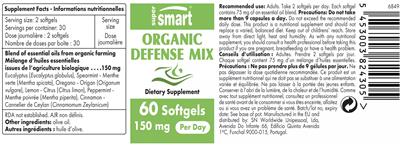
Organic Defense Mix contains six active ingredients, all essential oils: oregano, lemon, peppermint, eucalyptus, spearmint, and cinnamon. These are concentrated plant extracts traditionally used for their aromatic and antimicrobial properties.
The product also contains olive oil as an inactive ingredient to dilute and carry the essential oils. Essential oils are potent—they're much stronger and more concentrated than the same herbs used in food or tea.
That's why they're packaged as softgel capsules rather than loose drops or powder.
Does it work?
Strong evidence
The evidence for what these oils actually do is thin across the board. For peppermint specifically, we have solid data showing it's likely effective for irritable bowel syndrome (IBS) and possibly effective for indigestion, nausea from chemotherapy, and cramping during medical procedures.
For the other five oils—oregano, lemon, eucalyptus, spearmint, and cinnamon—the facts we hold show insufficient reliable evidence to rate them for any of the conditions they're used for (acne, bronchitis, asthma, colds, cognitive decline, and others). That doesn't mean they don't work; it means the research isn't established enough yet to say one way or the other.
How safe is it?
Well-documented data
These essential oils are generally well tolerated in food amounts, but the concentrated oils in this supplement are a different story—they're stronger and less studied than their culinary cousins. The most common side effects are mild: heartburn, belching, nausea, diarrhea, and abdominal discomfort.
Some people report topical irritation or burning if they handle the capsules or burp up the oil. Rare but serious reactions include allergic responses—swelling of lips and tongue, difficulty breathing, and in one documented case, anaphylaxis from oregano.
Eucalyptus oil, if ingested in large amounts or undiluted, can cause serious toxicity including seizures, coma, and breathing problems. Spearmint oil has caused allergic dermatitis and, in one trial, anxiety in a single participant.
Cinnamon in high doses over time raises concern for liver damage because of its coumarin content. On pregnancy: oregano and cinnamon's safety data advises against supplement amounts during pregnancy (food is fine).
Peppermint and eucalyptus are likely safe in pregnancy. For lemon, spearmint, and the blend, there isn't enough data to know either way—talk with your doctor.
For breastfeeding, concentrated supplements haven't been well studied for any of these oils; food and tea amounts are generally considered safe.
Meds to double-check
Moderate interaction found
Before taking this product, double-check with your pharmacist if you're on: blood thinners or antiplatelet drugs (like warfarin or aspirin); diabetes medications; liver-metabolized drugs (especially those using CYP3A4, CYP2C9, or CYP2C19 enzymes—ask your pharmacist if you're unsure); the immunosuppressant cyclosporine; sedating drugs or CNS depressants; liver-damaging medications; the antifungal itraconazole; amphetamines; or the barbiturate pentobarbital. The interactions listed are Moderate to Minor, but they involve a wide range of common medications.
The bottom line
Scorecard at a glanceFormula with limited ingredient disclosure with strong clinical evidence behind its ingredients' uses. Moderate medication interactions have been identified, and safety information is well characterized.
If you take blood thinners, diabetes drugs, or any medication broken down by your liver, you need to check this product against your exact medications before starting it. Peppermint is the only ingredient here with solid evidence of benefit—for IBS and digestive upset—but you're getting five other oils whose effectiveness isn't established.
The product is generally well tolerated, but concentrated essential oils aren't the same as using herbs in food. Talk with your pharmacist about whether it fits your medications and health goals.
Educational only — not medical advice; always confirm with your pharmacist. Our editorial policy · How we use AI
Assessment coverage: 6 of 6 active ingredients matched to our full ingredient reviews (monographs). Based on the product label dated Jun 25, 2025.
This Scorecard evaluates available label information, ingredient evidence, and known medication-safety considerations. It does not independently verify product identity, purity, potency, contamination, or manufacturing quality. How these ratings are computed
General information
Key facts about Organic Defense Mix, straight from the product label.
| Brand | SuperSmart |
|---|---|
| Barcode (UPC) | 5453003824305 |
| Net contents | 60 Softgel(s) |
| Market status | On market |
| Date entered into DSLD | Jun 25, 2025 |
| DSLD ID | 332717 |
| Product type | Botanical |
| Supplement form | Softgel Capsule |
| Dietary claims / uses | All Other |
| Intended target group(s) | Adult (18 - 50 Years) |
Everything in this section is reproduced from the manufacturer’s own product label — it’s the label speaking, not HelloPharmacist. We show it so you can see exactly what the maker states; we don’t verify or endorse those statements.
Supplement Facts
The label details for Organic Defense Mix by SuperSmart, sourced from the NIH Dietary Supplement Label Database.
Supplement Facts
| Ingredient | Amount | % DV |
|---|---|---|
| Oregano Essential Oil | 0 NP | -- |
| Lemon Essential Oil | 0 NP | -- |
| Peppermint Essential Oil | 0 NP | -- |
| Blend of Essential Oils | 150 mg | -- |
| Eucalyptus Essential Oil | 0 NP | -- |
| Spearmint Essential Oil | 0 NP | -- |
| Cinnamon Essential Oil | 0 NP | -- |
Other ingredients: Olive Oil
Tap any ingredient to jump to its full detail below.
These statements are the manufacturer’s wording, reproduced from the product label — the label is saying it, not HelloPharmacist. We don’t verify or endorse them.
FDA Statement of Identity
Dietary Supplement
Formula
Organic Defense Mix 150 mg per day
Each softgel contains 75 mg of an essential oil blend.
Formulation
Organic Defense Mix 150 mg per day
Suggested/Recommended/Usage/Directions
Recommended use: Adults. Take two softgels per day.
Precautions
Precautions: Do not take more than 9 capsules a day. Do not exceed the recommended daily dose. This product is a nutritional supplement and should not replace a varied, balanced diet.
Keep out of childrens' reach.
As with any nutritional supplement, you should consult a health professional before taking this product if you are pregnant, breastfeeding or have a health problem.
Storage
Store away from direct light, heat and humidity.
Is this label outdated? Report a formula or label change and our pharmacy team will review it.
Organic Defense Mix by SuperSmart label
The label scan from the NIH Dietary Supplement Label Database. Tap to enlarge.
Label images are published by the NIH Dietary Supplement Label Database for the version of this product on file. Always read your actual product label.
View the full label (PDF)The Ingredients in Organic Defense Mix by SuperSmart
These are the 6 active ingredients this product is made of. Select any to open its full monograph.
Serving size2 Softgel(s) Dosage formSoftgel Capsule Servings per container30 Amounts shown are per serving.
Most supplement products combine several ingredients, and a medication can interact with the product through any one of them. Each ingredient below shows whether it has known drug interactions.
Blend of Essential Oils
Other (inactive) ingredients: Olive Oil. These complete the product’s ingredient list but are not active constituents.
Organic Defense Mix by SuperSmart Drug Interactions
HelloPharmacist Interaction Report
Organic Defense Mix by SuperSmart contains six essential oils, and the ingredients we could check are documented to interact with a significant number of medications.
The most serious interaction involves peppermint essential oil and drugs that are broken down by the liver enzyme CYP3A4 (such as certain blood pressure medications, cholesterol drugs, and immunosuppressants)—peppermint can raise their levels and effects, a Moderate-severity concern. Altogether, these interactions span 1,194 individual medications.
Read the full breakdown — every affected drug type, severity by severity
The product's other checked ingredients interact with several other drug categories. Oregano essential oil may increase bleeding risk with blood thinners (anticoagulants) or antiplatelet drugs, and may lower blood sugar too much if you're on diabetes medications—both Moderate concerns.
Peppermint also affects drugs broken down by liver enzymes CYP2C19, CYP2C9, and CYP1A2, and raises levels of the immunosuppressant cyclosporine. Eucalyptus essential oil similarly interacts with those same liver enzymes, plus diabetes drugs, amphetamines, and the barbiturate pentobarbital.
Cinnamon essential oil may lower blood sugar additively with diabetes drugs and could harm the liver if taken in high doses alongside other liver-damaging medications. Spearmint oil may alter how sedating drugs work and could add to liver damage risk with hepatotoxic drugs.
Lemon essential oil and the unnamed blend of essential oils—we either could not check one or it's listed as containing other ingredients individually. Lemon does have a documented Minor interaction with the antifungal itraconazole.
Because this product contains multiple essential oils with overlapping enzyme interactions and blood sugar effects, check your exact medications with the search tool on this page before taking it.
Check your own medications below · Editorial policy · How we use AI
Want to check YOUR meds against Organic Defense Mix?
Ask about interactions with your drugs in plain English — “Can I take it with lisinopril?” — and we find you the answer in seconds, ingredient by ingredient.
Go to the checkerIngredients driving the most interactions
Individual Drug Interactions
The ingredients in Organic Defense Mix interact with 1,216 drugs. Click any drug to see the details.
6 of the 6 ingredients in Organic Defense Mix interact with drugs. Each result below shows which ingredient is responsible. Eucalyptus Essential Oil Peppermint Essential Oil Spearmint Essential Oil Cinnamon Essential Oil Oregano Essential Oil Lemon Essential Oil
6-mercaptopurinePurinethol
How 6-mercaptopurine interacts with Organic Defense Mix — through 2 ingredients. Tap an ingredient for the detail:
Cinnamon Essential OilHepatotoxic Drugs Moderate
Interaction Summary
Theoretically, large doses of cassia cinnamon might cause additive effects when used with hepatotoxic drugs.
Read the full Cinnamon Essential Oil + 6-mercaptopurine interactionSpearmint Essential OilHepatotoxic Drugs Moderate
Interaction Summary
Theoretically, high doses of spearmint might increase the risk of liver damage when taken with hepatotoxic drugs.
Read the full Spearmint Essential Oil + 6-mercaptopurine interactionAdo-trastuzumab EmtansineKadcyla
How Ado-trastuzumab Emtansine interacts with Organic Defense Mix — through 2 ingredients. Tap an ingredient for the detail:
Peppermint Essential OilCytochrome P450 3a4 (cyp3a4) Substrates Moderate
Interaction Summary
Theoretically, peppermint might increase the levels of CYP3A4 substrates.
Read the full Peppermint Essential Oil + Ado-trastuzumab Emtansine interactionEucalyptus Essential OilCytochrome P450 3a4 (cyp3a4) Substrates Moderate
Interaction Summary
Theoretically, eucalyptus might increase the levels of CYP3A4 substrates.
Read the full Eucalyptus Essential Oil + Ado-trastuzumab Emtansine interactionAbacavir Sulfate, Dolutegravir, LamivudineTriumeq
How Abacavir Sulfate, Dolutegravir, Lamivudine interacts with Organic Defense Mix — through 2 ingredients. Tap an ingredient for the detail:
Spearmint Essential OilHepatotoxic Drugs Moderate
Interaction Summary
Theoretically, high doses of spearmint might increase the risk of liver damage when taken with hepatotoxic drugs.
Read the full Spearmint Essential Oil + Abacavir Sulfate, Dolutegravir, Lamivudine interactionCinnamon Essential OilHepatotoxic Drugs Moderate
Interaction Summary
Theoretically, large doses of cassia cinnamon might cause additive effects when used with hepatotoxic drugs.
Read the full Cinnamon Essential Oil + Abacavir Sulfate, Dolutegravir, Lamivudine interactionAbacavir, LamivudineEpzicom
How Abacavir, Lamivudine interacts with Organic Defense Mix — through 2 ingredients. Tap an ingredient for the detail:
Cinnamon Essential OilHepatotoxic Drugs Moderate
Interaction Summary
Theoretically, large doses of cassia cinnamon might cause additive effects when used with hepatotoxic drugs.
Read the full Cinnamon Essential Oil + Abacavir, Lamivudine interactionSpearmint Essential OilHepatotoxic Drugs Moderate
Interaction Summary
Theoretically, high doses of spearmint might increase the risk of liver damage when taken with hepatotoxic drugs.
Read the full Spearmint Essential Oil + Abacavir, Lamivudine interactionAbciximabReoPro
How Abciximab interacts with Organic Defense Mix — through 1 ingredient. Tap an ingredient for the detail:
Oregano Essential OilAnticoagulant/antiplatelet Drugs Moderate
Interaction Summary
Theoretically, oregano might increase the risk of bleeding when taken with anticoagulant or antiplatelet drugs.
Read the full Oregano Essential Oil + Abciximab interactionAbemaciclibVerzenio
How Abemaciclib interacts with Organic Defense Mix — through 2 ingredients. Tap an ingredient for the detail:
Eucalyptus Essential OilCytochrome P450 3a4 (cyp3a4) Substrates Moderate
Interaction Summary
Theoretically, eucalyptus might increase the levels of CYP3A4 substrates.
Read the full Eucalyptus Essential Oil + Abemaciclib interactionPeppermint Essential OilCytochrome P450 3a4 (cyp3a4) Substrates Moderate
Interaction Summary
Theoretically, peppermint might increase the levels of CYP3A4 substrates.
Read the full Peppermint Essential Oil + Abemaciclib interactionAbiraterone
How Abiraterone interacts with Organic Defense Mix — through 4 ingredients. Tap an ingredient for the detail:
Cinnamon Essential OilHepatotoxic Drugs Moderate
Interaction Summary
Theoretically, large doses of cassia cinnamon might cause additive effects when used with hepatotoxic drugs.
Read the full Cinnamon Essential Oil + Abiraterone interactionPeppermint Essential OilCytochrome P450 3a4 (cyp3a4) Substrates Moderate
Interaction Summary
Theoretically, peppermint might increase the levels of CYP3A4 substrates.
Read the full Peppermint Essential Oil + Abiraterone interactionSpearmint Essential OilHepatotoxic Drugs Moderate
Interaction Summary
Theoretically, high doses of spearmint might increase the risk of liver damage when taken with hepatotoxic drugs.
Read the full Spearmint Essential Oil + Abiraterone interactionEucalyptus Essential OilCytochrome P450 3a4 (cyp3a4) Substrates Moderate
Interaction Summary
Theoretically, eucalyptus might increase the levels of CYP3A4 substrates.
Read the full Eucalyptus Essential Oil + Abiraterone interactionAbiraterone AcetateYonsa, Zytiga
How Abiraterone Acetate interacts with Organic Defense Mix — through 4 ingredients. Tap an ingredient for the detail:
Eucalyptus Essential OilCytochrome P450 3a4 (cyp3a4) Substrates Moderate
Interaction Summary
Theoretically, eucalyptus might increase the levels of CYP3A4 substrates.
Read the full Eucalyptus Essential Oil + Abiraterone Acetate interactionSpearmint Essential OilHepatotoxic Drugs Moderate
Interaction Summary
Theoretically, high doses of spearmint might increase the risk of liver damage when taken with hepatotoxic drugs.
Read the full Spearmint Essential Oil + Abiraterone Acetate interactionCinnamon Essential OilHepatotoxic Drugs Moderate
Interaction Summary
Theoretically, large doses of cassia cinnamon might cause additive effects when used with hepatotoxic drugs.
Read the full Cinnamon Essential Oil + Abiraterone Acetate interactionPeppermint Essential OilCytochrome P450 3a4 (cyp3a4) Substrates Moderate
Interaction Summary
Theoretically, peppermint might increase the levels of CYP3A4 substrates.
Read the full Peppermint Essential Oil + Abiraterone Acetate interactionAbrocitinibCibinqo
How Abrocitinib interacts with Organic Defense Mix — through 3 ingredients. Tap an ingredient for the detail:
Peppermint Essential OilCytochrome P450 2c9 (cyp2c9) Substrates, Cytochrome P450 2c19 (cyp2c19) Substrates Moderate
Interaction Summary
Theoretically, peppermint might increase the levels of CYP2C9 substrates.
Read the full Peppermint Essential Oil + Abrocitinib interactionOregano Essential OilAnticoagulant/antiplatelet Drugs Moderate
Interaction Summary
Theoretically, oregano might increase the risk of bleeding when taken with anticoagulant or antiplatelet drugs.
Read the full Oregano Essential Oil + Abrocitinib interactionEucalyptus Essential OilCytochrome P450 2c19 (cyp2c19) Substrates, Cytochrome P450 2c9 (cyp2c9) Substrates Moderate
Interaction Summary
Theoretically, eucalyptus might increase the levels of CYP2C19 substrates.
Read the full Eucalyptus Essential Oil + Abrocitinib interactionAcalabrutinibCalquence
How Acalabrutinib interacts with Organic Defense Mix — through 2 ingredients. Tap an ingredient for the detail:
Eucalyptus Essential OilCytochrome P450 3a4 (cyp3a4) Substrates Moderate
Interaction Summary
Theoretically, eucalyptus might increase the levels of CYP3A4 substrates.
Read the full Eucalyptus Essential Oil + Acalabrutinib interactionPeppermint Essential OilCytochrome P450 3a4 (cyp3a4) Substrates Moderate
Interaction Summary
Theoretically, peppermint might increase the levels of CYP3A4 substrates.
Read the full Peppermint Essential Oil + Acalabrutinib interactionAcarboseGlucobay, Prandase, Precose
How Acarbose interacts with Organic Defense Mix — through 4 ingredients. Tap an ingredient for the detail:
Cinnamon Essential OilAntidiabetes Drugs, Hepatotoxic Drugs Moderate
Interaction Summary
Theoretically, cassia cinnamon may have additive effects with antidiabetes drugs.
Read the full Cinnamon Essential Oil + Acarbose interactionSpearmint Essential OilHepatotoxic Drugs Moderate
Interaction Summary
Theoretically, high doses of spearmint might increase the risk of liver damage when taken with hepatotoxic drugs.
Read the full Spearmint Essential Oil + Acarbose interactionEucalyptus Essential OilAntidiabetes Drugs Moderate
Interaction Summary
Theoretically, eucalyptus leaf might increase the risk of hypoglycemia.
Read the full Eucalyptus Essential Oil + Acarbose interactionOregano Essential OilAntidiabetes Drugs Moderate
Interaction Summary
Theoretically, oregano might increase the risk for hypoglycemia when taken with antidiabetes drugs.
Read the full Oregano Essential Oil + Acarbose interactionAcebutololRhotral, Sectral
How Acebutolol interacts with Organic Defense Mix — through 2 ingredients. Tap an ingredient for the detail:
Spearmint Essential OilHepatotoxic Drugs Moderate
Interaction Summary
Theoretically, high doses of spearmint might increase the risk of liver damage when taken with hepatotoxic drugs.
Read the full Spearmint Essential Oil + Acebutolol interactionCinnamon Essential OilHepatotoxic Drugs Moderate
Interaction Summary
Theoretically, large doses of cassia cinnamon might cause additive effects when used with hepatotoxic drugs.
Read the full Cinnamon Essential Oil + Acebutolol interactionAcenocoumarolSintrom
How Acenocoumarol interacts with Organic Defense Mix — through 1 ingredient. Tap an ingredient for the detail:
Oregano Essential OilAnticoagulant/antiplatelet Drugs Moderate
Interaction Summary
Theoretically, oregano might increase the risk of bleeding when taken with anticoagulant or antiplatelet drugs.
Read the full Oregano Essential Oil + Acenocoumarol interactionAcepromazineAtravet
How Acepromazine interacts with Organic Defense Mix — through 1 ingredient. Tap an ingredient for the detail:
Spearmint Essential OilCns Depressants Moderate
Interaction Summary
Theoretically, spearmint might alter the sedative effects of CNS depressants.
Read the full Spearmint Essential Oil + Acepromazine interactionAcetaminophenChildren's Tylenol, Children's Tylenol Meltaways, Tylenol, Tylenol Ex Strength
How Acetaminophen interacts with Organic Defense Mix — through 4 ingredients. Tap an ingredient for the detail:
Spearmint Essential OilHepatotoxic Drugs Moderate
Interaction Summary
Theoretically, high doses of spearmint might increase the risk of liver damage when taken with hepatotoxic drugs.
Read the full Spearmint Essential Oil + Acetaminophen interactionCinnamon Essential OilHepatotoxic Drugs Moderate
Interaction Summary
Theoretically, large doses of cassia cinnamon might cause additive effects when used with hepatotoxic drugs.
Read the full Cinnamon Essential Oil + Acetaminophen interactionEucalyptus Essential OilCytochrome P450 1a2 (cyp1a2) Substrates Moderate
Interaction Summary
Theoretically, eucalyptus might increase the levels of CYP1A2 substrates.
Read the full Eucalyptus Essential Oil + Acetaminophen interactionPeppermint Essential OilCytochrome P450 1a2 (cyp1a2) Substrates Minor
Interaction Summary
Theoretically, peppermint might increase the levels of CYP1A2 substrates.
Read the full Peppermint Essential Oil + Acetaminophen interactionAcetaminophen, AspirinGemnisyn
How Acetaminophen, Aspirin interacts with Organic Defense Mix — through 5 ingredients. Tap an ingredient for the detail:
Oregano Essential OilAnticoagulant/antiplatelet Drugs Moderate
Interaction Summary
Theoretically, oregano might increase the risk of bleeding when taken with anticoagulant or antiplatelet drugs.
Read the full Oregano Essential Oil + Acetaminophen, Aspirin interactionEucalyptus Essential OilCytochrome P450 1a2 (cyp1a2) Substrates Moderate
Interaction Summary
Theoretically, eucalyptus might increase the levels of CYP1A2 substrates.
Read the full Eucalyptus Essential Oil + Acetaminophen, Aspirin interactionCinnamon Essential OilHepatotoxic Drugs Moderate
Interaction Summary
Theoretically, large doses of cassia cinnamon might cause additive effects when used with hepatotoxic drugs.
Read the full Cinnamon Essential Oil + Acetaminophen, Aspirin interactionSpearmint Essential OilHepatotoxic Drugs Moderate
Interaction Summary
Theoretically, high doses of spearmint might increase the risk of liver damage when taken with hepatotoxic drugs.
Read the full Spearmint Essential Oil + Acetaminophen, Aspirin interactionPeppermint Essential OilCytochrome P450 1a2 (cyp1a2) Substrates Minor
Interaction Summary
Theoretically, peppermint might increase the levels of CYP1A2 substrates.
Read the full Peppermint Essential Oil + Acetaminophen, Aspirin interactionAcetaminophen, Aspirin, CaffeineExcedrin, Excedrin Extra Strength, Excedrin Migraine
How Acetaminophen, Aspirin, Caffeine interacts with Organic Defense Mix — through 5 ingredients. Tap an ingredient for the detail:
Spearmint Essential OilHepatotoxic Drugs Moderate
Interaction Summary
Theoretically, high doses of spearmint might increase the risk of liver damage when taken with hepatotoxic drugs.
Read the full Spearmint Essential Oil + Acetaminophen, Aspirin, Caffeine interactionCinnamon Essential OilHepatotoxic Drugs Moderate
Interaction Summary
Theoretically, large doses of cassia cinnamon might cause additive effects when used with hepatotoxic drugs.
Read the full Cinnamon Essential Oil + Acetaminophen, Aspirin, Caffeine interactionPeppermint Essential OilCytochrome P450 3a4 (cyp3a4) Substrates, Cytochrome P450 1a2 (cyp1a2) Substrates Moderate
Interaction Summary
Theoretically, peppermint might increase the levels of CYP3A4 substrates.
Read the full Peppermint Essential Oil + Acetaminophen, Aspirin, Caffeine interactionOregano Essential OilAnticoagulant/antiplatelet Drugs Moderate
Interaction Summary
Theoretically, oregano might increase the risk of bleeding when taken with anticoagulant or antiplatelet drugs.
Read the full Oregano Essential Oil + Acetaminophen, Aspirin, Caffeine interactionEucalyptus Essential OilCytochrome P450 1a2 (cyp1a2) Substrates, Cytochrome P450 3a4 (cyp3a4) Substrates Moderate
Interaction Summary
Theoretically, eucalyptus might increase the levels of CYP1A2 substrates.
Read the full Eucalyptus Essential Oil + Acetaminophen, Aspirin, Caffeine interactionAcetaminophen, Brompheniramine, PhenylpropanolamineDimetapp Cold and Flu
How Acetaminophen, Brompheniramine, Phenylpropanolamine interacts with Organic Defense Mix — through 4 ingredients. Tap an ingredient for the detail:
Eucalyptus Essential OilCytochrome P450 1a2 (cyp1a2) Substrates Moderate
Interaction Summary
Theoretically, eucalyptus might increase the levels of CYP1A2 substrates.
Read the full Eucalyptus Essential Oil + Acetaminophen, Brompheniramine, Phenylpropanolamine interactionCinnamon Essential OilHepatotoxic Drugs Moderate
Interaction Summary
Theoretically, large doses of cassia cinnamon might cause additive effects when used with hepatotoxic drugs.
Read the full Cinnamon Essential Oil + Acetaminophen, Brompheniramine, Phenylpropanolamine interactionSpearmint Essential OilHepatotoxic Drugs Moderate
Interaction Summary
Theoretically, high doses of spearmint might increase the risk of liver damage when taken with hepatotoxic drugs.
Read the full Spearmint Essential Oil + Acetaminophen, Brompheniramine, Phenylpropanolamine interactionPeppermint Essential OilCytochrome P450 1a2 (cyp1a2) Substrates Minor
Interaction Summary
Theoretically, peppermint might increase the levels of CYP1A2 substrates.
Read the full Peppermint Essential Oil + Acetaminophen, Brompheniramine, Phenylpropanolamine interactionAcetaminophen, ButalbitalAxocet, Bancap, Bucet, Butex Forte, Esgic CF, Orbivan CF +5 more
How Acetaminophen, Butalbital interacts with Organic Defense Mix — through 4 ingredients. Tap an ingredient for the detail:
Spearmint Essential OilHepatotoxic Drugs Moderate
Interaction Summary
Theoretically, high doses of spearmint might increase the risk of liver damage when taken with hepatotoxic drugs.
Read the full Spearmint Essential Oil + Acetaminophen, Butalbital interactionCinnamon Essential OilHepatotoxic Drugs Moderate
Interaction Summary
Theoretically, large doses of cassia cinnamon might cause additive effects when used with hepatotoxic drugs.
Read the full Cinnamon Essential Oil + Acetaminophen, Butalbital interactionEucalyptus Essential OilCytochrome P450 1a2 (cyp1a2) Substrates Moderate
Interaction Summary
Theoretically, eucalyptus might increase the levels of CYP1A2 substrates.
Read the full Eucalyptus Essential Oil + Acetaminophen, Butalbital interactionPeppermint Essential OilCytochrome P450 1a2 (cyp1a2) Substrates Minor
Interaction Summary
Theoretically, peppermint might increase the levels of CYP1A2 substrates.
Read the full Peppermint Essential Oil + Acetaminophen, Butalbital interactionAcetaminophen, Butalbital, CaffeineEsgic, Esgic Plus, Fiogesic, Fioricet, Repan, Tecnal +1 more
How Acetaminophen, Butalbital, Caffeine interacts with Organic Defense Mix — through 4 ingredients. Tap an ingredient for the detail:
Peppermint Essential OilCytochrome P450 1a2 (cyp1a2) Substrates, Cytochrome P450 3a4 (cyp3a4) Substrates Moderate
Interaction Summary
Theoretically, peppermint might increase the levels of CYP1A2 substrates.
Read the full Peppermint Essential Oil + Acetaminophen, Butalbital, Caffeine interactionEucalyptus Essential OilCytochrome P450 3a4 (cyp3a4) Substrates, Cytochrome P450 1a2 (cyp1a2) Substrates Moderate
Interaction Summary
Theoretically, eucalyptus might increase the levels of CYP3A4 substrates.
Read the full Eucalyptus Essential Oil + Acetaminophen, Butalbital, Caffeine interactionCinnamon Essential OilHepatotoxic Drugs Moderate
Interaction Summary
Theoretically, large doses of cassia cinnamon might cause additive effects when used with hepatotoxic drugs.
Read the full Cinnamon Essential Oil + Acetaminophen, Butalbital, Caffeine interactionSpearmint Essential OilHepatotoxic Drugs Moderate
Interaction Summary
Theoretically, high doses of spearmint might increase the risk of liver damage when taken with hepatotoxic drugs.
Read the full Spearmint Essential Oil + Acetaminophen, Butalbital, Caffeine interactionAcetaminophen, Butalbital, Caffeine, CodeineEsgic with Codeine, Fioricet w/ Codeine
How Acetaminophen, Butalbital, Caffeine, Codeine interacts with Organic Defense Mix — through 4 ingredients. Tap an ingredient for the detail:
Peppermint Essential OilCytochrome P450 3a4 (cyp3a4) Substrates, Cytochrome P450 1a2 (cyp1a2) Substrates Moderate
Interaction Summary
Theoretically, peppermint might increase the levels of CYP3A4 substrates.
Read the full Peppermint Essential Oil + Acetaminophen, Butalbital, Caffeine, Codeine interactionSpearmint Essential OilCns Depressants, Hepatotoxic Drugs Moderate
Interaction Summary
Theoretically, spearmint might alter the sedative effects of CNS depressants.
Read the full Spearmint Essential Oil + Acetaminophen, Butalbital, Caffeine, Codeine interactionCinnamon Essential OilHepatotoxic Drugs Moderate
Interaction Summary
Theoretically, large doses of cassia cinnamon might cause additive effects when used with hepatotoxic drugs.
Read the full Cinnamon Essential Oil + Acetaminophen, Butalbital, Caffeine, Codeine interactionEucalyptus Essential OilCytochrome P450 1a2 (cyp1a2) Substrates, Cytochrome P450 3a4 (cyp3a4) Substrates Moderate
Interaction Summary
Theoretically, eucalyptus might increase the levels of CYP1A2 substrates.
Read the full Eucalyptus Essential Oil + Acetaminophen, Butalbital, Caffeine, Codeine interactionAcetaminophen, Butalbital, CodeineBancap w/ Codeine
How Acetaminophen, Butalbital, Codeine interacts with Organic Defense Mix — through 4 ingredients. Tap an ingredient for the detail:
Eucalyptus Essential OilCytochrome P450 1a2 (cyp1a2) Substrates Moderate
Interaction Summary
Theoretically, eucalyptus might increase the levels of CYP1A2 substrates.
Read the full Eucalyptus Essential Oil + Acetaminophen, Butalbital, Codeine interactionCinnamon Essential OilHepatotoxic Drugs Moderate
Interaction Summary
Theoretically, large doses of cassia cinnamon might cause additive effects when used with hepatotoxic drugs.
Read the full Cinnamon Essential Oil + Acetaminophen, Butalbital, Codeine interactionSpearmint Essential OilHepatotoxic Drugs, Cns Depressants Moderate
Interaction Summary
Theoretically, high doses of spearmint might increase the risk of liver damage when taken with hepatotoxic drugs.
Read the full Spearmint Essential Oil + Acetaminophen, Butalbital, Codeine interactionPeppermint Essential OilCytochrome P450 1a2 (cyp1a2) Substrates Minor
Interaction Summary
Theoretically, peppermint might increase the levels of CYP1A2 substrates.
Read the full Peppermint Essential Oil + Acetaminophen, Butalbital, Codeine interactionAcetaminophen, Butalbital, Codeine PhosphatePhrenilin #3
How Acetaminophen, Butalbital, Codeine Phosphate interacts with Organic Defense Mix — through 4 ingredients. Tap an ingredient for the detail:
Spearmint Essential OilCns Depressants, Hepatotoxic Drugs Moderate
Interaction Summary
Theoretically, spearmint might alter the sedative effects of CNS depressants.
Read the full Spearmint Essential Oil + Acetaminophen, Butalbital, Codeine Phosphate interactionCinnamon Essential OilHepatotoxic Drugs Moderate
Interaction Summary
Theoretically, large doses of cassia cinnamon might cause additive effects when used with hepatotoxic drugs.
Read the full Cinnamon Essential Oil + Acetaminophen, Butalbital, Codeine Phosphate interactionEucalyptus Essential OilCytochrome P450 1a2 (cyp1a2) Substrates Moderate
Interaction Summary
Theoretically, eucalyptus might increase the levels of CYP1A2 substrates.
Read the full Eucalyptus Essential Oil + Acetaminophen, Butalbital, Codeine Phosphate interactionPeppermint Essential OilCytochrome P450 1a2 (cyp1a2) Substrates Minor
Interaction Summary
Theoretically, peppermint might increase the levels of CYP1A2 substrates.
Read the full Peppermint Essential Oil + Acetaminophen, Butalbital, Codeine Phosphate interactionAcetaminophen, Caffeine, Chlorpheniramine, Hydrocodone, PhenylephrineHycomine Compound
How Acetaminophen, Caffeine, Chlorpheniramine, Hydrocodone, Phenylephrine interacts with Organic Defense Mix — through 4 ingredients. Tap an ingredient for the detail:
Eucalyptus Essential OilCytochrome P450 3a4 (cyp3a4) Substrates, Cytochrome P450 1a2 (cyp1a2) Substrates Moderate
Interaction Summary
Theoretically, eucalyptus might increase the levels of CYP3A4 substrates.
Read the full Eucalyptus Essential Oil + Acetaminophen, Caffeine, Chlorpheniramine, Hydrocodone, Phenylephrine interactionPeppermint Essential OilCytochrome P450 1a2 (cyp1a2) Substrates, Cytochrome P450 3a4 (cyp3a4) Substrates Moderate
Interaction Summary
Theoretically, peppermint might increase the levels of CYP1A2 substrates.
Read the full Peppermint Essential Oil + Acetaminophen, Caffeine, Chlorpheniramine, Hydrocodone, Phenylephrine interactionCinnamon Essential OilHepatotoxic Drugs Moderate
Interaction Summary
Theoretically, large doses of cassia cinnamon might cause additive effects when used with hepatotoxic drugs.
Read the full Cinnamon Essential Oil + Acetaminophen, Caffeine, Chlorpheniramine, Hydrocodone, Phenylephrine interactionSpearmint Essential OilHepatotoxic Drugs, Cns Depressants Moderate
Interaction Summary
Theoretically, high doses of spearmint might increase the risk of liver damage when taken with hepatotoxic drugs.
Read the full Spearmint Essential Oil + Acetaminophen, Caffeine, Chlorpheniramine, Hydrocodone, Phenylephrine interactionAcetaminophen, Caffeine, CodeineGesic C15, Gesic C30, Gesic C8, Lenoltec 1, Lenoltec 2, Lenoltec 3 +1 more
How Acetaminophen, Caffeine, Codeine interacts with Organic Defense Mix — through 4 ingredients. Tap an ingredient for the detail:
Spearmint Essential OilCns Depressants, Hepatotoxic Drugs Moderate
Interaction Summary
Theoretically, spearmint might alter the sedative effects of CNS depressants.
Read the full Spearmint Essential Oil + Acetaminophen, Caffeine, Codeine interactionCinnamon Essential OilHepatotoxic Drugs Moderate
Interaction Summary
Theoretically, large doses of cassia cinnamon might cause additive effects when used with hepatotoxic drugs.
Read the full Cinnamon Essential Oil + Acetaminophen, Caffeine, Codeine interactionPeppermint Essential OilCytochrome P450 3a4 (cyp3a4) Substrates, Cytochrome P450 1a2 (cyp1a2) Substrates Moderate
Interaction Summary
Theoretically, peppermint might increase the levels of CYP3A4 substrates.
Read the full Peppermint Essential Oil + Acetaminophen, Caffeine, Codeine interactionEucalyptus Essential OilCytochrome P450 3a4 (cyp3a4) Substrates, Cytochrome P450 1a2 (cyp1a2) Substrates Moderate
Interaction Summary
Theoretically, eucalyptus might increase the levels of CYP3A4 substrates.
Read the full Eucalyptus Essential Oil + Acetaminophen, Caffeine, Codeine interactionAcetaminophen, Caffeine, Codeine, SalicylamideCodalan No.1, Codalan No.2, Codalan No.3
How Acetaminophen, Caffeine, Codeine, Salicylamide interacts with Organic Defense Mix — through 4 ingredients. Tap an ingredient for the detail:
Eucalyptus Essential OilCytochrome P450 1a2 (cyp1a2) Substrates, Cytochrome P450 3a4 (cyp3a4) Substrates Moderate
Interaction Summary
Theoretically, eucalyptus might increase the levels of CYP1A2 substrates.
Read the full Eucalyptus Essential Oil + Acetaminophen, Caffeine, Codeine, Salicylamide interactionPeppermint Essential OilCytochrome P450 1a2 (cyp1a2) Substrates, Cytochrome P450 3a4 (cyp3a4) Substrates Moderate
Interaction Summary
Theoretically, peppermint might increase the levels of CYP1A2 substrates.
Read the full Peppermint Essential Oil + Acetaminophen, Caffeine, Codeine, Salicylamide interactionSpearmint Essential OilCns Depressants, Hepatotoxic Drugs Moderate
Interaction Summary
Theoretically, spearmint might alter the sedative effects of CNS depressants.
Read the full Spearmint Essential Oil + Acetaminophen, Caffeine, Codeine, Salicylamide interactionCinnamon Essential OilHepatotoxic Drugs Moderate
Interaction Summary
Theoretically, large doses of cassia cinnamon might cause additive effects when used with hepatotoxic drugs.
Read the full Cinnamon Essential Oil + Acetaminophen, Caffeine, Codeine, Salicylamide interactionAcetaminophen, Caffeine, DihydrocodeineDHC Plus, Panlor DC, Panlor SS
How Acetaminophen, Caffeine, Dihydrocodeine interacts with Organic Defense Mix — through 4 ingredients. Tap an ingredient for the detail:
Cinnamon Essential OilHepatotoxic Drugs Moderate
Interaction Summary
Theoretically, large doses of cassia cinnamon might cause additive effects when used with hepatotoxic drugs.
Read the full Cinnamon Essential Oil + Acetaminophen, Caffeine, Dihydrocodeine interactionSpearmint Essential OilCns Depressants, Hepatotoxic Drugs Moderate
Interaction Summary
Theoretically, spearmint might alter the sedative effects of CNS depressants.
Read the full Spearmint Essential Oil + Acetaminophen, Caffeine, Dihydrocodeine interactionPeppermint Essential OilCytochrome P450 3a4 (cyp3a4) Substrates, Cytochrome P450 1a2 (cyp1a2) Substrates Moderate
Interaction Summary
Theoretically, peppermint might increase the levels of CYP3A4 substrates.
Read the full Peppermint Essential Oil + Acetaminophen, Caffeine, Dihydrocodeine interactionEucalyptus Essential OilCytochrome P450 3a4 (cyp3a4) Substrates, Cytochrome P450 1a2 (cyp1a2) Substrates Moderate
Interaction Summary
Theoretically, eucalyptus might increase the levels of CYP3A4 substrates.
Read the full Eucalyptus Essential Oil + Acetaminophen, Caffeine, Dihydrocodeine interactionAcetaminophen, Caffeine, IsomethepteneMigralam
How Acetaminophen, Caffeine, Isometheptene interacts with Organic Defense Mix — through 4 ingredients. Tap an ingredient for the detail:
Eucalyptus Essential OilCytochrome P450 1a2 (cyp1a2) Substrates, Cytochrome P450 3a4 (cyp3a4) Substrates Moderate
Interaction Summary
Theoretically, eucalyptus might increase the levels of CYP1A2 substrates.
Read the full Eucalyptus Essential Oil + Acetaminophen, Caffeine, Isometheptene interactionPeppermint Essential OilCytochrome P450 1a2 (cyp1a2) Substrates, Cytochrome P450 3a4 (cyp3a4) Substrates Moderate
Interaction Summary
Theoretically, peppermint might increase the levels of CYP1A2 substrates.
Read the full Peppermint Essential Oil + Acetaminophen, Caffeine, Isometheptene interactionSpearmint Essential OilHepatotoxic Drugs Moderate
Interaction Summary
Theoretically, high doses of spearmint might increase the risk of liver damage when taken with hepatotoxic drugs.
Read the full Spearmint Essential Oil + Acetaminophen, Caffeine, Isometheptene interactionCinnamon Essential OilHepatotoxic Drugs Moderate
Interaction Summary
Theoretically, large doses of cassia cinnamon might cause additive effects when used with hepatotoxic drugs.
Read the full Cinnamon Essential Oil + Acetaminophen, Caffeine, Isometheptene interactionAcetaminophen, Caffeine, PyrilamineMidol Max Strength Menstrual
How Acetaminophen, Caffeine, Pyrilamine interacts with Organic Defense Mix — through 4 ingredients. Tap an ingredient for the detail:
Peppermint Essential OilCytochrome P450 3a4 (cyp3a4) Substrates, Cytochrome P450 1a2 (cyp1a2) Substrates Moderate
Interaction Summary
Theoretically, peppermint might increase the levels of CYP3A4 substrates.
Read the full Peppermint Essential Oil + Acetaminophen, Caffeine, Pyrilamine interactionSpearmint Essential OilHepatotoxic Drugs Moderate
Interaction Summary
Theoretically, high doses of spearmint might increase the risk of liver damage when taken with hepatotoxic drugs.
Read the full Spearmint Essential Oil + Acetaminophen, Caffeine, Pyrilamine interactionCinnamon Essential OilHepatotoxic Drugs Moderate
Interaction Summary
Theoretically, large doses of cassia cinnamon might cause additive effects when used with hepatotoxic drugs.
Read the full Cinnamon Essential Oil + Acetaminophen, Caffeine, Pyrilamine interactionEucalyptus Essential OilCytochrome P450 3a4 (cyp3a4) Substrates, Cytochrome P450 1a2 (cyp1a2) Substrates Moderate
Interaction Summary
Theoretically, eucalyptus might increase the levels of CYP3A4 substrates.
Read the full Eucalyptus Essential Oil + Acetaminophen, Caffeine, Pyrilamine interactionAcetaminophen, Chlorpheniramine Maleate, Dextromethorphan HbrVicks Formula 44M Cough, Cold & Flu Relief
How Acetaminophen, Chlorpheniramine Maleate, Dextromethorphan Hbr interacts with Organic Defense Mix — through 4 ingredients. Tap an ingredient for the detail:
Eucalyptus Essential OilCytochrome P450 1a2 (cyp1a2) Substrates, Cytochrome P450 3a4 (cyp3a4) Substrates Moderate
Interaction Summary
Theoretically, eucalyptus might increase the levels of CYP1A2 substrates.
Read the full Eucalyptus Essential Oil + Acetaminophen, Chlorpheniramine Maleate, Dextromethorphan Hbr interactionPeppermint Essential OilCytochrome P450 1a2 (cyp1a2) Substrates, Cytochrome P450 3a4 (cyp3a4) Substrates Moderate
Interaction Summary
Theoretically, peppermint might increase the levels of CYP1A2 substrates.
Read the full Peppermint Essential Oil + Acetaminophen, Chlorpheniramine Maleate, Dextromethorphan Hbr interactionCinnamon Essential OilHepatotoxic Drugs Moderate
Interaction Summary
Theoretically, large doses of cassia cinnamon might cause additive effects when used with hepatotoxic drugs.
Read the full Cinnamon Essential Oil + Acetaminophen, Chlorpheniramine Maleate, Dextromethorphan Hbr interactionSpearmint Essential OilHepatotoxic Drugs Moderate
Interaction Summary
Theoretically, high doses of spearmint might increase the risk of liver damage when taken with hepatotoxic drugs.
Read the full Spearmint Essential Oil + Acetaminophen, Chlorpheniramine Maleate, Dextromethorphan Hbr interactionEach ingredient & the kinds of drugs it affects
For each ingredient in Organic Defense Mix with known interactions, here are the types of medications they can affect. Open any type for the detail — or search your exact drug in the checker above.
Eucalyptus Essential Oil
Amphetamines
Theoretically, inhaling eucalyptol may reduce the effectiveness of amphetamines.
Animal research suggests that inhaling eucalyptol may reduce the levels of amphetamines in the blood.
Antidiabetes Drugs
Theoretically, eucalyptus leaf might increase the risk of hypoglycemia.
Animal research suggests that eucalyptus leaf might have hypoglycemic activity, and might have additive effects when used with antidiabetes drugs.
Cytochrome P450 1A2 (Cyp1A2) Substrates
Theoretically, eucalyptus might increase the levels of CYP1A2 substrates.
In vitro research suggests that eucalyptus oil might inhibit CYP1A2, although this has not been reported in humans.
Cytochrome P450 2C19 (Cyp2C19) Substrates
Theoretically, eucalyptus might increase the levels of CYP2C19 substrates.
In vitro research suggests that eucalyptus oil might inhibit CYP2C19, although this has not been reported in humans.
Cytochrome P450 2C9 (Cyp2C9) Substrates
Theoretically, eucalyptus might increase the levels of CYP2C9 substrates.
In vitro research suggests that eucalyptus oil might inhibit CYP2C9, although this has not been reported in humans.
Cytochrome P450 3A4 (Cyp3A4) Substrates
Theoretically, eucalyptus might increase the levels of CYP3A4 substrates.
In vitro research suggests that eucalyptus oil might inhibit CYP3A4, although this has not been reported in humans.
Pentobarbital (Nembutal)
Theoretically, inhaling eucalyptol might reduce the effectiveness of pentobarbital.
Animal research suggests that inhaling eucalyptol reduces the level of pentobarbital that reaches the brain.
Peppermint Essential Oil
Cyclosporine (Neoral, Sandimmune)
Theoretically, peppermint oil might increase the levels and adverse effects of cyclosporine.
In animal research, peppermint oil inhibits cyclosporine metabolism and increases cyclosporine levels. Inhibition of cytochrome P450 3A4 (CYP3A4) may be partially responsible for this interaction. An interaction between peppermint oil and cyclosporine has not been reported in humans.
Cytochrome P450 2C19 (Cyp2C19) Substrates
Theoretically, peppermint might increase the levels of CYP2C19 substrates.
In vitro research shows that peppermint oil inhibits CYP2C19. So far, this interaction has not been reported in humans.
Cytochrome P450 2C9 (Cyp2C9) Substrates
Theoretically, peppermint might increase the levels of CYP2C9 substrates.
In vitro research shows that peppermint oil inhibits CYP2C9. So far, this interaction has not been reported in humans.
Cytochrome P450 3A4 (Cyp3A4) Substrates
Theoretically, peppermint might increase the levels of CYP3A4 substrates.
Clinical research in healthy volunteers shows that a single dose of peppermint oil 600 mg inhibits CYP3A4 enzymes and increases the AUC of felodipine, a CYP3A4 substrate. However, in vitro research suggests that peppermint oil only inhibits CYP3A4 at very high concentrations.
Cytochrome P450 1A2 (Cyp1A2) Substrates
Theoretically, peppermint might increase the levels of CYP1A2 substrates.
In vitro and animal research shows that peppermint oil and peppermint leaf inhibit CYP1A2. However, in clinical research, peppermint tea did not significantly affect the metabolism of caffeine, a CYP1A2 substrate. It is possible that the 6-day duration of treatment may have been too short to identify a difference.
Spearmint Essential Oil
Cns Depressants
Theoretically, spearmint might alter the sedative effects of CNS depressants.
Animal research suggests that (-)-carvone, a major constituent of spearmint, has sedative effects. However, in humans, chewing spearmint-flavored gum induced arousal effects.
Hepatotoxic Drugs
Theoretically, high doses of spearmint might increase the risk of liver damage when taken with hepatotoxic drugs.
Animal research suggests that drinking spearmint tea for 30 days can increase markers of liver damage, including aspartate aminotransferase (AST) and alanine aminotransferase (ALT), and cause liver degeneration and necrosis, in a dose-dependent manner. This effect has not been reported in humans.
Cinnamon Essential Oil
Antidiabetes Drugs
Theoretically, cassia cinnamon may have additive effects with antidiabetes drugs.
Cassia cinnamon may lower blood glucose levels, and have additive effects in patients treated with antidiabetic agents. Dose adjustments to diabetes medications might be necessary.
Hepatotoxic Drugs
Theoretically, large doses of cassia cinnamon might cause additive effects when used with hepatotoxic drugs.
There is some concern that ingesting large amounts of cassia cinnamon for an extended duration might cause hepatotoxicity in some people. Cassia cinnamon contains coumarin, which can cause hepatotoxicity in animal models. In humans, very high doses of coumarin from 50-7000 mg/day can result in hepatotoxicity that resolves when coumarin use is discontinued. Lower amounts might also cause liver problems in sensitive people, such as those with liver disease or those taking potentially hepatotoxic agents.
Oregano Essential Oil
Anticoagulant/Antiplatelet Drugs
Theoretically, oregano might increase the risk of bleeding when taken with anticoagulant or antiplatelet drugs.
In vitro research shows that aristolochic acid isolated from oregano leaves has antithrombin activity. It has also been reported that oregano oil inhibits arachidonic acid-induced, and ADP-induced, platelet aggregation.
Antidiabetes Drugs
Theoretically, oregano might increase the risk for hypoglycemia when taken with antidiabetes drugs.
In vitro and animal research shows that oregano extracts might lower blood glucose levels.
Lemon Essential Oil
Itraconazole (Sporanox)
Theoretically, taking itraconazole capsules or tablets with a beverage containing lemon might increase the levels and clinical effects of itraconazole.
In one case report, dissolving itraconazole tablets in a small amount of specific beverages containing lemon prior to administration increased the level of itraconazole in a lung transplant patient. In this case, the increased bioavailability was desirable and was likely due to improved tablet dissolution in the acidic beverage.
Brand information
Manufacturer and brand details for Organic Defense Mix, from the product label.
SuperSmart
See all SuperSmart products- Name
- SN Worldwide Unipessoal, Lda
- Street Address
- Avenida Do Infante 66, Edificio Quinta Avenida 1 C
- City
- Funchal
- ZipCode
- 9000-015
Organic Defense Mix by SuperSmart: Common Questions
Does Organic Defense Mix by SuperSmart interact with any medications?
How can one product interact with so many drugs?
Where does this information come from?
Does peppermint in this product actually work for anything?
Will this make my blood thinner or blood sugar drop?
Is this safe to take during pregnancy?
What are the most common side effects?
Can I take this if I'm on antifungal medication for a yeast infection?
Why are these essential oils stronger than just eating oregano or mint?
Written and reviewed by the HelloPharmacist editorial staff. Our editorial policy
Not sure if Organic Defense Mix is safe with your meds?
Our pharmacists answer your medication & supplement questions — free.
Label information is sourced from the NIH Dietary Supplement Label Database and reflects the product version on file; always read your actual product label. This page is for education only and is not a substitute for professional medical advice. Confirm with your pharmacist or doctor before combining supplements and medications.
The Full Monographs Behind Organic Defense Mix’s Ingredients
Every ingredient we hold a full HelloPharmacist monograph for — uses, evidence, safety, and the complete interaction list.
Oregano
Interacts with 208 drugsOregano is a common Mediterranean cooking herb that is also sold as a concentrated oil or supplement, often standardized for a compound called carvacrol. While lab studies suggest it may hav...
Read the full Oregano monograph → Herb & supplement monographLemon
Interacts with 1 drugLemon is a common citrus fruit that is a good source of vitamin C and citric acid, and it is widely used in food, drinks, and home remedies. While it can support hydration and a healthy diet...
Read the full Lemon monograph → Herb & supplement monographPeppermint
Interacts with 798 drugsPeppermint is a popular herb with the best evidence supporting enteric-coated peppermint oil for easing IBS symptoms. It is generally well tolerated for most adults, but it can cause heartbu...
Read the full Peppermint monograph → Herb & supplement monographEucalyptus
Interacts with 880 drugsEucalyptus is best known for its strong-smelling oil used in vapor rubs, inhalants, and lozenges to ease coughs and congestion. It may provide mild, short-term relief of cold symptoms, but t...
Read the full Eucalyptus monograph → Herb & supplement monographSpearmint
Interacts with 581 drugsSpearmint is a common culinary mint that is generally safe in food and tea amounts. Early research suggests possible benefits for digestion, mild hormone-related issues (such as excess facia...
Read the full Spearmint monograph → Herb & supplement monographCassia Cinnamon
Interacts with 444 drugsCassia cinnamon is the common, inexpensive cinnamon used in cooking, and it is also taken as a supplement, most often for blood sugar support. The evidence for its health benefits is mixed a...
Read the full Cassia Cinnamon monograph →Sources & How We Checked
Organic Defense Mix's label data comes from the NIH Dietary Supplement Label Database; the ingredient interaction data is from the Natural Medicines database, reviewed by our pharmacists.
- NIH Dietary Supplement Label Database (DSLD) — The official product label on file for this supplement.
- Natural Medicines (Therapeutic Research Center) — Evidence-graded clinical reference behind the ingredient interaction data.
Content is written and reviewed by licensed HelloPharmacist pharmacists. See our data sources and editorial standards for how this information is built and checked.
The 118 references behind this product’s interaction data
Every citation that drives the interaction findings for this product’s ingredients, from the evidence-graded Natural Medicines (TRC Healthcare) database. Open an ingredient to browse its citations — links open the study on PubMed or the publisher’s site.
Oregano 12 references
- Brinker F. Herb Contraindications and Drug Interactions. 2nd ed. Sandy, OR: Eclectic Medical Publications, 1998.
- Benito M, Jorro G, Morales C, et al. Labiatae allergy: systemic reactions due to ingestion of oregano and thyme. Ann Allergy Asthma Immunol 1996;76:416-8. PubMed
- Chevallier A. Encyclopedia of Herbal Medicine. 2nd ed. New York, NY: DK Publ, Inc., 2000.
- Ciganda C, and Laborde A. Herbal infusions used for induced abortion. J Toxicol.Clin Toxicol. 2003;41:235-239. PubMed
- Futrell, J. M. and Rietschel, R. L. Spice allergy evaluated by results of patch tests. Cutis 1993;52(5):288-290.
- Tognolini, M., Barocelli, E., Ballabeni, V., Bruni, R., Bianchi, A., Chiavarini, M., and Impicciatore, M. Comparative screening of plant essential oils: phenylpropanoid moiety as basic core for antiplatelet activity. Life Sci. 2-23-2006;78(13):1419-1432. PubMed
- Goun, E., Cunningham, G., Solodnikov, S., Krasnykch, O., and Miles, H. Antithrombin activity of some constituents from Origanum vulgare. Fitoterapia 2002;73(7-8):692-694. PubMed
- Lemhadri, A., Zeggwagh, N. A., Maghrani, M., Jouad, H., and Eddouks, M. Anti-hyperglycaemic activity of the aqueous extract of Origanum vulgare growing wild in Tafilalet region. J Ethnopharmacol. 2004;92(2-3):251-256. PubMed
- McCue, P., Vattem, D., and Shetty, K. Inhibitory effect of clonal oregano extracts against porcine pancreatic amylase in vitro. Asia Pac.J Clin.Nutr. 2004;13(4):401-408.
- Ragi, J., Pappert, A., Rao, B., Havkin-Frenkel, D., and Milgraum, S. Oregano extract ointment for wound healing: a randomized, double-blind, petrolatum-controlled study evaluating efficacy. J.Drugs Dermatol. 2011;10(10):1168-1172.
- Singletary K. Oregano: overview of the literature on health benefits. Nutrition Today 2010;45(3):129-38.
- Silva MLAE, Lucarini R, Dos Santos FF, et al. Hypoglycemic effect of rosmarinic acid-rich infusion (RosCE) from Origanum vulgare in alloxan-induced diabetic rats. Nat Prod Res 2022;36(17):4525-4531.
Lemon 2 references
- Ruggenenti P, Caruso MR, Cortinovis M, et al. Fresh lemon juice supplementation for the prevention of recurrent stones in calcium oxalate nephrolithiasis: A pragmatic, prospective, randomised, open, blinded endpoint (PROBE) trial. EClinicalMedicine 2021;4 PubMed
- Umemura K, Katada Y, Nakagawa S, et al. Improved absorption of itraconazole tablet by co-administration with lemon beverages in a lung transplant recipient: A case report. J Infect Chemother 2022;28(8):1203-1207. PubMed
Peppermint 41 references
- Liu JH, Chen GH, Yeh HZ, et al. Enteric-coated peppermint-oil capsules in the treatment of irritable bowel syndrome: a prospective, randomized trial. J Gastroenterol 1997;32:765-8. PubMed
- Pittler MH, Ernst E. Peppermint oil for irritable bowel syndrome: a critical review and metaanalysis. Am J Gastroenterol 1998;93:1131-5. PubMed
- Kline RM, Kline JJ, Di Palma J, Barbero GJ. Enteric-coated, pH-dependent peppermint oil capsules for the treatment of irritable bowel syndrome in children. J Pediatr 2001;138:125-8. PubMed
- Madisch A, Heydenreich CJ, Wieland V, et al. Treatment of functional dyspepsia with a fixed peppermint oil and caraway oil combination preparation as compared to cisapride. A multicenter, reference-controlled, double-blind equivalence study. Arzneimittel
- May B, Kuntz HD, Kieser M, Kohler S. Efficacy of a fixed peppermint oil/caraway oil combination in non-ulcer dyspepsia. Arzneimittelforschung 1996;46:1149-53.
- Micklefield GH, Greving I, May B. Effects of peppermint oil and caraway oil on gastroduodenal motility. Phytother Res 2000;14:20-3. DOI
- Morton CA, Garioch J, Todd P, et al. Contact sensitivity to menthol and peppermint in patients with intra-oral symptoms. Contact Dermatitis 1995;32:281-4. PubMed
- May B, Kohler S, Schneider B. Efficacy and tolerability of a fixed combination of peppermint oil and caraway oil in patients suffering from functional dyspepsia. Aliment Pharmacol Ther 2000;14:1671-7. PubMed
- Nash P, Gould SR, Bernardo DE. Peppermint oil does not relieve the pain of irritable bowel syndrome. Br J Clin Pract 1986;40:292-3. DOI
- Rees WD, Evans BK, Rhodes J. Treating irritable bowel syndrome with peppermint oil. Br Med J 1979;2:835-6. PubMed
- Davies SJ, Harding LM, Baranowski AP. A novel treatment of postherpetic neuralgia using peppermint oil. Clin J Pain 2002;18:200-2. PubMed
- Weston CF. Anal burning and peppermint oil. Postgrad Med J 1987;63:717. PubMed
- Dresser GK, Wacher V, Wong S, et al. Evaluation of peppermint oil and ascorbyl palmitate as inhibitors of cytochrome P4503A4 activity in vitro and in vivo. Clin Pharmacol Ther 2002;72:247-55. PubMed
- Wacher VJ, Wong S, Wong HT. Peppermint oil enhances cyclosporine oral bioavailability in rats: comparison with D-alpha-tocopheryl poly(ethylene glycol 1000) succinate (TPGS) and ketoconazole. J Pharm Sci 2002;91:77-90.
- Lawson MJ, Knight RE, Tran K, et al. Failure of enteric-coated peppermint oil in the irritable bowel syndrome: a randomized double-blind crossover study. J Gastroenterol Hepatol 1988;3:235-8. DOI
- Unger M, Frank A. Simultaneous determination of the inhibitory potency of herbal extracts on the activity of six major cytochrome P450 enzymes using liquid chromatography/mass spectrometry and automated online extraction. Rapid Commun Mass Spectrom 2004;1 PubMed
- Maliakal PP, Wanwimolruk S. Effect of herbal teas on hepatic drug metabolizing enzymes in rats. J Pharm Pharmacol 2001;53:1323-9. PubMed
- Rogers SN, Pahor AL. A form of stomatitis induced by excessive peppermint consumption. Dent Update 1995;22:36-7.
- Cappello G, Spezzaferro M, Grossi L, et al. Peppermint oil (Mintoil) in the treatment of irritable bowel syndrome: a prospective double blind placebo-controlled randomized trial. Dig Liver Dis 2007;39:530-6. PubMed
- Moghadam BK, Gier R, and Thurlow T. Extensive oral mucosal ulcerations caused by misuse of a commercial mouthwash. Cutis 1999;64:131-134.
- Andersen, K. E. Contact allergy to toothpaste flavors. Contact Dermatitis 1978;4(4):195-198. PubMed
- Barnard, D. R. Repellency of essential oils to mosquitoes (Diptera: Culicidae). J Med Entomol. 1999;36(5):625-629. PubMed
- Tamir, S., Davidovich, Z., Attal, P., and Eliashar, R. Peppermint oil chemical burn. Otolaryngol.Head Neck Surg. 2005;133(5):801-802. PubMed
- Kalavala, M., Hughes, T. M., Goodwin, R. G., Anstey, A. V., and Stone, N. M. Allergic contact dermatitis to peppermint foot spray. Contact Dermatitis 2007;57(1):57-58. PubMed
- Vermaat, H., van Meurs, T., Rustemeyer, T., Bruynzeel, D. P., and Kirtschig, G. Vulval allergic contact dermatitis due to peppermint oil in herbal tea. Contact Dermatitis 2008;58(6):364-365. PubMed
- Merat, S., Khalili, S., Mostajabi, P., Ghorbani, A., Ansari, R., and Malekzadeh, R. The effect of enteric-coated, delayed-release peppermint oil on irritable bowel syndrome. Dig.Dis.Sci. 2010;55(5):1385-1390. PubMed
- Tran, A., Pratt, M., and DeKoven, J. Acute allergic contact dermatitis of the lips from peppermint oil in a lip balm. Dermatitis 2010;21(2):111-115. DOI
- Hitz, Lindenmuller, I and Lambrecht, J. T. Oral care. Curr Probl.Dermatol 2011;40:107-115.
- Shavakhi, A., Ardestani, S. K., Taki, M., Goli, M., and Keshteli, A. H. Premedication with peppermint oil capsules in colonoscopy: a double blind placebo-controlled randomized trial study. Acta Gastroenterol Belg 2012;75(3):349-353.
- Lech, Y., Olesen, K. M., Hey, H., Rask-Pedersen, E., Vilien, M., and Ostergaard, O. [Treatment of irritable bowel syndrome with peppermint oil. A double- blind study with a placebo]. Ugeskr.Laeger 10-3-1988;150(40):2388-2389.
- Parys, B. T. Chemical burns resulting from contact with peppermint oil mar: a case report. Burns Incl.Therm.Inj. 1983;9(5):374-375. PubMed
- Bayat R, Borici-Mazi R. A case of anaphylaxis to peppermint. Allergy Asthma Clin Immunol. 2014;10(1):6. PubMed
- Rich G, Shah A, Koloski N, et al. A randomized placebo-controlled trial on the effects of Menthacarin, a proprietary peppermint- and caraway-oil-preparation, on symptoms and quality of life in patients with functional dyspepsia. Neurogastroenterol Motil 2 PubMed
- Douros A, Bronder E, Andersohn F, et al. Herb-Induced Liver Injury in the Berlin Case-Control Surveillance Study. Int J Mol Sci 2016;17(1). PubMed
- Begas E, Tsioutsiouliti A, Kouvaras E, et al. Effects of peppermint tea consumption on the activities of CYP1A2, CYP2A6, Xanthine Oxidase, N-acetyltranferase-2 and UDP-glucuronosyltransferases-1A1/1A6 in healthy volunteers. Food Chem Toxicol 2017;100:80-9 PubMed
- Cash BD, Epstein MS, Shah SM. A Novel Delivery System of Peppermint Oil Is an Effective Therapy for Irritable Bowel Syndrome Symptoms. Dig Dis Sci 2016;61(2):560-71. PubMed
- Elsaie LT, El Mohsen AM, Ibrahim IM, Mohey-Eddin MH, Elsaie ML. Effectiveness of topical peppermint oil on symptomatic treatment of chronic pruritus. Clin Cosmet Investig Dermatol 2016;9:333-8. PubMed
- Wu J, Xu R, Zhan R, et al. Effective symptomatic treatment for severe and intractable pruritus associated with severe burn-induced hypertrophic scars: A prospective, multicenter, controlled trial. Burns 2016;42(5):1059-66. PubMed
- Weerts ZZRM, Masclee AAM, Witteman BJM, et al. Efficacy and safety of peppermint oil in a randomized, double-blind trial of patients with irritable bowel syndrome. Gastroenterology. 2020;158(1):123-136. PubMed
- Nee J, Ballou S, Kelley JM, et al. Peppermint Oil Treatment for Irritable Bowel Syndrome: A Randomized Placebo-Controlled Trial. Am J Gastroenterol 2021;116(11):2279-2285. PubMed
- Ingrosso MR, Ianiro G, Nee J, et al. Systematic review and meta-analysis: efficacy of peppermint oil in irritable bowel syndrome. Aliment Pharmacol Ther 2022;56(6):932-41. PubMed
Eucalyptus 23 references
- Electronic Code of Federal Regulations. Title 21. Part 182 -- Substances Generally Recognized As Safe. Available at: https://www.accessdata.fda.gov/scripts/cdrh/cfdocs/cfcfr/CFRSearch.cfm?CFRPart=182
- Unger M, Frank A. Simultaneous determination of the inhibitory potency of herbal extracts on the activity of six major cytochrome P450 enzymes using liquid chromatography/mass spectrometry and automated online extraction. Rapid Commun Mass Spectrom 2004;1 PubMed
- De Vincenzi M, Silano M, De Vincenzi A, et al. Constituents of aromatic plants: eucalyptol. Fitoterapia 2002;73:269-75. PubMed
- Gray AM, Flatt PR. Antihyperglycemic actions of Eucalyptus globulus (Eucalyptus) are associated with pancreatic and extra-pancreatic effects in mice. J Nutr 1998;128:2319-23. PubMed
- Whitman BW, Ghazizadeh H. Eucalyptus oil: therapeutic and toxic aspects of pharmacology in humans and animals. J Paediatr Child Health 1994;30:190-1. PubMed
- Barker SC and Altman PM. An ex vivo, assessor blind, randomised, parallel group, comparative efficacy trial of the ovicidal activity of three pediculicides after a single application--melaleuca oil and lavender oil, eucalyptus oil and lemon tea tree oil,
- Vilaplana, J. and Romaguera, C. Allergic contact dermatitis due to eucalyptol in an anti-inflammatory cream. Contact Dermatitis 2000;43(2):118.
- Juergens, U. R. [Reducing the need for cortisone. Does eucalyptus oil work in asthma? (interview by Brigitte Moreano]. MMW.Fortschr Med 3-29-2001;143(13):14.
- Tascini, C., Ferranti, S., Gemignani, G., Messina, F., and Menichetti, F. Clinical microbiological case: fever and headache in a heavy consumer of eucalyptus extract. Clin Microbiol.Infect. 2002;8(7):437, 445-437, 446. PubMed
- Galdi, E., Perfetti, L., Calcagno, G., Marcotulli, M. C., and Moscato, G. Exacerbation of asthma related to Eucalyptus pollens and to herb infusion containing Eucalyptus. Monaldi Arch.Chest Dis. 2003;59(3):220-221.
- Spoerke, D. G., Vandenberg, S. A., Smolinske, S. C., Kulig, K., and Rumack, B. H. Eucalyptus oil: 14 cases of exposure. Vet Hum.Toxicol 1989;31(2):166-168.
- Jori, A., Bianchetti, A., Prestini, P. E., and Gerattini, S. Effect of eucalyptol (1,8-cineole) on the metabolism of other drugs in rats and in man. Eur.J Pharmacol 1970;9(3):362-366. PubMed
- Tibballs, J. Clinical effects and management of eucalyptus oil ingestion in infants and young children. Med J Aust 8-21-1995;163(4):177-180. PubMed
- Webb, N. J. and Pitt, W. R. Eucalyptus oil poisoning in childhood: 41 cases in south-east Queensland. J Paediatr.Child Health 1993;29(5):368-371. PubMed
- Gyldenløve M, Menné T, Thyssen JP. Eucalyptus contact allergy. Contact Dermatitis. 2014;71(5):303-304. PubMed
- Higgins C, Palmer A, Nixon R. Eucalyptus oil: contact allergy and safety. Contact Dermatitis. 2015;72(5):344-346. PubMed
- de Groot AC, Schmidt E. Eucalyptus oil and tea tree oil. Contact Dermatitis. 2015;73(6):381-386. PubMed
- Greive KA, Barnes TM. The efficacy of Australian essential oils for the treatment of head lice infestation in children: A randomised controlled trial. Australas J Dermatol. 2018;59(2):e99-e105. PubMed
- Paulsen E, Thormann H, Vestergaard L. Eucalyptus species as a cause of airborne allergic contact dermatitis. Contact Dermatitis. 2018;78(4):301-303.
- Mathew T, John SK, Kamath V, et al. Essential oil related seizures (EORS): A multi-center prospective study on essential oils and seizures in adults. Epilepsy Res. 2021;173:106626. PubMed
- Dudipala SC, Mandapuram P, Ch LK. Eucalyptus Oil-Induced Seizures in Children: Case Reports and Review of the Literature. J Neurosci Rural Pract 2021;12(1):112-115. PubMed
- Panda PK, Sharawat IK, Panda P, Dawman L, Kasinathan A. Clinico-laboratory characteristics and outcome of patients with eucalyptus oil-induced/provoked seizures: A case series and systematic review of the published patients. Trop Doct 2021;51(4):518-522. PubMed
- Sai Chandar D, Prashanthi M, Laxman Kumar C, Amith Kumar C. Eucalyptus Oil-Induced Seizures in Children: A Single-Center Prospective Study. Cureus 2021;13(3):e14109. PubMed
Spearmint 20 references
- Electronic Code of Federal Regulations. Title 21. Part 182 -- Substances Generally Recognized As Safe. Available at: https://www.accessdata.fda.gov/scripts/cdrh/cfdocs/cfcfr/CFRSearch.cfm?CFRPart=182
- Akdogan M, Ozguner M, Aydin G, Gokalp O. Investigation of biochemical and histopathological effects of Mentha piperita Labiatae and Mentha spicata Labiatae on liver tissue in rats. Hum Exp Toxicol 2004;23:21-8.
- Poon, T. S. and Freeman, S. Cheilitis caused by contact allergy to anethole in spearmint flavoured toothpaste. Australas.J Dermatol. 2006;47(4):300-301. PubMed
- Andersen, K. E. Contact allergy to toothpaste flavors. Contact Dermatitis 1978;4(4):195-198. PubMed
- de Sousa, D. P., Farias Nobrega, F. F., and de Almeida, R. N. Influence of the chirality of (R)-(-)- and (S)-(+)-carvone in the central nervous system: a comparative study. Chirality 5-5-2007;19(4):264-268.
- Larsen, W., Nakayama, H., Fischer, T., Elsner, P., Frosch, P., Burrows, D., Jordan, W., Shaw, S., Wilkinson, J., Marks, J., Jr., Sugawara, M., Nethercott, M., and Nethercott, J. Fragrance contact dermatitis: a worldwide multicenter investigation (Part II PubMed
- Guney, M., Oral, B., Karahanli, N., Mungan, T., and Akdogan, M. The effect of Mentha spicata Labiatae on uterine tissue in rats. Toxicol.Ind.Health 2006;22(8):343-348.
- Masumoto, Y., Morinushi, T., Kawasaki, H., Ogura, T., and Takigawa, M. Effects of three principal constituents in chewing gum on electroencephalographic activity. Psychiatry Clin.Neurosci. 1999;53(1):17-23. PubMed
- Bulat, R., Fachnie, E., Chauhan, U., Chen, Y., and Tougas, G. Lack of effect of spearmint on lower oesophageal sphincter function and acid reflux in healthy volunteers. Aliment.Pharmacol Ther. 1999;13(6):805-812. PubMed
- Francalanci, S., Sertoli, A., Giorgini, S., Pigatto, P., Santucci, B., and Valsecchi, R. Multicentre study of allergic contact cheilitis from toothpastes. Contact Dermatitis 2000;43(4):216-222. PubMed
- Bonamonte, D., Mundo, L., Daddabbo, M., and Foti, C. Allergic contact dermatitis from Mentha spicata (spearmint). Contact Dermatitis 2001;45(5):298.
- Tomson, N., Murdoch, S., and Finch, T. M. The dangers of making mint sauce. Contact Dermatitis 2004;51(2):92-93. PubMed
- Clayton, R. and Orton, D. Contact allergy to spearmint oil in a patient with oral lichen planus. Contact Dermatitis 2004;51(5-6):314-315. PubMed
- Dal Sacco, D., Gibelli, D., and Gallo, R. Contact allergy in the burning mouth syndrome: a retrospective study on 38 patients. Acta Derm.Venereol. 2005;85(1):63-64. PubMed
- Goncalves, J. C., Oliveira, Fde S., Benedito, R. B., de Sousa, D. P., de Almeida, R. N., and de Araujo, D. A. Antinociceptive activity of (-)-carvone: evidence of association with decreased peripheral nerve excitability. Biol Pharm Bull. 2008;31(5):1017- PubMed
- Ormerod, A. D. and Main, R. A. Sensitisation to "sensitive teeth" toothpaste. Contact Dermatitis 1985;13(3):192-193. PubMed
- Skrebova, N., Brocks, K., and Karlsmark, T. Allergic contact cheilitis from spearmint oil. Contact Dermatitis 1998;39(1):35. PubMed
- Damiani E, Aloia AM, Priore MG, et al. Allergy to mint (Mentha spicata). J Investig Allergol Clin Immunol 2012;22:309-10.
- Connelly AE, Tucker AJ, Tulk H, et al. High-rosmarinic acid spearmint tea in the management of knee osteoarthritis symptoms. J Med Food 2014;17:1361-7. PubMed
- Lasrado JA, Nieman KM, Fonseca BA, et al. Safety and tolerability of a dried aqueous spearmint extract. Regul Toxicol Pharmacol 2017;86:167-176. PubMed
Cassia Cinnamon 20 references
- Electronic Code of Federal Regulations. Title 21. Part 182 -- Substances Generally Recognized As Safe. Available at: https://www.accessdata.fda.gov/scripts/cdrh/cfdocs/cfcfr/CFRSearch.cfm?CFRPart=182
- Khan A, Safdar M, Ali Khan M, et al. Cinnamon improves glucose and lipids of people with type 2 diabetes. Diabetes Care 2003;26:3215-8. PubMed
- De Benito V, Alzaga R. Occupational allergic contact dermatitis from cassia (Chinese cinnamon) as a flavouring agent in coffee. Contact Dermatitis 1999;40:165. PubMed
- Drake TE, Maibach HI. Allergic contact dermatitis and stomatitis caused by a cinnamic aldehyde-flavored toothpaste. Arch Dermatol 1976;112:202-3.
- Press release. Cinnamon capsules to reduce blood sugar are medicinal products! Efficacy has not been scientifically proven - some products contain high levels of coumarin. Federal Institute of Risk Assessment (BfM), Germany, November 11, 2006. Available a
- Felter SP, Vassallo JD, Carlton BD, Daston GP. A safety assessment of coumarin taking into account species-specificity of toxicokinetics. Food Chem Toxicol 2006;44:462-75. PubMed
- Crawford P. Effectiveness of cinnamon for lowering hemoglobin A1C in patients with type 2 diabetes: a randomized, controlled trial. J Am Board Fam Med 2009;22:507-12. PubMed
- Akilen, R., Tsiami, A., Devendra, D., and Robinson, N. Glycated haemoglobin and blood pressure-lowering effect of cinnamon in multi-ethnic Type 2 diabetic patients in the UK: a randomized, placebo-controlled, double-blind clinical trial. Diabet.Med. 2010; PubMed
- Lu T, Sheng H Wu J Cheng Y Zhu J Chen Y. Cinnamon extract improves fasting blood glucose and glycosylated hemoglobin level in Chinese patients with type 2 diabetes. Nutr Res. 2012;32(6):408-412. PubMed
- Choi, J., Lee, K. T., Ka, H., Jung, W. T., Jung, H. J., and Park, H. J. Constituents of the essential oil of the Cinnamomum cassia stem bark and the biological properties. Arch Pharm Res 2001;24(5):418-423.
- Altschuler JA, Casella SJ, MacKenzie TA, Curtis KM. The effect of cinnamon on A1C among adolescents with type 1 diabetes. Diabetes Care 2007;30(4):813-6. PubMed
- Stoecker BR, Zhan Z, Luo R, et al. Cinnamon extract lowers blood glucose in hyperglycemic subjects. FASEB J. 2010;22:722.1 (Abstract only). DOI
- Admani S, Hill H, Jacob SE. Cinnamon Sugar Scrub Dermatitis: "Natural" Is Not Always Best. Pediatr Dermatol. 2017;34(1):e42-e43. PubMed
- Isaac-Renton M, Li MK, Parsons LM. Cinnamon spice and everything not nice: many features of intraoral allergy to cinnamic aldehyde. Dermatitis. 2015;26(3):116-21. PubMed
- Vandersall A, Katta R. Eyelid dermatitis as a manifestation of systemic contact dermatitis to cinnamon. Dermatitis. 2015 Jul-Aug;26(4):189. PubMed
- Wickenberg J, Lindstedt S, Nilsson J, Hlebowicz J. Cassia cinnamon does not change the insulin sensitivity or the liver enzymes in subjects with impaired glucose tolerance. Nutr J 2014 Sep 24;13:96. PubMed
- Brancheau D, Patel B, Zughaib M. Do cinnamon supplements cause acute hepatitis? Am J Case Rep 2015;16:250-4. PubMed
- Shekarchizadeh-Esfahani P, Heydarpour F, Izadi F, Jalili C. The effect of cinnamon supplementation on liver enzymes in adults: A systematic review and meta-analysis of randomized controlled trials. Complement Ther Med 2021;58:102699. PubMed
- Bernaola J, Valverde-Monge M, Otal-Buesa M, Cullen D, Heras-Mendaza F. Cinnamon allergic contact cheilitis. Contact Dermatitis 2023;88(5):418-419. PubMed
- Patel K, Howard M, Tate B. Cheilitis caused by allergic contact dermatitis to cinnamon in chai tea: A case report. Contact Dermatitis 2023;88(3):239-240. PubMed
Parts of this content are provided by the Therapeutic Research Center, LLC.
DISCLAIMER: Currently this does not check for drug-drug interactions. This is not an all-inclusive comprehensive list of potential interactions and is for informational purposes only. Not all interactions are known or well-reported in the scientific literature, and new interactions are continually being reported. Input is needed from a qualified healthcare provider including a pharmacist before starting any therapy. Application of clinical judgment is necessary.
© 2021 Therapeutic Research Center, LLC