
Pot Marigold Ingredients & Drug Interactions
by Herbal Terra
What is this page for?
First and foremost: checking Pot Marigold against your medications. The heart of this page is the interaction checker and the full interaction report — how this product’s ingredients may interact with prescription and over-the-counter medicines you may be taking.
Around that, we add a pharmacist’s high-level view of the product as a whole — what’s inside, the evidence for its stated use, how transparent the label is, and what safety data exists — so you can see the full picture in one place. It’s educational information from our licensed clinical databases and the clinical staff at HelloPharmacist — not medical advice — and we don’t sell or endorse products. Our editorial policy
Pot Marigold is a dietary supplement by Herbal Terra with 1 active ingredient. Its ingredients are commonly taken for minor wounds and skin healing, skin inflammation and irritation, diaper rash.Based on those ingredients, 248 medications have a known interaction with it, the most serious rated minor. The ingredients most likely to interact are certified organic Pot Marigold (Calendula officinalis) dried flower liquid extract. Use the checker below to test your specific medication, or read the full HelloPharmacist Interaction Report.
Check Your Meds Against Pot Marigold by Herbal Terra
Ask about any prescription or over-the-counter medication and we check it for interactions with Pot Marigold by Herbal Terra — and tell you which ingredient is responsible.
AI summaries are generated from our interaction database for education only — always confirm with your pharmacist. How we use AI
Ask the Pharmacist
A licensed pharmacist will answer your question by email — free, usually within 24 hours.
Got it — thank you!
A licensed pharmacist will answer within 24 hours. Keep an eye on your email (worth checking spam, just in case).
HelloPharmacist Scorecard of Pot Marigold by Herbal Terra
Our pharmacy team’s full take, with four database checks built into the cards below — a summary of what is known, not a grade of the product itself.
What’s inside
Full disclosure
This product contains one active ingredient: a liquid extract made from dried certified organic pot marigold flowers (Calendula officinalis). The extract is prepared using a menstruum, which is the liquid solvent used to draw out the plant's compounds.
Does it work?
Couldn't assess
The evidence we hold doesn't establish that calendula is effective for any of the conditions listed on file — acne, bacterial vaginosis, burns, COPD, liver disease, or radiation dermatitis all carry a rating of insufficient reliable evidence. That means the research either isn't there yet or isn't strong enough to say one way or the other.
If you're thinking about using it for a specific concern, talk with your doctor or pharmacist about what the current evidence shows.
How safe is it?
Well-documented data
Calendula is generally well tolerated when applied to skin, but allergic reactions can happen — especially if you're sensitive to plants in the ragweed and daisy family (Asteraceae/Compositae), which includes ragweed, chrysanthemums, marigolds, daisies, and many herbs. A patch test with calendula is a good idea before regular use if you have known plant allergies.
When taken by mouth, allergic reactions are possible. Rarely, topical use has caused burning, itching, redness, or scaling, though it's not always clear how much calendula was responsible versus other ingredients in the product.
During pregnancy, there isn't enough safety data, so taking calendula by mouth is best avoided. For breastfeeding, we don't have safety information on file — talk with your doctor or pharmacist before using it.
Meds to double-check
Minor interactions only
If you take CNS depressants — sedatives, sleep aids, anti-anxiety medications, or certain pain relievers — double-check them with the interaction tool on this page before adding calendula. The interaction is documented but appears minor in practice.
The bottom line
Scorecard at a glanceFully disclosed formula with no assessable stated purpose. Only minor medication interactions are documented, and safety information is well characterized.
Herbal Terra's Pot Marigold is a single-ingredient calendula extract. If you take CNS depressants, check your specific medications with the tool on this page before starting.
Allergic reactions are the main safety concern, particularly if you're sensitive to ragweed or daisy-family plants. Talk with your own doctor or pharmacist before using it, especially if you're pregnant, breastfeeding, or taking any prescription medications.
Educational only — not medical advice; always confirm with your pharmacist. Our editorial policy · How we use AI
Assessment coverage: 1 of 1 active ingredient matched to our full ingredient reviews (monographs). Based on the product label dated Sep 25, 2020.
This Scorecard evaluates available label information, ingredient evidence, and known medication-safety considerations. It does not independently verify product identity, purity, potency, contamination, or manufacturing quality. How these ratings are computed
General information
Key facts about Pot Marigold, straight from the product label.
| Brand | Herbal Terra |
|---|---|
| Barcode (UPC) | 7429523276205 |
| Net contents | 4 Fluid Ounce(s); 120 mL |
| Market status | On market |
| Date entered into DSLD | Sep 25, 2020 |
| DSLD ID | 234579 |
| Product type | Botanical |
| Supplement form | Liquid |
| Dietary claims / uses | All Other, Structure/Function |
| Intended target group(s) | Adult (18 - 50 Years), Organic, Gluten Free |
Everything in this section is reproduced from the manufacturer’s own product label — it’s the label speaking, not HelloPharmacist. We show it so you can see exactly what the maker states; we don’t verify or endorse those statements.
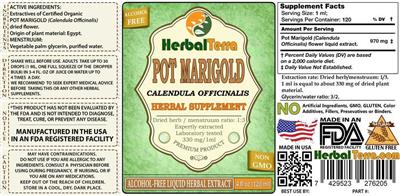
Supplement Facts
The label details for Pot Marigold by Herbal Terra, sourced from the NIH Dietary Supplement Label Database.
Supplement Facts
| Ingredient | Amount | % DV |
|---|---|---|
| certified organic Pot Marigold (Calendula officinalis) dried flower liquid extract | 970 mg | -- |
Other ingredients: Menstruum
Tap any ingredient to jump to its full detail below.
These statements are the manufacturer’s wording, reproduced from the product label — the label is saying it, not HelloPharmacist. We don’t verify or endorse them.
Formulation
Origin of plant material: Egypt.
Manufactured in the USA in an FDA registered facility
Alcohol free
Dried herb/menstruum ratio: 1:3 Expertly extracted Laboratory tested 330 mg/1 mL Premium product Alcohol-free liquid herbal extract
Non GMO
No artificial ingredients, GMO, gluten, color additives, fillers, preservatives or binders. Natural Gluten Free
Suggested/Recommended/Usage/Directions
Direction Shake well before use. Adults take up to 30 drops (1 mL, one full squeeze of the dropper bulb) in 3-4 fl. oz of juice or water up to 4 times a day. We recommend to seek expert medical advice before taking this or any other herbal supplements.
FDA Disclaimer Statement
Notice This product has not been evaluated by the FDA and is not intended to diagnose, treat, cure, or prevent any disease.
Precautions
Caution May have contraindications.
Do not use if you are allergic to any ingredients.
Consult a physician before using during pregnancy, if nursing, or if you are on any medications.
Keep out of the reach of children.
Storage
Store in a cool, dry, dark place.
Formula
Calendula officinalis
FDA Statement of Identity
Herbal Supplement
Seals/Symbols
Made in USA Made in an FDA registered facility Natural Gluten Free
Is this label outdated? Report a formula or label change and our pharmacy team will review it.
Pot Marigold by Herbal Terra label
The label scan from the NIH Dietary Supplement Label Database. Tap to enlarge.
Label images are published by the NIH Dietary Supplement Label Database for the version of this product on file. Always read your actual product label.
View the full label (PDF)The Ingredients in Pot Marigold by Herbal Terra
This is the 1 active ingredient this product is made of. Select it to open its full monograph.
Serving size1 mL Dosage formLiquid Servings per container120 Amounts shown are per serving.
Certified organic Pot Marigold (Calendula officinalis) dried flower liquid extract
Interacts with248 drugs
Calendula is a flowering plant whose petals are used mainly in skin creams, oils, and ointments to soothe minor irritation and support wound healing....
Certified organic Pot Marigold (Calendula officinalis) dried flower liquid extract monograph & interactionsOther (inactive) ingredients: Menstruum. These complete the product’s ingredient list but are not active constituents.
Pot Marigold by Herbal Terra Drug Interactions
HelloPharmacist Interaction Report
Herbal Terra's Pot Marigold contains calendula, which has documented interactions with CNS depressants (medications that slow brain and nervous system activity, like sedatives, sleep aids, and some pain relievers).
The interaction is Minor in severity — theoretically calendula might add to their effects, though this appears unlikely in practice. Calendula has been used for over 30 years without reports of sedation in humans, despite some animal research suggesting one of its compounds might have sedative properties.
Read the full breakdown — every affected drug type, severity by severity
Although the documented interaction is minor, you'll want to double-check your exact medications with the tool on this page if you take any CNS depressants before adding this product.
Check your own medications below · Editorial policy · How we use AI
Want to check YOUR meds against Pot Marigold?
Ask about interactions with your drugs in plain English — “Can I take it with lisinopril?” — and we find you the answer in seconds, ingredient by ingredient.
Go to the checkerIngredients driving the most interactions
Individual Drug Interactions
The ingredients in Pot Marigold interact with 248 drugs. Click any drug to see the details.
1 of the 1 ingredient in Pot Marigold interact with drugs. Each result below shows which ingredient is responsible. certified organic Pot Marigold (Calendula officinalis) dried flower liquid extract
AcepromazineAtravet
How Acepromazine interacts with Pot Marigold — through 1 ingredient. Tap an ingredient for the detail:
Certified Organic Pot Marigold (calendula Officinalis) Dried Flower Liquid ExtractCns Depressants Minor
Interaction Summary
Theoretically, calendula might have additive effects when used with CNS depressants, although this appears to be unlikely.
Read the full Certified Organic Pot Marigold (calendula Officinalis) Dried Flower Liquid Extract + Acepromazine interactionAcetaminophen, Butalbital, Caffeine, CodeineEsgic with Codeine, Fioricet w/ Codeine
How Acetaminophen, Butalbital, Caffeine, Codeine interacts with Pot Marigold — through 1 ingredient. Tap an ingredient for the detail:
Certified Organic Pot Marigold (calendula Officinalis) Dried Flower Liquid ExtractCns Depressants Minor
Interaction Summary
Theoretically, calendula might have additive effects when used with CNS depressants, although this appears to be unlikely.
Read the full Certified Organic Pot Marigold (calendula Officinalis) Dried Flower Liquid Extract + Acetaminophen, Butalbital, Caffeine, Codeine interactionAcetaminophen, Butalbital, CodeineBancap w/ Codeine
How Acetaminophen, Butalbital, Codeine interacts with Pot Marigold — through 1 ingredient. Tap an ingredient for the detail:
Certified Organic Pot Marigold (calendula Officinalis) Dried Flower Liquid ExtractCns Depressants Minor
Interaction Summary
Theoretically, calendula might have additive effects when used with CNS depressants, although this appears to be unlikely.
Read the full Certified Organic Pot Marigold (calendula Officinalis) Dried Flower Liquid Extract + Acetaminophen, Butalbital, Codeine interactionAcetaminophen, Butalbital, Codeine PhosphatePhrenilin #3
How Acetaminophen, Butalbital, Codeine Phosphate interacts with Pot Marigold — through 1 ingredient. Tap an ingredient for the detail:
Certified Organic Pot Marigold (calendula Officinalis) Dried Flower Liquid ExtractCns Depressants Minor
Interaction Summary
Theoretically, calendula might have additive effects when used with CNS depressants, although this appears to be unlikely.
Read the full Certified Organic Pot Marigold (calendula Officinalis) Dried Flower Liquid Extract + Acetaminophen, Butalbital, Codeine Phosphate interactionAcetaminophen, Caffeine, Chlorpheniramine, Hydrocodone, PhenylephrineHycomine Compound
How Acetaminophen, Caffeine, Chlorpheniramine, Hydrocodone, Phenylephrine interacts with Pot Marigold — through 1 ingredient. Tap an ingredient for the detail:
Certified Organic Pot Marigold (calendula Officinalis) Dried Flower Liquid ExtractCns Depressants Minor
Interaction Summary
Theoretically, calendula might have additive effects when used with CNS depressants, although this appears to be unlikely.
Read the full Certified Organic Pot Marigold (calendula Officinalis) Dried Flower Liquid Extract + Acetaminophen, Caffeine, Chlorpheniramine, Hydrocodone, Phenylephrine interactionAcetaminophen, Caffeine, CodeineGesic C15, Gesic C30, Gesic C8, Lenoltec 1, Lenoltec 2, Lenoltec 3 +1 more
How Acetaminophen, Caffeine, Codeine interacts with Pot Marigold — through 1 ingredient. Tap an ingredient for the detail:
Certified Organic Pot Marigold (calendula Officinalis) Dried Flower Liquid ExtractCns Depressants Minor
Interaction Summary
Theoretically, calendula might have additive effects when used with CNS depressants, although this appears to be unlikely.
Read the full Certified Organic Pot Marigold (calendula Officinalis) Dried Flower Liquid Extract + Acetaminophen, Caffeine, Codeine interactionAcetaminophen, Caffeine, Codeine, SalicylamideCodalan No.1, Codalan No.2, Codalan No.3
How Acetaminophen, Caffeine, Codeine, Salicylamide interacts with Pot Marigold — through 1 ingredient. Tap an ingredient for the detail:
Certified Organic Pot Marigold (calendula Officinalis) Dried Flower Liquid ExtractCns Depressants Minor
Interaction Summary
Theoretically, calendula might have additive effects when used with CNS depressants, although this appears to be unlikely.
Read the full Certified Organic Pot Marigold (calendula Officinalis) Dried Flower Liquid Extract + Acetaminophen, Caffeine, Codeine, Salicylamide interactionAcetaminophen, Caffeine, DihydrocodeineDHC Plus, Panlor DC, Panlor SS
How Acetaminophen, Caffeine, Dihydrocodeine interacts with Pot Marigold — through 1 ingredient. Tap an ingredient for the detail:
Certified Organic Pot Marigold (calendula Officinalis) Dried Flower Liquid ExtractCns Depressants Minor
Interaction Summary
Theoretically, calendula might have additive effects when used with CNS depressants, although this appears to be unlikely.
Read the full Certified Organic Pot Marigold (calendula Officinalis) Dried Flower Liquid Extract + Acetaminophen, Caffeine, Dihydrocodeine interactionAcetaminophen, Chlorpheniramine, Codeine, PhenylephrineColrex
How Acetaminophen, Chlorpheniramine, Codeine, Phenylephrine interacts with Pot Marigold — through 1 ingredient. Tap an ingredient for the detail:
Certified Organic Pot Marigold (calendula Officinalis) Dried Flower Liquid ExtractCns Depressants Minor
Interaction Summary
Theoretically, calendula might have additive effects when used with CNS depressants, although this appears to be unlikely.
Read the full Certified Organic Pot Marigold (calendula Officinalis) Dried Flower Liquid Extract + Acetaminophen, Chlorpheniramine, Codeine, Phenylephrine interactionAcetaminophen, Chlorpheniramine, Phenylpropanolamine, OpiumHista-Derfule
How Acetaminophen, Chlorpheniramine, Phenylpropanolamine, Opium interacts with Pot Marigold — through 1 ingredient. Tap an ingredient for the detail:
Certified Organic Pot Marigold (calendula Officinalis) Dried Flower Liquid ExtractCns Depressants Minor
Interaction Summary
Theoretically, calendula might have additive effects when used with CNS depressants, although this appears to be unlikely.
Read the full Certified Organic Pot Marigold (calendula Officinalis) Dried Flower Liquid Extract + Acetaminophen, Chlorpheniramine, Phenylpropanolamine, Opium interactionAcetaminophen, Chlorzoxazone, CodeineAcetazone Forte C8, Parafon Forte C8
How Acetaminophen, Chlorzoxazone, Codeine interacts with Pot Marigold — through 1 ingredient. Tap an ingredient for the detail:
Certified Organic Pot Marigold (calendula Officinalis) Dried Flower Liquid ExtractCns Depressants Minor
Interaction Summary
Theoretically, calendula might have additive effects when used with CNS depressants, although this appears to be unlikely.
Read the full Certified Organic Pot Marigold (calendula Officinalis) Dried Flower Liquid Extract + Acetaminophen, Chlorzoxazone, Codeine interactionAcetaminophen, CodeineTylenol No.3, Tylenol w/ Codeine
How Acetaminophen, Codeine interacts with Pot Marigold — through 1 ingredient. Tap an ingredient for the detail:
Certified Organic Pot Marigold (calendula Officinalis) Dried Flower Liquid ExtractCns Depressants Minor
Interaction Summary
Theoretically, calendula might have additive effects when used with CNS depressants, although this appears to be unlikely.
Read the full Certified Organic Pot Marigold (calendula Officinalis) Dried Flower Liquid Extract + Acetaminophen, Codeine interactionAcetaminophen, Codeine, DoxylamineMersyndol
How Acetaminophen, Codeine, Doxylamine interacts with Pot Marigold — through 1 ingredient. Tap an ingredient for the detail:
Certified Organic Pot Marigold (calendula Officinalis) Dried Flower Liquid ExtractCns Depressants Minor
Interaction Summary
Theoretically, calendula might have additive effects when used with CNS depressants, although this appears to be unlikely.
Read the full Certified Organic Pot Marigold (calendula Officinalis) Dried Flower Liquid Extract + Acetaminophen, Codeine, Doxylamine interactionAcetaminophen, Codeine, MethocarbamolAcetaminophen, Codeine, Methocarbamol, Robaxacet 8
How Acetaminophen, Codeine, Methocarbamol interacts with Pot Marigold — through 1 ingredient. Tap an ingredient for the detail:
Certified Organic Pot Marigold (calendula Officinalis) Dried Flower Liquid ExtractCns Depressants Minor
Interaction Summary
Theoretically, calendula might have additive effects when used with CNS depressants, although this appears to be unlikely.
Read the full Certified Organic Pot Marigold (calendula Officinalis) Dried Flower Liquid Extract + Acetaminophen, Codeine, Methocarbamol interactionAcetaminophen, Dichloralantipyrine, IsomethepteneAmidrine, Midchlor, Migquin, Migratine
How Acetaminophen, Dichloralantipyrine, Isometheptene interacts with Pot Marigold — through 1 ingredient. Tap an ingredient for the detail:
Certified Organic Pot Marigold (calendula Officinalis) Dried Flower Liquid ExtractCns Depressants Minor
Interaction Summary
Theoretically, calendula might have additive effects when used with CNS depressants, although this appears to be unlikely.
Read the full Certified Organic Pot Marigold (calendula Officinalis) Dried Flower Liquid Extract + Acetaminophen, Dichloralantipyrine, Isometheptene interactionAcetaminophen, Dichloralphenazone, IsomethepteneMidrin
How Acetaminophen, Dichloralphenazone, Isometheptene interacts with Pot Marigold — through 1 ingredient. Tap an ingredient for the detail:
Certified Organic Pot Marigold (calendula Officinalis) Dried Flower Liquid ExtractCns Depressants Minor
Interaction Summary
Theoretically, calendula might have additive effects when used with CNS depressants, although this appears to be unlikely.
Read the full Certified Organic Pot Marigold (calendula Officinalis) Dried Flower Liquid Extract + Acetaminophen, Dichloralphenazone, Isometheptene interactionAcetaminophen, Dichlorophenazone, IsometheptaneIsocom
How Acetaminophen, Dichlorophenazone, Isometheptane interacts with Pot Marigold — through 1 ingredient. Tap an ingredient for the detail:
Certified Organic Pot Marigold (calendula Officinalis) Dried Flower Liquid ExtractCns Depressants Minor
Interaction Summary
Theoretically, calendula might have additive effects when used with CNS depressants, although this appears to be unlikely.
Read the full Certified Organic Pot Marigold (calendula Officinalis) Dried Flower Liquid Extract + Acetaminophen, Dichlorophenazone, Isometheptane interactionAcetaminophen, DiphenhydramineTylenol PM, Tylenol PM Ex Strength
How Acetaminophen, Diphenhydramine interacts with Pot Marigold — through 1 ingredient. Tap an ingredient for the detail:
Certified Organic Pot Marigold (calendula Officinalis) Dried Flower Liquid ExtractCns Depressants Minor
Interaction Summary
Theoretically, calendula might have additive effects when used with CNS depressants, although this appears to be unlikely.
Read the full Certified Organic Pot Marigold (calendula Officinalis) Dried Flower Liquid Extract + Acetaminophen, Diphenhydramine interactionAcetaminophen, Diphenhydramine, PseudoephedrineChildren's Tylenol Allergy, Cold Control, Contac Night Allergy Relief
How Acetaminophen, Diphenhydramine, Pseudoephedrine interacts with Pot Marigold — through 1 ingredient. Tap an ingredient for the detail:
Certified Organic Pot Marigold (calendula Officinalis) Dried Flower Liquid ExtractCns Depressants Minor
Interaction Summary
Theoretically, calendula might have additive effects when used with CNS depressants, although this appears to be unlikely.
Read the full Certified Organic Pot Marigold (calendula Officinalis) Dried Flower Liquid Extract + Acetaminophen, Diphenhydramine, Pseudoephedrine interactionAcetaminophen, HydrocodoneAnexsia, Anodynos DHC, Azdone, Co-Gesic, Doucet, Lorcet +9 more
How Acetaminophen, Hydrocodone interacts with Pot Marigold — through 1 ingredient. Tap an ingredient for the detail:
Certified Organic Pot Marigold (calendula Officinalis) Dried Flower Liquid ExtractCns Depressants Minor
Interaction Summary
Theoretically, calendula might have additive effects when used with CNS depressants, although this appears to be unlikely.
Read the full Certified Organic Pot Marigold (calendula Officinalis) Dried Flower Liquid Extract + Acetaminophen, Hydrocodone interactionAcetaminophen, MeperidineDemerol APAP
How Acetaminophen, Meperidine interacts with Pot Marigold — through 1 ingredient. Tap an ingredient for the detail:
Certified Organic Pot Marigold (calendula Officinalis) Dried Flower Liquid ExtractCns Depressants Minor
Interaction Summary
Theoretically, calendula might have additive effects when used with CNS depressants, although this appears to be unlikely.
Read the full Certified Organic Pot Marigold (calendula Officinalis) Dried Flower Liquid Extract + Acetaminophen, Meperidine interactionAcetaminophen, OxycodonePercocet, Roxicet, Tylox, Xartemis XR
How Acetaminophen, Oxycodone interacts with Pot Marigold — through 1 ingredient. Tap an ingredient for the detail:
Certified Organic Pot Marigold (calendula Officinalis) Dried Flower Liquid ExtractCns Depressants Minor
Interaction Summary
Theoretically, calendula might have additive effects when used with CNS depressants, although this appears to be unlikely.
Read the full Certified Organic Pot Marigold (calendula Officinalis) Dried Flower Liquid Extract + Acetaminophen, Oxycodone interactionAcetaminophen, PentazocineTalacen
How Acetaminophen, Pentazocine interacts with Pot Marigold — through 1 ingredient. Tap an ingredient for the detail:
Certified Organic Pot Marigold (calendula Officinalis) Dried Flower Liquid ExtractCns Depressants Minor
Interaction Summary
Theoretically, calendula might have additive effects when used with CNS depressants, although this appears to be unlikely.
Read the full Certified Organic Pot Marigold (calendula Officinalis) Dried Flower Liquid Extract + Acetaminophen, Pentazocine interactionAcetaminophen, PropoxypheneDarvocet-N 100, Darvocet-N 50, E-Lor, Wygesic
How Acetaminophen, Propoxyphene interacts with Pot Marigold — through 1 ingredient. Tap an ingredient for the detail:
Certified Organic Pot Marigold (calendula Officinalis) Dried Flower Liquid ExtractCns Depressants Minor
Interaction Summary
Theoretically, calendula might have additive effects when used with CNS depressants, although this appears to be unlikely.
Read the full Certified Organic Pot Marigold (calendula Officinalis) Dried Flower Liquid Extract + Acetaminophen, Propoxyphene interactionAcetazolamideAk-Zol, Diamox
How Acetazolamide interacts with Pot Marigold — through 1 ingredient. Tap an ingredient for the detail:
Certified Organic Pot Marigold (calendula Officinalis) Dried Flower Liquid ExtractCns Depressants Minor
Interaction Summary
Theoretically, calendula might have additive effects when used with CNS depressants, although this appears to be unlikely.
Read the full Certified Organic Pot Marigold (calendula Officinalis) Dried Flower Liquid Extract + Acetazolamide interactionAlfentanilAlfenta
How Alfentanil interacts with Pot Marigold — through 1 ingredient. Tap an ingredient for the detail:
Certified Organic Pot Marigold (calendula Officinalis) Dried Flower Liquid ExtractCns Depressants Minor
Interaction Summary
Theoretically, calendula might have additive effects when used with CNS depressants, although this appears to be unlikely.
Read the full Certified Organic Pot Marigold (calendula Officinalis) Dried Flower Liquid Extract + Alfentanil interactionAlprazolamNiravam, Xanax
How Alprazolam interacts with Pot Marigold — through 1 ingredient. Tap an ingredient for the detail:
Certified Organic Pot Marigold (calendula Officinalis) Dried Flower Liquid ExtractCns Depressants Minor
Interaction Summary
Theoretically, calendula might have additive effects when used with CNS depressants, although this appears to be unlikely.
Read the full Certified Organic Pot Marigold (calendula Officinalis) Dried Flower Liquid Extract + Alprazolam interactionAluminum Hydroxide, Aspirin, Codeine Phosphate, Magnesium HydroxideAscriptin Codeine #2
How Aluminum Hydroxide, Aspirin, Codeine Phosphate, Magnesium Hydroxide interacts with Pot Marigold — through 1 ingredient. Tap an ingredient for the detail:
Certified Organic Pot Marigold (calendula Officinalis) Dried Flower Liquid ExtractCns Depressants Minor
Interaction Summary
Theoretically, calendula might have additive effects when used with CNS depressants, although this appears to be unlikely.
Read the full Certified Organic Pot Marigold (calendula Officinalis) Dried Flower Liquid Extract + Aluminum Hydroxide, Aspirin, Codeine Phosphate, Magnesium Hydroxide interactionAminoglutethimideCytadren
How Aminoglutethimide interacts with Pot Marigold — through 1 ingredient. Tap an ingredient for the detail:
Certified Organic Pot Marigold (calendula Officinalis) Dried Flower Liquid ExtractCns Depressants Minor
Interaction Summary
Theoretically, calendula might have additive effects when used with CNS depressants, although this appears to be unlikely.
Read the full Certified Organic Pot Marigold (calendula Officinalis) Dried Flower Liquid Extract + Aminoglutethimide interactionAminophylline, Amobarbital, EphedrineAmesec
How Aminophylline, Amobarbital, Ephedrine interacts with Pot Marigold — through 1 ingredient. Tap an ingredient for the detail:
Certified Organic Pot Marigold (calendula Officinalis) Dried Flower Liquid ExtractCns Depressants Minor
Interaction Summary
Theoretically, calendula might have additive effects when used with CNS depressants, although this appears to be unlikely.
Read the full Certified Organic Pot Marigold (calendula Officinalis) Dried Flower Liquid Extract + Aminophylline, Amobarbital, Ephedrine interactionEach ingredient & the kinds of drugs it affects
For each ingredient in Pot Marigold with known interactions, here are the types of medications it can affect. Open any type for the detail — or search your exact drug in the checker above.
certified organic Pot Marigold (Calendula officinalis) dried flower liquid extract
Cns Depressants
Theoretically, calendula might have additive effects when used with CNS depressants, although this appears to be unlikely.
Although some animal research has suggested that a saponoside constituent in calendula may have sedative effects, calendula has been used for over 30 years without reports of sedation in humans.
Brand information
Manufacturer and brand details for Pot Marigold, from the product label.
Pot Marigold by Herbal Terra: Common Questions
Does Pot Marigold by Herbal Terra interact with any medications?
How can one product interact with so many drugs?
Where does this information come from?
Can I use this if I'm pregnant or breastfeeding?
Will this help with acne, burns, or wound healing?
What are the side effects?
Should I patch test this first?
Does it interact with my sleep medication or anti-anxiety drug?
Written and reviewed by the HelloPharmacist editorial staff. Our editorial policy
Not sure if Pot Marigold is safe with your meds?
Our pharmacists answer your medication & supplement questions — free.
Label information is sourced from the NIH Dietary Supplement Label Database and reflects the product version on file; always read your actual product label. This page is for education only and is not a substitute for professional medical advice. Confirm with your pharmacist or doctor before combining supplements and medications.
The Full Monographs Behind Pot Marigold’s Ingredients
Every ingredient we hold a full HelloPharmacist monograph for — uses, evidence, safety, and the complete interaction list.
Sources & How We Checked
Pot Marigold's label data comes from the NIH Dietary Supplement Label Database; the ingredient interaction data is from the Natural Medicines database, reviewed by our pharmacists.
- NIH Dietary Supplement Label Database (DSLD) — The official product label on file for this supplement.
- Natural Medicines (Therapeutic Research Center) — Evidence-graded clinical reference behind the ingredient interaction data.
Content is written and reviewed by licensed HelloPharmacist pharmacists. See our data sources and editorial standards for how this information is built and checked.
The 9 references behind this product’s interaction data
Every citation that drives the interaction findings for this product’s ingredients, from the evidence-graded Natural Medicines (TRC Healthcare) database. Open an ingredient to browse its citations — links open the study on PubMed or the publisher’s site.
Calendula 9 references
- Newall CA, Anderson LA, Philpson JD. Herbal Medicine: A Guide for Healthcare Professionals. London, UK: The Pharmaceutical Press, 1996.
- Reider N, Komericki P, Hausen BM, et al. The seamy side of natural medicines: contact sensitization to arnica (Arnica montana L.) and marigold (Calendula officinalis L.). Contact Dermatitis 2001;45:269-72..
- Gol'dman II. [Anaphylactic shock after gargling with an infusion of Calendula]. Klin Med (Mosk) 1974;52:142-3.
- Paulsen E. Contact sensitization from Compositae-containing herbal remedies and cosmetics. Contact Dermatitis 2002;47:189-98. PubMed
- Bojadjiev C. On the sedative and hypotensive effect of preparations from the plant Calendula officinalis. Nauch Trud Visshi Med Inst Sof 1964;43:15-20.
- Samochowiec L. Pharmacological study of saponosides from Aralia mandshurica Rupr. et Maxim and Calendula officinalis L. Herba Pol. 1983;29:151-155.
- Madisetti M, Kelechi TJ, Mueller M, Amella EJ, Prentice MA. Feasibility, acceptability, and tolerability of RGN107 in the palliative wound care management of chronic wound symptoms. J Wound Care. 2017;26(Sup1):S25-S34. PubMed
- Final Assessment report on Calendula officinalis L., flos. European Medicines Agency: Committee on Herbal Medicinal Products (HMPC). 2018. EMA/HMPC/603409/2017. Available at: https://www.ema.europa.eu/en/documents/herbal-report/final-assessment-report-cal
- Puaratanaarunkon T, Washrawirul C, Chuenboonngarm N, Noppakun N, Asawanonda P, Kumtornrut C. Efficacy and safety of a facial serum containing snail secretion filtrate, Calendula officinalis, and Glycyrrhiza glaba root extract in the treatment of maskne: A
Parts of this content are provided by the Therapeutic Research Center, LLC.
DISCLAIMER: Currently this does not check for drug-drug interactions. This is not an all-inclusive comprehensive list of potential interactions and is for informational purposes only. Not all interactions are known or well-reported in the scientific literature, and new interactions are continually being reported. Input is needed from a qualified healthcare provider including a pharmacist before starting any therapy. Application of clinical judgment is necessary.
© 2021 Therapeutic Research Center, LLC